The Church that Makes a Difference (Matthew 16:13-20)

Photo by Felix Mittermeier on Pexels.com

When Jesus came to the region of Caesarea Philippi, he asked his disciples, “Who do people say the Son of Man is?”

They replied, “Some say John the Baptist; others say Elijah; and still others, Jeremiah or one of the prophets.”

“But what about you?” he asked. “Who do you say I am?”

Simon Peter answered, “You are the Messiah, the Son of the living God.”

Jesus replied, “Blessed are you, Simon son of Jonah, for this was not revealed to you by flesh and blood, but by my Father in heaven. And I tell you that you are Peter, and on this rock I will build my church, and the gates of Hades will not overcome it. I will give you the keys of the kingdom of heaven; whatever you bind on earth will be bound in heaven, and whatever you loose on earth will be loosed in heaven.” Then he ordered his disciples not to tell anyone that he was the Messiah. (New International Version)

A lot of research studies have come out in the past 20 years demonstrating that legions of adults, especially between the ages of 18-29, are leaving the Church in droves. This confirms my own anecdotal evidence over the years that about 80% of twenty-somethings drop out of church altogether. So, why are people leaving? Can anything be done about it?

Most of the studies can be boiled down to three major reasons: 

  1. The Church is irrelevant to my life and doesn’t talk about things important to me
  2. The Church is judgmental toward others not like themselves
  3. The Church is hypocritical by saying one thing and yet living another way

A good, right, and real confession of Jesus will speak a relevant word into the culture and into various generations, will proclaim the gospel of grace (not judgment), and will live what it believes.

In today’s Gospel lesson, Jesus and his disciples are in the Gentile (non-Jewish) territory of Caesarea Philippi, a city 25 miles north of the Sea of Galilee. Up to this point, the disciples encountered a lot of people and heard a lot of things said. So, Jesus asked them two questions: 

Who do people say the Son of Man is?

The disciples gave a variety of answers, which is to be expected, with some of them being a bit esoteric. John the Baptist raised from the dead is a stretch. Elijah was a man who never died, but was just taken to heaven; maybe he’s back. Maybe Jeremiah or one of the other prophets got sent back. 

When asking this question to folks today, you will also get a variety of answers as to whom Jesus is – a good teacher, a model humanitarian, a myth or a legend who didn’t really exist. A few times I have been told that Jesus was an alien from another planet. My personal favorite when I asked who Jesus, a guy answered that he was a nudist, and that if we all just took off our clothes, there would be peace in the world.

Who do you say I am?

Peter acted as the spokesperson for the group. Given the disciples’ track record of scratching their heads over nearly everything Jesus said or did, one might expect to hear another crazy answer. But Peter got it right by confessing, “You are the Christ, the Son of the Living God.” 

“Christ” is another way of saying “Messiah,” or “Savior.” It literally means, in the Greek language, “Answer.”  Peter confessed Jesus as being The Answer, the person for whom everything comes down to. Peter may not have fully understood what he was saying, but he said it.

The reason that craziness didn’t come out of Peter’s mouth is that “The Answer” was divinely revealed to him.  Faith in Jesus Christ is a gift given to us by God. 

“All things have been committed to me by my Father. No one knows the Son except the Father, and no one knows the Father except the Son and those to whom the Son chooses to reveal him.” Jesus (Matthew 11:27, NIV)

Peter was blessed – not necessarily because of sincerity, openness, or deserving it – but because of God’s grace which revealed to him that Jesus is the “Answer.”

The Apostle Peter put himself in a position to know by obeying the voice of Jesus to follow him. It took him and the other disciples a while to “get it,” but eventually they did. And if it took years of being with Jesus for the disciples to make a right and good confession of faith, then it’s important that we have a great deal of patience for our friends and relatives.

Jesus proclaimed Peter (which means “rock”) the immovable object from which the Church would be built.  The Apostle Paul framed it this way:

You are no longer foreigners and strangers, but fellow citizens with God’s people and also members of his household, built on the foundation of the apostles and prophets, with Christ Jesus himself as the chief cornerstone. In him the whole building is joined together and rises to become a holy temple in the Lord. (Ephesians 2:19-21, NIV)

Christ is the one who builds the Church – and not me,  nor you. This reality is encouraging and comforting to me. If it was up to me to build the Church, I would screw it up so badly that it would actually be overcome by hell. But I can’t screw it up, because it’s Christ’s Church, not mine. 

So, we can move forward and storm the gates of hell, we can move and work and act and call others to confess, all with the confidence and security of knowing that Jesus is building his Church. There’s no need to worry whether we’re getting it right, or not, because we aren’t the ones in control of the project.

However, I admit what Jesus says next isn’t very comforting to me. Christ told Peter that he will give him the “keys of the kingdom of heaven,” and that whatever he binds on earth will be bound in heaven, and whatever he lets loose on earth will be loosed in heaven.

Giving Peter the keys of the kingdom seems akin to giving an 8 year old the keys to the car and saying, “Go ahead, take it for a spin, you can drive it!” 

What are the keys of the kingdom? 

The preaching of the holy gospel and Christian discipline toward repentance. Both preaching and discipline open the kingdom of heaven to believers and close it to unbelievers. 

How does the preaching of the gospel open and close the kingdom of heaven? 

The kingdom of heaven is opened by proclaiming and publicly declaring to all believers, each and every one, that, as often as they accept the gospel promise in true faith, God, because of what Christ has done, truly forgives all their sins. The kingdom of heaven is closed, however, by proclaiming and publicly declaring to unbelievers and hypocrites that, as long as they do not repent, the anger of God and eternal condemnation rest on them. (The Heidelberg Catechism, Q&A 83, 84 )

The Church is true to its mission when it proclaims the good news of God’s grace in Christ. We possess the keys of the kingdom. Jesus knew exactly what he was doing, that is, the risks and the problems of letting people do the task of proclaiming the gospel. Yet, Christ still tossed us the keys to his Mercedes.

Conclusion

A Church that makes a difference is made up of people who confess Jesus, are called by God, and call others to confess Jesus, too. The de-churched and the disaffected want to see a Church that seeks to understand the world, to provide relevant ministry to others, and to tackle the injustice that exists everywhere.

We must use the power given us with the keys of the kingdom to bestow mercy to the weak, the oppressed, and the lost. We need to live what we believe with a passionate heart and an unashamed faith.

Together, as God’s people, we can extend the hospitality and the kindness to make a difference in the church and the world. 

May our confession of Christ shape our words and our actions. And may it give us the confidence and boldness to live as Jesus did, and to enjoy him forever. Amen.

Walk on Water? Why? (Matthew 14:22-33)

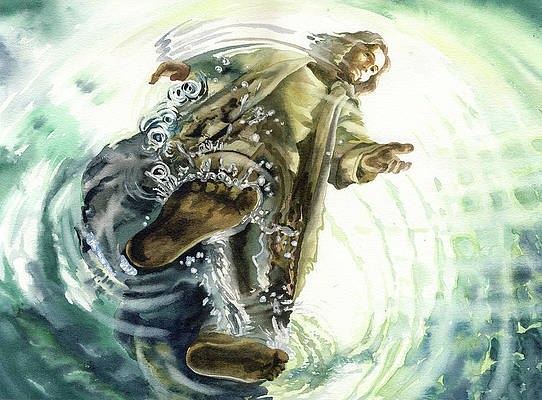
Jesus Walks on Water, by Konstantin Alexejewitsch Korowin, 1890 

Immediately Jesus made the disciples get into the boat and go on ahead of him to the other side, while he dismissed the crowd. After he had dismissed them, he went up on a mountainside by himself to pray. Later that night, he was there alone,and the boat was already a considerable distance from land, buffeted by the waves because the wind was against it.

Shortly before dawn Jesus went out to them, walking on the lake. When the disciples saw him walking on the lake, they were terrified. “It’s a ghost,” they said, and cried out in fear.

But Jesus immediately said to them: “Take courage! It is I. Don’t be afraid.”

“Lord, if it’s you,” Peter replied, “tell me to come to you on the water.”

“Come,” he said.

Then Peter got down out of the boat, walked on the water and came toward Jesus. But when he saw the wind, he was afraid and, beginning to sink, cried out, “Lord, save me!”

Immediately Jesus reached out his hand and caught him. “You of little faith,” he said, “why did you doubt?”

And when they climbed into the boat, the wind died down. Then those who were in the boat worshiped him, saying, “Truly you are the Son of God.” (New International Version)

In the New Testament Gospels, we see Jesus for who he is – Son of God and true Sovereign of the universe – seeking to reconcile people to God through his life, miracles, and teaching. In the Gospels we also see Christ’s disciples for who they are – a rag-tag bunch who express both belief and doubt, and experience both faith and failure.

The reality of the Christian life is that it is a sort of three-steps-forward and two-steps-backward kind of experience. The expectation that we will “succeed” and have everything go hunky-dory each time we step out in faith, is far from how things actually work in both the world and in God’s kingdom. Doubt and failure are important experiences for the believer in Jesus.

Without failure, there is no Christian life. Why? Because it means we are still in the boat.

It’s evidence that we never left the safety of established routines and responded to God’s command to step out of our comfort zone, and boldly go where we’ve never gone before.

Our failures may, like Peter, be colossal bellyflops. Yet, Jesus is there – extending grace to Peter and helping him, even in his failure of faith. Failure does not define us; it isn’t our identity. Jesus is Lord over everything, including storms, hardship, and trouble. 

Yes, there are a lot of scary things in life. Learning to ride a bike was scary. Driving for the first time on an icy road was scary. Getting married and having kids was scary. Admitting a fault, mistake, or weakness is scary. Being vulnerable with another person is scary.

It can even be scary to be at church. Why? Because we might fail, and it may crush us.

The fear of failure, however, need not control our lives. Why? Because grace overcomes everything.

We all find ourselves, at times, caught midway between faith and doubt. But to know this situation is to experience grace. If the worst scenario you worry about in your head would actually come to pass, it will still never change the reality that God loves you! And it will not stop Jesus from extending his hand to you in a life-saving grip of grace. 

Fear melts away when we keep our eyes on Jesus. So, we must focus on Christ, instead of fixating on the waves around us. The truth sets us free. Therefore, let’s notice five truths about Jesus that help us overcome the fear of failure and embrace a life of faith.

1. Jesus is a person of prayer

Jesus was deeply dependent on his heavenly Father. His life exhibited the necessities of simple prayer and obedience. If Jesus found the need for solitude and prayer for his life and ministry, how much more to we need it!? 

The Lord had his disciples get into the boat and go out on the lake. Jesus knew they were about to face a storm. The boat ended up getting thrown around by the waves. Even though the disciples were doing God’s will by going out on the lake, they were not spared from adversity.  

Jesus wanted his disciples to experience the storm. Why? Because it is through the storm that we learn faith.  

Faith is developed through experience and adversity. Faith that never endures distress, never grows and matures. Faith must be exercised – and if it isn’t, it atrophies and becomes useless. 

Show me a person with great faith, and I’ll show you a person that has gone through a boatload of adversity and hurt, having allowed Jesus to grace them with healing.

2. Jesus is present with us, and this presence brings an end to fear

Being in the middle of a lake during a storm did not prevent Jesus from being present with the disciples – he just walked on the water to be with them. Even though the disciples had just participated in the miracle of Jesus feeding the five thousand, another miracle was not on their radar – which is why they did not recognize Jesus and were afraid when they saw him.

While afraid, we don’t see Jesus, even when he’s right in front of our faces. Why? Because we don’t expect him to be there and mistake him for a ghost.  

When the disciples cried out in fear, Jesus responded. I used to have a factory job, training workers. When the training was completed, I had the trainees evaluate our time together. The top response I received is that my presence helped them to learn their job – the freedom to fail time and time again without judgment. Having me there to rescue them, when things got too much, built confidence that they could do it on their own.

3. Jesus desires those who follow him to imitate him

Jesus walked on water. Jesus invited Peter to walk on water. Peter was not chided by Jesus for getting out of the boat, but for doubting that he could continue in the miracle that was happening. 

Jesus isn’t merely interested in disciples being able to regurgitate his teaching. Why? Because he wants us to exercise our learning through actual deeds of faith.  

Once the command of Jesus was given to Peter, “Come”, then walking on water became only a matter of trust.

“Christianity has not been tried and found wanting. It has been found difficult and left untried.”

G.K. Chesterton

We understandably get nervous when a crazy Jesus and an unpredictable Holy Spirit call us to change by getting out of the friendly confines of the boat. Why? After all, we might fail. 

However, it is at those times that we bank on God’s Word and promises. The Apostle James said that if we find ourselves lacking wisdom to deal with the unpredictable and unknowable, we are to ask God who gives generously to all without finding fault and will be given to us. (James 1:5)

Christ Walking on the Sea, by Natali Fedorova

Peter responded to his predicament by crying out to Jesus, “Lord, save me!” Jesus immediately reached out and saved Peter from his own doubt and lack of faith. Jesus called Peter a “little-faith.”

Many people have lived too long with the notion that God is some stern angry deity who is constantly displeased with sinful people, and that only through perfection will God ever be happy with us. The truth is that Jesus wants us to imitate him; and, when we fail, he is there to pick us up. 

4. Jesus has the authority to settle the storm when he is ready to do it

Jesus is King. Christ is Sovereign of the world. He will bring the crisis to an end according to his own good pleasure and good timing. Rather than spending all our emotional capital by worrying or conniving to get out of a situation, we can trust God and keep our eyes on Jesus.  Our job is to believe; God’s job is everything else.

5. Jesus’ power led the disciples to acknowledge who he is

Worship happens when we see Jesus as he really is, the Son of God. Flat, dull, boring worship comes from flat, dull, boring Christians who are unable to see the power of Jesus in their lives. We discover the power of God when we are in a situation which requires God’s strength to deliver us. Grasping Jesus as the Son of God is more than a verbal confession of faith; it is being able to trust him, like getting out of a boat in the middle of a lake.

We are to live by faith in the Son of God who loved us and gave himself for us (Galatians 2:20). It doesn’t require much faith to pray that Aunt Mable’s bunions will feel better. It only requires a little faith to give a dollar when you have ten dollars. It takes no faith to discuss the weather and steer clear of hard conversations.

But it does require faith:

  • to pray for a miraculous healing every day without giving up for a little boy who is racked by epilepsy, and trust God to spare his life
  • to write a check for $100 to someone in need when you have exactly $100 in your checking account, and trust God to provide for you own necessities. 
  • to go off the grid of the routine schedule to have a difficult discussion about social justice, and trust God to act on Christ’s teachings. 
  • to live as though the mission of God in this world is the most important thing we could ever do, and trust God to step out and do it.

It would be great if we could pray and act without ever doubting or failing, yet the only way to do that is to never step out of the boat. Instead, live life. Trust God. And see what happens.

Holy God, help us, your people, to embrace the life that is truly life by stepping out of the boat.  May Jesus define our lives instead of letting failure define us. May we accept the grace that is ours in Jesus Christ our Lord, in whose name we are bold to pray. Amen.

A Lot of Hurting, Touching, and Healing (Luke 6:12-19)

Jesus calls his twelve disciples, by Sadao Watanabe

One of those days Jesus went out to a mountainside to pray, and spent the night praying to God. When morning came, he called his disciples to him and chose twelve of them, whom he also designated apostles: Simon (whom he named Peter), his brother Andrew, James, John, Philip, Bartholomew, Matthew, Thomas, James son of Alphaeus, Simon who was called the Zealot, Judas son of James, and Judas Iscariot, who became a traitor.

He went down with them and stood on a level place. A large crowd of his disciples was there and a great number of people from all over Judea, from Jerusalem, and from the coastal region around Tyre and Sidon, who had come to hear him and to be healed of their diseases. Those troubled by impure spirits were cured, and the people all tried to touch him, because power was coming from him and healing them all. (New International Version)

Pain is a lot

Touch is important. Humanity needs touch. It’s also one of those things that we likely take for granted. 

Philip Yancey and Dr. Paul Brand co-authored a book, originally published in 1982, entitled “Pain: The Gift Nobody Wants.” It’s largely a biography of Dr. Brand, who pioneered both the diagnosis and prognosis of leprosy. 

He discovered that leprosy occurs because of a lack of feeling – an inability to sense touch. The delicate nerve endings we all have in our fingers and toes are numb to the leper. The lack of sensing pain in the extremities leads to small cuts or injuries, which would be immediately treated by someone who feels pain, becoming gangrene with the losing of fingers and toes.

The ability to feel, to reach out and touch another person, is vitally important to our spiritual and emotional lives. Without touch, the calloused heart and unfeeling soul does not realize the damage that is being done to it.           

One of the gifts we have as people is the ability to feel guilt, sorrow, disappointment, and pain – to be touched mentally, emotionally, and spiritually – as well as physically. And in our ability to feel pain, it brings about attention to prayer and addressing the situation.

Many people are troubled in either mind or spirit, or experience chronic ailments of the body, day in and day out. They just want relief, to be at peace in both body and soul.

Jesus prays… a lot

In today’s Gospel lesson, Luke puts together two stories: one of Jesus choosing and calling his twelve disciples; and then one of Jesus being among the people and healing them of their diseases and their troubles. Let’s observe the relationship between them.

Jesus often withdrew to lonely, isolated places in order to pray (Luke 5:16). On this particular occasion, he went out and spent the entire night in prayer to God. When morning came, we discover the reason for the all-night prayer meeting: Christ chose the people who would be closest to him in his earthly ministry. He called the twelve to follow him and be his disciples.

I find it highly instructive that Jesus spent so much time in prayer before making such big decisions about his ministry. If anyone could size up somebody as a potential follower, it seems to me it would be Jesus. And yet, there was a lot of deliberation and interaction with the Father. Since the Lord Jesus found it necessary to pray with an extending time, and consult with the heavenly Father, I would say that our own prayer life and reaching out to consult and collaborate could probably use an upgrade.

Jesus heals… a lot of people

Then, Jesus and his disciples, together enter the fray of the crowd. And the disciples get their first lesson in following Jesus: Christ-centered ministry is about healing – it’s about restoring people to physical, mental, emotional, and spiritual health.

Healing is at the heart of all real Christian ministry. And healing is really what everyone is to be about, whether they identify as Christian, or not. To be healed is to experience a holistic restoration of body, mind, emotions, and spirit.

Touch is a big part of healing. Physical touch is important, and it’s powerful. Sometimes, bodily healing is needed because a person has been physically abused, or experienced some sort of physical trauma. And it can be very difficult to have others touch them, after such experiences. Yet, part of the healing will be in experiencing redemptive touch – either by surgeons, family, friends, or trusted others. The answer to bad touch and bad pain is to experience good touch and the good pain of healing.

Non-physical touch is no less important. And, I believe, Jesus understood this perhaps more than most. He routinely “touched” people in ways that changed their lives. Christ sought to not only bring physical healing, but also to heal the mental, emotional, and spiritual wounds.

Jesus touches… a lot of lives

Jesus touched a lot of lives through his healing ministry:

  • In healing lepers of their disease, Christ made sure that they were no longer ostracized from the community but were restored to full function in society.
  • In curing persons demonized and tormented by evil spirits, Jesus was concerned to restore them to their right mind and ensure they were included as members of society, as well as restored to their families.
  • In bringing salvation from guilt and shame, Jesus brought reconciliation and restoration between God and sinners.
  • In all his relational interactions, Jesus was intentional about making connections to the lonely and the lost, to those who were emotionally cut off from the mass of society.

So, whenever we feel pain – whether in body, mind, emotion, or spirit – this experience lets us know that we need to pay attention to something. As we do that, it can drive us to the source of healing, wholeness, and restoration. We go to prayer – not out of duty – but because we are convinced that there are divine resources only God can provide.

And we can come, again and again, finding the grace to help us in our time of need. For God’s mercy is inexhaustible; the grace of God will never run out or run dry.

Therefore, let followers of Jesus everywhere be aqueducts of grace, angels of mercy, and agents of healing in a world which so desperately needs the love, care, and attention we can give them.

May God the Father bless you; God the Son heal you; and God the Holy Spirit give you strength. May God the holy and undivided Trinity guard your body, save your soul, protect your mind, and bring you safely to his heavenly country; where he lives and reigns for ever and ever. Amen.

Ascension of the Lord (Acts 1:1-11)

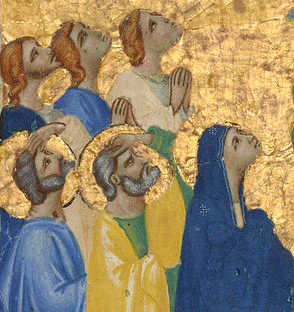
The Ascension of Christ, by Pacino di Bonaguida, c.1340

Theophilus, the first scroll I wrote concerned everything Jesus did and taught from the beginning, right up to the day when he was taken up into heaven. Before he was taken up, working in the power of the Holy Spirit, Jesus instructed the apostles he had chosen. After his suffering, he showed them that he was alive with many convincing proofs. He appeared to them over a period of forty days, speaking to them about God’s kingdom. While they were eating together, he ordered them not to leave Jerusalem but to wait for what the Father had promised. He said, “This is what you heard from me: John baptized with water, but in only a few days you will be baptized with the Holy Spirit.”

As a result, those who had gathered together asked Jesus, “Lord, are you going to restore the kingdom to Israel now?”

Jesus replied, “It isn’t for you to know the times or seasons that the Father has set by his own authority. Rather, you will receive power when the Holy Spirit has come upon you, and you will be my witnesses in Jerusalem, in all Judea and Samaria, and to the end of the earth.”

After Jesus said these things, as they were watching, he was lifted up and a cloud took him out of their sight. While he was going away and as they were staring toward heaven, suddenly two men in white robes stood next to them. They said, “Galileans, why are you standing here, looking toward heaven? This Jesus, who was taken up from you into heaven, will come in the same way that you saw him go into heaven.” (Common English Bible)

It’s been two-millennia since Jesus Christ ascended to heaven. Since then, a lot has changed.

Yet, on the other hand, we’re still in the same situation as the early church: Jesus is still up there; and we are still down here. That means, because we are still awaiting Christ’s return, the original call and practice of the church is still in effect.

As far as experiences go, it’s hard to top being one of the original disciples and seeing Jesus ascend into the clouds to heaven. Now what? How do you go about your life after that?

In the spiritual life, we move back and forth between moments of genuine inspiration and the sheer routine of our daily mundane lives. The uplifting mountain-top experience and the hard slog of walking through the valley are both important. The trick is to channel the energy from one into the other. For that to happen, we need to work out rhythms of grace that connect expectant prayer with the action of being witnesses.

Prayer and witness – both are necessary for the church; and they are closely tied to the risen and ascended Christ. The ascension of the Lord Jesus means Christ is exalted above everything; he’s in charge. By his authority he has made us prayerful witnesses and given us the means of carrying out that job.

Jesus and the disciples, even after forty days together, post-resurrection, were not on the same page. The disciples were anticipating a restoration of David’s kingdom. Their vision for the future was a great apocalypse in which Jesus, as the ultimate mixed martial arts champion, would beat up all their enemies. Then, set up a political kingdom just like King David of old. 

But Jesus had a different agenda. Instead of creating an immediate utopia, where the disciples would be in charge and in control, Jesus bluntly told them that knowing God’s timetable is not in their pay grade. Instead, the disciples were commissioned for a job, which didn’t include gawking at the sky and trying to figure out when the end of the world was happening.

Christ’s Ascension, by Scott Rayl

Although we (understandably and deservedly) want peace and justice now, Jesus avoided handing out prophecy charts detailing when that would happen. He essentially said to quit thinking about that stuff because it’s really none of our business.

Rather, our business is being witnesses of Jesus. The angels came along immediately after Jesus ascended and said to the disciples to stop standing there slack jawed. Jesus is coming back and, meanwhile, there is a job to do – to be witnesses of Christ’s redemptive events. And, the strength of that witness will come from the Holy Spirit. So, hang tight in prayer.

So, what does it mean to be a “witness?” A few years back, I was called to the bedside of an actively dying patient. The patient’s spouse and parents were present. In the space of two hours I watched them in the throes of grief. And I provided all the spiritual support I could. 

The situation had similarities to many emergencies I have attended, with one exception: I noticed that I was different. I did not “do” or “say” a lot. Mostly, I was present. I remember, at times during my encounter, feeling helpless. In some ways I was. I certainly couldn’t fix a thing. Yet, this time, I saw my role in a new way. 

I distinctly remember the sense of bearing witness to this sacred event. There was an entire world outside the patient room that knew nothing of this family’s intense grief. But I knew. I watched the whole thing. I was present for all the struggles of the medical team, the tears of the husband, the grief of a Dad, the angry questions of a mother toward a God that she didn’t know how to approach – who seemed aloof and capricious.  I was there for it all. Even now, I still carry those folks and their story in my heart.

And it was enough. 

Yes, it was enough. This was the first time I ever said that after such a situation. I had a settled sense that the role of witnessing the events in front of me was a blessed and sacred responsibility. Billions of people on planet earth didn’t know the grief of these people. I did. Because I was there. 

There is something both mystical and necessary about this understanding of being a witness with active prayerful observation.

I wonder if that’s how the disciples felt after Christ’s ascension. Perhaps my experience is what Jesus meant when he said, “You shall be my witnesses.” Maybe a witness is one who has the special role of observing the suffering of Christ, his resurrection of the dead, and the ongoing work of the Spirit. 

God is, I believe, the ultimate witness. When no one else sees, God sees. Where there is grief, God is present. Wherever pain, hurt, and brokenness exists, God is there bearing witness to it all. 

And, once in a while, the Lord is gracious to invite me into the scene to witness it along with him. Jesus is our Immanuel – God with us. And that is enough for me. 

In the book of Acts, praying and witnessing was a consistent pattern that the early church practiced. They prayed about whom to choose as leaders and bore witness to the Spirit setting individuals apart for the work of gospel proclamation and service to the church. They prayed for the Holy Spirit to come on people and bore witness to miraculous signs of the Spirit’s work. They prayed for the courage to preach and heal and bore witness to the saving work of God.

As the book of Acts unfolds, we see Peter imprisoned for being a witness. So, the church went to prayer. Peter was released, and when he showed up at the prayer meeting, the believers at first did not believe it was him.  Even with their little faith they were able to witness God answer their prayers. (Acts 12:1-18)

It was at a prayer meeting where Paul and Barnabas were set apart by the Spirit to bear witness in other locations. (Acts 13:1-3)

While traveling from city to city, Paul constantly devoted himself to prayer and listened to the Spirit. (Acts 16:1-35)

People came to Christ because of prayerfully listening to the Spirit and the obedient action that followed by Peter, Paul, and the other believers giving witness to how the risen Christ saved their lives. This was possible because of the risen and ascended Christ.

There is not one square inch of this earth that Jesus is not Lord. This means we can be alive with devotion to prayer and to being witnesses in this world for Jesus. Just as a cup of coffee needs a warm-up, so our prayers need to be refreshed so that God’s purposes will be accomplished. And his purposes are that all of creation comes, in a real and practical way, under Christ’s lordship.

What does the ascension of Jesus Christ mean for us today? That we belong to God and have the wondrous privilege of prayer and witness in a world that so desperately needs to connect with the transcendent and divine.