The Real Thing (Hebrews 9:24-28)

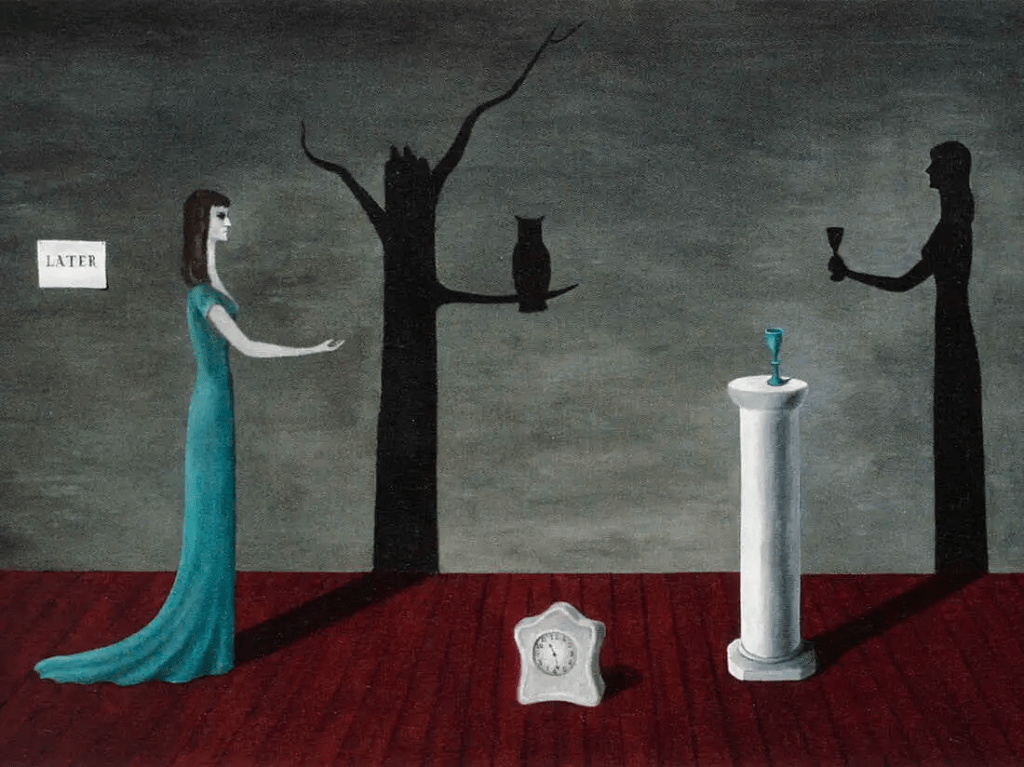
Strange Shadows (Shadows and Substance), by Gertrude Abercrombie, 1950

For Christ did not enter a sanctuary made by human hands, a mere copy of the true one, but he entered into heaven itself, now to appear in the presence of God on our behalf. 

Nor was it to offer himself again and again, as the high priest enters the holy place year after year with blood that is not his own, for then he would have had to suffer again and again since the foundation of the world.

But as it is, he has appeared once for all at the end of the ages to remove sin by the sacrifice of himself. And just as it is appointed for mortals to die once and after that the judgment, so Christ, having been offered once to bear the sins of many, will appear a second time, not to deal with sin but to save those who are eagerly waiting for him. (New Revised Standard Version)

I admit that the Book of Hebrews in the New Testament is one of my favorite books of the Bible. I also recognize that Hebrews is one of the most difficult books to deal with. And specifically, chapter 9 can be quite mind-boggling.

The author of Hebrews, whoever he was actually was, did the intellectually and theologically staggering job of establishing continuity between the two testaments of the Bible.

He compared and contrasted the old (or first) covenant with the new (or second) covenant, examining the Levitical priesthood and its sacrificial system, with Christ as the high priest whose singular sacrifice ended all sacrifices.

The old sacrificial system began on Mount Sinai. Moses sprinkled the sacrificial blood of bulls and goats on both the people and the tabernacle. He was consecrating them, and the sacrificial implements, so that everyone could participate in the worship of Yahweh.

In the new covenantal system, blood is also used to purify. Yet, the heavenly tabernacle could not be cleansed with the blood of animals. It required a better and superior sacrifice. (Hebrews 9:23)
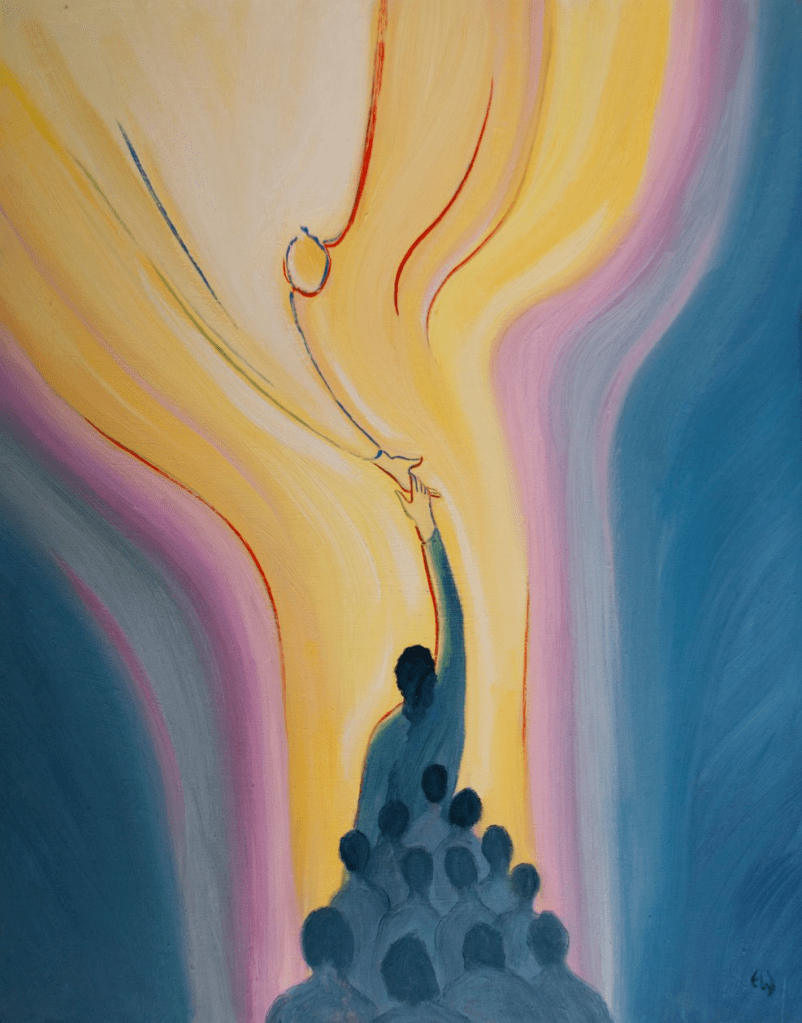
The Sacrifice of Christ, by Elizabeth Wang, 2002

That sacrifice is Jesus. He was both the high priest officiating the ritual, and the actual sacrificial offering. It is the life of Jesus, given in self-sacrificial death, which enables worshipers to come to God without any obstruction whatsoever.

Jesus does not have to keep offering himself. It was a one and done affair. One sacrifice on behalf of everyone. Once for all.

This is, of course, a distinctively Christian view and approach to the problem of guilt, shame, disobedience, and death. It has been a very compelling view for millions of people over the past two millennia.

In whatever way one seeks to understand and make sense of the author’s line of reasoning concerning a Christian approach to sacrifice and dealing with sin, what is apparent to me is that the author talked of a reality that we do not presently see.

The author of Hebrews was lifting up something important that he wanted us to notice. He was pointing out the reality of spiritual forces that have the power to both destroy and give life.

The earthly objects that we can see, touch, feel, hear, and smell are mere representations or shadows of heavenly things.

Many people, if not most people, today would say that invisible things such as our ideas and philosophies of religion are mere mental ways of understanding the objective reality in front of us that we can use our five senses to detect.

But the author of Hebrews insists – and I believe rightly so – that it’s the other way around. Everything we are presently experiencing with our objective senses is a projection of the ultimate invisible reality.

In other words, this entire world will pass away, because it is but a shadow in the history of eternity. The invisible God is the real deal. The heavenly sanctuary is reality. Love is the permanent operating system of eternity, and not your 401(k) or the next political election.

Jesus the Christ has offered himself once for all time, and for all sins. And he did it because the triune God – Father, Son, and Spirit – is a community of unitive love. That is, God is Love. So therefore, God can only do that which is love.

The end of time is not yet here. This present world with all of its inconsistent ways of doing both good and bad is still with us. But Jesus will come again.

The sin issue has been dealt with, once and for all. Christ did that. Jesus will return in order to bring salvation to those who are waiting for him.

If we must wait, let us do it patiently, with all of the faith and endurance it requires. Yet, this is not a passive waiting. We are to be busy proclaiming the good news of God’s invisible realm with both words and sacraments – with the signs and shadows and representations we have that point to the reality of God.

Everything visible and tangible on this earth is mirroring a greater, better, and superior reality which we cannot see with our eyes or touch with our hands.

Christianity is unabashed that all things point to Christ, who is the first and the last, the alpha and omega, the be all and end all of everything.

Come, Lord Jesus, Son of God, Son of Humanity. We long for you to return in glory and set us and this entire sinful world aright with your divine justice.

Be our guest, Lord Jesus, our Savior and Friend. We receive in faith your salvation. We trust that both the physical food and spiritual food you give will sustain us for our work and worship in this world.

May it be so, to the glory of God, and through the enablement of the Holy Spirit. You are one God – Father, Son, and Spirit – in one holy community of Love, now and forevermore. Amen.

Facing Death (1 Kings 1:1-30)

Mural of King David, in the Wilshire Boulevard Temple, Los Angeles

King David was now a very old man, and although his servants covered him with blankets, he could not keep warm. So his officials said to him, “Your Majesty, let us find a young woman to stay with you and take care of you. She will lie close to you and keep you warm.” 

A search was made all over Israel for a beautiful young woman, and in Shunem they found such a woman named Abishag, and brought her to the king. She was very beautiful, and waited on the king and took care of him, but he did not have intercourse with her.

Now that Absalom was dead, Adonijah, the son of David and Haggith, was the oldest surviving son. He was a very handsome man. David had never reprimanded him about anything, and he was ambitious to be king.

He provided for himself chariots, horses, and an escort of fifty men. He talked with Joab (whose mother was Zeruiah) and with Abiathar the priest, and they agreed to support his cause. But Zadok the priest, Benaiah son of Jehoiada, Nathan the prophet, Shimei, Rei, and David’s bodyguards were not on Adonijah’s side.

One day Adonijah offered a sacrifice of sheep, bulls, and fattened calves at Snake Rock, near the spring of Enrogel. He invited the other sons of King David and the king’s officials who were from Judah to come to this sacrificial feast, but he did not invite his half-brother Solomon or Nathan the prophet or Benaiah or the king’s bodyguards.

Then Nathan went to Bathsheba, Solomon’s mother, and asked her, “Haven’t you heard that Haggith’s son Adonijah has made himself king? And King David doesn’t know anything about it! If you want to save your life and the life of your son Solomon, I would advise you to go at once to King David and ask him, ‘Your Majesty, didn’t you solemnly promise me that my son Solomon would succeed you as king? How is it, then, that Adonijah has become king?’” And Nathan added, “Then, while you are still talking with King David, I will come in and confirm your story.”

So Bathsheba went to see the king in his bedroom. He was very old, and Abishag, the young woman from Shunem, was taking care of him. Bathsheba bowed low before the king, and he asked, “What do you want?”

She answered, “Your Majesty, you made me a solemn promise in the name of the Lord your God that my son Solomon would be king after you. But Adonijah has already become king, and you don’t know anything about it. He has offered a sacrifice of many bulls, sheep, and fattened calves, and he invited your sons, and Abiathar the priest, and Joab the commander of your army to the feast, but he did not invite your son Solomon. Your Majesty, all the people of Israel are looking to you to tell them who is to succeed you as king. If you don’t, as soon as you are dead, my son Solomon and I will be treated as traitors.”

She was still speaking, when Nathan arrived at the palace. The king was told that the prophet was there, and Nathan went in and bowed low before the king. Then he said, “Your Majesty, have you announced that Adonijah would succeed you as king? This very day he has gone and offered a sacrifice of many bulls, sheep, and fattened calves. He invited all your sons, Joab the commander of your army, and Abiathar the priest, and right now they are feasting with him and shouting, ‘Long live King Adonijah!’ But he did not invite me, sir, or Zadok the priest or Benaiah or Solomon. Did Your Majesty approve all this and not even tell your officials who is to succeed you as king?”

King David said, “Ask Bathsheba to come back in”—and she came and stood before him. Then he said to her, “I promise you by the living Lord, who has rescued me from all my troubles, that today I will keep the promise I made to you in the name of the Lord, the God of Israel, that your son Solomon would succeed me as king.” (Good News Translation)

King David, by Sefira Lightstone

Death isn’t exactly a popular subject. You might think, since all of us will eventually experience it personally, and most of us have seen it up close through dying loved ones, we would talk it up as something to face and deal with squarely. And yet, we don’t.

Ideally, death ought to teach us how to live, how to face our limitations, and how to accept hardship and the inevitable.

If we will let today’s Old Testament lesson speak to us concerning the subject of death, we can observe four differing responses to the impending death of King David…

King David’s servants: death as a problem to solve

The servants of David treated his downward health as a problem to be solved. They essentially sidestepped the issue of death. Perhaps they believed it to be too negative a subject, or were simply too uncomfortable with the prospect of losing their king.

King David’s servants remembered well the vigorous David who took on enemies and problems. They wanted him to act like a king, so they looked for the miracle cure of a virgin who would be some sort of fix for David.

In the ancient world, a king’s vitality was always linked to his sexual vigor. The servants thought if they could arouse David, he would be back to his old kingly self. In other words, the servants were trying to avoid death. And, of course, it didn’t work.

King David’s son Adonijah: death as an opportunity to seize

Whereas the servants were scheming a way to get the old David back in the saddle, Adonijah was impatient to see his father David in the grave. He sought to use death for his own advantage.

Adonijah wanted his dad, the king, out of the way, so that he could pursue his own kingship. So, he simply proclaimed himself king, hoping to hasten David’s death.

The guy was looking for an opportunity; and, I might add, Adonijah ended up losing his own life for it. He never understood the true dynamics of life and death – that life is complicated, death should be honored, and not used for personal gain.

King David’s wife Bathsheba: death as a difficulty to navigate

Honestly, I have a lot of compassion for Bathsheba, because she got a raw deal earlier in her life with David. Bathsheba was married to Uriah, and was used by David, ending up in her husband’s death.

But then King David took her in and made Bathsheba one of his many wives. After their first child together died, they had Solomon. And this was the person Bathsheba really cared about. She wanted to make sure her son Solomon became king.

Reading today’s narrative, you may wonder why King David needed a virgin – where was his wife? Bathsheba showed up to see David, not because she wanted to keep him warm and comfort him, but because she was concerned for her son.

For Bathsheba, David became a means to an end – someone who could help her negotiate a difficult situation. She sought to navigate the complicated politics around death.

King David’s caregiver Abishag: death as a reality to witness

Throughout the story, we have no recorded words from Abishag. Everyone else had plenty to say. In contrast to all of the other people, Abishag was simply a witness to David’s deteriorating health, and eventual death.

She seems to me like a hospice worker, who exists to ease the person’s pain at end of life. In this, we can perhaps learn more from Abishag than from anyone else – to be present, listen, and serve.

Unfortunately, death brings out the worst in some people. But if we will face death, and not view it as a problem to be solved, an opportunity to be seized, or a difficulty to be negotiated, I believe we will find the grace of God when we become sacred witnesses to death.

Jesus faced death. He did not try and avoid death; was not impatient to get death over with; and did not stoically endure death as a difficulty. Christ’s death is life – bringing meaning to both life and death.

Into your hands, O merciful Savior, we commend all your servants staring death in the face today. We humbly ask that you acknowledge these sheep of your own fold, these lambs of your own flock, and these sinners of your own redeeming. Receive them into the arms of your mercy, into the blessed rest of everlasting peace, and into the glorious company of the saints in light. Amen.

Holy Saturday (Psalm 31:1-4, 15-16)

In you, O Lord, I seek refuge;
    do not let me ever be put to shame;
    in your righteousness deliver me.
Incline your ear to me;
    rescue me speedily.
Be a rock of refuge for me,
    a strong fortress to save me.

You are indeed my rock and my fortress;
    for your name’s sake lead me and guide me;
take me out of the net that is hidden for me,
    for you are my refuge….

My times are in your hand;
    deliver me from the hand of my enemies and persecutors.
Let your face shine upon your servant;
    save me in your steadfast love. (New Revised Standard Version)

Holy Saturday is a quiet place sandwiched between the ignominy of the Cross and the celebration of Resurrection – a day of solitude, silence, and stillness. 

This isn’t a particularly popular day. People don’t rave about Holy Saturday. Many Christians haven’t even a thought that this day could have any significance. Yet, this very day has its place in the scheme of the Christian life.

Whenever Christians quickly jump to triumphal language about victory, and speak little-to-nothing about suffering, then we are left with a cheap grace which has been purchased with the counterfeit currency of velocity. 

Today is meant for us to get of our heads and wrap our hearts around the important reality that Jesus Christ was truly and bodily dead in the grave. 

It was real suffering on Good Friday, and it’s a real death on Holy Saturday. There’s no movement. All is silent and still. Jesus is in the solitude of a dark graveyard tomb. 

There’s no getting around this: If we want Resurrection Day with all its celebration and glory, then we cannot circumvent Holy Saturday with its quiet silence and somber sadness. 

Holy Saturday must be observed if we are to experience real and practical freedom from the bondage of shame. And shame is powerful. It keeps a person locked within themselves, alone with their secrets hidden far from others.

Far too often we may try and cope with our shameful words or actions through promising to work harder, pledging to have greater willpower, or complaining that life is unfair. None of this gets to the root of our shame.

Unlike guilt, which our conscience identifies as specific behaviors to repent of, shame is the message of our inner critic who obnoxiously decries that we are somehow flawed, not enough, and inherently lacking intelligence, courage, or volition.

Shame is the insidious mechanism which interprets bad events we experience as the result of our own badness. In other words, we didn’t just do something bad – we ourselves are bad. We reason (wrongly) that if we were good, bad things wouldn’t happen to us.

If that were true, we would need a serious re-interpretation of Jesus, who suffered terribly and was killed. In actuality, he’s lying in a cold grave because of the power of evil in the world, and not because he was personally culpable.

Shame is the vampire who lives in the shadows and feeds on secrets – which is why the posture of shame is to hide our face in our hands. If shame persists, we withdraw from others and experience grinding loneliness. 

Therefore, the path out of shame is to openly name our shame and tell our stories, that is, nailing the stake of vulnerability into the heart of shame, and exposing it to the light, causes it to disintegrate and vaporize.

In contrast to the unhealthy hiding of ourselves within prison walls of shame is seeking refuge and hiding ourselves in God. Even a cursory look at today’s psalm evidences an open and vulnerable person who wants nothing to do with shame. The psalmist unabashedly and without shame is quite forward in presenting his wants to God.

The psalms are meant for repeated use, to be voiced aloud again and again. In doing this simple activity, we shame-proof our lives. God’s face shines upon us and takes away the shadows of shame. It is no coincidence that Jesus forsook the shame of the cross through publicly uttering the words of this psalm: “Into your hands I commit my spirit.” (Luke 23:46)

Unchecked verbal violence will eventually lead to physical violence.

If wordy persecution comes from others, the primary tactic will most likely be shaming the people such persons want to control. Such enemies will frame a justification for violence because the people for whom they are leveling shame are “bad,” even “monsters.” If verbal persecution comes from within, the shame can reach a critical mass of suicidal ideation and perhaps outright attempts at ending one’s life.

We cannot long co-exist with the living death of shame. But the good news is that we don’t have to. Instead, we can live in the strong fortress and the rock of refuge which is God.

The Lord traffics in redeeming mercy and steadfast love, not in the demeaning judgment of shame. We can flee to God and find grace to help us in our time of need. There is no shame in reaching out for help. We all need deliverance from something. It’s a matter of whether we are open to ask for it, or not.

Holy Saturday is here for you to know that Jesus Christ absorbed all of the world’s massive shame, yesterday, on Good Friday. Christ died. And the shame he took on, died with him. It’s no more and will rise no more.

But someone will rise….

Father God, into your hands I commit my spirit – everything I am and all that I hope to be – so that Jesus Christ might be exalted in me through the power of your Holy Spirit. I choose to leave shame where it belongs – nailed to the cross. With your divine enablement, I shall walk in the newness of life through expressing my needs and wants with courage, confidence, and candor. May it be so according to your steadfast love. Amen.

Cyber-Monday Is (Not) My Master (Romans 6:1-11)

What shall we say, then? Shall we go on sinning so that grace may increase? By no means! We are those who have died to sin; how can we live in it any longer? Or don’t you know that all of us who were baptized into Christ Jesus were baptized into his death? We were therefore buried with him through baptism into death in order that, just as Christ was raised from the dead through the glory of the Father, we too may live a new life.

For if we have been united with him in a death like his, we will certainly also be united with him in a resurrection like his. For we know that our old self was crucified with him so that the body ruled by sin might be done away with, that we should no longer be slaves to sin— because anyone who has died has been set free from sin.

Now if we died with Christ, we believe that we will also live with him. For we know that since Christ was raised from the dead, he cannot die again; death no longer has mastery over him. The death he died, he died to sin once for all; but the life he lives, he lives to God.

In the same way, count yourselves dead to sin but alive to God in Christ Jesus. (New International Version)

Not many Christians can quote these verses of the Apostle Paul to the Romans, even though they encapsulate the heart of Christian theology about God, humanity, and sin. Maybe that’s why so many people have their own alternative story:

So what do we do? We get on-line and do some shopping, that’s what we do!

Should we keep on missing out on sales so that the great market economy keeps on slashing prices, so I have to compete for what I want? I should hope not! If we’ve left Black Friday, where sales is sovereign, how can we avoid Cyber-Monday? Or didn’t you realize what kind of price cuts are going on?

You were baptized into the ultimate deal. When you signed up for those holiday sale alerts, you left that old country of brick and mortar sales behind; you’ve entered into the new country of one touch shopping—a new life in a new cyber world!

That’s what baptism into the market economy means. When we are immersed into the ways of the savvy shopper, we are raised up with a whole new credit line! Each of us is raised into a light-filled computer screen world so that we can see where we’re going in our new sales-sovereign country.

Could it be any clearer? Our old way of a newspaper coupon clipping life was nailed to that old printing press, a decisive end to that miserable life—no longer captive to the mail carrier’s showing up at the mailbox!

If we get included in the on-line list, we also get included in those life-saving sales. We know that when the price drops it will eventually rise again. But never again will the end of the sale have the last word. The sale’s been brought to us; we don’t have to go to it. Think of it this way: physical stores and newspapers speak a dead language that means nothing to you; Cyber-Monday speaks your mother tongue, and you hang on every word.

Cyber-Monday. It’s no wonder Americans keep creating new holidays centered in sales events. After all, the impulse to shop runs high in most Westerners. Shopping can quite easily move from necessity to compulsion. Before you know it, we can be consuming without much restraint. 

On-line shopping, especially, is just so darn easy and can trigger the brain just as much as any addiction. There is often a very thin line between justified shopping and sinful rationalization of consumption. So, how do we say “no” in the face of competing choices? Whatever besetting sin is in our lives, how do we put it aside and rid ourselves of it? 

One of the practical ways of approaching this answer is to read Romans 6, not from a generic standpoint, but make it very personal. In other words, it could be quite helpful to make all of the pronouns personal and name the specific sin when sin is mentioned. For example, it could look something like this:

“What shall I say, then? Shall I go on shopping so that grace may increase? By no means! I died to shopping; how can I live in it any longer?  Or don’t I know that I am baptized into Christ Jesus and, so, am baptized into his death? I am therefore buried with him through baptism into death in order that, just as Christ was raised from the dead through the glory of the Father, I, too, may live a new life.”

You can put your own besetting sin or struggle into the text: 

“If I have been united with him like this in his death, I will certainly also be united with him in his resurrection. For I know that my old self was crucified with him so that shopping or gossiping or lying or overeating or alcoholism or legalism, etc. might be done away with, that I should no longer be a slave to shopping – because I have died and have been freed from the compulsive and obsessive need to shop.”

I think you get the idea. We are to count ourselves dead to all the addictions, compulsions, and activities that we use to replace the finished work of Christ. Instead, we are to reckon ourselves dead to it but alive to God in Christ. 

The struggle against sin comes down to daily affirmations of faith that we belong to God through Jesus – and not to some other master. Yes, the daily work of spiritually affirming our identity might seem mundane, but it is quite necessary to achieving practical victory.

Lord God, as we begin this season of Advent, grant us grace for seeking your kingdom first; and our fiefdom of self, last. Rather than spending more money and expending more worry, help us invest our time and treasures, talent and tears into your just and right way of life. Free us to love and serve others with joy, with the same generous love and sacrificial care you lavish on us. Amen.