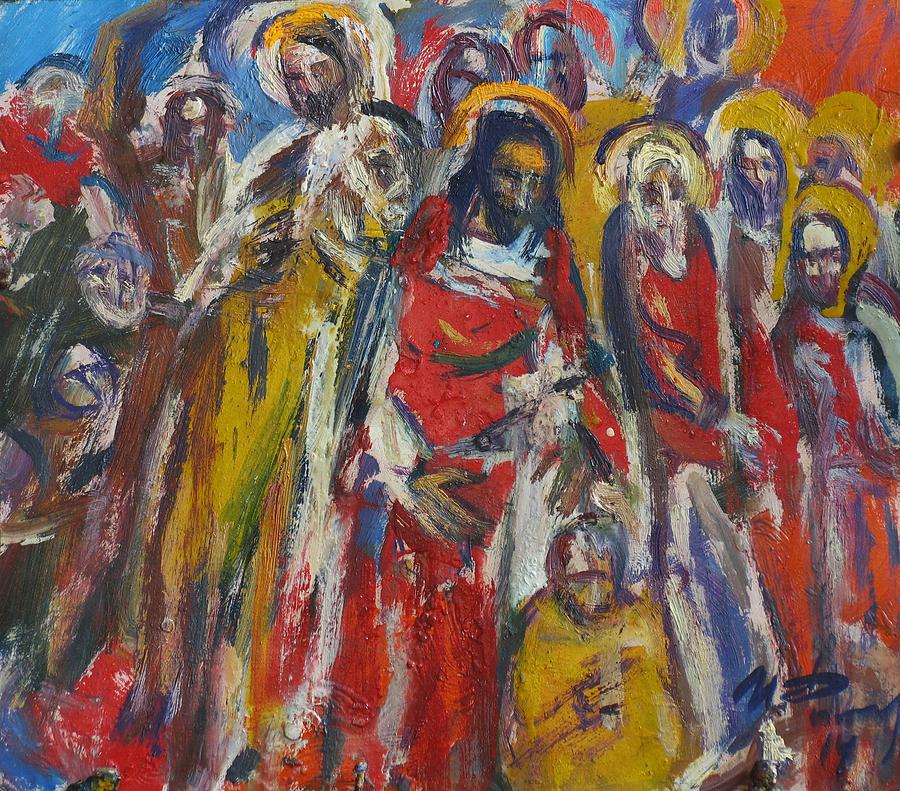
Mark 8:22-26 – A Ministry of Touch

“Healing” by Ivan Filichev

They [Jesus and his disciples] came to Bethsaida, and some people brought a blind man and begged Jesus to touch him. He took the blind man by the hand and led him outside the village. When he had spit on the man’s eyes and put his hands on him, Jesus asked, “Do you see anything?”

He looked up and said, “I see people; they look like trees walking around.”

Once more Jesus put his hands on the man’s eyes. Then his eyes were opened, his sight was restored, and he saw everything clearly. Jesus sent him home, saying, “Don’t even go into the village.” (New International Version)

Spirituality is, of course, a matter of the spirit. It is also a matter of the body. It may be lost on us that the way our spirituality is expressed is through our very real physical selves. A disembodied spirituality is really no spirituality, at all.

Christianity is profoundly physical. A core doctrine of the Church is the incarnation of Christ, God becoming man. Jesus has a real flesh and blood body. His physical body was the vehicle by which he did the will of God. Christ’s earthly ministry directed attention to people’s holistic needs – including the physical body.

So, perhaps it ought not surprise us when Jesus intentionally and literally touches people. From one person to another, Jesus was attentive to the power of compassionate and healing physical touch. For healing does not happen from afar; it is close enough to be personal, touching the spirit, the emotions, the mind, and the body.

In today’s Gospel lesson, some folks came to Jesus with a blind man in tow. They were evidently concerned and close enough to the man to beg Jesus to touch him. Yes, touch him. The small group of people were looking for a tangible reach from Jesus.

Just the other day, I visited a dear lady in the hospital for which I’m a Chaplain. As I began to speak with her, she reached out her hand, and I took it. I then realized that she was blind. This patient, in the dark because of her eyes, and in a strange unfamiliar place, needed more than a verbalized healing prayer from me. She needed a very real physical connection. The ability to compassionately touch another person has tremendous power.

“To touch is to give life.”

Michelangelo

Skin-to-skin contact is vital for our mental, emotional, spiritual, and physical health. Sensory deprivation is a real thing, and it’s a pervasive problem, especially during a pandemic.

We now know that whenever we feel unusual stress and pressure in our lives that the body releases the stress hormone cortisol. One of the biggest things actual physical touch can do is reduce the abnormal stress, allowing the immune system to work the way it should. What’s more, touch helps calm our heart rate and blood pressure, enabling us to have a more regulated way of life.

Jesus took the blind man by the hand and walked him outside the village. Let’s pause on that factoid for a moment. There was a man who literally walked with Jesus, hand-in-hand, for perhaps a few miles. I wonder what he experienced, just in that walk. What seems clear to me is that this event of walking was part of the man’s healing. He quite simply needed this bodily experience with Jesus.

I find it a bit humorous that some commentators struggle with the process of Christ’s healing the blind man, as if Jesus himself was struggling with trying to heal the guy. However, by taking the approach of an embodied spirituality, we can discern that this man required a great deal of touch from Jesus. The spitting, the putting the hands on the eyes, and then doing it again, was all deliberately tactile and just what the man needed for his healing of both body and soul.

Christ’s physical body was an instrument of grace. And our own bodies are meant to bless others with appropriate and compassionate touch. I realize this gets complicated with social distancing practices and concerns with health during a pandemic, yet we can still be agents of healing through simple acts of touch, including the following:

  1. Hug others. Hugs are healthy. I completely understand that some people aren’t huggers, and we ought to be guarded hugging others we don’t know very well. I usually ask before I hug someone outside of my family or church. Unfortunately, many people have had bad experiences being touched, and my heart goes out to them. Yet, the need for meaningful and positive touch still remains both for us and for others.
  2. Pet the dog. My wife’s little dog is a prima donna. He drives me nuts sometimes (maybe most of the time). Yet, because of his disposition, he is the perfect little gentleman when in a care facility or in public. He likes the attention. If you have a pet, let other folks pet them. I’m a busy guy, but when it comes to taking time for neighborhood kids to pet the dog while I’m walking him, I’m all in. It is a simple ministry that anyone can do.
  3. Hold hands or offer light touch. This can and perhaps should be a liberal activity within most families. It can also be done with others. It’s not weird to do this, even in some contexts with strangers. For example, when leading someone in the hospital to their appointed place, depending on the circumstance, I place a light hand on the back or shoulder. Hospitals aren’t exactly destination vacation spots, so folks can be nervous when in them. Simple ways of appropriate touch help calm the anxiety.
  4. Fist pumps and elbow bumps have replaced handshakes, and that’s a good thing. Fist and elbows just aren’t the same thing as a good old fashioned tight handshake, yet it is still an opportunity to touch. Some touch is better than no touch. Don’t give up on practicing ways to physically connect, even if those ways aren’t ideal.
  5. Use your eyes. There are just going to be some circumstances and places where you cannot offer an actual physical ministry of touch. So, use your eyes. Imagine in your mind offering a hug or a handshake to the person and intentionally focus that picture to your eyes. Since our physical eyes communicate a lot, the other person will pick it up.

Every day is an opportunity, for the believer, to walk with Jesus along our life’s journey. As we allow Christ to touch our lives, we, in turn, are able to touch others both spiritually and sometimes even physically through compassionate ministry.

May you know the grace of being touched by Jesus, and the blessing of touching others with the love of God.


Mark 6:35-44 – You Want Us To Do What?

Late in the afternoon his disciples came to him and said, “This is a remote place, and it’s already getting late. Send the crowds away so they can go to the nearby farms and villages and buy something to eat.”

But Jesus said, “You feed them.”

“With what?” they asked. “We’d have to work for months to earn enough money to buy food for all these people!”

“How much bread do you have?” he asked. “Go and find out.”

They came back and reported, “We have five loaves of bread and two fish.”

Then Jesus told the disciples to have the people sit down in groups on the green grass. So, they sat down in groups of fifty or a hundred.

Jesus took the five loaves and two fish, looked up toward heaven, and blessed them. Then, breaking the loaves into pieces, he kept giving the bread to the disciples so they could distribute it to the people. He also divided the fish for everyone to share. They all ate as much as they wanted, and afterward, the disciples picked up twelve baskets of leftover bread and fish. A total of 5,000 men and their families were fed. (New Living Translation)

I once knew a dear church lady who made a pan of lasagna for a local soup kitchen. When she showed up, it turned out, other church ladies didn’t. Hers was to be one pan amongst many. Instead, it was the only one. When a long line formed of hungry impoverished people, she felt both compassion and heartsick. Her immediate thought was to go and buy several pans of lasagna. But she knew it would take too long, and she wasn’t even sure she could find enough to feed everyone.

So, rather than turning the people away, the dear woman looked up to heaven, uttered a prayer of thanksgiving to God for what little she had, and began serving. She said, “I just kept sticking my spatula into the pan, and lasagna kept coming out. By the time the last person in line came, I served the last of it. I can’t explain it. It just happened.”

No one left hungry.

Today’s Gospel lesson of Jesus feeding the five thousand men and their families is not just a nice account of something that happened a long time ago. Jesus is still doing miracles. The Lord is still expanding his benevolent reach all across God’s big world.

Jesus takes our meager resources and turns them into something with a large impact on a lot of people. For this to happen, all we need to do is follow our Lord’s simple instructions: “You feed them.” 

“But Jesus! I don’t have much money. I’m not a good organizer. I can’t do what you’re asking!”

“I don’t…” “I’m not…” “I can’t…” Jesus hears it every day.

Jesus really doesn’t want to hear about our “buts.” Maybe we ought to take the word “but” out of our language altogether. That’s because it’s not about us, at all.

Jesus can multiply whatever little we have to accomplish his benevolent work through us. 

Jesus could clearly do miracles without us having any involvement. Yet, he deliberately chooses to use us and our drop-in-the-bucket resources to participate in his work. Jesus wants to use our minds, our mouths, and the very marrow of our being to effect a miracle.

Our work is to bring Jesus our five small loaves and two fish. He’ll do the rest.

It is the compassion of Jesus which motivates him to miracles.

The crowd did not leave him alone. Rather than being annoyed by the situation because it was not on his agenda to deal with any people, Jesus looked at the large group of people and had compassion on them.  His heart went out to them.

God does not begrudgingly deal with us, as if we are an interruption to his day.

All these hungry people. What to do about it? “You feed them,” Jesus says. I perhaps detect a hint of sarcasm in the tone of the disciples reply: “We have only five loaves of bread and two fish.”  Their math was way off because they did not count Jesus. 

Through simple prayer and active obedience, we must give Jesus what we have, no matter how little or insignificant.

In this contemporary era, much of what we do is concerned to be reasonable and rational with a strong scientific or proven base for engaging ministry. Although I don’t have much of a stomach for believers who incessantly want a miracle for everything and see devils under every rock, I equally have no stomach for doing ministry as if it were an Enlightenment project, completely drained of all faith and the possibility of seeing God work in ways that are incomprehensible to our modern sensibilities.

Indeed, looking out at all the vast Western resources have accomplished with money and buildings and programs, it makes me want to explain, “This is amazing! It is incredible what we know-how American Christians can do without God!” 

I am curious what Christ’s Church would look like if we were to have an underlying presupposition and assumption that God is still in the business of doing miracles? I wonder: Would it impact the way we pray, and the way we act? 

What if we altogether forsook shame and had the boldness to say, “This might sound crazy, but what if we…”

  • “Found everyone in our city who needs food and go love on them and feed them” (instead of just going the rational route of only supplying the food pantry).
  • “Used our property to create a community garden and seek to help people grow their own food.” (instead of just giving out some food cards).
  • “Built a smart robot to plant the fields of disabled farmers and gave them the rights to the tech we developed.” (am I getting too crazy yet!?). 

In the kingdom of God, there are no boundaries – only unlimited opportunities to give our small ideas, little bits of strength, and puny resources to Jesus so that he can take it and feed the world.

Jesus is perfectly able to do his work without us and without what we have. However, he wants to use us and our meager resources to accomplish the miraculous meeting of needs far beyond what we could ever imagine. 

We too often do nothing. That’s because we mistakenly believe God either cannot or does not want to use me or what I have.

It just won’t do to stand afar off and expect God to work without us giving what we have, whether that something is time, money, conversation, food, hospitality, or whatever. Our excuses won’t do for Jesus – my home is too small, it is not clean enough, I don’t have enough money, I am not smart enough, my schedule won’t allow it, I don’t have enough resources…. All you need is something, no matter how seemingly insignificant it is.

You want me to do what? Feed thousands? The real pre-miracle work for many people is to be open, real, and transparent enough to believe Christ can do a miracle through confessing sin, participating in a ministry, having a spiritual conversation with somebody different than me, or just saying what I actually think and feel.  

The question is never, “Can God use me?” The real question is, “What miracle does Jesus want to do through me and through his Church?”

It was no accident when Jesus distributed the bread that it sounds a lot like communion.

The Lord’s Supper may seem to be irrelevant to some – as if it is only a way to remember Jesus, a mere regular ritual. Yet, God’s design is much bigger. Jesus wants to do a miracle through the distribution and ingestion of the common elements of bread and wine – a miracle of healing, a miracle of bringing true satisfaction the world can never give. 

It isn’t realistic to expect that Jesus can use the Table to feed and reach thousands. However, we don’t serve a God who is limited to work through rational means by only using our five senses. 

We serve a God who does unexpected miracles within the life of the community.

Lord, I believe. Help me in my unbelief! I open my mind and heart believing in your infinite power and possibility. I believe in your constant expression of perfect good in and through me. I know that with you all things are possible. All that I am, all I was, and all I hope to be I give to you. I am yours. Amen.

*Above painting: Feeding of the 5,000 by Laura James

**Above: Ethiopian Orthodox Church depiction of Christ feeding the 5,000

Mark 10:32-34, 46-52 – The Irony of Following Jesus

Jesus healing blind Bartimaeus by Johann Heinrich Stöver, 1861. St John’s Church, Hesse, Germany

They were on their way up to Jerusalem, with Jesus leading the way, and the disciples were astonished, while those who followed were afraid. Again, he took the Twelve aside and told them what was going to happen to him. “We are going up to Jerusalem,” he said, “and the Son of Man will be delivered over to the chief priests and the teachers of the law. They will condemn him to death and will hand him over to the Gentiles, who will mock him and spit on him, flog him and kill him. Three days later he will rise….”

Then they came to Jericho. As Jesus and his disciples, together with a large crowd, were leaving the city, a blind man, Bartimaeus (which means “son of Timaeus”), was sitting by the roadside begging. When he heard that it was Jesus of Nazareth, he began to shout, “Jesus, Son of David, have mercy on me!”

Many rebuked him and told him to be quiet, but he shouted even more, “Son of David, have mercy on me!”

Jesus stopped and said, “Call him.”

So, they called to the blind man, “Cheer up! On your feet! He’s calling you.” Throwing his cloak aside, he jumped to his feet and came to Jesus.

“What do you want me to do for you?” Jesus asked him.

The blind man said, “Rabbi, I want to see.”

“Go,” said Jesus, “your faith has healed you.” Immediately he received his sight and followed Jesus along the road. (NIV)

“Irony” and “ironic” are terms describing when an outcome of an event is contrary or different from what would be expected. Here are a few examples of irony: The firehouse burnt down. The police officer got arrested. When I was a kid, my family physician’s name was Dr. Fail (really!).

There is an overarching ironic lesson to our Gospel story today. The people following Jesus with 20/20 vision are spiritually blind. Their great need is the same as blind Bartimaeus: to have their eyes opened to Jesus and to what God was doing around them. Bartimaeus was marvelously and miraculously given sight by Jesus – the others, however, remained unchanged and in the dark. 

Irony #1: Many followed Jesus, but only a few were his followers.

All kinds of people physically followed Jesus around for all kinds of reasons while he was here on this earth.  Some wanted to bask in the latest celebrity buzz that Jesus generated. Others wanted to see all the cool stuff Jesus did, like healing people. Some were plain curious. And a few were interested in being like Jesus by showing selfless compassion. Jesus continually sought to press the crowd following him into authentic disciples who would follow his teaching.

Many people desire to conform and go with the flow. That’s great if the crowd is good, and not so good if the group is going in a bad direction. In the Old Testament, a few unruly complainers got the Israelites all stirred up with the result of making a golden calf and turning away from God. However, sometimes it is right and necessary to go against the crowd, which leads us to the next irony….

Irony #2: Out of all Christ’s followers, it is a blind man that sees Jesus for who he is, the Son of David.

Spiritual blindness afflicted many people, yet Bartimaeus discerned it was Messiah who was walking by him. So, he went against the crowd and shouted to Jesus. Blind Bartimaeus didn’t care how he looked to others, and it didn’t matter to him that he stuck out like a sore thumb. 

Sometimes we might forget that Jesus often avoided crowds, and that most of his life occurred away from the centers of power and influence. Jesus swam upstream of the prevailing notions of righteousness. Christ did not cow-tow to the crowd, but instead, paid attention to those in need and forgotten by others. Jesus did not “work the crowd” to get ahead and further his agenda. He did not cozy-up to the rich and powerful. And he deliberately avoided celebrity status. Jesus showed extraordinary love to an overlooked person. He used his immense power for one powerless person.

Irony #3: The ones following Jesus were the ones trying to keep a blind man from Jesus.

It seems to me one of the ironies about the church is that Christ’s own followers can be the greatest obstacle to others following him. I can imagine a group of gossipy church folk shushing Bartimaeus: “Don’t bother Jesus, he is such a busy man! He has important work to do!” I can also picture them standing next to blind Bartimaeus saying, “Just stop, man, you’re embarrassing yourself.” 

But Bartimaeus would not stop. He shouted all the louder. True and genuine faith is a needy person crying out in desperation for Jesus to help. Jesus asked a beautiful question: “What do you want me to do for you?”  “I want to see,” Bartimaeus responded. So, Jesus had compassion on him and gave him his sight. Here we have two men, Jesus and Bartimaeus, ignoring all the people around them, and having a divine encounter.

This all makes me wonder why it is so hard for us to simply say what we want. It could be that we don’t want to buck the crowd, or to look different. Maybe we don’t want to admit our need in front of others. So, we just stick to superficial conversations and insist that everything is okay, when it isn’t.

Jesus said, concerning the crowd, “Although they see, they don’t really see.” (Matthew 13:13) If we are concerned about how we will be seen by others, we will likely not be seen by God, and will miss Jesus when he walks right in front of us.

Conclusion

How might we raise our ability to see Jesus and truly follow him as he desires us to?

Listen to Jesus. Jesus was headed to Jerusalem and had a lot on his mind and heart with anticipating his passion and death. What made Christ attentive to Bartimaeus out of all the people around him was that he was listening. If we want to see Jesus and follow him, we must be listeners and attentive to compassion, like Jesus, to the needy and lowly among us. 

I recently read a story from a Christian who lived during Nazi Germany. He said, “I considered myself a Christian. We heard stories of what was happening to the Jews, but we tried to distance ourselves from it, because what could anyone do to stop it? A railroad track ran behind our small church, and each Sunday morning we could hear the whistle in the distance and then the wheels coming over the tracks. We became disturbed when we heard the cries coming from the train as it passed by. We realized it was carrying Jews like cattle in the cars! Week after week the whistle would blow. We dreaded to hear those wheels because we knew we would hear the cries of the Jews in route to a death camp. Their screams tormented us. So, when we heard the whistle blow, we began singing hymns. By the time the train came past our church, we were singing at the top of our voices. If we heard the screams, we sang more loudly, and soon we heard them no more. Years have passed, and no one talks about it anymore. But I still hear that train whistle in my sleep. God forgive me. Forgive all of us who called ourselves Christians yet did nothing to intervene.” 

Respond to Jesus. Once Jesus listened, he responded by asking a question. Christ took the time to heal Bartimaeus. Jesus could have simply healed him without even stopping. He could have even started a healing factory where everyone with a need just moved through a line and got healed. Jesus was doing more than giving sight; he was giving a blessing – the blessing of time and relationship.

The gospel is personal, which is why we ought to resist being non-relational in ministry to others. It’s about more than meeting a physical need. It is about blessing other people with the gift of relationship. It begins with recognizing self as the one who needs Jesus. It starts with having our own eyes opened to see our own need and then the great need of people around us.

God of all compassion, I confess that it is natural for me to do things my way. I recognize that I am limited, but that you know all things. I yield my spiritual eyesight to you so that my spiritual vision will be clear. Jesus Christ came to give sight to the blind and to open our eyes. I commit my ways to you so that I can see your ways and not my own. Amen.

Matthew 15:32-39 – Feeding the Four Thousand

Jesus Feeds the 4000
Jesus Feeds the 4000 by Laura James

Jesus called his disciples to him and said, “I have compassion for these people; they have already been with me three days and have nothing to eat. I do not want to send them away hungry, or they may collapse on the way.”

His disciples answered, “Where could we get enough bread in this remote place to feed such a crowd?”

“How many loaves do you have?” Jesus asked.

“Seven,” they replied, “and a few small fish.”

He told the crowd to sit down on the ground. Then he took the seven loaves and the fish, and when he had given thanks, he broke them and gave them to the disciples, and they in turn to the people. They all ate and were satisfied. Afterward the disciples picked up seven basketfuls of broken pieces that were left over. The number of those who ate was four thousand men, besides women and children. After Jesus had sent the crowd away, he got into the boat and went to the vicinity of Magadan. (NIV)

Through the event of Christ miraculously feeding more than four-thousand people, the Christian tradition embraces a living, ascended, and glorified Jesus who still looks to feed those in need. Furthermore, just as Christ had his disciples participate in the miracle, so he still wants to use us today in feeding the world. It is therefore necessary that we work on aligning our resources – our emotional energy, our money, our service – toward reaching out to people who are hungry, both physically and spiritually.

Jesus did just that in feeding thousands of people. He organized his disciples for a miracle even though they failed to understand what he was doing until he did it. The disciples, bless their head scratching, wondered how the vast throng of people were going to be fed, even though they had already participated in the feeding of the five thousand (Matthew 14:13-21). The disciples sarcastically responded to Jesus, “Where could we get enough bread in this remote place to feed such a crowd?”  Maybe they were less thick-headed and more hard-hearted. You see, unlike the previous feeding miracle, this one took place in the Gentile territory of Tyre and Sidon.

It appears the disciples were having a hard time with Jesus using his efforts, compassion, and miracles for Gentiles (non-Jewish people) instead of Jews. It could be that they were thinking Jesus should stand for holiness by being as far apart from pagans as they can get. Besides, it wasn’t as if there weren’t any hungry people among their own Jewish people. Maybe they were thinking: “Shouldn’t the miraculous and divine resources be better utilized in keeping them within the Jewish community? After all, the gentile Romans oversee the land. Couldn’t they take care of the needy? Is this really our responsibility?”

Jesus would have none of that kind of thinking. Christ most certainly could have avoided the Gentiles if he wanted to; but he didn’t. Jesus could have fed the people and done a miracle without the involvement of his Jewish disciples, but he didn’t. Jesus wanted his disciples to be part of the miracle through distributing the bread and fish for the people to eat.  Jesus would have nothing to do with his Jewish disciples avoiding the Gentile people.  He wanted the disciples to meaningfully connect with the hungry people.

I wonder whom Jesus wants us to meaningfully connect with. I am curious if Christ is looking to align his divine resources for people in our lives – and to use us as the means of a miracle. Perhaps the people who are quite different from us are the ones we are to feed. I am wondering how we view such persons. If we tend to freight our language about them in sarcasm, perhaps that is a clue to our own implicit or unconscious bias.

Back in the 1980’s and 1990’s, I had many conversations and dialogues with Christians about AIDS and the gay community. I am saddened that the pervasive attitude I encountered at the time was how gays and lesbians were ruining our society (among other attitudes not worth repeating). Instead of seeing them through the eyes of the compassionate Jesus and seizing an opportunity to love an entire community of people, the discussions were more about how to keep “homosexuality” and the “gay disease” out of church. The hospitals at that time had wards of persons dying from HIV, and few Christians present to bring the compassionate resources of Jesus to them. Withholding spiritual or physical food from people in need, no matter who they are, is not the way of the Lord Jesus – the One who feeds and heals. However, giving the grace of food and fellowship to all in need emulates the compassion of Jesus. Indeed, there is always room at the Table.

Table of Hope by Joey Velasco
“Table of Hope” by Joey Velasco

Jesus not only meets the needs of all kinds of people, he also gives lavishly so that the supply is more than enough. The resources of grace will never run out; there is always enough. I hope our legacy to the people of this earth is that there is always enough grace from us because we have ourselves received grace from the Lord Jesus.

Most folks, especially the poor, rarely have their needs met through rational ethereal arguments and pious pronouncements of truth. And their needs cannot be met if available resources are placed on the outside of their access to them due to existing attitudes about poverty and/or particular people groups. The needs of people are met through non-judgmental compassion which finds a way to connect them with food, both physical and spiritual, even if it takes a miracle to happen.

God Almighty, the One who sustains all, we ask you to pour your powerful Spirit into all who are empty this day. Fill the hearts of persons who are troubled. Fill the minds of people who are confused. Fill the stomachs of your children who are hungry. Fill the souls of people who are feeling lost. Fill the lives of all who need you, but do not know you. May your Spirit fill us all to overflowing, dear Lord, and may we be inspired to share our abundance with others so that there will be no more empty hearts and minds, stomachs, and souls. We pray all this in the name of Jesus Christ, who fills lives with your endless grace. Amen.