Like Father Like Son (John 5:19-29)

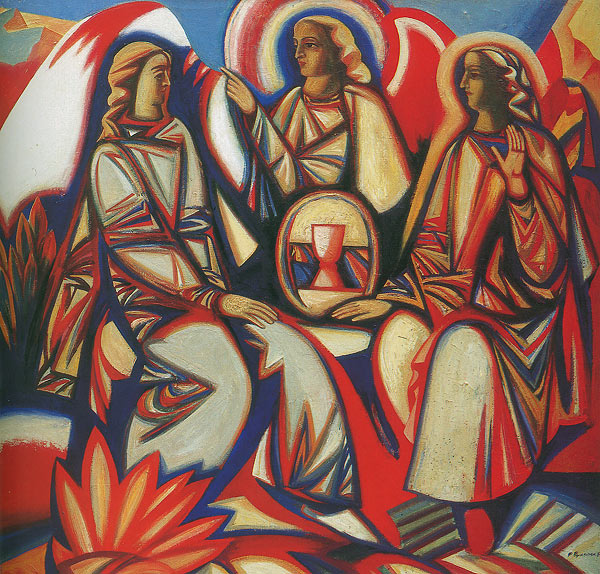
The Trinity, by Ukrainian painter Feodosiy Humeniuk, 1981

Jesus responded to the Jewish leaders: 

“I assure you that the Son can’t do anything by himself except what he sees the Father doing. Whatever the Father does, the Son does likewise. The Father loves the Son and shows him everything that he does. He will show him greater works than these so that you will marvel. 

As the Father raises the dead and gives life, so too does the Son give life to whomever he wishes. The Father doesn’t judge anyone, but he has given all judgment to the Son so that everyone will honor the Son just as they honor the Father. Whoever doesn’t honor the Son doesn’t honor the Father who sent him.

I assure you that whoever hears my word and believes in the one who sent me has eternal life and won’t come under judgment but has passed from death into life.

I assure you that the time is coming—and is here!—when the dead will hear the voice of God’s Son, and those who hear it will live. Just as the Father has life in himself, so he has granted the Son to have life in himself. He gives the Son authority to judge because he is the Human One.

Don’t be surprised by this, because the time is coming when all who are in their graves will hear his voice. Those who did good things will come out into the resurrection of life, and those who did wicked things into the resurrection of judgment.”

(Common English Bible)

So goes the parent, so goes the child. Sons look and act a great deal like their fathers. And there is no mistaking the resemblance between Father of the heavens and Son of the incarnation.

In Christianity, to see Jesus is to see God. To know Christ is to know the Lord. They are distinct, yet inextricably linked as one; each is differentiated from the other in personhood, yet united with the same divine substance.

The deity of the Father and the deity of the Son is one, equal in glory, co-eternal in majesty.

What the Father is, the Son is.

Uncreated, eternal, almighty, and sovereign is the Father; uncreated, eternal, almighty, and sovereign is the Son.

The Father and the Son are not two gods but one God.

There is only one Father; there is only one Son. Each is neither greater nor lesser than the other.

Whoever wants to be saved from guilt, shame, sin, death, and hell – and to be delivered from the injustice of the world, the failings of oneself, and the machinations of evil, should think about the Father and the Son and the Spirit, the Holy Trinity, one God.

– Athanasian Creed

So, why is all this creedal Christian doctrine of any importance? Why pay attention to such things?

Because there are many issues and problems in this world of great importance which must be addressed and dealt with. We need to have some idea of how to go about: 

  • Governing ourselves as a free people
  • Eradicating poverty and disease
  • Educating our children
  • Paying taxes
  • Providing excellent and cost effective healthcare for everyone
  • Dismantling racism
  • Seeking peaceful international relations
  • Building responsible and accountable local community relationships
  • Supporting small businesses
  • Helping workers make a decent contributive living
  • Loving our families and faith communities 

It is my unshakable conviction that all these issues, and many others, need more than our collective mental attention and physical resources; these problems also need spiritual resolutions and solutions.

Seasons, years, centuries, and millennia come and go. People are born, live, and die. Generations exist and then are no more. Civilizations rise and fall. Through it all and above it all is the person of Jesus.

Christ is alive. He brings breath from dust, beauty from ashes, order from chaos, stability from insecurity, dignity from disrespect, and meaning from uncertainty. Jesus gives life, abundant and to the full.
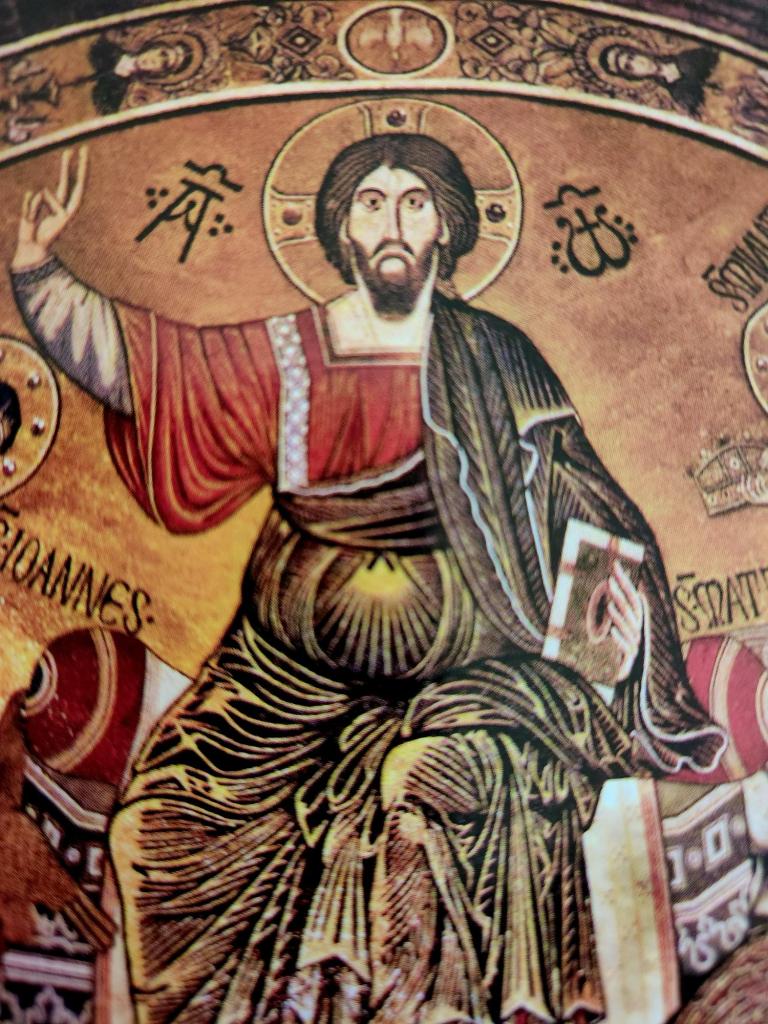
Christ the King, San Miniato al Monte Church, Florence, Italy

Today, this very moment, Christ is still on the throne of all creation. 

Human elections and institutions only have authority as given by Jesus, the Ruler of all.

Presently, Jesus is attentive and vigilant to people, actively interceding for us at the right hand of his Father in heaven. At this very moment, the Holy Spirit is the continuing presence of Christ on this earth, applying Christ’s redemption of humanity to the lives of millions. 

Sometimes we need to remember how important our spiritual resources are to living in this world – and to clarify what’s really of ultimate significance in this old broken world. 

My unwavering spiritual persuasion is this: People need the Lord. Therefore, it only makes good spiritual sense to live in ways that foster a connection with Jesus. 

This morning, I did what I do every morning – whether I’m sick or well, sad or happy, facing a busy day or a relaxed day – I began my day with Scripture reading, prayer, reflection, and gratitude. And I do it with the realization that Christ is King, that as the divine/human Lord of all, his:

  • authority is real
  • rule is benevolent
  • sovereignty is ubiquitous
  • reign is supreme
  • judgments are right and good
  • power is mighty enough to raise the dead

The Christian tradition holds that Jesus Christ is the exalted and glorified Son of God, the Sovereign authority over every dominion. The works of Jesus bear testimony to the cosmic reality that he is Lord of all. And, if that were not enough, Jesus shares his divine power with us, his people.

In the face of Christ’s majesty, the valid and appropriate response is sheer submission to Christ’s authority. 

Just as Jesus listened to the Father and obeyed the Father’s will, so we need to listen to Jesus and carry out his will. 

Just as Jesus enjoyed his relationship with the Father, so we are to bask in our wonderful relationship with Jesus. 

Since Jesus submitted to death on a cross and rose from the dead through God’s power, we now have access to that power by God’s grace through faith in Christ. And we are to use that divine power to take up our own cross and bear the great issues and problems of our day with all the spiritual resources granted to us in Christ Jesus.

Like Father, like Son. Like Christ, like Christians. May all followers of Jesus resemble their Lord in each word and in every way.

Almighty God, to you all hearts are open, all desires known, and from you no secrets are hid: Cleanse the thoughts of our hearts by the inspiration of your Holy Spirit, that we may perfectly love you, and worthily magnify your holy Name; through Christ our Lord. Amen.

Luke 8:22-25 – Where Is Your Faith?

One day Jesus said to his disciples, “Let us go over to the other side of the lake.” So, they got into a boat and set out. As they sailed, he fell asleep. A squall came down on the lake, so that the boat was being swamped, and they were in great danger.

The disciples went and woke him, saying, “Master, Master, we’re going to drown!”

He got up and rebuked the wind and the raging waters; the storm subsided, and all was calm. “Where is your faith?” he asked his disciples.

In fear and amazement, they asked one another, “Who is this? He commands even the winds and the water, and they obey him.” (New International Version)

“I’m not afraid of storms, for I’m learning how to sail my ship.”

Louisa May Alcott

The opposite of faith isn’t little to no faith – it’s fear.

Fear, at its core, is being afraid of getting hurt. Fear is an emotion which alerts us to some danger that may break my heart or my body.

Being afraid, in and of itself, is neither good nor bad. It’s more about why fear bubbles up for us.

So, what makes you afraid? Why? How does fear influence your life?

Fear is often at the root of unhealthy behaviors such as:

  • Vilifying another, afraid that others I don’t know or who are different from me might harm me, my family, or my community.
  • Hiding my emotions, afraid my weaknesses or failures will be exposed or exploited.
  • Serving others, afraid that I won’t have worth, meaning, or purpose without helping.
  • Achieving or winning, afraid that I will be irrelevant or unwanted.
  • Smiling and being upbeat, afraid of facing and feeling the deep sadness within me.
  • Procrastinating projects, tasks, or conversations, afraid of being disliked or rejected.

Today’s Gospel story has Jesus at the center of the storm. The wind and the waves, the storm, is not the central element of the story. Jesus is. And that’s an important distinction, because whenever we put outside circumstances as the central elements of our own stories, anxious fear is the inevitable result.

“Fear keeps us focused on the past or worried about the future. If we can acknowledge our fear, we can realize that right now we are okay.”

Thich Nhat Hanh

The disciples were surprised that even the wind and the waves obey him! They were afraid because of the furious storm. Yet, Jesus was sleeping, not the least bit fearful. The disciples woke him, and in shallow breathed words of anxiety stated they all were going to drown because of the extreme conditions.

In my mind’s eye, I imagine Jesus slowly awaking and lazily rising from his slumber, simply rebuking the wind and waves, with neither any anxiety nor any hurry, and then chiding the disciples for their inability to place their faith in him.

Jesus Calms the Storm by the Benedictine Sisters of Turvey Abbey

The disciples’ expectations of and faith in Jesus were way too low! That’s what fear does. It diminishes faith. Like Chicken Little, who thought the sky was falling and all was ruined, we become chickens of little faith.

Many people believe God hears and answers prayer. Yet sometimes, our faith can be so small that, when God answers those prayers in ways far superior to our expectations, we are slack-jawed and astonished by it. Luke’s Gospel records several instances of people being surprised by Jesus: 

Everyone who heard him was amazed at his understanding and his answers. (Luke 2:47, NIV)

They were astounded at his teaching because he spoke with authority. In the synagogue there was a man who had the spirit of an unclean demon, and he cried out with a loud voice, “Leave us alone! What have you to do with us, Jesus of Nazareth? Have you come to destroy us? I know who you are, the Holy One of God.” But Jesus rebuked him, saying, “Be quiet and come out of him!”

Then the demon, throwing the man down before them, came out of him without doing him any harm. They were all astounded and kept saying to one another, “What kind of word is this, that with authority and power he commands the unclean spirits and they come out?” (Luke 4:32-36, NRSV)

I want you to know that the Son of Man has authority on earth to forgive sins.” Then he said to the paralyzed man, “Get up, pick up your stretcher, and go home.”

The man immediately stood up in front of them and picked up the stretcher he had been lying on. Praising God, he went home.

Everyone was amazed and praised God. They were filled with awe and said, “We’ve seen things today we can hardly believe!” (Luke 5:24-26, GW)

Jesus was driving out a demon that could not talk; and when the demon went out, the man began to talk. The crowds were amazed. (Luke 11:14, GNT)

Jesus is more marvelous, wonderful, powerful, and awesome than we know. Jesus will take care of us; he will not let his people be destroyed. And, what’s more, he has the power and authority to heal us.

Whenever we truly grasp who Jesus is, and how much he loves us, there is no room for fear, only faith. 

Even though the disciples’ faith was small, Jesus still responded to it with grace because even small faith is faith. Grace is undeserved help. Our Lord helps anyone who approaches him, whether with little faith or big. Our small faith is no obstacle for Jesus in delivering us from the storms of life.

You might be presently experiencing a violent storm in your life. Please know that Jesus can bring peace.

Perhaps you have a besetting sin that dogs you every day. Jesus can deliver you.

It could be that depression follows you like a lost kitten wherever you go. Jesus can bring new life and fresh joy to your life.

Maybe there is an estranged relationship you have lost hope over. Jesus can restore it.

Perchance you think your neighbor, co-worker, or family member is too far from God to ever know Jesus. By now you know the response….

Ethiopian Orthodox Church depiction of Jesus calming the storm

Our expectations of Jesus are much too small! We can pray big prayers because we serve a big and powerful God who has the authority to command even the wind and the waves!

The Gospel of Mark portrays Jesus as the ultimate authority over everything, including powerful storms. Christ uses that authority to bestow grace, even in the face of the smallest of faith in his followers. Jesus cares about people and seeks to deliver them from the dominion of darkness.  

So, may we participate with Jesus in his agenda for this world.

May we submit to his rule and authority.

May we exhibit the same care, compassion, and concern for people as Jesus does.

May we find our faith, especially amidst the worst of situations.

Lord Jesus, Son of God, I believe all things are possible through you; help my unbelief! Take my small and seemingly insignificant faith and use it to calm the storms in my life and demonstrate your authority even over the wind and the waves. Amen.

Luke 9:1-6 – On Power, Authority, and Mission

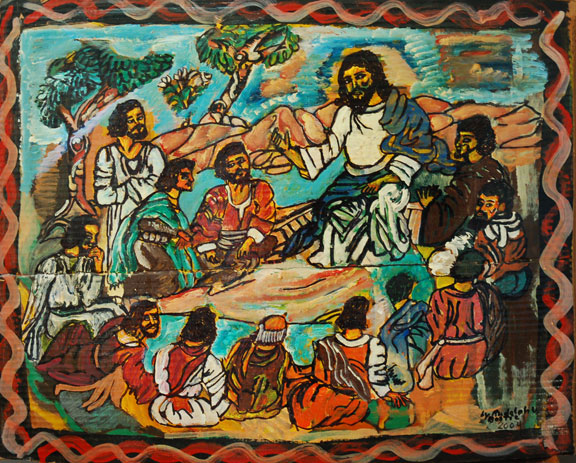
Jesus and the Disciples by Rudolph Bostic (1941-2021)

Jesus called the Twelve together and he gave them power and authority over all demons and to heal sicknesses. He sent them out to proclaim God’s kingdom and to heal the sick. He told them, “Take nothing for the journey—no walking stick, no bag, no bread, no money, not even an extra shirt. Whatever house you enter, remain there until you leave that place. Wherever they don’t welcome you, as you leave that city, shake the dust off your feet as a witness against them.” They departed and went through the villages proclaiming the good news and healing people everywhere. (Common English Bible)

You have likely heard the old nineteenth century adage from a member of the British Parliament, Lord Acton: “Power tends to corrupt, and absolute power corrupts absolutely.” The rest of the quote, which we seldom hear is this: “Great men are almost always bad men, even when they exercise influence and not authority.”

It’s almost as if Jesus knew this well before Lord Acton uttered it nearly two millennia later. Jesus Christ, in a truly wise and generous display of leadership, shared his power and authority with others. Rather than hoarding power and using authority to gain more authority, the Lord Jesus, rightful Ruler of the universe, delegated power and enabled those who ministered with him to share in carrying out his mission.

The only real Christian ministry is a bestowed ministry, granted to us by the delegation of Jesus. What this means for us, practically, is that believers minister as servants of God and stewards of the power and authority given to us. Grasping this basic accountability helps us to truly serve others with sensitivity and care – knowing we must give an account for the privilege of ministering in Christ’s name.

“There is no stronger test of a person’s character than power and authority, exciting as they do every passion, and discovering every latent vice.”

Plutarch (46-119, C.E.)

This has tremendous implications for us in all areas of life. Within the family, this means that parental authority can and ought to be delegated in wise increments, over time, as children grow and mature. The concept that a dad should be some sort of supreme leader who barks orders and demands fealty from mom and the kids is downright misguided, not to mention incredibly weird.

It also means that in the church and in faith communities, the wise use of power and authority will seek to identify and mentor younger disciples who will be given appropriate authority for expected ministry. Church leadership will listen to and equip those who have passions for particular service with the requisite authority to engage in effective ministry.

At the workplace, this involves forsaking a top-down approach of authority in favor of distributing power equitably amongst the workers with the greatest responsibilities.

In the political arena, this means Christians won’t tie their hopes in gaining power but rather in giving it away. They will seek equity and the common good of all citizens. And if that means deferring to a voice which isn’t being heard, then that is precisely what we do. Perhaps we see so little civility and concern for the other because Christians are much too enamored with dramatic miracles fueled by power.

Mosaic in the Papal Basilica, Rome, of Jesus and Disciples

Let’s not lose sight of the reality that healing sicknesses and suppressing the demonic is solely derived from Christ’s own authority, not ours. To press this reality home, Jesus instructed his disciples to take nothing with them. No staff, bread, bag, or money. Live among the locals, with them, on their turf and with their activities. Use the power and authority given to improve their lives and in so doing, lead them to greater spiritual truths.

If they don’t accept this gracious ministry, move on. No arm-twisting. No manipulation. No guilt-tripping. And definitely no using your given authority for grandstanding. A simple warning with shaking the dust off the feet is sufficient.

Every detail of the mission Christ gave to the disciples was a lesson in sheer and total dependence on God. Humble ministry and modest lifestyle will set the best table for a proper focus on benevolent and compassionate ministry. Just as increased knowledge ought to be used to love better and show us how much we actually don’t know, so increased authority ought to be used to serve others better and show us how much power we don’t have so that we might continually seek after the God who possesses all power and authority.

The good news is that God’s infinite and supreme power is given and focused in the person of Jesus Christ, who in turn, graciously bestows the authority to his followers so that they may proclaim forgiveness and new life. It’s a big message requiring large authority. And Jesus freely gives it:

And Jesus came and said to them, “All authority in heaven and on earth has been given to me. Go therefore and make disciples of all nations, baptizing them in the name of the Father and of the Son and of the Holy Spirit, and teaching them to obey everything that I have commanded you. And remember, I am with you always, to the end of the age.” (Matthew 28:18-20, NRSV)

It’s enough to make old Lord Acton smile in his grave.

Eternal God, you call us to live with faith in a world filled with so many challenges. Help us remember our mandate and our mission to use our given authority properly, lovingly, and confidently with obedience to our Lord.

Teach us by your Word, through our brothers and sisters in Christ, and in our prayers to learn and understand what you would have us to be and to do, so that we may fulfil our calling as Christ’s Body here on earth.

Draw your church together into one great company of disciples, together following our Lord Jesus Christ into every walk of life, together serving him in his mission to the world, and together witnessing to his love, in the strength of your Holy Spirit. Amen.

Hebrews 4:12-16 – Jesus Is Our Great High Priest

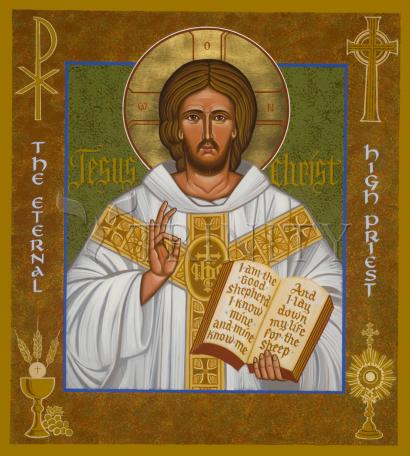
Jesus, the Eternal High Priest, by Joan Cole

For the word of God is alive and active. Sharper than any double-edged sword, it penetrates even to dividing soul and spirit, joints and marrow; it judges the thoughts and attitudes of the heart. Nothing in all creation is hidden from God’s sight. Everything is uncovered and laid bare before the eyes of him to whom we must give account.

Therefore, since we have a great high priest who has ascended into heaven, Jesus the Son of God, let us hold firmly to the faith we profess. For we do not have a high priest who is unable to empathize with our weaknesses, but we have one who has been tempted in every way, just as we are—yet he did not sin. Let us then approach God’s throne of grace with confidence, so that we may receive mercy and find grace to help us in our time of need. (New International Version)

Church Persecution and Christian Suffering

The book of Hebrews was originally a sermon preached to a group of believers who had come to Christ out of Judaism. From the book of Acts, we know there were thousands of Jewish Christians who were dispersed from Jerusalem when Stephen was martyred.  A great persecution broke out, and many believers fled west to places like Galatia, Ephesus, Greece and Rome. 

The Jewish believers were immigrants in a foreign land, looking to practice their faith without harm. Yet, their experience was anything but ideal. These followers of Christ found fellow ethnic Jews in the places where they went, yet those Jews had no use for these people that they believed were in some sort of aberrant cult.

What is more, the surrounding Gentile culture did not understand Christianity, at all, and many of those who held to pagan religions bought into rumors, such as, that Christians were cannibals who ate at what’s called the Lord’s Table.

So, here we have a situation where these displaced Christians had no respect from both Jews and Gentiles. As a result, they had a difficult time carrying out business because no one trusted them. They were essentially alone in the world. 

Losing Their Grip

Initially, they embraced their identity as Christians and held up quite well under the stress. However, over time, their resolve began to slowly erode. The followers of Jesus began to question their adverse situation. 

They began listening to their fellow Jews throw doubts on their faith. The hard life was not improving, maybe even becoming worse.  Eventually, the church came to a point where they began re-considering their whole way of life as Christians, and their faith commitment started slipping. The Christians actually considered leaving the Church and Christianity and going back to their old life in Judaism.

The Message of Hebrews

It was at this point that a vigorous believer in Jesus came to town, saw the situation of the church, and preached a spirited message to them. The preacher called them to hold tight to their commitment – to see Jesus afresh and anew as superior over all the Old Testament, as the fulfillment of all the promises of God. 

So, then, throughout the book of Hebrews we have this wonderful explanation and exposition of how to make sense of Jesus and the Old Testament, and of what Jesus really means to the church. Throughout his sermon, the preacher occasionally paused his teaching and gave the people a stiff warning about falling away from Christ. He called the church to be bold and confident in Christ, to stand up to the suffering, and to confront their temptations so that they would persevere in their commitment to Jesus Christ for the rest of their lives.

God’s Word and Work

We pick up the teaching and the exhortation in chapter four. Hebrews 4:12-16 is composed of two distinct sections that are paired together for a reason.  Verses 12-13 give us a graphic visual of the penetrating work of God’s Word, of the reality that God can get deep inside us. The next section, verses 14-16, lays out God’s response to our being under divine scrutiny – that there is grace and mercy available because of Jesus, our great high priest who is superior to every priest of the Old Testament to the point of being the last and permanent priest forever! 

These verses are bound together because we all need to struggle with the tension between God’s Word to us, and our words to God; between God’s judgment that opens our souls on a spiritual operating table, and God’s grace which jumpstarts our broken hearts. Our most fundamental need is for God’s mercy in Jesus Christ.

The Christian Life

It is important that our outer lives and our inner lives match each other. Whenever the two are out of sync, we come under the judgment of God’s Word. These early Hebrew Christians had slowly drifted from the truth so that their inner and outer lives did not line up well.

Some of them still performed the outward duties of being a Christian yet were inwardly despising their hard situation. A growing vacuum developed on their insides as they slowly started letting go of Jesus as their object of devotion. Their hearts began to harden because of their hard lives. 

On the other hand, there were other Hebrew Christians who began drifting in a different way. Inwardly, they tried to maintain their devotion and commitment to Christ. Yet these believers began compromising their outward life to match the culture around them. In both cases of hardening inwardly, and of compromising outwardly, they each shared the situation of drifting away from their original commitment to Christ.

Even today, it is a real temptation to try and avoid suffering, to grow weary of our present circumstances and look for a way to get out from under the pain and find a quick fix.  Whenever we find ourselves in such a situation, the remedy is to be reminded that we must continue to hold firmly to the faith we profess because of who Jesus is.

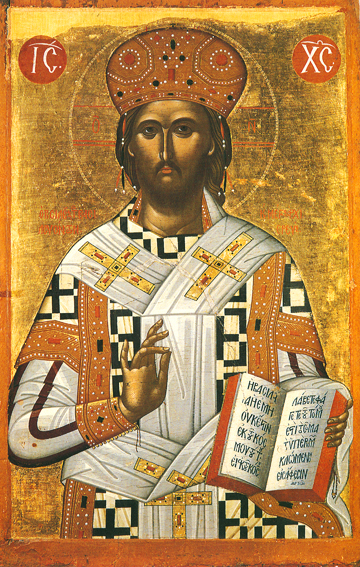
15th Century Orthodox icon of Christ the Great High Priest

Jesus As Permanent High Priest

Jesus is our great high priest. In the Old Testament, among the twelve tribes of the ancient Israelites, the tribe of Levi made up the class of priests. One of those Levites, always a descendent of the original Levite priest, Aaron, had the task of once a year entering a place called the Holy of Holies, which was at the center of the Temple, to offer a bloody sacrifice on behalf of the people, to atone for their sins from the previous year.

Jesus is our great and ultimate high priest. He did not enter the temporary sacrificial system to deal with sins for only a year. Jesus not only took on the role of high priest, but became the sacrifice, as well. As a result, we now have a thorough and permanent forgiveness of sins through Christ. So, the Hebrew Christian who considered going back to an old outdated system needed to be brought back to his senses and embrace again the once-for-all sacrifice of Jesus. 

As they considered Jesus, the believers needed to remember that Christ was not so far removed from them that the church could not relate to Jesus. Rather, Jesus is able to sympathize with each and every trouble, trial, and temptation we face because he faced the very same kind of sufferings. 

The only difference between Christ and his followers is that Jesus did not succumb to the trouble, but persevered and secured for us deliverance from sin, death, and hell. Jesus is the One who deserves every bit of our commitment, allegiance, and devotion. Christ is the One whom we are to worship inside and out.

Approaching God with Boldness

Let us then approach Jesus with confidence, with boldness, knowing that with him there is mercy and grace. Jesus not only suffered for us in the past; he also suffers with us now, in the present. We, as believers, are in union with Jesus. Christ is our great high priest, the One intimately involved in every nook and cranny of our lives. He knows what you and I are going through and is ready to give grace to help right now. 

Approaching Jesus has nothing to do with being good enough to do so. Coming to Jesus is about grace. Whenever we drift from Jesus and are confronted with God’s Word cutting us to the heart, the end result is not wrath or judgment; the result is mercy and grace.

Like the early Hebrew Christians, we all face situations out of our control that wear us down and cause us to become weary. In our tired state, we can be tempted to let our commitment to Christ slide in some small way. Over time, the small compromises of faith can snowball into a big slide away from God. 

Yet, Jesus is not sitting in heaven frustrated or confounded. God is not looking for a reason to punish people. It is just the opposite. Jesus, the Son of God, our great high priest, is looking for a reason to give grace and help us in our time of need. Christ is waiting for us to approach the throne of grace with confidence. Right now, Jesus is alive. He is scanning the world and the church, looking to extend mercy to those who need it. 

Asking for Help

We must avoid a spiritual hardening of heart which estranges us from approaching Jesus. Every one of us needs help. We are not God. We have weaknesses. We have confusion. We have limitations of all kinds. We need help.  And every one of us has something else: guilt and shame. At the bottom of our hearts, we feel undeserving, and so, avoid coming to Jesus. Yet, we need with family, loneliness, work, health, finances.

So, what to do? I can try to deny it all and be a superman who doesn’t need any help. I can try to drown it all with alcohol. I can be obsessive and compulsive about controlling events and/or people. I can simply succumb to discouragement. Here is what God declares: Jesus Christ became a High Priest to shatter despair with hope, to rescue that drowning person and that anxious individual.

God planned for a High Priest, a Savior, a Redeemer, and a gracious Helper. You and I are not trapped. We have Jesus. 

The book of Hebrews is all about a call to commitment – an invitation to come to Jesus.  And it is the most important invitation you will ever receive. Let us approach the throne of grace with confidence….

This is the confidence we have in approaching God: That if we ask anything according to his will, he hears us.  And if we know that he hears us – whatever we ask – we know that we have what we asked of him. Spirit of God, lead us into your will. Help us in all things. Fill our hearts and lives to overflowing with divine mercy and grace so that what comes out of our mouths and the actions we do are compassionate, kind, and good, through our great High Priest, Jesus Christ. Amen.