“With all my heart I glorify the Lord! In the depths of who I am I rejoice in God my savior. He has looked with favor on the low status of his servant. Look! From now on, everyone will consider me highly favored because the mighty one has done great things for me. Holy is his name. He shows mercy to everyone, from one generation to the next, who honors him as God. He has shown strength with his arm. He has scattered those with arrogant thoughts and proud inclinations. He has pulled the powerful down from their thrones and lifted up the lowly. He has filled the hungry with good things and sent the rich away empty-handed. He has come to the aid of his servant Israel, remembering his mercy, just as he promised to our ancestors, to Abraham and to Abraham’s descendants forever.” (Common English Bible)
Mary, the mother of Jesus, was able to wrap both her head and heart around an incredible reality – that God had done great things for her. And it was enough for her to erupt into a great song of praise. Indeed, the Lord shows mercy to everyone who worships and adores the mighty acts of God.
It strikes me that Mary, instead of being full of worry and afraid of the future, and as an unmarried teen with child, is full of the Spirit and faith. Mary neither complained nor fretted for the nine months of her pregnancy; she praised God and was clear-headed about the grace shown to her.
Mary’s canticle gives us insight into the mystery of the incarnation: God chooses the weak, those of low esteem, and the powerless. Mary was quite ordinary for her day. She had no wealth and nothing which would cause anyone to pick her out of a crowd.
Yet, Mary is the one chosen by God. And her wonderful response to grace demonstrated that there is so much more to any person than what we can see with our eyes and perceive through our earthly glasses of high positions and strength of personalities.
What’s more, Mary had the wisdom to discern that her situation typified the Lord’s egalitarian work of leveling the field so that all persons have what they need. Her son, the Messiah, would carry this into his own life and ministry – declaring good news to the poor, comforting the brokenhearted, proclaiming freedom for captives, telling those who mourn that the time of the Lord’s favor has come.
We may tend to think that the work of God is surprising, only because we might often experience so little of grace and mercy in this old world. But God is always full of grace, mercy, and power to those who are powerless and in need of help. The Lord has our backs.
Perhaps if we all, both individually and corporately, continually used our words to identify and declare the great things God has done, we would then realize the consistent blessing of the Lord.
I encourage you to take some time today and either journal and/or speak with another about the ways in which God has been good to you in this Advent season, and like Mary, offer praise for each act of mercy. Mary exhibited no helplessness but had her heart calibrated to detect the grace of God when it was present.
May the joy of the angels, the eagerness of the shepherds, the perseverance of the wise, the obedience of Joseph and Mary, and the peace of the Christ child be yours this Christmas. And may the blessing of God almighty – Father, Son, and Spirit – be among you and remain with you always. Amen.
In those days Caesar Augustus declared that everyone throughout the empire should be enrolled in the tax lists. This first enrollment occurred when Quirinius governed Syria. Everyone went to their own cities to be enrolled. Since Joseph belonged to David’s house and family line, he went up from the city of Nazareth in Galilee to David’s city, called Bethlehem, in Judea. He went to be enrolled together with Mary, who was promised to him in marriage and who was pregnant. While they were there, the time came for Mary to have her baby. She gave birth to her firstborn child, a son, wrapped him snugly, and laid him in a manger, because there was no place for them in the guestroom.
Nearby shepherds were living in the fields, guarding their sheep at night. The Lord’s angel stood before them, the Lord’s glory shone around them, and they were terrified.
The angel said, “Don’t be afraid! Look! I bring good news to you—wonderful, joyous news for all people. Your savior is born today in David’s city. He is Christ the Lord. This is a sign for you: you will find a newborn baby wrapped snugly and lying in a manger.” Suddenly a great assembly of the heavenly forces was with the angel praising God. They said, “Glory to God in heaven, and on earth peace among those whom he favors.”
When the angels returned to heaven, the shepherds said to each other, “Let’s go right now to Bethlehem and see what’s happened. Let’s confirm what the Lord has revealed to us.” They went quickly and found Mary and Joseph, and the baby lying in the manger. When they saw this, they reported what they had been told about this child. Everyone who heard it was amazed at what the shepherds told them. Mary committed these things to memory and considered them carefully. The shepherds returned home, glorifying and praising God for all they had heard and seen. Everything happened just as they had been told. (Common English Bible)
Nacimiento (Nativity), by Leoncio Saenz, 1983
It is of significance – and not by accident – that Jesus had a humble birth in a lowly setting. All around was the backdrop of a powerful Roman Empire. Whereas Christ could have been born as the mighty king that he actually is, he instead was born and then laid in a feeding trough for animals.
Caesar Augustus — whose name means revered or exalted one — ended a long period of war in the Roman Empire and was hailed as a prince of peace, the savior of the world. With his reign began the Pax Romana (Roman Peace). Under the rule of Augustus, the economy was booming; culture, religion, and infrastructure were developed and prospered. He was hailed by many with the title “Ceasar is Lord.”
Yet, as with many powerful rulers in history, Augustus ruthlessly suppressed his enemies and limited their human rights. It was peace by totalitarian rule – which is really no peace, at all.
It was in those days that Augustus proclaimed his decree for a census of the entire Roman world, so that taxes could be collected from all the conquered peoples of the empire. And so, despite being very pregnant, Mary and her fiancé Joseph made the arduous 90-mile trek from Nazareth in Galilee to Bethlehem, the city of David. That was the only way they could be properly registered, to return to the ancestral home.
It’s no surprise that Mary ended up giving birth to Jesus, far from their actual home, in less than ideal circumstances, for a delivery of a baby.
It appeared Ceasar Augustus was the absolute ruler, and much too powerful for anyone to challenge him. It also seemed that Jesus, a vulnerable little infant with even smaller resources, could do anything but just try and survive. But appearances can be, and are often, quite deceiving.
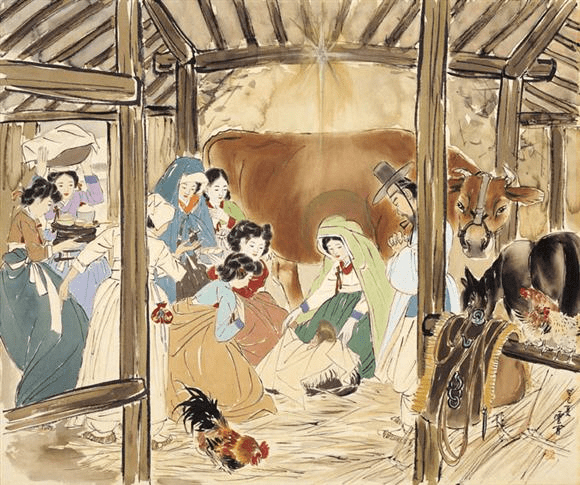
The Birth of Jesus Christ, by Woonbo Kim Ki-chang, 1952
In truth, Jesus is Lord, and Ceasar is not. Christ is the real Prince of Peace who brings God’s benevolent rule and reign to earth, as it is always done in heaven. And it will not be achieved through military power, but by the justice and mercy of God. Because, as it turns out, Love is a much greater force than any human authority or empire.
Considering God’s gracious kingdom – which turns all appearances on its head – it is quite appropriate that news of Christ’s royal birth comes first to a bunch of shepherds. They were among the lowliest of the emperor’s subjects.
Although we may tend to romanticize the shepherds keeping watch over their flocks by night, most people thought of shepherds as low class workers who nobody wanted to be around. They were poor, illiterate, and thought to be dishonorable drunks. Shepherds also had the reputation of being thieves because they grazed their flocks on other people’s property. In short, they were mostly the outcasts of society.
To this group of people the angel announces good news of great joy for all the people everywhere – and not just the powerful and the rich: To you is born this day in the city of David, a Savior, who is the Messiah, the Lord. The shepherds go to Bethlehem to find this baby, and become the first to share the good news of the Savior’s birth.
Today, we still live in a world dominated by people who desire power and privilege over others. We still live in a world enamored with wealth and resources, power and authority, military might and social control. In this world, much like the ancient world, the lowly still get trampled and the least among us get little if any attention.
Masters of both small and large worlds will eventually be toppled, not to mention our own personal petty empires we seek to build. All of our planning and scheming will never bring true peace and security. Jesus has arrived! Christ is born! All other empires are now on borrowed time.
Nativity, by Joseph Mulamba-Mandangi, 2001
The Savior is born for all the world, for us, even though we are separated from Christ’s birth by two millennia. Jesus still comes to bring peace on earth and goodwill to all humanity through the power of Love. He still casts out fear and relieves anxious hearts. And his reign will last forever and ever.
With Jesus Christ as Sovereign, outcasts are welcomed in; the hungry are fed; the poor are lifted up; captives are set free; enemies are reconciled. And wherever the good news is proclaimed, guilt and shame melts away, and lives are changed.
Today Christians all over the world celebrate the birth of Christ. And we also look forward to his coming again, when his reign of justice, mercy, and peace comes in all its fullness.
May God bless you this Christmas and always. May you be comforted by the Lord’s presence in your life, and always follow his guiding light. For Christ has come, the Immanuel, God with us. Amen.
Praise the Lord! Praise the Lord from the heavens; praise him in the heights! Praise him, all his angels; praise him, all his host!
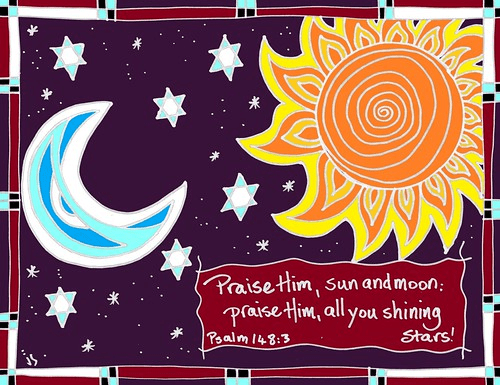
Praise him, sun and moon; praise him, all you shining stars! Praise him, you highest heavens and you waters above the heavens!
Let them praise the name of the Lord, for he commanded, and they were created. He established them forever and ever; he fixed their bounds, which cannot be passed.
Praise the Lord from the earth, you sea monsters and all deeps, fire and hail, snow and frost, stormy wind fulfilling his command!
Mountains and all hills, fruit trees and all cedars! Wild animals and all cattle, creeping things and flying birds!
Kings of the earth and all peoples, princes and all rulers of the earth! Young men and women alike, old and young together!
Let them praise the name of the Lord, for his name alone is exalted; his glory is above earth and heaven. He has raised up a horn for his people, praise for all his faithful, for the people of Israel who are close to him. Praise the Lord! (New Revised Standard Version)
Everything in all creation points to a Creator who cares for us. The 12 days of Christmas (December 25–January 5) are a great celebration. King Jesus has come; he is the rightful Sovereign over all creation. Believers recognize Christ’s incarnation – affirming the identity of Jesus as both full human and fully divine.
Worshipers praise the Lord. It’s in our spiritual DNA to give adoration, praise, and honor to God. Today’s Psalm is not only meant for good times; it’s also for the despondent, difficult, and downright hard times. There’s always an open season on praising the Lord, no matter what’s going on in and around us.
Psalm 148 helps to re-orient us around praise to God, instead of remaining stuck in being disoriented. Whether in good times or bad, we praise the Lord.
Who should praise the Lord?
Everyone. Everything.
God has created and continues to impact every nook and cranny of creation. Therefore, the entire universe – every creature and all humanity – acknowledge the Lord with praise.
The outer reaches of the universe, on everything out there which we cannot even see, praise the Lord.
The earth and everything in it praise the Lord.
The forces of nature praise the Lord.
The landscape, the flora and fauna, animals and humans, together with all creation, praise the Lord.
Young people, old people, men and women – no matter who they are or where they come from – praise the Lord.
The proper purpose of everything and everyone that exists is giving adoration and praise to God.
In the Ancient Near East, the sun, moon, and stars were considered gods by the various people groups. This Psalm was, therefore, more than a summons to praise – this was a call to recognize the One true God as the sovereign and the rightful ruler of all. Thus, the ancient peoples understood this psalm as a claim that their gods must bow to Israel’s God.
What is praise to the Lord?
Praise to the Lord is a recognition that God deserves praise from everyone and everything. Praise is physical posture and a heart stance of bowing, yielding, and submitting to God. “Praise the Lord” in the Hebrew language is “hallelujah.” And “hallelujah literally means “to raise the hands.”
We are told 10 times in the 14 verses of Psalm 148 to praise the Lord, that is, to raise our hands. It’s a symbol of submission and joy. To have open hands lifted toward heaven conveys our obedience and commitment to God.
When do we praise the Lord?
Praising the Lord and lifting the hands, is not only to occur in church or worship setting; praise happens everywhere.
We lift our arms in reverent submission at our workplaces when we land a client or have a good day; and when cranky and critical people demean us. Praising the Lord isn’t limited to good circumstances.
We raise our hands and praise the Lord when our neighbors care about us and look out for us, as well as when they make noise and irritate us with their less than kept up yards and houses. Yielding to God’s purposes for our lives is not dependent upon whether we have good neighbors or not.
We praise the Lord and raise our hands when our marriages are life-giving and thriving, as well as when our relationship with our spouse is dry, dull, and going nowhere. It’s always open season on praising the Lord and reflecting his image through love.
We praise the Lord for our kids, not only when they do what’s right; but also when they’re complete stinkers and drive us nuts. We are to use our hands for praise and enact obedience, and not for violence through finger pointing or physical punishment.
In adversity, we praise the Lord because it gives us a chance to put our faith into action. In times when someone is being insensitive and callous, it provides the opportunity to praise the Lord and love them because God loves us.
At all times, in all places, in every circumstance, and with each situation we raise our hands in hallelujah to Jesus for saving us from our misguided ways and bringing us back into fellowship with God.
Lift your hands, always! And when, like Moses, we can no longer lift them, let others help hold them up we so that we can keep praising God. (Exodus 17:11-12)
Why praise the Lord?
Because God created everything and everyone.
The Lord designed every living thing and fashioned a man and a woman in the divine image as the pinnacle of creative work.
Adam and Eve walked with God and had perfect praise of the Lord and fellowship with each other. Yet, tragedy happened. The people God formed were deceived into thinking that the Lord was holding out on them by not letting them eat from a certain tree in the garden. So, they disobeyed, ate the fruit, and so plunged the world into darkness.
However, God did not turn away from humanity. Holy Scripture is the revelation of a God who goes out of the way to do whatever it takes to reclaim people back to fellowship so that they can fulfill their original design to praise the Lord.
The height of God’s love is sending the Son, the Lord Jesus. God became one of us so that he could save us from ourselves.
Whenever we have exhausted all the avenues this world has to offer in bringing fulfillment, satisfaction, and peace to our lives – there stands Jesus, crucified, risen, ascended, and waiting with open arms for you and me to lift our hands and see that he has the only way for us to live.
The reason you have felt for so long that you are a square peg in a round hole is that your life is meant to praise the Lord. You are not meant to fit into the world; you are meant for God.
Where do we praise the Lord?
From the heavens and the earth. From everywhere in all creation, and from everyone as creatures, there is to be praise to the Lord.
Humanity is one part of a big grand chorus of praise that arises from all creation. Some of the psalmist’s pairings of praise are quite informative.
The sun that praises God during the daytime and the moon that offers its praise at night, reminds us that God’s praise is never silenced.
The highest heavens and waters above the sky, along with the earth and what’s under its waters, helps us recall that God’s creation, from top to bottom, praises the Lord.
The mountains and hills, with creatures and flying birds on them and circling them, communicates to us that both the noticeable and scarcely noticeable offer their praises to our God and King.
All creation burps out their praise – which means that some folk really are dumber than rocks because even the rocks know enough to praise the Lord.
We praise the Lord – outdoors, indoors, at home, at work, in the neighborhood, with family, church, from every place there is to be a lifting of the hands to God.
How do we praise the Lord?
Of course, we raise our hands in adoration for the God who gives us life and watches over us in such a way that not a hair on our heads can fall apart from the divine will.
We praise the Lord by being the people God created us to be – walking in fellowship with the Lord and enjoying the divine/human relationship forever.
No matter our current situation, every day and every situation is a summons to praise the Lord. God’s claim upon our lives leads us toward raising our hands to heaven.
The person who praises God is marked by a deep humility of understanding that they are not God; expressive gratitude for God’s actions; patient confidence in God’s promises; and a sense of unity, participating in harmony with God, others, and all creation in praising the Lord!
Most High, all-powerful, all-good Lord, All praise is Yours, all glory, honor and blessings. To you alone, Most High, do they belong; no mortal lips are worthy to pronounce Your Name.
We praise You for all Your creatures, especially for Brother Sun, who is the day through whom You give us light. He is beautiful and radiant with great splendor, of You Most High, he bears Your likeness.
We praise You for Sister Moon and the stars, in the heavens You have made them bright, precious and fair.
We praise You for Brothers Wind and Air, fair and stormy, all weather’s moods, by which You cherish all that You have made.
We praise You, for Sister Water, so useful, humble, precious and pure.
We praise You for Brother Fire, through whom You light the night. He is beautiful, playful, robust, and strong.
We praise You for Sister Earth, who sustains us with her fruits, colored flowers and herbs.
We praise You for those who pardon, or who for love of You bear sickness and trial.
Blessed are those who endure in peace, by You they will be crowned.
We praise You for Sister Death, from whom no-one living can escape. Woe to those who die in their sins! Blessed are those that She finds doing Your Will. No second death can do them harm.
We praise and bless You Lord, give You thanks, and humbly serve You. Amen.
The Scriptures say that God accepted Abraham because Abraham had faith. And so, you should understand that everyone who has faith is a child of Abraham. Long ago the Scriptures said God would accept the Gentiles because of their faith. This is why God told Abraham the good news that all nations would be blessed because of him. This means everyone who has faith will share in the blessings given to Abraham because of his faith.
Anyone who tries to please God by obeying the Law is under a curse. The Scriptures say, “Everyone who doesn’t obey everything in the Law is under a curse.” No one can please God by obeying the Law. The Scriptures also say, “The people God accepts because of their faith will live.”
The Law isn’t based on faith. It promises life only to people who obey its commands. But Christ rescued us from the Law’s curse, when he became a curse in our place. This is because the Scriptures say that anyone who is nailed to a tree is under a curse. And because of what Jesus Christ has done, the blessing promised to Abraham was taken to the Gentiles. This happened so that by faith we would be given the promised Holy Spirit. (Contemporary English Version)
We are just a day away from the Nativity of the Lord, Christmas Eve, the night Christians everywhere observe the birth of Christ.
And just two days from now Christians throughout the world will have a grand celebration of Christ’s incarnation – God breaking into this old fallen world to be with us and redeem us.
Many will be show up at a church worship service on that day, perhaps especially because Christmas Day falls on a Sunday, in the year of 2022. All might be in the same place; yet they’re there for different reasons.
Some come to the worship service because that’s what they have done every Sunday throughout the year – and they wouldn’t think of being anywhere else.
Others choose to be a part of the gathering because they enjoy the specialness of the day, the beauty of the celebration, and the traditions which surround it all.
There are also those who show up because the season has been hard; while others may bask in the joy of Christmas, they’re just looking for something positive to get them through for a while.
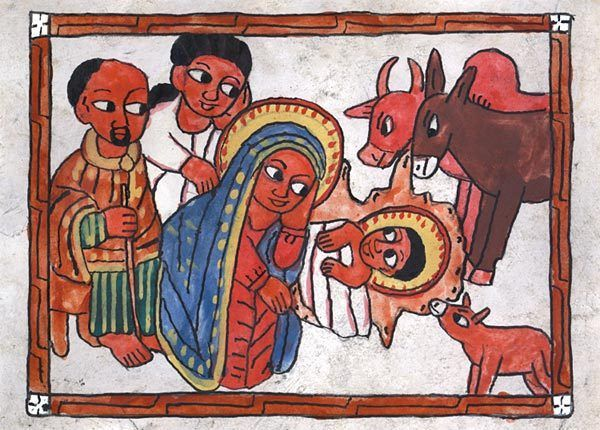
Ethiopian Orthodox icon of the Nativity of the Lord
And then there are those who enter the day for none of the previous mentioned reasons. No, they simply show up because they feel it is their duty to do so, or at the least, because they might receive some special spiritual Brownie points from God. In other words, they gather with the rest with the sheer motivation of Law.
Such an approach illustrates the “curse” of the Law. The Law itself is not bad. But if the rest of the equation isn’t factored into life, Law becomes a hard taskmaster and keeps the law-keeper in a terrible bondage without any delight to go with the duty.
People also need Gospel, the good news which fulfills all the requirements and demands of Law. Law is good, but by itself, apart from Gospel, it becomes an insidious tool of evil.
Whereas Law focuses solely on what we do, Gospel homes in on why we do it.
Law bosses us around and tells us what to do. Gospel frees us to embrace the spirit of Law to love God and neighbor.
It doesn’t take faith to obey the rules and regulations of Law. Gospel, however, can only be realized, internalized, and lived by faith.
It takes faith to receive grace and forgiveness – and to give it. Faith requires an acceptance of spiritual realities. It is the key to tapping into the power of love in the universe.
By faith, people throughout history, like Abraham, have listened with spiritual ears to the God of all. They step out, not merely because of Law, but because they rely on divine promises. Such faith enables them to wait patiently for the coming of eternal forces to take permanent residence on earth. Law can’t do that; only Gospel can.
Faith in the Bible is a complete trust in God, in who God is and what God has done. Because God has demonstrated faithfulness through steadfast love, people are gifted with faith to know the Lord and exhibit love through good works.
God Is with Us by Hanna Varghese
In Christianity, the height of faith is to place one’s life completely in God’s hands, believing in the person and work of Jesus Christ.
Jesus said, “I assure you that if you have faith the size of a mustard seed, you could say to this mountain, ‘Go from here to there,’ and it will go. There will be nothing that you can’t do.” (Matthew 17:20, CEV)
The size of faith isn’t the issue – it’s in whom that faith is placed. The littlest of faith in Jesus can have massive results, whereas the biggest of faith in someone who cannot get you to where you need to go, is useless.
Outward rituals and observance of Law have their place; but they don’t deliver anyone from sin, death, or hell. Only faith can do that.
If you are a follower of Christ Jesus, it makes no difference whether you are circumcised or not. All that matters is your faith that makes you love others. (Galatians 5:6, CEV)
It’s one thing to be kind and love others during a holiday season; it’s quite another thing to have that be your default character throughout the entire year. Love for a season comes merely from Law. But Love for a lifetime grows from the rich soil of the Gospel.
And it’s the Gospel of Jesus Christ which we celebrate and give thanks.
Gracious God, we thank you for sending your Son. Even before we loved you, you loved us and gave us the gift of faith. Help us to love one another and to see all people in the same way you do – to love them even when they don’t love us back. Enable us by your Spirit to show continual love throughout the entire year, for the sake of Jesus Christ our Savior. Amen.










 Rev. Tim Ehrhardt