I Am Among You As One Who Serves (Luke 22:24-30)

The Last Supper, by Mamdouh Kashlan (1929-2022)

A dispute also arose among them as to which one of them was to be regarded as the greatest. But he said to them, “The kings of the Gentiles lord it over them; and those in authority over them are called benefactors. But not so with you; rather the greatest among you must become like the youngest, and the leader like one who serves. For who is greater, the one who is at the table or the one who serves? Is it not the one at the table? But I am among you as one who serves.

“You are those who have stood by me in my trials; and I confer on you, just as my Father has conferred on me, a kingdom, so that you may eat and drink at my table in my kingdom, and you will sit on thrones judging the twelve tribes of Israel. (New Revised Standard Version)

Jesus and his disciples had prepared for the Passover meal. They ate and drank together. Christ gave them words which have endured throughout Christian history as the Lord’s Supper. He spoke of the bread as his body, and the cup as the new covenant in his blood. Jesus communed with them and communicated about his impending death.

It was a moving experience for all. The disciples received from their Lord an intense act of love; and a new humanity around Christ’s body and blood. Indeed, the essence of new life is self-sacrificial love.

And then… the disciples began quarreling with each other about positions, and titles, and honors, and who was better, and who would be top dog in God’s kingdom….

It was a moment that I think every parent can relate to, at some level. Sitting around a dinner table, enjoying a rich conversation, becoming close with one another as a family… and then the kids begin bickering with each other about the most mundane of things.

Just a minute ago, you believed you were getting somewhere, and experiencing a shared family bond of love, commitment, and purpose… and then, in a matter of seconds, it all crashes down in a ridiculous display of posturing and positioning of one sibling over another….

I admit, this has happened to me more than once, when my own kids were growing up. And I also admit that I lost my sanctification on more than one occasion, watching this crazy schizophrenic scene play out in front of me.

Which is why I have a lot of respect for Jesus in responding to his disciples with humility, calmness, and a forthright spirit. He addressed their puny questions in a way that rebuked them without making them feel like they just got a Dad lecture.

In the sort of table fellowship that Jesus practiced with his disciples throughout his earthly ministry, he consistently sought to undermine the existing systems of domination in all levels of society. Even the religious system of Christ’s day had a distinct stratifying of persons in an inequitable structure of power.

The kingdom of God, however, is different. God’s economy is characterized by equality, mutuality, diversity, and shared power. It’s all based in a communal, as well as individual, relational connection with the Creator God.

God almighty, Creator of heaven and earth, is gracious, merciful, and kind. The Lord brings rain on both the righteous and the wicked. Thus, any sort of claim to being greater or superior or better than another person or group of people, has no place around the table of Christ’s body and blood.

Catholics are no better than Protestants. Evangelical Christians have no superiority over Progressive Christians. The Coptic Church doesn’t have the high ground on Eastern Orthodoxy. Christians who observe the Lord’s Supper as a remembrance are not greater than those who discern the Table as a sacrament.

And if one has the ears to hear it, Christians really ought to know better than to believe they should have greater control over the world and its systems than Buddhists, Muslims, or Jews.

Puffing up one’s chest and insisting that “My Dad is better than your Dad” is the stuff of childish preoccupations, and not of God’s kingdom.
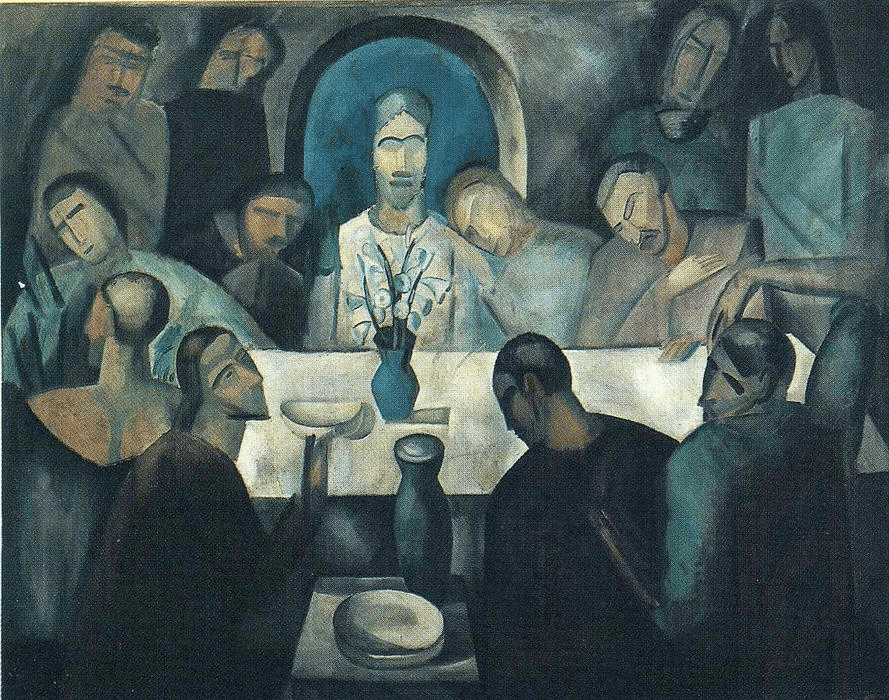
The Last Supper of Jesus, by André Derain (1880-1954)

There are plenty of people in this old messed-up world who lord their power and authority over others. If we take the words of Jesus seriously, Christians are not to be part of that structure and system.

And yet, here we are, in this contemporary time and place in history, having a chunk of the population thinking Christendom is the way to go, that a form of Christian Nationalism should be the political system – as if the kingdom of God and the kingdom of this world are what’s on the ballot.

Christians are the very folks who need to insist on serving, not leading; building up, not tearing down; loving, not hating; being integrated and connected, not fragmented and disconnected from others, as well as from reality.

Any sort of earthly power and authority the Christian has, must be used to include, help, and support, instead of excluding, ignoring, and destroying. The greatest among us must become like the youngest, and the leader like one who serves.

Christians must support and promote the idea of political office as a public service; and the concept of being a citizen as serving the common good of all persons, not just some persons.

Jesus came to this earth to serve. Therefore, his followers are also to serve. The words and ways of Christ centered in humble service, merciful justice, and prayer for one’s enemies. His followers must do no less.

Jesus Christ came to usher in a moral and ethical kingdom in which God’s gracious and benevolent will is done on this earth, as it is always done in heaven. He did not come to make sure Christians have lots of political power and authority over all the non-Christians.

Yes, indeed, we will be given power and authority – but not to baptize existing earthly structures so that the system serves the interests of Christians. We receive so that we can give. We give so that we might serve. And we serve because our Lord is a servant.

So, if Christians truly desire to bring change and transformation to this world, it will be through a compassionate and caring system of service to our fellow humanity – and not by imposing our beliefs and will upon others in a modern day form of the Inquisition.

Let us then, traffic in love; aspire to meekness; practice servanthood; and become the wait staff for the world’s needs.

That is what it really means to stand with Jesus in this time of trial.

Gracious and loving God, you work everywhere reconciling, loving, and healing your creatures and your creation. In your Son, and through the power of your Holy Spirit, you invite each of us to join you in your work.

I ask you to form me more and more in your image and likeness, through my prayers and worship of you; and through the study of Holy Scripture, so that my eyes will be fully opened to your mission in the world.

Send me into my family, church, community, workplace, and world to serve Christ with faith, hope, and love, through the power of the Holy Spirit. Amen.


A Great Number of People Believe (Acts 11:19-26)

Now those who had been scattered by the persecution that broke out when Stephen was killed traveled as far as Phoenicia, Cyprus and Antioch, spreading the word only among Jews. Some of them, however, men from Cyprus and Cyrene, went to Antioch and began to speak to Greeks also, telling them the good news about the Lord Jesus. The Lord’s hand was with them, and a great number of people believed and turned to the Lord.

News of this reached the church in Jerusalem, and they sent Barnabas to Antioch. When he arrived and saw what the grace of God had done, he was glad and encouraged them all to remain true to the Lord with all their hearts. He was a good man, full of the Holy Spirit and faith, and a great number of people were brought to the Lord.

Then Barnabas went to Tarsus to look for Saul, and when he found him, he brought him to Antioch. So for a whole year Barnabas and Saul met with the church and taught great numbers of people. The disciples were called Christians first at Antioch. (New International Version)

The earliest of believers in Jesus Christ were Jews. Jewish converts to Christianity were not typically received well amongst their families, communities, and culture. So, when Stephen, one of those converts, retold Jewish history emphasizing a stubborn lack of awareness amongst their ancestors – and then connected it with present day attitudes – a full fledged persecution of Christians broke out.

As a result, the Church – located almost exclusively in Jerusalem – was scattered throughout Judea and across the Roman Empire in a Christian diaspora. In Christ’s ascension, he told the disciples that they would be witnesses beginning at Jerusalem, and then to Judea and outside the Middle East. Little did the small band of believers know, at the time, how that plan would come about.

As it turns out, although life was hard being a Christian refugee in a strange location, the believers spread the good news of Jesus wherever they went. Thus, gospel seeds were planted all across the land.

There is no place we can go where God is not already there.

And so, the displaced Christians discovered God was with them in their sojourning. Their faithful proclamation of good news was the impetus to bringing about many more converts to Jesus Christ.

What was happening in Judea and the Empire came back to the church leaders in Jerusalem. They then, smartly, sent one of their own, Barnabas, to Antioch in order to check out the scene and bring the new believers some encouragement. Since Barnabas was the consummate encourager, the church was emboldened, with even more converts entering into faith in Christ.

Barnabas, as an encourager, had the knack for knowing what he could do and not do; he also knew someone who could supply what he couldn’t do. He was so sure that Saul (Paul) was the right person for the job that he went to Tarsus – which was about 400 miles from Antioch – in order to find him and get him to the new believers as soon as possible. The result was an explosion of fresh converts coming to faith and into the church.

It’s no coincidence that the man with the biggest heart in the church is described in today’s text as a good man who was filled with the Holy Spirit. The Spirit is the One who makes all the difference with the growth of Christianity and the establishment of the Church.

Barnabas could see the evidence of God’s grace in the city of Antioch because he was filled to the full, with God’s own Spirit. He observed people with changed lives; an incredibly diverse and connected international community of believers; and so, encouraged them all in this good work brought about by the Spirit of God.

More and more people were added to the fellowship because of the robust spiritual dynamic that took place. This was not a matter of people using slick marketing strategies to make the name of Jesus Christ known; instead, the adding was all God. The Lord added to the Lord, and not people adding people to the Church. In other words, God is both the subject and the object, the source and the goal, of all good Christian ministry.

Then, when the Lord connected Barnabas together with Saul (Paul) who was also filled with the Holy Spirit and many spiritual gifts from God, the result was nothing less than large numbers of persons coming to faith in Christ and being added to the Church.

The believers in Antioch were so chatty about their faith that the first reference of being called “Christians” were to these converted Jewish believers in Jesus. Even though the moniker of “Christian” was probably a term of derision and meant to mock the Antiochene Church, it stuck, and was held up proudly by the believers. They were completely okay with being called “little Christ’s.”

After all, since they were truly Christ-centered in all they did, it was a fitting title for the fledging and growing Church. It clearly identified them as the people who serve and follow Christ. We, too, these many centuries later, have the very same Spirit of God that they did – and therefore, the same opportunity to speak of Jesus and see the Holy Spirit do the work of adding to the Church.

We pray, almighty God, that all who confess your Name may
be united in your truth, live together in your love, and reveal
your glory in the world.

Guide people everywhere, and of all the nations, in the
ways of justice and peace; that we may honor one another
and serve the common good.

Give us all a reverence for the earth as your own creation,
that we may use its resources rightly in the service of others
and to your honor and glory.

Bless all whose lives are closely linked with ours, and grant
that we may serve Christ in them, and love one another as he
loves us.

Comfort and heal all those who suffer in body, mind, or
spirit; give them courage and hope in their troubles, and
bring them the joy of your salvation.

Lord, in your mercy, hear our prayer. Amen.

Living Stones (1 Peter 2:4-10)

As you come to him, the living Stone—rejected by humans but chosen by God and precious to him—you also, like living stones, are being built into a spiritual house to be a holy priesthood, offering spiritual sacrifices acceptable to God through Jesus Christ. For in Scripture it says:

“See, I lay a stone in Zion,
    a chosen and precious cornerstone,
and the one who trusts in him
    will never be put to shame.”

Now to you who believe, this stone is precious. But to those who do not believe,

“The stone the builders rejected
    has become the cornerstone,”

and,

“A stone that causes people to stumble
    and a rock that makes them fall.”

They stumble because they disobey the message—which is also what they were destined for.

But you are a chosen people, a royal priesthood, a holy nation, God’s special possession, that you may declare the praises of him who called you out of darkness into his wonderful light. Once you were not a people, but now you are the people of God; once you had not received mercy, but now you have received mercy. (New International Version)

The Apostle Peter describes Christians as “living stones” that form the temple of the Lord. In our worship we are like priests, carrying the sacrifices of praise and thanksgiving into the presence of God.

This is who we are; it is our identity. Christians belong to God in Jesus Christ through the power of the Holy Spirit. We have been formed – and continue to be formed – into the people of God as one, holy, catholic, and apostolic Church.

The word for stones in today’s text (Greek λίθος) specifically refers to large stones that have been hewn into shape. So Christians, as God’s holy people, have been set apart and shaped for the purpose of worshiping Jesus Christ. Instead of offering the blood of bulls and goats, like the select group of Old Testament priests did, we are all priests who now offer spiritual sacrifices because Jesus has taken care of the sin issue once for all. 

Christians continually offer to God the worship of Christ, and a holy life, in grateful response to Christ’s sacrificial death on our behalf. Jesus Christ is the Christian’s cornerstone and center, and is to be the Church’s passion and priority. In worship, God builds us into a community of faith who dedicate ourselves to knowing Jesus and making him known.

All of life (and not just a Sunday worship service) is to be a daily rhythm of God’s revelation to us, and our response to God in faith, thanksgiving, and an obedient life.

We were chosen to serve God, and to exist for worship. Worship is grounded in the triune God and centered in Christ. Worship is the heart and life response to the revelation of God in Christ. Genuine encounters of God’s revelation to us, and our response to those experiences, form us into disciples of Jesus.

For those who refuse God’s perspective, Jesus Christ is experienced as an obstacle. He becomes the rock which causes them to stumble and fall. Although the early Christians for whom the Apostle Peter addressed were often humiliated and ostracized, they are nevertheless God’s elect, honored, and precious people.

Peter, who was named “Rock” by the Lord himself, wanted his audience to know that they, too, are known by God as rocks, as precious living stones. So, he explained their identity by pointing out the parallels between them and Christ:

  • Christ is the living cornerstone—Christians are living stones
  • Christ was rejected by humans—Christians are strangers in the world
  • Christ is God’s chosen One—Christians are God’s elect
  • Christ is venerated by God—Christians are esteemed by God

Jesus has so closely identified with us, God’s people, that we are in a vital union with him. On account of Christ’s rising from death, Christians are like living stones who are acceptable to God through Christ.

As the late salesman on television from decades ago, Ron Popeil, used to say, “But wait, there’s more!” Christians have been born again, experiencing rebirth into a new life. Our identity has given us great privilege as building blocks into the following:

  • Incorporation into a new community, a temple that shares in God’s honor and symbolizes God’s presence and power
  • Membership in a holy and royal priesthood, offering spiritual sacrifices of holiness and love (1 Peter 1:15, 22)
  • Inclusion into the chosen people—a disparate people who share together in common values, patterns of living, and redemption
  • Citizens of a holy nation who enjoy a covenant relationship with God and worship the Lord who brought them out of darkness and into light

God has created a community of people in Christ who did not previously exist. Together as Christians and people of God, we celebrate Jesus in worship and revel in his saving mercy, which has given us fresh hope and new life.

Therefore, I humbly and proudly adopt the identification of “Christian.” I am here because of Jesus Christ and all the faithful believers who came before me on the firm foundation of the apostles and prophets. I am part of the great stone structure called the Church. I know who I am. I know who my people are. And that sense of belonging no one can ever take from me.

Soli Deo Gloria

Lord of heaven and earth, we pray that you will bring justice, faith and salvation to all peoples. You chose us in Christ to be your people and to be the temple of your Holy Spirit; we pray that you will fill your Church with vision and hope. In the baptism and birth of Jesus, you have opened heaven to us and enabled us to share in your glory: the joy of the Father, the Son, and the Holy Spirit. May your whole Church, living and departed,

come to a joyful resurrection in your city of light. Amen.

Who Is Jesus? (John 7:40-52)

The Light of the World, by William Holman Hunt, c.1853

On hearing his words, some of the people said, “Surely this man is the Prophet.”

Others said, “He is the Messiah.”

Still others asked, “How can the Messiah come from Galilee? Does not Scripture say that the Messiah will come from David’s descendants and from Bethlehem, the town where David lived?” Thus the people were divided because of Jesus. Some wanted to seize him, but no one laid a hand on him.

Finally the temple guards went back to the chief priests and the Pharisees, who asked them, “Why didn’t you bring him in?”

“No one ever spoke the way this man does,” the guards replied.

“You mean he has deceived you also?” the Pharisees retorted. “Have any of the rulers or of the Pharisees believed in him? No! But this mob that knows nothing of the law—there is a curse on them.”

Nicodemus, who had gone to Jesus earlier and who was one of their own number, asked, “Does our law condemn a man without first hearing him to find out what he has been doing?”

They replied, “Are you from Galilee, too? Look into it, and you will find that a prophet does not come out of Galilee.” (New International Version)

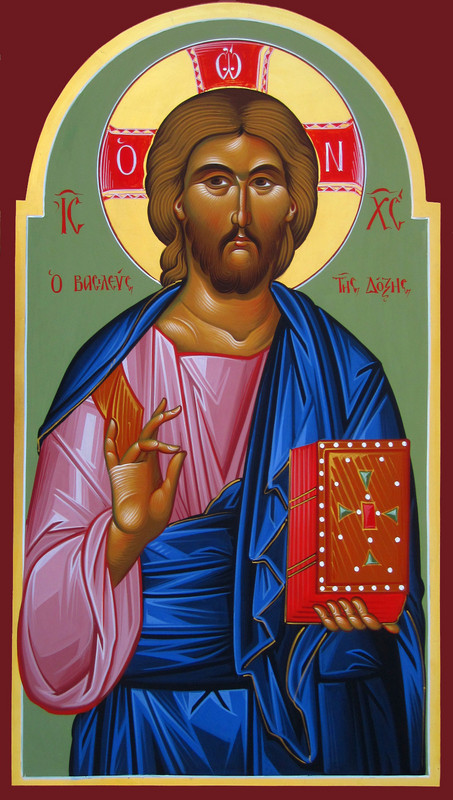
Orthodox Christian icon of Jesus Christ

There was a lot of buzz in Christ’s day of who Jesus really was. Prophet? Messiah? And, if Jesus really is a big deal, would he really come from Hicksville Nazareth? What about his credentials? His class? His pedigree?

Opinions on Jesus haven’t really changed all that much from the ancient world. They are still just as diverse now as when he was on this earth.

Unlike today, ancient people could not simply “Google” Jesus and find out where he was born and grew up. And they had no access to doing background checks in a matter of minutes to find out all kinds of things about him. Had the religious authorities bothered to do their homework and investigated Jesus, they would have found that, indeed, he was born of the Davidic line and in Bethlehem.

The short of it is that a chunk of the people simply assumed they knew Jesus wasn’t of proper Messiah credentials. They assumed and did not investigate because they did not want to know. No one can be faulted for ignorance. However, purposeful ignorance is perhaps the greatest of all sins, betraying a deep egoism of pride and prejudice.

In their hubris, the religious leaders sent the temple guards to bring Jesus in. Yet, in a clear demonstration of heavenly authority, the guards actually listened to Jesus and saw for themselves who he really is. Their simple confession testifies to Christ’s credibility. If one would but just see and listen for themselves, and engage in a genuine investigation, they could walk away finding truth.

6th-Century Byzantine mosaic of Jesus

Opponents of Jesus for the past two thousand years assume that Christians have been duped into taking the opiate of the people. Many think that followers of Christ were manipulated by religious hacks trying to gain power over others. But that’s a curious opinion, considering Jesus continually did just the opposite of that and was a champion for the poor, the powerless, and the marginalized persons of society.

When professional people with recognized degrees and competence do not believe you, nor take your own experience and learning seriously, what do you do?

Well, you could listen to them, or you could listen to your own gut telling you that you’re being gaslighted by a bunch of highly intelligent simpletons who are unfamiliar – are ignorant – of the faith you are familiar with.

What’s more, there are always smart and experienced people in the room who know better. Nicodemus was such a person. He was a serious scholar, and chose to speak up about these things. Authorities and credentials matter, yet of first importance is to know how to go about any sort of inquiry – rather than just passing over an objective investigation and assuming you know better.

Ethiopian artist depiction of Jesus teaching

For decades, I have (graciously) challenged others who do not believe in Jesus to actually read the Gospel accounts and at least engage in some minimal investigation – rather than giving opinions based on limited knowledge and secondary sources.

After all, as Nicodemus pointed out so long ago, shouldn’t we first give Jesus a fair hearing before we start dismissing him as nothing more than a religious figure that a bunch of people follow?

And I must also point out that this applies to us Christians, as well. Rather than waving aside Buddha or Muhammad or any other religious figure as false, don’t you owe their followers the basic respect of hearing them out before you dismiss them as fake, or in some cases, worse than that?

If you accuse another point of view, which is different than your own, as wrong or not real, without first hearing the accused and gathering objective evidence, then we really have no business getting uppity when another person accuses or dismisses our own faith.

Sadly, the colleagues of Nicodemus chose not to answer him but to instead engage in the age old practice of ad hominem argumentation by attacking the person, thereby deflecting having to give an answer.

People attack other people out of fear. And, in this case, it seems to me the religious leaders were downright afraid of investigating Jesus and giving him an honest hearing. Because if they did, they just might have their world turned upside-down; and they wanted the status quo to be maintained, at all costs, even if it meant ignoring the truth.

Jesus Washing the Feet of His Disciple, by Japanese artist Sadao Watanabe (1913-1996)

You don’t have to take my word on any of these things about Christ or Christianity. Read the Gospel of John for yourself – in one sitting if possible. Ingest the words. Drink in the experiences. Then, come and have a conversation with me.

Jesus, Lamb of God, have mercy on us.

Jesus, Bearer of our sins, have mercy on us.

Jesus, Redeemer of the world, give us your peace.

Jesus, Light of the world, shine in our hearts.

Jesus, Hope of all, be our companion on our way.

Jesus, Great Physician, heal our broken lives.

Jesus, Beloved Son of God, kindle within us the fire of your love. Amen.