Don’t Be Stupid (2 Timothy 2:14-26)

Keep reminding God’s people of these things. Warn them before God against quarreling about words; it is of no value, and only ruins those who listen. Do your best to present yourself to God as one approved, a worker who does not need to be ashamed and who correctly handles the word of truth. 

Avoid godless chatter because those who indulge in it will become more and more ungodly. Their teaching will spread like gangrene. Among them are Hymenaeus and Philetus, who have departed from the truth. They say that the resurrection has already taken place, and they destroy the faith of some. Nevertheless, God’s solid foundation stands firm, sealed with this inscription: “The Lord knows those who are his,” and, “Everyone who confesses the name of the Lord must turn away from wickedness.”

In a large house there are articles not only of gold and silver, but also of wood and clay; some are for special purposes and some for common use. Those who cleanse themselves from the latter will be instruments for special purposes, made holy, useful to the Master and prepared to do any good work.

Flee the evil desires of youth and pursue righteousness, faith, love and peace, along with those who call on the Lord out of a pure heart. Don’t have anything to do with foolish and stupid arguments because you know they produce quarrels. And the Lord’s servant must not be quarrelsome but must be kind to everyone, able to teach, not resentful. 

Opponents must be gently instructed, in the hope that God will grant them repentance leading them to a knowledge of the truth, and that they will come to their senses and escape from the trap of the devil, who has taken them captive to do his will. (New International Version)

Stupidity doesn’t have to do with intellect; it is a matter of character. A fool is stupid. A wise person is smart. One can be a “genius” yet still be as dumb as a bowling ball. And someone who never gets a “A” in school just might be the most knowledgeable person in the room.

Whoever loves discipline loves knowledge, but whoever hates correction is stupid.

Proverbs 12:1, NIV

The Apostle Paul understood this – which is why he put the focus on cultivating and communicating character instead of sheer intelligence. Anytime we purposefully neglect and forget this, we land into Paul’s “stupid” category of people.

Much of church ministry needs to be a memory care unit experience. That’s because too much spiritual dementia happens. There must be continual reminders about the importance of Christian character. It seems believers in Jesus too easily forget their identity and what they are supposed to be doing. This is most certainly not a new issue; it is one that has been endemic throughout the ages. It’s a problem as old as sin itself.

In the Gospels, Jesus miraculously fed a great crowd of people not once, but twice. The second time he called his disciples to remember what had happened the first time in order to understand the second. 

In the Epistles, Paul kept on reminding the Jewish believers to remember the ancient covenant; and he called the Gentile believers to keep in mind that they were once estranged from that very same covenant. Both Jews and Gentiles together needed to collectively remember the death of Christ that unites them into a new covenant community. And much like them, we are to remember Jesus Christ, raised from the dead, descended from David. (2 Timothy 2:8)

Whenever we forget who we are, whose we are, and what it is we are really all about, we get downright stupid. We get lost majoring on the minors and wagging our tongues like a bunch of foolish simpletons.

It’s stupid to say bad things
    about your neighbors.
If you are sensible,
    you will keep quiet.
A gossip tells everything,
but a true friend
    will keep a secret. (Proverbs 11:12-13, CEV)

Christians are blood-bought people of God, belonging to Jesus Christ, and given a mission to make disciples and participate with God in the redemption of all creation through remembering the poor, seeking justice, and being peacemakers in the church and the world. 

And what’s more, we are not to put up with letting others stand around and endlessly argue about lesser things, making every doctrine and dogma a battleground – as if the fine China and paper plates were exactly the same.

“Remember the height from which you have fallen!  Repent and do the things you did at first.” (Revelation 2:5, NIV)

There is a difference between the brains of dementia patients and Christian folk – the mind overtaken by dementia will only worsen, yet the church can recover its collective memory by listening again to the ancient Word of God; any and every congregation can be constantly refreshed with the promises and covenant of God. 

We must neither rely on mere pragmatism nor doing things the way we always have done them without any understanding of why we do it. 

Yet, we must understand that even when we point out what to remember and why we are to remember it to others, they aren’t always going to respond like we want them to – which is why instruction needs to be gentle so that another does not stumble on the messenger instead of the message.

A person of great understanding is patient, but a short temper is the height of stupidity. (Proverbs 14:29, GW)

It takes no effort to be stupid; but it takes a great deal of will and energy to keep learning and growing in the Christian life. Too many persons have unwittingly fallen into the trap of the devil, believing themselves to be godly because of their defense of the faith. Sadly, they’ve been defending their own interpretation of faith instead of the actual faith itself.

Please, don’t do that. Don’t be stupid. Better to focus on having a pure heart of your own rather than always pointing out the impurities of others.

Almighty God, to you all hearts are open, all desires known, and from you no secrets are hid. Cleanse the thoughts of our hearts by the inspiration of your Holy Spirit, that we may perfectly love you, and worthily magnify your holy Name, through Jesus Christ our Lord. Amen.

The Kingdom of God Is Here (Matthew 10:5-15)

Jesus sent his twelve harvest hands out with this charge:

“Don’t begin by traveling to some far-off place to convert unbelievers. And don’t try to be dramatic by tackling some public enemy. Go to the lost, confused people right here in the neighborhood. Tell them that the kingdom is here. Bring health to the sick. Raise the dead. Touch the untouchables. Kick out the demons. You have been treated generously, so live generously.

“Don’t think you have to put on a fund-raising campaign before you start. You don’t need a lot of equipment. You are the equipment, and all you need to keep that going is three meals a day. Travel light.

“When you enter a town or village, don’t insist on staying in a luxury inn. Get a modest place with some modest people and be content there until you leave.

“When you knock on a door, be courteous in your greeting. If they welcome you, be gentle in your conversation. If they don’t welcome you, quietly withdraw. Don’t make a scene. Shrug your shoulders and be on your way. You can be sure that on Judgment Day they’ll be mighty sorry—but it’s no concern of yours now. (The Message)

“People can’t observe the coming of God’s kingdom. They can’t say, ‘Here it is!’ or ‘There it is!’ You see, God’s kingdom is within  you.” Jesus, from Luke 17:20-21, GW

When Jesus told his followers that the kingdom of God is here, he didn’t simply mean that it all of a sudden showed up. No, it’s already here. It always has been. We just haven’t paid attention. And we haven’t noticed because we keep looking for a location, somewhere outside of ourselves. But, as it turns out, we already have what we’ve been searching for.

Christianity, at its core, is about following Christ. And that journey with Jesus is first and foremost a journey into oneself. This is why the Lord tells the disciples not to go first to outsiders. There’ll be a time for that. But now, the journey to their fellow Jews was to be an internal walk into the very depths of their own souls and the soul of a nation.

The singular message of this particular mission was to proclaim that the kingdom of God is near. It is here. In fact, it is so near and here that it is actually within you. But the disciples needed to discover this for themselves by going out and removing all obstacles to awareness of God’s light.

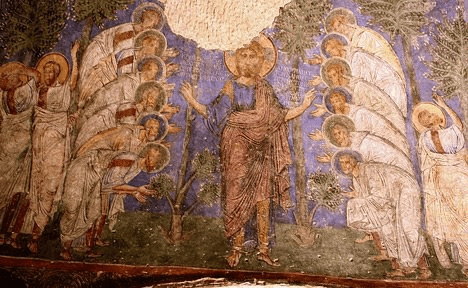
Jesus sent the disciples out and told them not to take anything with them because they already had what they needed. The kingdom of God is already within them.

A Byzantine fresco of Jesus sending the disciples, 12th century

So, they were to leave all their baggage and their stuff behind. The disciples were to be stripped of all their trusted outer resources so that they had the ability to see themselves, to others, and human need – and then to be moved in their hearts with compassion, just as Jesus is. 

Whenever we take all our pre-packaged stuff with us into relationships and the doing of Christ’s mission, we already assume we know what other people need. If we have nothing with us, then we are able to see people for who they actually are; we can genuinely listen to what they are saying. 

You have freely received compassion from God, so freely give it away. Not everyone will respond, but that’s not your business; they will have to deal with God on that later.

Compassion is to be our response to human need. Yet, we don’t always respond with compassion because of the obstacles within our own hearts and lives prevent us from seeing others and their needs.

The following are a few of obstructions which hinder us from compassion and perceiving the kingdom of God within us, and how to deal with them:

  1. Contempt. Contempt breeds contempt. Unacknowledged and unresolved anger produces bitterness. Hatred feeds more hatred. Our environment makes a difference. For example, if you find you have to check your heart at the workplace in order to do your job, then you need to either you quit your, or bring forth the kingdom of God by tirelessly advocating for compassionate treatment of people.
  2. Busyness. I’m referring to an unhealthy pace of life. Many of us work too much and do too many things. We cannot have compassionate hearts by moving so fast that we fail to see other people’s needs. Slow down. No one is going to come to the end of their life and wished they had been workaholics. Make a thoughtful plan to slow down enough so you can tune into the needs of others and have emotional energy for them.
  3. Resentment. It’s possible to become coldhearted by excessive and unrelenting caregiving. This is the same sort of problem as an unhealthy pace of life; you give so much that you actually begin to resent the people you care for. Caregiving has to be meticulously balanced with self-care. There’s a time for everything, including rest and recuperation.
  4. Inaction. Only receiving and not giving is what I call “spiritual constipation.” It’s when a person listens to hundreds and thousands of sermons and podcasts but doesn’t listen to their neighbor. They have no intention of putting anything they hear into practice.

However, with nothing restricting or obstructing God’s kingdom within us, we can see the divine image within each person and within ourselves. We can begin to radiate that divine presence and be transformed by it’s inner light.

Like Jesus, transfigured before the disciples on Mount Tabor, we too, become transfigured by God’s energy of love touching our hidden divine energy as image-bearers. That energy now comes forth because we have left everything behind to follow Christ and experience the generosity which, ironically, only comes from having nothing.

This is a spiritual walk we cannot take alone. The road we travel is the way of community. Just as God is community – Father, Son, and Spirit – always in a unity of love, so we, as God’s image-bearers with the divine light within us, must strip ourselves of everything that hinders and the sin that so easily entangles and run with perseverance the race marked out for us.

We are to fix our eyes on Jesus and see him, the pioneer of our faith, the Light of the World, the Living Water, and Bread for the world, who endured all things for the redemption of humanity and all creation.

Almighty God, you sent your Son Jesus Christ to reconcile the world to yourself: We praise and bless you for those whom you have sent in the power of the Spirit to proclaim that the kingdom of God is near. We thank you that in all parts of the earth a community of love has been gathered together by their prayers and labors, and that in every place your servants call upon your Name; for the kingdom and the power and the glory are yours forever. Amen.

What’s On Your Wish List? (Acts 26:24-29)

Before Paul finished defending himself, Festus shouted, “Paul, you’re crazy! Too much learning has driven you out of your mind.”

But Paul replied, “Honorable Festus, I am not crazy. What I am saying is true, and it makes sense. None of these things happened off in a corner somewhere. I am sure that King Agrippa knows what I am talking about. That’s why I can speak so plainly to him.”

Then Paul said to Agrippa, “Do you believe what the prophets said? I know you do.”

Agrippa asked Paul, “In such a short time do you think you can talk me into being a Christian?”

Paul answered, “Whether it takes a short time or a long time, I wish you and everyone else who hears me today would become just like me! Except, of course, for these chains.” (Contemporary English Version)

The Apostle Paul was quite the guy – a zealous, indefatigable, intense, Type-A dude. Yet it wasn’t those characteristics that Paul wanted others to see in him. He simply desired others to see Christ in him. 

Having been arrested for preaching the good news of forgiveness and new life in Jesus Christ, Paul found himself before King Agrippa, engaging in a DTR (define the relationship) talk; and making a strong apologetic for the Christian faith. 

Agrippa asked Paul, “In such a short time do you think you can talk me into being a Christian?” Paul answered with confidence and conviction, “Whether it takes a short time or a long time, I wish you and everyone else who hears me today would become just like me!” 

“Trial of the Apostle Paul” by Nikolai Bodarevsky, 1875

I wonder how many of us could boldly say the same thing as Paul. 

Are we the sort of Christians that others could emulate? 

Has our faith journey led us to the place of being a solid model of what a follower of Christ should look like? 

Do we expect others to change while avoiding change ourselves? 

Do we deeply desire and work toward others coming to know Jesus? 

So, what is on your wish list?

  • I wish each Christian everywhere would spend their relational and emotional energy making this world a better place by living into the words and ways of Jesus Christ.
  • I wish every person I encounter would have the privilege of knowing Christ as I have.
  • I wish all my parishioners and patients would become what I am, except, of course, for my self-made chains.

Perhaps we all must look in the mirror and examine our true desires. It’s easy to put our energy into good yet lesser wishes in life. Yet, if Christians are to become like their ancient forefather in the faith, the Apostle Paul, we will begin focusing our energies into things such as the following:

  • Making outreach a priority. We do what is most important to us. That’s probably self-evident. But churches and believers that do not make outreach a primary priority are really making it no priority, at all.

Paul said, “Do the work of telling the Good News. Do all the duties of a servant of God.” (2 Timothy 4:5, ERV)

  • Mentoring others into the words and ways of Jesus. Many church laypersons believe that training other Christians is what we pay the clergy to do.But this is really the responsibility of every believer.

Paul said, “You have often heard me teach. Now I want you to tell these same things to followers who can be trusted to tell others.” (2 Timothy 2:2, CEV)

  • Taking responsibility for spreading the good news. Blaming and shaming gets us nowhere. Pastors complain about churches. Churches bellyache about Pastors. And both attack the culture, the denomination, or some other external scapegoat. It’s time for all of us to own what needs to be said and done.

Paul said, “Be ready to spread the word whether or not the time is right. Point out errors, warn people, and encourage them. Be very patient when you teach.” (2 Timothy 4:2, GW)

  • Connecting prayer with telling the message of Christ. It doesn’t take a lot of energy to pray for Aunt Mable’s bunions to go away. It’s altogether another thing to pray sustained, focused, and passionate prayers for the people in my life to know Christ and him crucified, risen, ascended, and coming again.

Paul said, “Don’t forget to pray for us, that God will open doors for telling the mystery of Christ… Pray that every time I open my mouth I’ll be able to make Christ plain as day to them.” (Colossians 4:3-4, MSG)

  • Being compassionate and kind, like Christ, to others. There not only needs to be a clear articulation of the gospel, but also a clear demonstration of basic human kindness. Many Christians never get the opportunity to share the gospel because they’re just downright obnoxious.

Set Christ apart as Lord in your hearts and always be ready to give an answer to anyone who asks about the hope you possess. Yet do it with courtesy and respect, keeping a good conscience. (1 Peter 3:15-16, NET)

  • Establishing every Christian ministry as an opportunity to share the gospel. Intentional effort and energy toward proclaiming the gospel in both word and deed needs to go into everything we do.

Paul said, “So take special care how you conduct yourselves. Don’t be unwise but be wise. Make use of any opportunity you have because these are wicked times we live in.” (Ephesians 5:15-16, NTE)

  • Caring, not at all, that new Christians will change our lives or our church too much. I’m serious. I’ve heard the line many times by church folk in my years of pastoral ministry that new believers come in and change things we like. Come on, man. Get over it. Change is built into the Christian experience. God said:

I am about to do a new thing; now it springs forth; do you not perceive it? I will make a way in the wilderness and rivers in the desert. (Isaiah 43:19, NRSV)

You don’t need a personality like the Apostle Paul to live into your calling as a Christian. You and I only need to put our will and energy into things that matter most to God.

Risen and ascended Lord, you are the king of all creation. May your rule and reign take over my life to such a degree that everything that comes out of my mouth, and every action I take would be worthy of emulation in your way of love. Amen.

Give Thanks and Praise (Luke 17:11-19)

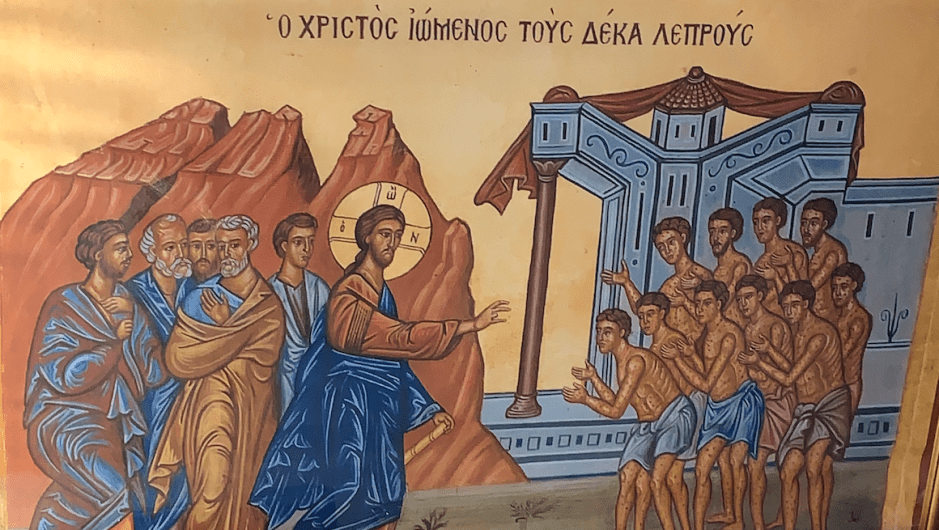
Eastern Orthodox depiction of Jesus Christ healing the ten lepers

Now on his way to Jerusalem, Jesus traveled along the border between Samaria and Galilee. As he was going into a village, ten men who had leprosy met him. They stood at a distance and called out in a loud voice, “Jesus, Master, have pity on us!”

When he saw them, he said, “Go, show yourselves to the priests.” And as they went, they were cleansed.

One of them, when he saw he was healed, came back, praising God in a loud voice. He threw himself at Jesus’ feet and thanked him—and he was a Samaritan.

 Jesus asked, “Were not all ten cleansed? Where are the other nine? Has no one returned to give praise to God except this foreigner?” Then he said to him, “Rise and go; your faith has made you well.” (New International Version)

Today’s Gospel story is both joyous and sad. The healing of ten lepers is astonishing and elicits praise and thanks… from only one. Maybe it’s because they stood at a distance. After all, it’s a close connection to God which causes praise and gratitude to arise within us – and not some appreciation from afar. Therefore, methinks we ought to consider what the nature of our own connection is. 

“Thanksgiving” to most Americans is Thanksgiving Day – a holiday filled with food, football, and family, the trifecta of American celebration. I myself admit to liberally indulging in all three. Although Thanksgiving has become a form of secular liturgical worship, I believe that underneath all the gravy, naps at halftime, and the occasional obnoxious relative, we know why we celebrate: To praise God and give thanks for our abundant blessings. 

It seems that even those who do not readily acknowledge the Divine intuitively know there is a power and source of blessing well beyond themselves which makes all good things occur.

Celebrations are a spiritual activity. God invented parties. When Israel was preparing for a new national life in the Promised Land, God told them to celebrate the Feast of Harvest with the first fruits of the crops (Exodus 23:16). The Levitical law prescribed how to go about giving thanksgiving offerings and offering praise (Leviticus 7:11-34).

Gratitude and praise was commanded, expected, and an important dimension of Old Testament worship. King David established a group of 288 full-time musicians to do nothing but praise and give thanks before God day and night (1 Chronicles 25).

Let us come into his presence with thanksgiving; let us make a joyful noise to him with songs of praise!

Psalm 95:2, NRSV

Enter his gates with thanksgiving
    and his courts with praise.
    Give thanks to him; bless his name.

For the Lord is good;
    his steadfast love endures forever
    and his faithfulness to all generations. (Psalm 100:4-5, NRSV)

It ought to have been reflexive for all ten lepers healed by Jesus to offer their worship to Jesus. A Samaritan, considered by many of the time as the lowliest of the low, a “half-breed,” was the lone person who came and fell at Christ’s feet with effusive praise and heartfelt gratitude. While the other nine went about their lives, free from disease and glad for it, only one guy took the time to thank Jesus and give glory to God. 

The Samaritan leper alone gives thanks to Christ, by Unknown artist

Sometimes we need to be reminded that celebration is a spiritual practice. It’s important to celebrate Jesus and for the ways God has provided and blessed us. In Holy Scripture, it is often the homeless, the sick, the lowly, and the outsiders who lead the way and demonstrate what genuine praise and honest thanksgiving looks like.

We, the Church, who belong to God and possess the Spirit, are to always remember and be mindful of what we truly have in Jesus Christ:

So then, just as you received Christ Jesus as Lord, continue to live your lives in him, rooted and built up in him, strengthened in the faith as you were taught, and overflowing with thankfulness. (Colossians 2:6-7, NIV)

We, like King David of old, are to establish continual worship of God:

Rejoice always, pray continually, give thanks in all circumstances; for this is God’s will for you in Christ Jesus.

1 Thessalonians 5:16-18, NIV

Our sacrifice as Christians is not with the blood of animals but with our lips and our lives:

Through Jesus, therefore, let us continually offer to God a sacrifice of praise—the fruit of lips that openly profess his name. (Hebrews 13:15, NIV)

And the worship service is eternal; it will never end:

And the twenty-four elders, who were seated on their thrones before God, fell on their faces and worshiped God, saying:

“We give thanks to you, Lord God Almighty,
    the One who is and who was,
because you have taken your great power
    and have begun to reign.” (Revelation 11:16-17, NIV)

Praising God and giving thanks to the Lord go together like mashed potatoes and gravy. Since God created everything, and since Jesus has brought healing to us through the cross, every juicy morsel of goodness we have is to be received with the full cognizance that God is behind it all.

Our lives need to be punctuated with times of celebration, praise, gratitude, and even blowout parties. Otherwise, we become dull, boring, lifeless, and bereft of Christ’s lifeblood coursing through our spiritual veins. A joyous and raucous group of healed believers jabbering incessantly with thanksgiving of God’s goodness are winsome and peculiar (in a good way and not in the strange way of your weird uncle who wants the turkey neck to gnaw on at the Thanksgiving meal).

Seems to me that Christians really ought to be at the forefront of having maximum fun because we are forgiven people; we know and experience the presence of God; our lives are hidden with God in Christ; we are confident and can approach the throne of God with boldness; and we possess the power of the Spirit and the shepherding ministry of Jesus.

Remember to give thanks. Plan to praise – out loud and with others – for the God who stands behind every good gift of creation. Let thanksgiving (not complaint) shape your life. Be the person who comes back to Jesus and offers praise and gratitude – and see how such gratefulness and glory can change the world.

Gracious God, Father of all mercies, we your unworthy servants give you humble thanks for all your goodness and steadfast love to us and to all whom you have made. We bless you for our creation, preservation, and all the blessings of this life; but above all praise you for your immeasurable love in the redemption of the world by our Lord Jesus Christ; for the means of grace, and for the hope of glory.

Give us such an awareness of your mercies, that with truly thankful hearts we may show forth your praise, not only with our lips, but in our lives, by giving up ourselves to your service, and by walking before you in holiness and righteousness all the days of our lives, through Jesus Christ our Lord, who with you and the Holy Spirit, be honor and glory throughout all ages and forevermore. Hallelujah! Amen!