
I Want To Know Christ (Philippians 3:7-11)

Jesus Christ and the Apostles, by Nikolas Martínez Ortiz de Zarate (1907-1990)

But whatever were gains to me I now consider loss for the sake of Christ. What is more, I consider everything a loss because of the surpassing worth of knowing Christ Jesus my Lord, for whose sake I have lost all things. I consider them garbage, that I may gain Christ and be found in him, not having a righteousness of my own that comes from the law, but that which is through faith in Christ—the righteousness that comes from God on the basis of faith. 

I want to know Christ—yes, to know the power of his resurrection and participation in his sufferings, becoming like him in his death, and so, somehow, attaining to the resurrection from the dead. (New International Version)

Whenever someone asks me what my favorite portion of Holy Scripture is, I reflexively turn to these verses in our New Testament lesson for today.

I resonate with these words from the Apostle Paul to the Church at Philippi, because they match what I truly believe, and how I really feel about Jesus.

We go through a lot of loss in this earthly life. We experience hardship and adversity. We grieve and lament.

Some of the losses in this life, we are okay with, or at least, we come around to being okay with them after a bit of time. Yet, there are other losses that are heartrending.

On the flipside, there are many gains we experience in this life. Some of them we worked very hard for, and others came to us as gifts.

Oftentimes, our gains and our losses are inextricably bound with each other. Something we consider precious is lost. We may even choose to set aside or give up something we have – we allow it become lost – so that we can gain something even better.

At other times, the process of gaining, losing, then gaining something good was not purposed by us, but by God.

And, to me, that’s probably the best sort of good there is.

Another way of putting the matter is: We must let go and accept how something or someone is, before we can experience what a truly good life really is.
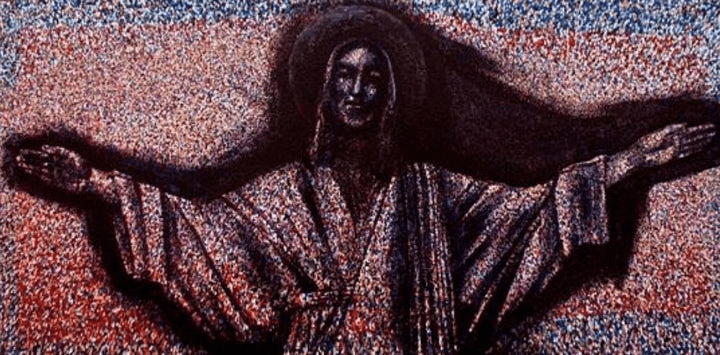
Jesus, by Ghanshyam Gupta

Allow me, or please indulge me, as I frame the Apostle’s words in my own sort of language:

Anything in this life that I have achieved; anything I have come to possess; any sort of position or title I hold or have held; any kind of identification I have, or prestige  I have gained, is of no value. In reality, it’s all rather worthless.

If you will let me take it even further, compared to having an authentic, real, and experiential relationship with Jesus as my Savior, my Lord, and my Friend, everything else is like a bunch of garbage. That’s how much I value Jesus. There’s no other thing, no other relationship, that comes remotely close to knowing Christ.

It isn’t so much that I found Jesus, but that he found me. So, I have a faith that’s got nothing to do with keeping up appearances or rule-keeping, or keeping ahold of anything. I have the life that is truly life.

But, oh my, there is so much more to experience and to know with Jesus! I want to experientially know the power of Christ’s mighty resurrection. I  want to be like him, and participate with him, as if Jesus were living his life through me.

And, I must tell you, I know that this sort of life means suffering. But I also know that this suffering puts me in solidarity with my Lord – which is exactly where I want to be.

I only want to live up to who I’m supposed to be in Christ, to be my true self, and not some faux Christian living according to mere rules and regulations. The only thing that counts to me is faith expressing itself through love.

I understand that I took a lot of liberties with the text, and elaborated on it in order to make it my own. But, truth be told, we all need to find ways to make scripture as our own.

We all must let go of some old ways and unlearn a lot of things, in order to discover new life and be united with Christ. Everyone needs to learn from the past, so that we can live a new life here in the present.

If you don’t like my words, that’s fine. You aren’t under any obligation to read them. Yet, I do believe we have an obligation to Holy Scripture, and specifically, to ingest it as if it were the best meal you’ve ever eaten.

Indeed, we end up experiencing a lot of losses in this life. Yet, with Jesus, we will never lose him, because he will never forsake us. Christ is our eternal gain. He’s alive, always living, so that we need never be concerned about him not existing anymore.

That’s my faith. That’s what I trust in, or rather whom I put my faith in, and my trust upon. It’s all about Jesus. Anything less will not stand the test of time, nor of satisfaction in life.

What will you do with Jesus?

Christ isn’t going to strongarm you into the kingdom of God. But he will doggedly go after you, and be a pester pup in your ears and an ever-present sense in your heart.

You might as well go ahead and consider him, or perhaps reconsider him, like you’ve never done before.

After all, you’ve really got nothing to lose.

We believe in one Lord, Jesus Christ,

the only Son of God,
eternally begotten of the Father,
God from God, Light from Light,
true God from true God,
begotten, not made,
of one being with the Father;
through him all things were made.
For us and for our salvation
he came down from heaven:
was incarnate of the Holy Spirit and the Virgin Mary,
and became truly human.
For our sake he was crucified under Pontius Pilate;
he suffered death and was buried.
On the third day he rose again
in accordance with the Scriptures;
he ascended into heaven
and is seated at the right hand of the Father.
He will come again in glory to judge the living and the dead,
and his kingdom will have no end. – The Nicene Creed, on Jesus Christ

Be Prepared, For the Lord Is Coming (Luke 1:5-17)

The Angel Appearing to Zechariah, by William Blake, 1800

In the days of King Herod of Judea, there was a priest named Zechariah, who belonged to the priestly order of Abijah. His wife was descended from the daughters of Aaron, and her name was Elizabeth. Both of them were righteous before God, living blamelessly according to all the commandments and regulations of the Lord. But they had no children because Elizabeth was barren, and both were getting on in years.

Once when he was serving as priest before God during his section’s turn of duty, he was chosen by lot, according to the custom of the priesthood, to enter the sanctuary of the Lord to offer incense. Now at the time of the incense offering, the whole assembly of the people was praying outside. 

Then there appeared to him an angel of the Lord, standing at the right side of the altar of incense. When Zechariah saw him, he was terrified, and fear overwhelmed him. 

But the angel said to him, “Do not be afraid, Zechariah, for your prayer has been heard. Your wife Elizabeth will bear you a son, and you will name him John. You will have joy and gladness, and many will rejoice at his birth, for he will be great in the sight of the Lord. He must never drink wine or strong drink; even before his birth he will be filled with the Holy Spirit. He will turn many of the people of Israel to the Lord their God. With the spirit and power of Elijah he will go before him, to turn the hearts of parents to their children and the disobedient to the wisdom of the righteous, to make ready a people prepared for the Lord.” (New Revised Standard Version)

We have the story of John the Baptist in the New Testament Gospels. In today’s Gospel lesson, we have the events surrounding his conception.

John’s birth story and life’s narrative are deeply rooted in Old Testament promises of deliverance and divine connection.

John’s ministry was one of preparing people for the Lord. John was, in many ways, the prophet Elijah who was to come, as Jesus said about him:

As they were coming down the mountain [of Transfiguration], Jesus ordered them, “Tell no one about the vision until after the Son of Man has been raised from the dead.” And the disciples asked him, “Why, then, do the scribes say that Elijah must come first?” He replied, “Elijah is indeed coming and will restore all things, but I tell you that Elijah has already come, and they did not recognize him, but they did to him whatever they pleased. So also the Son of Man is about to suffer at their hands.” Then the disciples understood that he was speaking to them about John the Baptist. (Matthew 17:9-13, NRSV)

Just as John’s story only has meaning because of Israel’s history, so the story of Jesus is deeply connected to the Old Testament, as well. Jesus is very much related to Israel’s God.

Furthermore, the coming salvation that the Gospel writer Luke wrote about is not only for the glory of Israel; it will also be a revelation of light available to Gentiles.

So it ought to be no surprise to the reader that the angelic birth announcement of John is reminiscent of similar messages in the Old Testament about the coming of a special child. (Genesis 16:7-13; 17:1-22; Judges 13:3-20)

John’s parents, Zechariah and Elizabeth, appear in the narrative as solid citizens of Israel, reminiscent of ancient heroes like Abraham and Sarah. And much like their faithful ancestors, Zechariah and Elizabeth are told they will have a child in their old age.

Elizabeth having been barren all her life is no problem or issue for God. The Lord had done it before; and would do it again.

And the child to come, John, will resemble Old Testament heroes, especially the prophet Elijah. (Malachi 4:5-6)

The visitation to the old couple was a message designed to be lifted up for the entire world: The Lord is coming! Be prepared!

All of us find ourselves getting on in years. Certainly, I do, as a father and grandfather. Yet, at any age, even younger persons feel this. We grow as people. We move on from being a baby to a toddler to an adolescent, a teenager, a young adult, middle-aged, older, geriatric.

We continually age. Hopefully, with the aging process comes a bit of wisdom.

I’d like to think that old Zechariah and Elizabeth had learned enough wisdom over their life’s journey to embrace both the meaning and mystery of that life.

I believe they had a sense of what is, and had an acceptance of it. Yet, at the same time, they had a sense of hope and of what could be. And that’s because they knew something of God’s promises.

Not everything will remain as it presently is. All will change. Acceptance entails knowing this, that all things will be different. And this helps open us to all the possibilities of prayers rooted in ancient promises.

The angel told Zechariah that his prayer had been heard. We aren’t told exactly what Zechariah had prayed. But it seems it was a rather “pregnant” prayer, full of asking for a child of his own, as well as a Messiah to come, and an Elijah to come.

In that sense, Zechariah’s very full prayer was answered magnanimously.

Now, in the spirit of old Zechariah and Elizabeth, we have our own opportunity to offer an advent prayer. We have the privilege of hearing the message.

The Lord is coming. Be prepared.

“Surely I am coming soon.”

Amen. Come, Lord Jesus!

The grace of the Lord Jesus be with all the saints. Amen. (Revelation 22:20-21, NRSV)

Gracious God, guard our hearts and minds by the power of Christ Jesus. Speak to our anxieties with the peace that passes understanding and let our gentleness and joy be a sign of Christ’s gracious presence.

Through Christ, with Christ, in Christ, in the unity of the Holy Spirit, all glory and honor are yours, almighty God, now and forever. Amen.

The Gospel Is For Everyone (Acts 11:1-18)

The Preaching of St. Peter In Jerusalem, by Charles Poërson, 1642

The apostles and the believers throughout Judea heard that the Gentiles also had received the word of God. So when Peter went up to Jerusalem, the circumcised believers criticized him and said, “You went into the house of uncircumcised men and ate with them.”

Starting from the beginning, Peter told them the whole story:“I was in the city of Joppa praying, and in a trance I saw a vision. I saw something like a large sheet being let down from heaven by its four corners, and it came down to where I was. I looked into it and saw four-footed animals of the earth, wild beasts, reptiles and birds. Then I heard a voice telling me, ‘Get up, Peter. Kill and eat.’

“I replied, ‘Surely not, Lord! Nothing impure or unclean has ever entered my mouth.’

“The voice spoke from heaven a second time, ‘Do not call anything impure that God has made clean.’ This happened three times, and then it was all pulled up to heaven again.

“Right then three men who had been sent to me from Caesarea stopped at the house where I was staying. The Spirit told me to have no hesitation about going with them. These six brothers also went with me, and we entered the man’s house. He told us how he had seen an angel appear in his house and say, ‘Send to Joppa for Simon who is called Peter. He will bring you a message through which you and all your household will be saved.’

“As I began to speak, the Holy Spirit came on them as he had come on us at the beginning. Then I remembered what the Lord had said: ‘John baptized with water, but you will be baptized with the Holy Spirit.’ So if God gave them the same gift he gave us who believed in the Lord Jesus Christ, who was I to think that I could stand in God’s way?”

When they heard this, they had no further objections and praised God, saying, “So then, even to Gentiles God has granted repentance that leads to life.” (New International Version)

In this Advent season, the Revised Common Lectionary Daily Readings for Year C direct us toward the good news that Christ’s incarnation is not only for Jewish people; it is also for everyone.

But Peter needed some remedial teaching about this gospel. He had to get the reality that God grants repentance leading to new life for Gentiles, firmly into his Jewish head and heart.

The first advent of Jesus Christ – his incarnation as the God-Man on this earth – was meant for the world, and not exclusively for the Jewish people. Sometimes, however, it takes a vision or a dream to really get the message across.

And God is gracious to do whatever it takes in order to gain our attention and bring us to a point of changing our minds about things we are in error about.

The Gospel is for everyone.

The Gospel is Jews and Gentiles. The Gospel is for you and for me. It’s for your grumpy neighbor and your crazy uncle. It’s for that obnoxious co-worker and the persnickety church lady. It’s for the Grinches and Scrooges of this world, as well as for the already convinced.

Yes, indeed, the good news of Jesus Christ is for everyone, without exception.

I do so hope that you don’t have to learn that truth the hard way. I do rather hope that you have a wonderful experience of discovering a Cornelius of whom you had no idea even existed, until the mercy of God led you otherwise.

It is my prayer that you have (or will have) a story to tell, much like Peter’s, in which you found that the grace of God has no limits, that there is plenty of Christ to go around for everyone.

There is no need to stand in God’s way, because no one can stop God’s grace. When the mercy of God starts moving, it becomes a giant snowball gaining speed and strength and size going downhill. And when it hits, you’re going to feel it!

Grace overcomes and overwhelms everything. 

One of the most scandalous truths of Christianity is that God graces common ordinary people who seem as dead as a bowling ball with the Holy Spirit and gives them life. 

The Apostle Peter had to learn this with some difficulty, but he embraced the work of God among the non-Jewish Gentiles. “The Holy Spirit fell on them just as on us at the beginning” was Peter’s plain account and confession of the reality that God grants repentance that leads to life for all kinds of people no matter what their race, ethnicity, gender, class, or background. 

It is a wondrous and astounding spiritual truth that God’s gracious concern is not limited to a certain type of person.

Along with Peter and the other believers so long ago, let us rejoice in the work of God that brings deliverance and transformation. 

Grace is and ought to be the guiding factor in how we interact with people. 

Losing sight of grace leads to being critical and defensive. Whereas, embracing grace leads to the humility of seeing the image of God in people very different from ourselves. 

Grace tears down barriers and causes us to do away with unnecessary distinctions between others. Our appropriate response to such a grace is to glorify God for his marvelous and amazing work. 

The Gospel is not only a gift to receive; it is also a wonderful gift to give.

Gracious God, just as you brought deliverance and salvation that leads to life for people from ancient times, and gifted them with your Holy Spirit, so today continue your mighty work of transformation in the hearts of people that I share the good news of Jesus with. Amen.

What Should We Do? (Acts 2:37-42)

Apostle Peter Preaching, by Lorenzo Veneziano, c.1370

When the crowd heard this, they were deeply troubled. They said to Peter and the other apostles, “Brothers, what should we do?”

Peter replied, “Change your hearts and lives. Each of you must be baptized in the name of Jesus Christ for the forgiveness of your sins. Then you will receive the gift of the Holy Spirit. This promise is for you, your children, and for all who are far away—as many as the Lord our God invites.” With many other words he testified to them and encouraged them, saying, “Be saved from this perverse generation.” Those who accepted Peter’s message were baptized. God brought about three thousand people into the community on that day.

The believers devoted themselves to the apostles’ teaching, to the community, to their shared meals, and to their prayers. (Common English Bible)

The Apostle Peter, follower of Jesus, had a fire in his belly and fresh wind in his lungs.

Pentecost will do that to a person.

The promised Holy Spirit came – the Spirit of fire and wind – and the result was an impassioned, reasoned, and convicting message from Peter.

The crowd of people listening to Peter understood clearly that he was saying the person and work of Jesus was the activity of God.

And Christ was killed because of his presence and ministry. But three days later, he was raised from death. And then, ascended to heaven, promising the Spirit’s continual involvement.

The people listening to Peter were cut to the heart, convicted in the depths of their soul, and beside themselves as to their culpability in Christ’s situation. They cried out to Peter and asked him what they should do, how they could possibly be a part of what God is doing in the world.

Peter’s response to the crowd was to change – to repent and be baptized, receiving the gift of the Holy Spirit. The Apostle was telling them to turn away from the old way, and turn toward the new coming kingdom of God.

Baptism assures people that God has received their repentance, and has forgiven them. It initiates the believer into the new community of the redeemed, the church.

This was not only for Jewish people, but also for Gentiles; and for everyone, both far and near.

Celebration, by John August Swanson (1938-2021)

The four qualities which characterized the earliest church were these:

  1. The new community followed apostolic teaching (the story of Jesus)
  2. The church continually engaged in fellowship (mutual encouragement and working together in unity)
  3. The believers broke bread together (kept meeting together in shared meals to remember the person and work of Jesus)
  4. They prayed (as the Lord had taught them to pray – for God’s gracious and benevolent kingdom to come, and God’s ethical and moral will to be done, right now on this earth, as it is always done in God’s heaven)

For those who are established in the faith of Christianity, all of this material raises several questions to reflect upon in how our life together as Christians is going:

How do Christians understand the word “repentance?”

Because this determines a great deal of how we live as believers. If we discern repentance as following the rules – both written and unwritten – then we are likely behaving more in the old ways that the earliest believers were to repent of.

But if we see repentance as a way of life, of continually offering prayers of confession to God, and seeking to align our life with the words and ways of Jesus, then we are living more into the spirit of Peter’s original exhortation to the people.

Is the Church living as the baptized community of the redeemed?

Again, how do we understand the word “baptism?” If baptism is nothing more than a personal decision to outwardly show one’s faith, then we have severely truncated Peter’s meaning of the word.

Baptism is the outward sign that we belong to God. And belonging to God is something God does, not us.

One good way of understanding the whole of the Christian life is that we are to ‘live into our baptism,’ that is, we are to daily live our lives cognizant that our life is not our own.

We belong to God. Long before we happened to choose God, God chose us. And we must always remember that.

Are believers in Jesus living in the Spirit?

The Spirit has been given as the continuing presence of Jesus on this earth. The Spirit reminds us of Christ’s words and ways, his person and work. To live in the Spirit is to be continually reminded that what is important to Jesus, needs to be important to us.

“You’re blessed when you’re at the end of your rope. With less of you there is more of God and his rule.

“You’re blessed when you feel you’ve lost what is most dear to you. Only then can you be embraced by the One most dear to you.

“You’re blessed when you’re content with just who you are—no more, no less. That’s the moment you find yourselves proud owners of everything that can’t be bought.

“You’re blessed when you’ve worked up a good appetite for God. He’s food and drink in the best meal you’ll ever eat.

“You’re blessed when you care. At the moment of being ‘care-full,’ you find yourselves cared for.

“You’re blessed when you get your inside world—your mind and heart—put right. Then you can see God in the outside world.

“You’re blessed when you can show people how to cooperate instead of competing or fighting. That’s when you discover who you really are, and your place in God’s family.

“You’re blessed when your commitment to God provokes persecution. The persecution drives you even deeper into God’s kingdom. (Matthew 5:3-10, MSG)

Are individual Christians and the Church communicating the promise to those who are far away? In other words, are we seeking to include others in the community?

Too many churches are closed groups who have a lot of extraneous rules and ancillary beliefs in order to truly be a part of their local church.

This does not mean we are to have no rules or guidelines or any teaching about our particular Christian tradition. However, it does mean that make sure we are proclaiming good news (which is what the word “gospel” means) because the gospel is radically inclusive, not exclusive.

Therefore, to have a community of people who genuinely love one another by spiritually changing and growing, serving and helping, sharing and encouraging, praying and opening up, is to have a group of redeemed persons who give a compelling proclamation of good news through both their gracious words and their loving actions.

If we have little Christ’s walking about this world and living according to his words and ways, and being full of the Spirit, then we give other people a big reason for faith, hope, and love in a world that is too often characterized by being overwhelmed, jaded, and hopeless.

One can never go wrong with living a blessed life as Jesus has defined it; and as the early apostles and believers lived it.

May it be so, to the glory of God, and for the blessing of the church and the world. Amen.