

Monday of Holy Week (Psalm 36:5-11)

The Via Dolorosa (Latin: the way of sorrows) is a narrow path through the streets of the Old Jerusalem, the final route traveled by Jesus of Nazareth on the way to his crucifixion.

Your steadfast love, O Lord, extends to the heavens,
    your faithfulness to the clouds.
Your righteousness is like the mighty mountains;
    your judgments are like the great deep;
    you save humans and animals alike, O Lord.

How precious is your steadfast love, O God!
    All people may take refuge in the shadow of your wings.
They feast on the abundance of your house,
    and you give them drink from the river of your delights.
For with you is the fountain of life;
    in your light we see light.

O continue your steadfast love to those who know you
    and your salvation to the upright of heart!
Do not let the foot of the arrogant tread on me
    or the hand of the wicked drive me away. (New Revised Standard Version)

The desert journey is almost over. The sojourn with Jesus in his life and ministry will soon culminate in the ultimate experience of sorrow and joy. The Christian season of Lent is nearly at the end. We are in it’s final days, known as Holy Week.

We have a Holy Week because of love. There is yet another journey we must take, along the Via Dolorosa to the hill of Golgotha, because of God’s steadfast love.

Love suffers. Every parent knows this. Because of a parent’s committed and faithful love toward a child, they feel not only the joys but also the sorrows and pain of their children. I can say that this feeling does not go away, even with adult children. And it’s compounded with grandchildren. Just as our love is big enough to hold multiple children and grandchildren, so our capacity for experiencing deep emotion for their welfare is equally large.

Holy Week reminds us that God’s committed parental love suffers. It is because of God’s immense and steadfast love that there is a road to the cross and a tortured death for Jesus. The cost of our salvation involves a very bloody affair. Deliverance comes at the price of horrible violence. Jesus Christ lived and died for us, because of love.

He suffered much because he loved much.

God’s people, walking in the way of love, quickly discover that it is simultaneously walking in the way of suffering. From Old Testament times through the New Testament era and into the present day, the faithful have always experienced suffering as a central part of their piety and devotion in showing steadfast love. 

The medieval mystics of the Church understood quite well the connection between suffering and love. They could not imagine a Christian life without hardship, difficulty, and persecution. Thomas à Kempis, a sort of pastor to pastors, wrote in the fifteenth century:

“Sometimes it is to our advantage to endure misfortunes and adversities, for they make us enter into our inner selves and acknowledge that we are in a place of exile and that we ought not to rely on anything in this world.  And sometimes it is good for us to suffer contradictions and know that there are those who think ill and badly of us, even though we do our best and act with every good intention….  When men ridicule and belittle us, we should turn to God, who sees our innermost thoughts, and seek His judgment….  It is when a man of good will is distressed, or tempted, or afflicted with evil that he best understands the overwhelming need he has for God, without whom he can do nothing….  It is in such times of trial that he realizes that perfect security and full peace are not to be found in this world.”

Thomas à Kempis, The Imitation of Christ

And yet, it is because of love that suffering is transformed and endured as something wholly other than sheer pain or hurt. Thomas à Kempis went on to say:

“Love is a mighty power, a great and complete good; Love alone lightens every burden and makes the rough places smooth. It bears every hardship as though it were nothing and renders all bitterness sweet and acceptable. The love of Jesus is noble and inspires us to great deeds; it moves us always to desire perfection. Love aspires to high things and is held back by nothing base. Love longs to be free, a stranger to every worldly desire, lest its inner vision become dimmed, and lest worldly self-interest hinder it, or ill-fortune cast it down…. Love knows no limits, but ardently transcends all bounds. Love feels no burden, takes no account of toil, attempts things beyond its strength; love sees nothing as impossible, for it feels able to achieve all things. Love therefore does great things; it is strange and effective; while he who lacks love faints and fails.”

Thomas à Kempis, The Imitation of Christ

Holy Week’s message is certainly one of suffering love. Jesus went to the greatest lengths possible to give Divine steadfast love to humanity. So, let us not shy away from the cross, but journey with Jesus to Golgotha, embracing the love of God for us. In so doing, we will find the inner resources needed to love the world, even in all its unloveliness.

Grant, we pray, almighty God, that, though in our weakness we fail, we may be revived through the Passion of your Only Begotten Son. Who lives and reigns with you in the unity of the Holy Spirit, God, for ever and ever. Amen.

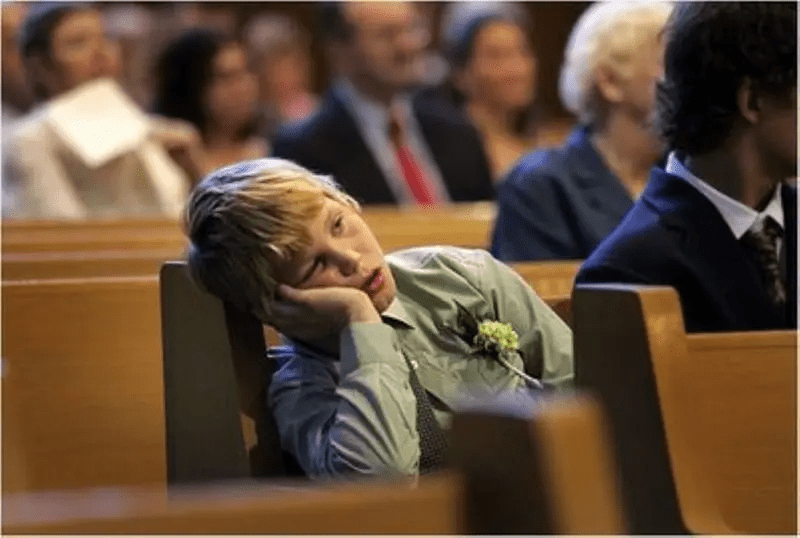
Bored To Death (Acts 20:7-12)

On Sunday we met to break bread. Paul was discussing Scripture with the people. Since he intended to leave the next day, he kept talking until midnight. (Many lamps were lit in the upstairs room where we were meeting.)

A young man named Eutychus was sitting in a window. As Paul was talking on and on, Eutychus was gradually falling asleep. Finally, overcome by sleep, he fell from the third story and was dead when they picked him up. Paul went to him, took him into his arms, and said, “Don’t worry! He’s alive!” Then Eutychus went upstairs again, broke the bread, and ate. Paul talked with the people for a long time, until sunrise, and then left.

The people took the boy home. They were greatly relieved that he was alive. (God’s Word Translation)

I’m bored

When I was a kid, the church worship service on Sunday was the longest hour of my week. I wanted to play in the pew, but my mom wouldn’t let me. I asked to go the bathroom, but my dad wasn’t having it. I tried to draw in the hymnal, but my sister always took everything around me ought of sight. My only relief was to sleep and drool on whatever I could lay my head on.

I’ve come a long way since then. But my experience taught me something. God isn’t boring, so I’m not going to be boring, either. Maybe I could have taught the Apostle Paul a thing or two.

In our New Testament lesson for today, the lateness of the hour (past midnight) and the ambiance of the room (all those burning oil lamps, presumably to keep people awake without any coffee) clues a church-going person immediately that something bad is about to go down. A long-winded preacher only serves to make for a combustible situation.

Uh-oh

In all fairness to Paul, if the congregants were bored out of their minds, the text doesn’t tell us. My guess is that the author, Luke, doesn’t want to go there. Yet, we have evidence of a bored person in the form of none other than a young person, a kid named Eutychus.  

He’s over by the open window, propped up on the ledge, and can’t keep his eyes open. Heck, for all we know, everyone was starting to doze off. And, as every preacher has experienced, as somebody slips into sleep, we just talk even longer.

The young man’s precipitous position leads to disaster: he falls out the third floor window. And, as one might expect, he fell to his death. Now, instead of some slap-stick comedic set up, we have a genuine tragedy: a young person literally bored to death by preaching.

The Apostle Paul raises Eutychus to life, by Gerard Hoet, 1728

All of a sudden, the story is no laughing matter. So, what might we learn from the preacher who bored Eutychus to death?

He finally stops preaching

The sermon is interrupted (as it turns out, of course, only momentarily) in order to attend to the tragedy. Sometimes, the sermon has to stop. Everything has to stop. We have to take a good, hard look at what’s going on. There are questions to ask, things to notice, conversations to begin. We have to get particular about where we are, and what we’re doing, before we can keep going with anything.

Maybe, just maybe, if Eutychus was part of the communion service, he wouldn’t have been on the margins and at risk of falling. As for many churches today, it could be there’s no young people around because they all fell out the window. Never underestimate the power of participation. Most youth just need to be asked to help out. But most adults don’t ask. And most kids aren’t going to volunteer.

He threw himself on him

Paul went down to Eutychus, and bending over him, took him in his arms in an emotional embrace – similar to what the father did when the prodigal son came home. (Luke 15:11-32)

In both cases – the prodigal son and Eutychus – they each needed a new life. The prodigal fell asleep to who he was, in a living death, and woke to his condition and went home. Eutychus literally fell asleep to an actual death and was woke to a resurrected life – returning back to the congregation (and even more preaching! *sheesh* leave it alone, Paul).

Each was found. Each had someone care about them by throwing their arms around them and giving them new life. That’s what grace is. Grace is giving the gift of seeing another person and embracing them – no matter whether they’re worthy of it, or not.

He’s alive

“He’s alive” is a statement of fact, of reality. It puts all the attention on what is true, right now, in this moment – and deflects attention away from who’s around the living person. In other words, Paul doesn’t take credit for Eutychus coming to life or restoring breath to him.

Implicitly, we know where the power comes from to raise Eutychus to life. It doesn’t come from the preacher. However, there is an important task that every preacher can do: witness a new life and bring the announcement of that life to the community. Preaching can (and ought to) bear witness to the activity of God in raising the dead and granting life.

The preacher can encourage the congregation to celebrate life around the Lord’s Table, notice the people on the margins of the community, and stay awake to the possibilities of what God can do amongst us.

Turns out, neither the length of a sermon nor the level of boredom is the issue. What’s most important is proclaming the gospel of grace in word and sacrament. And that’s something we all can participate in together and celebrate.

God of life, may we learn how to live from the mercy which was brought to us through the mission of your Son – whose saving love extends to every person, whose presence reaches into every place, Jesus Christ, who makes all things new, who lives and reigns with you and the Holy Spirit, one God, now and forever. Amen.

What Does God Want? (John 11:1-45)

The Raising of Lazarus, by Rembrandt, c.1632

Now a man named Lazarus was sick. He was from Bethany, the village of Mary and her sister Martha. (This Mary, whose brother Lazarus now lay sick, was the same one who poured perfume on the Lord and wiped his feet with her hair.) So the sisters sent word to Jesus, “Lord, the one you love is sick.”

When he heard this, Jesus said, “This sickness will not end in death. No, it is for God’s glory so that God’s Son may be glorified through it.” Now Jesus loved Martha and her sister and Lazarus. So when he heard that Lazarus was sick, he stayed where he was two more days, and then he said to his disciples, “Let us go back to Judea.”

“But Rabbi,” they said, “a short while ago the Jews there tried to stone you, and yet you are going back?”

Jesus answered, “Are there not twelve hours of daylight? Anyone who walks in the daytime will not stumble, for they see by this world’s light. It is when a person walks at night that they stumble, for they have no light.”

After he had said this, he went on to tell them, “Our friend Lazarus has fallen asleep; but I am going there to wake him up.”

His disciples replied, “Lord, if he sleeps, he will get better.” Jesus had been speaking of his death, but his disciples thought he meant natural sleep.

So then he told them plainly, “Lazarus is dead, and for your sake I am glad I was not there, so that you may believe. But let us go to him.”

Then Thomas (also known as Didymus) said to the rest of the disciples, “Let us also go, that we may die with him.”

On his arrival, Jesus found that Lazarus had already been in the tomb for four days. Now Bethany was less than two miles from Jerusalem, and many Jews had come to Martha and Mary to comfort them in the loss of their brother. When Martha heard that Jesus was coming, she went out to meet him, but Mary stayed at home.

“Lord,” Martha said to Jesus, “if you had been here, my brother would not have died. But I know that even now God will give you whatever you ask.”

Jesus said to her, “Your brother will rise again.”

Martha answered, “I know he will rise again in the resurrection at the last day.”

Jesus said to her, “I am the resurrection and the life. The one who believes in me will live, even though they die; and whoever lives by believing in me will never die. Do you believe this?”

“Yes, Lord,” she replied, “I believe that you are the Messiah, the Son of God, who is to come into the world.”

After she had said this, she went back and called her sister Mary aside. “The Teacher is here,” she said, “and is asking for you.” When Mary heard this, she got up quickly and went to him. Now Jesus had not yet entered the village, but was still at the place where Martha had met him. When the Jews who had been with Mary in the house, comforting her, noticed how quickly she got up and went out, they followed her, supposing she was going to the tomb to mourn there.

When Mary reached the place where Jesus was and saw him, she fell at his feet and said, “Lord, if you had been here, my brother would not have died.”

When Jesus saw her weeping, and the Jews who had come along with her also weeping, he was deeply moved in spirit and troubled. “Where have you laid him?” he asked.

“Come and see, Lord,” they replied.

Jesus wept.

Then the Jews said, “See how he loved him!”

But some of them said, “Could not he who opened the eyes of the blind man have kept this man from dying?”

Jesus, once more deeply moved, came to the tomb. It was a cave with a stone laid across the entrance. “Take away the stone,” he said.

“But, Lord,” said Martha, the sister of the dead man, “by this time there is a bad odor, for he has been there four days.”

Then Jesus said, “Did I not tell you that if you believe, you will see the glory of God?”

So they took away the stone. Then Jesus looked up and said, “Father, I thank you that you have heard me. I knew that you always hear me, but I said this for the benefit of the people standing here, that they may believe that you sent me.”

When he had said this, Jesus called in a loud voice, “Lazarus, come out!” The dead man came out, his hands and feet wrapped with strips of linen, and a cloth around his face.

Jesus said to them, “Take off the grave clothes and let him go.”

Therefore many of the Jews who had come to visit Mary, and had seen what Jesus did, believed in him. (New International Version)

The Raising of Lazarus, by Vincent Van Gogh, 1890

Here’s a Captain Obvious observation:

what God wants, and what we want, is not always the same thing. 

Today’s Gospel story centers around a man named Lazarus, the brother of Mary and Martha. The disciples were familiar with them since they were committed followers of Jesus. 

Their friend Lazarus became deathly ill. Christ and the disciples caught wind of it. Everyone believed Jesus could do something about this. But Jesus stayed put. He didn’t make a move to go to his sick friend. 

After a few days, Lazarus died. It was only then, that Jesus made his move.

The religious authorities in Jerusalem had it out for Jesus. But Jesus decided to go to Bethany and Jerusalem anyway. This made no sense to the disciples. Lazarus was lying dead in Bethany. Going there would put everyone at risk – which is why Thomas uttered the defeatist and dramatic statement, “Let us also go, that we may die with him.”

Yet, they all went. And once they arrived, Christ and his disciples found the grieving sisters. Mary and Martha believed that Jesus was the promised Messiah who would come and save the people. They didn’t understand why Jesus stayed away and didn’t come sooner. 

If Jesus had been there, he could have healed Lazarus. He healed other people, so why not a friend and a brother?

The death of Lazarus seemed to be the end. No one was happy with how things shook-out. Lazarus died. The disciples’ plans were dead. Mary and Martha’s expectations died…

but death is exactly what it takes in to have resurrection.

There’s no such thing as a painless miracle. Death isn’t a pleasant affair. I have been with countless people at the end of life, and I will tell you that, although it’s possible for a death to be peaceful, it’s still ugly business. 

It’s also painful to watch carefully laid and prayed over plans die. It hurts to see a long sought after dream just go up in smoke and die. To see anything or anyone we deeply care about die is gut-wrenching. Yet, in order for a resurrection to occur, there must first be a death.

There cannot be a new life unless there’s an old one. 

Jesus did the impossible by raising Lazarus from death and giving him new life. And the resurrection of Lazarus pointed to an even greater truth: Christ’s own death and resurrection was coming, and it will change everything.

Whenever what we want dies, then we are in a position to ask: So, what does God want? 

God wanted something better than what everybody else wanted. By allowing ourselves to be consumed with what God wants, it turns out to be the very best thing for us, even if it does not quite jive with what I want.

Everyone’s expectations needed to die, along with Lazarus, for the resurrection to become reality. Only then did Jesus act by rising Lazarus from death.

Jesus pointed to himself as the one able to bring life to all that is dead among us. Sometimes:

  • dreams must die so that Jesus can resurrect them to new life, with outcomes far more glorious than you and I could ever imagine
  • plans have to be dead and buried before Jesus will breathe new life into them, making those plans so much more than they could ever have been in our hands.
  • ministries, even churches, need to be dead as a doorknob so that Jesus can resurrect them and give them new life, invigorated with spiritual resurrection power.

If we desire to see the miracle of resurrection, we must die to ourselves – take up our crosses and follow Jesus into the grave so that he can transform our lowly expectations into a glorious new existence. Death does not have the last word because Christ’s resurrection makes it possible for us to have new life. Again, I ask:

What does God want? God wants to raise the dead to life.

Do you believe this? Yes, I believe. Help me in my unbelief.

Follow the path of what God wants and watch what the Lord will do for you.

It’s All About Jesus (Luke 24:44-53)

“Road to Emmaus” by He Qi

Jesus said to them, “These are my words that I spoke to you while I was still with you—that everything written about me in the Law from Moses, the Prophets, and the Psalms must be fulfilled.” Then he opened their minds to understand the scriptures. He said to them: 

“This is what is written: the Christ will suffer and rise from the dead on the third day, and a change of heart and life for the forgiveness of sins must be preached in his name to all nations, beginning from Jerusalem. You are witnesses of these things. Look, I’m sending to you what my Father promised, but you are to stay in the city until you have been furnished with heavenly power.”

He led them out as far as Bethany, where he lifted his hands and blessed them. As he blessed them, he left them and was taken up to heaven. They worshipped him and returned to Jerusalem overwhelmed with joy. And they were continuously in the temple praising God. (Common English Bible)

Perhaps you are feeling lost, maybe overwhelmed. Likely, you have experienced the feeling, even many times in your life, of being ungrounded, lacking a solid foundation under your feet – not quite knowing what’s up or down.

You sense there needs to be a great unifying force in your life – something to orient yourself around and make sense of the world, others, and especially yourself.

From the standpoint of Christianity, all of Holy Scripture – both Old and New Testaments – are focused upon and have their centrality in the person and work of Jesus the Christ. And it is this same Christ who opens us to understanding the scriptures.

My earliest memories of the Bible are in the church in which I grew up. I remember Bible stories from Sunday School and the pastor talking about particular verses from the Bible while I sat in our regular family pew. 

It wasn’t until my late teen years that I took up the task of reading the Scriptures for myself. And, I have to tell you, it absolutely changed my life. I found that many of the stories I heard as a kid were a lot juicier than I realized. I also discovered that there were simply a lot of things in the Bible I didn’t know even existed. 

However, the most profound breakthrough for me was plowing through all four Gospels and seeing the life and ministry of Jesus. My adoration and appreciation of Christ rose exponentially after watching him in action throughout Matthew, Mark, Luke, and John.

Rowan LeCompte (1925–2014) and Irene Matz LeCompte (1926–1970), The Walk to Emmaus. Resurrection Chapel, National Cathedral, Washington, DC. Photo: Victoria Emily Jones

I was so impressed with reading the Gospels that I moved into the rest of the New Testament. Then, I went back to the Old Testament and read the entire thing. In a matter of months I had read the entire Bible. Yet, I had more questions than when I started. There was just far too much I didn’t understand about it. 

So, I read the whole thing again… then again… and again… somewhere along the line, I’ve lost count of how many times I have read the Bible – I estimate around four-hundred times for the New Testament and the Old Testament about two hundred. And I still have so much more to learn and discover!

I’m not telling you this to impress anyone. In fact, many feel as if all that reading of the Bible is over the top. I assure you that it isn’t. 

After all, how could the living Christ ever open my mind to understanding the scriptures if I never bothered to read them?

And, after having read it once, why in the world would I spend so much of my life in plain straightforward reading of the Bible? I offer several reasons for my practice:

I can only lay hold of God’s promises if I know what they are. 

Living from a place of faith and calm in the midst of uncertainty and unrest doesn’t just happen. It comes from knowing the words of Scripture and allowing Christ to permeate my soul. The promises of Scripture are like an asthmatic’s inhaler, enabling us to slow down and take a deep breath.

I can only be like Jesus if I am getting to intimately know him. 

Reading Scripture about Jesus is like eating food. I have to do it regularly. It nourishes me for the day. Bible reading is stored energy, stockpiled emotional and psychological capital.   can speak and act like Jesus throughout the day by making moment-by-moment withdrawals from that vast reservoir of stored Scripture knowledge.

I can only be wise if I am connected to wisdom literature. 

By nature, we are all ignorant, and have to learn what is wise, just, and good through humility and experience. Over time, we can shed folly and become wise. I need help with becoming wise. I need a word from God each and every day to face life’s challenges, its ups-and-downs, as well as its mediocrity and mundane nature. Every day the Bible tweaks my life and prompts fresh mid-course corrections.

I need to see Jesus for who he is, and not what I think he is. 

Everyone has an idea about Jesus. But I believe the Christian Scriptures tell me who Jesus really is in all of his attributes, character, and sovereignty – which then tells me who God actually is. God is pretty big – so big that I can read the Bible for a lifetime and never exhaust knowing the Lord. I read my Bible in order to sharpen my vision of God and to think more accurately about all that matters most in this life.

I need to see the Church for what it is, and not what I think it is. 

Everybody and their dog have an opinion about how church should be and operate. But I must take my cues from the Bible about what is most important about the church and what it should be doing. I read the Bible in order to better know and understand who God’s people really are, and what they ought to be doing in this world. That’s important because the church is Christ’s Body.

I need Jesus. 

Reading the Bible is a personal experience — an actual encounter with the author. Daily Bible reading requires routine and structure, but it’s not mechanical—just as a body requires a bony skeleton, but it’s not the skeleton that gives it life. We do with the Bible what the Psalms guide us in doing—adore God, thank God, complain to God, wrestle with God, express perplexity to God, etc. Without God I am lost. Which is why, apart from Scripture, I am lost.

Reading the Bible is an investment of time, energy, reflection, meditation, and prayer. Struggling through its contents can change your life. It did mine. 

One of the great tasks you could ever do is to read the entire Bible from Genesis to Revelation, because it is God’s Word that reveals to us Jesus, the center of it all, the way, the truth, and the life.