

A Lot of Hurting, Touching, and Healing (Luke 6:12-19)

Jesus calls his twelve disciples, by Sadao Watanabe

One of those days Jesus went out to a mountainside to pray, and spent the night praying to God. When morning came, he called his disciples to him and chose twelve of them, whom he also designated apostles: Simon (whom he named Peter), his brother Andrew, James, John, Philip, Bartholomew, Matthew, Thomas, James son of Alphaeus, Simon who was called the Zealot, Judas son of James, and Judas Iscariot, who became a traitor.

He went down with them and stood on a level place. A large crowd of his disciples was there and a great number of people from all over Judea, from Jerusalem, and from the coastal region around Tyre and Sidon, who had come to hear him and to be healed of their diseases. Those troubled by impure spirits were cured, and the people all tried to touch him, because power was coming from him and healing them all. (New International Version)

Pain is a lot

Touch is important. Humanity needs touch. It’s also one of those things that we likely take for granted. 

Philip Yancey and Dr. Paul Brand co-authored a book, originally published in 1982, entitled “Pain: The Gift Nobody Wants.” It’s largely a biography of Dr. Brand, who pioneered both the diagnosis and prognosis of leprosy. 

He discovered that leprosy occurs because of a lack of feeling – an inability to sense touch. The delicate nerve endings we all have in our fingers and toes are numb to the leper. The lack of sensing pain in the extremities leads to small cuts or injuries, which would be immediately treated by someone who feels pain, becoming gangrene with the losing of fingers and toes.

The ability to feel, to reach out and touch another person, is vitally important to our spiritual and emotional lives. Without touch, the calloused heart and unfeeling soul does not realize the damage that is being done to it.           

One of the gifts we have as people is the ability to feel guilt, sorrow, disappointment, and pain – to be touched mentally, emotionally, and spiritually – as well as physically. And in our ability to feel pain, it brings about attention to prayer and addressing the situation.

Many people are troubled in either mind or spirit, or experience chronic ailments of the body, day in and day out. They just want relief, to be at peace in both body and soul.

Jesus prays… a lot

In today’s Gospel lesson, Luke puts together two stories: one of Jesus choosing and calling his twelve disciples; and then one of Jesus being among the people and healing them of their diseases and their troubles. Let’s observe the relationship between them.

Jesus often withdrew to lonely, isolated places in order to pray (Luke 5:16). On this particular occasion, he went out and spent the entire night in prayer to God. When morning came, we discover the reason for the all-night prayer meeting: Christ chose the people who would be closest to him in his earthly ministry. He called the twelve to follow him and be his disciples.

I find it highly instructive that Jesus spent so much time in prayer before making such big decisions about his ministry. If anyone could size up somebody as a potential follower, it seems to me it would be Jesus. And yet, there was a lot of deliberation and interaction with the Father. Since the Lord Jesus found it necessary to pray with an extending time, and consult with the heavenly Father, I would say that our own prayer life and reaching out to consult and collaborate could probably use an upgrade.

Jesus heals… a lot of people

Then, Jesus and his disciples, together enter the fray of the crowd. And the disciples get their first lesson in following Jesus: Christ-centered ministry is about healing – it’s about restoring people to physical, mental, emotional, and spiritual health.

Healing is at the heart of all real Christian ministry. And healing is really what everyone is to be about, whether they identify as Christian, or not. To be healed is to experience a holistic restoration of body, mind, emotions, and spirit.

Touch is a big part of healing. Physical touch is important, and it’s powerful. Sometimes, bodily healing is needed because a person has been physically abused, or experienced some sort of physical trauma. And it can be very difficult to have others touch them, after such experiences. Yet, part of the healing will be in experiencing redemptive touch – either by surgeons, family, friends, or trusted others. The answer to bad touch and bad pain is to experience good touch and the good pain of healing.

Non-physical touch is no less important. And, I believe, Jesus understood this perhaps more than most. He routinely “touched” people in ways that changed their lives. Christ sought to not only bring physical healing, but also to heal the mental, emotional, and spiritual wounds.

Jesus touches… a lot of lives

Jesus touched a lot of lives through his healing ministry:

  • In healing lepers of their disease, Christ made sure that they were no longer ostracized from the community but were restored to full function in society.
  • In curing persons demonized and tormented by evil spirits, Jesus was concerned to restore them to their right mind and ensure they were included as members of society, as well as restored to their families.
  • In bringing salvation from guilt and shame, Jesus brought reconciliation and restoration between God and sinners.
  • In all his relational interactions, Jesus was intentional about making connections to the lonely and the lost, to those who were emotionally cut off from the mass of society.

So, whenever we feel pain – whether in body, mind, emotion, or spirit – this experience lets us know that we need to pay attention to something. As we do that, it can drive us to the source of healing, wholeness, and restoration. We go to prayer – not out of duty – but because we are convinced that there are divine resources only God can provide.

And we can come, again and again, finding the grace to help us in our time of need. For God’s mercy is inexhaustible; the grace of God will never run out or run dry.

Therefore, let followers of Jesus everywhere be aqueducts of grace, angels of mercy, and agents of healing in a world which so desperately needs the love, care, and attention we can give them.

May God the Father bless you; God the Son heal you; and God the Holy Spirit give you strength. May God the holy and undivided Trinity guard your body, save your soul, protect your mind, and bring you safely to his heavenly country; where he lives and reigns for ever and ever. Amen.

A Life of Compassion (Matthew 9:35-10:23)

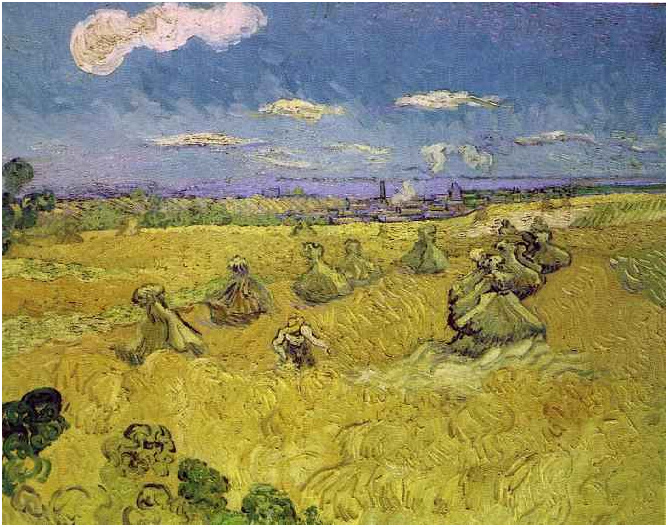
Wheat Stacks with Reaper, by Vincent Van Gogh, 1888

Jesus went through all the towns and villages, teaching in their synagogues, proclaiming the good news of the kingdom and healing every disease and sickness. When he saw the crowds, he had compassion on them, because they were harassed and helpless, like sheep without a shepherd. Then he said to his disciples, “The harvest is plentiful but the workers are few. Ask the Lord of the harvest, therefore, to send out workers into his harvest field.”

Jesus called his twelve disciples to him and gave them authority to drive out impure spirits and to heal every disease and sickness.

These are the names of the twelve apostles: first, Simon (who is called Peter) and his brother Andrew; James son of Zebedee, and his brother John; Philip and Bartholomew; Thomas and Matthew the tax collector; James son of Alphaeus, and Thaddaeus; Simon the Zealot and Judas Iscariot, who betrayed him.

These twelve Jesus sent out with the following instructions: “Do not go among the Gentiles or enter any town of the Samaritans. Go rather to the lost sheep of Israel. As you go, proclaim this message: ‘The kingdom of heaven has come near.’ Heal the sick, raise the dead, cleanse those who have leprosy, drive out demons. Freely you have received; freely give.

“Do not get any gold or silver or copper to take with you in your belts—no bag for the journey or extra shirt or sandals or a staff, for the worker is worth his keep. Whatever town or village you enter, search there for some worthy person and stay at their house until you leave. As you enter the home, give it your greeting. If the home is deserving, let your peace rest on it; if it is not, let your peace return to you. If anyone will not welcome you or listen to your words, leave that home or town and shake the dust off your feet. Truly I tell you, it will be more bearable for Sodom and Gomorrah on the day of judgment than for that town.

“I am sending you out like sheep among wolves. Therefore be as shrewd as snakes and as innocent as doves. Be on your guard; you will be handed over to the local councils and be flogged in the synagogues. On my account you will be brought before governors and kings as witnesses to them and to the Gentiles. But when they arrest you, do not worry about what to say or how to say it. At that time you will be given what to say, for it will not be you speaking, but the Spirit of your Father speaking through you.

“Brother will betray brother to death, and a father his child; children will rebel against their parents and have them put to death. You will be hated by everyone because of me, but the one who stands firm to the end will be saved. When you are persecuted in one place, flee to another. Truly I tell you, you will not finish going through the towns of Israel before the Son of Man comes. (New International Version)

Use your voice for kindness, your ears for compassion, your hands for charity, your mind for truth, and your heart for love.

We need compassion; humanity cannot survive without it.

Compassion is…

  • a concern for the well-being of others
  • the basis for altruism and the most virtuous motive one can possess
  • activated within the human heart when witnessing another person’s suffering
  • helping other people feel seen, heard, and known
  • the bridge that connects us with another in need
  • life

While on this earth, I believe Jesus was the very embodiment of compassion. To reflect on Christ’s compassion helps us to raise our own compassion quotient, and thus, avoid succumbing to the whims of indifference concerning human need.

Compassion responds to human need

In his earthly ministry of preaching, teaching, and healing, Jesus went through all the towns and villages. He neither waited for people to come to him nor wanted anyone to fall through the cracks. Doing this compassionate work, Jesus was moved by the depth of people’s needs.

The word for “compassion” in the Bible means “to be moved in the pit of your gut.” It is to be filled with pity and heartbroken over the unmet needs of people.

So, what moves and stirs compassion deep down in your gut?

Jesus went into towns and was broken-hearted over people who were harassed and helpless, locked into patterns of life that were harmful and damaging. 

Jesus came to this earth to seek and save people, offering forgiveness and a new life. Jesus willingly brought compassion – and his motivation for doing so was neither from duty nor guilt. Compassion is the proper motivation for all things.

Just as Jesus went out and ministered, then was moved by what he saw, so our compassion is aroused whenever we go out and enter people’s lives, seeing first-hand the depth of human need.

Compassion results in prayer

Christ saw the masses of people and told his disciples to ask God to send workers because the harvest is plentiful. Jesus knows there are large numbers of people waiting to hear good news. So, he said to pray earnestly and compassionately.

Compassion brings us to prayer and impels us to pray that workers be sent to people who are ripe for hearing good news. We must not listen to the hellish lie: That certain people don’t really want the good news of the kingdom of God; that my neighbor, or co-worker, or family member is not spiritual and doesn’t care about forgiveness or grace – that there is nothing within them to respond to compassion.

The devil does not want us to have merciful compassion for them, to be moved to intercede for them in prayer, nor to become a harvester in the field of people. Jesus said the harvest is plentiful; and it is through compassionate prayer that the work will be done.

Compassion sends us out

The call to prayer is central, but it’s not everything. As faith without works is dead, so prayer without mission is empty.

The people Jesus authorized for ministry were a collection of twelve motley disciples who thought differently about a great many things. Yet, the compassion of Jesus changes lives and brings people together from diverse backgrounds and viewpoints.

The disciples were told, in their initial mission as followers of Jesus, to go only to the house of Israel. Israel’s house needed to be put in order first before they could ever think of going to Gentiles. We begin by reaching out to people in our own backyard.

“You will be my witnesses in Jerusalem, and in all Judea and Samaria, and to the ends of the earth.” Jesus (Acts 1:8, NIV)

Jesus told the disciples to do exactly what he had been doing: preaching and healing, proclaiming the message that “the kingdom of God is near.” 

The kingdom is not only something in the future; the kingdom of God has already broken into the present time, and the evidence of it is the transformation of people’s lives now. The blessings and promises of kingdom life are presently available.

Jesus sent the disciples out and told them not to take anything with them. They were to leave all their baggage behind. The disciples were to be stripped of everything so that they had the ability to see people and their needs and be moved with compassion as Jesus was.

The kingdom of God was near to them, so they did not need to add anything for the mission. Jesus did not want his disciples assuming they already knew what people needed. Instead, they must be present to people and discover their needs without bias. As compassion is freely received, it is to be freely given.

Cultivating Compassion

Compassion is the appropriate response to human need. Yet, we do not always react with compassion. The following are a few approaches which prevent us from becoming compassionate, along with some ways of cultivating a compassionate life:

  1. A defeating and discouraging environment. Contempt, anger, hatred, and abuse drives out compassion. The environment around us makes a difference. If we find we must check our hearts at the door and avoid compassion to just make it, then we need a change of environment. Life is too short, and the world too compassion-starved, to maintain a situation that drags us down and hinders the kingdom of God within us.
  2. An unhealthy pace of life.  A person cannot have a compassionate heart if they are running too fast to see other people’s needs. When spare moments are used to try and figure out how to keep all the balls in the air and all the plates spinning, there’s no way to dole out compassion to others. So, slow down. No one comes to the end of life and wishes they had logged more hours of work at their job. Develop a plan on how to slow down enough to tune into the needs of others and have emotional energy for them.
  3. Excessive caregiving. Compassion fatigue is a real thing. Resentment can build toward the very people we care for because of constant giving without receiving. When the emotional gas tank is empty, it is possible to become cold-hearted. Yet, some keep going anyway – and ruin their engine. Caring for others must be meticulously balanced with caring for self. There is a time for everything, including rest and recuperation. Jesus regularly practiced the disciplines of solitude and silence. If he needed those restorative practices, so do we.
  4. Objectifying people. Whenever we put adjectives in front of people, compassion is lacking. Referring to “those” people, “lesbian” neighbors, “black” folks at work, my “obnoxious” relative, or, the “poor” family down the street, are all examples of objectifying people and putting them at a distance from ourselves. Your neighbors are your neighbors, your family is your family, and the people in your life are just people, period. Compassion arises as we look for what is common among us, not different. Compassion brings solidarity with others, not separation and division.

May you allow God the time to form a compassionate heart within through being with Jesus. May compassion toward others be the defining characteristic of your life.

Let Mercy Be Our Guide (Matthew 12:1-8)

At that time Jesus went through the grainfields on the Sabbath. His disciples were hungry and began to pick some heads of grain and eat them. When the Pharisees saw this, they said to him, “Look! Your disciples are doing what is unlawful on the Sabbath.”

He answered, “Haven’t you read what David did when he and his companions were hungry? He entered the house of God, and he and his companions ate the consecrated bread—which was not lawful for them to do, but only for the priests. Or haven’t you read in the Law that the priests on Sabbath duty in the temple desecrate the Sabbath and yet are innocent? I tell you that something greater than the temple is here. If you had known what these words mean, ‘I desire mercy, not sacrifice,’you would not have condemned the innocent. For the Son of Man is Lord of the Sabbath.” (New International Version)

I’ll just say it plainly: We people are quick to judge. All of us have been on the end of someone judging us for something we did or said; and also all of us have played the judge, telling someone they aren’t right, when we really don’t know what’s going on or don’t have the full picture.

In today’s Gospel lesson, the Pharisees take issue with Christ’s disciples doing something unlawful (that is, unbiblical). Since the Pharisees chose to respond to the situation using the ground of Scripture, Jesus responded to them on Scriptural grounds.

Jesus went back to the Bible, with three pointed biblical retorts: “Haven’t you read?” “Haven’t you read in the Law?” and “If you had known what these words mean….”

David and His Companions

The first example of Jesus, in reply to the Pharisees’ issue with the disciples picking heads of grain on the Sabbath, was to lift up David and his men. They had the audacity to waltz into the holy place, take the sacred Bread of the Presence, and proceed to eat it. And it was all done above board.

In a usual circumstance, it would be unlawful for anyone other than a priest to eat the bread. However, under unusual circumstances or extreme situations, it is very much permitted for the priest(s) to give the bread to others. This gets at the spirit and intent of the Law, not just the letter of it.

If we are unable to practice biblical injunctions with both knowledgeable skill and practical art, then we are failing to keep the Law. In other words, meeting the very real needs of people is a high priority – which is a major point of divine commands to begin with.

Priests on Sabbath Duty

The Pharisees had a problem with the disciples “working” on the Sabbath day. Rather than quibble about whether they were working by sowing and reaping, or not, Jesus went to the example and reality that the priests of God “work” on the Sabbath day – an argument which every Christian Pastor knows all too well, since we do a great deal of work on our Sunday of “rest.”

Jesus is merely making a simple observation that priestly work is done on the Sabbath without any guilt, sin, or shame behind it. In fact, it’s expected. Just as the priests are squeaky clean, then so are Christ’s disciples.

Christ brings it closer to his main point – that if the temple and all the ritual laws can validate Sabbath work – then it follows that Jesus has the freedom to “work” on the Sabbath because he is actually Lord of the Sabbath. It’s an argument from the lesser to the greater. If the temple is important, and Christ is greater than the temple, then there ought to be no constraints to Messiah’s work in this world.

If You Only Knew Your Bible

The lynchpin and hinge point of all Christ’s words hangs on the revealed biblical heart of God toward the very situation in which the disciples were in the field getting some heads of wheat. And it is the verse drawn from the prophet Hosea: “I desire mercy, not sacrifice.”

Again, the point of the Law, the aim of the biblical commands, is not self-sacrifice. It isn’t about going without eating because you would need to work in order to prepare food. Rather, it is having a big heart directed toward the needs of humanity. Human willpower, self-discipline, and right theology don’t mean much, at all, next to the weightier matters of empathy, compassion, and relational connection.

Religious duty is just that. But spiritual care which seeks to bring heartfelt compassion, responsible love, and social justice to a community is the sort of divine work that God is looking for in God’s people. Anything less than that is only hollow legalism.

So, instead of ignoring the Law, Jesus was actually upholding and fulfilling God’s Law. Christ was keeping the spirit, heart, and intent of divine instructions – even though it may have looked otherwise to a particular group of people.

Sabbath and the Reformation

In the Protestant Reformation, John Calvin understood this meaning, that the Sabbath is made for humanity, not humanity for the Sabbath, and that Jesus Christ is Lord of the Sabbath. Therefore, we are to observe the Lord’s Day (Sunday) in an intentionally non-legalistic way:

“The Lord’s Day was not established for us to hallow it before all others, that is, to count it more holy. For this is the prerogative of God alone, who has honored all days equally (Romans 14:15). But it was established for the church to gather for prayers and praises of God, for hearing the Word, for the use of the sacraments.”

John Calvin, Institutes of the Christian Religion (Book 1, Chapter 14)

Let mercy, not judgment nor sacrifice, be our interpretive guide through the whole of Holy Scripture and the Christian life, to the glory of God. Amen.

Final Exhortations on the Christian Life (Hebrews 13:1-16)

Forever Hebrews, by Anthony Falbo

Keep on loving one another as brothers and sisters. Do not forget to show hospitality to strangers, for by so doing some people have shown hospitality to angels without knowing it. Continue to remember those in prison as if you were together with them in prison, and those who are mistreated as if you yourselves were suffering.

Marriage should be honored by all, and the marriage bed kept pure, for God will judge the adulterer and all the sexually immoral. Keep your lives free from the love of money and be content with what you have, because God has said,

“Never will I leave you;
    never will I forsake you.”

So we say with confidence,

“The Lord is my helper; I will not be afraid.
    What can mere mortals do to me?”

Remember your leaders, who spoke the word of God to you. Consider the outcome of their way of life and imitate their faith. Jesus Christ is the same yesterday and today and forever.

Do not be carried away by all kinds of strange teachings. It is good for our hearts to be strengthened by grace, not by eating ceremonial foods, which is of no benefit to those who do so. We have an altar from which those who minister at the tabernacle have no right to eat.

The high priest carries the blood of animals into the Most Holy Place as a sin offering, but the bodies are burned outside the camp. And so Jesus also suffered outside the city gate to make the people holy through his own blood. Let us, then, go to him outside the camp, bearing the disgrace he bore. For here we do not have an enduring city, but we are looking for the city that is to come.

Through Jesus, therefore, let us continually offer to God a sacrifice of praise—the fruit of lips that openly profess his name. And do not forget to do good and to share with others, for with such sacrifices God is pleased. (New International Version)

Whenever I read this final chapter in the New Testament book of Hebrews, it gives me the feel of a parent blurting out a bunch of loving exhortations before the kids leave.

Throughout this incredible letter to a group of struggling Jewish Christians, the author of Hebrews offered a mix of pastoral encouragement along with pointed spiritual warnings. Now, after doing his best to demonstrate that Jesus is worth holding on to, the author exhorts the people with several practical instructions to help focus them for a life of guidance and direction in the ways of Christianity.

Keep on Loving Each Other

Love is the distinguishing characteristic of a Christian. A group of people can only persevere if they encourage one another daily with a combination of cheerleading and rebuke. The big idea is that everyone must hold each other accountable for living the Christian life.

Show Hospitality to Strangers

The word for hospitality literally means “love of stranger.” It’s the opposite of xenophobia (fear of the other). Hospitality is an expression of love for Christ in meeting the needs of people we don’t even know. Why do it? One good reason is that they just might be angels.

Remember Prisoners and Mistreated Persons

In the ancient world, there was no state-supported prison system. Incarcerated persons were completely dependent upon the mercy of their family and friends for food and relational connection. In the case of those who were truly alone, the church extended needed benevolence to them. Otherwise, prisoners would languish and eventually die.

Furthermore, we are to be observant of those who endure suffering from mistreatment. Why? Because the believers were in that position, too. Instead of “looking out for number one,” the church was to engage the community and not be isolated from its needs.

Honor the Institution of Marriage

God cares about how we honor our commitments. Ideally, couples are to keep their relationship pure without adulterating themselves with others. They submit to one another out of reverence for Christ. And they keep their promises to each other, no matter what circumstances they find themselves in.

In God’s economy, there’s no such thing as “free love” in the sense that we can have multiple partners without any sort of consequence or fallout. Friends with benefits is a misnomer. Random sex is oxymoronic. And casual lovers are in huge denial. There is a high cost to it all.

Don’t Love Money

This, of course, is a tricky one. We need money. Everyone must use money. But the love of money sets us on a dark path from which few are able to return. The best way (and really the only way) of avoiding the money pit is to be content with what you have.

Gratitude and thanksgiving has the power to grant us a happy life, even though it may be a very simple one. The only permanent things in the universe are relationships – everything else will burn.

Remember Your Leaders

Recall those persons who were good examples in both their speech and action. And imitate their faith. I wonder how many of us could say that to another person – to mimic our own life. If you’re like me, one of the things which stick out to you about respected leaders in your life, is their passion and desire in living for Christ. And, like Jesus, they were never fickle, but were always consistent and unwavering in their commitments.

Don’t Be Carried Away by Different Teachings

The basic message of the gospel has not changed: There is still good news of great joy for all who believe, because Jesus has taken care of the sin issue once for all through his singular sacrifice. And Jesus will sustain us by means of the Holy Spirit graciously given us. There’s no need to look elsewhere for our needs to be met.

Bear Christ’s Disgrace

Go to Jesus outside the camp – or in other words – live a holy life. Live into the words and ways of Christ. In doing so, we will actually end up being ridiculed, even abused. In concluding the Beatitudes in the Sermon on the Mount, Jesus promised that living a holy life of humility, righteousness, mercy, purity and peacemaking will result in persecution. (Matthew 5:10-12)

So, why live this way? Because it is the path to our eternal inheritance. The broad road leads to destruction, but the narrow way of holiness brings us to eternal life.

Continually Offer to God a Sacrifice of Praise

Praise comes from a heart full of gratitude for deliverance from sin, death, and hell – for salvation from all the guilt and shame of things done and things left undone. Praise is our sacrifice, not animals. In a world where many people want followers of Jesus to keep their mouths shut, those devoted to Christ find themselves incessantly chattering about Jesus because of their union with him.

Be Benevolent

Part of offering a sacrifice of praise is using our time and resources for the benefit of blessing the church and the world. We aren’t simply consumers who receive salvation and blessing from God; we are also producers who thoughtfully and compassionately give of our gifts, talents, time, and money for those in need of grace and love.

Conclusion

Why are we to obey these various exhortations from the author of Hebrews? Because we were purchased at a price – the precious blood of Jesus Christ. And as a result of receiving such a grace from God, the believer willingly gives themselves to becoming holy, serving faithfully, and offering compassionate spiritual care in the name of Christ.

For love is always the true litmus test of every genuine follower of Jesus, and the thing which gives motivation and shape to each exhortation.

Amen. May it be so, to the glory of God.