A Real Change of Life (Matthew 12:43-45)

“When an evil spirit leaves a person, it goes into the desert, seeking rest but finding none. Then it says, ‘I will return to the person I came from.’ So it returns and finds its former home empty, swept, and in order. Then the spirit finds seven other spirits more evil than itself, and they all enter the person and live there. And so that person is worse off than before. That will be the experience of this evil generation.” (New Living Translation)

Nature abhors a vacuum. A tilled plot of soil will be overtaken with weeds if nothing is planted and nurtured in the turned-over dirt. 

The pecking order of a brood of chickens cannot handle the death of the top hen without filling the position almost immediately. 

In the spiritual realm, the exorcising of a demon will not simply leave a person empty of evil – their life will be filled with something in its place.

Jesus told a story about a man who was delivered from an unclean (evil) spirit. It’s a powerful and simple narrative on the necessity of true repentance, that is, on what a real change of life is like. 

Genuine freedom is more than getting rid of something bad and destructive; the evil must be replaced with something good and useful. In other words, biblical repentance, a true transformation of a person, is both a turning away from ungodliness and an embrace of righteousness.

We are delivered from evil so that we can start living into right and peaceful relationships, as God intends for us.

For example, the Apostle Paul exhorted the Ephesian believers to not only stop stealing but also to get a job and start sharing with others. They were not only to stop lying and using their tongues for gossip and slander and start using their words to speak truth that builds up others. (Ephesians 4:25-32)

The spiritual principle is the same as the nature principle: A empty vacuum will always be filled. The man who did not fill his life with God ended up having a problem with evil seven times greater than when he started. If anything, or anyone, is emptied of its unhealthy elements and practices, it is imperative that the hole be immediately filled with healthy disciplines for life.

Whether dealing with addictions, bad habits, or any kind of evil influence, a two-pronged approach is needed for its eradication. We expel the evil by replacing it with godliness. 

For example, the man struggling with pornography or adultery must not only stop the behavior but take up the mantle of being a champion for women’s issues; or the woman who has no healthy boundaries and allows herself to be used and abused must not only separate from the problem or person but adopt her identity in Christ as a precious child of God and enforce righteous limitations. 

These examples are not meant to be simplistic answers to complex situations. Rather, they illustrate why so many people do not experience freedom and continue to have even greater enslavement to their passions and sufferings. Freedom is realized through replacing old practices with new disciplines that directly attack the old.

We all have needs. How we get those needs met is often a mixed bag of both legitimate and illegitimate ways. In a perfect world, everyone would be aware of their needs and be able to express them to one another without shame, anxiety, or anger. Since we live on a blemished fallen planet, we end up trying to meet our needs indirectly through hustling for love, hoarding resources, and controlling others – all harmful ways which destroys souls and relationships.

In order to focus on meeting our needs in a wise and healthy manner, we must take a step beyond ending a toxic relationship, cutting up a credit card, or saying “no” to another responsibility. We often get into our mess to begin with because we are out of touch with ourselves and our needs. We need affection and encouragement, and there is no shame in needing this. We need security and safety, and there is no problem in acquiring this. There are some things we need to control, and that is okay.

If we fail to address our needs, we might do the necessary work of deliverance, then turn right around and become worse off than before by filling the empty place of our lives with:

  • Being all things to all people, as if we were the Messiah.
  • Being successful so that we stay ahead of being needy.
  • Pulling inside ourselves and trusting nobody.
  • Distancing from our needs and pretending they are not there.
  • Being continually vigilant so that we are never hurt that way again.
  • Keeping a positive spin on everything, as if there is no negative stuff in the world.
  • Challenging other’s opinions and behaviors to keep the focus off our needs.
  • Becoming a wallflower so that we can never be the brunt of someone else’s vitriol or evil.

Instead, we can let Jesus fill the emptiness with love, purpose, peace, joy, attention, and grace. Christ is the Savior who delivers us from evil, and the Holy Spirit is the Sanctifier who carefully applies the work of salvation to our lives. When our hearts and minds are full of God, there is no place for the demons to get in.

True change and transformation equally forsakes evil and embraces righteousness; replaces the unhealthy with the healthy; jettisons the illegitimate and seeks the legitimate; and puts away unnecessary suffering and pursues peace and joy in the Spirit.

O God, I no longer want to live with saying I’m sorry and going right back to the old pig slop of sin. I cannot change on my own. I need Jesus to both take away the sin and give me a new life of living for him. Help me to make choices that put to death the old way of life, and the courage to live into my forgiveness in the power of the Holy Spirit. Amen.


Encouragement for Today (1 Thessalonians 4:13-18)

Brothers and sisters, we do not want you to be uninformed about those who sleep in death, so that you do not grieve like the rest of mankind, who have no hope. 

For we believe that Jesus died and rose again, and so we believe that God will bring with Jesus those who have fallen asleep in him. According to the Lord’s word, we tell you that we who are still alive, who are left until the coming of the Lord, will certainly not precede those who have fallen asleep. 

For the Lord himself will come down from heaven, with a loud command, with the voice of the archangel and with the trumpet call of God, and the dead in Christ will rise first. After that, we who are still alive and are left will be caught up together with them in the clouds to meet the Lord in the air. And so we will be with the Lord forever. Therefore encourage one another with these words. (New International Version)

Everyone needs encouragement. Everybody wants some good news in their lives. People must not only have food, drink, clothing, and shelter, but also words that they can live by – words that can sustain them and help to make ends meet for their daily lives.

The Thessalonian Christians needed some good words of encouragement. They believed the Lord Jesus was coming soon. Any day now, at any time, Christ will return and take us to be with him forever. And yet, day after day, there was nothing but the anticipation, along with the expectations that weren’t realized.

On top of it all, some of the believing brothers and sisters died. So, what happens to them when they die? Will they somehow be excluded from enjoying Christ’s return? And, by the way, are we missing out on something here? Did Jesus come, and we somehow missed it?

The believers in the Thessalonian Church were left with concerns – not only for those who had died, but for those who were still alive. Perhaps somebody, even themselves, were being excluded from the gracious visitation of God. They were curious, but most of all confused.

Hope needed to be clarified for the Christians. A confident expectation would help sustain them in this life. They can keep laboring in the Lord with faith, have hope for the future, and realize love in both this life and in the life to come.

Christ will descend from the clouds with a cry of command, the sound of a trumpet, and lift the faithful into heaven. In other words, for those people who were living in the Roman Empire, Christ will arrive with the fanfare and pageantry of any Roman Emperor. Peace and security are here – not from Ceasar – but from a Sovereign who is greater than any earthly ruler.

I realize that many believers today see this vision of the coming Christ as a literal description. Maybe it is, and maybe it isn’t. But whatever it is, the Apostle Paul intended to assure the Thessalonian faithful that the promises of God were backed up by a power even greater than that of Rome.

Furthermore, true peace, security, and hope are not found in the Pax Romana of Rome, but in the gracious rule and reign of God. Christ is the Lord; Ceasar is not. The Thessalonians, therefore, were encouraged to let God be the source of their peace. For the One who calls you is faithful.

The encouragement we need is really not so different from what the Thessalonians needed to hear. Two thousand years later, like them, we continue to look for signs that assure us that God has not forgotten us; that we will not be left behind; and that we will not be separated from those who have already died.

As world problems continue, and as time marches on, we may grow weary. We might then place more hope and confidence in the power of a national government that offers us peace and security, as we patiently wait for God. Like the Thessalonians, all we really need is the assurance that God’s power and God’s promise is real.

We might not see Christ coming down from the sky today, or even next week, or next year. But we can still embrace the hope we need in order to get by every single day.

Although an apocalypse is coming, it is actually in the little things of life that helps sustain us till then. An encouraging and timely word from a friend; praying with a fellow believer; giving thanks to God for all things; and living with an awareness of the spiritual throughout the world all these things strengthen us and enable us to see God at work.

Through a consistent walk with God, day after day, the power and presence of God becomes real to us – maybe just as real as a dramatic scene of Christ coming down from the clouds – and offers us hope to face each new day with courage and compassion for a world in desperate need of salvation.

Almighty and all-sufficient God, give me strength to live another day.

Let me not be a coward in difficult circumstances, or to turn tail and run in the face of hard responsibilities.

Help me not lose faith in other people.

Keep my heart tender and wise, in spite of others’ ingratitude, treachery, or meanness.

Preserve me from minding the little stings of life, or of giving them to others.

May my heart be pure; and may I live honestly and fearlessly, so that no outward failure can dishearten me or take away the joy of inward integrity.

Open wide the eyes of my soul that I may see good in all things.

Grant me today some new vision of your truth.

Inspire me with a spirit of joy and gladness.

Make me the cup of strength to suffering souls.

I ask all of this in the name of my Deliverer, Lord, and Friend, Jesus Christ. Amen.

The Second Woe Upon the Earth (Revelation 9:13-21)

The sixth angel sounded his trumpet, and I heard a voice coming from the four horns of the golden altar that is before God. It said to the sixth angel who had the trumpet, “Release the four angels who are bound at the great river Euphrates.” And the four angels who had been kept ready for this very hour and day and month and year were released to kill a third of mankind. The number of the mounted troops was twice ten thousand times ten thousand. I heard their number.

The horses and riders I saw in my vision looked like this: Their breastplates were fiery red, dark blue, and yellow as sulfur. The heads of the horses resembled the heads of lions, and out of their mouths came fire, smoke and sulfur. A third of mankind was killed by the three plagues of fire, smoke and sulfur that came out of their mouths. The power of the horses was in their mouths and in their tails; for their tails were like snakes, having heads with which they inflict injury.

The rest of mankind who were not killed by these plagues still did not repent of the work of their hands; they did not stop worshiping demons, and idols of gold, silver, bronze, stone and wood—idols that cannot see or hear or walk. Nor did they repent of their murders, their magic arts, their sexual immorality or their thefts. (New International Version)

In an apocalyptic vision of God’s judgment at the end of time, the Apostle John saw seven angels with seven trumpets. Each blast of the horn brought ever increasing levels of destruction upon the earth. The final three trumpets are also described as the three woes. (Revelation 8:2-6, 13)

The Sixth Trumpet (Second Woe)

The sixth angel sounded the sixth trumpet, which was also the second woe pronounced on the world. Four angels are released from their place of restraint. Whereas the invasion of locusts in the fifth trumpet (first woe) came from the pit of hell, the next invasion comes from the east, from the outskirts, that is, outside the Roman Empire.

The terrible angels go out to kill a third of all humanity. They lead a massive destructive force that overwhelms the earth. The incredible army looks something like centaurs, being horse and rider in one. And out of their mouths come fire, smoke, and sulfur. These are three plagues which brings death to a third of humanity.

The Response to the Second Woe’s Invasion

John records the human response to the divine judgment unleashed upon humanity with the four angels and their three plagues. In reality, it’s actually a lack of response; there is no change of heart and no repentant attitude from anyone. The awful devastation does nothing to elicit any sort of self-reflection, public awareness of sin, or reconsideration of ways by those left alive.

The Apostle records that the rest of the people, after going through such a traumatic time, keep up their worship of demons and their idolatry. They continue to murder, carouse, and steal, as if nothing had happened.

What’s more, John’s graphic and disturbing vision – from it’s very beginning – does not record a single person turning away from their evil ways. The surviving inhabitants of the earth act like old Pharaoh in Egypt during the days of Moses and the exodus; their hearts are hard, and they are not about to change.

What It Means For Us

A big question for us as contemporary people, two-thousand years removed from John’s apocalyptic vision is this: Do the judgments contained in the book of Revelation have any relevance for us today?

Some might dismiss all of this as weird historical story that nobody can really understand, so we might just as well put it aside as belonging in the past. Others grew up hearing “fire and brimstone” sermons from Revelation that did nothing for them other than help them decided that they never want to be in a church again and listen to a sinner about how sinful everybody is.

Although I do not condone hellfire preaching that does little more than make people feel bad, I do believe these difficult judgment chapters in the book of Revelation have something to say to us which we would do well to hear.

  • If we dig in and want what we want, without considering anyone else or even God, then we really cannot expect blessing either in this life or the life to come.
  • If and when disaster or destruction happens – and afterwards go on our merry way as if nothing even occurred – then we have come under divine judgment.
  • If we purposely stick our heads in the sand, and intentionally avoid what is happening around us in this world, then it will not go well for us in the end.
  • If we become angry, and nurse the grudge to the point of becoming hateful and unloving, then the hardness of heart will not recognize God’s visitation when it comes.
  • If we hurt and harm others without any remorse, or make excuses for bad behavior when called out on it, then we are no better than the unrepentant mass of humanity in the book of Revelation.

There is coming a time when it will be too late. The Day of the Lord will come. There will be a final judgment. But if you are reading this, there is obviously still time. Spiritual procrastination only leads to destruction. Spiritual attention to the here-and-now leads to life. What will you do “Today?”

Our Father who is in heaven,

uphold the holiness of your name.

Bring in your kingdom

so that your will is done on earth as it’s done in heaven.

Give us the bread we need for today.

Forgive us for the ways we have wronged you,

just as we also forgive those who have wronged us.

And don’t lead us into temptation,

but rescue us from the evil one. Amen.

The Trumpets of Judgment (Revelation 8:6-9:12)

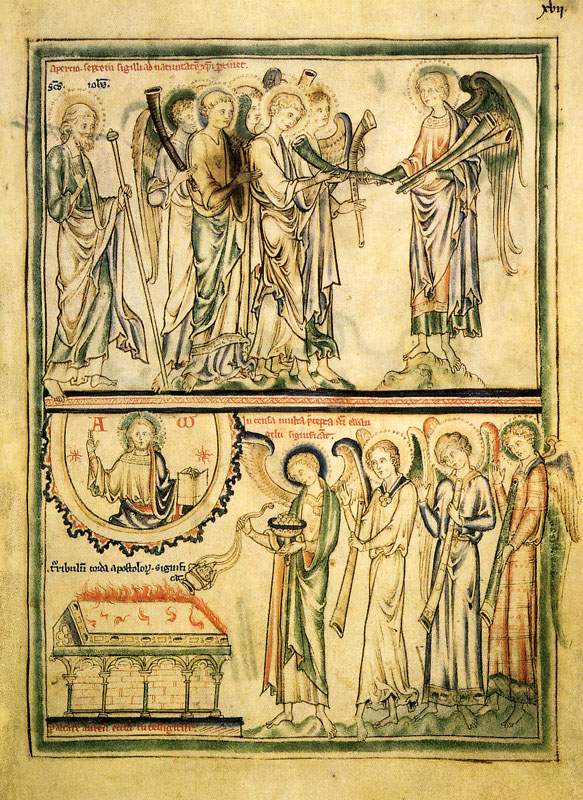
The seven angels with seven trumpets, and the angel with a censer, c. 1020 C. E.

Then the seven angels who had the seven trumpets prepared to sound them.

The first angel sounded his trumpet, and there came hail and fire mixed with blood, and it was hurled down on the earth. A third of the earth was burned up, a third of the trees were burned up, and all the green grass was burned up.

The second angel sounded his trumpet, and something like a huge mountain, all ablaze, was thrown into the sea. A third of the sea turned into blood, a third of the living creatures in the sea died, and a third of the ships were destroyed.

The third angel sounded his trumpet, and a great star, blazing like a torch, fell from the sky on a third of the rivers and on the springs of water—the name of the star is Wormwood. A third of the waters turned bitter, and many people died from the waters that had become bitter.

The fourth angel sounded his trumpet, and a third of the sun was struck, a third of the moon, and a third of the stars, so that a third of them turned dark. A third of the day was without light, and also a third of the night.

As I watched, I heard an eagle that was flying in midair call out in a loud voice: “Woe! Woe! Woe to the inhabitants of the earth, because of the trumpet blasts about to be sounded by the other three angels!”

The fifth angel sounded his trumpet, and I saw a star that had fallen from the sky to the earth. The star was given the key to the shaft of the Abyss. When he opened the Abyss, smoke rose from it like the smoke from a gigantic furnace. The sun and sky were darkened by the smoke from the Abyss. And out of the smoke locusts came down on the earth and were given power like that of scorpions of the earth. 

They were told not to harm the grass of the earth or any plant or tree, but only those people who did not have the seal of God on their foreheads. They were not allowed to kill them but only to torture them for five months. And the agony they suffered was like that of the sting of a scorpion when it strikes. During those days people will seek death but will not find it; they will long to die, but death will elude them.

The locusts looked like horses prepared for battle. On their heads they wore something like crowns of gold, and their faces resembled human faces. Their hair was like women’s hair, and their teeth were like lions’ teeth. They had breastplates like breastplates of iron, and the sound of their wings was like the thundering of many horses and chariots rushing into battle. They had tails with stingers, like scorpions, and in their tails they had power to torment people for five months. They had as king over them the angel of the Abyss, whose name in Hebrew is Abaddon and in Greek is Apollyon (that is, Destroyer).

The first woe is past; two other woes are yet to come. (New International Version)

Angels receiving seven trumpets, c. 1255 C.E.

Woah; this isn’t exactly some light bedtime reading. It has to do with the end of all things, with God’s judgment upon the earth. Seven angels with seven trumpets are about to sound them with disastrous results. The last three trumpets are also referred to as the three woes upon the earth.

The first four trumpets are bad, yet not nearly as terrible as the last three. The first four affect the natural world and one-third of the earth; whereas the last three directly impact the earth’s inhabitants and affect the entire world.

As hard as it may be to accept biblical readings like today’s, God is not only the author of abundant flourishing, but also of devastating destruction. And it’s in direct answer to the prayers of the saints. (Revelation 8:3)

Although hail and blood remind the biblical student of the plagues of judgment in ancient Egypt before the great exodus of Israelites, it’s the fire that does damage to the trees and grass of the earth. A third of the earth’s land resources are completely burned up.

The second angel blowing the second trumpet results in a great mountain being hurled into the sea. This is reminiscent, for those familiar with the Gospels, of Jesus stating that one with a small amount of faith can command a mountain to be thrown into the sea, and it will be done. (Mark 11:23)

Going back into the Old Testament, in the giving of the Law on the mountain, and with the disobedience of the people at the foot of the mountain, Mount Sinai was ablaze with fire and the glory of God. The New Testament scene in Revelation appears to be something of a Mount Sinai taken up and thrown into the sea – signifying that the grace of Christ has supplanted the curse of the law.

As a result of the second trumpet, a third of all the great oceans are destroyed.

Although C.S. Lewis gave the name “Wormwood” to a fictional agent of Satan, the Wormwood here is a messenger of God, a star that falls from the sky as a result of the third trumpet blown. A third of all the earth’s drinkable water becomes bitter because of the star – which seems to be a link to previous times of judgment from God:

“I will make them eat bitter food
    and drink poisoned water,
because from the prophets of Jerusalem
    ungodliness has spread throughout the land.” (Jeremiah 23:15, NIV)

“They have followed the stubbornness of their hearts; they have followed the Baals, as their ancestors taught them.” Therefore this is what the Lord Almighty, the God of Israel, says: “See, I will make this people eat bitter food and drink poisoned water. (Jeremiah 9:14-15, NIV)

There’s nothing that falls from the sky with the blast of the fourth trumpet. Yet a third of the sun, moon, and stars are dimmed. This is a portent that something worse is about to happen – which is what the “eagle” [vulture] announces against the earth’s inhabitants.

Another star falls to the earth, but with even more disaster than the previous star – opening a pit in the heart of the earth. Smoke comes billowing out, darkening the sun. Then, locusts with the stinging power of scorpions, come upon the land.

Rather than humans having authority to trample on snakes and scorpions, these demonic insects carry the ability and the authority to harm humanity – much like the great locust horde of judgment during the time of the prophet Joel (Joel 2:1-11). The difference with John’s Apocalypse is that these are a demonic host with Apollyon the Destroyer leading them.

The previous judgments were from above; this first woe is from below – connecting the powers of death, destruction, and the grave together with the force of evil. It’s a time of sheer torture; a traumatic five months of horrendous agony.

Conclusion

None of these terrible scenes of judgment are meant to scare the hell out of anybody and put the fear of heaven into them. Instead, the New Testament book of Revelation (also known as the Apocalypse of John) is meant for devoted believers in Jesus to be encouraged that an end is coming. They can persevere in following Jesus because it will be worth it.

The hardships, difficulties, and persecutions experienced – for following the words and ways of Jesus – will not last; a time is coming soon when God will judge the living and the dead. Evil will be dealt its final blow. And we will enter a realm of unending peace with the God for whom we have given our all.

Therefore, since we are receiving a kingdom that cannot be shaken, let us be thankful, and so worship God acceptably with reverence and awe, for our “God is a consuming fire.” (Hebrews 12:28-29; Deuteronomy 4:24)

May the Lord answer you in the day of trouble!
    The name of the God of Jacob protect you!
May he send you help from the sanctuary
    and give you support from Zion.
May he remember all your offerings
    and regard with favor your burnt sacrifices. Selah

May he grant you your heart’s desire
    and fulfill all your plans. Amen. (Psalm 20:1-4)