Acts 2:1-21 – The Day of Pentecost

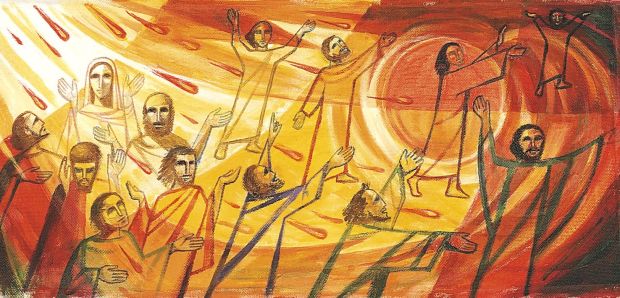
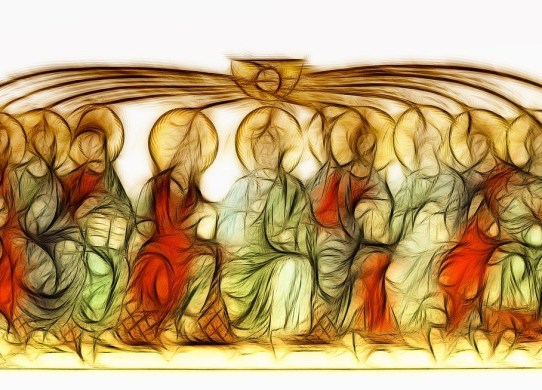
When Pentecost Day arrived, they were all together in one place. Suddenly a sound from heaven like the howling of a fierce wind filled the entire house where they were sitting. They saw what seemed to be individual flames of fire alighting on each one of them. They were all filled with the Holy Spirit and began to speak in other languages as the Spirit enabled them to speak.

There were pious Jews from every nation under heaven living in Jerusalem. When they heard this sound, a crowd gathered. They were mystified because everyone heard them speaking in their native languages. They were surprised and amazed, saying, “Look, aren’t all the people who are speaking Galileans, every one of them? How then can each of us hear them speaking in our native language? Parthians, Medes, and Elamites; as well as residents of Mesopotamia, Judea, and Cappadocia, Pontus and Asia, Phrygia and Pamphylia, Egypt and the regions of Libya bordering Cyrene; and visitors from Rome (both Jews and converts to Judaism), Cretans and Arabs—we hear them declaring the mighty works of God in our own languages!” They were all surprised and bewildered. Some asked each other, “What does this mean?” Others jeered at them, saying, “They’re full of new wine!”

Peter stood with the other eleven apostles. He raised his voice and declared, “Judeans and everyone living in Jerusalem! Know this! Listen carefully to my words! These people aren’t drunk, as you suspect; after all, it’s only nine o’clock in the morning! Rather, this is what was spoken through the prophet Joel:

In the last days, God says,
I will pour out my Spirit on all people.
    Your sons and daughters will prophesy.
    Your young will see visions.
    Your elders will dream dreams.
    Even upon my servants, men and women,
        I will pour out my Spirit in those days,
        and they will prophesy.
I will cause wonders to occur in the heavens above
    and signs on the earth below,
        blood and fire and a cloud of smoke.
The sun will be changed into darkness,
    and the moon will be changed into blood,
        before the great and spectacular day of the Lord comes.
And everyone who calls on the name of the Lord will be saved. (Common English Bible)
The Holy Spirit is the distinguishing mark of the believer in Jesus Christ.

Therefore, since the Spirit is given, the main responsibility of Christians is to receive. 

Christianity is distinctive in this sense – it is primarily a religion of receiving. The Christian life is lived by the power of the Holy Spirit, and not in our own strength. The function of faith is to receive what grace offers. 

We are saved and sanctified by grace alone through faith. God lives in and through us by means of the Spirit. The miraculous and the supernatural cannot, obviously, be done by any human person.  It can, however, be accomplished through the power of the Holy Spirit.

People tend to put a lot of pressure on themselves to be a certain way and to do certain things. The result? Tiredness. Discouragement. Imbalance. Lots of giving. Little receiving.

Christianity is not chiefly about giving but receiving. The Christian life is about putting oneself in a position to receive through prayer and humility. In Christianity, the opposite of receiving is not giving – it’s pride. 

Maybe this kind of talk makes you uncomfortable. I’m not talking about being passive or lazy. I’m highlighting the need of receiving grace from God by means of the Holy Spirit. Then, the Spirit to work in and through us. 

Jesus said we would do greater works than even he himself with the advent of the Spirit! (John 14:12-14)

The question then becomes: Will we let God be God? Will we allow the Spirit to do work in us?
The Spirit is elsewhere described in Holy Scripture as a gentle presence, an encourager, counselor, and comforter. Yet, not here at Pentecost – the Spirit is portrayed like a violent wind and an unusual fire.

The Holy Spirit on the Day of Pentecost was not some gentleman caller entering politely when invited. Instead, the Spirit appears more like a drunken sailor who bursts into the room and causes a big ruckus. There’s nothing subtle about the Spirit at Pentecost. The Spirit is electric, bombastic, and volcanic, causing a huge scene and upheaving the status quo.

Because of Pentecost, Christians are marked and defined by God’s Spirit living within them and being full of the Spirit. God wants to pour out the Spirit on all kinds of people to overflowing so that what comes out of them is “prophecy.” 

The prophet Joel and the Apostle Peter do not intend the word “prophecy” to mean predicting the future. Rather, they are referring to inspired speech coming from a heart overflowing with the Spirit. 

Just as an inebriated person says and does things they would not typically say or do because they are filled with alcohol, so the person filled with God’s Spirit says things and does things they would not typically say or do because their inspiration and courage come as a result of God within them.

Thus, we must cast off the unholy spirits of inebriation and receive the Holy Spirit of God.

Descent of the Holy Spirit at Pentecost mosaic by Anna Wyner

God sobered-up the little band of Christ followers from learners to practitioners, sending them into the world with a mission.

Being on a mission from God is not really about ability; it’s about being filled and sent. 

First time parents may read and learn all they can about parenting before their child is born. Yet, when that little bundle comes into the world, and the hospital puts this kid in your arms and sends you out, you feel inadequate for the task. Parenting becomes a kind of supernatural affair where you pray and learn on the fly, finding out that you need something beyond yourself to get anywhere in raising this screaming, pooping, sleeping person who depends completely on you for everything. 

God sends us into the world to make disciples. And we may feel very inadequate for the task. However, this has more to do with receiving the Spirit. The Spirit comes looking to turn our lives upside-down with new life in Jesus Christ. 

Pentecost means that the Spirit came to shake things up and accomplish among God’s people what they could never do on their own.

Everyone who calls on the name of the Lord will be saved. 

The Church in the New Testament was not a country club for people to simply enjoy the perks of membership.  The community of the redeemed, the Church, is actually more like a place where the people seem drunk because they are all talking with inspired speech from the Holy Spirit. 

Maybe we don’t need to be saved in the sense that we have already called on the name of the Lord concerning forgiveness in Christ. Yet, maybe we need to call on the name of the Lord to be delivered from our misguided attempts to see the Christian life as a pleasant affair.

Perhaps we need deliverance from disordered priorities and misguided loves. We may need to be saved from ourselves so that we are open to the Holy Spirit with palms up receiving from God whatever it is the Spirit wants to do in and through us, rather than telling God how we think things ought to go. 

Prayer, then, is more about receiving the Spirit and God’s purposes for us rather than giving God an earful and expecting the Lord to bless our plans.

Pentecost is the launching pad of the church’s mission – it was explosive because the Spirit is a kind of wild man who fills people up to overflowing so that what comes out of them is inspired speech and missional actions.

If a language barrier cannot stop the Spirit from operating, then how much more can God transform us and use us in the lives of those around us?

Joel’s prophecy, quoted by Peter, is only partially fulfilled. Events have been set in motion by Pentecost for the complete fulfillment of God’s justice. So, there’s some urgency for people to fill their vacuous souls with the grace freely offered to them in Christ.

The outpouring of the Spirit is a sign: The end is near. And the generous giving of the Spirit is inclusive – there is room for all kinds of people. Through the Spirit, God saves all who call on the name of the Lord.

Today is not just another day on the calendar. It is the Day of Pentecost! 

Just as marriages occasionally need a spark and a fire and a fresh wind, so we need the Holy Spirit to breathe on us, comfort us, and inspire us.

May we be filled with the Spirit as we anticipate what our God will do now, and in the years to come.

Spirit of the living God, through the reading and proclamation of the Word, may you refresh our spirits, reshape our desires, recreate our hearts, and reform our ways so that we will shine with your enduring glory, through Jesus Christ, our risen and ascended Lord. Amen. 

Acts 1:1-11 – Ascension of the Lord

In my first book I told you, Theophilus, about everything Jesus began to do and teach until the day he was taken up to heaven after giving his chosen apostles further instructions through the Holy Spirit. During the forty days after he suffered and died, he appeared to the apostles from time to time, and he proved to them in many ways that he was actually alive. And he talked to them about the Kingdom of God.

Once when he was eating with them, he commanded them, “Do not leave Jerusalem until the Father sends you the gift he promised, as I told you before. John baptized with water, but in just a few days you will be baptized with the Holy Spirit.”

So, when the apostles were with Jesus, they kept asking him, “Lord, has the time come for you to free Israel and restore our kingdom?”

He replied, “The Father alone has the authority to set those dates and times, and they are not for you to know. But you will receive power when the Holy Spirit comes upon you. And you will be my witnesses, telling people about me everywhere—in Jerusalem, throughout Judea, in Samaria, and to the ends of the earth.”

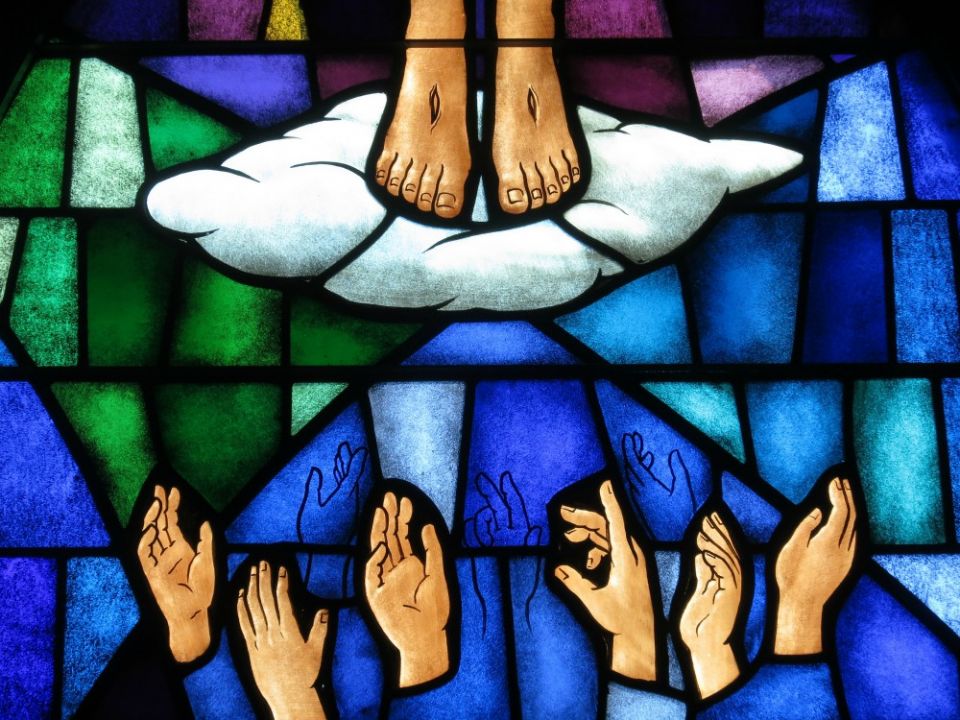
After saying this, he was taken up into a cloud while they were watching, and they could no longer see him. As they strained to see him rising into heaven, two white-robed men suddenly stood among them. “Men of Galilee,” they said, “why are you standing here staring into heaven? Jesus has been taken from you into heaven, but someday he will return from heaven in the same way you saw him go!” (New Living Translation)

“At his Ascension, our Lord entered Heaven, and he keeps the door open for humanity to enter.”

Oswald Chambers

Jesus was taken up to heaven in what Christians celebrate as the “Ascension of the Lord.” This is a hugely important event for followers of Jesus.

The Ascension means that Christ is now presently sitting at God’s right hand, offering continual prayers on our behalf to the Father. We have an advocate, a champion, who has gone before us and secured deliverance from sin, death, and hell.

On top of it all, Christ’s ascension means that Jesus is the universal ruler; he commands a kingdom that will never end. Yes, the Ascension of the Lord is a big deal.

So, why does a day set aside on the Christian Calendar celebrating the Lord’s mighty and redemptive ascension over all creation garner such scant attention from many churches?

Maybe the church has A.D.D. (Ascension Deficit Disorder).

Our clue to the inability to focus on such a grand redemptive event is the disciples’ response when Jesus ascended.

The picture St. Luke paints for us in the account of our Lord’s ascension, is a group of guys looking up into the sky slack-jawed and shoulders hunched.

It took a couple of angels to come along and ask them what in the world they were doing just standing there. Now is not the time to stand and gawk at the clouds, the angels insisted. Jesus will come back when he comes back. You aren’t going to know when. So, now is the time to get busy with what Jesus just told you to do two minutes ago: Tell everyone about me.

Christ’s ascension to heaven is a deeply theological event. It’s freighted with major implications for our prayer lives. And it means Christ is the King to whom we must obey.

Jesus is coming again. In the meantime, there’s to be no cloud-gawking. Instead, there is to be a well-developed and well-cultivated connection with Jesus which proclaims the good news that Christ died, rose from death, and ascended to heaven for mine and your forgiveness of sins and a new clean slate on life.

Trying to peer into the future about how the end of history will shake-out is, frankly, not the job we are called to do. Believers in Jesus aren’t supposed to stand and gawk at the clouds waiting for the Lord’s return, as if we are in some earthly holding tank until heaven. 

Rather, we are to bear witness about the person and work of Jesus. The Ascension of the Lord means we are God’s people blessed with deliverance from the realm of sin, and the hope of Christ’s coming again. The Church everywhere recognizes together the rule and reign of the Lord Jesus.

The world, as we know it, shall eventually come to an end. Until that time, Christians since the time of the ascension have been proclaiming Christ crucified, died, risen, ascended, and coming again.

This is a day of joy and celebration for us. Jesus is our ascended and glorified king! The fate of the earth is with the benevolent and mighty Ruler of all. Jesus is Lord, and no other human leader is. Thank you, Jesus.

The great Reformed Confession, the Heidelberg Catechism, question and answer 49, states:

Q: How does Christ’s ascension to heaven benefit us?

A: First, he is our advocate

            in heaven

            in the presence of his Father.

Second, we have our own flesh in heaven

            as a sure pledge that Christ our head

            will also take us, his members,

            up to himself.

Third, he sends his Spirit to us on earth

            as a corresponding pledge.

            By the Spirit’s power

                        we seek not earthly things

                        but the things above, where Christ is,

                                    sitting at God’s right hand.

Amen.

1 Corinthians 5:6b-8 – Easter Is More Than a Day

All Creation Sings His Praise by Jen Norton

Your boasting is not good. Don’t you know that a little yeast affects the whole batch of dough? Clean out the old yeast so that you may be a new batch of dough—you are, in fact, without yeast. For Christ, our Passover lamb, has been sacrificed. So then, let us celebrate the festival, not with the old yeast, the yeast of vice and evil, but with the bread without yeast, the bread of sincerity and truth. (New English Translation)

Easter is more than one day. It’s as if a massive spiritual 10.0 earthquake occurred on that day with a great tsunami of life powerfully overwhelming all of history.

Today begins the Christian season of Eastertide. It is a time of realizing we are without yeast, that is, without any old unhealthy ingredients which may work through the whole batch of dough. We are to live into the new reality given to us by means of Christ’s resurrection from death.

Eastertide spans the next fifty days until the Day of Pentecost. That’s a hefty seven weeks of bringing the new life we enjoy to the forefront. Eastertide’s intentional focus is to acknowledge and celebrate the resurrection of Jesus Christ, exulting in our own new life in him.

Now, you might say to yourself, “Why do we need to have some liturgical season about Christ’s resurrection? Shouldn’t we be living like we recognize this every day?” Yes, of course we should. 

Yet, consider this: If we only sing songs of resurrection on Easter Sunday and only occasionally think of Christ’s resurrection outside of Easter Sunday, then perhaps, its sage to bring a highlighted focus to the resurrection in a special season. 

Just as it is necessary to take more than one vacation day in the year for renewal, so it is essential to observe more than one day to enjoy Easter. If nothing else, Eastertide gives believers an opportunity to let Christ’s resurrection percolate in our hearts so that we experience new life, as people who exhibit an alive-spirit. And, God knows, we could use much more of that in our congregations and our world!

If eternal life and being fully alive are needed for us, then it only makes sense that we take advantage of what Eastertide has to offer: A deliberate look at Christ’s resurrection, exploring its implications and impact for us. 

Simply assuming we all know about resurrection simply will not do, any more than my wife assuming I love her without looking her straight in the eye and telling her so. 

If Christ has not been raised, your faith is futile (1 Corinthians 15:17). Being people of sincerity and truth comes with a purposeful eye on a new resurrected life. Without an Eastertide, there’s a sin-as-usual kind of approach to life with a shoulder shrug that says, “Meh, what’s a guy to do?” 

Methinks that unhelpful boasting and sinful pride are directly related to moving on from Easter Sunday and backsliding to the old life. Like a dog returning to its vomit, so is a church who puts away sin on a Sunday, then goes back to pre-resurrection living – which is no life, at all.

Instead, with Eastertide’s full focus, we have the hope of life everlasting because Christ has risen from death.  We have the hope of individual renewal, corporate revitalization, and worldwide revival because there is a risen Savior.

Therefore, this is the perfect time of year to engage in some renewal practices, or even make a few simple changes that show signs of life. Here are just a few ideas for lifting Christ’s resurrection into the next few months:

Pray for a revival of spirituality. Christ brings life, so praying to God for revival is a deliberate way of connecting with God.

Squarely address the leaven of harmful and unhelpful bread. Gossip, back-biting, slander, injustice, oppression, gaslighting, and hate are all poisonous yeast that kills those who are hungry. Casually sluffing-off someone’s acerbic speech and actions as “That’s just the way they are,” will not do, unless you want to exist in a pro-death culture.

Serve unleavened bread. Promote healthy practices of living. If guilty acts and shameful actions bring death, using our words and deeds for encouragement, love, mercy, forgiveness, and building up one another promotes growth, health, and life.

Proclaim resurrection.  I believe the church is meant to be the hope of the world because Christ is the risen Lord. Graciously proclaim the resurrected Christ and how the spiritual life makes a difference in daily existence.

Start a new ministry you always believed would make a difference. It is the appropriate season to take a risk. After all, if you have eternal life, can you really fail? Host a new in-person or virtual small group. Take initiative to up your knowledge of technology. Read some significant books and start a book club. I’m willing to bet you have some idea(s) rolling around inside you about blessing the world. Now, during Eastertide, is the time to turn that idea into reality.

Eat spiritually nutritious bread. If you would not think of skipping meals for days at a time, then consider the erosion to your soul and your church which can occur when folks don’t read their Bibles on a regular basis or pray with any kind of consistency. Stick to a plan. It will not only bring growth to your own life but will impact those around you.

Just keeping the word “Eastertide” in front of you for the next few months can be a simple yet powerful way of reminding us that God has called us to new life. Let the reality of Christ’s resurrection strengthen your heart so that new life informs all your thinking, speaking, feeling, and acting.

Holy and righteous God, you raised Christ from the dead and glorified him at your right hand. Let the words of Scripture, fulfilled in Jesus your Son, burn within our hearts and open our minds to recognize him in the breaking of bread. Amen.

Psalm 51:1-17 – Ash Wednesday

Have mercy on me, God, according to your faithful love!
    Wipe away my wrongdoings according to your great compassion!
Wash me completely clean of my guilt;
    purify me from my sin!
Because I know my wrongdoings,
    my sin is always right in front of me.
I’ve sinned against you—you alone.
    I’ve committed evil in your sight.
That’s why you are justified when you render your verdict,
    completely correct when you issue your judgment.
Yes, I was born in guilt, in sin,
    from the moment my mother conceived me.
And yes, you want truth in the most hidden places;
    you teach me wisdom in the most secret space.

Purify me with hyssop and I will be clean;
    wash me and I will be whiter than snow.
Let me hear joy and celebration again;
    let the bones you crushed rejoice once more.
Hide your face from my sins;
    wipe away all my guilty deeds!
Create a clean heart for me, God;
    put a new, faithful spirit deep inside me!
Please don’t throw me out of your presence;
    please don’t take your holy spirit away from me.
Return the joy of your salvation to me
    and sustain me with a willing spirit.
Then I will teach wrongdoers your ways,
    and sinners will come back to you.

Deliver me from violence, God, God of my salvation,
    so that my tongue can sing of your righteousness.
Lord, open my lips,
    and my mouth shall proclaim your praise.
You don’t want sacrifices.
    If I gave an entirely burned offering,
    you wouldn’t be pleased.
A broken spirit is my sacrifice, God.
    You won’t despise a heart, God, that is broken and crushed. (Common English Bible)

Ash Wednesday is an ancient holy day on the Church Calendar. It marks the beginning of the season of Lent—a time of penitence, discipline, and renewal.

We are reminded of our mortality, we confess our sins, and we experience forgiveness through Christ’s death and resurrection. The “imposition of ashes” is a central part of Ash Wednesday observances, whereby the penitent worshiper receives ashes on the forehead in the sign of the cross.

In Holy Scripture, ashes serve both as a symbol of mortality and as a sign of mourning and repentance. But neither sin nor death is the final word. So, we also have confidence and gratitude that Christ has conquered death, and nothing can separate us from the love of God, which is in Jesus, our Lord.

Today, on this Ash Wednesday, the appropriate posture of the devout Christian is prayer. Specifically, prayers of confession of our great and many sins, shortcomings, and moral failures. 

This might sound negative and a major downer. Yet, to not look evil square in the face and call it out for what it is, is at best denial, and at the worst allowing a bitter seed of unforgiveness to gestate in the depths of your soul. 

It seems to me there is no better way to confront the darkness within than with using the ancient prayer book of the Old Testament Psalms. I encourage you to pray Psalm 51 out loud and slowly, with a generous amount of emotional flavor – even, and especially, if you don’t feel like it. 

Pray the ancient psalm over more than once, and perhaps several times punctuated throughout the day today. In doing so, you will be joining the faithful across this entire big world who today offer to God a prayer of subversion against the blackness on this earth.

Holy God, as the season now turns to Lent, we pray that you will guide us in the days ahead.  As we journey with Jesus, give us an abiding sense of your presence, an unguarded sense of ourselves, and an awareness of the needs of this world.

Loving God, as we are marked with the ashes of earth, we bring before you the frailty of our very human lives:  our fragile health; the uncertainty of our plans; the changing nature of our relationships. Grant us patience in suffering and healing from our ills. Give us, in equal measure, humility and hope in our pursuits. Bind us in love that is constant, yet able to change according to the needs and circumstances before us.

Just God, you call us to action; to bring freedom to the oppressed; to care for those in need; to lift the burdens of others. We ask you to increase our courage and our will to work for the peace you envision and desire. We pray for an end to warfare and conflict, accepting our call to be peacemakers. We pray for an end to hunger and homelessness, knowing we are called to share with others and show hospitality. We pray for an end to false righteousness, evil speech, and shallow faith in our lives, in the church, in our public life, and among all the nations.

Eternal God, we pray your kingdom will come in fullness; that what is perishable will be raised imperishable; that death itself will be swallowed up in victory; through Jesus Christ, our Savior and Lord. Amen.