Ash Wednesday (Matthew 6:16-34)

“When you fast, do not look somber as the hypocrites do, for they disfigure their faces to show others they are fasting. Truly I tell you, they have received their reward in full. But when you fast, put oil on your head and wash your face, so that it will not be obvious to others that you are fasting, but only to your Father, who is unseen; and your Father, who sees what is done in secret, will reward you.

“Do not store up for yourselves treasures on earth, where moths and vermin destroy, and where thieves break in and steal. But store up for yourselves treasures in heaven, where moths and vermin do not destroy, and where thieves do not break in and steal. For where your treasure is, there your heart will be also.

“The eye is the lamp of the body. If your eyes are healthy, your whole body will be full of light. But if your eyes are unhealthy, your whole body will be full of darkness. If then the light within you is darkness, how great is that darkness!

“No one can serve two masters. Either you will hate the one and love the other, or you will be devoted to the one and despise the other. You cannot serve both God and money.

“Therefore I tell you, do not worry about your life, what you will eat or drink; or about your body, what you will wear. Is not life more than food, and the body more than clothes? Look at the birds of the air; they do not sow or reap or store away in barns, and yet your heavenly Father feeds them. Are you not much more valuable than they? Can any one of you by worrying add a single hour to your life?

“And why do you worry about clothes? See how the flowers of the field grow. They do not labor or spin. Yet I tell you that not even Solomon in all his splendor was dressed like one of these. If that is how God clothes the grass of the field, which is here today and tomorrow is thrown into the fire, will he not much more clothe you—you of little faith? So do not worry, saying, ‘What shall we eat?’ or ‘What shall we drink?’ or ‘What shall we wear?’ For the pagans run after all these things, and your heavenly Father knows that you need them. 

But seek first his kingdom and his righteousness, and all these things will be given to you as well. Therefore do not worry about tomorrow, for tomorrow will worry about itself. Each day has enough trouble of its own. (New International Version)

Traditional Ash Wednesday services focus on the brevity of life and remind worshippers that they came from dust and will soon enough return back to the earth, dust once more. For our many of our parents in the faith, Lent was typically a sad season in which they gave up something in order to prepare themselves for eternal life.

The salvation promised and hoped for led them to look away from the joys of Spring and the beauties of the earth. Faithful Christians, in generations past, trained their eyes on heaven, forsaking time for eternity.

Yes, life is serious and risky business, and no one gets out alive. Yet is salvation really all about escaping this world of constant grief and death? Or is it seeing everlasting beauty in each passing moment?

It could be that you struggle with Ash Wednesday services and the season of Lent precisely because of its focus on giving up something, or because when you were a kid this time of year seemed like such a downer. Maybe your typical approach to Lent in the past has been a shoulder shrug and a response of “meh.”

So, therefore, I want us to get a different take on the meaning of Ash Wednesday and look at it from a different angle.

I will take away the ashes on their head, and I will give them a crown. I will take away their sadness, and I will give them the oil of happiness. I will take away their sorrow, and I will give them celebration clothes. 

Isaiah 61:3, ERV

The uncertainty of life can invite us to praise and wonder, to seize the moment—for this is the day the Lord has made and I will rejoice in it! All that I love and care for is mortal and fleeting, but mortality is the inspiration to celebration and love.

This is the sort of approach I saw in a dear friend who died fifteen years ago from a very long struggle with cancer. Bea always found ways to rejoice in her suffering, to be attentive to the working of God around her, and to bless those who needed God’s grace more than she did. More than once I found Bea, in one of her many hospital stays, out of the bed and in someone else’s room playing her dulcimer (she had once been a music teacher) and singing a hymn of praise to a fellow patient.

This Ash Wednesday, I’m not only fasting and giving up a few meals a week; I’m also letting go of everything that keeps me from rejoicing in the passing beauty of the earth.

Yes, we are dust, but we are real earthly sacred dust. Dust is good, after all, emerging from God’s intergalactic creativity. We are frail, but we are also part of a holy adventure reflecting God’s love over thousands of years.

Ash Wednesday is a time for us to pause, notice, wake up, and discover that God is in this place. This day invites us to take a much needed break and open up to the precarious yet beautiful world in which we live. So in this season of Lent, I plan on considering the lilies and the birds of the air.

In some Christian traditions, the imposition of ashes is accompanied by the words, “repent and believe the gospel.” And that I plan to do this year. I plan to turn around and be more present to the moment, appreciating God’s grandeur, and believing the good news—the embodied, everlasting, beautiful, wondrous, and gracious good news of walking with the Lord who is with me, surrounds me, and goes before me and after me.

Pastor and author, Jan Richardson, lost her husband to cancer several years ago during the season of Lent. She chose to cremate her husband so that his ashes might remind her and her family that there is beauty in the dust.  She wrote the following poem at her first Ash Wednesday without him:

Blessing the Dust

All those days
you felt like dust,
like dirt,
as if all you had to do
was turn your face
toward the wind
and be scattered
to the four corners

or swept away
by the smallest breath
as insubstantial—

did you not know
what the Holy One
can do with dust?

This is the day
we freely say
we are scorched.

This is the hour
we are marked
by what has made it
through the burning.

This is the moment
we ask for the blessing
that lives within
the ancient ashes,
that makes its home
inside the soil of
this sacred earth.

So let us be marked
not for sorrow.
And let us be marked
not for shame.
Let us be marked
not for false humility
or for thinking
we are less
than we are

but for claiming
what God can do
within the dust,
within the dirt,
within the stuff
of which the world
is made
and the stars that blaze
in our bones
and the galaxies that spiral
inside the smudge
we bear.

Amen.

Epiphany of the Lord (Matthew 2:1-12)

After Jesus was born in Bethlehem in Judea, during the time of King Herod, Magi from the east came to Jerusalem and asked, “Where is the one who has been born king of the Jews? We saw his star when it rose and have come to worship him.”

When King Herod heard this he was disturbed, and all Jerusalem with him. When he had called together all the people’s chief priests and teachers of the law, he asked them where the Messiah was to be born. “In Bethlehem in Judea,” they replied, “for this is what the prophet has written:

“‘But you, Bethlehem, in the land of Judah,
    are by no means least among the rulers of Judah;
for out of you will come a ruler
    who will shepherd my people Israel.’”

Then Herod called the Magi secretly and found out from them the exact time the star had appeared. He sent them to Bethlehem and said, “Go and search carefully for the child. As soon as you find him, report to me, so that I too may go and worship him.”

After they had heard the king, they went on their way, and the star they had seen when it rose went ahead of them until it stopped over the place where the child was. When they saw the star, they were overjoyed. On coming to the house, they saw the child with his mother Mary, and they bowed down and worshiped him. Then they opened their treasures and presented him with gifts of gold, frankincense and myrrh. And having been warned in a dream not to go back to Herod, they returned to their country by another route. (New International Version)

The light exists; it’s there. But not everyone likes it.

While many celebrate the light, such as Christians on the day of Epiphany, others wrap themselves in the cloak of darkness. There are various responses to Jesus as the Light of the World; not all of them are the same.

King Herod responds with anger

Herod was distressed with the news of a potential King of the Jews being born; he saw this as a threat to his rule. Herod, ever the narcissistic person who always sought to wipe out any threat to his throne, went over the top in seeking destroy Jesus. 

At the time of Christ’s birth, Herod had been the reigning king for about 30 years. During that time, his paranoia about losing power led him to kill his wife and three of his own sons because he saw them as threats to his authority. Herod feigned a desire to worship Christ, but this was really a sinister façade in order to get rid of Jesus by any means possible.

Jerusalem responds with anxiety

The people of Jerusalem felt that Jesus was going to upset the status quo. He was, for them, a threat to their security; any change within the system might cause Herod to take it out on them (which he had done before). 

Although the people were looking for a deliverer, they did not want things to shake up too much and arouse the Romans to abuse them.

Whenever we get caught up in maintaining the status quo, out of fear, then we have no room in the inn for Mary and Joseph. 

Always trying to keep people happy and not upset them is a tenuous way to live. Such an agenda will typically result in missing Jesus when he shows up. That’s because we’re not really looking for him to start with. 

For example, if our task as parents is to just keep our kids out of trouble, they’re going to miss Jesus; and if they find him, it will be in spite of us and not because of us. Yet, if our truest desire for them is to know Christ, then our prayers, our words, and our actions will reflect the ethics of God’s kingdom.

Religious leaders respond with apathy

The chief priests and teachers of the law had all the right answers; and responded to Herod’s questions with the correct information.

The sad part is that the guys who knew the most about Scripture, who actually had a handle on God’s law, were simply satisfied with that knowledge and nothing more. They seemed  unconcerned with getting off their butts and getting on their knees to worship the Son of God.

If we know the truth, we must act on it. Jesus wants people to worship in spirit and in truth. He wants more than a mere recognition; Jesus desires us.

The Magi respond with adoration

The Three Wise Men by He Qi

The Wise men, or Magi, were Gentiles and pagan astrologers (not kings). They devoted themselves to studying the stars and discerning what was happening. Because of this, they were often advisors and counselors to kings.

Some may find it scandalous that God used such persons, but that’s okay. The Lord typically uses the folks we believe are (or should be) unusable. Turns out it is the people such as the Magi that demonstrate their devotion and adoration through actual worship and giving of costly gifts.

Epiphany

Each year on January 6 in the Church Calendar, after the twelve days of Christmas, is the celebration of Epiphany. Christ’s coming to this earth as a child and becoming like us is much more than a baby in a manger.  Epiphany of the Lord helps to bring a vision and understanding of God’s glory to all kinds of people of the world.

The word “epiphany” means “manifestation” or “appearance” – which is exactly what happened with the Magi in visiting Jesus. The season of Epiphany has a special emphasis on the teaching and healing ministry of Jesus. The focus of these weeks is that salvation is not limited to Israel but extends to the Gentiles, as well.

With Epiphany’s light, we see that one of the most scandalous truths of Christianity is that God graces common ordinary people, who seem far from God, with the gift of Jesus. 

God grants life for all kinds of people – no matter their race, ethnicity, gender, class, or background. It’s a wondrous and astounding spiritual truth that God’s gracious concern is not limited to a certain type of person or a particular group of people.

Grace

Grace is and ought to be the guiding factor in how we interact with people. 

Losing sight of grace leads to being critical and defensive. Like King Herod of old, a graceless person becomes enamored with earthly power and control. But embracing grace leads to the humility of seeing the image of God in people quite different from us. 

Like the Apostle Peter, who learned in a vision to bring the gospel to non-Jews, old legalisms begin to wear away so that people from all walks of life can have access to Jesus and his gracious saving and healing ministry. (Acts 10-11:18)

Grace topples barriers and clears away unnecessary distinctions between others. Our appropriate response to such a grace is to glorify God for this marvelous and amazing work.

Light

A light was provided to lead the Magi to Jesus. Apart from God’s gracious intervention, they would have remained in darkness. 

This old broken world is enveloped in spiritual darkness. All kinds of people have no light at the end of the tunnel of their lives for hope and new life. Christ brings that light to those unable to see. And Jesus, in his teaching ministry, exhorted his followers not to hide their light but to let it shine for all to see. (Matthew 5:14-16)

Sometimes, maybe oftentimes, the best way to bring resolution to our own troubles and problems is through helping others make sense of their lives through the gracious light of Christ. Then, they can see an appearance, an epiphany, of what their lives could be in the gracious and benevolent rule and reign of God. 

In this season of Epiphany, let us journey with Jesus through his earthly upbringing, walk with him in his gracious ministry to people; and keep watch with him so that our own light does not grow dim.

Merciful God of life and light, you have gifted the Church through the goodness of your grace to be your hands; to do your work; to be your voice; to share your words; and to bring healing for broken lives. You have graciously gifted your people with the blessings of your Spirit, the power to transform lives and make all things new.

Now may our hearts receive, our mouths proclaim, our hands prepare for compassionate service so that the love we have will overflow into the hearts of others. May they receive your grace, your renewing Spirit, and your love, through Jesus Christ our Savior. Amen.

The Christ Candle of Light (John 1:1-5)

In the beginning was the Word, and the Word was with God, and the Word was God. He was with God in the beginning. Through him all things were made; without him nothing was made that has been made. In him was life, and that life was the light of all mankind. The light shines in the darkness, and the darkness has not overcome it. (New International Version)

Merry Christmas!

Glory to God in the highest, and on earth peace, goodwill toward humanity! Today we celebrate the mystery of the incarnation – the unfathomable miracle of God becoming human – all for us and for our salvation.

The beginning of the Apostle John’s Gospel is an astounding passage of Scripture. These are verses to slowly and worshipfully read through because it is a theologically rich, lovingly beautiful, and missionally sensitive piece of Holy Scripture. 

The high and holy God has chosen to come and reveal true divinity to us in the person of Jesus. We know God through Christ. We learn what God is like through Jesus. God graciously condescended to us, bent down to communicate in ways we can understand and discern, through the Lord Jesus. 

The God which Christians worship and serve is an over-the-top gracious and generous God. This is a God who has gone to incredible lengths in restoring lost humanity. Since God has bridged the great chasm between heaven and earth, we have hope, joy, peace, and faith. With God in the neighborhood, divine love becomes our motivation to reach out in compassionate service. People matter to God – so much so, that the Father sent the Son to be with us, our Emmanuel.

Jesus is the light of the world.

“I am the light of the world. Whoever follows me will never walk in darkness but will have the light of life.” (John 8:12, NIV)

Jesus told his followers they are the light of the world.

“You are the light of the world. A town built on a hill cannot be hidden. Neither do people light a lamp and put it under a bowl. Instead they put it on its stand, and it gives light to everyone in the house. In the same way, let your light shine before others, that they may see your good deeds and glorify your Father in heaven.” (Matthew 5:14-16, NIV)

A simple observation: Neither Jesus nor his followers become light. They are light. So, what does that mean?

To be light means we take a particular posture toward the world. It means we have a unique role in how we are with one another and in society.

Sometimes it’s important to say what something is not before we talk about what it is. To be light means we are not:

  • The Judge. The incarnation of Jesus was not for the purpose of playing Sheriff in the Old West, riding into the town of this world and gunslinging the bad guys either out of town or into the cemetery. Just because the world shot the sheriff, does not mean they’re off the hook for not shooting the deputy. There is judgment coming. But neither you nor I are the judge. “Do not judge,” said Jesus, otherwise you will be judged. (Matthew 7:1-2)
  • Cave-Dwellers. Rabbit-hole Christians. Dorm toads. Or any other metaphor for separating oneself from society and hiding out. Cave-dwellers want to hide out and start little fires that will only warm themselves. A rabbit-hole Christian scurries from hole to hole trying to avoid the world. Dorm toads never leave the friendly confines of their apartment swamp.

“I have come into the world as a light, so that no one who believes in me should stay in darkness.”

John 12:46, NIV

Rather than judging and hiding, people of the light are:

  • Encouragers. They speak constructive words of edification. Encouragers know there is a bit of light in everyone, so they see through the darkness to the good which can be enlightened and called forth in others. People who encourage have a glow about them which is attractive and winsome.
  • Aware. Being light causes one to see themselves in high definition. Both the image of God and the fallen nature of humanity is seen and held together. People of the light are aware of their identity. They are then able to act with humility, gentleness, and meekness. Since they know they are infinitely loved by God, this brings a great freedom to speak and act with confidence.
  • Believers. Faith begins with receiving grace. It then works its way from an internal truth to an outward expression. People of the light follow in the footsteps of their Lord Jesus. They love, lead, and linger in society as spiritual beings who help illumine the path.
  • Merciful. Since they were once in darkness themselves, people of the light set aside pre-meditated judgment and deal compassionately with those who are spiritually blind.
  • Pure. The light has its way of exposing impurities. People of the light squarely face their own reality and purposely seek purity in all their dealings with society.
  • Peacemakers. Being characterized by the light means we not only possess personal peace; we also make peace through creating and sustaining harmonious relations with others. The light enables us to be spiritual ombudsmen who carefully and effectively bring peace between warring factions.

Jesus is the light of the world. We are the light of the world. That means we do not hide but are present and involved in our families, neighborhoods, communities, local institutions, national affairs, and world problems. Being characterized as followers of Jesus causes a person and a faith community to be visible, to show the world who Jesus is, and what he is like.

The earliest followers of Jesus allowed their light to shine in the world through:

  • Taking in unwanted children, orphans, and babies left exposed to infanticide.
  • Ministry to the sick and dying during times of plague and disease, as well as visiting those in prison without families.
  • Help and kindness to the poor, foreigners, immigrant strangers, and widows, especially when no one else would.

Where light is present, no one needs to remain in darkness. Even a small flickering flame can illumine enough to make a way. And when many small flames come together, there is a great light for all to see.

For what we preach is not ourselves, but Jesus Christ as Lord, and ourselves as your servants for Jesus’ sake. For God, who said, “Let light shine out of darkness,” made his light shine in our hearts to give us the light of the knowledge of God’s glory displayed in the face of Christ. (2 Corinthians 4:5-6, NIV)

May the light of Christ, the living Word, dispel the darkness of our hearts so that we may walk as children of light and sing the praises of a merciful God throughout the world. Amen.

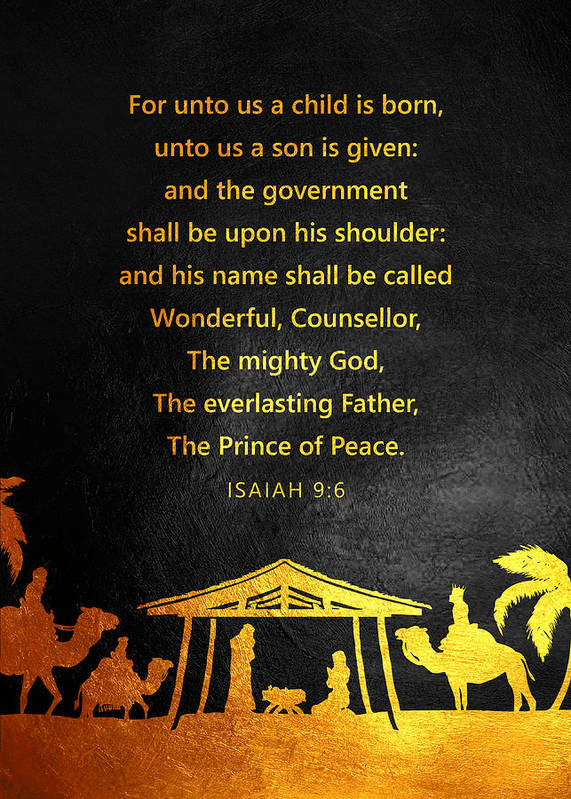
Almighty God, for unto us a child is born, to us a son is given, and the government will be on his shoulders. And he will be called Wonderful Counselor, Mighty God, Everlasting Father, Prince of Peace. You have given your one and only Son to take our nature upon him, and to be born on this day of the virgin Mary.

Help us, who have been born again and made your children by adoption and grace, may be a light for the nations, being daily renewed by your Holy Spirit. Through Jesus Christ our Lord, we pray, to whom with you and the Holy Spirit be honor and glory, now and forever. Amen.

The Mighty God (Isaiah 9:2-7)

The people walking in darkness
    have seen a great light;
on those living in the land of deep darkness
    a light has dawned.
You have enlarged the nation
    and increased their joy;
they rejoice before you
    as people rejoice at the harvest,
as warriors rejoice
    when dividing the plunder.
For as in the day of Midian’s defeat,
    you have shattered
the yoke that burdens them,
    the bar across their shoulders,
    the rod of their oppressor.
Every warrior’s boot used in battle
    and every garment rolled in blood
will be destined for burning,
    will be fuel for the fire.
For to us a child is born,
    to us a son is given,
    and the government will be on his shoulders.
And he will be called
    Wonderful Counselor, Mighty God,
    Everlasting Father, Prince of Peace.
Of the greatness of his government and peace
    there will be no end.
He will reign on David’s throne
    and over his kingdom,
establishing and upholding it
    with justice and righteousness
    from that time on and forever.
The zeal of the Lord Almighty
    will accomplish this. (New International Version)

Bully-Buster

I am the youngest of five siblings. I have a brother two years older than me. When he was younger, my brother spent summers doing bench press contests, and won most of them. This kind of big brother in very handy all through school growing up because, believe it or not, I could sometimes be mouthy toward kids I thought were jerks, who were much bigger and stronger than me. On more than one occasion, my big brother became my bully-buster.

Sometimes we all need a warrior who will take care of the enemy, the bully, who is too big and strong for us to handle on our own.

On this final day of Advent, Christmas Eve, let’s consider one of the titles in today’s Old Testament lesson: “Mighty God.” 

The prophet Isaiah spoke to the spiritually backslidden nation of Judah. They faced continual war, not always looking to God to handle their predicament. Yet, despite the people’s failings, the Lord is a God of grace and hope. Conflict and war won’t always exist; hope will come, not by a larger military or more weapons, but through a child.

Jesus has become our warrior, our bully-buster, defeating the powers of sin, death, and hell, and bringing salvation to us.

El Gibbor

The adjective “mighty” comes from the noun form of the Hebrew word “gibbor” which means “warrior.” In other words, God in Christ is our Warrior. 

God is the One who fights our battles. This reality has a rich history in the Old Testament, beginning with the Exodus of the Israelites from Egypt: 

Moses answered the people, “Do not be afraid. Stand firm and you will see the deliverance the Lord will bring you today. The Egyptians you see today you will never see again. 14 The Lord will fight for you; you need only to be still.” (Exodus 14:13-14, NIV)

God in Christ fights to uphold justice and righteousness, using divine power to do for us what we cannot do for ourselves. 

The ultimate “bully” is the devil himself, and Christ has defeated him on the cross and brought victory and deliverance from sin to our lives.

“With good reason does Isaiah call him strong or mighty, because our contest is with the devil, death, and sin, enemies too powerful and strong, by whom we would be immediately vanquished, if the strength of Christ had not rendered us invincible. Thus we learn from this title that there is in Christ abundance of protection for defending our salvation, so that we desire nothing beyond him; for he is God, who is pleased to show himself strong on our behalf.”

John Calvin

While we were yet 90-poiund weaklings, the cross of Christ became our strength and our hope: 

When you were dead in your sins and in the uncircumcision of your flesh, God made you alive with Christ. He forgave us all our sins, having canceled the charge of our legal indebtedness, which stood against us and condemned us; he has taken it away, nailing it to the cross. And having disarmed the powers and authorities, he made a public spectacle of them, triumphing over them by the cross. (Colossians 2:13-15, NIV)

Jesus is our Victor. Christ’s vicarious atonement for humanity brought victory over sin and evil through the cross. Thus, the devil is defeated; the prince of this world cast out. Jesus has brought a great moral triumph over the powers of darkness. The evil yoke of slavery to sin has been broken through the blood of Christ. The Son overcame the tyrant of our souls and secured liberty and salvation from the dogged effects of Satan upon us. 

Jesus as our Warrior, the Mighty God, brings a big dose of hope and confidence to our lives. 

I walked the halls of my school without fear because of my big brother. So, how much more can we move about our lives, not cringing in fear, but confident and full of hope because we have Jesus the Warrior who has taken care of the sin issue once for all, and puts the devil in his place?

The Divine Warrior

Righteousness will be his belt and faithfulness the sash around his waist. (Isaiah 11:5, NIV)

He put on righteousness as his breastplate,
    and the helmet of salvation on his head;
he put on the garments of vengeance
    and wrapped himself in zeal as in a cloak. (Isaiah 59:17, NIV)

If those verses sound familiar to Christians, it’s because the Apostle Paul had them in mind when he wrote to the church at Ephesus:

Finally, be strong in the Lord and in his mighty power. Put on the full armor of God, so that you can take your stand against the devil’s schemes. For our struggle is not against flesh and blood, but against the rulers, against the authorities, against the powers of this dark world and against the spiritual forces of evil in the heavenly realms. 

Therefore put on the full armor of God, so that when the day of evil comes, you may be able to stand your ground, and after you have done everything, to stand. Stand firm then, with the belt of truth buckled around your waist, with the breastplate of righteousness in place, and with your feet fitted with the readiness that comes from the gospel of peace. In addition to all this, take up the shield of faith, with which you can extinguish all the flaming arrows of the evil one. Take the helmet of salvation and the sword of the Spirit, which is the word of God. (Ephesians 6:10-17, NIV)

Our response and responsibility, in light of Jesus as our Victor and Divine Warrior, is to take our stand as we continually deal with the world, the flesh, and the devil. 

Jesus has won the war, yet there are still mop up operations that need to take place, that is, pockets of resistance which must be dealt with. 

We face the enemies of our souls with the equipment given us and move ahead with confidence – and not fear – because we have protection from God. We have all we need, because we have Jesus, the bully busting, divine deliverer who is working on our behalf and growing his church.

Conclusion

Jesus is the Mighty God, the Divine Warrior, the powerful One who has conquered sin and death. Christ’s divine power was evident from the very beginning of his birth: conceived by the power of the Spirit; led by the Spirit; living, teaching, and healing in the Spirit; and resurrected with divine spiritual power.

Therefore, put your trust in Christ.  

Are you carrying a heavy yoke of trouble? Give your troubles to him because he is “the mighty God.” 

Do you have burdens that weigh you down? Cast all your anxiety on him; he is “the mighty God.” 

Is someone oppressing you? Go to Jesus in all your dilemmas; when the enemy comes in like a flood, this mighty God shall make a way for your deliverance. 

Are you overcome with grief and sorrow over a situation? The mighty God can deal with it. Tell him everything. He’ll handle all the bullies.  

If you have royally messed-up or feel as though you have screwed-up everything, then go to Christ because he is “the mighty God.” Fall on your knees. Confess your guilt and shame. Lay bare your poor, guilty, helpless, naked, and defenseless soul before his mighty power. For the Lord is able to save completely all those that come to God by him.  

Silent night. Holy night. The Prince of Peace is entering this world. The Mighty God is our joy and our song of deliverance, now and forever. Amen.