Colossians 1:15-23 – Worship That Is Fit for a King

The Son is the image of the invisible God, the firstborn over all creation. For in him all things were created: things in heaven and on earth, visible and invisible, whether thrones or powers or rulers or authorities; all things have been created through him and for him. He is before all things, and in him all things hold together. And he is the head of the body, the church; he is the beginning and the firstborn from among the dead, so that in everything he might have the supremacy. For God was pleased to have all his fullness dwell in him, and through him to reconcile to himself all things, whether things on earth or things in heaven, by making peace through his blood, shed on the cross.

Once you were alienated from God and were enemies in your minds because of your evil behavior. But now he has reconciled you by Christ’s physical body through death to present you holy in his sight, without blemish and free from accusation— if you continue in your faith, established and firm, and do not move from the hope held out in the gospel. This is the gospel that you heard and that has been proclaimed to every creature under heaven, and of which I, Paul, have become a servant. (New International Version)

Jesus is King. Neither you, nor I, are. 

A simple statement; yet, not easily engrafted into daily life. 

The original sin of Adam and Even was rebellion – to break the bonds of loving authority God provided for them. We (especially us Americans) have this nasty anti-authoritarian strain which runs rather deep in us. 

As a child, when my middle daughter was grappling with the implications of faith in Christ, she once blurted out an honest cry that we can likely resonate with: “I just don’t want another person in my life telling me what to do!” 

Indeed, Jesus is King; we are not.

The New Testament lesson for today is rich with the pre-eminence and lordship of Jesus Christ: 

  • All things were created through Jesus and for him. 
  • Everything in all creation is held together by Jesus. 
  • Christ is the head of the church. 
  • In Jesus Christ, complete divinity exists and reigns. 
  • Jesus made peace through the cross because he had the authority and the qualifications to do so. 
  • Broken relationships and proper lines of authority are now restored and redeemed in Christ.

We can also likely relate to, at times, indulging an illusion of being in control and independently dictating the course of our lives. Yet, mercifully, Jesus is the great Sovereign, and this is a good thing – because in Christ we find reconciliation and purity of life. 

“The supreme thing is worship. The attitude of worship is the attitude of a subject bent before the King… The fundamental thought is that of prostration, of bowing down.”

G. Campbell Morgan

Because Christ is King, we really ought to submit to him. In fact, we need to pay some attention to how our bodies are to submit to his lordship.

When the body moves to animating physical actions of submission, this helps the heart to follow. Whole person worship involves engaging the mind, spirit, emotions, and, yes, the body. To neglect the body in worship is to truncate the ability to connect with God in Christ.

A typical metaphor for the Church is the “Body of Christ.” We can live into that phrase through an embodied spirituality of submission. Our individual bodies are temples of the Holy Spirit, important for expressing worship. (1 Corinthians 3:16)

God created us with literal physical bodies. And Jesus has a literal physical body. Bodies are important for whole person worship. This means the physical postures we take in worshiping King Jesus are significant. We need to pay attention to them.  

A healthy practice for Christians is to kneel in the presence of the Lord. I realize some Christian traditions do it as a part of their worship, and some do not. Some like it, some don’t. Yet, bowing, even prostrating oneself (if you are physically able!) can be a powerful symbol of the heart’s desire and disposition to submit to the lordship and authority of Jesus Christ. 

Crawling out of bed in the morning onto one’s knees and beginning the day aiming to live into the will of God, and ending the day in the same manner, are a practical means of remembering who Jesus is and who we are.

I believe all believers need to feel free in adopting a physical posture of worship which helps them connect with God in Christ. For some, that will be sitting in a comfortable position in contemplation. Others will want to stand, raise their hands, even dance in praise.

It also behooves us to let our bodies respond to whatever is happening with us spiritually. Exuberant praise needs the expression of hand clapping and toe tapping. Confession of sin needs a bit of bowing, kneeling, even prostrating. For prayer, hands open and palms facing up to receive blessing from God is a good bodily position of worship.

You get the idea. Just remember we need to strive for congruence in our worship, that is, what is happening with our outward bodily movements needs to match what is occurring inward with our spirits. And when the two are in sync, meaningful worship can happen – worship of submission fit for a king.

Sovereign God, in your mercy you have sent your Son, the Lord Jesus, who has brought reconciliation to a once broken relationship.  I bow before you in obedience, submission, and worship.  Let me live a cross-shaped life through enjoying the peace you have given me in Christ in both body and soul. Amen.

Hunger and Thirst for Justice and Righteousness

Welcome, friends! Jesus was and is deeply concerned for right relationships and just actions amongst humanity. Click the videos below, and let us consider his words….

Matthew 5:6 – Pastor Tim Ehrhardt
Words by Stuart Townsend. Sung by Kristyn Getty

O Lord, open my eyes that I may see the needs of others.
Open my ears that I may hear their cries.
Open my heart so that they need not be without comfort.
Let me not be afraid to defend the weak because of the anger of the strong,
Nor afraid to defend the poor because of the anger of the rich.
Show me where love and hope and faith are needed,
And use me to bring them to those places.
And so open my eyes and my ears
That I may this coming day be able to do some work of peace for you. Amen.

A Big Glorious Vision of Worship

In the year that King Uzziah died, I saw the Lord, high and exalted, seated on a throne; and the train of his robe filled the temple. Above him were seraphim, each with six wings: With two wings they covered their faces, with two they covered their feet, and with two they were flying. And they were calling to one another:

“Holy, holy, holy is the Lord Almighty;
    the whole earth is full of his glory.”

At the sound of their voices the doorposts and thresholds shook, and the temple was filled with smoke.

“Woe to me!” I cried. “I am ruined! For I am a man of unclean lips, and I live among a people of unclean lips, and my eyes have seen the King, the Lord Almighty.”

Then one of the seraphim flew to me with a live coal in his hand, which he had taken with tongs from the altar. With it he touched my mouth and said, “See, this has touched your lips; your guilt is taken away and your sin atoned for.”

Then I heard the voice of the Lord saying, “Whom shall I send? And who will go for us?”

And I said, “Here am I. Send me!” (Isaiah 6:1-8, NIV)

Uzziah was a king of Judah who reigned for fifty-two years. For most of his rule, he followed God faithfully. Under Uzziah the Jews had enjoyed the best political stability, economic security, and consistent worship of God since the days of King Solomon, hundreds of years before. 

Yet, if one were to look below the surface of Judah, it was also a time of spiritual complacency, apathy in worship, taking prosperity for granted, and self-centered – often oppressing others. The nation needed a fresh experience of God, and it came through the prophet Isaiah.

The essence of worship is a recognition and celebration of the triune God. Worship is a relational rhythm between God and humanity in which God self-reveals and people respond.

Worship is an experience of seeing and hearing divine revelation; repenting from wayward actions; and renewing missional service.

Worshiping the triune God ideally happens every day. It’s a lifestyle – not the result of one cleverly planned hour on Sunday. The people of Isaiah’s day were going through the ritual motions of worship without having their hearts in it. Worship was a kind of rabbit’s foot for them in which, if they had regular attendance within the temple, they believed they could do whatever they wanted with their lives outside the temple. 

As a result, the people did not see or hear God in their worship. Authentic worship of God does not have to do with the environment, the fellowship, or the music. True worship of the triune God is a heart desire to see and hear God. 

If worship does not happen in the sanctuary, that is because worship fails to occur daily life. Real worship is a life-changing encounter with Father, Son, and Holy Spirit. It experiences God’s revelation and changes our view of him. Bona fide worship leads to repentance and changes our view of self. True worship brings spiritual renewal and changes our view of mission and service.

Revelation: Worship Changes Our View of God

Isaiah saw a vision of God in the majestic divine throne room. It was a grand and transcendent vision of a God who dominates the entire setting. The train of God’s robe filled the temple. This is Isaiah’s way of saying the vision was incredibly large. If the train of his robe fills up the temple, then God is an immense Being. Gaining a vision of God’s hugeness is what causes our human problems to be seen as small. 

One time the Assyrian King Sennacherib invaded the land and approached Jerusalem during the reign of Uzziah’s great grandson, Hezekiah. The Assyrians were the dreaded horde of the ancient world, and it seemed no one could withstand them. So, the people prayed:

King Hezekiah and the prophet Isaiah son of Amoz cried out in prayer to heaven about this. And the Lord sent an angel, who annihilated all the fighting men and the commanders and officers in the camp of the Assyrian king… So, the Lord saved Hezekiah and the people of Jerusalem from the hand of Sennacherib king of Assyria and from the hand of all others. God took care of them on every side. (2 Chronicles 32:20-22, NIV)

Isaiah’s vision included seraphs – angels with the job description to glorify God with ceaseless praise. Their physical description symbolizes their function: covering their face symbolizes humility in God’s presence; covering their feet identifies it as holy ground; and flying symbolizes their work to do God’s will.

The seraphs have two-thirds wing power for worship, and one-third wing power for work. If this is any indication how God’s creatures are to conduct their lives, we as humans have a great deal of adjusting to do to accommodate the worship of God.

The sound of worship that came from the seraphs was proclaiming God’s holiness. Isaiah’s view of God changed as a result. As he saw God’s glory, Isaiah saw God as much bigger than he had before. For example, European visitors who come to the United States sometimes have no frame of reference as to how spacious the geography of our country is.

Some have a notion they can make day trips to places like San Francisco, Houston, or New York City because where they live is much more geographically compact. But once they get here, they experience the land in all its glory, and they gain an appreciation for the bigness of America. We all need to experience God’s glory and see God’s holiness because it will cause us to repent of old ways of seeing.

Repentance: Worship Changes Our View of Self

Isaiah was reduced to nothing after seeing a vision of the holy God. Humans cannot see God’s glory without also seeing their sinful selves. Isaiah’s response to God was not praise, but confession. Show me a proud, self-centered, and arrogant person and I will show you a person who has not seen God. Isaiah was unable to cleanse his own sin. Isaiah needed God to purge and purify his uncleanness. The New Testament says:

If we live in the light in the same way as he is in the light, we have fellowship with each other, and the blood of Jesus, his Son, cleanses us from every sin… If we confess our sins, he is faithful and just to forgive us our sins and cleanse us from everything we’ve done wrong. (1 John 1:7, 9, CEB)

Seeing God completely unravels us, for we see our depravity for what it truly is:

  • When the Apostle Peter saw the Lord’s immensity and power through a miraculous catch of fish he fell at Jesus’ knees and said, “Go away from me, Lord; I am a sinful man.” (Luke 5:8) 
  • When the Apostle John had a vision of Christ’s glory, and heard his voice, he fell at the Lord’s feet as though dead. (Revelation 1:12-17)
  • When the prophet Ezekiel had a vision of God and saw the appearance of God’s glory, he fell facedown. (Ezekiel 1:25-28)
  • Even Daniel, perhaps the most righteous prophet of all time, when seeing a vision of God’s glory, fell prostrate with his face to the ground, totally overwhelmed with God’s holiness and his own human sinfulness. (Daniel 8:15-18)

There is wickedness and indifference in the world. People do not see God’s glory and holiness. Because, if they did, they would be totally undone and see the foulness and degradation of hate and injustice. They would turn from apathetic and complacent ways of living. The world and the church need a vision of a holy God that comes from meeting with God. Isaiah saw the Lord. And because he repented, he was then able to hear the voice of God.

Renewal: Worship Changes Our View of Service

God is calling us. God’s voice has gone out. If we do not hear it, it’s because we have not experienced God’s self-revealing and have not responded with repentance. Apart from worship, we are unable to hear God. While Isaiah was worshiping God, he saw, responded, and heard the Lord. The early church heard the voice of God to service and mission:

The church at Antioch had several prophets and teachers…. While they were worshiping the Lord and fasting, the Holy Spirit told them, “Appoint Barnabas and Saul to do the work for which I have chosen them.” Everyone prayed and fasted for a while longer. Next, they placed their hands on Barnabas and Saul to show that they had been appointed to do this work. Then everyone sent them on their way. (Acts 13:1-3, CEV)

Isaiah was willing. He didn’t ask any clarifying questions. He neither inquired what the mission would be nor questioned God as to the plan. Isaiah plainly said, “Here I am, send me.”  It was an unconditional response to hearing God. Isaiah made no deals with God, did not try and negotiate terms of service. Isaiah simply told God he was willing to be sent. 

Many people fill their lives with stuff and activity. And they are unable to hear the voice of God. There’s just too much noise drowning out God. We have uncritically, without any discernment through prayer and worship, filled our lives to overflowing with never-ending things to do. And we have even sanctified it and called it holy, as if God’s will for us is to be constantly on the go.

Someday, we must give an account of our lives. God will ask why we did not take a risk, get involved, and go out into the world with a deep sense of mission. Too many people will say, “I never heard the call!” Yet, God was calling. “Whom shall I send? And who will go for us?” says the triune God.

Conclusion

God’s glory was revealed to Isaiah. Isaiah responded to that vision with confession and repentance. This brought a renewed sense of mission to his life. Isaiah was then able to hear God’s voice calling him to service. It is not our ability God cares about. Because God can equip anybody for any type of work. Instead, it is our availability God cares about.

We need to put ourselves in a position to see and hear God. The obstacles to visioning God’s glory and hearing God’s voice are legion: inattention to God’s Word and God’s creation; no mindfulness to the Holy Spirit; intense, constant, and prolonged preoccupations; lack of availability to the ways of Jesus; little sleep; unhealthy habits; a dull spiritual sense; lack of personal and divine awareness; a paucity of spiritual practices and disciplines; and a failure to be able to experience a vision of God.

God has graciously revealed himself to us as Father, Son, and Spirit. The Trinity is not so much a doctrine to believe as it is a powerful reality to live into. If we see and hear God today it will cause us to repent and be renewed in mission and service.

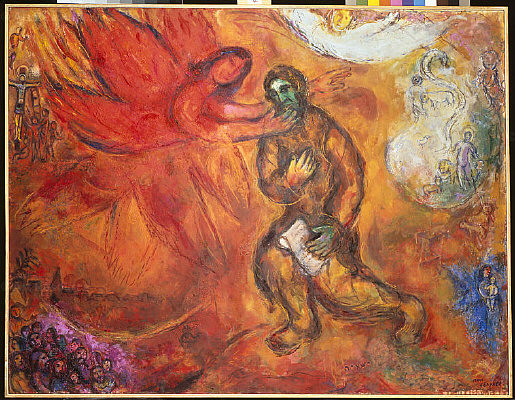
*Above painting of the prophet Isaiah by Marc Chagall, 1968

Joshua 8:30-35 – Recall the Ancient Ways

One day, Joshua led the people of Israel to Mount Ebal, where he told some of his men, “Build an altar for offering sacrifices to the Lord. And use stones that have never been cut with iron tools, because that is what Moses taught in The Book of the Law.”

Joshua offered sacrifices to please the Lord and to ask his blessing. Then with the Israelites still watching, he copied parts of The Book of the Law of Moses onto stones.

Moses had said that everyone in Israel was to go to the valley between Mount Ebal and Mount Gerizim, where they were to be blessed. So, everyone went there, including the foreigners, the leaders, officials, and judges. Half of the people stood on one side of the valley, and half on the other side, with the priests from the Levi tribe standing in the middle with the sacred chest. Then in a loud voice, Joshua read the blessings and curses from The Book of the Law of Moses. (CEV)

The ancient Israelites were in the Promised Land. Finally! It was quite the circuitous journey to get to this point. It might have been easy to kick back and celebrate. However, Joshua, their leader, knew there was a prerequisite to jubilation. First, the tone had to be set for how they were going to live and be as the inhabitants of this land.

So, Joshua gathered the entire nation and copied God’s Law in front of them, as given to Moses from God. Then, in the hearing of all the people, Joshua read the attitudes, activities, and attributes which would bring them ongoing blessing, as well as the behaviors which would bring a curse.

Joshua’s work is paradigmatic for us. Just as Moses received the Law from God and read it to the people; and, then, did it again just before the people started their campaign to enter the land, so Joshua followed his mentor’s lead and did the same. Reminders of God’s work and faithfulness, recollecting God’s gracious commands, and renewing our vows to God are all significant and ongoing works for every generation to emulate.

Why, pray tell, must we engage in such a ritual repeatedly? For two reasons: we tend to forget the things we are supposed to remember; and performing a practice again and again helps press it into our minds and hearts. This is precisely why I am a believer in liturgical worship and following the Christian Year. The redemptive events of Jesus become more than doctrines to believe; they are grafted into the soul by the sheer repetition of practice.

Part of the reason why so many Christian evangelicals have fled the Church is that they received no catechetical instruction again and again through time honored methods of worship and instruction. So, when they left, it was as if there was nothing to leave – it was easy. With little awareness of the great inheritance they possess in the faith, many persons have scant knowledge that what they are leaving is a rich historical tradition with the very things they are searching for but never received.

Oh, my goodness, people of God, it behooves us to pass on the faith in ways which both make sense and are true to the ancient way of the commandments, our apostolic tradition, and of Christ. It will do no good to disparage history, as if it began with Billy Graham. If folks are going to walk away, let them do it with the full cognizance of what they are walking away from. I cannot say I could blame anyone for leaving an eviscerated faith that is no faith, at all.

This very blog is partly dedicated to following the Revised Common Lectionary because it is the continual cycle of following Christ daily and yearly which patiently and profoundly constructs the soul over time.

Psychology as a discipline was established in the late nineteenth and early twentieth centuries largely because of a grand collective loss of memory amongst so many people. Psychological studies vigorously investigated the reason why this phenomenon was so ubiquitous.

It is also noteworthy that the great rise in secularism over the past few centuries before the 1800’s, found an apex at this same time with the introduction of psychology as a bona fide academic discipline. If humanity was meant for living in consistent rhythms of life and faith, then it makes sense that, when taken away, what remains is a massive societal memory loss with large implications for the individual.

We must reverse the curse of sacred memory loss and confusion of mind (Deuteronomy 28:28). We ought to recapture the mind, heart, and spirit for their intended purpose and design. We need metaphysicians who will do the important work of soul craft and bring blessings yet again to the world. There is some urgency to mentoring others in the faith, as the Apostle Paul did with his young protégé Timothy:

“You have heard my message, and it’s been confirmed by many witnesses. Entrust this message to faithful individuals who will be competent to teach others.” (2 Timothy 2:2, GW)

Spiritual care and connection are not optional – they are a necessity we cannot live without. A spiritual cultivation and tending of the soul have positive effects on our stress and overall well-being. Spirituality brings health and vitality to our psychosocial selves and reinforces integrity and excellence in relating to others.

So, let us not jettison the important work of tending the soul through ancient practices of breathing, reading, reflecting, contemplating, praying, worshiping, and applying the work of Christ to our world’s greatest issues and needs.

Almighty and everlasting God, in Christ you have revealed your glory among the nations: Preserve the works of your mercy, that your Church throughout the world may persevere with steadfast faith in the confession of your Name; through Jesus Christ our Lord, who lives and reigns with you and the Holy Spirit, one God, for ever and ever. Amen.