Jesus Tempted by Russian painter Ilya Repin (1844-1930)
Jesus was led by the Spirit into the wilderness to be tempted by the devil. After fasting forty days and forty nights, he was hungry. The tempter came to him and said, “If you are the Son of God, tell these stones to become bread.”
Jesus answered, “It is written: ‘Man shall not live on bread alone, but on every word that comes from the mouth of God.’”
Then the devil took him to the holy city and had him stand on the highest point of the temple. “If you are the Son of God,” he said, “throw yourself down. For it is written:
“‘He will command his angels concerning you, and they will lift you up in their hands, so that you will not strike your foot against a stone.’”
Jesus answered him, “It is also written: ‘Do not put the Lord your God to the test.’”
Again, the devil took him to a remarkably high mountain and showed him all the kingdoms of the world and their splendor. “All this I will give you,” he said, “if you will bow down and worship me.”
Jesus said to him, “Away from me, Satan! For it is written: ‘Worship the Lord your God and serve him only.’”
Then the devil left him, and angels came and attended him. (NIV)
In our most vulnerable moments, the devil attempts to swoop in and offer his demonic delights for us to consider. We call it “temptation.” Indeed, it can be quite alluring to entertain ways of getting what we need and want through avenues other than God.
In the desert, the place of preparation for ministry, Jesus fasted and prayed forty days. If ever there was a time when Jesus would be vulnerable to alternative religion, the devil mused, wringing his demonic hands together with wicked delight, it would be out in the desert by himself. So, Satan tempted Jesus with three whoppers he thought would get to Jesus, for sure. Having tempted Jesus with food and a way to fame, and having failed both times, Satan gave his final temptation.
To us this temptation to bow down and worship Satan seems like a no-brainer. Well, of course, no one would do such a thing as this, especially Jesus. And he did not. But it was still tempting. It really was. Jesus knew very well what was ahead of him. He had just spent forty days in an intense orientation for an upcoming three years of hard ministry with an end of tortuous death to look forward to.
Satan presented to Jesus an alternative way, a different path to achieve his purpose for being on this earth. Jesus could have it all without the three years, without the hard slugging to communicate the kingdom of God has come. Most of all, Jesus could circumvent the cross and establish his rule over all the earth – all pain free! The temptation, yes, was very tempting. Become King Jesus now with no suffering.
This has always been one of our great temptations, as well: Take the easy path. Get what you want, what you deserve, now, with no hardship.
The values of God’s kingdom include trust, patience, and perseverance. Temptation insists we need none of those hard things to be successful. Satan is the original slickster, marketing his quick and easy wares for people to buy into the notion that life can lived without pain and hardship, and with wild success, right now. The scary thing about it is that Satan can deliver… but it will cost us our very lives. Slavery to sin is the price we pay for hitching our hopes to the quick and easy.
The Christian season of Lent is a time for the slow, patient, deliberate development of the soul in attachment with the Lord Jesus. Engaging in spiritual disciplines is hard. It is difficult to fast and pray. Growing in Christ is slow and takes a great deal of learned perseverance. Far too many of us are tempted to circumvent the hard work of discipleship and simply have a spiritual professional distill everything we need into one hour on Sunday morning. Or we fabricate our own religious practice and beliefs, picking and choosing what fits our lifestyle, as if convenience and comfort are the summum bonum of life, instead of worship.
Christ was able to face down temptation because the desert strengthened him. Yes, he was vulnerable. But he was not weak. If we want to handle temptation, it will take Lent to help us. It will take the desert to spiritually form us and prepare us for godly ministry that puts the devil in his place.
Lord Jesus, you are the king of all creation. Just as you chose the hard path of God’s kingdom, so help me to persevere with faith and patience. May my life reflect your words and ways, in the power of the Holy Spirit. Amen.
We prepare for things we really care about; we anticipate things that are important to us. This was the point of Christ’s parable about ten bridesmaids. (Matthew 25:1-13)
People who really care about hunting make careful preparations for the season and anticipate opening day. Those who care about Green Bay Packers football look forward to game-day, plan for special food to eat, and set aside normal activities to watch them play. And, of course, weddings are events which take lots of preparation because families care about the upcoming marriage. Since I have raised three girls, I can testify first-hand that wedding plans begin in third grade for many females.
Some folks show up to things late and unprepared because they simply do not value the event enough to be ready for it. Casual hunters and fair-weather football fans go home when it gets too cold because they are not adequately prepared for the conditions. Quickie weddings happen in Las Vegas when two people are not prepared to have a marriage for a lifetime. People drop out of impromptu events when there is no fun or gets too hard. However, if they really care about it, they prepare for it, have patience through it, and persevere in it when things get tough.
The true test of authentic commitment comes when things are not easy and it takes blood, sweat, and tears to see something through. A Christian is one who professes Christ as Lord and Savior, and backs the words up with a resolve to live into their baptism; to avail themselves of Holy Communion; to plan and prepare for both personal and public worship; and to make it their aim to love God, one another, and neighbor.
There are few human events more freighted with emotion and preparation than weddings. Parents invest a lot of time, energy, resources, and love to have a meaningful wedding for their kids. There is also the potential for disaster at a wedding. Since I have done my share of weddings, I can tell you that a lot of things go sideways in the preparation process and even at the wedding itself. I have seen bridesmaids pass out, grooms forget the ring, and families fight like cats and dogs in the narthex just as the bride is ready to come down the aisle. All kinds of crazy stuff can happen with a wedding.
At my own wedding, the bridesmaids were literally sown into their dresses by the seamstress just hours before the wedding; one of my groomsman did not show up because, I later found out, he was in jail; and, we were married on the hottest and most humid day of the year – 100 degrees – which did not go so well for a bunch of women trying to have their best ever hair day.
Yet, we got married anyway. The wedding happened because it was important to us. I think it is interesting that Jesus chose to tell a parable using a wedding to tell us what the kingdom of God is like. Weddings in Christ’s day were just as prone to mishap, maybe even more so, than weddings today.
In ancient Israel, a couple would become engaged but not set a wedding date. The groom took the time to busily prepare a home for himself and his bride to live. It might take days, or weeks, or months, even years. It is this imagery that Jesus picked up to communicate his point of being prepared for things we care about.
No one knew when the groom would be finished with preparations. (Note: Jesus the bridegroom is busy making preparations for a great wedding feast at the end of the age when he will come back and take us to be with him forever, John 14:1-4). When the groom was ready, he left the home he had prepared and went to the bride’s house. Then, the two of them, along with their wedding party, would have a grand procession through the streets of the town, almost always after dark, and then back to the home of the groom. So, oil lamps were important to have ready and on standby.
Ten Bridesmaids by Dinah Rau, 20
Here is the parable of the bridesmaid’s setting: The groom has left his house and begun his trek through town. He might come right away, and he might not, depending on what route he takes. The bridesmaids (or virgins) have their oil lamps ready. Five of them have plenty of oil, and five of them do not. The groom took a circuitous route, so the virgins fell asleep waiting. At midnight, the groom finally showed up at the bride’s house. Five virgins were ready and five were not ready.
The five bridesmaids without enough oil went to find or buy some more, while the five virgins with plenty of oil joined the celebration. The procession returned to the groom’s house, posthaste, before the five bridesmaids who were not part of the procession finally caught up to them at the house. They knocked on the door and expected to get in. But the door was shut and was not going to be opened. The marriage happened without them.
Bottom line of the story: The five foolish bridesmaids were not ready because they did not care enough to be prepared. This, at face value, might seem harsh. Yet, in Christ’s time, not having the oil needed for the lamps would be akin, in our day, to half the bridesmaids showing up at the wedding at the last minute in jeans and t-shirts without having done their hair and expecting to stand up with the bride. No bride or groom and their family in our culture is going to roll with that kind of behavior because it is deeply offensive.
As in all of Christ’s parables, the characters represent the people listening. The five wise and five foolish bridesmaids point to the various characters who were following Jesus. Those folks consisted of both faithful disciples of Jesus, as well as wedding crashers who were not there because they valued and respected Jesus.
Jesus told us to keep watch, because we do not know the day or the hour when he will return. So, the big question for every professing believer in Jesus is: Are you prepared? We are to maintain constant vigilance, being always alert for Jesus to show up. It is one thing to profess Christ; it is quite another thing to live each day doing God’s will and being prepared for Jesus to return. In short, Jesus wants more than fair-weather Christians.
We cannot assume someone else will give us oil, or simply rely on another person to have everything we need to live the Christian life. Each one of us must listen and learn from God’s Word for ourselves; cultivate a life of prayer; serve the church and the world in ways God has called us to, without relying on someone else to do the work I should be doing.
For those whom Jesus is the most important person in their lives, you will see preparations to serve him every day. It is my personal practice to rise each morning by 5:00am. I light a candle and spend some quiet unhindered time reading Scripture, reflecting on it, and praying. Throughout the day I pause to intentionally connect with God in prayer and worship (Yes, even a Pastor must do this!).
I get up early in the morning regardless of how I feel. I engage in spiritual disciplines even when it does not strike my fancy. I go to work and do what it takes to get myself in a position to be a blessing to others, despite the times when I am less than 100%. I do it because God has called me, and I care about that.
Let us come back to Christ’s message of the parable: We prepare for things we really care about, and we anticipate things that are important to us. For the first three hundred years of the church, believers in Jesus met in cramped places with few resources other than the Holy Spirit of God. When Christianity became the official religion of the Roman Empire under Constantine, everything literally changed overnight. Emperor Constantine built St. Peter’s Basilica and instituted state-funded support for bishops. Suddenly, Christianity was cool. At this point, the church began a moral and spiritual slide into worldliness and decadence.
It seems throughout the history of Christianity that the church flourishes most when it is under some sort of persecution or adversity. And when it is not, it flounders and lapses into worldliness. Sometimes, the primary values and goals of Christians are ensuring that we get our way through politicians, as if our hope is ultimately tied to political elections. Instead, our goal must be to live for Jesus, no matter the circumstances. In fact, the church’s faith grows more genuine when it is proven through great trials.
The return of Jesus is a future reality which needs to be constantly on our spiritual radars. Jesus wants us to watch and pray, to be prepared, because it could be today that the bridegroom shows up at our house!
When they found him on the other side of the lake, they asked him, “Rabbi, when did you get here?”
Jesus answered, “Very truly I tell you, you are looking for me, not because you saw the signs I performed but because you ate the loaves and had your fill. Do not work for food that spoils, but for food that endures to eternal life, which the Son of Man will give you. For on him God the Father has placed his seal of approval.”
Then they asked him, “What must we do to do the works God requires?”
Jesus answered, “The work of God is this: to believe in the one he has sent.”
So, they asked him, “What sign then will you give that we may see it and believe you? What will you do? Our ancestors ate the manna in the wilderness; as it is written: ‘He gave them bread from heaven to eat.’”
Jesus said to them, “Very truly I tell you, it is not Moses who has given you the bread from heaven, but it is my Father who gives you the true bread from heaven. For the bread of God is the bread that comes down from heaven and gives life to the world.”
“Sir,” they said, “always give us this bread.”
Then Jesus declared, “I am the bread of life. Whoever comes to me will never go hungry, and whoever believes in me will never be thirsty. (NIV)
Christians everywhere hold to Jesus as the Son of God, Lord of the universe, and Savior of all. However, for most people who were following Jesus around in the first century, this was not their understanding of Christ. In his earthly ministry, Jesus spoke in ways that introduced people to who he really was and sought to bring them to a point of following him based on his identity.
Jesus wanted the crowds to him for who he really is – themselves for what they really needed – and follow him based on the deepest needs of their lives. I believe Jesus is the hope of all nations and all people, and in him humanity’s most basic and profound needs are met for forgiveness, love, and purpose in life. To address this, I ask three basic philosophical and theological questions of life:
What should human beings seek the most and work the hardest for in life?
The responses in history are legion. The ancient Greek philosopher Aristotle thought a proper appreciation for an ethical and virtuous life found in practical wisdom was where people’s most concerted efforts should be. Karl Marx, the father of communism and socialism believed the proletariat should use their heads and their hands to rise above their economic conditions and oppression. In the late 1960’s, Bobby Kennedy said we ought to be working the hardest to achieve justice and not advance ourselves on the misfortunes of others. In more recent times, the Harvard Business Review is continually on the lookout for the best ways of being efficient, productive, and making the most of time because work itself is paramount.
Jesus said people are not to work for food that spoils, but for food that endures to eternal life.
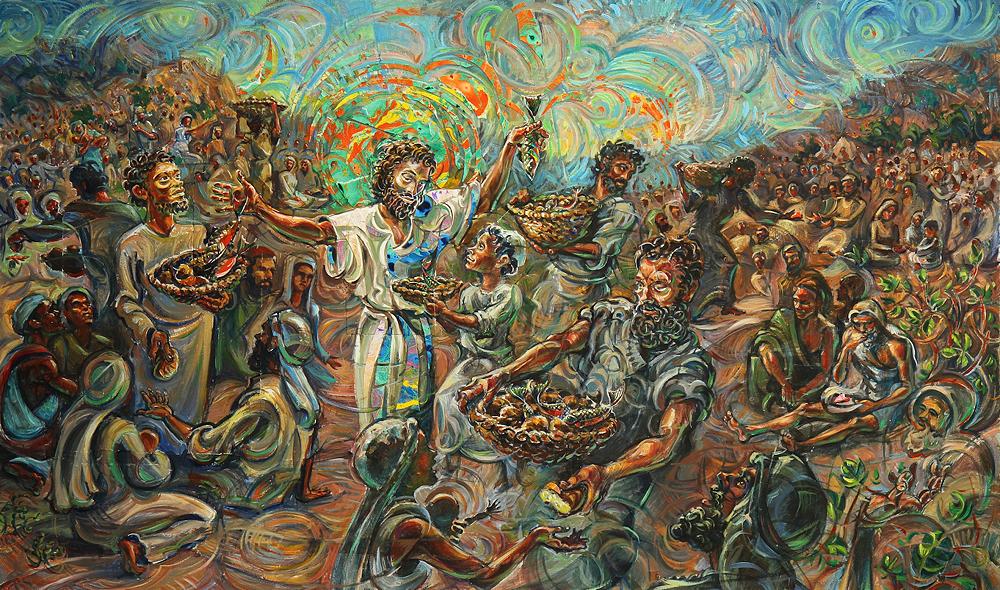
He said this coming off one of his most famous miracles of all, the feeding of the five thousand. Afterward, Jesus withdrew overnight to a place of solitude and prayer. He did another miraculous event by walking on water out to his disciples in a boat. In the morning, he and they were on the other side of the lake. The crowd did not know where he was and went looking for him.
Jesus knew the crowd of people wanted more. What they got was perhaps unexpected. Jesus told them to put their efforts into getting the bread that keeps on feeding. Jesus wanted the people to pursue and follow him not only for the things he could do for them, but to seek him for who he is.
Jesus had further aspirations for the people beyond providing a supper – he desired the people to feast on himself – to ingest him, to take him into their lives in a deep and profound way as the fulfillment of all the hope and promises of the Old Testament.
Jesus Feeds the Crowd by American artist Eric Feather
Jesus is the bread, the basic staple of life, that meets the cravings and needs of all people everywhere. Starving people, both in body and spirit, find in Jesus a meal which keeps on giving, a feast of grace that is both delectable and unending.
The answer to my own question is that, for me, one’s highest pursuit and greatest quest is Jesus. Apart from Christ, I will starve. Furthermore, Jesus is not some cheap fast food off a value menu; he is real soul food to be ingested and enjoyed with others.
I believe people need Jesus. A passionate seeking of Jesus, to follow him, live for him, center life around him, is my most ardent desire. I do not simply desire Jesus for what he can do for me; I vigorously chase after him because if I do not have Jesus, I will die, I will starve to death.
For me, Jesus is so much more than a nice addition to my life, like a new puppy; Jesus is Lord and Savior. I must consume him, or I will be completely undone, and I will not survive! Jesus is my bread, my food, my life! I cannot survive on a daily crumb, but I feast on every word that comes from the mouth of Jesus because in Christ there is the life that is truly life.
What should human beings be doing to do the works of God?
The short answer: believe. To have and keep faith in the One God has sent, Jesus, is the primary “work” that pleases God. Jesus communicated to the crowd that they can do so much more than follow him for another earthly meal – they can place their faith and hope in him for food that will last, food that will transcend the three-dimensional world.
Faith is more than an intellectual recognition to some facts about Christianity. And belief is not about always having clarity and certainty to every facet and loci of Christian doctrine. No, Christian faith is complete trust in Jesus as our hope and our life. Education, economic uplift, political stability, and institutional peace and justice are important activities for this world. For the Christian, the accomplishment of these and so much more comes from the grace of God in Christ. As people come to the end of themselves with their homebrewed and half-baked attempts at being satisfied, Jesus stands at the door and knocks, the Living Bread who offers himself for humanity’s deepest needs.
Giving kudos to Jesus might be nice, yet Christ himself cares about folks placing their trust in him for grace, forgiveness, and hope in their world. Jesus longs to reconnect people with God through giving himself as the means of making that happen. All the works we do in this life, every good deed we accomplish, and each positive action we do are all helpful and necessary… and they all pale in comparison to the greatest work of all, to believe in Jesus Christ as the hope of this world, the hope of your family, the hope of the church, and the hope of your life and mine. And it is all accessed by faith in the Son of God who loved me and gave himself for me.
Who really does the will of God?
Answer: Those who come to God through Christ. The person who comes to Jesus will never go hungry, and the one who believes in Christ will never be thirsty. Such persons do the will of God. They do not settle for signs of Jesus but desire him and find their ultimate satisfaction in him.
Yet far too many people settle for signs of Jesus rather than Jesus himself. It would be silly if I drove to a sign on Interstate 94 that said, “Milwaukee” and sat there under it, believing I was really in the city of Milwaukee. And it would be weird if I looked around for the art museum or other places underneath the sign.
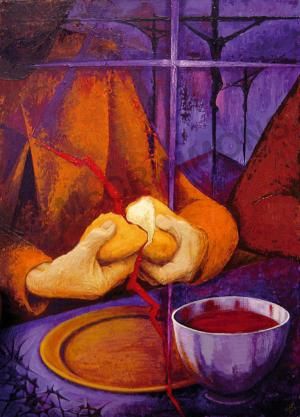
Church buildings and furniture, stained-glass windows, pews, and even the Bible are not Jesus – they are simply and hopefully signs which point to him. They are all designed to lead us to Christ so that we may come to him. And coming to Christ is what the Lord’s Supper, Holy Communion, the Eucharist, and any other description you want to give about ingesting Jesus is about. The elements of bread and cup bring us to Christ so that we can experience Jesus and be joined to him by faith in a mystical union of human and divine in the unseen heaven.
Conclusion
Where will you find true satisfaction and hope? Probably not in the clearance aisle at Wal-Mart. Likely not in conforming to cultural Christianity or embracing generic forms of Jesus as merely good teacher and moral example. Furthermore, life’s ultimate satisfaction and hope are not to be found in a spotless house and perfect kids; in working more hours and making more money. Nor will we find contentment and peace in the radical independence of doing things my way.
Jesus is the Bread of Life. Through ingesting him, passionately pursuing him, believing in him, and coming to him in everything, we find the life that is truly life. Do not settle for any substitutes to Jesus. Come to the real person.
Lord God, you said that when we seek you with all our hearts, you will be found. As the deer pants for streams of water, so we, your people, long for you in a dry and weary land. We hunger and thirst for your righteousness. We deeply desire your presence in all things. So, we die to ourselves and surrender to your will and way for us, by faith trusting you will come into our lives and completely take over. May your blessing rest upon us as we seek Jesus. Amen.
Welcome, friends! It is a privilege to be with you on this World Communion Sunday. We gather around Jesus, our highest joy, as Christians unite in the surpassing value of knowing Christ. Click the video below and let us discover together the heartbeat of the Church everywhere…
Let us partake of Christ together in heartfelt worship.
I pray that the Lord Jesus Christ will bless you and be kind to you! May God bless you with his love, and may the Holy Spirit join all your hearts together. Amen.








 Rev. Tim Ehrhardt