Acts 28:23-31 – Focused on Mission

Apostle Paul by Ivan Filichev

They arranged to meet Paul on a certain day and came in even larger numbers to the place where he was staying. He witnessed to them from morning till evening, explaining about the kingdom of God, and from the Law of Moses and from the Prophets he tried to persuade them about Jesus. Some were convinced by what he said, but others would not believe. They disagreed among themselves and began to leave after Paul had made this final statement: “The Holy Spirit spoke the truth to your ancestors when he said through Isaiah the prophet:

“‘Go to this people and say,
“You will be ever hearing but never understanding;
    you will be ever seeing but never perceiving.”
For this people’s heart has become calloused;
    they hardly hear with their ears,
    and they have closed their eyes.
Otherwise they might see with their eyes,
    hear with their ears,
    understand with their hearts
and turn, and I would heal them.’

“Therefore, I want you to know that God’s salvation has been sent to the Gentiles, and they will listen!”

For two whole years Paul stayed there in his own rented house and welcomed all who came to see him. He proclaimed the kingdom of God and taught about the Lord Jesus Christ—with all boldness and without hindrance! (New International Version)

The Apostle Paul took quite a licking throughout his Christian life. Incredibly, Paul not only physically survived whippings, beatings, stoning, arrests, shipwreck, and imprisonment – he also came through it all with a robust spirit and a dogged determination to live his life with purpose and mission.

Acts 28 is the final chapter in the book. Paul is in Rome under house arrest. Even in this situation, he kept finding ways to engage others. Since he couldn’t go to them, he had others come to him – lots of them.

Paul described to the visitors his own experience of encountering the risen Christ. He reasoned with his fellow Jews and vigorously debated with them from the Scriptures. It was always the deep desire and hope of Paul that his own people come to faith in Christ, just as he had. Although some did, most didn’t.

Many decades ago, my grandfather was approached by one of his friends about investing in a new insurance company startup. For a lot of reasons, grandpa ended up not participating in his friend’s venture. So, the friend asked others. Eventually, the startup happened and steadily grew. Today, Nationwide Insurance has over 250 billion dollars of assets. Good old gramps just didn’t know what he was rejecting.

The good news of Jesus Christ, I believe, is worth infinitely more than an insurance company. Christian mission, I believe, is worth investing my life into. I’m glad the gospel was proclaimed to Gentiles because I am a recipient of such grace. And I’m grateful that Paul tenaciously kept interacting with people for the last two years of his life under arrest.

Despite, and even because of, Paul’s sufferings and his house arrest, the message of faith and forgiveness in Christ was confidently and consistently presented to a steady flow of people, including the highest heads of state. Difficulties are no problem for God. The Lord bends all circumstances to divine and good purposes, creating new avenues of faith, hope, and love that wouldn’t be possible under “normal” times.

“He is no fool who gives what he cannot keep to gain that which he cannot lose.”

Jim Eliot

In fact, Paul endured five years of imprisonment: two in a Caesarea jail; two under house arrest in Rome; and nearly a year in transport between the two cities. For a personality like Paul, we might imagine this would drive him nuts. Yet, several letters to the churches, now contained in the New Testament, were written during that time.

Whether we like it, or not, nothing proves, affirms, and grows our faith quite like our willingness to endure suffering for the gospel. Witness, suffering, and martyrdom are inextricably bundled together in God’s economy. When suffering is viewed as a necessary means to an altruistic and noble end, then, although the pain is no less real, there is the opportunity for both willing endurance and genuine joy.

Paul was willing to labor on behalf of people who were very different from himself. His concern was for all people everywhere – both his own people, the Jews, as well as Gentiles. Paul never gave in and never gave up. He had a magnanimous spirit and even greater spiritual gifts. He willingly and gladly used that spirit and gifts for the benefit of humanity.

In 64 C.E. Paul was condemned and executed. Before his death, he wrote that he had fought the good fight, finished the race, and kept the faith. Now, the next generations of new believers must follow in his footsteps and continue the work

This is precisely why the book of Acts ends so abruptly, with no resolution, no tidy conclusion – because the work is still being done and will carry on until Christ returns.

Gracious and loving God, you work everywhere reconciling, loving, and healing your people and your creation. In your Son Jesus, and through the power of your Holy Spirit, you invite each of us to join you in your work. We ask you to form us more and more in your image and likeness, through our prayer and worship of you and through the study of Holy Scripture so that our eyes will be fully opened to your mission in the world. Then, God, into our communities, our nation, and the world, send us to serve with Christ, taking risks to give life and hope to all people and all of your creation, through Jesus Christ our Lord.. Amen.


Luke 11:29-32 – Going Against the Crowd

As the crowds increased, Jesus said, “This is a wicked generation. It asks for a sign, but none will be given it except the sign of Jonah. For as Jonah was a sign to the Ninevites, so also will the Son of Man be to this generation. The Queen of the South will rise at the judgment with the people of this generation and condemn them, for she came from the ends of the earth to listen to Solomon’s wisdom; and now something greater than Solomon is here. The men of Nineveh will stand up at the judgment with this generation and condemn it, for they repented at the preaching of Jonah; and now something greater than Jonah is here. (New International Version)

Just when we think we might have a handle on Jesus as the meek and gentle Savior we get a picture of Jesus behaving badly. When the crowds begin increasing we might expect Jesus to be pleased. After all, we might reason, Jesus can reach more people, have a wider influence, and greater impact with a crowd. It’s good for kingdom business. 

But Jesus isn’t down for all the people following him around. He opens his mouth and tells them they are an evil generation. 

“The crowds” continually get a bad rap throughout the New Testament Gospels. That’s because Jesus isn’t much of a crowd kind of guy. Although he loved people deeply, the Lord Jesus typically had some hard words for the masses.

“It’s better to walk alone than with a crowd going in the wrong direction.” 

Mahatma Gandhi

Maybe it would help if we used the word “mob.” This is likely the more nuanced understanding of “crowds.” It’s the herd mentality which tends to rub Jesus the wrong way, that is, doing something without understanding why you’re doing it, just because other people are doing it. A mob of people acting in concert never ends well, which is why Christ confronts the crowd.

Jesus chided the people who were looking for a cool miracle, a clear sign of his power, and nice clean lines of spiritual authority. Christ didn’t give it to them. Instead, Jesus let the mob know they have ample opportunity to accept him – yet they aren’t doing a dang thing to move in that direction.

Sometimes, we might so desperately want to make Jesus as Joe Cool so that others will follow him. If only Jesus will heal this person in a big audacious miraculous way, we wrongheadedly think, lots of people will believe. 

Or, if only Jesus will compassionately and powerfully perform some grand universal sign that nobody can miss, we believe, the world will have to take notice and put their trust in God. 

However, that’s not how Jesus rolls. Christ simply pointed people back to characters in the Old Testament. Jesus insists that if people won’t take notice of what they already have, they are not going to be swayed with a shiny new miraculous sign from heaven.

Jesus defies any stereotype we might try and corral him with. And that’s as it ought to be – since Jesus is the rightful and sovereign King. 

So, this is why we need a steady daily stream of God’s Word to help ground us into the ways of Jesus. The more we allow the Scriptures to shape our spirituality, the more our lives will be formed into the likeness of Jesus. 

Spiritual growth and maturity is a process. It is often slow. There are not a lot of bells and whistles to it. On most days, there is not a lot of drama – just the pedantic plodding of a faithful believer trying to make sense of living the Christian life. 

And those are the people I think Jesus most likes to hang-out with.

“A man who wants to lead the orchestra must turn his back on the crowd.” 

Max Lucado

The popular thing isn’t always the right or best thing. Rather than being a lemming which ends up running off a cliff, we have other options, especially when it comes to thinking spiritually and theologically about things:

  1. Stop and think. It’s easy to go through a typical day on autopilot and do things out of habit. The best way to avoid this is to consciously stop and think about why you’re doing something or holding tightly to a particular belief. Does what I’m doing jive with the words and ways of Jesus? Why am I believing or living in this way? What is my purpose?
  2. Take the necessary time to make sound decisions. Avoid copying other people and taking shortcuts. Instead, pray, consult, collaborate, seek wisdom, and make a deliberate and well-thought decision based in the ethics of God’s kingdom. Am I doing my due diligence with properly searching the Scriptures and praying before I act? Have I interacted with some trusted and sage people?
  3. Be willing to stand out from the crowd. If what you believe and the way you need to live your life makes you stick out, well then, it makes you stick out. Giving up your power by letting others make decisions for you isn’t going to end well. To be a faithful followers of Jesus, we will likely have to go against some social norms and stand out as individual believers.

Astounding God, you sometimes shake us out our pre-conceived notions about you and invite us to see Jesus from a different viewpoint. Help me to see Jesus so that I might more fully embrace him and walk in his ways and in the strength of the Spirit. Amen.

All Saints Day

In all times and every place throughout history God has specialized in taking imperfect or broken people and transforming their lives. On the Christian Calendar, November 1 is the day each year to remember the saints who have gone before us. This day is meant to be a way of not forgetting the people, friends, and family, as well as long-dead historical saints, who have made a significant impact in our spiritual lives.

All Saints Day is much more than a focus on extraordinary persons; it highlights the work of ordinary Christians who faithfully lived their lives and persevered to the end. We give thanks for the gift of how they daily lived their faith. We also remember that all believers in Jesus are united and connected.

Remembering is a prominent theme in Holy Scripture. Over a hundred times we are told to remember God’s covenant with people and redemptive actions on their behalf; to remember the needy and those less fortunate; and, to remember the significant persons who influenced us in our journey of faith.

“Remember your leaders, who spoke the word of God to you.  Consider the outcome of their way of life and imitate their faith.” (Hebrews 13:7, NIV)

The saints of the past are an inspiration to us in the present. They serve us as a model of faithfulness in persevering in our Christian lives. Through biblical stories of very human persons being used of God, as well as reading biographies of godly people who were dedicated to God in service, we gain motivation and patience until Jesus returns.

“God creates out of nothing. Wonderful you say. Yes, to be sure, but he does what is still more wonderful: he makes saints out of sinners.”

Søren Kierkegaard

Who were the people in your life that went out of their way to communicate God’s love to you with both words and actions?  Who were those persons who labored behind the scenes in prayer so that you and others would know Jesus? 

If any of those persons are still around, and you know where they are, remember them. Drop them a note. Express to them a simple thank you for their influence in your life. You will not only encourage that person – it will help you remember and re-engage with something in your life you may have forgotten or have just taken for granted for too long.

Gordon McDonald, a Christian pastor and writer, at the passing of a lifelong mentor, recalled the loyalty and crucial counsel given in a time of crisis:

“He was there when, many years later, my life fell apart because of a failure for which I was totally responsible. In our worst moments of shame and humiliation, he came and lived in my home for a week and helped me do a searing examination of my wife. I will always remember his words: ‘You are momentarily in a great darkness. You have a choice to make. You can—as do so many—deny this terrible pain, or blame it on others, or run away from it. Or you can embrace this pain and let it do its purifying work as you hear the things God means to whisper into your heart during the process. If you choose the latter, I expect you will have an adventurous future modeling what true repentance and grace is all about.’”

We truly stand on the shoulders of those who have gone before us in faith and patience. We will continue to persevere and thrive in faith when we remember them and allow those here in the present to journey with us along this road of faith.

Today is an intentional day of remembrance. We remember answered prayer and salvation. We recollect the people who gave us the life-giving gospel message in both word and deed. We remember the death of Christ and recall that he said he is coming back.

It is sage to recall events of rescue and pull them forward into the present so that all God’s worshipers can taste and see that the Lord is good. This is exactly what the Apostle Peter did for a church which needed to recall and remember the mighty acts of God:

Like newborn babies, crave pure spiritual milk, so that by it you may grow up in your salvation, now that you have tasted that the Lord is good. As you come to him, the living Stone—rejected by humans but chosen by God and precious to him—you also, like living stones, are being built into a spiritual house to be a holy priesthood, offering spiritual sacrifices acceptable to God through Jesus Christ. (1 Peter 2:2-5, NIV)

Our memories are accessed through symbols and with taste and sight. God uses symbols as a means of revelation. For example, when the Lord wanted to demonstrate the ugliness of sin and the cost of forgiveness, he told the Israelites to kill an animal and sprinkle its blood on their clothing and on the altar. It sounds awful. Yet, the worshiper never walked away from the experience scratching his head and wondering what it was all about because he encountered and tasted the drama of sin and redemption. His senses saw it, felt it, smelled it, and tasted the meat from it. 

Symbols have the power to access other parts of our being in knowing God. We are more than thinking beings; we are also emotional and sensory creatures. We need ordinary events, like shared meals, that include symbols and rituals. Every year faithful Jews gather to remember and re-enact the Passover – the story of how they were enslaved in Egypt, oppressed by Pharaoh, and set free by God. To this day pious Jews still remember the Passover by eating and drinking together and telling stories.

We need both words and sacraments. Therefore, holidays like Thanksgiving and Christmas involve both verbal expressions of gratitude and love, and particular actions of kindness and gratitude in giving gifts and sharing food. Together, it all connects us to God, to one another, and to a history of God’s people. Jesus met his disciples in the Upper Room to celebrate Passover together. Jesus energized their time together by filling it with words and symbols of care and redemption. Jesus told the disciples about his upcoming death and provided symbols which reinforced the words. 

“Take and eat – this is my body…. Take this cup – drink from it, all of you.” (Luke 22:7-20)

Rather than analyzing the bread and discussing the wine’s vintage, the disciples simply ate and drank. They tasted real food and drink. They also tasted real spiritual food. It is one thing to speak of God’s presence, and it is another to experience that presence through an ordinary shared ritual of bread and cup.

God is good, all the time; and, all the time, God is good. Jesus is our Emmanuel, God with us. Christ is present with us through our ritual of fellowship and food. When the sixteenth-century Reformer John Calvin was asked how Jesus is present to us at the Lord’s Supper he explained:

“Now if anyone asks me how this takes place, I shall not be ashamed to confess that it is a secret too lofty for either the mind to comprehend or my words to declare….  I rather experience it than understand it.”

John Calvin

The taste of real bread reminds us of the physical incarnation of Christ, and Christ’s humiliation and death. Drinking from the tangible cup reminds us of the bodily sacrifice of Christ, the drops of blood which Jesus sweat in Gethsemane, and the beatings, floggings, nails, and crown of thorns that caused the bleeding. Tasting the bread and cup when celebrating communion reminds us that our sins are forgiven, we are united to Christ, and we are united together. 

There are historical events which happened and are forgotten. Then, there are past actions which linger with continual results into the present. The incarnation, life, death, resurrection, ascension, and glorification of the Lord Jesus are past redemptive events which continue to exert powerful force into the here and now.

Saints throughout church history moved the message of Christ along and demonstrated for us that the past is alive in the person of Jesus Christ. Along with them we proclaim that Christ has died, Christ has risen, Christ is coming again. And God has something planned for those who have gone before us, along with us, so that together we will experience the perfect righteousness of Christ forever. (Hebrews 11:39-40)

Believers are encouraged through word and sacrament to proclaim the good news of Jesus Christ until he comes again. So, let us respond to God’s wooing invitation to eat and drink, to taste and see that the Lord is good through faith, hope, and love. For God is our refuge and strength, our ever-present help.

Hebrews 9:11-14 – A Clear Conscience

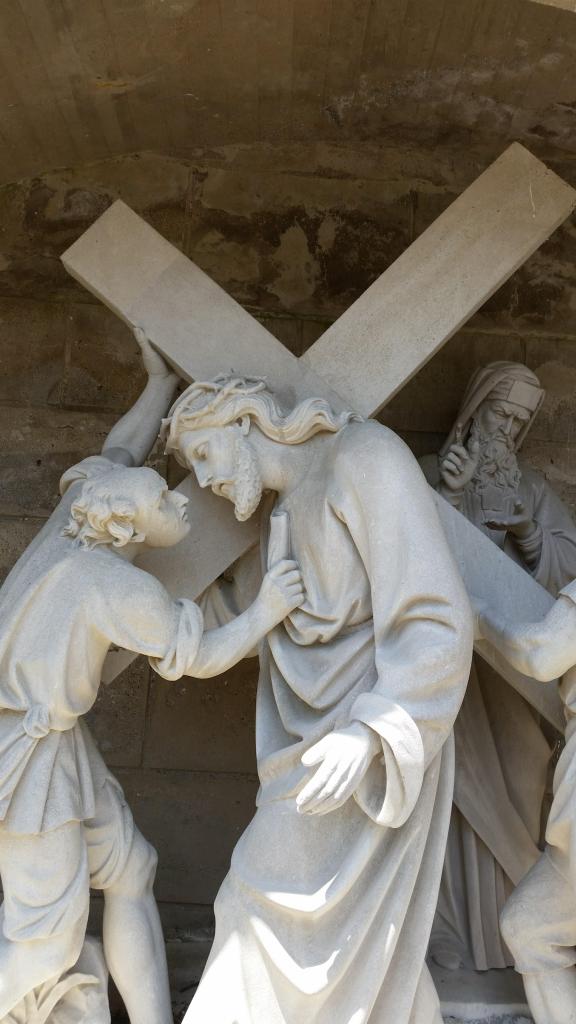
Stations of the Cross at Holy Hill, Hubertus, Wisconsin

When the Messiah arrived, high priest of the superior things of this new covenant, he bypassed the old tent and its trappings in this created world and went straight into heaven’s “tent”—the true Holy Place—once and for all. He also bypassed the sacrifices consisting of goat and calf blood, instead using his own blood as the price to set us free once and for all. If that animal blood and the other rituals of purification were effective in cleaning up certain matters of our religion and behavior, think how much more the blood of Christ cleans up our whole lives, inside and out. Through the Spirit, Christ offered himself as an unblemished sacrifice, freeing us from all those dead-end efforts to make ourselves respectable, so that we can live all out for God. (The Message)

We all have times when we feel guilty. Guilt, in and of itself, is a good thing. Guilt is the response of our conscience telling us we have done something wrong or have not done the good we know we ought to have done. It’s what we do with the guilt that determines the trajectory of our Christian lives. There are several ways we can respond to guilt.

  1. Denial. We can deny and rationalize our guilt by not accepting the truth about what we have done. Using phrases such as, “It’s not my fault,” “It’s only wrong if I get caught,” “I didn’t hurt anybody,” “They deserved it,” and “It’s not that bad,” has the effect of searing our conscience like a hot iron so that we eventually do not feel guilty. The inevitable result of this is hardness of heart.
  2. Shame. Another inappropriate way of dealing with guilt is the opposite of denying guilt; it is to hyper-focus on the guilt by feeling ashamed. Guilt feels bad for actions done or not done. Shame, however, feels bad for who I am, as if I am incapable of being good. Shame believes I do bad things because I am bad and deserve the consequences. In other words, shame is really false guilt.
  3. Inaction. Shame and false guilt may result in despair. We become inactive because of feeling discouraged or defeated. We might reason to ourselves, “What’s the point? I screw up everything I do.” So, we do nothing.
  4. Hyperactive. Some folks become a flurry of activity, working like crazy to feel better in the hope that guilt and shame disappear. It is to impose a penance upon yourself to try and cope with the icky feeling of guilt.

            The good news is that we can experience freedom from guilt and a clear conscience because of Jesus Christ.

  • If we have been victimized in the past, we no longer have to feel ashamed as though we caused or deserved the violence done to us.
  • If we have said or done some truly egregious things that displease God and damage others, we no longer have to live with the regret and the guilt on our consciences. 
  • If we have failed others and God by not living up to who we ought to be, we no longer have to live day after day with our consciences bound with guilt and shame.

            There are three reasons from Hebrews which tell us why we can have freedom from guilt and live with a clear conscience. They all focus on the person and work of Jesus Christ.

Christ has obtained eternal redemption for us by his blood.

Under the old sacrificial system, year after year, the priest offered the same sacrifices which never took away sin. The animal sacrifice was an act of worship in which the worshiper acknowledged guilt before God. The continuous ritual was designed to point forward to a better sacrifice.

The worshiper was purposely led to think, “Wouldn’t it be great if we didn’t have to do this all the time?” The blood of bulls and goats were an annual reminder of sins – such sacrifices never cleansed the conscience of the worshiper. Jesus Christ, however, is the sacrifice to end all sacrifices. Jesus has secured, once and for all, our eternal redemption through his own blood.

The death of Christ, Holy Hill, Hubertus, Wisconsin

Dr. Samuel Weinstein is the chief pediatric cardiac surgeon for a children’s hospital in the New York City. He once traveled to El Salvador to provide life-saving operations for less-fortunate children. Dr. Weinstein and his team operated on an eight year old boy. Twelve hours into the surgery, the procedure took a deadly turn.  

Dr. Weinstein said, “The surgery had been going well, but he was bleeding a lot and there were not many medicines we would use to stop the bleeding. After a while, they said they couldn’t give him blood because they were running out and he had a rare type.” The boy’s blood type was B-negative, which is present in only two percent of the population.

The only other person in the room with a blood type of B-negative was Dr. Weinstein. Immediately knowing what he had to do, he stepped down from the operating table. As his colleagues continued their work, Dr. Weinstein set aside his scalpel, took off his gloves, and began washing his hands and forearm. Then, in the corner of an unfamiliar operating room, the prestigious doctor from one of the most advanced hospitals in the world sat down to give away his own blood. 

When he had given his pint, Dr. Weinstein drank some bottled water and ate a Pop-Tart. Then—twenty minutes after stepping away from the table—he rejoined his colleagues. After watching his own blood circulating into the boy’s small veins, Dr. Weinstein completed the operation that saved the boy’s heart—and his life.

It is the blood of Jesus Christ which saves us from sin, death, and hell. Our condition is so dire that we can do nothing other than let Jesus deliver us. By faith, we trust Jesus to secure a new life for us free from guilt and shame.

Christ cleanses our consciences.

For some, the greatest prison is not tangible or physical – it is the prison of conscience bound and wracked by guilt and shame. Yet, Jesus has taken care of the problem of a guilty conscience once for all through his blood. Forgiveness comes through Jesus. Christ cleanses us from the inside-out and frees us from being slaves to our guilt.

In 1811, the U.S. government began collecting and storing letters like the following note dated from February 6, 1974: “I am sending ten dollars for blankets I stole while in World War II. My mind could not rest. Sorry I’m late.” It was signed by an ex-GI. And there was this postscript: “I want to be ready to meet with God.”  The U.S. government not only collects and stores these letters, but the Treasury Department established a fund and labeled it the “Conscience Fund.” Since its inception, the fund has grown to almost seven million dollars.

A clear conscience is worth a lot. If we try and impose penance upon ourselves, how do we know when it’s enough? In Christ, we are not just outwardly clean, but inwardly clean because of his finished work on the cross. 

Accepting this reality, through God’s eternal Spirit, helps us experience forgiveness and cleansing. The Holy Spirit takes the redemptive events of Jesus and applies them to our consciences so that we are assured of forgiveness.

Christ sanctifies our service.

In the Old Testament sacrificial system, the high priest entered the temple/tabernacle to offer animal sacrifices. Once a year, on the Day of Atonement (Yom Kippur) the priest entered the Most Holy Place. He slaughtered a heifer, took some blood, and sprinkled it on the altar. 

The priest had bells on his ankles when performing this ritual, along with a rope tied to one ankle. In case the judgment of God broke out on the priest and he was killed, then the other priests could reel him out of the Most Holy Place without entering themselves and being killed, as well.

There were several rituals to perform to access God. And, even then, the sprinkling of blood only outwardly took care of cleansing the people. But when Jesus offered himself once for all, the curtain separating the Most Holy Place from the people was torn from top to bottom. The way has been opened for complete purification, inside and out, a cleansing of the guilty conscience so that we might now serve the living God with freedom and confidence.

Since Christ has obtained redemption for us by his blood, cleansed our consciences, and sanctified our service, here’s how we can live into his finished work:

  • Confess and forsake known sin.

Those who hide their sins won’t succeed [shame] but those who confess and give them up will receive mercy. (Proverbs 28:13, CEB)

If we confess our sins, God will forgive us. We can trust God to do this. He always does what is right. He will make us clean from all the wrong things we have done. (1 John 1:9, ERV)

  • Ask forgiveness and be reconciled to anyone you have wronged. 

Jesus said, “So if you are offering your gift at the altar and remember there that another believer has something against you, leave your gift at the altar. First go away and make peace with that person. Then come back and offer your gift. (Matthew 5:23-24, GW)

  • Make restitution to those you have wronged. 

If any of you commit a crime against someone, you have sinned against me [God]. You must confess your guilt and pay the victim in full for whatever damage has been done, plus a fine of twenty percent. (Numbers 5:6-7, CEV)

  • Don’t procrastinate in clearing your wounded conscience.

Paul said he did his best to keep his conscience clear before God and others (Acts 24:16). Some people put off dealing with their guilt, believing their conscience will clear itself in time – but it will not. Procrastination only allows the guilt feelings to fester. Unchecked guilt eventually turns to shame. Today is the day to deal with guilt.

God forgives, not because of the quality of our prayers, but on the basis of Christ’s blood. We can now take advantage of our wonderful situation of freedom to serve the church and the world because God is bigger than a guilty conscience.