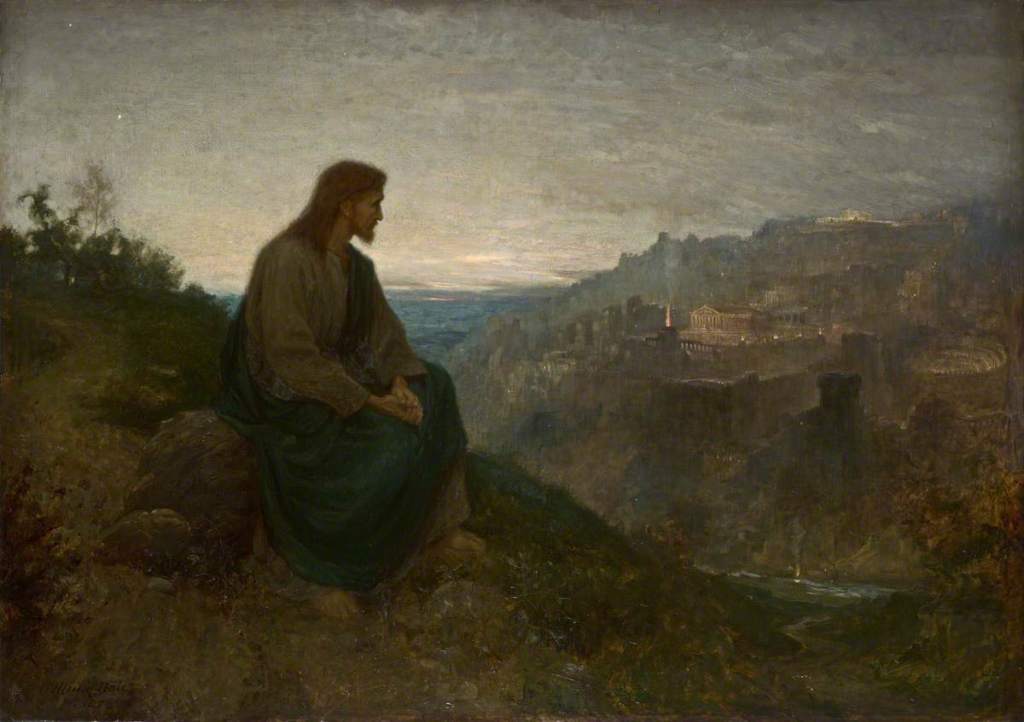
Luke 13:31-35 – Blessed Is He Who Comes In the Name of the Lord

“If Thou Had’st Known” by William Brassey (1846-1917) Royal Scottish Academy of Art & Architecture; http://www.artuk.org/artworks/if-thou-hadst-known-186809

At that time some Pharisees came to Jesus and said to him, “Leave this place and go somewhere else. Herod wants to kill you.”

He replied, “Go tell that fox, ‘I will keep on driving out demons and healing people today and tomorrow, and on the third day I will reach my goal.’ In any case, I must press on today and tomorrow and the next day—for surely no prophet can die outside Jerusalem!

“Jerusalem, Jerusalem, you who kill the prophets and stone those sent to you, how often I have longed to gather your children together, as a hen gathers her chicks under her wings, and you were not willing. Look, your house is left to you desolate. I tell you – you will not see me again until you say, ‘Blessed is he who comes in the name of the Lord.’” (New International Version)

King Herod of Judea, who was in the pocket of the Roman Empire, was issuing threats against Jesus. And those threats had some teeth behind them. Herod had recently beheaded Christ’s friend and cousin, John the Baptist (Luke 9:7-9). Yet, Jesus seemed unconcerned by the warnings. He made it clear that he was going to keep doing what he was doing, unfazed by Herod’s bluster.

Jesus had no intention of halting his travels, even because of a credible threat by the governing powers. Christ emphasized his words by assuring his listeners that the work he is doing will be done today, and the next, and the day after that—building ultimately to his greatest work of securing redemption through his crucifixion and resurrection. 

I hope to be always journeying towards Jerusalem with a heart full of compassion that will not waver in the midst of violent killing and injustice. That isn’t easy, yet I know that my humble pilgrimage with Jesus will be worth it all, in the end.

A pilgrimage is an apt description for the Christian season of Lent. Believers journey with Jesus, making the slow trek with him through his earthly ministry and to Jerusalem, up the Mount of Olives. There Christ is crucified – and we with him:

I have been crucified with Christ and I no longer live, but Christ lives in me. The life I now live in the body, I live by faith in the Son of God, who loved me and gave himself for me. (Galatians 2:20, NIV)

So far, we have made a stop in Bethlehem, following the star to the place where the newborn king was laid in a simple stinky feeding trough. The juxtaposition of that reality could not be more pronounced. The rightful Lord of all, far more powerful than old King Herod or the Roman Emperor, comes to earth not to be served, but to serve, and give his life as a ransom for many. (Mark 10:42-45)

In our walk with Jesus, we observe him deliberately posturing himself as a lowly servant throughout his earthly ministry. Whereas Herod acted the predictable part of a power hungry worldly ruler, squelching all rivals to the throne, Jesus shared his authority with others, along with a promise of continual presence. (Matthew 2:16-18, 28:16-20)

There is nothing romantic about this journey, this walk with Christ. It is often a hard road, and many count the cost of discipleship and choose to walk away.

Yet, Jesus is down for the struggle. He knows that injustice and systemic evil must be carefully rooted out. He understands that hearts and minds aren’t changed overnight. It will take time. So, we walk slowly with our Lord because Christ is in it for the long haul. We see Jesus is patiently, and sometimes imperceptibly, using divine power and authority to preserve the good and weed out the bad.

Dealing with human sin and the awful fallenness of this world will take a while. It will be an extended process because there are so many hard hearts. Jesus was ready, willing, and able to gather people together, as a mother hen gathers her chicks – yet there was an unwillingness to it.

And Christ, the heavenly ruler, isn’t in the business of twisting arms and manipulating others, like Herod, the earthly ruler.

Instead, Jesus invites. He doesn’t squeeze people like an orange to get their juice. Christ carefully prepares a meal. He sets the table himself. He gives of himself. Like some wildly potent superfood, a bit of wine and morsel of bread is more than enough to fill the hungry soul and the thirsty spirit.

With Jesus, there is always room at the Table.

There is room for you and for me. There is room for every kind of person – from every nation, race, gender, ethnicity, class – no matter the distinctions and no matter the past. It is the love of God in Christ, not the judgment, which brings people peace and salvation. It comes through a baby who grew and learn and suffered, just like us, and not through some wily old fox of a ruler.

Eventually, the phrase will be uttered, “Blessed is he who comes in the name of the Lord.” Jesus pulled this phrase from the Old Testament psalms. He did this, knowing quite well the context surrounding the verse:

The stone the builders rejected
    has become the cornerstone;
the Lord has done this,
    and it is marvelous in our eyes.
The Lord has done it this very day;
    let us rejoice today and be glad.

Lord, save us!
    Lord, grant us success!

Blessed is he who comes in the name of the Lord. (Psalm 118:22-26, NIV)

The chicks may scatter and refuse to be gathered. The builders might reject the crucial cornerstone and still try to build. Yet, it will not always be this way. As we journey with Jesus, eventually along the Via Dolorosa, the way of suffering, the road to Calvary, with an eye to where this will all culminate at an empty tomb and a great celebration of new life.

We will not be looking down at our feet forever in sorrow but will lift our faces toward the clouds. Just as we see Jesus ascending, we shall see Christ coming again. The time is near….

Look! He comes with the clouds of heaven.
    And everyone will see him—
    even those who pierced him.
And all the nations of the world
    will mourn for him.
Yes! Amen! (Revelation 1:7, NLT)

The triumphal entry of Jesus on Palm Sunday is followed by a triumphal entry into my heart, and the hearts of many. And there is coming yet another triumphal entry, back to this earth. All things will made new….

“There will be no more death, no more grief or crying or pain. The old things have disappeared.” Then the one who sits on the throne said, “And now I make all things new!” (Revelation 21:4-5, GNT)

May it be so, to the glory of God.

Almighty God, you know that we have no power in ourselves to help ourselves: Keep us both outwardly in our bodies and inwardly in our souls so that we may be defended from all adversities that may happen to the body, and from all evil thoughts that may assault and hurt the soul, through Jesus Christ our Lord, who lives and reigns with you and the Holy Spirit, one God, for ever and ever. Amen.

Deuteronomy 9:6-14 – Remember and Learn

Moses and the Masks by Israel Tsvaygenbaum, 2002

So, understand this: It’s not because you’ve been living right that the Lord your God is giving you this good land to possess. You are impossible to deal with!

Never forget how you made the Lord your God angry in the desert. You’ve rebelled against the Lord from the day you left Egypt until you came here. Even at Mount Horeb you made the Lord so angry that he wanted to destroy you. When I went up on the mountain to get the stone tablets, the tablets of the promise that the Lord made to you, I stayed on the mountain 40 days and 40 nights without food or water. Then the Lord gave me the two stone tablets inscribed by God himself. On them were written all the words that the Lord spoke to you from the fire on the mountain on the day of the assembly.

At the end of the 40 days and 40 nights, the Lord gave me the two stone tablets with his promise on them. He told me, “Leave right away. Your people whom you brought out of Egypt have ruined everything. They’ve quickly turned from the way I commanded them to live. They’ve made an idol for themselves.”

The Lord also said to me, “I’ve seen these people, and they are impossible to deal with. Leave me alone! I’ll destroy them and wipe their name off the earth. Then I’ll make you into a nation larger and stronger than they are.” (God’s Word Translation)

Significant things happen on mountains in the Bible. In the anticipation of Transfiguration Sunday, in which Christ’s glory is revealed on a mountain top, today’s Old Testament lesson reminds us of a great mountain event. And it was not all bunnies and butterflies. 

The book of Deuteronomy is a restatement of the Law. Moses recalled and recounted an oral history of Israel. They were about to enter the Promised Land, and Moses wanted the people to remember and never forget God’s saving actions and God’s Law. 

Forty years earlier, God graciously met with Moses on the mountain and gave him the Ten Words (Ten Commandments). However, the ugly truth was that, while Moses was with God on the mountain, the people became impatient, insolent, and rebellious. They degenerated into a chaotic mass riot who quickly worshiped an idol. Definitely not Israel’s best moment.

In restating Israel’s Law and history, Moses wanted the people to remember the Mount Sinai event in all of its foulness and degradation. It was important for them to not forget how stubborn and pig-headed their parents and grandparents were in running from the one true God to a false god. The people needed to avoid the sins of the previous generation so that they could enjoy God and thrive in the new land being given to them.

It does no one any good to whitewash the past or to altogether ignore it. 

Whether it is one’s personal past, a previous generation, or even a national history, we must face the sins of our forebears, to remember and not forget. We must neither be so extremely individualistic that we disconnect ourselves from our generational moorings, nor be dismissive of past sins – as if they have no influence upon us today. 

Mountain experiences can either be glorious, turn very dark, or a bit of both. We are meant to learn from them all, to remember and not forget.

Yet not all remembered. Which is why, over a millennium later, the New Testament issued it’s own remembrance and warning so that we will learn and not forget – contrasting the two mountains of Sinai and Zion:

Unlike your ancestors, you didn’t come to Mount Sinai—all that volcanic blaze and earthshaking rumble—to hear God speak. The earsplitting words and soul-shaking message terrified them, and they begged him to stop. When they heard the words— “If an animal touches the Mountain, it’s as good as dead”—they were afraid to move. Even Moses was terrified.

No, that’s not your experience at all. You’ve come to Mount Zion, the city where the living God resides. The invisible Jerusalem is populated by throngs of festive angels and Christian citizens. It is the city where God is Judge, with judgments that make us just. You’ve come to Jesus, who presents us with a new covenant, a fresh charter from God. He is the Mediator of this covenant. The murder of Jesus, unlike Abel’s—a homicide that cried out for vengeance—became a proclamation of grace.

So don’t turn a deaf ear to these gracious words. If those who ignored earthly warnings didn’t get away with it, what will happen to us if we turn our backs on heavenly warnings? His voice that time shook the earth to its foundations; this time—he’s told us this quite plainly—he’ll also rock the heavens: “One last shaking, from top to bottom, stem to stern.” The phrase “one last shaking” means a thorough housecleaning, getting rid of all the historical and religious junk so that the unshakable essentials stand clear and uncluttered.

Do you see what we’ve got? An unshakable kingdom! And do you see how thankful we must be? Not only thankful, but brimming with worship, deeply reverent before God. For God is not an indifferent bystander. He’s actively cleaning house, torching all that needs to burn, and he won’t quit until it’s all cleansed. God himself is Fire! (Hebrews 12:18-29, MSG)

The old adage from the late philosopher, George Santayana, stated in his 1905 book, The Life of Reason, is true: “Those who cannot remember the past are condemned to repeat it!”

Winston Churchill, restating the phrase for the British House of Commons in 1948 said, “Those who fail to learn from history are condemned to repeat it.”

Let us, then, ascend the mountain with Jesus and learn from him. And let us descend into the valley of the world remembering Christ’s words and ways for ourselves and for the next generations of believers.

God of history, your sovereign reign and rule extends to all creation and has existed for all time. You know the sins of my past, the heart of my present, and the soul of my future. Do not let me forget my sins, not because you hold them over my head, but because your grace has saved me from them all through Jesus Christ, my Savior. Amen.

Romans 8:1-11 – Life in the Spirit

Therefore, there is now no condemnation for those who are in Christ Jesus, because through Christ Jesus the law of the Spirit who gives life has set you free from the law of sin and death. For what the law was powerless to do because it was weakened by the flesh, God did by sending his own Son in the likeness of sinful flesh to be a sin offering. And so he condemned sin in the flesh, in order that the righteous requirement of the law might be fully met in us, who do not live according to the flesh but according to the Spirit.

Those who live according to the flesh have their minds set on what the flesh desires; but those who live in accordance with the Spirit have their minds set on what the Spirit desires. The mind governed by the flesh is death, but the mind governed by the Spirit is life and peace. The mind governed by the flesh is hostile to God; it does not submit to God’s law, nor can it do so. Those who are in the realm of the flesh cannot please God.

You, however, are not in the realm of the flesh but are in the realm of the Spirit, if indeed the Spirit of God lives in you. And if anyone does not have the Spirit of Christ, they do not belong to Christ. But if Christ is in you, then even though your body is subject to death because of sin, the Spirit gives life because of righteousness. And if the Spirit of him who raised Jesus from the dead is living in you, he who raised Christ from the dead will also give life to your mortal bodies because of his Spirit who lives in you. (New International Version)

I feel tremendously privileged to be a Christian and enjoy the very Spirit of God. The people of God are spiritual people, possessing God’s own Spirit. The Apostle Paul wanted Christians to know what they truly have as believers in Jesus.

No Condemnation

There is now no condemnation, no judgment, for those who are in Christ. God has pronounced a verdict, and that decision is final. We have been united to Christ by means of God’s Spirit. Since God condemns neither you nor I, there is no need whatsoever to condemn ourselves or other believers.

Since no condemnation is our reality as Christians, we are to believe this promise of God and swim in its wonderful privilege. 

Believe that the sin issue has been taken care of once for all through the life and death of Christ. If you do not feel forgiven, then put yourself in a position to believe. 

It would be silly to go into the bathroom, turn on the shower, and then just stand in the middle of the bathroom without getting under the showerhead. It would be silly because you did not put yourself in a position to actually become clean. You may believe that a shower and using soap and shampoo will make you clean, but if you do not actually avail yourself of the privilege of actually taking the shower but just stand there and look at it, you will not really be clean. 

We must put ourselves in a position to experience the privilege of knowing our wonderful state of cleanliness and no condemnation by actually reading the Word of God on a regular basis; praying in the Spirit on all occasions; and practicing the silence and solitude necessary to receive the cleansing work of the Holy Spirit.

Two people are declared “married” in a formal wedding ceremony. The couple then works out their shared union together over a lifetime. The minister does not pronounce condemnation at the ceremony; he declares a blessing. Yet, from that point forward, the two people must work on their marriage. They must believe their relationship is important enough to warrant putting themselves in a position to grow together. They will intentionally create date nights and conversations on the couch. They’ll seek to learn, appreciate, and participate in the other’s interests and life. 

“Grace is not opposed to effort; it is opposed to earning. Earning is an attitude. Effort is an action. Grace, you know, does not just have to do with forgiveness of sins alone.”

Dallas Willard, The Great Omission

Just as we do not marry ourselves and pronounce ourselves a married couple, so we do not save ourselves. However, having a marriage license does not mean there is no effort to be done in the relationship. A marriage is both a legal reality, and a kind of mystical union between two married persons.

It is a beautiful thing to be in a relationship where there is no condemnation. Because of Jesus Christ we are free to be the people God created us to be – forgiven and no longer burdened by sin’s condemnation.

Freedom from Sin and Death

In Holy Scripture, sin is not only a personal struggle but a present ubiquitous reality in the world. The power and presence of sin is found everywhere. There is personal, institutional, and systemic sin. Because sin is everywhere, death is everywhere. Biblically, death doesn’t only refer to physical death but is also a relational term referring to spiritual death. Death means relational separation from God. Conversely, life is relational connection with God. 

God did all the action necessary to make the union possible. God sent the Son. God became incarnate. God’s Son became a sin-offering, an atoning sacrifice for our sins. God condemned sin in sinful humanity. God met the righteous requirements of the law. God effects holiness in us by means of the Spirit. 

Rather than saving us from sin then simply telling us to live a holy upright life, God the Father and Son sent God the Holy Spirit to indwell us so that we can live like Jesus. 

Therefore, we must put ourselves in a position to experience life through dwelling in the Scriptures and letting the Spirit and the Word work together to effect practical change in our lives. 

Having the Mind of Christ

A problem we all face is that we inhabit a fallen world. Our mindset can easily get screwy. If we want life and peace, we need the mind of Christ and the Spirit. Whatever our minds are occupied with, that’s what determines whether we will have life and peace, or not. 

If the objects of our thoughts, interests, and affections are continually away from Christ and the Spirit, we will experience death, not life. If we put ourselves in a position to indulge the sinful nature, we will miss real life. A loose mind only leads to relational separation.

The addict knows very well that there are two choices, life or death. The first of twelve steps in Alcoholics Anonymous is to admit that I am powerless over alcohol and that my life has become unmanageable. The second step is to believe that a Power greater than myself can restore me to sanity. The third step is to turn my life and my will over to that Power. So, it is the same for us. 

We are powerless over sin, which will, if left unchecked, lead to death. But in the Spirit (and not in the alcoholic spirits) we have life. Sin, like alcohol, is a daily possibility, even after giving my life and my will to God. Yet, there is also the possibility of life. And that hope of life comes with possessing the mind of Christ and the Spirit. 

We have hope that through the Spirit’s power that we will overcome the power of choices that lead to death, and instead, embrace choices that lead to life. So, whatever we put into our minds is vitally important. 

The Spirit Indwelling Us

The Spirit is the sine qua non of the Christian life, that is, the distinguishing mark of the believer in Jesus. The Spirit opposes the sinful nature and expects us to do the same. There’s no need to try and live the Christian life on our own power when we possess spiritual power.

Pentecost by Edgardo De Guzman

There exists an internal struggle within us that desires to do right but has a compulsion to do otherwise. Yet, the indwelling Spirit gives us victory. Jesus lived the life for us that we could not live. His life, as much as his death, achieved salvation from sin for us. 

The very same Spirit that helped Jesus live his life, and raised him from death, is the same Spirit whom we possess.

When I was a kid, I remember my grandmother canning preserves. I would sit on a stool in the kitchen and watch her, looking forward to having some grape preserves on my next piece of toast. I once asked her, “Why are you always melting that wax over the fruit?” I didn’t understand how wax could make my toast taste any better. 

Grandma answered, “The wax seals the jar tightly so the fruit can’t be contaminated. If I didn’t seal it, the fruit would eventually rot.” As an amateur in the canning business, I could see the importance of picking grapes, boiling them, and canning them. But I now know how important sealing and preserving are.

You and I are God’s preserves. God not only chose us, redeemed us, and called us to life in the Son – God also had a plan for preserving us as heirs of eternal life. God gave us the indwelling Spirit so that we can live as we ought, free from sin and doing the will of God through spiritual power working within us. 

I hope today that you have a deep appreciation for the privileges of no condemnation, freedom from sin, possessing the mind of Christ and the power of the indwelling Spirit. And more than that, that you will avail yourselves of this tremendous gift of the Spirit and experience life and peace.

Gracious God, fill us with the knowledge of your will through all spiritual wisdom and understanding. May we live lives worthy of the Lord Jesus and please him in every way; bearing fruit in every good work, growing in the knowledge of God; being strengthened with all power according to your glorious might so that we may have great endurance and patience, joyfully giving thanks to you.  For you have rescued us from the dominion of darkness and have brought us into the kingdom of the Son you love, in whom we have redemption, the forgiveness of sins. Amen.

Luke 11:37-52 – Calling Them Out

Pharisees by German painter Karl Schmidt-Rottluff, 1912

When Jesus had finished speaking, a Pharisee invited him to eat with him; so, he went in and reclined at the table. But the Pharisee was surprised when he noticed that Jesus did not first wash before the meal.

Then the Lord said to him, “Now then, you Pharisees clean the outside of the cup and dish, but inside you are full of greed and wickedness. You foolish people! Did not the one who made the outside make the inside also? But now as for what is inside you—be generous to the poor, and everything will be clean for you.

“Woe to you Pharisees, because you give God a tenth of your mint, rue and all other kinds of garden herbs, but you neglect justice and the love of God. You should have practiced the latter without leaving the former undone.

“Woe to you Pharisees, because you love the most important seats in the synagogues and respectful greetings in the marketplaces.

“Woe to you, because you are like unmarked graves, which people walk over without knowing it.”

One of the experts in the law answered him, “Teacher, when you say these things, you insult us also.”

Jesus replied, “And you experts in the law, woe to you, because you load people down with burdens they can hardly carry, and you yourselves will not lift one finger to help them.

“Woe to you, because you build tombs for the prophets, and it was your ancestors who killed them. So, you testify that you approve of what your ancestors did; they killed the prophets, and you build their tombs. Because of this, God in his wisdom said, ‘I will send them prophets and apostles, some of whom they will kill and others they will persecute.’ Therefore, this generation will be held responsible for the blood of all the prophets that has been shed since the beginning of the world, from the blood of Abel to the blood of Zechariah, who was killed between the altar and the sanctuary. Yes, I tell you, this generation will be held responsible for it all.

“Woe to you experts in the law because you have taken away the key to knowledge. You yourselves have not entered, and you have hindered those who were entering.” (New International Version)

“The greatest way to live with honor in this world is to be what we pretend to be.”

Socrates

An outward showy spirituality means little to nothing – and it actually results in injustice and a lack of concern for others. Conversely, paying attention to the inner person has the effect of making our outer actions helpful and healing.

As you can tell from today’s Gospel lesson, Jesus had no use for the showy kind of spirituality. He was looking for a generous spirit of love and justice, willing to share with others from altruistic and benevolent motives. Instead, he got bupkis.

The woes Jesus pronounced on the showy spiritual charlatans were a kind of grieving and lamenting of how far astray the religious were from genuine heartfelt spirituality.

Unfortunately, there are pious people today who claim the name of Christ and slam the door of God’s kingdom in the faces of others by:

  • Saying God’s grace is for all, then turning around and avoiding certain people, calling them “sinners.”
  • Having explicit written statements or rules that exclude people from serving God.
  • Binding people to human traditions and practices instead of Holy Scripture. 
  • Declaring the seven deadly words of the Church: “We’ve never done it that way before.” 

Jesus called the religious leaders out. And rather than listening and changing, the leaders just felt insulted and offended. They refused to hear that their nit-picking religious obsessions and criticizing judgments of others kept people from accessing God’s love and justice.

The Lord’s words are pointed and hard. Jesus talked to them this way, it seems to me, because they probably wouldn’t have heard it any other way. In other words, Christ talked their language so they could hear him.

The Pharisees often get a bad rap. But they were faithful givers. They rightly and deservedly gave a tenth of everything they had. However, the problem was that they did it so they could feel really good about themselves, thereby feeling justified in neglecting the weightier matters of the law, the stuff they really didn’t want to do. 

This is the kind of mental gymnastics which is still done today, by saying, “Hey, man, I do my part. I give,” but all the while having no intention of focusing on weightier matters of justice, mercy, and faithfulness. It is essentially using money and stuff to buy off God. It is focusing on the minutia of pennies and dimes, instead of saving lives.

The weighty matters of the Law were there in the Old Testament. They just got ignored….

“This is what the Lord All-Powerful said:
‘You must do what is right and fair.
    You must be kind and
    show mercy to each other.
Don’t hurt widows and orphans,
    strangers, or poor people.
Don’t even think of doing bad things to each other!’”

But they refused to listen
    and refused to do what he wanted.
They closed their ears so that they
    could not hear what God said.
They were very stubborn
    and would not obey the law.
The Lord All-Powerful used his Spirit
    and sent messages to his people through the prophets.
But the people would not listen,
    so the Lord All-Powerful became very angry. (Zechariah 7:9-12, ERV)

Righteousness is profoundly social. It has to do with pursuing right relationships with people, not just people I like or who I feel deserve it. Jesus mentioned justice and love because these terms really have to do with our neighbors, not only our buddies and cronies. 

Any evil person can love those who love him; but the one who loves Jesus, loves the people for whom no one else cares or loves.

As God’s people, we are meant by the Lord to be forthright, frank, genuine, honest, humble, open, real, truthful, authentic, just, righteous, sincere, and upright in all our relations with others. To do otherwise is to be hypocritical.

Hypocrisy does not practice what it preaches, keeps people out of God’s kingdom, focuses on externals, and majors on the minors. Jesus loved the Pharisees enough to call them out and call them back to the true worship of God.

Because anything less than a deep concern for all humanity is not true religion.

Blessed God and Father of the universe, I am not above you and I am not the master of all things. Instead, I am your servant and your child. Help me be quick to look at myself when I am prone to look over to others. Thank you that you have wild and abundant grace for me that will never end nor let me go. Teach me your ways and help me be receptive to them, so I will not fall. I submit to your rule and reign over all things, including all my thoughts, opinions, perceptions, decisions, beliefs, and actions, through Jesus Christ my Lord. Amen.