Philippians 2:5-11 – Descending Into Greatness

In your relationships with one another, have the same mindset as Christ Jesus:

Who, being in very nature God,
    did not consider equality with God something to be used to his own advantage;
rather, he made himself nothing
    by taking the very nature of a servant,
    being made in human likeness.
And being found in appearance as a man,
    he humbled himself
    by becoming obedient to death—
        even death on a cross!

Therefore, God exalted him to the highest place
    and gave him the name that is above every name,
that at the name of Jesus every knee should bow,
    in heaven and on earth and under the earth,
and every tongue acknowledge that Jesus Christ is Lord,
    to the glory of God the Father. (New International Version)

So, what kind of people (and what kind of church) would we be if we resembled these verses of Holy Scripture?  

The Apostle Paul said to the church in Philippi that their “attitude” or “mindset” should be the same as Christ Jesus. Their thinking ought to be like the mind of Christ. To think well, live well, and be well, we need the mind of Christ.

To relate to others in a godly way, to navigate this fallen world with integrity and truth, to make an impact on those around us, we must adopt the mindset and attitude of Jesus.  

Everything comes down to God – how we should think and how we ought to live. Within the life of the one true God, exists three persons: Father, Son, and Spirit. Within the Holy Trinity, there exists perfect love, absolute holiness, united harmony, and constant respect. 

Just as God is holy, we are to be holy.

Therefore, once you have your minds ready for action and you are thinking clearly, place your hope completely on the grace that will be brought to you when Jesus Christ is revealed. Don’t be conformed to your former desires, those that shaped you when you were ignorant. But, as obedient children, you must be holy in every aspect of your lives, just as the one who called you is holy. It is written, You will be holy, because I am holy. (1 Peter 1:13-16, CEB)

Just as God is love, so we are to love one another.

Dear friends, we should love each other, because love comes from God…. This is how God showed his love to us: He sent his one and only Son into the world so that we could have life through him. This is what real love is: It is not our love for God; it is God’s love for us. He sent his Son to die in our place to take away our sins. Dear friends, if God loved us that much, we also should love each other. (1 John 4:7-11, NCV)

Just as Jesus is a humble servant, so we are to practice humble service in all relationships.

Everyone must live in harmony, be sympathetic, love each other, have compassion, and be humble. Don’t pay people back with evil for the evil they do to you, or ridicule those who ridicule you. Instead, bless them, because you were called to inherit a blessing. (1 Peter 3:8-9, GW)

Humility is vital to Christian existence, and not optional. There is no place in the believer’s life for pride, posturing, and power-broking. Instead, we are to take the posture of lowliness, using any kind of influence for the benefit and encouragement of others – just like Jesus did while on this earth. 

In a world pre-occupied with power and control, safety and security, influence and throwing its weight around, there is Jesus. Christ did the opposite of engaging in upward mobility; he practiced downward mobility. In doing so Jesus Christ descended into greatness as Lord and Savior.

To have the mind and attitude of Christ happens through emulating our Lord’s example of humility. Jesus is God. Yet, despite that reality, the pre-incarnate Christ did not sit in heaven as the second person of the Trinity and hold onto his lofty position with tight fists. 

Jesus came to this earth with a humble willingness to open his hands and relinquish his rights and privileges as God. Christ divested himself of all his privilege. He became a slave. Jesus gladly emptied himself and held nothing back. Christ completely gave himself up for us.

Jesus became one of us, yet never ceased being the Lord of all. It’s just that he willingly put his kingly robe in the closet and put on Dickies and work boots. Jesus came among us and purposely limited himself to identify with us fully – and secured for us the greatest generosity imaginable: an answer to the problem of guilt and shame through forgiveness of sins.

Jesus became a servant, a bond-slave. Christ completely tied himself to us, not coming to this earth seeking to be served, but serving and giving his life as a ransom for many. 

What’s more, Christ kept going lower and lower to the point of descending to the greatest humiliation and shame of all – death on a cross. The King of the universe was killed by sinful humanity so that he might redeem and save those very same people from their terrible plight of bondage to the power of sin.

Therefore, we are to be humble, embracing the lowly status of being slaves to God and to one another. The Philippian church had a real problem with pride. Hear the exhortations given to the Philippian church so that they would practice humility in all their relationships: 

  • Live your life in a manner worthy of the gospel of Christ, so that, whether I come and see you or am absent and hear about you, I will know you are standing firm in one spirit, striving side by side with one mind for the faith of the gospel (Philippians 1:27, NRSV)
  • Don’t be jealous or proud but be humble and consider others more important than yourselves. (Philippians 2:3, CEV)
  • You must continue to live in a way that gives meaning to your salvation. (Philippians 2:12, ERV)
  • Do all things without murmuring and arguing. (Philippians 2:14, NRSV)
  • Brothers and sisters, imitate me, and pay attention to those who live by the example we have given you. (Philippians 3:17, GW)
  • Do not be anxious [tight-fisted control] about anything, but in every situation, by prayer and petition, with thanksgiving [open-handed humility] present your requests to God. (Philippians 4:6, NIV)

As a result of Christ’s humble obedience to the Father, he was exalted from the lowest place to the highest place. King Jesus is on the throne, above everyone and everything. Because of his descent to this earth, he ascended in glory and honor. We now see God in a new way, through Jesus – and it causes us to bend the knee and confess with the tongue that Jesus Christ is Lord.

In the ancient Roman world, Jesus as Lord was subversive language. Because if Jesus is Lord, Caesar is not, and ultimate allegiance does not belong to the Empire. And it is no different in our day. The issue of who we pledge our fealty to, still pertains to us. If Jesus is Lord, no earthly politician or religious figure is owed lordship status.

To follow Jesus, one must practice downward mobility and embrace humility.

Bowing the knee to Christ becomes second nature whenever we give our unflagging allegiance to him. We accept that we are the creatures and God is the Creator, that God is God, and we are not.

As we enter Holy Week, hear the prophet Isaiah’s words of humiliation and exaltation:

Just watch my servant blossom!
    Exalted, tall, head and shoulders above the crowd!
But he didn’t begin that way.
    At first everyone was appalled.
He didn’t even look human—
    a ruined face, disfigured past recognition.
Nations all over the world will be in awe, taken aback,
    kings shocked into silence when they see him.
For what was unheard of they’ll see with their own eyes,
    what was unthinkable they’ll have right before them.

Who believes what we’ve heard and seen?
    Who would have thought God’s saving power would look like this?

The servant grew up before God—a scrawny seedling,
    a scrubby plant in a parched field.
There was nothing attractive about him,
    nothing to cause us to take a second look.
He was looked down on and passed over,
    a man who suffered, who knew pain firsthand.
One look at him and people turned away.
    We looked down on him, thought he was scum.
But the fact is, it was our pains he carried—
    our disfigurements, all the things wrong with us.
We thought he brought it on himself,
    that God was punishing him for his own failures.

But it was our sins that did that to him,
    that ripped and tore and crushed him—our sins!
He took the punishment, and that made us whole.
    Through his bruises we get healed.
We’re all like sheep who’ve wandered off and gotten lost.
    We’ve all done our own thing, gone our own way.
And God has piled all our sins, everything we’ve done wrong,
    on him, on him.

He was beaten, he was tortured,
    but he didn’t say a word.
Like a lamb taken to be slaughtered
    and like a sheep being sheared,
    he took it all in silence.
Justice miscarried, and he was led off—
    and did anyone really know what was happening?
He died without a thought for his own welfare,
    beaten bloody for the sins of my people.
They buried him with the wicked,
    threw him in a grave with a rich man,
Even though he’d never hurt a soul
    or said one word that wasn’t true.

Still, it’s what God had in mind all along,
    to crush him with pain.
The plan was that he give himself as an offering for sin
    so that he’d see life come from it—life, life, and more life.
    And God’s plan will deeply prosper through him.

Out of that terrible travail of soul,
    he’ll see that it’s worth it and be glad he did it.
Through what he experienced, my righteous one, my servant,
    will make many “righteous ones,”
    as he himself carries the burden of their sins.
Therefore I’ll reward him extravagantly—
    the best of everything, the highest honors—
Because he looked death in the face and didn’t flinch,
    because he embraced the company of the lowest.
He took on his own shoulders the sin of the many,
    he took up the cause of all the black sheep. (Isaiah 52:13-53:12, MSG)

Lord Jesus, Son of God, you walked the earth with humility, despite being Lord of all. Your meekness confused the proud and arrogant. Your nobly attended to the needy and destitute. Teach me to model my life after you, to live with a humble spirit. Help us to never view ourselves as greater or better than others. Let our hearts always imitate your humility. Amen.

Hebrews 2:1-9 – Pay Attention

We must pay the most careful attention, therefore, to what we have heard, so that we do not drift away. For since the message spoken through angels was binding, and every violation and disobedience received its just punishment, how shall we escape if we ignore so great a salvation? This salvation, which was first announced by the Lord, was confirmed to us by those who heard him. God also testified to it by signs, wonders and various miracles, and by gifts of the Holy Spirit distributed according to his will.

It is not to angels that he has subjected the world to come, about which we are speaking. But there is a place where someone has testified:

“What is mankind that you are mindful of them,
    a son of man that you care for him?
You made them a little lower than the angels;
    you crowned them with glory and honor
    and put everything under their feet.”

In putting everything under them, God left nothing that is not subject to them. Yet at present we do not see everything subject to them. But we do see Jesus, who was made lower than the angels for a little while, now crowned with glory and honor because he suffered death, so that by the grace of God he might taste death for everyone. (New International Version)

In my line of work as a hospital chaplain on a behavioral health unit, I frequently deal with patients who have brain disorders. Many of them, including many in my own family, have Attention Deficit Disorder (A.D.D.). Many people believe this to be a disadvantage.

Yet, I have noticed that since their brain chemistry doesn’t have a good filter for sifting all the stimuli they hear each day, many A.D.D. folks are quite intentional about picking out the voice they want to hear and engaging with it. Whereas others might take this for granted, the patients in my life know the value of creating the skills to pay attention.

The ability to pay attention and listen is necessary for a successful and sustainable Christian life.

The consequence of not developing such competency is that we will drift away – our minds will wander and allow other competing voices to overwhelm the singular voice of Jesus. Taking salvation for granted may subversively set us up for spiritual failure.

Whenever we think we already know about Christ’s person and work, we neglect to really pay attention. Bad idea.

Assuming we are paying attention is not the same thing as actually doing it. Assumptions create a slow drift away from truth. Therefore, we need continual reminders of Christ’s redemptive events. 

We must avoid the precarious position of being lost in a sea of competing voices.

We need an intentional plan for paying attention – without assuming we will be focused. Here are a few ways of daily mindfulness so that we will not become S.A.D.D. (Spiritual Attention Deficit Disorder):

  • Read Holy Scripture each day with a combination of standing and sitting, reading silently and out loud.
  • Hold a cross or other Christian reminder in your hand and feel free to fidget with it.
  • Journal your thoughts in a notebook.
  • Set a consistent time and place for spiritual reading and prayer.
  • Use different translations and versions of the Bible to read.
  • Go outside occasionally and pray while walking.
  • Focus on your breathing, and consider using breath prayers (i.e., Breathe out: “Speak Lord.” Breathe in: “I am listening.”)
  • Drink some coffee, tea, or something soothing, and picture the comfort of Christ coming into your life.
  • Be aware of distractions and acknowledge them without judging yourself.
  • Observe the Christian Year and the Daily Lectionary.

While some might argue that observing Lectionaries, the Church Calendar, Christian seasons, and worship liturgies are vain repetition, I insist otherwise: We are in grave danger of not paying attention to what we have heard, lest we drift away from it. 

Like a beach-goer on the lake drifting on her flotation device far out from shore, we can be unaware of how far we have strayed from our spiritual moorings.  If the passion and death of Jesus can only get a shoulder shrug and a “meh” out of us, there is a real problem.

Forming habits of worship, fellowship, service, and piety are essential to deliberately maintaining attention to Jesus. Perhaps if we all felt S.A.D.D. we would be more intentional about grafting reminders and practices into our lives.

Ignorance does not come from a lack of education; it comes from a failure to pay attention to the most important things in life.

God pays attention to us in a special way, different from all other creation. As the only creatures for whom the image and likeness of God resides, we have an innate sense of connection with the divine. Paying attention to things, especially to what Christ has secured for us through the cross, reflects the God who is continually observing humanity.

May your contemplation of Christ and his redemptive events of incarnation, holy life, teaching, death, resurrection, and ascension be always fresh and continually meaningful.

God, as You speak through scriptures, whispers, dreams, circumstances, nature, and people in our lives, help us to pay attention to Your voice. May we hear You in the many ways You communicate. May we pay attention to the important and the urgent and may we choose wisely. May we live attentively today.

Psalm 126 – Planting in Tears and Harvesting with Joy

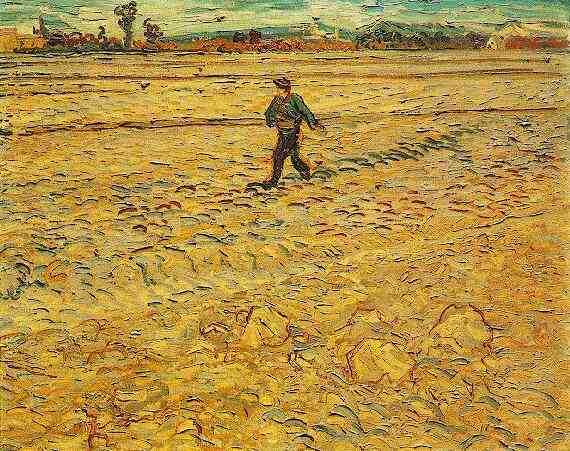
The Sower, by Vincent Van Gogh, 1881

When the Lord brought back his exiles to Jerusalem,
    it was like a dream!
We were filled with laughter,
    and we sang for joy.
And the other nations said,
    “What amazing things the Lord has done for them.”
Yes, the Lord has done amazing things for us!
    What joy!

Restore our fortunes, Lord,
    as streams renew the desert.
Those who plant in tears
    will harvest with shouts of joy.
They weep as they go to plant their seed,
    but they sing as they return with the harvest. (New Living Translation)

Many people are familiar with the phrase, “You reap what you sow.” Although the saying is typically referred to in the context of avoiding poor decisions (Galatians 6:7) the principle is woven throughout Holy Scripture in other scenarios, as well, as it is in today’s psalm.  

Sowing and reaping are, of course, agricultural terms. Farmers and gardeners tend to the soil through tilling, planting, cultivating, weeding, and eventually harvesting. The images of farming and the growth of plants serve as fitting metaphors for the spiritual life. Growth does not occur quickly. Instead, constant and vigilant attention to one’s spirit eventually brings a harvest of good works and godly attitudes. 

Jesus said, “My food is to do what the one who sent me wants me to do. My food is to finish the work that he gave me to do.” (John 4:34, ERV)

In a culture which values immediacy and having things now, the slow growth of the spiritual life can be a difficult principle to grasp. We may think that whenever we sin – with no immediate lightning to zap us – that therefore what we did must not have been so bad. 

Eventually, however, our implanted seeds will sprout and become visible to all. Conversely, we might believe whenever we dedicate ourselves to altruistic service, and then see no immediate results, that we must be doing something wrong. So, we may easily become discouraged and give up.

Sow for yourselves righteousness; reap steadfast love. Break up your fallow ground; for it is time to seek the Lord, that he may come and rain righteousness upon you. (Hosea 10:12, NRSV)

The psalmist reminds us of the need for patience. Just as it takes continual watering to reap a harvest in the field, so the Christian’s life of weeping and tears, of tilling deeply into the things of God, is the necessary work to eventually spot a sprout, see growth, and finally bear fruit. 

The tedious cultivating and weeding of our souls is the task before us. If we are patient and consistent, we will realize a harvest of righteousness. 

The Sower, by Vincent Van Gogh, 1888

Jesus taught his Beatitudes to help us understand that righteousness, peace, and joy come through connecting with our poverty of spirit; mourning over personal and corporate sin; embracing humility and meekness; hungering and thirsting after righteousness.

Only through the blood, sweat, and tears of spiritual agony will we come through to the deep happiness of seeing the Lord accomplish great things in our lives. In other words, joy is neither cheap nor easy. It is the fruit of many tears.

Spiritual farming involves sound practices of sowing and reaping. There is suffering before glory, tears before joy, lament before healing.

Just as a farmer cannot take short-cuts in the planting and cultivating process if he wants to have a bounteous and delicious harvest, so there is no getting around the painful work of grieving our changes and losses.

Avoiding the hard work of spiritual farming leads to a bogus harvest where we bite into a fresh ear of sweet corn only to discover a mouthful of worms.

Remember this: The person who plants a little will have a small harvest, but the person who plants a lot will have a big harvest.

2 Corinthians 9:6, NCV

The bulk of our lives are played out in the liminal space between sowing and reaping. The farmer plants and waits, attentive to the land and the weather until the time of harvest. We, too, exist in a time of patience. So, we pray, recalling past harvests and anticipate that with God’s good help, we will enjoy abundance.

This in-between time is often characterized by tears.

As she stood behind him at his feet weeping, she began to wet his feet with her tears. Then she wiped them with her hair, kissed them and poured perfume on them. (Luke 7:38, NIV)

I grew up on an Iowa farm. I only saw my father cry twice in my life. The first time, I was just a boy, two days after my eighth birthday – a devastating hailstorm destroyed the crops that had been planted just six weeks before. Despite farm equipment and technological savvy, the farmer is still at the mercy of the weather.

And we will always be at the mercy of God. Because God is good, just, and fair, the Lord does great and benevolent things. To be blessed, we need to embrace the dog days of summer in all its banality and its tears until we reach the time of reaping. There is joy, and it is coming, if we do the work of spiritual farming and wait patiently.

Likely, none of us awake in the morning, sit up on the edge of the bed, and say to ourselves, “Well, let’s see, I think I’ll cry and be sorrowful today.” We might do that with joy, but not with sadness. It can be easier to gravitate toward the fulfillment of dreams, laughter, and happiness than tears and weeping.

Yet, if we want to experience authentic joy, the path to it is through crying because it is our tears which find a better way.

“Normality is a paved road: It’s comfortable to walk, but no flowers grow on it.”

Vincent Van Gogh

Whether it comes from a certain denominational tradition, ethnic background, or family of origin dynamics, there are many Christians who love to emphasize Jesus as Victor and camp in resurrection power – while eschewing Christ as the man of sorrows, acquainted with grief and sadness.

By viewing only one dimension of Christ’s redemptive work, pastoral care often falls far short of true help. Trying to engineer cheerfulness and create solutions to a person’s genuine grief is, at best, not helpful, and at worst, damaging to their soul. It only leads to cheap inauthentic joy.

Sincerely singing spontaneous songs of joy, with a sense of abundant satisfaction, comes through suffering and sorrow. There must be a crucifixion before there is a resurrection. In the agrarian culture of ancient Israel, the metaphor of sowing a reaping connected well to the importance of planting tears and allowing them to flower later into an abundant harvest of joy.

Perhaps in contemporary American culture, a more apt metaphor would be financial investing and cashing out. The investment we put into attending to our grief with expressions of lament through tears, will eventually get a return, and we shall be able to cash out with a rich bounty of joy.

Easter is coming. Resurrection and new life will occur. The journey of Lent, with seeds repentance carefully planted, watered with tears, shall bring an abundant harvest of joy.

Gratias Deo. Thanks be to God.

Luke 9:10-17 – Jesus Feeds Five-Thousand

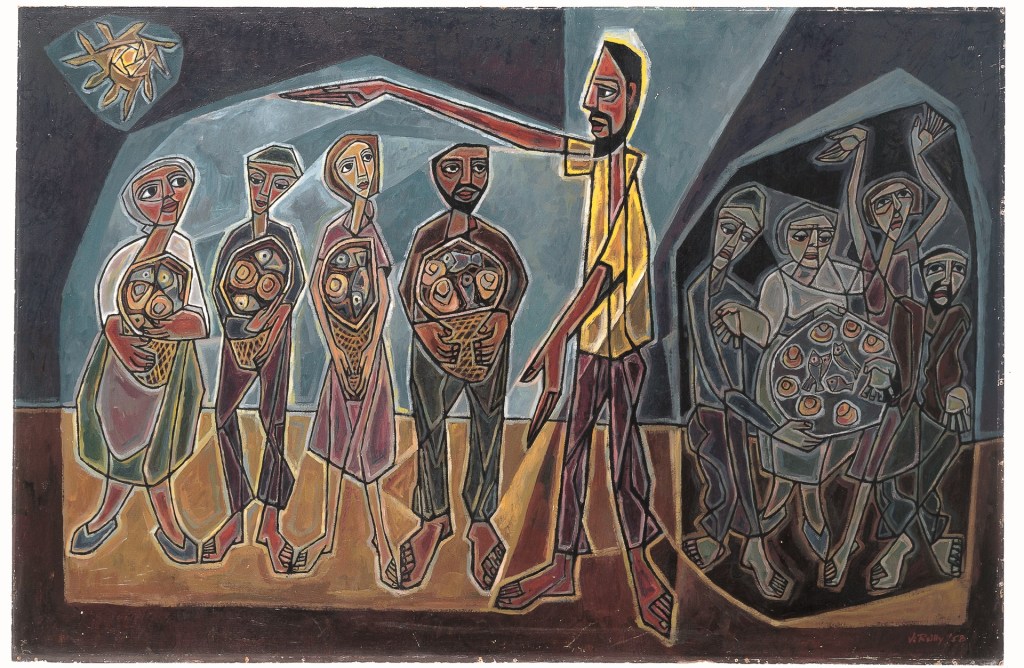
The Feeding of the Five Thousand by John Reilly, 1958

When the apostles returned, they reported to Jesus what they had done. Then he took them with him, and they withdrew by themselves to a town called Bethsaida, but the crowds learned about it and followed him. He welcomed them and spoke to them about the kingdom of God and healed those who needed healing.

Late in the afternoon the Twelve came to him and said, “Send the crowd away so they can go to the surrounding villages and countryside and find food and lodging, because we are in a remote place here.”

He replied, “You give them something to eat.”

They answered, “We have only five loaves of bread and two fish—unless we go and buy food for all this crowd.” (About five thousand men were there.)

But he said to his disciples, “Have them sit down in groups of about fifty each.” The disciples did so, and everyone sat down. Taking the five loaves and the two fish and looking up to heaven, he gave thanks and broke them. Then he gave them to the disciples to distribute to the people. They all ate and were satisfied, and the disciples picked up twelve basketfuls of broken pieces that were left over. (New International Version)

Jesus feeding five thousand people is not just an incredible story that happened a long time ago. Today, Jesus is still in the miracle business because he is still in the kingdom business. Christ still takes our meager resources and turns them into something that has a large impact on a lot of people. 

For that to happen, all we need do, is follow the Lord’s simple instructions: “You give them something to eat,” and, “Bring them [five loaves and two fish] here to me.” Jesus, using a simple act of obedience by his disciples, did one of the most famous miracles in history.

Jesus can multiply whatever little we possess to accomplish his kingdom work through us. 

It is true that Jesus most certainly can do miracles without us. And yet, Christ chooses to use us simple folk to participate in his work. God uses our simple prayers for the miracle of a transformed life. The Lord uses our imperfect speech to bring new life to others. Jesus takes our miniscule bank account to bring a river of financial resources to many through a small act of giving. 

Faith is our true work – to believe God can do the extraordinary through our ordinary loaf of bread and piece of fish.

The Compassion of Jesus Motivates Him To Do Miracles

Jesus withdrew to a solitary place. The crowd, however, did not leave him alone. But rather than being annoyed by the situation because this interruption was not on his divine day planner, Jesus looked at the large group of people and had compassion on them. 

Christ’s heart went out to thousands of people, so he set about the work of healing the sick. Please know that God does not begrudgingly deal with you, as if you were an interruption to his day; the Lord has compassion for you.

The Desire of Jesus is For Us to Participate in the Miracles He Does

After a full day of healing, Christ’s disciples came to him as if he was unaware of the people’s need for food.  They had a very rational and realistic answer to the problem of hunger in front of them; dismiss the crowd so they can go out to eat. 

Jesus calmly responded, “They don’t need to go away; you give them something to eat.” 

I detect perhaps a hint of sarcasm and a slight eye roll in the reply of the disciples, “We have only five loaves of bread and two fish.” But their math was way off because they did not count Jesus. 

The Five Thousand by Eularia Clarke, 1962

Jesus simply said, “Bring them here to me.” My friends, if we have ears to hear, Jesus is still saying this today to us – bring them here to me. Through simple prayer and active obedience, we must give Jesus what we have, no matter how little or insignificant.

Most of what happens in Western Christianity, much like the ancient disciples, is a reasonable doing of rational ministry. Many ministries have little to nothing to do with the impossibility of faith and seeing God work in ways that are incomprehensible to our modern sensibilities.

The earthly miracles of Christ were not an isolated instance. God has always been taking the impossible and making it possible.

Now there was a woman who had been married to a member of a group of prophets. She appealed to Elisha, saying, “My husband, your servant, is dead. You know how he feared the Lord. But now someone he owed money to has come to take my two children away as slaves.”

Elisha said to her, “What can I do for you? Tell me what you still have left in the house.”

She said, “Your servant has nothing at all in the house except a small jar of oil.”

He said, “Go out and borrow containers from all your neighbors. Get as many empty containers as possible. Then go in and close the door behind you and your sons. Pour oil into all those containers. Set each one aside when it’s full.”

She left Elisha and closed the door behind her and her sons. They brought her containers as she kept on pouring. When she had filled the containers, she said to her son, “Bring me another container.”

He said to her, “There aren’t any more.” Then the oil stopped flowing, and she reported this to the man of God.

He said, “Go! Sell the oil and pay your debts. You and your sons can live on what remains.” (2 Kings 4:1-7, CEB)

What if we were to live as if God was interested in doing the miraculous? Would it change the way we pray, and the way we act? 

What if we understood just enough of Jesus, of what he can and wants to do, that we are bold to say:

  • “This might sound crazy, but what if we found out the names of everyone in our community who needs food and go love on them and feed them?” (instead of only the rational means of a food pantry)
  • “This might sound crazy, but what if we used our property to create a community garden and help people grow their own food?” (instead of only the rational means of government aid) 
  • “This might sound crazy, but what if we prayed for one-hundred people, by name, to be healed?” (instead of only the rational means of relying on the pastor to pray)

Most of our plans are humanly possible and doable. Maybe we ought, instead, to seek the impossible.

We may often do nothing out of a sense that God either cannot or does not want to use me or what I have. However, it just won’t do to stand afar off and expect God to work without us giving what we have, whether that something is time, money, conversation, food, hospitality, or whatever. 

Our excuses won’t do for Jesus – my home is too small, I don’t have enough money, I am not smart enough, my schedule won’t allow it, I don’t have enough resources…. In God’s economy you don’t need much, at all. Just a mustard seed worth of faith will do. Jesus wants us to be a part of the miracles he is doing.

Conclusion

I can visualize the disciples befuddled by Christ’s words. I can imagine hearing their excuses. “You want me to do what?  Feed thousands?  Lead someone to Jesus?  Pray in front of others?….” 

The miracle for many a believer is to be open, real, and transparent enough to believe that Christ can do the impossible through confessing sin, participating in ministry, having a spiritual conversation with an unbeliever, or just naming out loud what one actually thinks and feels.  

The question is never, “Can God use me?” The real question is, “What miracle does God want to do through me, and through us as a community of faith?”

It is no accident that when Jesus distributed the bread, it sounds a lot like communion. The Lord’s Supper may seem to be irrelevant – only something we do to remember Jesus, or a mere ritual. But God’s design is much bigger. The Lord wants to do a miracle. 

God wants our observance of Christian communion to bring a healing which the world cannot give. It appears irrational that Jesus can use a small Table to feed and reach thousands. Yet, we don’t serve a God who is limited to work through rational means. 

O God, our heavenly Father, you have blessed us and given us dominion over all the earth. Increase our faith and our reverence for the mystery of life. Give us new insight into your purposes for the human race, and new wisdom and determination in making provision for its future, no matter whether it makes sense, or not, in accordance with your goodwill, through Jesus Christ our Lord. Amen.