For the Common Good of All (1 Corinthians 12:4-13)

There are different spiritual gifts, but the same Spirit gives them. There are different ways of serving, and yet the same Lord is served. There are different types of work to do, but the same God produces every gift in every person.

The evidence of the Spirit’s presence is given to each person for the common good of everyone. The Spirit gives one person the ability to speak with wisdom. The same Spirit gives another person the ability to speak with knowledge. To another person the same Spirit gives courageous faith. To another person the same Spirit gives the ability to heal. Another can work miracles. Another can speak what God has revealed. Another can tell the difference between spirits. Another can speak in different kinds of languages. Another can interpret languages. There is only one Spirit who does all these things by giving what God wants to give to each person.

For example, the body is one unit and yet has many parts. As all the parts form one body, so it is with Christ. By one Spirit we were all baptized into one body. Whether we are Jewish or Greek, slave or free, God gave all of us one Spirit to drink. (God’s Word Translation)

Being given a gift from someone is rightly associated with joy, celebration, goodness, and the possibility of what the gift is and how it might be used.

Unpacking Our Spiritual Gifts

And this is why we unpack gifts with curiosity and abandon. It would be weird if we were given a gift, then let it sit unopened. Instead, we typically receive the gift, rip it open, and express gratitude for the thoughtfulness. Then, we explore it, enjoy it, and use it.

The Spirit, likewise, has been marvelously given to God’s people. Each individual Christian is specially provided a gift to open, use, and enjoy. Spiritual gifts graciously given to us are meant for the common good of all. And this use for the common good is where the gift is different than Christmas presents or birthday gifts.

Spiritual gifts are designed by God to be acts and words of service, dispersed for the benefit of others. Yes, they are meant for us to enjoy them. Yet, they are not meant solely for personal satisfaction.

Using Our Spiritual Gifts

So, if a person’s spiritual gift is teaching, they do not stand in front of a mirror and talk at themselves. Rather, they jump into the fray of learning and explaining, and do it in such a gracious and loving way that the enablement of the Spirit is evident.

If a person’s gift is faith, they do not merely step out and act with unusual courage for the purpose of personal betterment in a holy belief from God. They also demonstrate faithfulness to God’s people and to God’s world. The gift is for the common good of all persons.

The accumulation of wisdom and knowledge is meant for the strengthening of faith in others. Spiritual gifts are intended by God to be shared freely for the common good of all people so that people are strengthened in faith and supported for the rigors of daily life in the world.

Therefore, we really need to take some initiative in identifying our gift(s), unpacking them, and indiscriminately using them. Spiritual health and wholeness can only truly be realized through everyone’s active participation in distributing their God-given abilities.

Stewarding Our Spiritual Gifts

Spiritual gifts are neither to be hoarded, nor miserly dealt to only people I like or my own little world of groupies and friends. Any and every ability comes from God, and is therefore, given for the benefit of all persons. Underprivileged groups need the giftedness of others, as well as discovering their own resources so that everyone is built up in a society of redeemed persons.

What’s more, spiritual mavericks are not so helpful here. The Lone Ranger is not a good model for us. Christians are the Body of Christ, meant to function as one. Just as the Holy Trinity of divine persons – Father, Son, and Spirit – work together in unity of purpose and harmony of being, so persons of the Church are to unify and act as one in the mission of God.

Diversity of gifts are to be expressed in unity of building up others and extending Christ’s love to the world. When we harmoniously coordinate our joint efforts in utilizing our collective spiritual gifts, the world is turned upside-down with kingdom grace and ethics.

Goodness, joy, and possibility become alive when people unpack their gifts and use them for the common good of everyone.

Spiritual Gift Envy

Sometimes, we might succumb to “gift envy.” We observe the talented gift of another and secretly wish it for ourselves. The proper remedy to such a malady is gratitude. When we give thanks to God for the gift(s) we truly possess, then envy has nowhere to reside and slithers away.

None of God’s gifts are “sexy” in the sense that they come easily without effort and always look appealing. On the contrary, our gifts are meant to be received and developed with lots of daily mundane work so that we live into the special endowment bestowed upon us.

In reality, this takes a lifetime of development. That’s because the Spirit’s gifts are so generously large – much bigger than we originally observe at first glance. Like an engagement ring in a tiny box, receiving the gift and putting it on will involve commitments and challenges we cannot at the time perceive.

Whatever it is you do well, do it to the glory of God. Allow God to activate it and energize it for the prevailing needs of a church and a world which is in want of seeing spiritual fruit manifested in kindness, goodness, and love.

O Lord, you have taught me that without love, whatever I do is worth nothing. Send your Holy Spirit and pour into my heart your greatest gift, which is love, the true bond of peace and of all virtue, without which whoever lives is accounted dead before you. Grant this for the sake of your only Son Jesus Christ, who lives and reigns with you and the Holy Spirit, one God, now and forever. Amen.

Humble Leadership (Numbers 11:24-30)

So Moses went out and told the people what the Lord had said. He brought together seventy of their elders and had them stand around the tent. Then the Lord came down in the cloud and spoke with him, and he took some of the power of the Spirit that was on him and put it on the seventy elders. When the Spirit rested on them, they prophesied—but did not do so again.

However, two men, whose names were Eldad and Medad, had remained in the camp. They were listed among the elders, but did not go out to the tent. Yet the Spirit also rested on them, and they prophesied in the camp. A young man ran and told Moses, “Eldad and Medad are prophesying in the camp.”

Joshua son of Nun, who had been Moses’ aide since youth, spoke up and said, “Moses, my lord, stop them!”

But Moses replied, “Are you jealous for my sake? I wish that all the Lord’s people were prophets and that the Lord would put his Spirit on them!” Then Moses and the elders of Israel returned to the camp. (New International Version)

“Blessed are the meek, for they will inherit the earth.”

Jesus (Matthew 5:5)

My dad was on the local schoolboard for many years when I was a kid. I remember him telling me that he could predict was the Superintendent of Schools was going to do. Dad would introduce a motion (an idea or action to take) knowing that it would be struck down by the Superintendent, who then would introduce the same motion months later as if it were his own idea.

We all have likely had the experience of other people taking credit for our work, or at least spinning a situation to make it appear like the person was more responsible or in charge of something good than they actually were. After all, most of us want to look good in the eyes of others. So, leaders sometimes (most of the time?) reinterpret and bend situations to make their leadership shine, especially when it isn’t shining at all.

But Moses was a different sort of leader. He is described in Holy Scripture as “a very humble man, more humble than anyone else on the face of the earth.” (Numbers 12:3, NIV)

Today’s Old Testament lesson illustrates for us what humility and meekness truly look like. And the leadership of Moses had an authentic shine to it which resulted from being close to God. (Exodus 34:29-34; 2 Corinthians 3:12-18)

What is a meek and humble leader?

In a world enamored with issues of power and authority, Moses was a counter-cultural leader who understood his position and embodied the true nature of service to both God and people.

Humility acknowledges that the leader is not the one who is truly in charge. Ultimately, God is, and not any of us. The Holy Spirit is totally sovereign and acts in whatever way the Lord wills. The Spirit will not be stereotyped, nor can anyone really discern or predict what the Spirit will do or not do.

For sure, a life of prayer, faith, and holiness are necessary for the Christian life. Yet, we must not therefore assume that our spiritual disciplines somehow guarantee particular outcomes. It’s plain arrogance to suppose that somehow we can maneuver or manipulate God for our own purposes – which is why we need to cultivate a life of humility and meekness.

The reply of Moses to Joshua’s concern about the Spirit being manifested in an unexpected way illustrates a gentle and generous spirit of heart. Far from silencing the two men prophesying apart from the others, Moses instead longed for such a blessing to be extended to all the people.

Good and godly leaders are such because their sole passion is to honor and glorify the Lord. For them, it doesn’t really matter whether they’re personally involved in the great and spiritual thing happening, or not. That’s humility, my friends.

If there’s a distinction between humility and meekness, it is this: The humble person is self-aware enough to know they can only do anything by the hand of God operating within them; and the meek person is socially aware enough to understand that, in their lowliness, they are unable to look down on anyone else. Therefore, pride, arrogance, and hubris are nowhere to be found.

To have divine validation is all that’s needed for the godly leader; and when one is content with what they need and want most, there’s no need for human accolades and constant attention.

Far too often, we equate meek with weak. If someone is meek, some folks wrongly reason they must be a washrag, or overly introverted, and maybe not taking proper initiative in life. Of all the leadership qualities we may aspire to, I doubt that meekness would make any leader’s top ten list of desired character traits.

Why would I want to be meek?

Jesus, an unquestioned leader, described himself as meek. Yet, many English translations steer clear of the word. For example, “Come to me,” the New International Version of the Bible says, “all you who are weary and burdened, and I will give you rest. Take my yoke upon you and learn from me, for I am gentle and humble in heart, and you will find rest for your souls. For my yoke is easy and my burden is light.” Only the King James Version translates the word as “meek,” instead of “gentle.”

What does it mean to be meek?

“Meek” is a word used in other ancient Greek literature for breaking a horse. It’s the change from being a wild stallion who wants to go his own way, to a broken horse who is able to be guided and used, allowing others on his back without bucking.

At the crucifixion, Jesus was naked, exposed, and vulnerable to the idle curiosity of the crowd and the vulgar frivolity of the soldiers who were having a party around his suffering. “If you are the king of the Jews,”they taunted,“save yourself.” (Luke 23:35-36)

The extraordinary thing is there was no spirit of revenge with Jesus. Christ did not curse his tormentors, but instead prayed, “Father forgive them, for they don’t know what they’re doing.” (Luke 23:34)

What characterizes a meek person?

  • The meek have a desire to put other’s interests ahead of their own, because they know it is not all about them. They practice healthy rhythms of giving and receiving with others, without prejudice or favoritism.
  • The meek are more concerned with edifying and building up their brothers and sisters than justifying themselves. They don’t care who gets the credit. And they receive criticism well.
  • The meek are truly egalitarian and do all things with equity and inclusion. They make no distinctions between rich and poor, beautiful and ugly, intelligent and cognitive deficits, black and white, gay and straight, Democrat and Republican, or insider and outsider. In the meek person’s mind, every person is created in the image of God and therefore deserves respect, attention, and justice.

How do I live as a meek person?

Perhaps repentance is in order. It could be that too many people have made much more of themselves than what they truly are. Maybe we have adopted a stance of shaming others, believing that some people need a bit of guilt from a leader in order to change their obnoxious ways.

Moses did not retaliate against the prophesying men or squelch what the Spirit was doing. Non-retaliation happens whenever we understand that we’re flat on our backs before God, and there is no place to look but up. And it also means there is no ability to look down on others. It is to be broken and moldable before God. 

Most importantly for the spiritual person, Moses had regular and extended times of meeting with God. It’s what kept him humble and maintaining a perspective on life that is healthy and helpful.

This day, almighty and holy God, be within and without me, lowly and meek, yet all-powerful. Christ as a light; Christ as a shield; Christ beside me, on my left and my right, I walk with you in humility of heart in the strength of the Holy Spirit. Amen.

The Age of the Spirit (Joel 2:18-29)

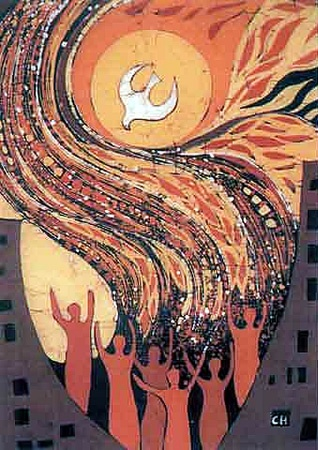
“Come, Holy Spirit,” by Mary Anne Durnin

The Lord was deeply concerned
about his land
    and had pity on his people.
In answer to their prayers
    he said,
“I will give you enough grain,
wine, and olive oil
    to satisfy your needs.
No longer will I let you
    be insulted by the nations.
An army attacked from the north,
but I will chase it
    into a scorching desert.
There it will rot and stink
from the Dead Sea
    to the Mediterranean.”

The Lord works wonders
    and does great things.
So tell the soil to celebrate
and wild animals
    to stop being afraid.
Grasslands are green again;
fruit trees and fig trees
    are loaded with fruit.
Grapevines are covered
    with grapes.

People of Zion,
celebrate in honor
    of the Lord your God!
He is generous and has sent
the autumn and spring rains
    in the proper seasons.
Grain will cover
    your threshing places;
jars will overflow
    with wine and olive oil.

I, the Lord your God,
will make up for the losses
    caused by those swarms
and swarms of locusts
    I sent to attack you.
My people, you will eat
    until you are satisfied.
Then you will praise me
for the wonderful things
    I have done.
Never again will you
    be put to shame.

Israel, you will know
    that I stand at your side.
I am the Lord your God—
    there are no other gods.
Never again will you
    be put to shame.

Later, I will give my Spirit
    to everyone.
Your sons and daughters
    will prophesy.
Your old men
    will have dreams,
and your young men
    will see visions.
In those days I will even give
my Spirit to my servants,
    both men and women. (Contemporary English Version)

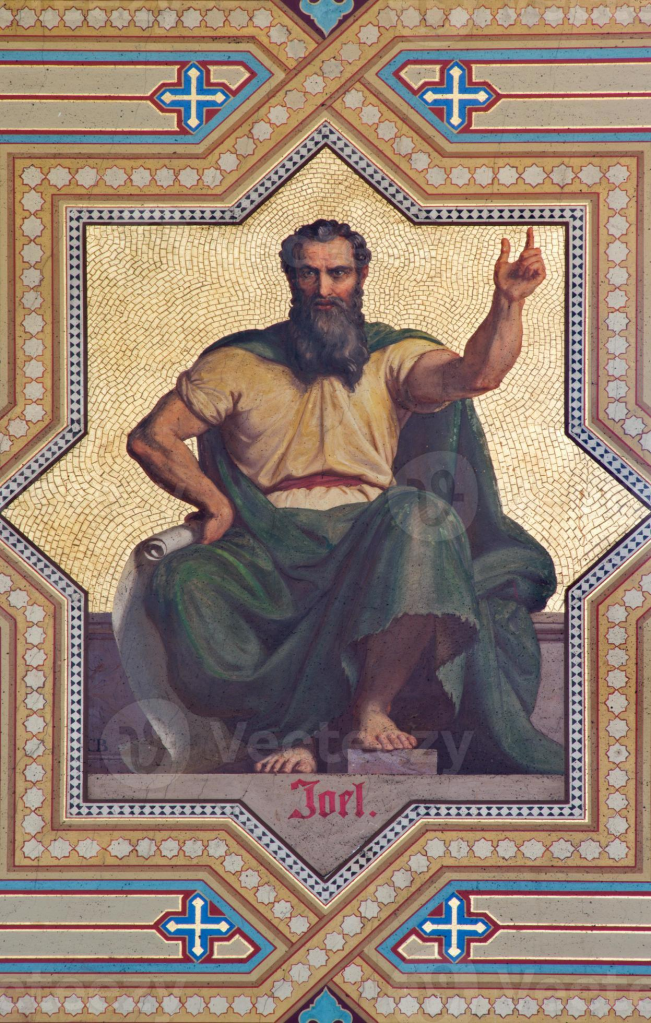
Fresco of the prophet Joel in the Altlerchenfelder Church, Vienna, Austria

We are in the wake of Pentecost Day. But it ought not to have come as a surprise. There were prophetic rumblings of the Spirit’s future tornadic activity, long before the time of Jesus.

The prophet Joel, along with all the Old Testament prophets, had both a message of grace and of judgment. And so, this prophetic book falls naturally into those two parts.

Within the first part of the prophecy, Joel speaks of a terrible locust plague that came over Israel as a judgment from God. The people had strayed from their spiritual and religious ways of covenant with God. The locusts, destroying every plant in their path, reflected the people’s lack of spiritually thriving and growing in grace. They, too, were vulnerable to destruction. They needed to repent and to return to their God.

Yet, the Lord’s anger lasts only a moment, but God’s mercy and blessing endure forever. So, words of grace were offered to the people. There is a time coming, Joel insisted, when God will pour out the divine Spirit far and wide to bless the people and contend with the nations who oppose the covenant community.

Put another way, the first part of the prophecy describes how God fought against God’s own people, to bring them back to their spiritual senses. And the second part of the prophecy describes how the Lord will fight against the nations who fight against God and God’s people.

The people’s affections and allegiance became attached to other things rather than God. So, the Lord sent an army of locusts to oppose them, to challenge their milquetoast and half-hearted attempts at following divine instructions.

Joel foresaw two things coming as the great Day of the Lord approaches: a great outpouring of the Holy Spirit; and a terrible time of divine judgment. 

Let’s take a few things to heart as a response to Joel’s prophecy:

Be aware of God’s purpose in history

From grasshopper swarms to world-wide judgment, to the dissolving of sun and moon—God’s purpose is to reveal divine glory to all the world.

“You will know that I am in the midst of Israel,
        and that I am the Lord your God—no other exists;
        never again will my people be put to shame.” (Joel 2:27, CEB)

“Father, the hour has come; glorify your Son so that the Son may glorify you.” Jesus (John 17:1, NRSV)

Stay close to the Lord

Don’t wander from God. But, if you do, the Lord will spend all kinds of energy in bringing us back and restoring us.

“But even now,” declares the Lord,
“return to me with all your heart—
with fasting, crying, and mourning.” (Joel 2:12, GW)

And the God of all grace, who called you to his eternal glory in Christ, after you have suffered a little while, will himself restore you and make you strong, firm and steadfast. (1 Peter 5:10, NIV)

Change the inside, not the outside

Repentance and faith are to be a way of life, and not simply a one time event. The way we present ourselves on the outside is a projection of what we want others to see. But God sees the heart, so we must go there and focus on the inner person.

Don’t rip your clothes
    to show your sorrow.
Instead, turn back to me
    with broken hearts.
I am merciful, kind, and caring.
I don’t easily lose my temper,
    and I don’t like to punish. (Joel 2:13, CEV)

Endure what you suffer as being a father’s punishment; your suffering shows that God is treating you as his children. Was there ever a child who was not punished by his father? If you are not punished, as all his children are, it means you are not real children, but bastards. In the case of our human fathers, they punished us and we respected them.

How much more, then, should we submit to our spiritual Father and live! Our human fathers punished us for a short time, as it seemed right to them; but God does it for our own good, so that we may share his holiness. When we are punished, it seems to us at the time something to make us sad, not glad. Later, however, those who have been disciplined by such punishment reap the peaceful reward of a righteous life. (Hebrews 12:7-11, GNT)

Earnestly seek the outpouring of the Holy Spirit

On the Day of Pentecost, the Apostle Peter said that the coming of the Holy Spirit was a fulfillment of Joel’s prophecy (Acts 2:16). That was just the beginning of the blessing. The Holy Spirit is still operative and active in the church and the world. The prophecy is far from complete.

In reply to those who were concerned about others prophesying and thereby possibly challenging authority, Moses said:

“Are you concerned what this might do to me? I wish the Lord would give his Spirit to all his people so everyone could be a prophet.” (Numbers 11:29, CEV)

And those who observed and heard the Spirit being poured out, exclaimed with slack jawed amazement:

“Aren’t these all Galileans? How come we’re hearing them talk in our various mother tongues?

Parthians, Medes, and Elamites;
Visitors from Mesopotamia, Judea, and Cappadocia,
    Pontus and Asia, Phrygia and Pamphylia,
    Egypt and the parts of Libya belonging to Cyrene;
Immigrants from Rome, both Jews and proselytes;
Even Cretans and Arabs!

“They’re speaking our languages, describing God’s mighty works!” (Acts 2:7-11, MSG)

The age of the Spirit is here. It hasn’t gone away. So, let’s pursue the spiritual life with all the energy given us, to the glory and praise of God. Amen.

The Day of Pentecost (Acts 2:1-21)

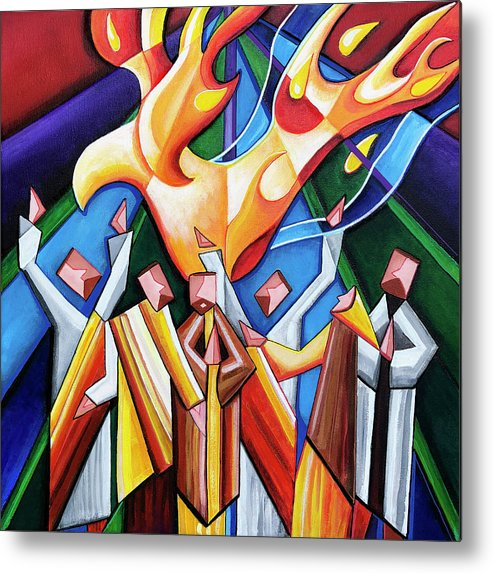
Pentecost, by Jennifer Allison

Now when the day of Pentecost had come, they were all together in one place. Suddenly a sound like a violent wind blowing came from heaven and filled the entire house where they were sitting. And tongues spreading out like a fire appeared to them and came to rest on each one of them. All of them were filled with the Holy Spirit, and they began to speak in other languages as the Spirit enabled them.

Now there were devout Jews from every nation under heaven residing in Jerusalem. When this sound occurred, a crowd gathered and was in confusion, because each one heard them speaking in his own language. 

Completely baffled, they said, “Aren’t all these who are speaking Galileans? And how is it that each one of us hears them in our own native language? Parthians, Medes, Elamites, and residents of Mesopotamia, Judea and Cappadocia, Pontus and the province of Asia, Phrygia and Pamphylia, Egypt and the parts of Libya near Cyrene, and visitors from Rome, both Jews and proselytes, Cretans and Arabs—we hear them speaking in our own languages about the great deeds God has done!”

All were astounded and greatly confused, saying to one another, “What does this mean?” But others jeered at the speakers, saying, “They are drunk on new wine!”

But Peter stood up with the eleven, raised his voice, and addressed them: “You men of Judea and all you who live in Jerusalem, know this and listen carefully to what I say. In spite of what you think, these men are not drunk, for it is only nine o’clock in the morning. But this is what was spoken about through the prophet Joel:

And in the last days it will be,’ God says,
that I will pour out my Spirit on all people,
and your sons and your daughters will prophesy,
and your young men will see visions,
and your old men will dream dreams.

Even on my servants, both men and women,
I will pour out my Spirit in those days, and they will prophesy.
And I will perform wonders in the sky above
and miraculous signs on the earth below,
blood and fire and clouds of smoke.

The sun will be changed to darkness
and the moon to blood
before the great and glorious day of the Lord comes.
And then everyone who calls on the name of the Lord will be saved.’ (New English Translation)

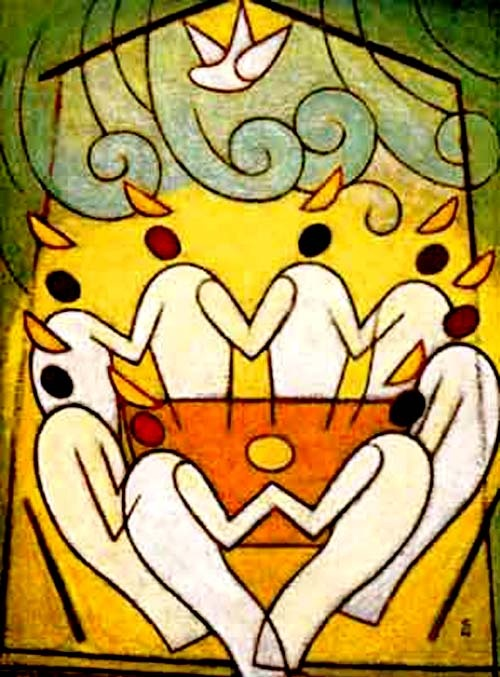
The Coming of the Holy Spirit, by Soichi Watanabe, 1996

Tornadoes are powerful. So is fire. They both have an immense potential for awe and destruction.  It’s interesting that when the little band of Christ’s followers experienced the Holy Spirit for the very first time, they likened what they encountered as wind and as fire. 

There is power in the Spirit – for both life and in destruction. It is the Spirit of God who dismantles and rearranges lives to make something different or new altogether. Most certainly, when the Spirit gets involved, nothing is going to be the same again.

On the Day of Pentecost, the Spirit upset the status quo and formed a new band of believers into the community of the redeemed (the Church). The presence of God’s Holy Spirit brings energy, strength, and ability to spread the good news of Jesus, heal broken lives, and bring an egalitarian way of life that sees no distinction based on race, class, gender, or ethnicity. 

The giving of the Spirit to the people of God is a whole lot more than a day set aside on a calendar, or a by-gone ancient thing that happened and has no significance for today. In fact, it is more than true to say that an authentic follower of Jesus Christ is a Pentecostal believer.  The New Testament knows nothing of a Christian who isn’t given the Spirit to accomplish the will of God on this earth.

Therefore, this time of the year is hugely significant when we attune ourselves to Holy Time because it is the age of the Spirit, the time of Pentecostal life and power. 

Ten days after recognizing Christ’s Ascension, and fifty days after our Lord’s resurrection from death, the Christian Calendar observes the day of Pentecost (which literally means “fifty” in Greek).  The day coincides with an established Jewish festival, the Feast of Weeks. Back in the day, Jerusalem would be filled with all kinds of different nationalities and ethnicities during the festival.

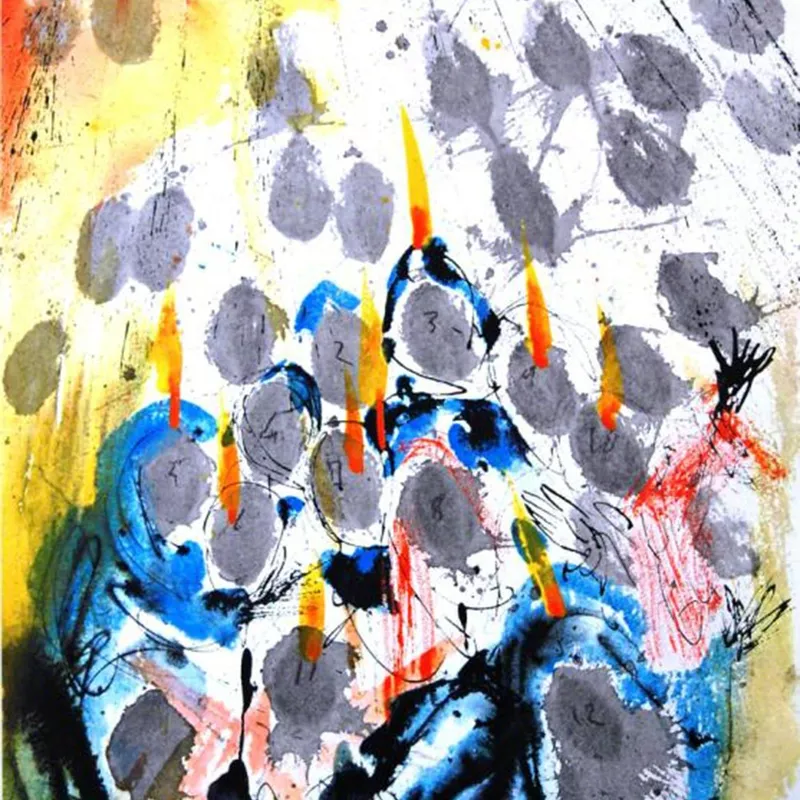
“There Appeared To Them Separated Tongues,” by Salvador Dali, 1967

Pentecost is often known as the birthday of the Church. It marks the time when the Holy Spirit came upon the fledgling believers in power. The disciple Peter, once a flaky up-and-down follower, was filled with the Spirit and spoke the Word of God boldly. His bold proclamation of repentance and faith in Jesus led directly to three-thousand persons added to the little band of one-hundred twenty.

And it didn’t stop there.

We live in an age where all believers in Jesus have the same Holy Spirit as our spiritual ancestors did. It’s an era of spiritual empowerment. The Church is called to reach the world with good news of forgiveness and grace through the person and work of Christ. 

So, then, the Church possesses confidence and security in knowing that the Spirit’s enablement and power is available for mission and spiritual care to the nations. It’s an immense calling that befits the bigness of God.

There are a wide range of Christian celebrations of Pentecost. Some churches do not recognize the holiday at all. Most churches at least mention it in prayer, song, or sermon. Other churches go all out, with worship focused on remembering the first Pentecost and praying for a similar outpouring of divine power. Churches that employ liturgical colors generally use red on Pentecost as a symbol of fiery spiritual power.

Pentecost reminds us that Christians are meant to live in the presence and power of the Holy Spirit, all the time. This day is a chance to confess our shortcomings and failures because of fear, apathy, and selfishness; and to ask for a fresh infusing and infilling of God’s wonderful Spirit. 

The Day of Pentecost flings every single believer into a congregational whole, the Church, and lets us know that we are not to be rugged individualists acting alone but are part of the Body of Christ. Therefore, we must renew our commitment to the Church for whom Christ died. 

The Spirit is ready to use us in forging spiritual bonds of kinship and solidarity. Pentecost throws disparate people together in a unified whole, made up of every kind of language, nationality, ethnicity, gender, and race.  We are all to use the gifts of the Spirit given to us for the benefit of building up one another.

We exist because of the Holy Spirit. Without the Spirit, there is no power source because the Spirit is the battery, the generator of the Christian life. We are to do all life and ministry through the power of the Spirit, equipping and encouraging each other, displaying the fruit of the Spirit, and worshiping the person of the Spirit in always being present with us.

Pentecost was (and is!) a watershed event. Worship, community, and outreach are the logical and collective responsibilities of each believer and every church around the globe.

Let us, then, recognize Pentecost and observe this day with heartfelt thanksgiving and a renewed impulse to exercise our spiritual abilities – graciously given to us by the Holy Spirit. Amen.