Romans 5:1-5 – Maybe There Can Be Peace…

Therefore, since we have been justified through faith, we have peace with God through our Lord Jesus Christ, through whom we have gained access by faith into this grace in which we now stand. And we boast in the hope of the glory of God. Not only so, but we also glory in our sufferings, because we know that suffering produces perseverance; perseverance, character; and character, hope. And hope does not put us to shame, because God’s love has been poured out into our hearts through the Holy Spirit, who has been given to us. (New International Version)

Today, there are millions, perhaps billions, of people without peace in this world.

Maybe…

Maybe there isn’t much peace in your life. Because of that unsettled icky sense of agitation, your mind is somewhere else. It could be that you are upset about something that has happened or are worried about something that is going to happen. 

Maybe the lack of peace has to do with another person. They did or said something, and it’s been grinding on you. So, you are having conversations with that person in your head for which you will probably never say aloud. 

Maybe you have to deal with someone else who doesn’t have peace, and it’s creating stress for you. And you are wondering when things will settle down.

Maybe the lack of peace runs much deeper than your immediate circumstances and plans. 

Maybe every day, day-in-and-day-out, you are not quite sure about where you stand with a person or a group of people.

Maybe you aren’t sure about how you stand with God. You wonder whether God is really pleased with you, or not. 

Maybe you aren’t even in touch with your lack of peace because you are an expert at pushing whatever feelings you have so far down that you think you’re fine. But you really aren’t.

Maybe you are a perfectionist…

Perfectionists are never at peace. The specter of perfectionism always hangs in the air. There’s a steady stream of “should have’s,” and “could have’s” making noise in your head. Your work, no matter how good, is never good enough. “I should have done better.”  “I ought to do better.”  “I must be better.” 

Instead of viewing life’s opportunities as challenges to be welcomed, the perfectionist sees life as one unending mountain to climb, never quite reaching the top. 

The constant companions of perfectionistic people are disappointment, condemnation, frustration, and perceived failure. There is, for them, an internal world of self-loathing based on the lie that I am not enough – I have to be perfect. Peace, for the perfectionist, is a pipe dream.

Maybe we could focus a bit on God…

The Christian God is a triune God, existing in three persons – Father, Son, and Spirit – the great Three-in-One. The Trinity is the basis for all we are and all we do.

All of life is grounded in the triune God. God exists in perfect unity and harmony. God is God’s own community of glorious love. God’s glory is primarily seen on this earth through creation, through us, God’s creatures.

Glory is revealed as we reflect the image of God stamped on us in creation. Since God is love, God’s people are to be characterized by love – loving God, loving one another, and loving neighbor. God’s people are meant to exist together in unity and harmony, reflecting the very nature of the Holy Trinity. 

Yet, after the creation of the world and humanity, man and woman fell into guilt and shame through bucking God’s design for people. Ever since, God has been on a mission to reclaim the lost glory.

Maybe we need to focus on the Son… 

The ultimate expression of God’s mission was the sending of the Son to this earth. It is through Christ’s life, death, resurrection, and ascension that the way has been opened to a renewed relationship with our triune God.

The way is now clear for us to experience real practical peace. It has been achieved through the cross of Jesus Christ.

Therefore, since God has initiated a rescue mission for us by sending the Son, since we have been justified through faith, we have peace with God. 

To be justified means God made us righteous – has made things right between us. God has also provided access for us to be right with each other and the rest of creation. To put this in a contemporary vernacular, we ask God, “Are we good?” and God responds, “We’re good.”

Since then, we’re good with God, we have peace with God. 

Since then, that is true, we cannot try and get peace by another way.

Peace does not come through doing the right things, and by being a good person. 

Peace does not come through trying to obtain feelings of peace.

Peace is not merely the absence of conflict – of just keeping people from strangling each other and harming one another. 

Peace cannot be achieved by trying to relieve anxiety through better effort. 

Maybe grace is the answer…

The antidote to perfectionism, the resolution to feeling a lack of peace is unconditional approval from God. 

Grace is the elixir of life. 

Grace is the thing a perfectionist cannot work to obtain, and the thing that truly helps. 

Grace is freely given; it is a gift.   

Grace (God’s loving unconditional acceptance of us) is the true way of peace.

Some folks have so tied themselves to impossible performances and conditional love that the gift of grace is hard to accept. 

Change won’t happen overnight, and that’s okay – because God deals with us according to grace, not by earning spiritual merit badges. 

The renewal that brings transformation is a process, not an event. In Scripture it’s called “sanctification.” So, it’s important to enjoy the process. 

When you’ve caught yourself going back to the pigsty of perfectionism, instead of beating yourself up, go ahead and laugh at yourself and your own fallibility. Perfectionists take themselves way too serious. Anytime they can lighten up, it lights up the face of God (in a non-performance sort of way!).

Maybe peace is possible…

Peace delivers us from our brokenness.  Again, let’s return to the triune God. There is perfect peace within Father, Son, and Spirit. God is perfect unity, harmony, and love.

Peace means living, working, and playing together. 

Peace means experiencing wholeness, integrity, and contentment, even in the midst of hard circumstances. 

Peace means being a peacemaker.

The late Fred Rogers, from Mister Rogers’ Neighborhood, got into television because he didn’t like TV. During spring break of his senior year in seminary he encountered television for the first time. What he saw repulsed him because he saw people demeaning each other and not having peace.  

Fred Rogers worried that TV programming would create a generation of emotionally-bankrupt children. Faced with the decision to either sour on television itself or work to restore the medium, he chose the latter. He dropped out of seminary and began pursuing a career in broadcasting. Fourteen years later, he created a television show that shaped entire generations of children, running on PBS from 1968-2001.

Mr. Rogers was a devout Christian who rarely talked about his faith on the air. Yet, his show infused our society with beauty and grace. “You’ve made this day a special day by just your being you,” he’d famously sign off. “There is no person in the whole world like you, and I like you just the way you are.” 

In many ways, the lasting legacy of Mr. Rogers will not only be the greater emotional stability of generations of children, but also his wonderful example of peace and how to restore the world through basic human kindness.

Maybe the path of peace is different than I believed…

Having all our circumstances like we want them is not the basis of experiencing peace. That’s being delusional. Peace doesn’t happen whenever everything goes our way.

Instead, we are to rejoice in all our circumstances, even the ones which cause suffering – because they the Holy Spirit’s means of teaching us to experience the peace we long for.

Suffering is our triune God’s way of weaning us off all that divides and antagonizes so that we can attach ourselves to God’s peace. 

One of the most read Christian books of all time was written in the 1500’s by a French woman known as Madame Guyon. She saw the disunity of the world and the lack of peace in our individual lives as stemming from our lack of practicing God’s ways. 

Much of the world doesn’t know what to do with suffering, and does not accept it, because people want their own way with everything.

War and Peace by U.S. Air Force Staff Sgt. Jamal D. Sutter

To know God’s peace, we must practice just the opposite – by refusing all personal desires we have, whether good or bad. Why? Because the practice of refusing our own will breaks it free so it can attach to God’s will.  

We need our brains to be rewired in saying “no” to ourselves.

The other part of Madame Guyon’s practice is to accept every circumstance, even difficulty and suffering, with joy and thanksgiving. 

We can learn to say “yes, thank you” for each hard circumstance, whether good or bad. As in the case of Mr. Rogers, the evil we observe can spur us toward making peace in this world. We detach from personal desires so we can attach to what God wants to do.

Peace, on the practical level, comes from persevering under suffering and rejoicing in it. Why rejoice? Because suffering produces character and character hope. There cannot be hope without suffering. 

God the Father called God the Son to suffer; and God the Spirit leads us into suffering so that we might know peace and hope on a daily basis.

Conclusion

Abandon everything to God. Let it go – every dream, every personal desire, everything you have so that you are free to know God’s will for your life. 

Accept each circumstance you face with joy and thanksgiving. The Trinitarian love of God is poured into our hearts through every circumstance of life, even if it is difficult and hard. 

When we practice abandonment of our wills and acceptance of our circumstances, the result gives us hope, the confident expectation that nothing in our lives happens in vain. 

Every situation can lead us to know God and experience peace. This is very different from simply believing in the Trinity; it is to daily experience the Trinity. 

Glorious God, make your presence known through our worship, our prayer, and our reading of your Word. Father, Son, and Holy Spirit, within you lies unity, love, justice, peace, and power.

Fill our outstretched hearts with your Spirit and encircle us with your love. Make yourself known to us in new and challenging ways. Empower us to forsake every will but your own.  Inspire us toward your peace. Do with us what you will, through Christ our Lord in the power of the Holy Spirit. Amen.

Ephesians 4:1-6 – Realizing Unity and Peace through Humility

As a prisoner for the Lord, then, I urge you to live a life worthy of the calling you have received. Be completely humble and gentle; be patient, bearing with one another in love. Make every effort to keep the unity of the Spirit through the bond of peace. There is one body and one Spirit, just as you were called to one hope when you were called; one Lord, one faith, one baptism; one God and Father of all, who is over all and through all and in all. (New International Version)

In the economy of God, unity isn’t a privilege but a necessity. Unity is not an ancillary or side issue to the real work of the Church and the Christian life; it is very much at the center of Christianity. 

Christians have been fashioned through the Holy Spirit into a single harmonious religious community of redeemed people, called to exemplify a counter-cultural presence in the world. 

There is a solid theological reason for this: God is one. Just as the triune God exists as one deity in three persons, so the church is to reflect God’s image through its unified oneness.

Although unity has been accomplished through the finished work of Jesus on the cross, the practical implications must be daily worked out. This is why we are to strive, or to put significant effort into, having unity. 

Simply getting along outwardly with someone or some group, while inwardly harboring animosity toward them, is not unity. Just because two people are not at each other’s throats does not mean there is peaceful unity. 

Unity only occurs when the Body of Christ works together in its diverse gifts toward a common goal of knowing Christ and making him known… with humility.  

In yesterday’s blog post on Ephesians 1:17-19, I laid down the challenge of praying chapter one’s prayer daily for two weeks. To up the ante on the prayer, try doing it with another person in the church. Having a common unity of purpose in mind and heart through prayer is a beautiful thing. 

In fact, if there is to be any sort of church revitalization, personal renewal, and national revival, it will begin in the prayer rooms of unified believers who share a common love for God and neighbor, a similar attitude of humility and gentleness, and a shared commitment of showing patience toward others.

This is the way of unity and peace. And it requires a great deal of effort to unpack these gracious spiritual gifts which have been mercifully given to us.

Unity is at the center of the earliest ecumenical creeds of the Church. The early church fathers (and mothers) wisely discerned the great importance of a unified faith and striving toward peace with all believers.

We believe in one God,

            the Father, the Almighty,

            maker of heaven and earth,

            of all that is, seen and unseen.

We believe in one Lord, Jesus Christ,

            the only Son of God,

            eternally begotten of the Father….

We believe in the Holy Spirit, the Lord, the giver of life,

            who proceeds from the Father and the Son….

We believe in one holy catholic and apostolic Church.

            We acknowledge one baptism for the forgiveness of sins. – The Nicene Creed

There is one Father, not three fathers; one Son, not three sons; one Holy Spirit, not three spirits.

And in this Trinity, no one is before or after, greater or less than the other; but all three persons are in themselves, coeternal and coequal; and so, we must worship the Trinity in unity and the one God in three persons….

Although he is God and man, he is not divided, but is one Christ.

He is united because God has taken humanity into himself; he does not transform deity into humanity.

He is completely one in the unity of his person, without confusing his natures.

For as the rational soul and body are one person, so the one Christ is God and man. – The Athanasian Creed

Since God is one, we are to be one people. This is the path of peace. One God. One people. There cannot be unity and peace apart from humility.

Invalidating a person’s feelings or thoughts does no one any good. It happens because of pride and a profound lack of humility.

Imagine going to see a doctor who turns out to be arrogant. He doesn’t really listen to you. He just gives a quick exam and offers his diagnosis with a regimen of more pills to take. You’re left sitting there while he’s off to another patient, colonizing another person’s mind and emotions with his expertise.

I’m not giving doctors a hard knock. I know many physicians, and they do wonderful compassionate work. Yet, it’s likely that you, like me, have had that occasional experience of the doctor, all full of themselves, having all the right answers on your pain and situation.

You may have also had the unfortunate experience of having a pastor, therapist, or counselor assess your situation with little information and even smaller compassion. Like writing a script for pills, they give you a few Bible verses and tell you to quit sinning and live obediently.

If pride and arrogance are the original sin, then the remedy to that malady is humility. No matter who we are – whether doctors, pastors, laypersons, patients, or whomever – we are meant and designed by our Creator God to live a humble life.

Humility is the cornerstone to the unity and peace we desire. Jesus said:

“Blessed are the poor in spirit, for theirs is the kingdom of heaven.” (Matthew 5:3, NIV)

The door of God’s kingdom swings-open on the hinges of humility. The Apostle Paul, seeking to follow his Master Jesus in his teaching and humility said:

“Since God chose you to be the holy people he loves, you must clothe yourselves with tenderhearted mercy, kindness, humility, gentleness, and patience.” (Colossians 3:12, NLT)

Basic human kindness with one another is grounded in humility.

The beauty of a humility-based existence is that multiple people discover together how to grow, thrive, and flourish in a situation where it isn’t currently happening. Breakthroughs occur in the soil of humility when all voices are heard and given weight.

We live with the confidence of the Psalmist:

“God leads humble people to do what is right and teaches them the way.” (Psalm 25:9, GW)

In the end, it’s a common commitment to exercise humility which realizes unity and enjoys peace.

May it be so, to the glory of God and for the sake of the world.

Blessed Holy Trinity, the God whom I serve, may your church on earth be one as you are one. I pray our unity of love and purpose will transform individuals, churches, organizations, systems, and the entire world for the glory of the Father, and of the Son, and of the Holy Spirit, one God, now and forever. Amen.

Ephesians 1:17-19 – Receive the Spirit

I ask the glorious Father and God of our Lord Jesus Christ to give you his Spirit. The Spirit will make you wise and let you understand what it means to know God. My prayer is that light will flood your hearts and you will understand the hope given to you when God chose you. Then you will discover the glorious blessings that will be yours together with all God’s people.

I want you to know about the great and mighty power that God has for us followers. (Contemporary English Version)

I meet a lot of people in my line of work. And I cannot recall anyone ever telling me they want to be a weak and foolish ignoramus without hope in this world. No, but I do listen to the longings of people to be wise and knowledgeable, who yearn to brim with hope and be a blessing to others.

Unfortunately, many folk live with regrets. They didn’t seek the good, the true, and the beautiful when they had the chance to do so. They failed to realize that the kind of life they really want requires receiving, opening, and applying. I’m talking about the gift of the Spirit.

The Spirit is graciously given, so we must receive and utilize this ultimate resourceful Person.

Wisdom, knowledge, hope, blessing, and strength are the qualities and virtues which the Spirit of God develops within people. They are accessed by faith and prayer.

Today’s New Testament lesson, on the heels of Pentecost, is a heartfelt prayer of the Apostle Paul to the Church. He desperately wanted the Ephesian believers to experience the fullness of the spiritual power which was available to them.

It’s still a prayer to be prayed by believers everywhere and at all times. In fact, all the prayers in Holy Scripture are meant to be prayed by us, and not left as ink on a page, only to be gazed at a few times in life. Here are a few observations about this biblical prayer: 

  • Praying this biblical prayer makes every Christian a “Pentecostal” believer, whether you are a in a Pentecostal Christian tradition, or not. The Holy Spirit is the sine qua non of the Christian life, the distinguishing mark of a believer.
  • Praying this prayer is what God wants us to pray. The Holy God desires that the Holy Spirit provide us with spiritual wisdom and understanding so that we will experientially know God’s great power for us who believe. Out of all the things we might pray, this is a doozy of a prayer to pray!

Here is an invitation for you: Pray this prayer every day for two weeks, beginning today. Yes, every single day. Maybe even multiple times in the day. Pray it for yourself, your church, your family, your friends, and even for those who do not yet know they need Jesus. 

Pray for the Spirit to be manifested in all of life. After fourteen days, see if there is any change in your life, in your church, your neighborhood, your workplace, and in your relationships. 

There is no need to keep bemoaning the state of religion and the lack of spirituality in this world when we have such a prayer as this to pray. More praying and less complaining, please. Try it and see the difference it makes.

I highlight the need for intentional prayer because asking for the Spirit to show up isn’t always our reflexive response to most things. Instead, we tend to immediately rely on our instincts, abilities, ingenuity, common sense, or our relational connections, and even Google for answers to our most vexing issues.

In Old Testament poetry, the Spirit is sometimes likened to a wise woman for whom we need to pursue in gaining understanding. She will never disappoint but freely gives to all who will humbly ask.

You’re blessed when you meet Lady Wisdom,
    when you make friends with Madame Insight.
She’s worth far more than money in the bank;
    her friendship is better than a big salary.
Her value exceeds all the trappings of wealth;
    nothing you could wish for holds a candle to her.
With one hand she gives long life,
    with the other she confers recognition.
Her manner is beautiful,
    her life wonderfully complete.
She’s the very Tree of Life to those who embrace her.
    Hold her tight—and be blessed! (Proverbs 3:13-18, MSG)

It would be great if we could simply fall asleep at night listening to someone talking positive thoughts, and then, wake up and be full of strength and wisdom. But it doesn’t work that way. The spiritual life is far from a chemical-like process of osmosis in which all the negative and stupid stuff gets filtered out with some positive thinking.

The blessings of wisdom and strength come through dogged pursuit, of going hard after Madame Insight and sticking very close to her. The Spirit is available. It’s just a matter of whether we will avail ourselves of God’s mercy, placed right in front of our faces.

Mighty God, I receive your Spirit. May the light of your gracious gospel flood my heart so that I will experientially know all of the blessings of Christ’s redemption and the incomparably great power available to me because of his finished work on the cross. Amen.

Luke 1:26-38 – The Holy Spirit Will Come on You

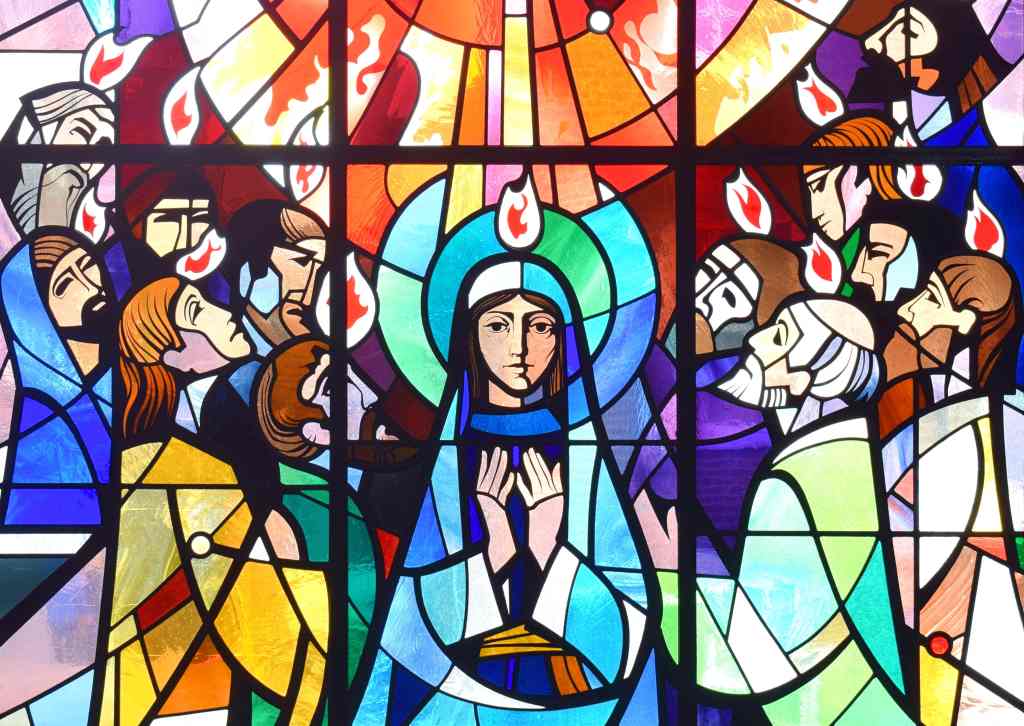
Pentecost by Jen Norton

In the sixth month of Elizabeth’s pregnancy, God sent the angel Gabriel to Nazareth, a town in Galilee, to a virgin pledged to be married to a man named Joseph, a descendant of David. The virgin’s name was Mary. The angel went to her and said, “Greetings, you who are highly favored! The Lord is with you.”

Mary was greatly troubled at his words and wondered what kind of greeting this might be.But the angel said to her, “Do not be afraid, Mary; you have found favor with God. You will conceive and give birth to a son, and you are to call him Jesus. He will be great and will be called the Son of the Most High. The Lord God will give him the throne of his father David,and he will reign over Jacob’s descendants forever; his kingdom will never end.”

“How will this be,” Mary asked the angel, “since I am a virgin?”

The angel answered, “The Holy Spirit will come on you, and the power of the Most High will overshadow you. So, the holy one to be born will be called the Son of God. Even Elizabeth your relative is going to have a child in her old age, and she who was said to be unable to conceive is in her sixth month. For no word from God will ever fail.”

“I am the Lord’s servant,” Mary answered. “May your word to me be fulfilled.” Then the angel left her. (New International Version)

It is good that the Daily Lectionary has us considering these verses of Scripture outside of the Advent season. In this time of year, in which we focus on the Spirit, we need to remember that these stories, and our faith, are meant to be held throughout the entire year.

Most of life is lived in the mundane, even in times of uncertainty. For the most part, our everyday lives involve going about our business and dealing with the daily grind. That’s because we are common ordinary people. So, we can especially relate to Mary because she is rather plain. 

To put Mary’s life in our contemporary vernacular, at the time of this encounter with the angel, she is of junior high age but has never attended school. She wears mostly clothes from Goodwill, and occasionally can get some from Wal-Mart. She cannot read because girls of her day rarely did.

Her parents make all the decisions that affect her life, including the one that she should be married to an older man named Joseph. We don’t know if she even liked him. Mary lives in a small town that most people cannot even point to on a map. 

One night, into the bedroom of this young girl comes the brightly beaming divine messenger Gabriel whose name means, “God has shown himself mighty.” Mary stands there in her ratty old flannel nightgown, her life very quickly moving from the ordinary to the extraordinary.

The juxtaposition could not be more pronounced: a mighty angel and a plain teen-ager; a messenger of the Most High God and a girl barely past puberty; a holy angelic light which beams in a simple candlelit bedroom; an awesome power encountering complete vulnerability.

Mary, compared to Gabriel, is defenseless, fragile, and overwhelmed. She’s in way over her head. That’s why we can relate to her. We can get our human arms around Mary. She is like us. She has faced life with little power to make it turn out the way she planned. Forces beyond her have rearranged her life and altered it forever.

Descent of the Holy Spirit by John Lawson

Mary is the Matron Saint of the Ordinary. We can totally understand why Mary responds the way she does. Mary’s initial reaction to the angel Gabriel was to be greatly troubled. She was disturbed and shaking in her hand-me-down slippers.

The angel confidently told Mary that she had found favor with God. This scenario didn’t happen because Mary had some extreme spirituality. Instead, God simply chose her to be the mother of Jesus.

Mary needed to come to grips with what was happening to her. This was well beyond anything she could have expected.  Becoming pregnant with the Savior of the world was not even remotely on her radar. 

She immediately sensed the crazy disconnect between what was being told to her and who she was. After all, she was a plain ordinary girl from the hick town of Nazareth and was being told that she would raise a king.  Maybe somebody in heaven screwed up. Maybe Gabriel got the wrong girl. Maybe his Google map sent Gabriel on a wild goose chase.

Relating to Mary, we can totally understand that she would question how in the world all this was going to happen. Not only is Mary ordinary and far from royalty, but she is also very much a virgin. Nothing about any of this made any sense.

But, then again, this is the very sort of thing that the wild and seemingly reckless Holy Spirit would do.

The angel let Mary know that God specializes in the impossible. There is nothing outside of God’s power. There’s nowhere we can go, no place on earth, no situation whatsoever, that is beyond God’s ability and reach to affect divine power.

We very rarely get straightforward answers to our questions about God. Yet, Mary asked a question and got a straight answer: She really can be pregnant with Jesus because the Holy Spirit will come upon her, will overshadow her with power.

If the story were to end there it would be a great story. However, the Spirit’s work goes well beyond effecting the miraculous. The Spirit also brings about faith.

God has poured out his love into our hearts by means of the Holy Spirit, who is God’s gift to us.

Romans 5:5, GNT

Mary believed the message and submitted herself completely to God’s will. We may completely understand if Mary simply said in her plain ordinary way that she was not prepared for this. We would totally “get it” if Mary pushed back on what the angel said to her. We could relate if Mary just dismissed the angel’s presence as a hallucination from using some bad chickpeas to make the hummus.

Yet, Mary not only believed; she also humbly submitted herself to what was happening. And this is what I believe we need to relate to most about Mary – not her being just a plain ordinary person in a non-descript village but stepping up to the calling she received.

We, too, have received a calling in our lives. We, too, have been given the power of the Holy Spirit. We, too, are ordinary people who have been given a very extraordinary task. 

Our response today can be the same as Mary all those centuries earlier: “I am the Lord’s servant; may it be to me as you have said.”

The Church is pregnant with possibilities because of the Holy Spirit.

We know the end of Mary’s story. She gave birth to Jesus and raised him in her plain ordinary way. She watched him grow up and embark on a ministry to proclaim that the kingdom of God is near. Mary didn’t always understand what Jesus said or what he was doing. And she experienced every mother’s nightmare in seeing her beloved son killed in a terribly gruesome manner right in front of her eyes. 

Yet, just as the Holy Spirit was with the birth of Jesus, so the Spirit was with Jesus at his resurrection from the dead. Jesus lived an ordinary life in a very extraordinary way. Furthermore, today Jesus invites us to do the same.

“You will receive power when the Holy Spirit has come upon you, and you will be my witnesses in Jerusalem, in all Judea and Samaria, and to the end of the earth.”

Jesus (Acts 1:8, CEB)

Because Christ accomplished his mission of saving people from their sins and establishing a kingdom that will never end, he has given us the same Holy Spirit to follow him forever and call other people to follow him, too. 

To trust and obey is God’s only way to live into the life of Jesus. The Christian life may often be difficult, but it isn’t complicated. It’s rather simple, just like Mary.

Mary responded to God’s revelation with faith, choosing to fully participate in what God was doing. “I am the Lord’s servant” is our confession, as well. Along with Mary we declare, “May it be to me as you have said.”

Good and gracious God, thank you for giving us your Son, the Lord Jesus. Draw us into the mystery of your love. Join our voices with the heavenly host, that we may sing your glory on high. Give us a place amongst all of your saints so that we may experience your Word made flesh, who lives and reigns with you in the unity of the Holy Spirit, in the splendor of eternal light, God forever and ever. Amen.