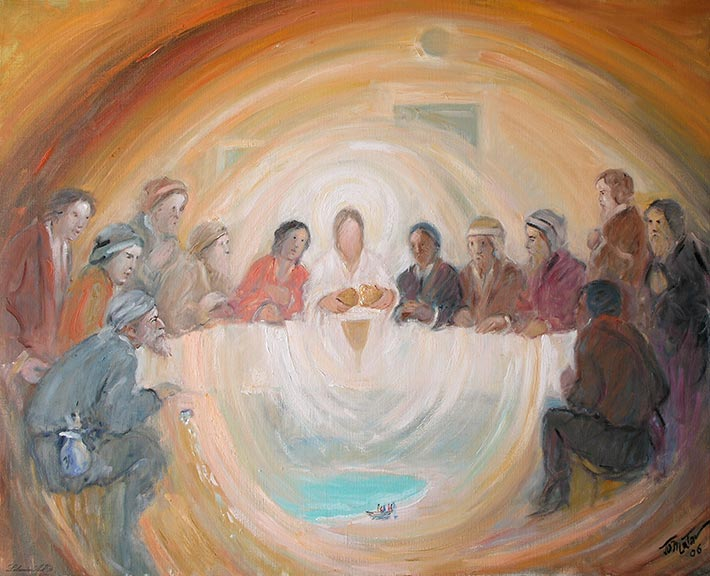
John 6:41-51 – The Bread of Life

“I Am the Bread of Life” by Lebanese painter Joseph Matar

The Jews there began to grumble about him because he said, “I am the bread that came down from heaven.” They said, “Is this not Jesus, the son of Joseph, whose father and mother we know? How can he now say, ‘I came down from heaven’?”

“Stop grumbling among yourselves,” Jesus answered. “No one can come to me unless the Father who sent me draws them, and I will raise them up at the last day.It is written in the Prophets: ‘They will all be taught by God.’ Everyone who has heard the Father and learned from him comes to me. No one has seen the Father except the one who is from God; only he has seen the Father. Very truly I tell you, the one who believes has eternal life.

I am the bread of life. Your ancestors ate the manna in the wilderness, yet they died. But here is the bread that comes down from heaven, which anyone may eat and not die. I am the living bread that came down from heaven. Whoever eats this bread will live forever. This bread is my flesh, which I will give for the life of the world.” (New International Version)

Christians everywhere hold to Jesus as the Son of God, Lord of the universe, and Savior of all.

However, for most people who were following Jesus around in the first century, this was not their understanding of Christ. In his earthly ministry, Jesus spoke in ways that introduced people to who he really was and sought to bring them to a point of following him based on his identity. 

Jesus wanted the crowds to see him for who he really is – themselves for what they really needed – and follow him based on the deepest needs of their lives.

I believe Jesus is the hope of all nations and all people, and in him humanity’s most basic and profound needs are met for forgiveness, love, and purpose in life. To address this, I ask three basic philosophical and theological questions of life:

What should human beings seek in life?

The responses in history are legion. The ancient Greek philosopher Aristotle thought a proper appreciation for an ethical and virtuous life found in practical wisdom was where people’s most concerted efforts should be. 

Karl Marx, the father of communism and socialism believed the proletariat should use their heads and their hands to rise above their economic conditions and oppression.

In the late 1960’s, Bobby Kennedy said we ought to be working the hardest to achieve justice and not advance ourselves on the misfortunes of others.

In more recent times, the Harvard Business Review is continually on the lookout for the best ways of being efficient, productive, and making the most of time because work itself is paramount.

Jesus insisted that people are not to work for food that spoils, but for food that endures to eternal life. Christ positioned himself as the bread of life – the one who is able to sustain humanity and enable to thrive and flourish in life.

By literally feeding thousands of people, Jesus wanted the people to understand the source of life itself comes from him. Jesus aspired beyond providing a supper for folks – he desired the people to feast on himself – to ingest him, to take him into their lives in a deep and profound way as the fulfillment of all the hope and promises of the Old Testament. 
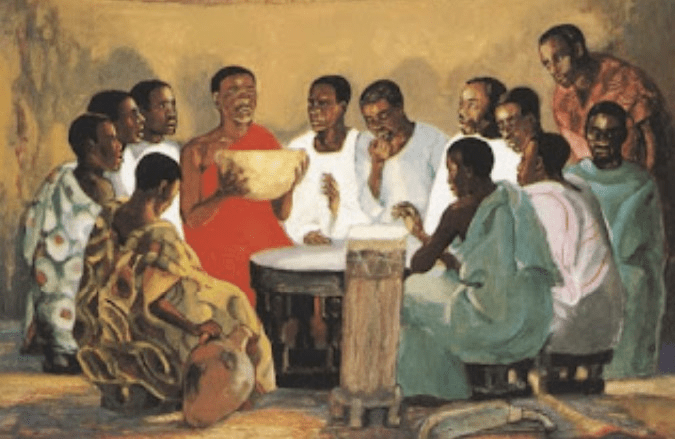
“The Lord’s Supper” by Cameroon artist Jesus Mafa, 1973

Jesus is the bread, the basic staple of life, that meets the cravings and needs of all people everywhere. Starving people, in both body and soul, find in Jesus a meal which keeps on giving, a feast of grace that is both delectable and unending.

The answer to my own question is that, for me, one’s highest pursuit and greatest quest is Jesus. Apart from Christ, I will starve. Furthermore, Jesus is not some cheap fast food off a value menu; he is real soul food to be ingested and enjoyed with others.

I believe people need Jesus. A passionate seeking of Jesus, to follow him, live for him, center life around him, is my most ardent desire. I do not simply desire Jesus for what he can do for me; I vigorously chase after him because if I do not have Jesus, I will die, I will starve to death. 

For me, Jesus is so much more than a nice addition to my life, like a new puppy; Jesus is Lord and Savior. I must consume him, or I will be completely undone, and I will not survive! Jesus is my bread, my food, my life!  I cannot survive on a daily crumb, but I feast on every word that comes from the mouth of Jesus because in Christ there is the life that is truly life.

What should human beings do in life?

Believe. To have and keep faith in the One God has sent, Jesus, is the primary “work” that pleases God.

Jesus communicated to the crowd that they can do so much more than follow him for another earthly meal – they can place their faith and hope in him for food that will last, food that will transcend the three-dimensional world.

Faith is more than an intellectual recognition to some facts about Christianity.

Belief is not about always having clarity and certainty to every facet and loci of Christian doctrine. Rather, Christian faith is a complete trust in Jesus as our hope and our life.

Education, economic uplift, political stability, and institutional peace and justice are important activities for this world. For the Christian, the accomplishment of these and so much more comes from the grace of God in Christ. As people come to the end of themselves with their homebrewed and half-baked attempts at being satisfied, Jesus stands at the door and knocks, the Living Bread who offers himself for humanity’s deepest needs.
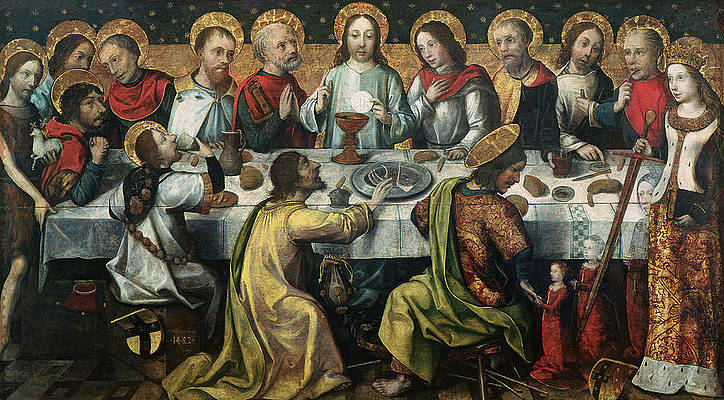
“The Last Supper” by Godefroy, 1482, C.E.

Giving kudos to Jesus might be nice, yet Christ himself cares about folks placing their trust in him for grace, forgiveness, and hope in their world. Jesus longs to reconnect people with God through giving himself as the means of making that happen.

All the works we do in this life, every good deed we accomplish, and each positive action we do are all helpful and necessary… and they all pale in comparison to the greatest work of all, to believe in Jesus Christ as the hope of this world, the hope of your family, the hope of the church, and the hope of your life. It’s all accessed by faith in the Son of God who loved me and gave himself for me.

Church buildings and furniture, stained-glass windows, pews, and even the Bible are not Jesus – they are simply and hopefully signs which point to him. They are all designed to lead us to Christ so that we may come to him. And coming to Christ is what the Lord’s Supper, Holy Communion, the Eucharist, and any other description you want to give about ingesting Jesus is about. The elements of bread and cup bring us to Christ so that we can experience Jesus and be joined to him by faith in a mystical union of human and divine in the unseen heaven.

Conclusion

Where will you find true satisfaction and hope? Probably not in the clearance aisle at Wal-Mart. Likely not in conforming to cultural Christianity or embracing generic forms of Jesus as merely a good teacher and moral example.

Furthermore, life’s ultimate satisfaction and hope are not to be found in a spotless house and perfect kids; in working more hours and making more money. Nor will we find contentment and peace in the radical independence of doing things my way.

Jesus is the Bread of Life. Through ingesting him, passionately pursuing him, believing in him, and coming to him in everything, we find the life that is truly life. Do not settle for any substitutes to Jesus. Come to the real person.

Lord God, you said that when we seek you with all our hearts, you will be found.  As the deer pants for streams of water, so we, your people, long for you in a dry and weary land.  We hunger and thirst for your righteousness.  We deeply desire your presence in all things. So, we die to ourselves and surrender to your will and way for us, by faith trusting you will come into our lives and completely take over. May your blessing rest upon us as we seek Jesus. Amen.

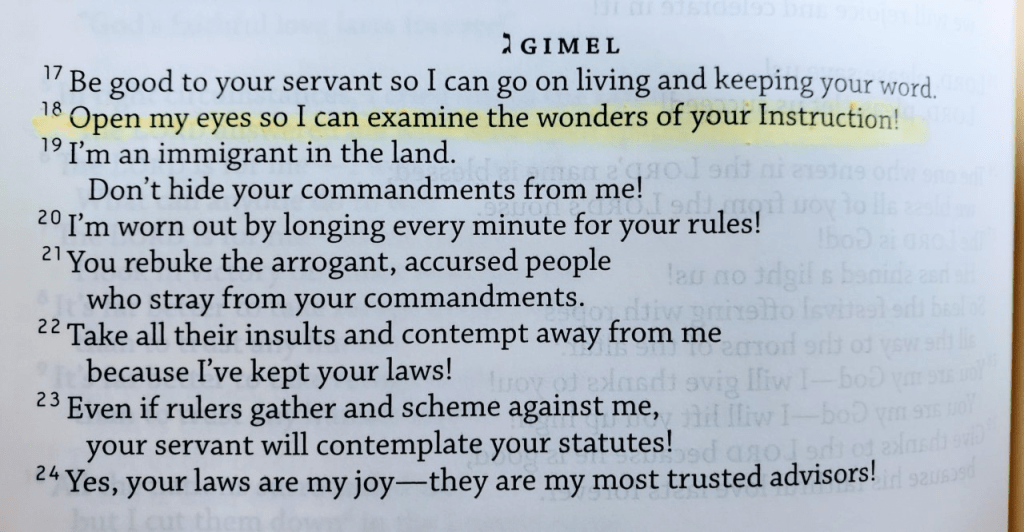
Psalm 119:17-32 – Examine the Wonders of God’s Instructions

Psalm 119:17-24, Common English Bible

ג Gimel

Be good to your servant while I live,
    that I may obey your word.
Open my eyes that I may see
    wonderful things in your law.
I am a stranger on earth;
    do not hide your commands from me.
My soul is consumed with longing
    for your laws at all times.
You rebuke the arrogant, who are accursed,
    those who stray from your commands.
Remove from me their scorn and contempt,
    for I keep your statutes.
Though rulers sit together and slander me,
    your servant will meditate on your decrees.
Your statutes are my delight;
    they are my counselors.

ד Daleth

I am laid low in the dust;
    preserve my life according to your word.
I gave an account of my ways and you answered me;
    teach me your decrees.
Cause me to understand the way of your precepts,
    that I may meditate on your wonderful deeds.
My soul is weary with sorrow;
    strengthen me according to your word.
Keep me from deceitful ways;
    be gracious to me and teach me your law.
I have chosen the way of faithfulness;
    I have set my heart on your laws.
I hold fast to your statutes, Lord;
    do not let me be put to shame.
I run in the path of your commands,
    for you have broadened my understanding. (New International Version)

The biblical psalms are one of my favorite places in the whole of Holy Scripture. I especially like Psalm 119 because it reminds me that I am not only saved from something, but I am also saved to something.

Genuine and real deliverance comes so that we can be free to love and serve God with our whole being. And Psalm 119 is there to help us know how to do just that.

Psalm 119 stretches for 176 verses as an acrostic to the Hebrew alphabet. Each Hebrew letter has its own 8 verse stanza, with each of those verses beginning with that letter. Unfortunately, of course, we lose this insight through translation.

One of the reasons the psalm was organized this way is because it was meant to be learned and memorized. In fact, the entire psalter was meant for public consumption – to be engrafted into the soul and hidden in the heart.

The wonders of Psalm 119 are, overall, a paeon of reverence and praise of God’s law. That’s because the Lord’s commands and instructions are an extension of the divine character. Laws of mercy and holiness are given to the people because God is merciful and holy.

Grace and law are not antithetical. They go together like a hand in a glove and rely upon each other. The hand of grace is what fills the glove of the law, and together, they extend divine help and direction to people in this fallen world of ours.

The heartfelt prayer of the psalmist is that the Lord would open his eyes so that he could see the wonders contained within God’s divine instructions for humanity.

“Open my eyes so I can truly see
the marvelous things in your law.”

Psalm 119:18, NET

This is a prayer for us, as well. Those who desire to please the Lord and walk in the way of God are continually seeking awareness of the divine all around them, insight into others, and understanding of self.

It is one thing to read the Bible, but it’s another thing altogether to understand it. The psalmist is asking for God to intervene on his behalf and remove anything and everything that would inhibit his ability to understand and discern God’s words and actions.

Insight, understanding, and application to life comes from dwelling in the Word. It is a process. A daily crumb will neither do to satiate our physical hunger nor our spiritual appetite.

Going days, even weeks, without ingesting God’s instructions will only lead to spiritual emaciation. It harms us and helps no one. Instead, we need to feed on Holy Scripture and savor every bite. Like the cow, we need to slowly chew and ruminate on Scripture so that it can be fully digested and become part of us.

I have memorized large chunks of the Bible over the years. The main reason my memory can call up so much Scripture is that I have read it, and continue to read it, over and over again. Even though I’ve read the Old Testament about one-hundred times and the New Testament in the neighborhood of three-hundred times, I still gain insight and understanding, seeing new and wondrous things.

I truly believe the Bible is an inexhaustible source of sage instruction and a continual fountain of wisdom. I’ll spend an eternity in heaven examining God’s Word and will never reach the height, depth, length, and breadth of it’s incredible, massive, and glorious precepts.

I am a strong advocate of straightforward readings of Scripture, over and over again. Although I encourage looking at devotionals, commentaries, and reflections (like this blog!) to help and encourage us, nothing can replace our constant and continual reading of the Bible.

The biblical Book of Psalms is the Church’s prayerbook. All 150 of them are meant to be used for every sort of life circumstance. Whether discouraged or anxious, joyful or confident, the psalms encompass the full range of the human condition – and Psalm 119 lets us know how central God’s instructions are to the life of God’s people.

So, read today’s psalm… several times. Let Scripture do it’s marvelous and wondrous work within you.

Blessed Lord, you caused all Holy Scriptures to be written for our learning. Help us so to wisely hear, read, mark, learn, and inwardly digest them so that by our patient reading of your holy Word, we may embrace and ever hold fast the blessed hope of everlasting life, which you have given us in our Savior Jesus Christ.

Colossians 1:27-2:7 – What Is God’s Goal For Your Life?

Gran Abuelo, a 3,600 year old Cyprus tree in Chile

God chose to make known how great among the gentiles are the riches of the glory of this mystery, which is Christ in you, the hope of glory.It is he whom we proclaim, warning everyone and teaching everyone in all wisdom, so that we may present everyone mature in Christ. For this I toil and strive with all the energy that he powerfully inspires within me.

For I want you to know how greatly I strive for you and for those in Laodicea and for all who have not seen me face to face. I want their hearts to be encouraged and united in love, so that they may have all the riches of assured understanding and have the knowledge of God’s mystery, that is, Christ, in whom are hidden all the treasures of wisdom and knowledge.I am saying this so that no one may deceive you with plausible arguments. For though I am absent in body, yet I am with you in spirit, and I rejoice to see your orderly conduct and the firmness of your faith in Christ.

As you therefore have received Christ Jesus the Lord, continue to walk in him, rooted and built up in him and established in the faith, just as you were taught, abounding in thanksgiving. (New Revised Standard Version)

I invite you to consider the question: “What is God’s goal for my life?” 

This might just be the most important question you ever answer. 

We are created in the image and likeness of God. We were designed for a purpose. Therefore, it is vital and necessary to know the aim, trajectory, and goal for your life.

First, however, let’s consider why we might be out-of-touch with the answer. 

In the beginning God created the heavens and the earth. Man and woman are the apex of God’s imaginative activity. Only humanity has within themselves the ability and the special character to connect with the divine in a special fellowship relationship. 

Yet, the original people fell from their place in Paradise. 

Now, in this current broken world we inhabit, and apart from God, people’s experience is fragmentation, disconnection, confusion, and separation in relationships and self-understanding.

One way of looking at the entirety of the Bible is that it reveals how God is graciously and patiently wooing wayward people back to Paradise. 

The ultimate fulfillment of this re-connection is found in the person and work of Jesus Christ. In Christ, what was lost is found; what was separated is connected; and what was scattered into a thousand pieces is being put back together again.

So, let’s get back to the question of God’s goal for you and me. Since we live in a fallen world, we have to deal with sin, death, and adverse situations. Yet we can take charge of our lives and face reality with a Christian life which thrives and flourishes.

“My friends, be glad, even if you have a lot of trouble.  You know that you learn to endure by having your faith tested.  But you must learn to endure everything, so that you will be completely mature and not lacking anything.  If any of you need wisdom, you should ask God, and it will be given to you.  God is generous and won’t correct you for asking.  But when you ask for something, you must have faith and not doubt.” (James 1:2-6, CEV)

What is God’s goal for my life? Maturity. That you and I will be completely mature. That we will work toward spiritual maturity in our own lives, and what’s more, labor toward presenting others mature in Christ Jesus.

Yes, maturity. Out of all the things which God might want from and for us, maturity is at the top of the list.

Maturity means to be a whole person, not fragmented, a complete and healthy person – in body, soul, spirit, mind, and emotions – all aligned together in a total package of wise living from encouraged hearts and loving faith communities.

Maybe that sounds too far from your own experience. Perhaps you feel that you are all over the place, as if you could never have it all together (or that others are never going to have it together). However, the goal is not about having it all together. 

Rather, maturity is about you and me submitting to adversity and hardship as our teachers. In other words, it’s suffering which leads us to God. Spiritual growth and development happens in the crucible of life. Faith formation occurs in the class of hard knocks.

And we are not to let any spiritual hucksters or charlatans come along and deceive us with all kinds of talk about how the Christian life is having every earthly desire satisfied and never having any significant problems again – that if we just name it and claim it, then our faith will move mountains of money into our bank account or put us into positions of power.

Wi’áaşal, a giant 1,000 year old oak tree in California, on the Pechanga Indian Reservation

Maturity requires spiritual growth over a long period of time. There is no substitute, no other way to be mature in Christ. And our faith will be tried at every turn so that it is strengthened in sustained living for Jesus.

Whenever things are going great, it’s too easy to attribute it to our own ingenuity, ability, or intellect. Yet, when things are rough and there is no apparent way out, we need something or someone outside of ourselves. 

Faith is a muscle that must be stretched, exercised, and used so that it will grow and develop. Trials to our faith and hard situations are the means of strengthening such a faith. The result of all that struggle is maturity, completeness, and wholeness. 

We learn to connect with a generous God who won’t chide us for our messiness and problems. God delights in hearing us and responding to our prayers.

God pays attention and responds… in his own good time and according to his own good grace, and not on our timetable or according to our expectations.

Sometimes we need to learn that the three-ring binder approach to Christian discipleship, with clear proven steps to move forward, is not what we really need. We need Jesus himself. 

In order to return to the Garden, we must walk through the gate of Christ and learn to enjoy the pasture we are currently in. 

Maybe our circumstances will change, and maybe they won’t. But that’s not the point. The aim of all Christian discipleship is that you and I will change, and that our perspective will be different.

So, what will you do today, even right now, to take charge of your life and make a step toward maturity and healthy spiritual wholeness? 

In truth, you know exactly what to do and who to be. You just need some encouragement and affirmation to get over a few fears. It’s okay to be afraid. It’s not okay to remain stuck in fear.

Gracious God of mission who reaches the world with mercy and love, you alone bring growth to your Church everywhere. Send your Holy Spirit to strengthen our faith, give shape to our Christian hope, and love to all our words and actions. May our witness in the world demonstrate a mature Christianity, full of grace and seasoned with salt, through Jesus Christ our Lord. Amen.

1 John 3:11-17 – Love, Not Hate

Cain and Abel by Gunter Tanzerel, 2011

The message you heard from the very beginning is this: we must love one another. We must not be like Cain; he belonged to the Evil One and murdered his own brother Abel. Why did Cain murder him? Because the things he himself did were wrong, and the things his brother did were right.

So do not be surprised, my friends, if the people of the world hate you. We know that we have left death and come over into life; we know it because we love others. Those who do not love are still under the power of death. Those who hate others are murderers, and you know that murderers do not have eternal life in them. This is how we know what love is: Christ gave his life for us. We too, then, ought to give our lives for others! If we are rich and see others in need, yet close our hearts against them, how can we claim that we love God? (Good News Translation)

For the world to be a life-giving place of thriving people, it must spin on the axis of love, grace, and belonging – and not be a death-dealing haunt of murder, hate, and disconnection.

“Death” and “life” are full of meaning in Holy Scripture. Whereas we tend to use death and life as referring chiefly to the body, they are primarily relational terms in the Bible.

Death is a separation from God and others; and life is connection with God and others.

In addition, death and life are biblically understood as forces or realms of being within or without. Whenever someone moves from death to life, they leave the realm of separation with its loneliness, lostness, lethargy, and lack of meaningful and helpful interaction with God and others to a place of connection in which there is love.

There is no love in the realm of death. Death is awful in the sense that it places one outside of love.

Like death and life, love is also a relational term and a force or power which exists. Love, in fact, is such a huge realm of being and such a large domain that it almost defies definition. We are mostly left to describe love because all attempts to nail down love with a precise definition will never do it justice.

Therefore, the Apostle Paul, in his great ode to love, did not even try to define it, but merely attempted to characterize love:

Love is patient. Love is kind. Love isn’t jealous. It doesn’t sing its own praises. It isn’t arrogant. It isn’t rude. It doesn’t think about itself. It isn’t irritable. It doesn’t keep track of wrongs. It isn’t happy when injustice is done, but it is happy with the truth. Love never stops being patient, never stops believing, never stops hoping, never gives up. (1 Corinthians 13:4-7, GW)

Consistent with the force and relational nature of death, life, and love, hate is not primarily a feeling toward another but exists as a stance toward another within the domain of darkness and death. To hate is to deliberately and volitionally separate from another person and/or from God. It is to consider someone as the “other” who is not like me, and so, I will neither associate nor interact with “those” people.

Love, however, thrives in the vast multi-dimensional realm of life. Love seeks connection with another and desires to act mercifully and kindly through discovering needs and meeting them. Although emotions of love are very real, those feelings are the result of calculated actions and words which benefit humanity and the common good of all persons.

It is vital that we make clear decisions to pursue life and love others. And Jesus is our model for this. Christ is the ultimate Connector, bringing vibrant life, even eternal life, through loving actions. Jesus intentionally entered the dark realm of death and absorbed all the hate of the world for you and me. In a great and loving reversal, Jesus Christ’s death – his separation from God and others – brought connection with God and others.

Likewise, followers of Jesus will learn to take on the world’s hatred, not fearing death’s ability to disconnect, and love others as they themselves have been loved by Christ. Christians are known by the way they act toward those in the realm of death; believers love and do not hate; despite being hated by another.

The biblical character Cain is Exhibit A of modeling the way of hatred and death. He separated himself from his brother, Abel, in every way possible – relationally, emotionally, mentally, and finally, physically through outright killing of the body.

The message from the Apostle John is this: Do not be like Cain. Be like Jesus. Love others, and do not hate them. Live for others, die to self.

Murder is also a relational term in Scripture. It is, of course, a tool forged from the flames of hell to be used by the hand of hatred to bring death’s realm of separation. Jesus clearly understood murder in this manner:

You know that our ancestors were told, “Do not murder” and “A murderer must be brought to trial.” But I promise you that if you are angry with someone, you will have to stand trial. If you call someone a fool, you will be taken to court. And if you say that someone is worthless, you will be in danger of the fires of hell. (Matthew 5:21-22, CEB)

Christians are people who put love where love is not – which means they brave death’s door to pull others from the flames.

But you, dear friends, must build each other up in your most holy faith, pray in the power of the Holy Spirit, and await the mercy of our Lord Jesus Christ, who will bring you eternal life. In this way, you will keep yourselves safe in God’s love. And you must show mercy to those whose faith is wavering. Rescue others by snatching them from the flames of judgment. Show mercy to still others, but do so with great caution, hating the sins that contaminate their lives. (Jude 20-23, NLT)

May your soul be blessed with love’s kiss.

May the grace and kindness of love bring life and continue to be life-giving for you.

May the hardness of hatred be far from you.

May death’s destructive power dwindle to nothing in the face of Christ’s love working in and through you to the glory of God. Amen.