

Luke 6:1-5 – Lord of the Sabbath

One Sabbath Jesus was going through the grainfields, and his disciples began to pick some heads of grain, rub them in their hands and eat the kernels. Some of the Pharisees asked, “Why are you doing what is unlawful on the Sabbath?”

Jesus answered them, “Have you never read what David did when he and his companions were hungry? He entered the house of God, and taking the consecrated bread, he ate what is lawful only for priests to eat. And he also gave some to his companions.” Then Jesus said to them, “The Son of Man is Lord of the Sabbath.” (New International Version)

We Christians tend to be rather hard on the Pharisees. Yet, most of them, much like us, were just trying to uphold their understanding of God’s commands. They wanted to do God’s will. And so did Jesus.

The problem in the New Testament Gospels is that Jesus and some of the Pharisees (not all of them, e.g., Nicodemus) were at loggerheads about how to view and interpret the Law. Jesus wanted them to see the purpose of the law, the heart and spirit of the law, and who was the lord of the law. For Jesus, many of the Pharisees were spiritually blind. They either would not or could not discern who Jesus was and what he was all about.

So, when we refer to spiritual blindness, let’s have a bit of humility about it. Although for the Apostle Paul, a dramatic event happened in which the scales of blindness (both physically and spiritually) fell from his eyes, most folks have a gradual ability to see, an awakening which requires a process of time and growing awareness. This was true of Christ’s original disciples. They believed, yet their faith was an extended process over three years. It wasn’t until after Christ’s resurrection and Pentecost that their faith became complete.
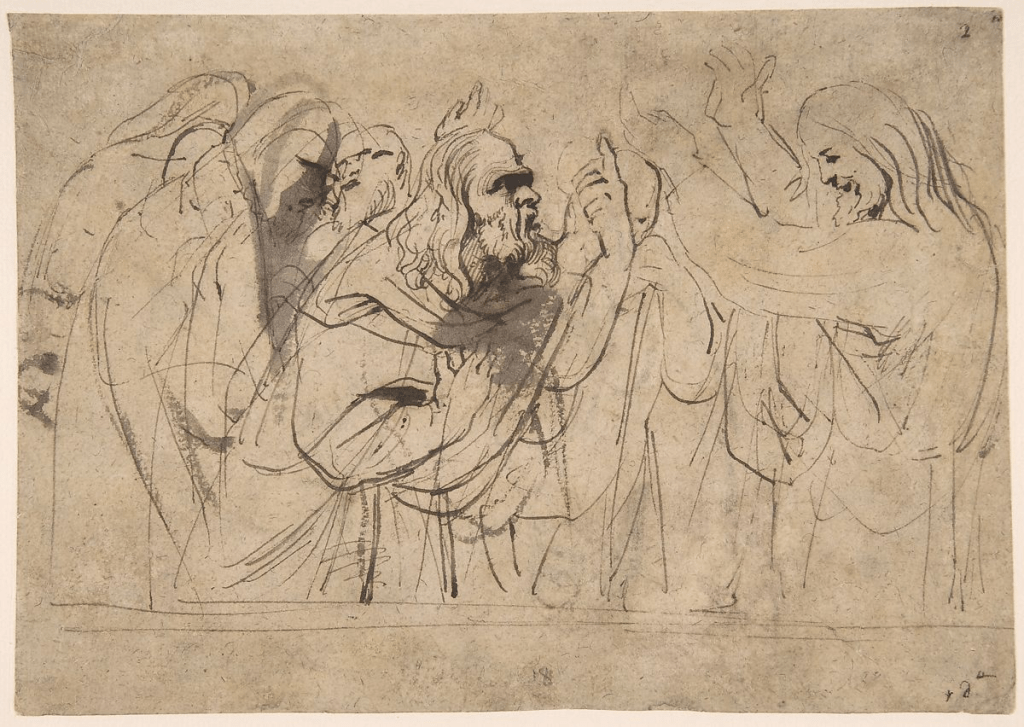
Christ and the Pharisees by Belgian artist Anthony van Dyck (1599-1641)

Jesus didn’t like it that those who should know better, those persons for whom the light of God’s truth ought to be clear and present, were in darkness. When leaders are blind, then we have the blind leading the blind, and nobody finds the door of God’s kingdom.

Many of the Pharisees in the New Testament, most of the heretics in the early church, and some of the spiritual phonies of today are actually not charlatans, that is, they are not deliberately trying to deceive or lead others astray; they are not trying to keep people out of God’s kingdom – they think they are doing the right thing when they are actually leading others astray. 

One of the eye-opening realities I discovered, when I first began studying church history, is that the early heresies condemned at the church councils were doctrines promoted and put forth by men who were not evil bad people – they were just sincerely misguided. They thought they were helping the church better understand the nature of God and Christ, when in fact they were promoting unhealthy doctrine – unintentionally closing the door of God’s kingdom to some people. 

And later when I worked on my master’s thesis in nineteenth century American religious history, I read hundreds of sermons from southern preachers before the American Civil War. I learned that they had a biblical defense for the institution of black chattel slavery. Many of them were pastors of large churches and led many people to Christ, that is, white people. They were slamming the door of God’s kingdom in the faces of African-Americans, and teaching others to do the same.

We can unwittingly slam the door of God’s kingdom in the faces of people when we say God’s grace is for all and then turn around and avoid particular people; or whenever we have explicit written statements or rules that exclude people from serving or being served; or when we bind people to human traditions and practices instead of Holy Scripture. 

The seven deadly words of the Church, believing it is doing the Lord’s will, is, “We’ve-never-done-it-that-way-before… We cannot have somebody out in the field picking heads of grain and rubbing them in their hands. That’s reaping; it’s work; and you can’t do that on the Sabbath.”

Never mind that there are people trying to eat or attempting to enter the kingdom of God. So, we lose sight that the Law was meant to benefit people, to help them thrive and flourish, to lead them into the grace and knowledge of God. The Law gets turned on its head by becoming a heavy burden to carry instead of an easy yolk which brings freedom.

No matter the issue, the last word to everything is grace, God’s grace in Jesus Christ.  

Just as the priest in David’s day was gracious in giving him and his men the consecrated bread meant only for the priests, so Jesus was gracious in giving himself, the Bread of Life, for the benefit of the whole world.

For the Christian, the Law points to Christ, who is the Law’s fulfillment. Now, we carry one another’s burdens, and in doing so, we fulfill the Law of Christ.

O God the Holy Spirit, Sanctifier of the faithful: Make us holy through your abiding divine presence. Enlighten the minds of your people more and more with the light of the everlasting Gospel. Bring erring souls to the knowledge of our Savior Jesus Christ; and those who are walking in the way of life, keep them steadfast in faith to the end.

Give patience to the sick and afflicted and renew them in body and soul. Guard those who are strong and prosperous from forgetting you. Increase in us your many gifts of grace and make us all fruitful in good works. This we ask, O blessed Spirit, whom with the Father and the Son we worship and glorify, one God, world without end. Amen.

Acts 7:44-53 – Pickle Barrel Christians

“The Holy Tent where God spoke to our ancestors was with them in the desert. God told Moses how to make this Tent, and he made it like the plan God showed him. Later, Joshua led our ancestors to capture the lands of the other nations. Our people went in, and God forced the other people out. When our people went into this new land, they took with them this same Tent they had received from their ancestors. They kept it until the time of David, who pleased God and asked God to let him build a house for him, the God of Jacob. But Solomon was the one who built the Temple.

“But the Most High does not live in houses that people build with their hands. As the prophet says:

‘Heaven is my throne,
    and the earth is my footstool.
So do you think you can build a house for me? says the Lord.
    Do I need a place to rest?
Remember, my hand made all these things!’”

Stephen continued speaking: “You stubborn people! You have not given your hearts to God, nor will you listen to him! You are always against what the Holy Spirit is trying to tell you, just as your ancestors were. Your ancestors tried to hurt every prophet who ever lived. Those prophets said long ago that the One who is good would come, but your ancestors killed them. And now you have turned against and killed the One who is good. You received the law of Moses, which God gave you through his angels, but you haven’t obeyed it.” (New Century Version)

Every year it’s a guarantee that some folks will complain about the weather. In the summer it’s too hot; in the winter, too cold. Can’t wait for autumn to come, then when it’s here, the murmuring comes out about how the weekend weather won’t cooperate with personal plans.

No matter the season, no matter the weather, somebody will be grumbling about it.

A big reason why I personally hold to the Christian Calendar with its liturgical seasons is that it helps shape me spiritually so that I can avoid being a stubborn complaining fool.

It seems like some folks have been baptized in pickle juice and inhabit a church resembling a pickle barrel. They have something negative to say about everything. And even when they acknowledge they don’t really understand something, they’ll still give a stone-faced retort, “I’m against it.”

They’re, ironically, surprised when they find themselves in a pickle.

The liturgical calendar, when properly observed, keeps us grounded in faith, hope, and love. There are plenty of things in this old fallen world which can take our eyes off our calling as Christians. Pandemics, politics, poverty, and pain can mess with us.

If we aren’t on solid spiritual ground, all the misfortunes of this life can take a significant toll on us. And for all the tangible things we see which creates angst within us, we miss the invisible God because our spiritual eyes are blind from all that vinegar in the pickle barrel.

Like the ancient Israelites for whom Stephen railed against in our New Testament lesson for today, we might become stubborn, hard-headed, and inflexible. We get lost in doing things our own way, and wanting our way, to the neglect of what God wants. 

Whenever that happens, there is damage to God’s people, God’s name, and God’s law. Rather than tongues being used for praising the Lord and encouraging others, God’s prophets who are calling us to holiness are verbally decapitated.

Anytime someone believes they have piously figured out everything, they will soon find themselves fighting against God.

The Lord of All has not called us to figure out every mystery and nail down each uncertainty. Those who claim to have done it are living in a pickle barrel. Perhaps they will eventually discover how large and immense God really is – much bigger than our puny thoughts and misguided practices. 

How then shall we live?

Let go of our illusions of power and privilege.

Submit afresh to the Lord for whom we must bow in all things. 

Open our spiritual eyes so that we can see the God who made the universe.

Take up our holy calling as Christ’s ambassadors, instead of expecting Jesus to be the ambassador for us.

If we can do that, then we are well on our way to seeing the grand and immense God of all.

So be humble under God’s powerful hand. Then he will lift you up when the right time comes.

1 Peter 5:6, ERV

The following practices can help us become more spiritually flexible and open to the Spirit’s work:

  • Stretch your faith muscle. Physical muscles which get little to no use will atrophy – which is why people who are confined to bed or with limitations need physical therapists to help work the muscles. Spiritually, if we are rarely or never in positions which work our faith muscle, then that faith will diminish and eventually atrophy. Faith is not static, but dynamic. It needs to be worked.
  • Breathe deeply. Proper breathing is essential in using our bodies. The same is true spiritually. Fear, worry, and anxiety cause us to have shallow breathing and unable to think straight. When we are amped-up about something, focus on doing some breath prayers, i.e., breathing in saying, “More of you,” and breathing out saying, “Less of me.”
  • Avoid extreme positions. A hyper-extended muscle will tear and cause a lot of damage. An acceptance of limitations and an awareness of our body’s true capacity prevents us from trying to do something our body simply cannot do. Our faith will not support extreme positions which alienate people and put God to the test.
  • Move more. Getting in bodily shape does not have to be dramatic and involve triathlons. Most of us simply need to get out of our chairs and move a bit more and we would be a lot healthier. Faith is mostly lived in the mundane daily decisions of life. Consistently taking small steps of faith each day will go a long way toward our spiritual health and vitality – not to mention helping us see a big God at work.
  • Listen. It is always best to listen to your body— only push it as far as it can handle, even if it is little by little. Many people would be better served if they would just listen to their gut and the spirit God put within them – rather than pushing themselves and others beyond what they can handle. Behind the attempt at doing too much is typically an issue of wanting the kind of control God possesses.

To do the will of God, we must have a growing awareness of a big unlimited God who cannot be contained in a tent or a building; and a small, limited self who is dependent upon God.

This will take relaxing the puckered pickle face and opening to greater flexibility. If you are not in the habit of following the Christian Calendar through the year, now is a good time to start. After all, nobody wants to smell like they just crawled out of a pickle barrel.

Holy God, heaven is your throne and the earth your footstool. You cannot be kept within any one church or any single place.  You are much too big for that!  Forgive me for my small thoughts of you and my weak faith. I humble myself before you so that you can live in and through me for the sake of Jesus. Amen.

Matthew 24:15-27 – Everything Will Change

“The prophet Daniel said that the disgusting thing that will cause destruction will stand in the holy place. When you see this (let the reader take note), those of you in Judea should flee to the mountains. Those who are on the roof should not come down to get anything out of their houses. Those who are in the field should not turn back to get their coats.

“How horrible it will be for the women who are pregnant or who are nursing babies in those days. Pray that it will not be winter or a day of rest, a holy day, when you flee. There will be a lot of misery at that time, a kind of misery that has not happened from the beginning of the world until now and will certainly never happen again. If God does not reduce the number of those days, no one will be saved. But those days will be reduced because of those whom God has chosen.

“At that time don’t believe anyone who tells you, ‘Here is the Messiah!’ or ‘There he is!’ False messiahs and false prophets will appear. They will work spectacular, miraculous signs and do wonderful things to deceive, if possible, even those whom God has chosen.Listen! I’ve told you this before it happens. So, if someone tells you, ‘He’s in the desert!’ don’t go out looking for him. And don’t believe anyone who says, ‘He’s in a secret place!’ The Son of Man will come again just as lightning flashes from east to west.” (God’s Word Translation)

Midwest American summers can be brutally hot and humid. And the winters can be terribly frigid and full of snow. 

Having lived in various university towns and worked with many college students, every Fall there are always new international students, and students from the American Deep South, that have never experienced a Midwest winter and snow. 

I might tell them, repeatedly, of the need for a sturdy winter coat before the snow flies. Yet, having never known sub-freezing, let alone sub-zero temperatures, it’s difficult to imagine such cold when the weather is warm. 

There is little belief that everything around them will change in a few short months to the point that it will be felt down to the bone.

At the coming of winter, I, or someone else, helped ensure they had a suitable coat. Even then, those students often bodily shake all winter and never take their scarves off.

Since none of us have yet experienced it, it might be difficult to imagine that someday Christ will return to judge the living and the dead. 

So, in order to help the disciples to grasp the coming future, Jesus told them to use discernment. Although it may seem improbable now, a time is coming which will be loaded with cosmic and cataclysmic changes. 

Sometimes, even for myself who has lived through many hard winters, it’s incredible to know that the landscape, as it is right now, will be completely different in another six months.

Seasons come and go. Eventually, the sky and the earth as we know it now will pass away. However, the words and ways of Jesus Christ will endure for all time. 

If we are attentive and alert, we will be ready. We will have a warm winter parka on hand.

For now, it means taking off the old clothes of fear, insecurity, hopelessness, and hate; and putting on the new clothes of righteousness, peace, and love in the Holy Spirit. 

You may not think winter is coming. But it is. It may even be here sooner than you believe.

Do you feel that chill in the air?

Almighty and everlasting Father, we long for the coming of your kingdom in Jesus Christ our Lord. We lament before you the signs that your kingdom has not yet come in its fullness. The signs of brokenness and divisions, oppression and abuse, poverty and loneliness, are everywhere present in this present world.

So, we cry out from the depths of our being for you to come and bring us humility, wisdom, discernment, comfort, and hope. Dispel the shadows of the night and turn our darkness into light, through Jesus Christ, your Son, our Lord who with you and the Holy Spirit reign as one God, now and forevermore. Amen.

Luke 12:22-31 – Do Not Worry

Then Jesus said to his disciples: “Therefore I tell you, do not worry about your life, what you will eat; or about your body, what you will wear. For life is more than food, and the body more than clothes. Consider the ravens: They do not sow or reap; they have no storeroom or barn; yet God feeds them. And how much more valuable you are than birds! Who of you by worrying can add a single hour to your life? Since you cannot do this very little thing, why do you worry about the rest?

“Consider how the wild flowers grow. They do not labor or spin. Yet I tell you, not even Solomon in all his splendor was dressed like one of these. If that is how God clothes the grass of the field, which is here today, and tomorrow is thrown into the fire, how much more will he clothe you—you of little faith! And do not set your heart on what you will eat or drink; do not worry about it. For the pagan world runs after all such things, and your Father knows that you need them. But seek his kingdom, and these things will be given to you as well. (New International Version)

Worry is debilitating. It sucks the life out of us. And Jesus doesn’t want us to live that way. So, he makes it clear that we don’t have to.

Jesus cares about your whole life, not just the spiritual part. Your physical, mental, and emotional needs are also important to God. The Lord wants you and I to thrive and flourish in this life – free from worry.

In our anxiety about the future, Jesus guides us to embodying a non-anxious presence as we move from day to day.

Do Not Worry About Your Life

Worry is that sinking feeling you get whenever you face surgery; or your friend is depressed and suicidal; or someone close to you is diagnosed with major mental illness; or you lose a job, a spouse, a reputation, or a million other things that happen to us in this world. 

Jesus is not saying that we should never be concerned about the significant situations we face; what he is saying is that when we worry, we are displaying an inability to see beyond my own little world. We are exhibiting feelings about the future of which we know nothing about. And we are letting those feelings hinder us in our ability to serve God, express faith, love others, and function in well-being on a daily basis. 

We are to acknowledge those sinking feelings and face them, rather than ignoring them, wishing they would go away, or stuffing them down. Why acknowledge them?

Because Life Is More Than Food and Clothes

Whenever we experience worry about how the necessities of life are going to be met, let’s back up the truck and take a big picture view of what’s going on. 

We must remind ourselves that God cares for life itself, all of it. The Lord knows what it takes to live in this world and make it on this earth. If God cares about life, which is so valuable, he will sustain us with what we need to live that life.

Because God Cares for the Birds In Creation 

People are the apex of God’s creation. Since God cares for every other creature on this earth, and sustains their lives, the Lord will certainly care for us, as well. 

Worry begins to melt away, and replaced by faith, not when we try and work up feelings of trust, but when we take the time to observe creation – watching the birds and seeing how God takes care of them. 

Birds don’t worry; they just enjoy God’s providence. 

They work hard, but they aren’t farmers who do the work of planting and harvesting crops. Yet, God sustains them for what they need. So then, if God provides for small creatures that don’t even make plans to avoid starvation, how much more will the Lord sustain you!?

Because Worry Accomplishes Nothing 

Worry is like a rocking chair; it gives you something to do; but doesn’t get you anywhere – it’s not helpful.

Because God Cares for the Flowers and Grass In Creation 

God can dress the flowers better than we ever could dress ourselves (which is what your wife has been telling you for years). 

Jesus chooses flowers and grass because they clearly illustrate something that is not here for very long, as well as something that is fragile. 

The logic is from the lesser to the greater: If God cares for something as fragile and temporary as flowers and grass, how much more will he care for you, Jesus says, “you of little faith.”

Jesus links our worry with a small faith. 

Here’s how it happens: We have expectations in life about how things ought to go. If we have expectations based on God’s promises, then, when adverse circumstances come, we will tend toward responding in peace and with trust.

However, if we expect the future to turn out a certain way in order to be happy, then the worry sets in. As the worry seeps into the soul, we begin to take matters into our own hands. 

If the situation ends up not turning out how we want, then we start questioning if God is good, or not. We wonder if God really has our best interests at mind – or is even there, at all.

Tethering ourselves to specific outcomes, instead of specific promises, will come around to bite us in the backside every time. We must bank on God taking care of us, no matter the situation, with outcomes of divine design, and not our shortsighted half-baked human plans.

Do Not Worry About It 

Why?

Because Your Heavenly Father Knows What You Need 

Unlike other deities, who are aloof and do not pay attention to people, God always watches us and knows our every need. Fickle deities may or may not come through for people – which keeps their worshipers forever worrying about whether they’ll get their needs met, or not. 

To know God is to be a stranger to worry. Just as my girls used to jump from our stairway steps in a leap of faith – because they knew for sure that Dad was going to catch them – so also your heavenly Father is a trustworthy God.

Because the Necessities of Life Will Be Given To You

God’s business is to provide for our necessities; our business is to seek first God’s kingdom and righteousness.  The verb form of “seek” communicates a continuous action, that is, we are to keep on seeking. 

We are to continually seek God’s kingdom by:

  • Submitting to Christ’s lordship
  • Being obedient to kingdom values 
  • Praying, “your kingdom come”
  • Bringing all of life under the gracious authority of Christ
  • Dethroning wealth and possessions as our first pursuits, and instead, seeking heavenly treasure as defined by Jesus
  • Pursuing social reform, political reform, church reform, private and public institutional reform

We are to continually seek God’s righteousness by: 

  • Being peacemakers
  • Forgiving others
  • Showing mercy, instead of judgment 
  • Pursuing right relations with family members, co-workers, neighbors, and fellow parishioners 
  • Providing for the needs of others
  • Agitating for justice in every sphere of society
  • Proclaiming the gospel to all nations

For the believer, there is to be no room for worry because we are busy with kingdom business. Whenever we are diverted from seeking God’s kingdom and righteousness, worry is sure to set in.

May God’s richest blessings rest upon you, as you seek to value what God values, and as you seek the Lord with all your heart, mind, soul, and strength.