How to Cope with Trials of Faith (James 1:2-11)

Consider it pure joy, my brothers and sisters, whenever you face trials of many kinds, because you know that the testing of your faith produces perseverance. Let perseverance finish its work so that you may be mature and complete, not lacking anything. If any of you lacks wisdom, you should ask God, who gives generously to all without finding fault, and it will be given to you. 

But when you ask, you must believe and not doubt, because the one who doubts is like a wave of the sea, blown and tossed by the wind. That person should not expect to receive anything from the Lord. Such a person is double-minded and unstable in all they do.

Believers in humble circumstances ought to take pride in their high position. But the rich should take pride in their humiliation—since they will pass away like a wild flower. For the sun rises with scorching heat and withers the plant; its blossom falls, and its beauty is destroyed. In the same way, the rich will fade away even while they go about their business. (New International Version)

Where do you turn when unwanted circumstances leave you wondering how to cope?

The Apostle James, no stranger to adversity and stressful situations, likened our position in hard situations as faith being on the witness stand, put to the test. Faith is being examined and cross-examined. And it must stand the test. 

Our attitude toward such trials, in all their varied forms, determines whether we will become upset, hard-hearted, and calloused, or, come through having our faith confirmed with newfound peace and joy.

Christians are to view their adverse situations as an opportunity for their faith in Christ to develop and grow.

Rejoice in the midst of trials

Telling someone to consider their tough situation as pure joy is a really hard pill to swallow. 

James, however, was looking to fortify the believers’ faith. Whenever we get a cut or a laceration, the first thing needed is to apply peroxide to the wound so there will be no infection from the injury. It might seem insensitive because peroxide applied to an open wound, frankly, hurts like hell. Yet it must happen. It’s a necessary part of healing. 

The Apostle cared enough about the people to tell them what they needed to hear, up front. Without a positive, godly, and wise perspective on their difficulties, their faith would fail. Infection would set in and destroy the fledgling church.

Suffering is a significant part of the Christian life. God never promised that life would be or should be all cupcakes and unicorns. 

In fact, Christ promised just the opposite – that everyone who wants to live for Jesus in this present broken world will have a hard time of it. It’s not a matter if you will face the testing of your faith, but of whenever you face trials.

The good news is that adversity can become our teacher. We can learn patient endurance, which is necessary to the development of our faith. Spiritual growth only matures through the testing of faith through adversity.

These troubles come to prove that your faith is pure. This purity of faith is worth more than gold, which can be proved to be pure by fire but will ruin. But the purity of your faith will bring you praise and glory and honor when Jesus Christ is shown to you.

1 Peter 1:7, NCV

Faith is not a neutral or static thing. Faith is active and dynamic. It’s always either developing or degenerating.  Without spiritual peroxide, faith degenerates and becomes rancid. Eventually, gangrene sets in, and an amputation will happen. To avoid this, we need to learn how to experience joy in the middle of hard things.

Faith is challenging, and often hard. Yet, even within the pain, faith is incredibly invigorating and joyful.

Do not avoid trials

We need perseverance. Only through endurance is spiritual maturity realized. Let your hard situation do its necessary work. Immature people avoid hard things and instead put their energy into keeping up appearances.

Conversely, the mature person perseveres through the test and trial of faith. They understand that there must be pressure for spiritual maturity to occur.

God is looking to do something beautiful in our lives. So, if we constantly run away and do not deal with our hard situations, there will never be a pearl. It takes about ten years for a pearl to form in an oyster in the ocean.  Observing an oyster every day, you never notice any movement is happening. But it’s there.

In the Christian life, the consistent daily choices over a long period of time (perseverance) form the eventual beauty.

Pray for wisdom in the trials

Ask God for wisdom to see the adverse circumstance from a different angle – of its positive good, and for what God is accomplishing in and through it. The truth is, God is developing within people a strong vibrant faith, if we allow it.

Within a hardship, it does little good to ask, “Why is this happening to me?” It is much better to ask, “Why is this trial here for me? What can I learn from it?”

With no meaningful prayers, there is no meaningful wisdom for our circumstances.

Believe God is good no matter the trial

God is not mean, but generous. The Lord gives with no questions asked, and without giving us a hard time about our situation. Yet, there is a condition….

We must believe – that God is good, answers prayer, and gives wisdom. We may doubt a lot of things. Yet we are always to be secure in the knowledge that God has our best interests at heart. This is why there can be joy and perseverance, even when everything around us is going to hell.

Christians in humble circumstances actually have a high position because their poverty enables them to be open to God; and the pressures of poverty lead them to rely on God’s enablement and provision.

Whenever you find yourself with few material possessions; work hard but struggle to keep food on the table; and find it difficult to pay the bills – then, you are stripped of the illusion of independence and are left vulnerable before God. Trust isn’t optional, but absolutely necessary for survival.

Will we pour our lives into things, or into people?

Will we look for ingenuity and technical solutions in order to make our budgets budge, or will we come to God?

Will we define success as worldly wealth, or will we define success as acting justly, loving mercy, and walking humbly with our God?

Do not trust in wealth during a trial

In the midst of hard times, those who love the Lord Jesus are realize their true position and draw strength from it. Yet, for those who do not trust God alone but trust in their wealth and resources, things will not end well.

“Watch out! Guard yourself against all kinds of greed. After all, one’s life isn’t determined by one’s possessions, even when someone is very wealthy.” Then he told them a parable: “A certain rich man’s land produced a bountiful crop. He said to himself, What will I do? I have no place to store my harvest! Then he thought, Here’s what I’ll do. I’ll tear down my barns and build bigger ones. That’s where I’ll store all my grain and goods. I’ll say to myself, You have stored up plenty of goods, enough for several years. Take it easy! Eat, drink, and enjoy yourself. But God said to him, ‘Fool, tonight you will die. Now who will get the things you have prepared for yourself?’ This is the way it will be for those who hoard things for themselves and aren’t rich toward God.” (Luke 12:15-21, CEB)          

Such persons fade away even while they go about their business. Those who trust in things are the real underprivileged people. They may grow up and look beautiful. And yet, the next day, they’re gone – annihilated by a hot wind. 

Like a cornfield in a massive hailstorm, or a flower in a severely hot sirocco wind, the rich cannot stand in the judgment, that is, if they are trusting in their wealth to provide power, control, attention, and status.

The upwardly mobile path of worldly success and financial security, never stopping to lay up treasure in heaven, will have a rude awakening with a major career change in hell.

Conclusion

Where are you on the spectrum of faith? 

Do you need to turn from trust in stuff, and trust in Christ? 

Confess to God a love of things over love of Christ.

Declare to God that you want to change.

Believe in forgiveness through the cross of Christ.

Tell a trusted person about your decision.

Grant, O God, that we may never lose our way through stubborn self-will, and never abandon the struggle but endure to the end. Help us never to choose the cheap way of avoiding or circumventing our trials but embrace the Via Dolorosa. May we never forget that sweat is the price of all things, and that without the cross, there cannot be the crown. Amen.

Less Is More (Luke 17:5-10)

The apostles said to the Lord, “Increase our faith!”

He replied, “If you have faith as small as a mustard seed, you can say to this mulberry tree, ‘Be uprooted and planted in the sea,’ and it will obey you.

“Suppose one of you has a servant plowing or looking after the sheep. Will he say to the servant when he comes in from the field, ‘Come along now and sit down to eat’? Won’t he rather say, ‘Prepare my supper, get yourself ready and wait on me while I eat and drink; after that you may eat and drink’? Will he thank the servant because he did what he was told to do? So, you also, when you have done everything you were told to do, should say, ‘We are unworthy servants; we have only done our duty.’” (New International Version)

You and I do not need control. Authority and power belong to God. And we are not God.

You and I need faith. And, since we belong to God, who is the ultimate authority and controls all things, we already have it.

You already have what you need: Jesus. There is no need to hustle and cajole for something you do not need.

Jesus tells his disciples two parables designed to reorient their thinking and their lives around God, and not around the typical worldly tools of power and authority.

We find self-control something very hard. We’d rather have plain old control.

In the 1990s, The Department of Transportation set aside $200 million dollars for research and testing of an automated Highway System. The plan was that this system would relieve traffic problems by placing all cars that entered the highway on “super cruise control,” allowing them to move in unison as they traveled in heavily congested cities.  

Such travel would be made possible by using special magnets embedded in the asphalt every four feet, which would transfer signals between the vehicles and a main computer system.  

Steering, acceleration and braking would be controlled by sensors, computer navigation systems and cameras along the side of the road. Control would be returned to drivers as they exited the highway.  According to the technology manager of the project, “The only thing we can’t do yet is get people to comfortably trust the system. It’s not a technology issue.”

The grace of God in Jesus Christ is our fail-safe system designed to put us in “super cruise control” when dealing with circumstances and relating to people. There is just one difficulty with the system: Getting people to comfortably trust it.

The real problem is that we prefer to retain control of life’s steering wheel, even though it is this tendency that drives us to discontentment and endless relational conflict. Rather than insisting on doing life our way, we need Jesus to take the wheel.

And the irony to all this is that we already have what we so desperately seek.

Just a little bit of Jesus makes a large impact on the world.

            Our Lord’s entire kingdom movement looked as insignificant as a mustard seed. Christ’s little band of disciples were, at best, a motley crew of very human characters who vacillated between faith and doubt; they spent as much time arguing amongst themselves as they did engaging in ministry. Yet, it was these same people who ended up turning the world upside-down.

            The insignificant and small looking mustard seed eventually becomes a world-sheltering tree. In the same way, a barbaric, bloody, seemingly insignificant cross became the means of changing the world.

            We, even though imperfect and small, can become, with Jesus in us, a healing force for the world. Little is much when God is in it. Although Gideon believed he needed to be in charge of a large army to defeat Israel’s enemies, God whittled his soldiers down to just 300, against a force described as an army with men as many as the sand on the seashore. Victory was no problem. Gideon already had what he needed: God. (Judges 7:1-25)

Never underestimate the potency of our little bit of ministry with Jesus animating it. Our…

Kind words spoken in the name of Jesus…

Hidden prayers uttered silently behind closed doors…

Secret giving in which the right hand doesn’t know what the left is doing…

Gentleness in the face of violence…

Humility in the midst of pride…

Mercy given instead of judgment…

Peacemaking wherever frustration exists…

These and so much more, when energized by Jesus, becomes a mighty force for good and change in this old fallen world.

Yet so many Christians think they need all kinds of power, authority, and control – then mountains can be moved, trees uprooted, and things can happen.

With this misguided notion, we too easily succumb to the temptations of winning success, spinning a superior self-image, and pinning down power to get what we want and need.

However, we already have what we need, Jesus, and we do not need what he has – power and authority; we just need him.

The Lord Jesus has shown us the way in this. In Christ’s incarnation, he emptied himself and became like one of us – eschewing the typical power dynamics of the world. At the beginning of his ministry, Jesus spends 40 days in the desert fasting – making himself empty.

And at the end of that time, the devil came to Christ and tempted him in the very same ways we are tempted (Matthew 4:1-11):

Satan: “You need to be successful.”

Jesus: “Nope, don’t need that.”

Satan: “Well, you definitely need to be on the right religious track.”

Jesus: “Get out of my face. I don’t need to play that game.”

Satan: “It’s simple. You can do your Father’s will with the tools of power I have.”

Jesus: “I’m not going there. I don’t need your sort of help.”

In submitting to his Father’s plan and will, Jesus showed us the way to live as his followers.

We, too, have to stare the same three temptations in the eye: the belief that I need to be successful, to be right, and to have everything under control.

The truth, however, is just the opposite. In actuality, we need to be poor in spirit, powerless,  and humble – not full of strength and control.

Jesus said, “My grace is sufficient for you, for my power is made perfect in weakness.” And Paul responded, “Therefore, I will boast all the more gladly about my weaknesses, so that Christ’s power may rest on me. That is why, for Christ’s sake, I delight in weaknesses, in insults, in hardships, in persecutions, in difficulties. For when I am weak, then I am strong.” (2 Corinthians 12:9-10, NIV)

In reality, we need to be open and vulnerable – not spinning a self-image which projects strength, authority, and power.

 In your relationships with one another, have the same mindset as Christ Jesus:

Who, being in very nature God,
    did not consider equality with God something to be used to his own advantage;
rather, he made himself nothing
    by taking the very nature of a servant,
    being made in human likeness.
And being found in appearance as a man,
    he humbled himself
    by becoming obedient to death—
        even death on a cross! (Philippians 2:5-8, NIV)

We need to be meek and gentle – just like our Lord – not puffing our chests out with a show of strength and authority.

Jesus said, “Come to me, all you who are weary and burdened, and I will give you rest.Take my yoke upon you and learn from me, for I am gentle and humble in heart, and you will find rest for your souls. For my yoke is easy and my burden is light.” (Matthew 11:28-30, NIV)

Less is truly more. Only those who have nothing to prove and nothing to protect can receive Christ. And Jesus himself will lead us on this path of self-emptying.

We already have Jesus. Therefore, we already have everything we need. Even a smidgeon of Christ is more than enough for us. What we may think we need – to win at success, to spin a narrative of rightness, and to pin down control through power and authority – amounts to nothing in the kingdom of God.

Instead, what we really need is to walk in the way of Jesus – to be weak through self-emptying, to leak out our pride and embrace humility and vulnerability, and to be meek by having a gentle spirit.

Being a servant is a good thing. And being a servant of the Lord Jesus Christ – the author and perfecter of our faith – is the only vocation we need. With Jesus, less is more.

Almighty and everlasting God, we are far too often influenced by what others think of us. We pretend to be in control, with it, in charge, and strong. Prevent us from trying to attract attention. Don’t let us gloat over praise on one hand or be discouraged by criticism on the other. Nor let us waste time weaving imaginary situations in which the most heroic, put together, and powerful person present is me. Rather, show us how to be humble of heart, just like your Son, our Lord, Jesus Christ, who with you and the Holy Spirit are one God, now and forever. Amen.

Exiled (Jeremiah 52:12-30)

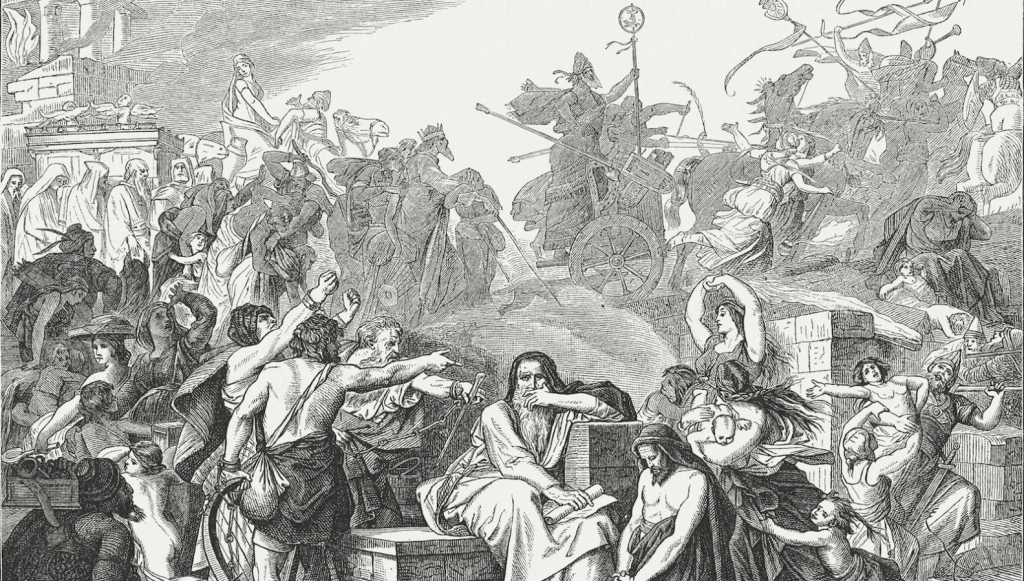
The Babylonian Exile by Jewish-German painter Eduard Bendemann (1811-1889)

In the nineteenth year of Nebuchadnezzar king of Babylon on the seventh day of the fifth month, Nebuzaradan, the king of Babylon’s chief deputy, arrived in Jerusalem. He burned the Temple of God to the ground, went on to the royal palace, and then finished off the city. He burned the whole place down. He put the Babylonian troops he had with him to work knocking down the city walls. Finally, he rounded up everyone left in the city, including those who had earlier deserted to the king of Babylon, and took them off into exile. He left a few poor dirt farmers behind to tend the vineyards and what was left of the fields.

The Babylonians broke up the bronze pillars, the bronze washstands, and the huge bronze basin (the Sea) that were in the Temple of God and hauled the bronze off to Babylon. They also took the various bronze-crafted liturgical accessories, as well as the gold and silver censers and sprinkling bowls, used in the services of Temple worship. The king’s deputy didn’t miss a thing. He took every scrap of precious metal he could find.

The amount of bronze they got from the two pillars, the Sea, the twelve bronze bulls that supported the Sea, and the ten washstands that Solomon had made for the Temple of God was enormous. They couldn’t weigh it all! Each pillar stood twenty-seven feet high with a circumference of eighteen feet. The pillars were hollow, the bronze a little less than an inch thick. Each pillar was topped with an ornate capital of bronze pomegranates and filigree, which added another seven and a half feet to its height. There were ninety-six pomegranates evenly spaced—in all, a hundred pomegranates worked into the filigree.

The king’s deputy took a number of special prisoners: Seraiah the chief priest, Zephaniah the associate priest, three wardens, the chief remaining army officer, seven of the king’s counselors who happened to be in the city, the chief recruiting officer for the army, and sixty men of standing from among the people who were still there. Nebuzaradan the king’s deputy marched them all off to the king of Babylon at Riblah. And there at Riblah, in the land of Hamath, the king of Babylon killed the lot of them in cold blood.

Judah went into exile, orphaned from her land.

3,023 men of Judah were taken into exile by Nebuchadnezzar in the seventh year of his reign.

832 from Jerusalem were taken in the eighteenth year of his reign.

745 men from Judah were taken off by Nebuzaradan, the king’s chief deputy, in Nebuchadnezzar’s twenty-third year.

The total number of exiles was 4,600. (The Message)

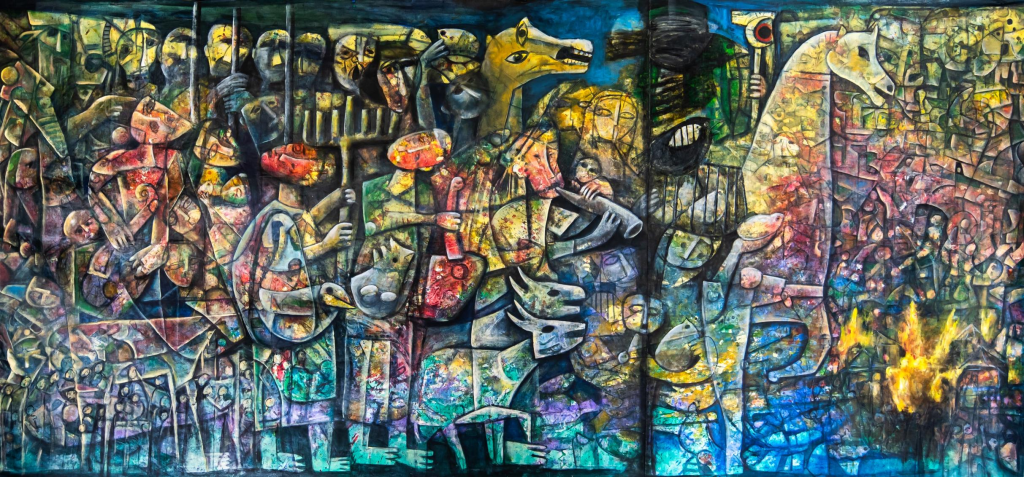
The Babylonian Exile by Fahri Aldin, 2017

Eventually, God’s words and decrees happen. It may take minutes. It might take centuries. But it will happen.

God promised destruction. It happened. The temple, the city walls, and the houses of Jerusalem were destroyed.

God decreed deportation of the people. It happened. Thousands of Jews were uprooted and moved to Babylon.

God foretold depression. It happened. The social and economic system of Judah collapsed.

God said there would be an occupation of Gentiles. It happened. The occupying force seized and confiscated the holy temple articles. They violated that which was sacred to Judah.

God repeatedly told the people that there would be a reckoning for the years of social injustice and religious infidelity. It happened. There was not just a deportation of persons; there were waves of removal.

The long prophecy of Jeremiah began with a proclamation of exile. It moved toward that exile. And then, in the end, the exile became reality.

Surely, it must have seemed to the citizens of Jerusalem that the end of the world was at hand. Their very identity as God’s people, as they had understood it for centuries, was now obliterated. Who are they now?

The Jewish exile changed forever their understanding of themselves and of God because they needed to reimagine what being the people of God really means without a place and without a temple.

God is both subject and object of all Holy Scripture, including the book of Jeremiah. Perhaps neglected in all the talk of exile is that the Lord was also cast-off, put away, and exiled. And rather than this being bad news, it becomes the good news that divine presence was right alongside the exiles.

In our darkest times, in the worst of circumstances, when all seems hopeless – there is a God who shows such solidarity with us that he is crucified and put to death so that we might live.

The Lord does not stand afar off from us but is beside us, even within us.

The sheer violation and agony of Good Friday and the depressive silence of Holy Saturday are the means of demonstrating the power of resurrection and new life.

We may be deported, depressed, and destroyed – exiled to a place we do not know and do not want to be. Yet, that is not the end of the story.

Exile is temporary. Mercy is forever. There cannot be a resurrection without a death. There must be suffering before there is glory.

Love wins. Every time.

God is Love. Thus, there is always hope….

How, Then, Shall We Live? (Luke 16:19-31)

The Rich Man and the Poor Man by Laura Jeanne Grimes, 2005

“There was a rich man who was dressed in purple and fine linen and lived in luxury every day. At his gate was laid a beggar named Lazarus, covered with sores and longing to eat what fell from the rich man’s table. Even the dogs came and licked his sores.

 “The time came when the beggar died, and the angels carried him to Abraham’s side. The rich man also died and was buried.In Hades, where he was in torment, he looked up and saw Abraham far away, with Lazarus by his side. So, he called to him, ‘Father Abraham, have pity on me and send Lazarus to dip the tip of his finger in water and cool my tongue, because I am in agony in this fire.’

 “But Abraham replied, ‘Son, remember that in your lifetime you received your good things, while Lazarus received bad things, but now he is comforted here, and you are in agony. And besides all this, between us and you a great chasm has been set in place, so that those who want to go from here to you cannot, nor can anyone cross over from there to us.’

 “He answered, ‘Then I beg you, father, send Lazarus to my family, for I have five brothers. Let him warn them, so that they will not also come to this place of torment.’

 “Abraham replied, ‘They have Moses and the Prophets; let them listen to them.’

 “‘No, Father Abraham,’ he said, ‘but if someone from the dead goes to them, they will repent.’

 “He said to him, ‘If they do not listen to Moses and the Prophets, they will not be convinced even if someone rises from the dead.’” (New International Version)

Many people look for a miracle at some point in life, especially for family. Whenever we see relatives walking far from God or siblings living without much thought to the words and ways of Jesus, it can be disconcerting. We may reason that if they could just experience or see some great miracle, then they will surely believe and embrace Jesus as Savior and Lord. 

Yet, Christ’s parable to us of the rich man and Lazarus graphically depicts an important message: God has already revealed divinity to humanity through Moses and the Prophets (the Old Testament). 

If people are not convinced by what already exists and what has existed for a long time, they likely will not respond when the miraculous slaps them in the face.

Maybe we too often look for the dramatic because the mundane typically rules the day. Perhaps what we are really looking for is already present in God’s revelation to us. It could be that the greatest task we have is not to beg for a miracle (even though there is nothing wrong with that!) but first to be quiet and listen to the Spirit of God speak through the Word of God so that our prayers to God arise in God’s way and God’s time.

Today’s Gospel story gets at the heart of where we immediately and reflexively turn when in dire straits. There is nothing wrong with turning to others, consulting trusted resources, or even Google. Yet, Holy Scripture is timeless. It contains everything we need for life and godliness in this present age. And I believe it has the answers to life’s most pressing questions.

Everyone has their trusted sources, as well as sources we don’t trust. If a person has a pattern of not consulting or investigating Holy Scripture, then it doesn’t matter who encourages them, even if it is a trusted person who shows up from the grave, to look into the Bible’s contents and believe it’s message.

If we look closely at the story, we are told the poor man’s name: Lazarus. And we are not told the rich man’s name. You see, the poor man, Lazarus, had his name written in the Book of Life. The rich man’s name cannot be spoken because it is not found there.

There are two choices in life, two opposing paths we can take. One is to choose pleasure and overlook the great needs of the earth. Like old Jacob Marley in the Christmas Carol, it is to forge a chain, link by link, day after day, which will eventually leave one in bondage and regret.

The other choice is hope. To look ahead by faith and see the eternal things which are coming, then shaping our existence to act in sync with permanent values, is to choose life. Although this may bring deprivation, even suffering, in this present existence, the decision to forego temporary pleasure for eternal glory shall be rewarded. It is to live for future prosperity through present affliction.

So, how shall we then live?

  • Will we anchor our souls in the good bosom of bettering our fellow humanity?
  • Is there an acknowledgment that the measure we give to others shall eventually be given to us?
  • Do we seek to hold faith with a neighbor in their poverty?
  • Are we trusting so much in our five senses – sight, smell, taste, hearing, touch – that we either cannot or will not trust in the sixth sense of the spirit which tells us to believe Moses and the prophets?

Christ has risen. Christ is coming again. If we align our lives with spiritual truth, we shall find our names written in the Book of Life. Let us actively look for Lazarus in our lives, so that we don’t carelessly step over him day after day while selfishly indulging in the good things of this life.

Mighty God, you have done miraculous things. Help me see what you have already done and teach me to listen so that your revelation becomes alive to me. Holy Spirit, impress the redemptive event of Christ’s resurrection on the hearts of all who do not know you so that they might know your amazing grace. Amen.