God and the Human Condition (Romans 1:18-25)

For the wrath of God is revealed from heaven against all ungodliness and injustice of those who by their injustice suppress the truth. For what can be known about God is plain to them because God has made it plain to them. Ever since the creation of the world God’s eternal power and divine nature, invisible though they are, have been seen and understood through the things God has made.

So they are without excuse, for though they knew God, they did not honor him as God or give thanks to him, but they became futile in their thinking, and their senseless hearts were darkened. Claiming to be wise, they became fools, and they exchanged the glory of the immortal God for images resembling a mortal human or birds or four-footed animals or reptiles.

Therefore God gave them over in the desires of their hearts to impurity, to the dishonoring of their bodies among themselves. They exchanged the truth about God for a lie and worshiped and served the creature rather than the Creator, who is blessed forever! Amen. (New Revised Standard Version)

Exchanging Good for Bad

Nature abhors a vacuum. Everything is filled with something. If one thing is given up, another thing will take its place. Change is actually more like an exchange of one thing for another. Something is taken out, then replaced with something different.

We have exchanged:

  • Behavior that attends to the common good of all persons, for self-interested behavior to what is good for me and my family and/or group
  • Good deeds done from a pure heart, for good deeds done from an impure heart which give me an advantage or leverage over another
  • Steadfast committed love of others, for hustled love that gets discarded whenever things get hard
  • Submission to one another out of a sense of sacred reverence, for disobedience to anyone I don’t like
  • Dignity of being an image-bearer of God for the shame and ignominy of self-image
  • Majesty and worth of all persons in the world, for becoming masters of small worlds
Photo by Kindel Media on Pexels.com

And that’s not all, there’s more. We also have a nasty tendency to replace:

  • Freedom for shackles
  • Virtue for vice
  • Morality for immorality
  • Justice for injustice
  • Goodness for ungodliness
  • Truth for a lie
  • Wisdom for foolishness
  • Immortality for mortality
  • Honor for dishonor
  • Devotion for disregard
  • God for gods

These are all very poor replacements. In fact, the exchanges are so dark that they leave us in a state of guilt before God and all creation. Indeed, we all have sinned and fallen short of our intended purpose on this earth.

Guilt and Shame

Our response must not exchange guilt for shame because they are different words:

Guilt is assigned by God so that repentance and reconciliation might happen.

Shame, however, is introduced by us; we are the ones who label ourselves as a bucket of pig slop, not God.

Guilt is a function of the conscience, letting us know when we have said or done something wrong or hurtful; it is specific to a particular action or lack of action.

Shame, however, is a function of the “inner critic.” It interprets bad words or actions as we ourselves being bad, focusing not on actions but on our very personhood in the form of judgmentalism leveled at myself.

Guilt says, “I have done something bad.”

Shame, however, says, “I am bad.”

Guilt serves a redemptive purpose through alerting us that we need to deal with a wrong.

Shame, however, damages our spirits through telling us we are flawed and unworthy of love and connection with others.

Because guilt and shame are not the same, they need to be dealt with in different ways.

Guilt, if not faced and dealt with, becomes gangrene of the soul. Over time it festers and poisons our spirits, leading to significant emotional and sometimes physical problems. Forgiveness (both in apologies and in forgiving oneself) is the primary tool in dealing with guilt.

Shame, however, lives in the shadows and feeds on secrets. If shame persists, we withdraw from others and experience grinding loneliness. Therefore, the path out of shame is to openly name your shame and tell your story – thus taking away shame’s power and giving it back to yourself. Vulnerability is the tool which erases shame.

“Shame, blame, disrespect, betrayal, and the withholding of affection damage the roots from which love grows. Love can only survive these injuries if they are acknowledged and healed.”

Brené Brown

Emotional Creatures

In the absence of light, there is darkness. Purging oneself of belief in God merely means that another god will take her place. Scripture labels this “idolatry.”

What’s more, in the absence of feeling, in the quest to absolve oneself of unwanted emotions, there still remains emotion – because humans are emotional creatures.

People mostly rid themselves of any god concept because of how they feel about it. In fact, we do just about everything in life based on our emotions. This is a good thing, not a bad thing. We get into problems and fuss about emotions mucking up things, only because we never faced those feelings to begin with.

A person will never know God unless they understand this. The worship of God and the practice of Christianity is not only to engage the mind and the spirit, but also the body and the emotions.

Emotions and feelings are not like foreign microbes that enter the body as unwanted interlopers. They didn’t enter humanity as part of the world’s curse, after Adam and Eve’s fall into disobedience. No!

Rather, we are our emotions, just as much as we are our body, mind, and soul. Therefore, every emotion which exists, resides in us, all the time. We cannot purge ourselves of our emotions any more than we can remove the heart, the brain, or the bowels, and then expect to live.

Denying our emotions, suppressing feelings, and leaving them unacknowledged is terribly unhealthy and will slowly kill us – because our emotions are vital to our very existence.

Getting Rid of God

There are millions of spiritually dead zombies walking the earth who have jettisoned God altogether – either deliberately or unwittingly – because they discarded their emotions, long before they exchanged the sacred for the secular.

We all sometimes get physically ill; it’s part of the human condition, and we all understand that. So, we go to bed, or to the doctor, or to the hospital’s emergency department – depending upon the severity of our illness. We even go to a physician when we are healthy, just to get a check-up and make sure everything in the body is working as it should.

We also all get spiritually and emotionally ill; it’s part of the human condition. But we all don’t understand that. So, we soldier on, going about our regular business as if everything is hunky-dory. We don’t attend to our emotional selves. We don’t slow down and address what’s going on, or go to a church, or go to anyone. Instead, we suffer in silence.

Just as it ludicrous to get rid of the body altogether whenever we get a disease, so we must not rid ourselves of God whenever we get spiritually and emotionally sick. We face the illness and deal with it. It might require surgery. Recovery will hurt. That’s all part of facing it.

Ignoring God is about as smart as ignoring a heart attack. It might go away for a short time, but it’ll come back with a vengeance and do you in.

Emotions aren’t to blame when things are rough. Neither is God to blame when bad stuff happens. Both our emotions and God are realities we must deal with.

Just like the force of gravity is always there and needs to be respected (by not simply walking off the roof of your house, believing you don’t need gravity anymore) so the person and the power of God is always here and we absolutely need to come to terms with that reality, instead of walking away.

What will you do?…

Pay Attention to the Word (2 Peter 1:16-21)

For we did not follow cleverly devised stories when we told you about the coming of our Lord Jesus Christ in power, but we were eyewitnesses of his majesty. He received honor and glory from God the Father when the voice came to him from the Majestic Glory, saying, “This is my Son, whom I love; with him I am well pleased.” We ourselves heard this voice that came from heaven when we were with him on the sacred mountain.

We also have the prophetic message as something completely reliable, and you will do well to pay attention to it, as to a light shining in a dark place, until the day dawns and the morning star rises in your hearts. Above all, you must understand that no prophecy of Scripture came about by the prophet’s own interpretation of things. For prophecy never had its origin in the human will, but prophets, though human, spoke from God as they were carried along by the Holy Spirit. (New International Version)

The Bible is a set of living documents. It breathes with a revitalizing and reliable message about Jesus Christ.

Rather than being merely an ancient book to be displayed as some sort of museum artifact on a coffee table, Holy Scripture has demonstrated amazing resilience of use and pertinence throughout the ages.

Millions of people have discovered it’s riches; and have found the Bible’s message of knowing Christ and him crucified, died, risen, and coming again as their hope and salvation. Indeed, God’s Word to people is a gracious revealing of God to humanity so that all persons may reconnect with divinity.

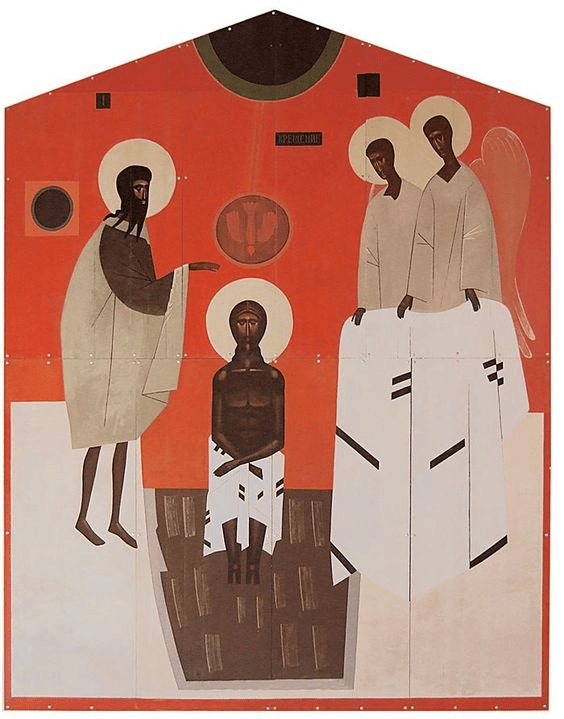
The earthly ministry of Christ had eyewitnesses and earwitnesses. The witness above all witnesses was the Most High who audibly affirmed Jesus with a voice from heaven:

“This is my dearly loved Son, who brings me great joy.” (Matthew 3:17, NLT)

Baptism of Christ, by Vitaly Melnichuk, 2009

Christianity is a religion of the book. Scripture unites us with believers across the world and throughout history. The Bible is to the Christian what weights and barbells are to a bodybuilder. 

The people of God need Holy Scripture, God’s Word, in order to spiritually grow and become mature. Christian character formation cannot truly occur apart from the continuous repetitions of reading the text of Scripture, and letting it build strength into the muscles of the soul.

Scripture is a powerful unifying force within the life of God’s people. We may not all explain every Bible verse in exactly the same way (hence the many different Christian traditions) but believers share a common desire to honor, apply, and obey God’s Word. Ultimately, a passion to listen, talk about, and apply God’s Word brings believers in Jesus together, rather than separates us. 

Perhaps because the average American household today has at least three or four Bibles, we take for granted the availability of God’s Word. It is always at our fingertips, on our smartphones and computers. Yet, because it is always present and available, we may let the busyness and business of life keep us from paying attention to it. 

A commitment to reading and listening to Holy Scripture ought not be done quickly or mechanically, and certainly not half-heartedly. For the Word to penetrate and seep into our souls, we must take the time to listen carefully and slowly.

A first century rabbi, Akiva, once noticed a tiny stream trickling down a hillside, dripping over a ledge on its way toward the river below. Below was a massive boulder. The rock bore a deep impression. The drip, drip, drip of water over the centuries had hollowed away the stone. Rabbi Akiva commented, “If mere water can do this to hard rock, how much more can God’s Word carve a way into my heart of flesh?”

Water flowing over a rock, all at once, leaves it unchanged. It is the slow but steady impact of each small droplet, year after year, decade after decade, that completely reforms the stone.

O how we desire quick answers to our questions! Yet we must take the time to prayerfully listen and reflect on God’s Word and allow it to do it’s work on us and in us. Truth is revealed over many days, months, and years. Big splashes aren’t usually God’s way of doing things. Instead, the slow drip of careful study, contemplative prayer, and meditative reflection, day after day, year after year, shapes us and spiritually forms us into the likeness of Christ.

Thus, a patient, humble, and teachable spirit is necessary. Sometimes the Bible is not apparently relevant. We oftentimes need others to help us and to encourage one another to stick with reading and learning, even when we aren’t sure about what it is saying. 

Rightly interpreting Scripture happens in community, both in present local churches and small groups and in the community of saints who have gone before us. It doesn’t occur in isolation.

Always an appropriate response to hearing God’s Word is to address and the problems of others and the issues of our day. That’s because God is not just concerned about you and me, but about other people, as well. 

What do you suppose would happen if we all committed to carefully reading and listening and meditating, even memorizing God’s Word on a daily basis? Would it transform our worship? Make a difference in our relationships? Change how we do life together?

Attention, people of God and of the Book! God is our God, the One and only!

Love the Lord your God with your whole heart:

Love God with all that is in you; love the Lord with all you’ve got! 

Write these foundational commands I’ve given you on your hearts. Get them inside of you. Then, get them inside your children. 

For this to happen, talk about God’s Word at home when you are eating supper together and when you are working or playing with each other. Start your day with God’s Word when you get up in the morning and end your day with God’s Word when you go to bed at night. 

Put God’s Word on your refrigerator and your car’s dashboard; have it on your smartphones and let it be available to you anywhere and anytime. Use every opportunity you have to incessantly chatter about God’s Holy Word.

(Deuteronomy 6:4-9, contemporary paraphrase)

Pay attention to the Word made flesh and the written Word proclaimed. It makes all the difference.

Our Great Physician, Your Word is like alcohol – when poured on an infected wound, it burns and stings, but only then can it kill germs. If it doesn’t burn, it doesn’t do any good. 

Father, we are all hungry baby birds this morning. Our heart-mouths are gaping wide, waiting for you to fill us. A cold wind seems to have chilled us. Wrap us in the blanket of your Word and warm us up. 

Lord, we find your Word like cabbage. As we pull down the leaves, we get closer to the heart. And as we get closer to the heart, it is sweeter.

–Daily Prayers of Haitian Christians, translated by Eleanor Turnbull (1924-2020) missionary to Haiti for over 50 years

Keep Your Conscience Clear (Acts 24:10-23)

When the governor motioned for him to speak, Paul replied:

“I know that for a number of years you have been a judge over this nation; so I gladly make my defense. You can easily verify that no more than twelve days ago I went up to Jerusalem to worship. My accusers did not find me arguing with anyone at the temple or stirring up a crowd in the synagogues or anywhere else in the city. And they cannot prove to you the charges they are now making against me. 

However, I admit that I worship the God of our ancestors as a follower of the Way, which they call a sect. I believe everything that is in accordance with the Law and that is written in the Prophets, and I have the same hope in God as these men themselves have, that there will be a resurrection of both the righteous and the wicked. So I strive always to keep my conscience clear before God and man.

After an absence of several years, I came to Jerusalem to bring my people gifts for the poor and to present offerings. I was ceremonially clean when they found me in the temple courts doing this. There was no crowd with me, nor was I involved in any disturbance. 

But there are some Jews from the province of Asia, who ought to be here before you and bring charges if they have anything against me. Or these who are here should state what crime they found in me when I stood before the Sanhedrin—unless it was this one thing I shouted as I stood in their presence: ‘It is concerning the resurrection of the dead that I am on trial before you today.’”

Then Felix, who was well acquainted with the Way, adjourned the proceedings. “When Lysias the commander comes,” he said, “I will decide your case.” He ordered the centurion to keep Paul under guard but to give him some freedom and permit his friends to take care of his needs. (New International Version)

Without exception, everyone has a conscience. It is our internal moral compass, an intangible guidance system.

Conscience is humanity’s hard-wired epistemic sense of knowing what and what not to do, beyond the five senses. The still small voice inside us continually gives discernment that transcends objective facts – even though we may not be able to articulate or explain why we know something is right or wrong.

Our conscience keeps us from being morally empty, bereft of direction, and aimless in this world. Paying attention to our conscience serves us quite well. The conscience is the angel on our shoulder, directing us to do and be better; it is the inner compunction to live a beautiful, good, and ethical life.

By allowing the conscience to chart for us a course forward, we can then avoid inaction in the face of stress, as well as immoral words and actions. The conscience tempers our inbred fight-or-flight syndrome so that we might respond wisely to adverse situations. 

The Apostle Paul, as was usual with him, was in a pickle. Yet, Paul never seemed to be shaken with circumstances which most of us would probably consider so distressing as to fall into despair.

In today’s New Testament lesson, Paul is in custody. While standing trial before Governor Felix, Paul used the opportunity to give a clear and rather relaxed testimony to his Christian faith. 

I suggest that the Apostle was able to give a cogent apologetic for his life and ministry – not because he was trying to get off the hook or because he thought it was his duty – but because of his well-attuned inner compass. That inner guidance system led him to say:

“I have committed myself to maintaining a clear conscience before God and with all people.” (Acts 24:16, CEB)

Statue of St. Paul in St. Peter’s Square, the Vatican, Rome

Living with an awareness of the conscience, and carefully listening to it, creates the ability to speak from that place of insight.

There’s no need to do all sorts of mental gymnastics or spin-doctoring. Although Paul gave a clear defense of his actions and attitudes, he did it without having an insecure defensiveness. Because of his conscience, he could articulate truth and steer clear of white lies and propping-up his ego.

I also suggest that the Apostle Paul’s effective engagement with others came from his God-given inner conscience. So, I wonder: 

  • How might my life be different if I shared the same concern as Paul to always have my conscience clear before both God and others? How might the world be different if this was a dedicated commitment?
  • What would happen if I sought to continually be in dialogue with my conscience and make decisions based on that connection? And what if I consistently brought before God the musings and inklings of my conscience?

The human conscience is not static but dynamic. It can be strong or weak. If it doesn’t get regular use, the conscience withers, eventually becomes calcified, and results in a hardening of the heart.

The following are just a few ways of gaining a healthy conscience and keeping it clear and clean:

Acknowledge

Make an acknowledgment of God. The Lord gave us an internal conscience of law and also an external code of law. They are both meant to operate together. The conscience needs to be formed from God’s revelation, that is, God’s written and natural laws; and then, we live life as God intends. 

The conscience is like a law written in the human heart. And it will show whether we are forgiven or condemned. (Romans 2:15, CEV)

“Conscience is like God’s herald and messenger; it does not command things on its own authority, but commands them as coming from God’s authority, like a herald when he proclaims the edict of the king. This is why conscience has binding force.”

St. Bonaventure

Let us draw near to God with a sincere heart and with the full assurance that faith brings, having our hearts sprinkled to cleanse us from a guilty conscience and having our bodies washed with pure water. (Hebrews 10:22, NIV)

Affirm

Let your own good deeds and the works of others be affirmed. Have realistic expectations. The lack of affirmation slowly and imperceptibly poisons the soul and infects the conscience.

“I give thanks to God, whom I serve with a clear conscience, as my ancestors did. I thank him as I remember you always in my prayers night and day.” (2 Timothy 1:3, GNT)

Ask

Petition God for help. Pray for divine resources to assist you. Divine wisdom guides human affairs. Divine authority governs human community. Divine love gives shape to the human conscience.

Pray for us. Our consciences are clear, and we always try to live right. (Hebrews 13:18, CEV)

Allow

Let other people into your life, whether Christian, or not. Sharing thoughts and ideas, feelings and emotions, concerns and celebrations, are all a path toward a healthier spirit, a better awareness of self and others, and a stronger conscience.

If someone who isn’t a believer asks you home for dinner, accept the invitation if you want to. Eat whatever is offered to you without raising questions of conscience. (But suppose someone tells you, “This meat was offered to an idol.” Don’t eat it, out of consideration for the conscience of the one who told you. It might not be a matter of conscience for you, but it is for the other person.). (1 Corinthians 10:27-28, NLT)

Acquire

Develop the necessary spiritual skill set of wisdom and holiness to feed the conscience. Let grace be the primary teacher.

We can say with confidence and a clear conscience that we have lived with a God-given holiness and sincerity in all our dealings. We have depended on God’s grace, not on our own human wisdom. That is how we have conducted ourselves before the world, and especially toward you. (2 Corinthians 1:12, NLT)

Pay attention to your conscience. Keep it clean and clear. It’s there to serve you well. So, let it.

Gracious God, you provide everything we need for life and godliness in this world. Help me to keep my conscience clear in all my words and actions; and keep it tender toward your will so that, through me, others might experience through the life-giving message of Jesus Christ, in the power of the Holy Spirit. Amen.

Take the Path of Peace (Zechariah 1:1-17)

Michelangelo’s depiction of the prophet Zechariah, Sistine Chapel, Rome

In the eighth month of the second year of Darius, the word of the Lord came to the prophet Zechariah son of Berekiah, the son of Iddo:

“The Lord was very angry with your ancestors. Therefore tell the people: This is what the Lord Almighty says: ‘Return to me,’ declares the Lord Almighty, ‘and I will return to you,’ says the Lord Almighty. Do not be like your ancestors, to whom the earlier prophets proclaimed: This is what the Lord Almighty says: ‘Turn from your evil ways and your evil practices.’ But they would not listen or pay attention to me, declares the Lord. Where are your ancestors now? And the prophets, do they live forever? But did not my words and my decrees, which I commanded my servants the prophets, overtake your ancestors?

“Then they repented and said, ‘The Lord Almighty has done to us what our ways and practices deserve, just as he determined to do.’”

On the twenty-fourth day of the eleventh month, the month of Shebat, in the second year of Darius, the word of the Lord came to the prophet Zechariah son of Berekiah, the son of Iddo.

During the night I had a vision, and there before me was a man mounted on a red horse. He was standing among the myrtle trees in a ravine. Behind him were red, brown and white horses.

I asked, “What are these, my lord?”

The angel who was talking with me answered, “I will show you what they are.”

Then the man standing among the myrtle trees explained, “They are the ones the Lord has sent to go throughout the earth.”

And they reported to the angel of the Lord who was standing among the myrtle trees, “We have gone throughout the earth and found the whole world at rest and in peace.”

Then the angel of the Lord said, “Lord Almighty, how long will you withhold mercy from Jerusalem and from the towns of Judah, which you have been angry with these seventy years?” So the Lord spoke kind and comforting words to the angel who talked with me.

Then the angel who was speaking to me said, “Proclaim this word: This is what the Lord Almighty says: ‘I am very jealous for Jerusalem and Zion, and I am very angry with the nations that feel secure. I was only a little angry, but they went too far with the punishment.’

“Therefore this is what the Lord says: ‘I will return to Jerusalem with mercy, and there my house will be rebuilt. And the measuring line will be stretched out over Jerusalem,’ declares the Lord Almighty.

“Proclaim further: This is what the Lord Almighty says: ‘My towns will again overflow with prosperity, and the Lord will again comfort Zion and choose Jerusalem.’” (New International Version)

God hulking-out isn’t something you want to see repeated, insisted the prophet.

Zechariah directed his message to the Jews returning from their exile in Babylon. He reminded them that their parents and forebears had been called to repent and return to the Lord. They didn’t. Hence, the Babylonian exile. Big hint from the prophet to the people: Don’t ever do that again. Things will get angry, large, and green if you do.

Zechariah’s generation was being given a chance: To live into God’s covenant and law; to hold fast onto their identity as God’s people.

The people listened to the prophet. They expressed their repentance and a desire to turn from past evil ways and embrace the ways of the Lord. And the returning exiles also acknowledged and accepted God’s judgment. The returning exiles understood that, as a people, they deserve the consequences to centuries of neglecting justice, mercy, and humility.

Every generation of believers must learn from the past. Not only do they need to receive the teachings and traditions of those who went before them, but each generation must also struggle with how to put that teaching and tradition into practice.

The past needs to be squarely faced and deliberately pulled into the present. That is the way a genuine hope is born, giving direction for the future. In other words, old words and ways from the past need new experiences in the present; only by doing this will there be guidance.

Bring in your kingdom so that your will is done on earth as it’s done in heaven. (Matthew 6:10, CEB)

Today’s Old Testament lesson includes the first of eight night visions from the prophet Zechariah. The gist of the first prophetic oracle is a message of assurance and comfort: God will restore. The Lord will renew.

Divine intervention is about to happen in the rebuilding of the temple – a physical example of the spiritual reality that is happening. Just as the ancient temple was being restored for new generations of worshipers, so the people were being renewed to be an example of piety and fidelity to God for millennia to come.

Peace and prosperity will again be realized.

Throughout Scripture, trees are a symbol of a thriving and flourishing life. The myrtle tree is a sign of God’s promise to bring new life, branching out to spread into the next generations. Like all trees, the myrtle needs plenty of moisture when young. Yet, it is distinctive in that the myrtle tree can tolerate drought, grow despite limited soil, and remain hardy when it becomes mature.

Your anger lasts a little while,
but your kindness lasts
    for a lifetime.
At night we may cry,
but when morning comes
    we will celebrate. (Psalm 30:5, CEV)

“Tolerate,” “grow,” and “remain” are anything but passive words. People are more than mere observers. “Repent” and “return” and “renew” are verbs. There is a great deal of activity to do. A divine/human cooperation needs to occur. On God’s end, even the angels get involved in the action. What’s happening here is both heavenly and earthly business.

Relational dynamics between God and God’s people are to be a dialogue and not a one-sided monologue. The Lord and the present generation are to demonstrate for future peoples how peace is actually realized and enjoyed.

The Vision of Zechariah, by Unknown artist, c.1300 C.E., Sicily

Like all biblical visions, Zechariah’s is not readily understandable. Nobody is sure about what the symbolism is behind the vision’s horses. Yet, I’ll venture to say that it’s the colors which are significant: red is the color of action; brown is a color of stability and fertility; and white represents purity and holiness. Red, brown, and white mixed together creates a beige color.

Beige is an earthy and dependable color. It’s an inherently welcoming and calming color, offering warmth and symbolizing harmony and comfort. Together, with the horses we have a representation of strength, stability, and structure. They are signs of peace and rest, of God’s shalom.

Spiritual wholeness, moral integrity, relational harmony, and settled peace don’t just magically happen. 

For the Christian, peace was bought at a price – the blood of Jesus. (Colossians 1:20)

Peace must be both passively received and actively pursued. (Ephesians 4:3)

Practices of peace need to be engrafted into our lives so that we might daily experience it. (Romans 14:13-15:7)

The name “Zechariah” is a Hebrew word meaning, “God remembered.” God has not forgotten divine promises. 

The time has come to take hold of the vision God had from the very beginning to walk with humanity in continual fellowship and happiness in the garden, a place of abundant growth, beauty, and health – a place of peace and rest.

The happiest, fully rested, and most peaceful people and nations on earth continually find a steady stream of joy in their families, their rituals/traditions, and their religion.

To find joy and happiness in life is to find peace and rest. And peace is something to be shared, to be passed onto others.

“The peace of Christ be with you.”

“And also with you.”

Such ritual words and practices are reminders of continually returning to the Lord and finding simplicity and satisfaction in Jesus.

In observing and celebrating the Lord’s Table, we find our penultimate remembrance of how peace was achieved, as well as our supreme participation in the triune God.

Perhaps, then, peace and prosperity will extend their tree-like branches over the earth and into the next generations.

Grace to you and peace from God our Father and the Lord Jesus Christ.

Peace before us,
Peace behind us,
Peace under our feet.

Peace within us,
Peace over us,
Let all around us be peace.

Christ before us,
Christ behind us,
Christ under our feet.

Christ within us,
Christ over us,
Let all around us be Christ. – a Navajo Prayer