A Living Hope (1 Peter 1:3-9)

Let us give thanks to the God and Father of our Lord Jesus Christ! Because of his great mercy he gave us new life by raising Jesus Christ from death. This fills us with a living hope, and so we look forward to possessing the rich blessings that God keeps for his people. He keeps them for you in heaven, where they cannot decay or spoil or fade away. They are for you, who through faith are kept safe by God’s power for the salvation which is ready to be revealed at the end of time.

Be glad about this, even though it may now be necessary for you to be sad for a while because of the many kinds of trials you suffer. Their purpose is to prove that your faith is genuine. Even gold, which can be destroyed, is tested by fire; and so your faith, which is much more precious than gold, must also be tested, so that it may endure. Then you will receive praise and glory and honor on the Day when Jesus Christ is revealed. 

You love him, although you have not seen him, and you believe in him, although you do not now see him. So you rejoice with a great and glorious joy which words cannot express, because you are receiving the salvation of your souls, which is the purpose of your faith in him. (Good News Translation)

There’s no need for hope if everything’s going just the way you like it. I remember when I was a college undergraduate, I hoped for Christ’s return toward the end of every semester. The prospect of all those final exams and the pressure of grades had me longing for heaven.

But that’s life. Maturity, resilience, perseverance, and just about every virtue you can think of comes as a result of life’s trials and sufferings. The Christian has hope, precisely because things aren’t the way they’re supposed to be.

Faith has to be tried and tested. And hard circumstances are the way of purifying it. Like gold being purged of any dross by being exposed to extreme heat, so our faith becomes strong, robust, and genuine by the purgative fires of life’s many large and small sufferings.

The whole point of it all is to make us people worthy of our spiritual calling. Resurrection only happens because there’s been a death. Glory is only realized through suffering.

New life, the Christian life, isn’t a matter of making a new set of resolutions, as if it were nothing more than aspirations at the beginning of a calendar year. Rather, Christian faith is a response to the mercy of God in Jesus Christ.

One of my all-time favorite stories is Victor Hugo’s Les Miserables. It’s a story of grace and new life, of a hopeless man given the chance at hope.

The main character is Jean Valjean, who spends nineteen years in jail for stealing a loaf of bread for his starving family. The experience in prison caused him to become a bitter and cynical man. After his release, Jean Valjean has nowhere to go. 

In desperation, he seeks lodging one night at the home of a Catholic bishop, who treats him with genuine kindness, which Valjean sees only as an opportunity to exploit. In the middle of the night, he steals the bishop’s silver and skedaddles. 

The next day, however, Valjean is caught by the police. When they bring him back to the bishop’s house for identification, the police are surprised when the bishop hands two silver candlesticks to Jean, implying that he had given the stolen silver to him, saying, “You forgot these.” 

After dismissing the police, the bishop turns to Jean Valjean and says, “I have bought your soul for God.” In that moment, by the bishop’s act of mercy, Valjean’s bitterness is broken. Hope springs to life.

Jean Valjean’s forgiveness is the beginning of a new life. The bulk of Victor Hugo’s novel demonstrates the utter power of a redeemed life. Jean chooses the way of mercy, as the bishop had done. Valjean raises an orphan, spares the life of a parole officer who spent fifteen years hunting him, and saves his future son-in-law from death, even though it nearly cost him his own life. 

“Jean Valjean, my brother, you no longer belong to what is evil but to what is good. I have bought your soul to save it from black thoughts and the spirit of perdition, and I give it to God.” ― Victor Hugo, Les Misérables

Throughout Jean Valjean’s new life, there are trials and temptations all along the way. Yet, mercy keeps his faith strong, and hope kindled. Whereas before, Valjean responded to mercy with a brooding melancholy and inner anger, now – after being shown grace – he responds to each case of unjust suffering with gratitude, deeply thankful for the chance to live a new life full of grace.

Hope is kept alive because of suffering. Faith is strengthened by means of adversity. And both originate because of mercy and grace.

Christianity is a worldview perspective that enables one to rejoice in difficulty. For the Christian, there is no empty meaningless grief; there is the hope that our suffering means something. Like the athlete who endures all the painful practice in order to realize a future hope, so the believer in Jesus goes into strict training for the development of faith – all in the confident expectation of a fulfilled salvation.

It’s a hard lesson to learn, this seemingly weird alchemy of faith, suffering, hope, joy, and new life. And every generation of Christians needs to experientially discover it. Each believer eventually learns, in the crucible of hard circumstances, that the promises of God are the ballast to persevere in faith and patience throughout life.

Christian hope is a confident expectation that the promises of God will be completely realized.

A Christian’s salvation encompasses past, present, and future.

We were saved back there in the past when Christ died on the cross for us. We were crucified with him.

We are presently being saved from the world, the sinful nature, and the devil, through the sanctifying work of the Spirit in making us holy.

And we will be saved in the future when Christ returns to judge the living and the dead. Then, our salvation will be fully realized. Since that hasn’t happened yet, we have hope to sustain us.

It was hope that sustained me in college. I endured all the hours of study, all the exams, all the various courses taken, with the confident expectation that I would someday walk across that stage, receive my diploma, and graduate with my intended degree.

We ourselves, who have the first fruits of the Spirit, groan inwardly as we wait eagerly for our adoption to sonship, the redemption of our bodies. For in this hope we were saved. But hope that is seen is no hope at all. Who hopes for what they already have? But if we hope for what we do not yet have, we wait for it patiently. (Romans 8:23-25, NIV)

The Christian’s hope for ultimate deliverance is imperishable, undefiled, and unfading. This means we can live through a difficult day or week or month or a year, or even decades, with spiritual endurance. Our goal shall come in all its fullness. 

Then I saw a new heaven and a new earth, for the first heaven and the first earth had passed away, and the sea was no more. And I saw the holy city, the new Jerusalem, coming down out of heaven from God, prepared as a bride adorned for her husband. And I heard a loud voice from the throne saying,

“See, the home of God is among mortals.
He will dwell with them;
they will be his peoples,
and God himself will be with them and be their God;
he will wipe every tear from their eyes.
Death will be no more;
mourning and crying and pain will be no more,
for the first things have passed away.” (Revelation 21:1-4, NRSV)

Eventually, suffering will have done its work and we will be with Christ forever. Until that day, let us explore all that God has for us, embracing both the meaning and the mystery of faith. 

Since our salvation is assured, let us live with confidence and run the race marked out for us.

Heavenly Father, you created us and lovingly care for us. We accept all our sufferings willingly, and as truly obedient children we submit ourselves to your holy will. Give us the strength to accept your loving visitation to us through adversity, and never let us grieve your heart by giving-in to impatience. We offer you our pains to be used for your honor and glory, through Jesus Christ our Lord, in the strength of the Holy Spirit. Amen.

The Longing of Christ’s Heart (Matthew 23:37-24:14)

“If Thou Had’st Known” by William Brassey Hole (1846-1917)

“Jerusalem, Jerusalem, you who kill the prophets and stone those sent to you, how often I have longed to gather your children together, as a hen gathers her chicks under her wings, and you were not willing. Look, your house is left to you desolate. For I tell you, you will not see me again until you say, ‘Blessed is he who comes in the name of the Lord.’”

Jesus left the temple and was walking away when his disciples came up to him to call his attention to its buildings. “Do you see all these things?” he asked. “Truly I tell you, not one stone here will be left on another; everyone will be thrown down.”

As Jesus was sitting on the Mount of Olives, the disciples came to him privately. “Tell us,” they said, “when will this happen, and what will be the sign of your coming and of the end of the age?”

Jesus answered: “Watch out that no one deceives you. For many will come in my name, claiming, ‘I am the Messiah,’ and will deceive many. You will hear of wars and rumors of wars but see to it that you are not alarmed. Such things must happen, but the end is still to come. Nation will rise against nation, and kingdom against kingdom. There will be famines and earthquakes in various places. All these are the beginning of birth pains.

“Then you will be handed over to be persecuted and put to death, and you will be hated by all nations because of me. At that time many will turn away from the faith and will betray and hate each other, and many false prophets will appear and deceive many people. Because of the increase of wickedness, the love of most will grow cold, but the one who stands firm to the end will be saved. And this gospel of the kingdom will be preached in the whole world as a testimony to all nations, and then the end will come. (New International Version)

Christ’s cry of love for the city of Jerusalem– the longing to bring the people together and shepherd them with care and compassion – came after a very pointed pronouncement of woes against a distorted religion that was in vogue at the time. Jesus saw the current state of worship, found it to be terribly wanting, gave a scathing rebuke, and saw ahead to its ultimate demise.

Jesus did not just blast the establishment, then humph and walk away disgusted. Instead, he looked with sadness over the city and broke into a tear-filled, heart-wrenching love song for his wayward people. Jesus was both angry and sad because of his deep concern for all people to know the true worship of God and to find their ultimate purpose and meaning in him.

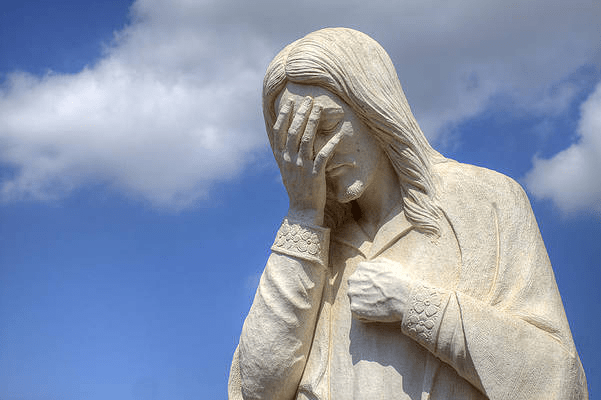
“And Jesus Wept” statue in Oklahoma City, Oklahoma

Any religious fool can rant about the ills of the world, ungodly persons, and defective institutions. However, it takes a person with the heart of Jesus to weep over it all and follow him into suffering on behalf of others so that they might come to the peaceable kingdom of righteousness. 

If our hearts are not unraveled over the sin and injustice of the world, we are in no position to rant about anything. That’s because grace and mercy is the currency of God’s economy. 

Thus, we need to repent like we mean it, pray as if our lives depended on it, and proclaim the good news of Christ as if there is not a tomorrow.

In a results-driven culture, congregations want clear strategy plans for ministry. Yet, a group of people can implement the best of ministries and still not realize their well-laid plans. If Jesus didn’t see what he wanted to happen come to fruition in Jerusalem, then I’m not sure how any of us can always expect success in ministry. We may fail in many ways; but let us not fail to weep over our communities and neighborhoods and long for them to know Christ.

It’s okay that neither every ministry goes as planned nor every person is blessed by what we do. If we find it hard to accept this, and feel out of control, then we want to know the future – how everything is going to shake-out. This is precisely what the disciples wanted to know, since their expectations weren’t realized.

Jesus essentially told them that things were going to get even tougher. Therefore, they need to be ready and persevere through the adversity. And some of that trouble will be downright cataclysmic. Jesus did not give his disciples a seminar on having a successful ministry; he simply told them to endure suffering and focus on proclaiming the gospel.

But for that to happen, we need to accept that we cannot control every variable of ministry and plan for every contingency. The only guarantees we have is that God is with us, and Christ is coming again. That’s it, my friends.

So, instead of control, we must accept our limitations and practice self-control. We can continually monitor our own internal motivations and desires so that they are in constant alignment with the words and ways of Jesus – including a heart of love that weeps over the brokenness and stubbornness of the world. 

Followers of Jesus walk the only true road of Christian discipleship: the path of humility. Out of all the characteristics that Jesus could have described himself, the only two words he ever used were “gentle and humble.” (Matthew 11:29)

Jesus Weeping Over Jerusalem, by Enrique Simonet Lombardo (1866-1927)

Jesus is the perfect example of a leader who always ministered with a complete sense of his divine power, human limitations, and concern for others. Christ never believed he was the reason for his own success, nor thought he was the reason for another’s failure of faith. Instead, Jesus always connected what he was doing to the will of his Father in heaven.

You can only avoid the seduction of arrogant pride when you recognize that you are not God and need the help of others. Truly humble folk dig a hole, throw their ego into it, and pour concrete on top of it. This allows them to listen deeply, give generously, and encourage others liberally.

Standing firm to the end doesn’t come through crafting complicated charts of the end times; it comes through being humble, being grounded in the here-and-now, being attentive to the people around us, and being a guide for the lost. More importantly, it’s what Christ wants us to be.

Loving Lord Jesus, let me have your zeal for God’s house and your heart for lost people! Change my heart, O God, and let it reflect your grace and truth in everything I say and do; through Christ my Savior, who with you and the Holy Spirit, reign now and forever. Amen.

Think of the Needs of the Group (1 Corinthians 10:23-11:1)

Looking at it one way, you could say, “Anything goes. Because of God’s immense generosity and grace, we don’t have to dissect and scrutinize every action to see if it will pass muster.” But the point is not to just get by. We want to live well, but our foremost efforts should be to help others live well.

With that as a base to work from, common sense can take you the rest of the way. Eat anything sold at the butcher shop, for instance; you don’t have to run an “idolatry test” on every item. “The earth,” after all, “is God’s, and everything in it.” That “everything” certainly includes the leg of lamb in the butcher shop. If a nonbeliever invites you to dinner and you feel like going, go ahead and enjoy yourself; eat everything placed before you. It would be both bad manners and bad spirituality to cross-examine your host on the ethical purity of each course as it is served. On the other hand, if he goes out of his way to tell you that this or that was sacrificed to god or goddess so-and-so, you should pass. Even though you may be indifferent as to where it came from, he isn’t, and you don’t want to send mixed messages to him about who you are worshiping.

But, except for these special cases, I’m not going to walk around on eggshells worrying about what small-minded people might say; I’m going to stride free and easy, knowing what our large-minded Master has already said. If I eat what is served to me, grateful to God for what is on the table, how can I worry about what someone will say? I thanked God for it, and he blessed it!

So eat your meals heartily, not worrying about what others say about you—you’re eating to God’s glory, after all, not to please them. As a matter of fact, do everything that way, heartily and freely to God’s glory. At the same time, don’t be callous in your exercise of freedom, thoughtlessly stepping on the toes of those who aren’t as free as you are. I try my best to be considerate of everyone’s feelings in all these matters; I hope you will be, too.

It pleases me that you continue to remember and honor me by keeping up the traditions of the faith I taught you. (The Message)

“To know how to free oneself is nothing; the arduous thing is to know what to do with one’s freedom.”

Andre Gide

Extreme individualism wants what it wants and doesn’t give a thought about anyone else – which is why we always have such a peck of trouble in the world all the time.

We need to get a phrase into our language which will become a continual mantra we say and observe:

Think of the needs of the group.

Christianity is a religion of community, of being attentive to and meeting one another’s needs, and of caring about the common good of all persons throughout the world. Christians dishonor their Lord and buck their spiritual tradition whenever they go rogue and base everything they say and do on what sort of advantage it is for them without considering others.

Yes, believers in Jesus have freedom in Christ. The cross has released the shackles that kept us in sin’s bondage. But, no, that doesn’t mean we get to do whatever we want, whenever we want. That’s the way individualism looks at it. That’s not how a communal people, the church, are to look at it.

Freedom hinges on two very important and seemingly small grammar prepositions: from and to.

Freedom always involves two elements:

  1. Freedom from what hinders or oppresses us.
  2. Freedom to become who we are meant to be.

In Christianity, believers are saved from sin, death, and hell – released from guilt and shame. There is redemption from the pit of despair. The bonds that hindered are now broken through the cross of Christ. The power of the world, the sinful nature, and the devil are taken away.

Yet, in no way does that now mean that we now get to do whatever we want, as if we’ve finally outgrown childhood and parental authority.

The extreme individualist Christian looks at freedom solely from this vantage. As a result, such a person considers the church as nonobligatory, involvement in issues of justice as optional, the use of personal funds and resources as discretionary, and accountability to others as arbitrary.

Such individualism sees Christianity as a fire insurance policy from hell, and a ticket punched for heaven. Until Christ returns, the reasoning goes, I can do whatever the heck I want. It’s my life, not yours.

Christians, however, are still servants. Whereas we were once enslaved to the dark forces of this world, now we are slaves to Christ. We exchanged masters. Satan is no longer the deceitful and lying task master over us. We are now under new management and have a new Master, the Lord Jesus. We’ve changed allegiances.

And now, submitted to Christ, we embrace our mandate of freedom to become whom we were always meant to be: At peace with our Creator and in harmony with all creation. We are now free to enjoy right relationships with God and others, to walk in faith, hope, and love, and to bless both the church and the world.

The Christian’s freedom came at a price: the very blood of Christ Jesus. Therefore, we are not to abuse that freedom by focusing solely on our freedoms from all that once bound us. We are also responsible and accountable for using that freedom in going to the world and proclaiming the gospel in word and sacrament, as well as loving God and neighbor.

Freedom is only freedom when it has the well-being of everyone in mind.

Think of the needs of the group.

Lord God, almighty and everlasting Father: Help us to live into the freedom you have brought to us. May we exercise our freedom, with the heart of a faithful disciple of Jesus Christ, to serve your purposes. Unite us, protect our sacred liberties and rights, and defend us from every evil. Strengthen your people as a foundation of moral clarity, justice, love, and gospel proclamation. Grant all this by the power of your Holy Spirit and in the Name of Jesus Christ, your Son, our Lord. Amen.

What’s the Point of All This Suffering? (2 Thessalonians 1:3-12)

We ought always to thank God for you, brothers and sisters, and rightly so, because your faith is growing more and more, and the love all of you have for one another is increasing. Therefore, among God’s churches we boast about your perseverance and faith in all the persecutions and trials you are enduring.

All this is evidence that God’s judgment is right, and as a result you will be counted worthy of the kingdom of God, for which you are suffering. God is just: He will pay back trouble to those who trouble you and give relief to you who are troubled, and to us as well. This will happen when the Lord Jesus is revealed from heaven in blazing fire with his powerful angels. He will punish those who do not know God and do not obey the gospel of our Lord Jesus. They will be punished with everlasting destruction and shut out from the presence of the Lord and from the glory of his might on the day he comes to be glorified in his holy people and to be marveled at among all those who have believed. This includes you because you believed our testimony to you.

With this in mind, we constantly pray for you, that our God may make you worthy of his calling, and that by his power he may bring to fruition your every desire for goodness and your every deed prompted by faith. We pray this so that the name of our Lord Jesus may be glorified in you, and you in him, according to the grace of our God and the Lord Jesus Christ. (New International Version)

There are 66 books in the Bible. Every one of them, without exception, addresses human suffering. What’s the point of all this suffering? Isn’t salvation supposed to deliver me from all that mess? Why should I even read this dumb blog post?

All of the Apostle Paul’s epistles (a fancy way of saying “letters”) contain a perspective on suffering. And Paul’s reasoning and understanding of suffering goes like this:

  1. Jesus suffered. Throughout his earthly ministry, Christ endured opposition, trouble, and malevolence, especially in a cruel crucifixion and death. Yet, his suffering was the means of redeeming the world.
  2. Christians suffer. Throughout our earthly ministry, we will endure opposition, trouble, and malevolence; especially in a commitment to live the words and ways of Jesus. Yet, our suffering is the means of participating with Christ in redeeming the world.
  3. Suffering is mandatory. It is a significant means of spiritual growth for the Christian. And it is an important way of displaying Christianity’s virtues to a spiritually lost world.
  4. Misery is optional. There’s no solid biblical reason to become miserable or nihilistic with all the seemingly random suffering of the world. It’s hubris to think that my perspective on the subject of suffering and God is the right one.
  5. God is just. And Jesus is the rightful Judge of malevolent troublemakers.
  6. Christians, too, are to be just. Christians, however, are not the rightful judges; thus, there is to be neither executing of judgment on troublemakers nor any judgmentalism in Christ’s church.
  7. Suffering before glory. We are not above our Lord. Jesus rose from death, ascended to heaven, and is glorified. It had to happen that way. It has to happen that way for us, too. There must be suffering before there is glory.
  8. Suffering is temporary. Just like their Lord, Christians, too, shall rise from death, ascend to heaven, and participate in God’s glory. The suffering is for but a moment, but the glory is everlasting.

This reality of suffering and its purpose begs several questions of us. If this is all true (which it is) then:

  • Why do Christians spend so much of their spiritual energy praying and working toward avoiding suffering at any and all costs?
  • What does this tell us about ourselves?
  • Where do we feel the pull to resist change?
  • Will we allow suffering to be our teacher, or not?
  • How might our suffering bring justice and righteousness to a lost world?

Suffering is the mechanism by which spiritual growth is activated. If Christians never faced suffering, there would be no need for faith. That’s because faith is not static but active; it is meant to be regularly used, and if it is not, then belief atrophies and is worth nothing. Much like a muscle, faith needs daily exercise.

Furthermore, the Christian’s exercise of faith is not only for personal spiritual wellness but also for the benefit of others. To put the matter another way, Christians put blood, sweat, and tears into justice for the common good of everyone – thereby putting themselves in a position to be leveled with unjust vitriol. Whenever we challenge the power of another’s unjust actions, the inevitable consequence is fireworks in the form of catching some suffering.

This is why suffering for the right reasons is a sign of God’s grace in one’s life. We aren’t supposed to suffer because of our own stupidity and bad decisions; we are to suffer by our advocacy of the  powerless and the voiceless, thus redeeming time, energy, and resources for God’s kingdom. And it won’t be just a little bit of suffering; it will be a lot.

“If we are to enter God’s kingdom, we must pass through many troubles.”

Acts 14:22, CEB

We may get rather impatient with all this suffering. Yet, it’s also a sign and demonstration of God’s great patience – not wanting anyone to perish but all to enter eternal life. The least we can do is endure hardship for the sake of another’s life.

The Lord isn’t slow to do what he promised, as some people think. Rather, he is patient for your sake. He doesn’t want to destroy anyone but wants all people to have an opportunity to turn to him and change the way they think and act. (2 Peter 3:9, GW)

And if we persevere to the end, we will be vindicated; and malevolent troublemakers will have to contend with God. When we see the injustice of evil winning and good people suffering, it’s easy to get discouraged. But it won’t always be this way. Evil is temporary. Love is eternal.

There must be suffering. Yet, there will also be glory. Our trials and tribulations are but for a moment. But God’s favor lasts forever.

So then, earnest and heartfelt prayer is in order and always in season:

Great God of justice and righteousness, we pray that you will make us perfectly fitted for what you have called us to be. We ask that you fill our good ideas and acts of faith with divine energy so that it all amounts to something. May you cause our lives to honor the name of Jesus; and may we soon experience the day when Christ honors us. Your grace is sufficient for us – whether in good times or bad, through Jesus Christ our Lord in the power of the Holy Spirit. Amen.