Encouragement to Be Faithful (2 Timothy 1:3-7)

Orthodox icon of St. Timothy
Orthodox icon of St. Paul the Apostle

Timothy, I thank God for you—the God I serve with a clear conscience, just as my ancestors did. Night and day I constantly remember you in my prayers. I long to see you again, for I remember your tears as we parted. And I will be filled with joy when we are together again.

I remember your genuine faith, for you share the faith that first filled your grandmother Lois and your mother, Eunice. And I know that same faith continues strong in you. This is why I remind you to fan into flames the spiritual gift God gave you when I laid my hands on you. For God has not given us a spirit of fear and timidity, but of power, love, and self-discipline. (New Living Translation)

Every individual person I meet is interesting. Everyone has a story. Each person has values which are important to them.  

The Apostle Paul had quite the story of conversion to Christianity. And so, he understandably had a high value of passing on the faith to reliable and competent persons who would then do the same. Timothy was one of those persons, a protégé of his mentor Paul.

Paul reminded Timothy of his identity, rooted in a faithful family, and encouraged him to tap into that robust spirit which resides within him. The Apostle encouraged him to fully express that spirit without fear or timidity.

For example, I care about kids. Children are a high value to both me and my wife. When meeting and engaging a family for the first time, we will inevitably talk to the child before addressing the parents. We care about any issue in the world which has to do with children – and we have a strong sense of morality concerning children because we love kids.

Be faithful to your calling, and to the values and ethics which undergird it. Whatever is important to us is where our sense of morality and ministry lie.

“Wherever your treasure is, there the desires of your heart will also be.”

Jesus (Matthew 6:21, NLT)

Everyone is moralistic because everyone cares about something. And we will live and die by our code of ethics, grounded in the values we most cherish.

In Holy Scripture, although there are hundreds of laws in the Bible, the highest standard of ethics and morality is contained in just a few chapters: The Ten Words (Commandments) found in the Old Testament chapter of Exodus 20; and Christ’s Sermon on the Mount found in the New Testament chapters of Matthew 5-7. 

These few chapters can be distilled into a few short ethical phrases:

“Love God with all your heart, soul, mind, and strength.” And “Love your neighbor as yourself.” (Matthew 22:37-39)

This means that every teaching found in the Bible comes down to love. (Mark 12:30-31)

Throughout the history of the church, the highest ethical values have always had to do with knowing and loving the Creator, Sovereign, and triune God – Father, Son, and Spirit – and the majesty of people who are created in the divine image and likeness.

The movement and trajectory of Holy Scripture is that a good and benevolent God makes and keeps promises to people. Even when they fall and try to create small petty worlds of their own, a gracious God is active, wooing lost people to return to the spirit which resides within them.

Therefore, the Bible is an unfolding drama of redemption in which a loving God goes out of the way to bring back straying, hurting, helpless people. (Luke 15)

Which is why, for me, attending to the inner soul, teaching people the words and ways of Jesus, and providing spiritual care to others is a very high value. I love God, and I love people. It’s easy to understand, then, why I treasure the following:

  1. Practicing solitude, silence, and other spiritual disciplines.
  2. Connecting with God daily in contemplative prayer and meditative Bible reading.
  3. Paying attention to hurting people and bringing them grace, mercy, faith, hope, love, and gentleness.
  4. Seeking to act with civility and respect toward others I disagree with, or just don’t like very well.
  5. Engaging others who don’t share my values of faith in God.
  6. Praying and hoping for people to be healed and whole.
  7. Pursuing the common good of all people, no matter who they are.

My deep conviction is that the care of the soul is just as important as the care of the body; that attention to exercising the mind with Holy Scripture is just as important to overall health and well-being as cardio workouts and sensible eating; and that the hope of the world resides with knowing Jesus Christ (and not with a lesser hope that wishes things will work out in the end if I’m sincere to my personal ethical beliefs).

Paul wanted Christians to engage in the care of souls, to fan into flame the spiritual gifts which already lie within us, even if they may seem dormant or non-existent.

So, be faithful to who you are, to what you have been called to, and especially to the good news:

For there is one God and one Mediator who can reconcile God and humanity—the man Christ Jesus. He gave his life to purchase freedom for everyone. This is the message God gave to the world at just the right time. (1 Timothy 2:5-6, NLT)

Great God and Father of all, remember the multitudes who have been created in your image but have not known the redeeming work of our Savior Jesus Christ; and grant that, by the prayers and labors of your Church, they may be brought to know and worship you as you have been revealed in your Son, who lives and reigns with you and the Holy Spirit, one God, now and forever. Amen.

Changing the System (Philemon 1-25)

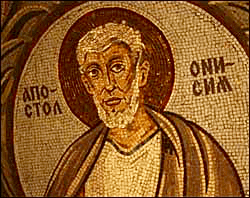
A mosaic of Philemon’s slave, Onesimus

Paul, a prisoner of Christ Jesus, and Timothy our brother,

To Philemon our dear friend and fellow worker—also to Apphia our sister and Archippus our fellow soldier—and to the church that meets in your home:

Grace and peace to you from God our Father and the Lord Jesus Christ.

I always thank my God as I remember you in my prayers, because I hear about your love for all his holy people and your faith in the Lord Jesus. I pray that your partnership with us in the faith may be effective in deepening your understanding of every good thing we share for the sake of Christ. Your love has given me great joy and encouragement, because you, brother, have refreshed the hearts of the Lord’s people.

Therefore, although in Christ I could be bold and order you to do what you ought to do, yet I prefer to appeal to you on the basis of love. It is as none other than Paul—an old man and now also a prisoner of Christ Jesus—that I appeal to you for my son Onesimus, who became my son while I was in chains. Formerly he was useless to you, but now he has become useful both to you and to me.

I am sending him—who is my very heart—back to you. I would have liked to keep him with me so that he could take your place in helping me while I am in chains for the gospel. But I did not want to do anything without your consent, so that any favor you do would not seem forced but would be voluntary. Perhaps the reason he was separated from you for a little while was that you might have him back forever—no longer as a slave, but better than a slave, as a dear brother. He is very dear to me but even dearer to you, both as a fellow man and as a brother in the Lord.

So if you consider me a partner, welcome him as you would welcome me. If he has done you any wrong or owes you anything, charge it to me. I, Paul, am writing this with my own hand. I will pay it back—not to mention that you owe me your very self. I do wish, brother, that I may have some benefit from you in the Lord; refresh my heart in Christ. Confident of your obedience, I write to you, knowing that you will do even more than I ask.

And one thing more: Prepare a guest room for me, because I hope to be restored to you in answer to your prayers.

Epaphras, my fellow prisoner in Christ Jesus, sends you greetings. And so do Mark, Aristarchus, Demas and Luke, my fellow workers.

The grace of the Lord Jesus Christ be with your spirit. (New International Version)

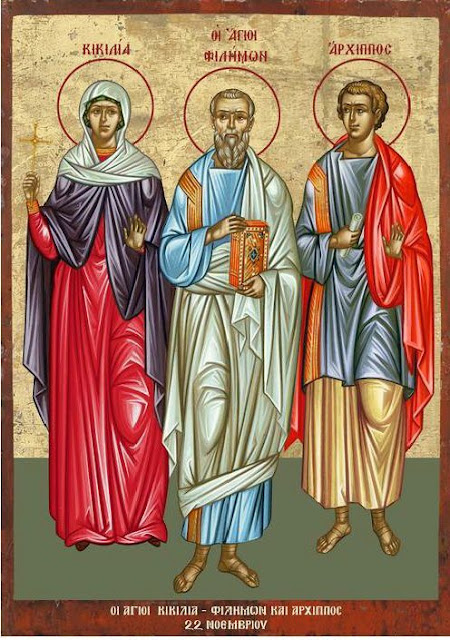
Orthodox depiction of Saints Apphia, Philemon, and Archippus

Tucked away near the end of the 66 books of the Holy Bible is the little letter of Philemon. Many Christians have neither heard a sermon preached on it, nor ever discussed it. Yet, there it is, contained as part of the New Testament canon. So, it could use some attention from us.

The letter is an appeal to Philemon concerning his slave Onesimus – who fled from his master and subsequently ended up converting to Christianity through the Apostle Paul’s influence.

At the time, Paul was imprisoned and Onesimus attended to his needs. Although Paul desired to keep Onesimus with him, he sent the slave back to Philemon. The Apostle was wanting the master to receive the slave as a beloved brother in the Lord, and not just as a servant. Then, Paul hoped Philemon would send Onesimus back to him, thus smoothing out the master/slave relationship and having his own needs met, as well.

The bottom line of the letter is that Paul very much desired that Onesimus be freed from his servitude by Philemon. He didn’t want to pull rank and twist Philemon’s arm to do it. Even though we don’t precisely know what happened in response to Paul’s letter, it’s likely that Onesimus was freed, since the appeal was included in the New Testament.

Christianity, ideally, is meant to transform lives, to change social relationships, to establish a truly egalitarian society in which the status of humans owning other humans would be done away with. Men ought to become brothers with one another and not highly stratified and separated with gross power inequities between them.

Now, in Christ, it doesn’t matter if you are a Jew or a Greek, a slave or free, male or female. You are all the same in Christ Jesus.

Galatians 3:28, ERV

Sitting where we are now, a few millennia later, we might find it curious that Paul and other biblical writers didn’t simply call for the outright abolition of slavery altogether. And yet, slavery was such an ensconced part of the ancient world (some places in the Roman Empire had up to 70% of the population as slaves) that to do so immediately would have likely brought such shock to the system that more harm than good may result.

In Paul’s experience, he continually went about the business of agitating for change by proclaiming a gospel of grace for all people. And the places where he did so saw great societal transformation – which is why Paul got so much pushback from so many authorities who benefited from keeping others under their feet.

In the household of faith, all persons are sisters and brothers and useful servants of one another and of the Lord.

The healings by Jesus in the Gospels not only restored one’s physical health but also restored the individual back to the community. The leper’s social stigma was lifted; the woman’s isolation due to bleeding was done away with; and stereotypes of those born with disabilities were overturned.

No one is inferior in the kingdom of God. Everyone is inherently worthy and has a vital purpose in God’s new society. Since the cross of Christ has erased all barriers, Christian community is to be realized through respectful equality, mutual love, and caring fellowship.

That’s how the system is changed.

Almighty God, by your Holy Spirit you have made us one with your saints in heaven and on earth. May our earthly pilgrimage be always supported by this fellowship of love and prayer, and know ourselves surrounded by their witness to your power and mercy; through Jesus Christ our Lord. Amen.

Why Did Jesus Come? (Matthew 9:14-17)

Then John’s disciples came and asked him, “How is it that we and the Pharisees fast often, but your disciples do not fast?”

Jesus answered, “How can the guests of the bridegroom mourn while he is with them? The time will come when the bridegroom will be taken from them; then they will fast.

“No one sews a patch of unshrunk cloth on an old garment, for the patch will pull away from the garment, making the tear worse. Neither do people pour new wine into old wineskins. If they do, the skins will burst; the wine will run out and the wineskins will be ruined. No, they pour new wine into new wineskins, and both are preserved.” (New International Version)

The late Abigail Van Buren, better known in her day as the columnist, “Dear Abby,” was the person who made famous the phrase, “The church is a hospital for sinners, not a museum of saints.”

We occasionally need words like Dear Abby’s that are reminders of why Christians and Churches exist in the first place. The Church does not remain on this earth solely for its own benefit, any more than a hospital exists for the benefit of doctors or insurance companies. 

The Church exists to extend the mission of Jesus through proclamation of the gospel, the good news of forgiveness and new life in Christ. The Church calls people who are ensnared, entrapped, and in bondage to guilt and shame, and who need the restorative touch of grace. 

Our calling is not to find out what others can do for us (e.g. tithing and attendance) but what we can do for others. That’s why we are the continuing presence of Jesus on this earth as the temple of the Holy Spirit. 

Even though I am a church pastor, it is not my church. The church is not your church. It is Christ’s Church and we are to act in accordance with that truth.

Some of you reading this blog post are unhealthy. Some of you are sick with sin; some are heart-sick; others are just plain sick and tired of being sick and tired. Jesus (nor me!) is not looking to heap on you a load of expectations and guilt for things you are not doing; but instead is pointing you to the source of healing and change and inviting you to admit your need and come to him. 

Conversely, you may be healthy, spiritually alive and well. Therefore, it’s your job to roll up your sleeves and serve, to participate fully in the mission of Jesus for the church and the world.

Why did Jesus come? 

Jesus came to set up a new structure that could embrace his mission of bringing new life to people.

Christ used the occasion of John’s disciples asking him about fasting to communicate that his mission of reaching people through mercy and forgiveness will need a significant structural change. 

The two illustrations Jesus used – cloth and wineskins – is to simply point out that old and new wineskins are incompatible; and old and new pieces of cloth don’t go together. I would put it this way: You don’t put a new collar on a dead dog.

The Lord Jesus didn’t come to this earth just to perpetuate the status quo; he didn’t enter this world through the incarnation to simply dress up the Jewish religion, or to make a few minor adjustments to what already is going on. No! Christ came to change the old and do something new so that his mission could go forward through us.

We need a structural system which can accommodate the finished work of Jesus on the cross.

The entire sacrificial system and ritual laws of the Old Testament were only a matter of food and drink and various ceremonial washings – external regulations applying until the time of the new order.(Hebrews 9:10)

Christ is the one who arranges a new covenant, so that those who have been called by God may receive the eternal blessings that God has promised. This can be done because there has been a death which sets people free from the wrongs they did while the first covenant was in effect. (Hebrews 9:15, GNT)

Jesus canceled the first covenant in order to put the second into effect; the old is obsolete and has served it’s purpose. Now, Christ’s new covenant is in effect – a system big enough to hold the mission of the Church. (Hebrews 8:13; 10:9)

I wonder:

  • Is there anything in your life or in your church that is obsolete?
  • Is there a practice, ministry, system, or structure that is ineffective and not contributing to the mission that Jesus has for us in reaching others? 
  • Are there any dead dogs you keep trying to prop up on its legs?
  • Are you focused on what is important to Jesus? Do you know what’s important to him?
  • Do you keep performing the same rituals over and over because that is what you’ve always done?
  • What needs to change in your life to accommodate the mission of Jesus?

If the mission of Jesus is to occur we must develop:

  1. A relationship with Jesus. Engaging in spiritual disciplines of prayer, giving, fasting, reading and meditating on Scripture, are activities that put us in a position to know Christ better and respond to what is important to him.
  2. Relationships with each other that are not superficial but help one another to grow in Christ. We need to hold one another accountable for how the mission of Jesus is being accomplished, or not.
  3. Relationships with those outside of the church. This world is filled with sick, needy, hurting, lonely, unhealthy people who are stuck. They need a major change of life that can come from Jesus working through his followers. 

May it be so. Soli Deo Gloria.

Seek the Least and the Lost (Matthew 18:1-14)

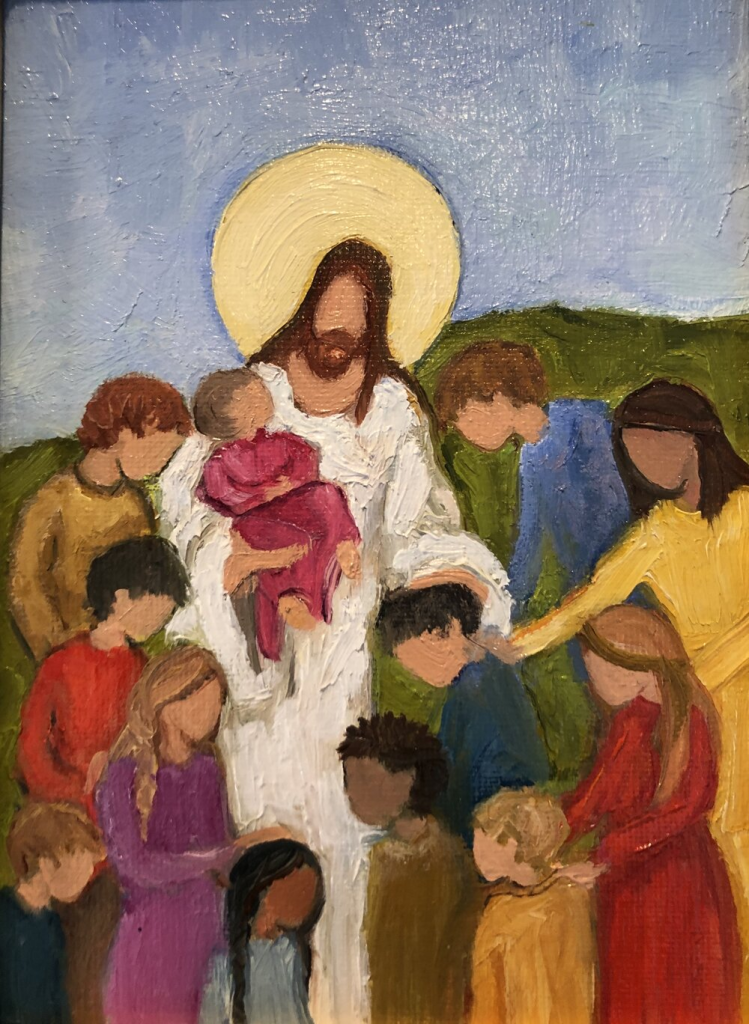
Child of God by Suzi Olson

At that time the disciples came to Jesus and asked, “Who, then, is the greatest in the kingdom of heaven?”

He called a little child to him and placed the child among them. And he said: “Truly I tell you, unless you change and become like little children, you will never enter the kingdom of heaven. Therefore, whoever takes the lowly position of this child is the greatest in the kingdom of heaven. And whoever welcomes one such child in my name welcomes me.

“If anyone causes one of these little ones—those who believe in me—to stumble, it would be better for them to have a large millstone hung around their neck and to be drowned in the depths of the sea. Woe to the world because of the things that cause people to stumble! Such things must come, but woe to the person through whom they come! If your hand or your foot causes you to stumble, cut it off and throw it away. It is better for you to enter life maimed or crippled than to have two hands or two feet and be thrown into eternal fire. And if your eye causes you to stumble, gouge it out and throw it away. It is better for you to enter life with one eye than to have two eyes and be thrown into the fire of hell.

“See that you do not despise one of these little ones. For I tell you that their angels in heaven always see the face of my Father in heaven.

“What do you think? If a man owns a hundred sheep, and one of them wanders away, will he not leave the ninety-nine on the hills and go to look for the one that wandered off? And if he finds it, truly I tell you, he is happier about that one sheep than about the ninety-nine that did not wander off. In the same way your Father in heaven is not willing that any of these little ones should perish. (New International Version)

“A person’s a person no matter how small.”

Horton Hears a Who! By Dr. Seuss

Jesus sees, honors, and protects little people. 

Horton the elephant spoke to people completely unconcerned for all the residents of Who Ville that lived on a clover. Dr. Seuss chose to make Horton an elephant, a large creature able to hear with big ears and be attentive to the small. Bigness can only come from becoming small.

Little people, the ones others fail to notice, matter to Jesus. And so, they ought to matter to us, too. Since Jesus sees and hears them, we should, too. 

Jesus often mingled with little people – children, women who had no rights, social misfits like lepers, the chronically ill, religious outsiders, tax collectors, and prostitutes. 

Our world is filled with similar people – angry adolescents, unwanted babies, forgotten old people, the mentally ill, moral failures, immigrants and refugees. If we have eyes to see and big ears to hear, we will notice the poor whom no one else hears. They are around us, even if they are invisible to us.

We’re all just little people before God. So, let’s be humble enough to see the little people around us. 

Who’s the greatest in the kingdom of heaven?

That question drips with a desire to position and posture oneself in a place of prominence and power. In other words, the questions really is, “How do I climb the ladder in God’s kingdom to be the most important person?”

In response, Jesus graciously and calmly called a child to him and answered that unless we become like a little child, we have no future with God. There’s only one way to have what you want, and it’s through humility.

Children had no status or rights in the ancient world. Ancient culture was not remotely youth or kid oriented. Kids were generally viewed as just potential adults. They were seen as weak, small, and unable to contribute much of anything until they grew up. 

Disciples of Jesus are to become like children, that is, lowly. Followers of Christ must give up their status and desire to be important. They can only be big if they become small.

Only by getting on the same level as little people can we ever welcome Jesus.

Why become like a little child?

Because a person who is attentive to the lowly is actually attentive to Jesus himself. 

We are not to welcome people because they are great, wise, rich, powerful, good-looking, and just like you and me – but because they are noticed by Jesus.

The proud person who seeks prominence is always looking for greener pastures and things to do that will impress people who will help advance them up the ladder of success. They do not care who gets stepped on along the way. 

The Christian, however, is to give all people, including the little ones and the marginal ones, the time of day and treat them as important.

How does one become humble and avoid sin?

Those who receive these little ones receive Jesus; those who reject these little ones reject Jesus, and by their lack of loving them cause them to sin. This, according to Jesus, is damnable behavior, and, so, must be dealt with in a radical manner because hell is worth avoiding at any cost. 

So then, the proud person must hack off part of themselves because it is better to be maimed for the rest of your life than enter hell. This is just one reason why a lot of folks stopped following Jesus.

Yet, Jesus insists that if, for example, your pursuit of money consumes you and you hold onto it and avoid the poor, give it away! If you hold onto your time like a clock miser and let it become your “precious” then you must get rid of it, you must give it away! It is better for you to have nothing than to have plenty of time and money and be thrown into hell fire!

In short, we should seek the lost.  

Instead of waiting for them to show up, or to seek us out, we must go get them.

The lost matter to God.

Those who are on the fence and are half-hearted in their devotion to Jesus and the mission of the church, matter to God. So are the spiritually indifferent and the not very committed. 

Coptic Church icon of Jesus the Good Shepherd

The temptation for spiritually serious persons is to look down on these lukewarm people. Jesus knew how easy it is to berate and despise such persons in our hearts:

To some who were confident of their own righteousness and looked down on everyone else, Jesus told this parable: “Two men went up to the temple to pray, one a Pharisee and the other a tax collector. The Pharisee stood by himself and prayed: ‘God, I thank you that I am not like other people—robbers, evildoers, adulterers—or even like this tax collector. I fast twice a week and give a tenth of all I get.’

“But the tax collector stood at a distance. He would not even look up to heaven, but beat his breast and said, ‘God, have mercy on me, a sinner.’

“I tell you that this man, rather than the other, went home justified before God. For all those who exalt themselves will be humbled, and those who humble themselves will be exalted.” (Luke 18:9-14, NIV)

If we are willing to humble ourselves, we can learn the hard practice of not hating others for what we hate in ourselves. 

We hate it when we are lax in our devotion to Christ; fail to accomplish what we want; miss opportunities to do good; and neglect to pray, give, or serve. So, when we see this as a pattern in someone else’s life, we may easily despise them in our hearts.

Turns out that many serious Christians must be converted as well – to seeing God’s heart for these despised little people.

What should be done about lost people?

Human reasoning might say, “Ah, let that one go; we have 99.” But God’s reasoning is, “I really care for that one.” Jesus wants to convert us to the statistically unimportant. 

If a person does not contribute to the life of the flock, do we care?

The parable contained within today’s Gospel lesson has become so familiar that it no longer shocks us. What kind of shepherd would be so stupid to abandon the entire flock and expose them to the dangers of wild animals and the harsh environment in order to search, maybe even unsuccessfully for one stinky, messed up, knurly, ugly, eats-too-much, sheep? 

And then, what’s more, when finding such a sheep, that shepherd rejoices more about this one sheep found than over the more dependable and attractive members of the flock? 

Only such a “foolish” shepherd can represent God’s concern for each one straying child.

Our Father in heaven is not willing that any of these little people should be lost. Therefore, we are to seek the lost.

Conclusion

Antonio Stradivarius (1644-1737) was an Italian violin maker. His violins are now the most prized violins ever made because of the rich and resonating sound they produce. The unique sound of a Stradivarius violin cannot be duplicated.

Surprisingly, these prized violins were not made from treasured pieces of wood, but instead were carved from discarded lumber. Stradivarius, who was very poor and could not afford fine materials like his contemporaries, got much of his wood from the dirty harbors where he lived. He would take those waterlogged pieces of wood to his shop, clean them up, and from those pieces of trashed lumber, he created instruments of rare beauty.

It has since been discovered that while the wood floated in those dirty harbors, microbes went into the wood and ate out the center of those cells. This left just the fibrous infrastructure of the wood that created resonating chambers for the music. From wood that nobody wanted, Stradivarius produced violins that everybody wants.

God has a plan. It is a plan to build a benevolent realm using not just the big and important, but the lowly and despised. 

May we all participate with the Lord and humble ourselves for kingdom purposes.