
Luke 4:38-44 – Every One of Them

“Healing” by Ivan Filichev, 2014

After leaving the synagogue he entered Simon’s house. Now Simon’s mother-in-law was suffering from a high fever, and they asked him about her. Then he stood over her and rebuked the fever, and it left her. Immediately she got up and began to serve them.

As the sun was setting, all those who had any who were sick with various kinds of diseases brought them to him; and he laid his hands on each of them and cured them. Demons also came out of many, shouting, “You are the Son of God!” But he rebuked them and would not allow them to speak, because they knew that he was the Messiah.

At daybreak he departed and went into a deserted place. And the crowds were looking for him; and when they reached him, they wanted to prevent him from leaving them. But he said to them, “I must proclaim the good news of the kingdom of God to the other cities also; for I was sent for this purpose.” So, he continued proclaiming the message in the synagogues of Judea. (New Revised Standard Version)

One of the most fundamental truths about the person of Jesus is that he heals all kinds of people. 

Even people who know very little about the historical Jesus know that he was a guy who brought healing to people while he was here on this earth.  For many Christians, the fact that Christ healed people is almost a “ho-hum” moment because we are so familiar with the Gospel stories about him doing the supernatural. 

Observation: Christ Healed Every One of Them

Yet, as with most Scripture stories we encounter, we really need to slow down a bit and let the story sink in. Then, we are likely to make simple but profound observations of the text. One of those observations is this: When people brought the sick and infirmed to Jesus, he healed every one of them. Christ laid his hands on each and every one of them and cured them.

Every one of them, Jesus healed. There is apparently no disease, no infirmity, no sickness, no malady, and no situation too much for Jesus to heal. Without exception, no matter the problem, every individual who came to Jesus was healed by Jesus. 

Observation: Every One of Them Were Healed Through Others

Here’s another simple but profound observation of the story: All those who had any who were sick brought them to Jesus. In other words, those needy folks didn’t come to Jesus on their own. It was their family, friends, and neighbors of the sick persons who brought them to Jesus for healing.

It is good to care for the sick. It is also good to encourage them to look to Jesus for their help and healing. Yet, it is also very good when we bring them to Jesus ourselves. 

Perhaps one of the main reasons we are not seeing more healing and new life in the Western church is because we are not bringing the needy to Jesus. Maybe it is our lack of faith and action, and not the sick person’s, that prevents healing from being realized. 

Methinks that a profound dearth and lack of prayer for others might be at the core of all the physical, mental, and spiritual sickness that abounds in this world. So, let us bring people to Jesus so that he will heal and cure every one of them.
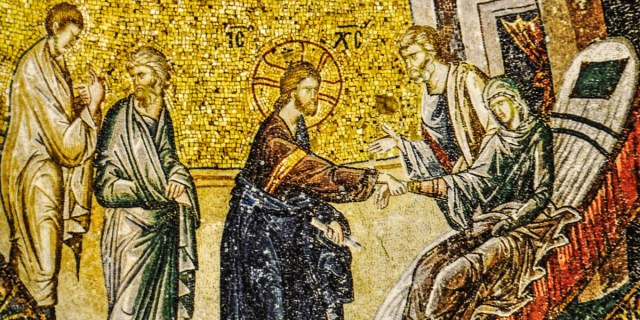
A mosaic of Jesus healing Peter’s mother-in-law, from a Byzantine Church, c.1100 C.E.

Observation: Christ Cares about Every One of Them

Jesus accepts, heals, and cures those at the margins of society. The sick, infirmed, and demon-possessed were the most marginalized people in the ancient world. They were at the mercy of a caring relative, that is, if they had one. If not, the only way of making it was to beg and rely on public charity. Yet, that was difficult because, in many cases, depending upon the illness, they were considered impure. No one would get near them. They couldn’t participate in the community.

But Jesus welcomed them. He took the time and attention to place his hands on each one of them. Their divine healing was much more than physical; being cured meant they no longer needed to be at the margins, unaccepted and unwanted. Jesus was giving them full inclusion to society.

The good news of Jesus Christ consists of meeting the holistic needs of people for health and community. Our Lord desires to integrate excluded people into society. If that takes the miraculous healing of sickness to do it, then Jesus will make it happen.

Observation: Christ Looks to Heal and Care for Every One of Them, Besides Just Us

It can be a real temptation to believe that our little group has the corner on Jesus. We don’t. Jesus was given for the life of the world – not just a few people who look, think, and act like you and me. In today’s story, the people didn’t want Jesus to go. That’s understandable. Yet, Christ left them because there were others in need of healing of both body and soul.

Christ’s mission is so much broader than we sometimes see or expect. Evangelical Christians camp on saving the soul. Progressive Christians hang their hat on social justice and the real physical needs of people. In reality, the gospel involves both body and soul. To only focus on one aspect is to truncate the gospel as only okay news, not good news.

I would argue there is far too much proclaiming of okay news today. Christianity needs a full-orbed gospel that addresses the holistic needs of people, just like Jesus did. It needs a robust Trinitarian theology with the love of God the Father, the grace of Jesus Christ, and the empowerment of the Holy Spirit delivering souls from spiritual death and saving bodies from worldly injustice.

Anything less is simply picking and choosing what we want and trying to keep Jesus to ourselves. Let’s not do that. Instead, let’s preach the gospel, a kingdom message in which the power of God comes upon people – transforming them from the inside-out and bringing them from the outside-in.

Healing God, we bring to you all those who are discouraged, depressed, diseased, disordered, and damaged in some way by the sin of this world. Cure them by your mighty power so that they will be included into our communities, as well as your heavenly kingdom. Amen.


1 Corinthians 14:1-12 – Pursue Love and Service

Pursue love and use your ambition to try to get spiritual gifts but especially so that you might prophesy. This is because those who speak in a tongue don’t speak to people but to God; no one understands it—they speak mysteries by the Spirit. Those who prophesy speak to people, building them up, and giving them encouragement and comfort. People who speak in a tongue build up themselves; those who prophesy build up the church.I wish that all of you spoke in tongues, but I’d rather you could prophesy. Those who prophesy are more important than those who speak in tongues unless they are able to interpret them so that the church might be built up. 

After all, brothers and sisters, if I come to you speaking in tongues, how will I help you unless I speak to you with a revelation, some knowledge, a prophecy, or a teaching? Likewise, things that aren’t alive like a harp or a lyre can make a sound, but if there aren’t different notes in the sounds they make, how will the tune from the harp or the lyre be recognized? And if a trumpet call is unrecognizable, then who will prepare for battle? 

It’s the same way with you: If you don’t use language that is easy to understand when you speak in a tongue, then how will anyone understand what is said?It will be as if you are speaking into the air! There are probably many language families in the world, and none of them are without meaning. So, if I don’t know the meaning of the language, then I will be like a foreigner to those who speak it, and they will be like foreigners to me. The same holds true for you: since you are ambitious for spiritual gifts, use your ambition to try to work toward being the best at building up the church. (Common English Bible)

Sometimes we need to look at a section of Scripture and see its big picture message, not losing sight of the forest for the trees. At first glance, it might be tempting to question or delve into whether tongues (a private language of communicating with God) and prophecy (divinely inspired speech for a person or group based in Holy Scripture) are for today, or not. 

Please keep in mind that spiritual gifts of tongues and prophecy were not the Apostle Paul’s driving concern when he wrote to the Corinthians. Paul wanted the Corinthian believers – who were puffing themselves up like peacocks so that others would admire their gifts and abilities – to grasp a basic important message: pursue love by striving to excel in building up people.

If we miss love, we have lost sight of God’s Word to us. A preoccupation with tongues and prophecy only makes us lose the forest for a few tress. Rather, we are to keep thinking about how we show love for all our brothers and sisters in Christ and put some significant effort into doing our part to encourage them. 

Spiritual gifts are given by God to Christians as a means of loving and encouraging the Church. They are not given in a vacuum, as if those gifts are only for an individual’s help. They’re meant to be directed toward helping and serving others.

For example, I am a teacher of God’s Word. It would be really weird if I jumped out of bed on a Sunday morning, got dressed, looked in the mirror and taught at myself. Then, went back to bed dreaming about what a great teacher I am. Spiritual gifts are meant to be unpacked and used for the community, not self.

“We make a living by what we get. We make a life by what we give.”

Winston Churchill

One of the great temptations of humanity is to finagle our efforts so that other people will notice and give props to our wonderful work. Indeed, we can write Facebook messages to garner as many “likes” as we can get, or post things on Twitter and our favorite blogs hoping to look smart and funny in the eyes of a community of people we may not even know personally. All the while we may be withholding love to actual people right in front our faces because they may not give to us the attention we crave.

Perhaps with Lent coming in another month, you might want to consider a fast from social media in order to better connect with people within your direct sphere of human touch and influence. Or maybe ask someone close to you what they believe your primary spiritual gifts are, with the expressed intention of using the information to explore fresh avenues of love and service to others. 

Whatever you do, pursue love and excel in building up the church.

Loving God, you have graciously gifted us all for love and service. May we continually see your love expressed to us through Jesus Christ so that we will be always inspired to pass on that same love to others for whom you also love. Amen.

Who Do We Minister To?

Welcome, friends! Matthew 22:36-40 are the words of Jesus to love God and love our neighbor. The ability to extend that love is grounded in God because God is Love. Click the videos below and let us consider the great love of God toward us and all humanity….

Pastor Tim Ehrhardt, Matthew 22:36-40

May Christ the Son be manifest to you, that your love and your life may be a light to the world. And may the blessing of God our Creator, Redeemer and Giver of life be with you always. Amen.

Romans 12:1-8 – On Being Worshipers and Servants

Brothers and sisters, in view of all we have just shared about God’s compassion, I encourage you to offer your bodies as living sacrifices, dedicated to God and pleasing to him. This kind of worship is appropriate for you. Don’t become like the people of this world. Instead, change the way you think. Then you will always be able to determine what God really wants—what is good, pleasing, and perfect.

Because of the kindness that God has shown me, I ask you not to think of yourselves more highly than you should. Instead, your thoughts should lead you to use good judgment based on what God has given each of you as believers. Our bodies have many parts, but these parts don’t all do the same thing. In the same way, even though we are many individuals, Christ makes us one body and individuals who are connected to each other. God in his kindness gave each of us different gifts. If your gift is speaking what God has revealed, make sure what you say agrees with the Christian faith. If your gift is serving, then devote yourself to serving. If it is teaching, devote yourself to teaching. If it is encouraging others, devote yourself to giving encouragement. If it is sharing, be generous. If it is leadership, lead enthusiastically. If it is helping people in need, help them cheerfully. (God’s Word)

China and Clay

Every person is important. Everyone is needed. Each individual is to offer their entire lives to God through worship and using their spiritual gifts. Every believer is to be active in building up others. 

When I was growing up, we had a fine China set that my parents kept in a beautiful China cabinet.  The set and the cabinet are old and were a prominent part of our house. However, we almost never used it. I can only remember once or twice that my Mom got the China out to use.

God is not looking for fine China believers who sit unused in a cabinet church. Instead, the Lord is looking for rough-and-tumble clay pots—the kind that can be used every day. God wants ordinary table-wear that can be handled in a crash-and-bang world.

Followers of Jesus Christ are to be like a working kitchen, where well-worn pots are filled again and again to dispense their life-giving contents to a thirsty world; and, where common plates and cups are used again and again to provide a hungry population with the Bread of Life.

Jews and Gentiles

Within the ancient Roman Church were both Jews and Gentiles – two groups vastly different from each other.  They tended to keep to themselves and only operate within their familiar and comfortable circles of friends and relatives.  But the Apostle Paul wanted them united through using their spiritual gifts for the benefit of the entire congregation, and not only within their respective groups.

We are to give ourselves in service to one another because of God’s mercy in Christ. Since God has saved us from our guilt and shame, we are to have a grateful response of worship that is dedicated to serving everyone. 

Worship and Service

The word “worship” in today’s New Testament lesson is where we get the word “liturgy.” That is, Paul’s vision for the church was to have daily liturgical rhythms of spiritual worship, not just on Sunday when we might pull out the fine China and try to impress people.

Paul did not guilt people into serving. Rather, he straightforwardly exhorts all Christians to appropriately respond to God’s grace by offering their lives in sacrificial service as a form of gratitude to God. For this response, our mental faculties must be renewed through saturation in Scripture. It is here we discern our spiritual gifts, know what God wants us to do with those gifts, and use them effectively in the church and the world. 

Grace and Gifts

Grace is given to every believer in Jesus, not just a select few. We all have different gifts and are graced with abilities for the benefit of other, without exception. When everyone collectively exercises their spiritual gifts, then there is clarity in knowing the will of God.

All Christians must share and work together by utilizing God’s grace, instead of getting burned-out because others are not serving. Grumbling about what others are not doing begs the question of whether we are over-functioning, or not.

It could be that we have succumbed to the danger the Apostle Paul warned us about: thinking so highly of ourselves that we believe our gifts are superior to others, so we need to maintain our control and hegemony in the group. This is a terribly misguided notion. 

Each of you should use whatever gift you have received to serve others, as faithful stewards of God’s grace in its various forms. If anyone speaks, they should do so as one who speaks the very words of God. If anyone serves, they should do so with the strength God provides, so that in all things God may be praised through Jesus Christ. To him be the glory and the power for ever and ever. Amen.

1 Peter 4:10-11, NIV

We belong to one another. Therefore, one major way of giving to God is through offering ourselves to each other with equity and without favoritism. We must not separate Christ from his church. To say that we need God, but do not need the church is to really say that we do not need God because the two are inseparable. Nowhere in Holy Scripture do we find individual Christians doing their own thing, isolated from a committed group of people, the church.

When Jesus called people to follow him in service to God and a world in need, some gave him excuses that they were busy and had other pressing matters to attend to before they could follow him. Jesus simply left them and told them they were not fit for the kingdom of God. (Luke 9:57-62)

When people were pre-occupied with building wealth, or gaining power, or jockeying for influence, Jesus told them to stop it, exercise some faith, and seek first the kingdom of God.  Build your treasure in heaven, Jesus said, because it will be permanent; and, not on earth where it is temporary. (Matthew 6:19-34)

Spiritual Gifts and Abilities

We are graced by God with abilities which God fully expects us to use. “Cheap grace” is merely embracing Christ as a personal Savior but not welcoming him as the Lord in whom we must sacrificially give our lives to service in the church and the world. Spiritual health and vitality cannot exist apart from every person using God’s given grace to contribute to the functioning of the Body of Christ. 

The list of spiritual gifts Paul provided is not exhaustive but represents a combination of speaking and serving gifts necessary to bless humanity. Paul exhorted the church not to restrain people’s service but let them go at using their spiritual gifts, full bore:

  • Speak what God has revealed. Prophets do not foretell the future. Rather, they have “inspired speech” from God that addresses what God’s people are to do in consideration of Scripture. 
  • Serving. Servants give themselves to all types of hands-on service. 
  • Teaching. Teachers instruct the faithful in all the revealed will of God. 
  • Encouraging others. Encouragers both speak and serve, coming alongside others and helping them to do something with both verbal coaching and tangible help. 
  • Sharing. Givers live a simple life so they can give generously and contribute to the needs of others. 
  • Leadership. Leaders get out in front and show the way in obtaining the will of God. 
  • Helping people in need. Helpers show mercy by seeing down-and-out hurting people and being a conduit of God’s grace to them.

There is no one person who possesses all these gifts. That’s why everyone must work together to have a spiritually healthy community. A spiritually toxic community is the inevitable result of only a few people using their giftedness.

To avoid relational toxicity, and embrace communal harmony, our minds need transformation through renewing practices of godly sacrifice, regular worship, pursuing unity, and becoming aware of our spiritual gifts.

Here’s three ways we can discover our gifts:

  1. Pay attention.  Every spiritual gift reflects God’s grace and character, and so, you will find joy and satisfaction in expressing it. Your spiritual gift will be a place of deep spiritual formation and growth in your life, as God uses it both to powerfully connect you spiritually and to expose areas of your soul that need forgiveness and redemption. 
  2. Try. Give it a whirl. Volunteer. Connect with a service or ministry or try doing what you feel might be something God wants you to do. Gifts are primarily discovered from others observing and affirming your gift and not so much by going through a research process. The encouragers among us will be happy to affirm the gifts of others.
  3. Develop. All spiritual gifts need growth, cultivation, and development. Paul told his young protégé, Timothy, to fan into flame the gift of God. (2 Timothy 1:6)

We will find our greatest delight in life through engaging in worship of God and service to others. That leads to a spiritually healthy Christian community that loves God, loves one another, and loves the world.

God of grace, stir up the spiritual gifts of your people. May the gifts your Holy Spirit has decided to give us be activated and used for your glory and the edification of others. May you grant peace and joy in churches everywhere so that no one will be jealous or covetous about anyone else’s gifts. May these gifts grow and develop in love so that the fruit of the Spirit will be truly manifested. May you receive all praise honor and glory through Jesus Christ, our Lord.  Amen.