Increase Our Faith? (Luke 17:5-10)

The apostles said to the Lord, “Increase our faith!” The Lord replied, “If you had faith the size of a mustard seed, you could say to this mulberry tree, ‘Be uprooted and planted in the sea,’ and it would obey you.

“Who among you would say to your slave who has just come in from plowing or tending sheep in the field, ‘Come here at once and take your place at the table’? Would you not rather say to him, ‘Prepare supper for me; put on your apron and serve me while I eat and drink; later you may eat and drink’? Do you thank the slave for doing what was commanded? So you also, when you have done all that you were ordered to do, say, ‘We are worthless slaves; we have done only what we ought to have done!’ ” (New Revised Standard Version)

Here’s a simple observation of today’s Gospel text: Because Christ’s apostles said to the Lord, “Increase our faith!” they were acknowledging that they did not have enough faith.

But is that really true? Did the apostles – or do any of us – lack the faith we need to live the sort of life Jesus wants us to live?

I know that I sometimes feel like I have such little faith that it prevents me from being the person I want to be, and to do the good things I want to do. Yet, if I’m honest with myself, I truly don’t lack for anything in living out my faith. For God has already given me what I need.

God is good, all the time. Divine resources are always present. The Spirit dwells within us.

I’m reminded of Peter’s encouragement:

His divine power has given us everything we need for a godly life through our knowledge of him who called us by his own glory and goodness. (2 Peter 1:3, NIV)

Jesus gave his disciples a hard answer to their request for faith. Perhaps hearing a bit of exasperation in the Lord’s voice, Christ communicated to them that they already have all the faith they need.

It’s never about the amount of faith. That’s because we already have enough faith. It doesn’t take much faith to radically change things. It’s much more an issue of accessing the faith which has already been provided for us.

Indeed, even if we have faith the size of a tiny little mustard seed, we could command a tree to be uprooted and throw itself into the sea. (Matthew 17:20; Mark 11:20-25)

Therefore, the apparently weakest of people in the world actually have the power to move mountains and uproot trees.

For example, when a sinful woman poured out expensive ointment on Jesus and applied it with her hair, Christ responded with a resounding “Your faith has saved you.” (Luke 7:50)

Furthermore, when a blind beggar longed to see again…

When a Samaritan leper looked for healing…

When a woman reached out and touched a tassel of the Lord’s garment…

When and a Gentile Roman Centurion came to Jesus on behalf of his ailing servant…

Christ affirmed the existing faith which was present with them – and each one of them therefore experienced the healing they so expected to realize. (Luke 3:48; 7:9; 18:42; 17:19)

In God’s economy, there is no distinction between basic trust in God and the faith that uproots trees. There is absolutely no need to try and manipulate spiritual forces in order to access a special kind of supernatural power. That’s what the pagans of old were always trying to do with their religion.

Getting a right or particular formula for a healing or a miracle is the stuff of other religions, not Christianity. For the Christian, something else is going on with faith.

What is impossible for us is possible with God. The issue with faith is where it is placed, and not with how much or how little you have. Any amount of faith that is directed to Jesus is more than enough. Even a mustard-seed-sized faith.

When participating in the sacrament of communion, you may wonder why a quarter-sized communion wafer is supposed to feed you anything. But this is communicating something important about our faith: Even a tiny portion of bread can fill and satiate the Christian’s need for spiritual sustenance.

A little bit of Jesus goes a very long way, no matter how many are gathered around the Table.

Having faith involves possessing thoughts, feelings, and actions which are thoroughly transformed by God. In other words, it involves being a “slave” of God, being a person who is devoted to engaging in God’s purposes for this world.

Whenever we engage in our work as servants of God, there’s no need for medals and accolades; we are simply doing what is expected of us. Our faith is quite enough to sustain us in doing our normal work in the world. Nothing added or unique is needed.

So, how do we access the faith needed to live the Christian life, in order to please God and bless the world? We do the work which is expected of us.

Then, we will find and see that the faith is there to do and to say what is needed. We need not wait for it; the faith is already there. But we will have to act if we want to see faith in action.

God of all ages, you have revealed your grace to us in the Savior, Jesus Christ our Lord. As we actively live into your mercy, strengthen us to do justice, to love mercy, and to walk humbly with You. May we accomplish Your divine will and live by the faith You have so graciously provided for us; through Christ, who lights the way to everlasting life. Amen.

“I Have Overcome the World” (John 16:25-33)

All Are Alike Unto God, by Madison Wardle

“Though I have been speaking figuratively, a time is coming when I will no longer use this kind of language but will tell you plainly about my Father. In that day you will ask in my name. I am not saying that I will ask the Father on your behalf. No, the Father himself loves you because you have loved me and have believed that I came from God. I came from the Father and entered the world; now I am leaving the world and going back to the Father.”

Then Jesus’ disciples said, “Now you are speaking clearly and without figures of speech. Now we can see that you know all things and that you do not even need to have anyone ask you questions. This makes us believe that you came from God.”

“Do you now believe?” Jesus replied. “A time is coming and in fact has come when you will be scattered, each to your own home. You will leave me all alone. Yet I am not alone, for my Father is with me.

“I have told you these things, so that in me you may have peace. In this world you will have trouble. But take heart! I have overcome the world.” (New International Version)

Imagine you are with Jesus in the Upper Room celebrating Passover. And your Lord tells you he is leaving – going back to the Father. After three years of a difficult, yet incredible ministry, there is palpable grief in the room. It’s as if you got sucker-punched. You want this time with Jesus to never end….

Jesus Christ, Son of God, Son of Man, Savior of the world, does not forget you. The Lord is concerned and careful to provide wonderful words of assurance: Father God loves you. I give you my peace. I have overcome the world.

My friend, do you hear the words of Jesus? Do you truly understand what the Lord of all the earth has said to you? The love and peace of Christ has overcome the world. That love and that peace is given to you. You, and not just someone else, possesses the love and peace to overcome the world.

Whenever we encounter trouble; in those times when grief seems to be swallowing us whole; and when all is dark and we cannot see our hand in front of our face – it is in these moments the Lord comes alongside us and communicates a loving divine presence which grants us the peace of settled rest, even if, and especially when, our troubling situations do not change.

If you have had a life largely free of struggle, the privilege of knowing where your next meal is coming from, and the assurance of having your most basic needs met, then please understand that many people throughout the world, right this moment, know nothing of that kind of experience.

However, this doesn’t necessarily mean that needy persons are unhappy, discontent, or bitter. Heavens, no!

Love and peace are neither bound nor limited by adverse circumstances.

In fact, love and peace are known in a much deeper way whenever we have been hated and in conflict. That’s because love thrives and flourishes in an environment of hate; and peace takes root more surely wherever there is disharmony and misunderstanding.

If everything always goes our way, how then would we know the Lord’s great grace to us? How would we ever know God as Provider unless we were in want? How would we know Christ as the Healer unless we were broken? How could we ever know resurrection unless there was a crucifixion?

Jesus specializes in the improbable and the impossible. He comes and lands on the Island of Misfit Toys, and airlifts the discarded ones to be a gift to the world.

You see, this is precisely how we overcome the world: We love and serve, just as our Lord did. Since he overcame, we walk in his footsteps.

The acquisition and presence of peace is anything but passive. Peace has been achieved through a bloody cross and settles within the spirit through an active pursuit of harmony, wholeness, integrity, and love.

Now that we have been put right with God through faith, we have peace with God through our Lord Jesus Christ. He has brought us by faith into this experience of God’s grace, in which we now live. And so, we boast of the hope we have of sharing God’s glory! We also boast of our troubles, because we know that trouble produces endurance, endurance brings God’s approval, and his approval creates hope. (Romans 5:1-4, GNT)

For the kingdom of God is not food and drink but righteousness and peace and joy in the Holy Spirit. The one who thus serves Christ is acceptable to God and has human approval. Let us then pursue what makes for peace and for mutual upbuilding. (Romans 14:17-19, NRSV)

God’s peace and love is free, but it is not cheap. It is obtained smack in the middle of worldly troubles. So, may the peace of God be with you, my friends, now and always.

Almighty and everlasting God, you are the fountain of all peace, spiritual and temporal. We humbly pray, in your great goodness grant us that peace which the world cannot give, that we may ever live in your fear, obedient to your commandments, to the end that you may deliver us from all our enemies, through your dear Son, Jesus Christ, our Lord. Amen.

Christ the King Sunday (John 18:33-37)

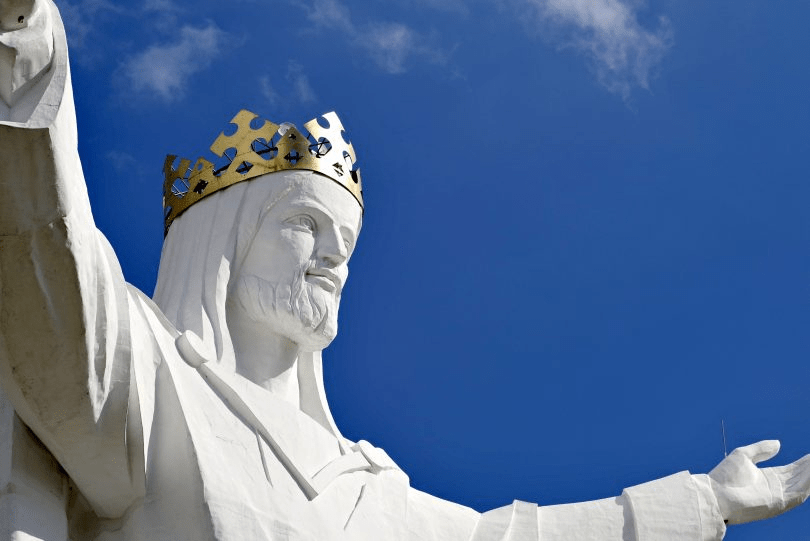
Statue of Christ the King, in Świebodzin, Poland

Then Pilate entered the headquarters again, summoned Jesus, and asked him, “Are you the King of the Jews?” 

Jesus answered, “Do you ask this on your own, or did others tell you about me?” 

Pilate replied, “I am not a Jew, am I? Your own nation and the chief priests have handed you over to me. What have you done?” 

Jesus answered, “My kingdom does not belong to this world. If my kingdom belonged to this world, my followers would be fighting to keep me from being handed over to the Jews. But as it is, my kingdom is not from here.” 

Pilate asked him, “So you are a king?”

Jesus answered, “You say that I am a king. For this I was born, and for this I came into the world, to testify to the truth. Everyone who belongs to the truth listens to my voice.” (New Revised Standard Version)

Each year in the Christian Calendar, Christ the King Sunday is observed as the final Sunday in the liturgical year. It comes at this time, just before the beginning of Advent, in order to consider an important question.

Since Jesus came to this earth in his incarnation to be a king, we must ask, “What kind of a king was Jesus?”

Christ was not, and is not, a king, a ruler (or any other sort of title one wants to use for an authoritative leader) in the same way as was the Roman Emperor, King Herod, or the regional authority of the time, Pontius Pilate.

Jesus was also not like those in authority such as the Jewish High Priest, the Jewish ruling council of the Sanhedrin, or the local synagogue ruler. And Christ is most definitely not like any sort of present day President, Prime Minister, or petty dictator in any of the world’s nations.

Jesus was a king and a ruler who used his power and authority for those on the underbelly of society, that is, people without much, if any, power or authority.

That means Christ the King is concerned to effect a very different set of values from that of any politically dominant governmental system or society that was or is on this earth.

Whether a person or group of people are seeking to win an election, initiate a coup, or effect a change in government, they want their particular system of governing to be in power. They want to call all the shots in a particular place.

That means there will be winners and losers. There will be people in power, and others without it. Some people will benefit from the system, and others will not. Looking at kingship and/or leadership from that perspective, there is a built in failure rate.

The obsession with winning, at a national level, typically involves securing a strong military. Yet, despite military might, soldiers rarely secure any sort of political solution to anything. All it really does is strongarm others into doing what the powerful want done. It does nothing to change the hearts of people.

People in power can be enamored with their authority to do things. And they don’t like it whenever they are not in control of everything. The kings, rulers, and even religious leaders in Christ’s day, were used to controlling public discourse and even the daily lives of common people.

From that sort of worldly understanding of power, Jesus had no real authority. He was this pathetic person standing before a powerful person. Most people would have been begging for their lives. But not Jesus. Christ knew who was really in charge. And it was not Pilate.

Pilate was flummoxed by the presence of Jesus. From Pilate’s perspective, Jesus was not at all acting like a king ought to. Pilate, in his authoritative role, wanted answers about what was going on. But he didn’t realize that his authority was given to him from a power outside the Roman Empire.

Christ’s kingdom is not of this world. Therefore, the power politics and authority positions of that kingdom are nothing what people like Pilate were used to. There was no way that Pilate could use the typical tactics of manipulation, lies, corruption, and leveraging power to come to a satisfactory outcome for himself.

The values of God’s kingdom are quite different from any political government in this world, either past or present.

Jesus had no need to try and be at the top of Pilate’s system, or of the Roman world. So, he wasn’t even going to try and exercise that kind of authority within it. And neither were his disciples. Clubs and swords and pitched battles would not be happening. There was absolutely no need for it whatsoever.

For us today, that means we serve the interests of humility, gentleness, respect, righteousness, mercy, purity, and peace. We are not here on this earth to engage in the routine and typical ways of earthly power politics.

For the Christian, Jesus is King. But this king isn’t riding around in a chariot or a limousine; he comes to us on a jack ass and driving a Subaru.

Jesus is the king with all the power of the universe, and yet is tortured and killed by those with the local society’s authority. That happened not because of weakness or inability, but because of a completely different set of values which have to do with love defeating hate, instead of an army winning a victory.

A God who is crucified is diametrically different than any other deity or authority which has ever existed. The power of love is the ultimate power of doing what is right, just, and good; and letting truth have its way, no matter what.

Christians everywhere must be reminded, on this Christ the King Sunday, that we serve a sovereign king whose power and authority is used to be a humble servant who meets the needs of others.

All Christians, therefore, ought to embrace and engage in becoming gentle folk who bring humble service to others wherever they go. Seeking power, position, prestige, and pedigree is in direct opposition to the values of God’s kingdom, with Christ as King.

Any sort of Christendom, which seeks to control both government and society, or a Christian Nationalism which intends to ensconce personal agendas into society, ought to be rejected.

Christian Nationalism is nothing more than Grape Nuts; just as the cereal is neither grapes nor nuts, so the political movement is neither Christian nor concerned for national interests.

This is a day for the church to reassess what is most important, to affirm its true values, and to evaluate how it really ought to operate in society.

Almighty and everlasting God, whose will it is to restore all things in your well-beloved Son, the King of kings and Lord of lords: Mercifully grant that the peoples of the earth, divided and enslaved by guilt and shame, may be freed and brought together under his most gracious rule; who lives and reigns with you and the Holy Spirit, one God, now and forever. Amen.

I Am Among You As One Who Serves (Luke 22:24-30)

The Last Supper, by Mamdouh Kashlan (1929-2022)

A dispute also arose among them as to which one of them was to be regarded as the greatest. But he said to them, “The kings of the Gentiles lord it over them; and those in authority over them are called benefactors. But not so with you; rather the greatest among you must become like the youngest, and the leader like one who serves. For who is greater, the one who is at the table or the one who serves? Is it not the one at the table? But I am among you as one who serves.

“You are those who have stood by me in my trials; and I confer on you, just as my Father has conferred on me, a kingdom, so that you may eat and drink at my table in my kingdom, and you will sit on thrones judging the twelve tribes of Israel. (New Revised Standard Version)

Jesus and his disciples had prepared for the Passover meal. They ate and drank together. Christ gave them words which have endured throughout Christian history as the Lord’s Supper. He spoke of the bread as his body, and the cup as the new covenant in his blood. Jesus communed with them and communicated about his impending death.

It was a moving experience for all. The disciples received from their Lord an intense act of love; and a new humanity around Christ’s body and blood. Indeed, the essence of new life is self-sacrificial love.

And then… the disciples began quarreling with each other about positions, and titles, and honors, and who was better, and who would be top dog in God’s kingdom….

It was a moment that I think every parent can relate to, at some level. Sitting around a dinner table, enjoying a rich conversation, becoming close with one another as a family… and then the kids begin bickering with each other about the most mundane of things.

Just a minute ago, you believed you were getting somewhere, and experiencing a shared family bond of love, commitment, and purpose… and then, in a matter of seconds, it all crashes down in a ridiculous display of posturing and positioning of one sibling over another….

I admit, this has happened to me more than once, when my own kids were growing up. And I also admit that I lost my sanctification on more than one occasion, watching this crazy schizophrenic scene play out in front of me.

Which is why I have a lot of respect for Jesus in responding to his disciples with humility, calmness, and a forthright spirit. He addressed their puny questions in a way that rebuked them without making them feel like they just got a Dad lecture.

In the sort of table fellowship that Jesus practiced with his disciples throughout his earthly ministry, he consistently sought to undermine the existing systems of domination in all levels of society. Even the religious system of Christ’s day had a distinct stratifying of persons in an inequitable structure of power.

The kingdom of God, however, is different. God’s economy is characterized by equality, mutuality, diversity, and shared power. It’s all based in a communal, as well as individual, relational connection with the Creator God.

God almighty, Creator of heaven and earth, is gracious, merciful, and kind. The Lord brings rain on both the righteous and the wicked. Thus, any sort of claim to being greater or superior or better than another person or group of people, has no place around the table of Christ’s body and blood.

Catholics are no better than Protestants. Evangelical Christians have no superiority over Progressive Christians. The Coptic Church doesn’t have the high ground on Eastern Orthodoxy. Christians who observe the Lord’s Supper as a remembrance are not greater than those who discern the Table as a sacrament.

And if one has the ears to hear it, Christians really ought to know better than to believe they should have greater control over the world and its systems than Buddhists, Muslims, or Jews.

Puffing up one’s chest and insisting that “My Dad is better than your Dad” is the stuff of childish preoccupations, and not of God’s kingdom.

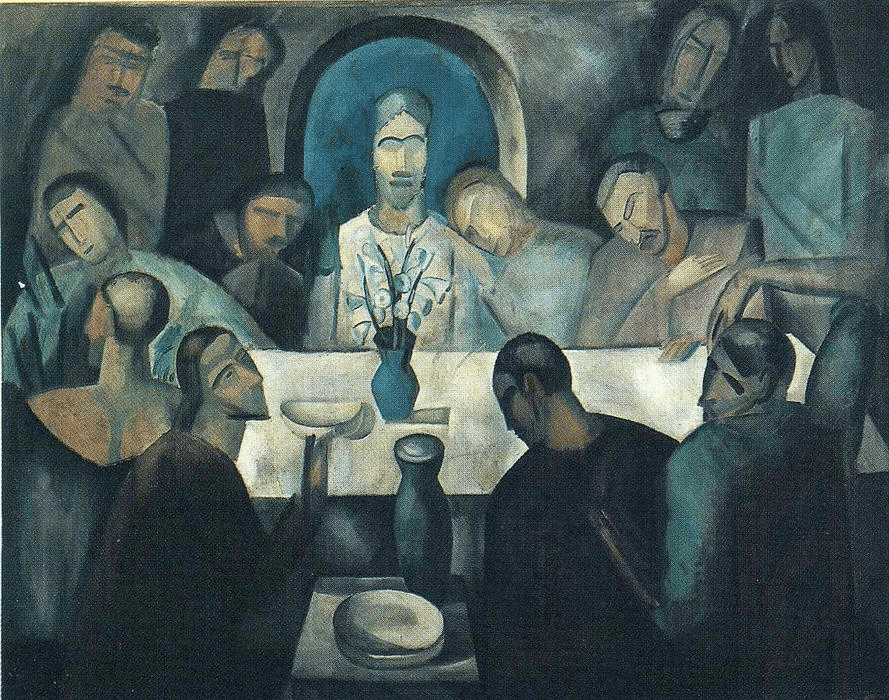
The Last Supper of Jesus, by André Derain (1880-1954)

There are plenty of people in this old messed-up world who lord their power and authority over others. If we take the words of Jesus seriously, Christians are not to be part of that structure and system.

And yet, here we are, in this contemporary time and place in history, having a chunk of the population thinking Christendom is the way to go, that a form of Christian Nationalism should be the political system – as if the kingdom of God and the kingdom of this world are what’s on the ballot.

Christians are the very folks who need to insist on serving, not leading; building up, not tearing down; loving, not hating; being integrated and connected, not fragmented and disconnected from others, as well as from reality.

Any sort of earthly power and authority the Christian has, must be used to include, help, and support, instead of excluding, ignoring, and destroying. The greatest among us must become like the youngest, and the leader like one who serves.

Christians must support and promote the idea of political office as a public service; and the concept of being a citizen as serving the common good of all persons, not just some persons.

Jesus came to this earth to serve. Therefore, his followers are also to serve. The words and ways of Christ centered in humble service, merciful justice, and prayer for one’s enemies. His followers must do no less.

Jesus Christ came to usher in a moral and ethical kingdom in which God’s gracious and benevolent will is done on this earth, as it is always done in heaven. He did not come to make sure Christians have lots of political power and authority over all the non-Christians.

Yes, indeed, we will be given power and authority – but not to baptize existing earthly structures so that the system serves the interests of Christians. We receive so that we can give. We give so that we might serve. And we serve because our Lord is a servant.

So, if Christians truly desire to bring change and transformation to this world, it will be through a compassionate and caring system of service to our fellow humanity – and not by imposing our beliefs and will upon others in a modern day form of the Inquisition.

Let us then, traffic in love; aspire to meekness; practice servanthood; and become the wait staff for the world’s needs.

That is what it really means to stand with Jesus in this time of trial.

Gracious and loving God, you work everywhere reconciling, loving, and healing your creatures and your creation. In your Son, and through the power of your Holy Spirit, you invite each of us to join you in your work.

I ask you to form me more and more in your image and likeness, through my prayers and worship of you; and through the study of Holy Scripture, so that my eyes will be fully opened to your mission in the world.

Send me into my family, church, community, workplace, and world to serve Christ with faith, hope, and love, through the power of the Holy Spirit. Amen.