
Get Up and Pray! (Luke 22:39-46)

The Garden of Gethsemane by He Qi

Jesus went out as usual to the Mount of Olives, and his disciples followed him. On reaching the place, he said to them, “Pray that you will not fall into temptation.” He withdrew about a stone’s throw beyond them, knelt down and prayed, “Father, if you are willing, take this cup from me; yet not my will, but yours be done.” An angel from heaven appeared to him and strengthened him. And being in anguish, he prayed more earnestly, and his sweat was like drops of blood falling to the ground.

When he rose from prayer and went back to the disciples, he found them asleep, exhausted from sorrow. “Why are you sleeping?” he asked them. “Get up and pray so that you will not fall into temptation.” (New International Version)

The prayer of Jesus and the sleeping of his disciples presents a contrast of approach when severe stress is upon us.

The Prayer of Jesus

Christ’s prayer expresses the tension all devout persons face: expressing our own wishes while seeking to submit to the Father’s wishes.

However, what is not the same, between our own prayers and the prayers of Jesus, is that we too often believe that if we are intense, wordy, and insistent enough with God, that our prayers will be answered.

While only feigning a few words about God’s will, we put our real efforts into lawyer-like presentations of why the Lord should answer our prayers in the way we want them answered.

Thus, prayer can too easily become a willful imperative that God grant our demands based in a very limited understanding of the big picture.

There is a big difference between willfulness and willingness. We must embrace the latter and eschew the former.

Jesus clearly stated exactly what he wanted: to have this terrible suffering, especially the pain about to be experienced, taken from him. Yet, he asks this with a willingness to accept the Father’s will for his life. Although an angel comes to bring comfort and strength, Christ’s request was denied. And Jesus was good with that.

We can, following the example of Jesus, unashamedly express our anguish, while at the same time, accepting God’s will for us, no matter what it may be.

Christ in Gethsemane by Michael O’Brien

It was God’s will for Jesus to suffer. And Christ not only suffered in the Garden of Gethsemane and on the cross; Jesus experienced the full range of human suffering throughout his life. He knew what it felt like to face continual adversity and hardship. 

The suffering of Christ helps us make sense of our own suffering. We can only truly be free from our stubborn expectations by embracing that which makes us suffer. 

Some suffer through the death of a loved one; some through cancer or a serious health issue; other believers right now throughout the world are suffering due to grinding poverty and la ack of food and clean water; many others suffer through violence done to them or their families.

Because of this reality, some of us may not even express our anguish to God in prayer. After all, what is a harshly worded e-mail, or trying to lose a few extra pounds, or an unexpected car repair, compared to starving children in the world? 

It’s good to keep our life situations in proper perspective, but it is also not good to tell God what he should and shouldn’t care about in this world. 

If the only things that matter and qualify as hardship and difficulty is human trafficking or the terrors of war, then you will soon find yourself plastering a smile on your face and nodding over-enthusiastically whenever someone asks you how you are doing…. Good grief…. I find chronically happy Christians to be insufferable (pun intended).

The sufferings of Christ qualified him to be a compassionate high priest, able to help us (Hebrews 2:5-18). A priest is one who stands in between the person and God, making things right with God. Christians possess a union with Jesus Christ because of his suffering, death, and resurrection. He is our champion. He stands with us in our suffering and temptations.    

The Sleep of the Disciples
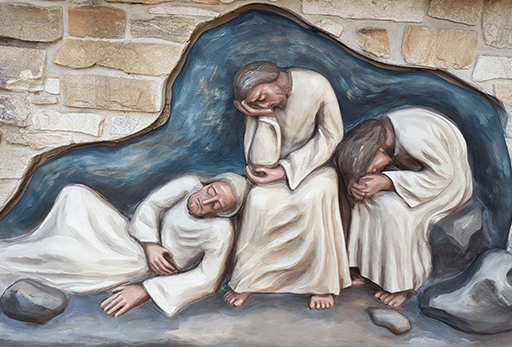
Even though their Lord told them to pray, the disciples nod-off in a stress-induced sleep. Jesus wanted them to remain awake, and he was talking of more than just physical alertness. The disciples needed to keep watch so that they didn’t fall into temptation.

Throughout his earthly ministry, Jesus had been warning them that his cross will lead to their own cross to bear. They, too, will have times of trial, so intense that it will be emotionally and spiritually overwhelming. Christ desired the disciples to follow his own example of offering anguished prayer which is thoroughly submissive to God.

So, our great task is to get up and pray!

Get up and pray so that no temptation can overtake you! (1 Corinthians 10:13)

Get up and pray so that you can endure hardship! (Hebrews 12:7)

Get up and pray for the enemies who persecute you so that you may be children of your Father in heaven! (Matthew 5:44-45)

Get up and pray so that you can encourage others and build them up in the faith! (1 Thessalonians 5:10-11)

Get up and pray so that you can be joyful in hope and patient in affliction! (Romans 12:12)

Get up and pray so that you may have peace in this world of trouble! (John 16:33)

Get up and pray so that you can submit to God and resist the devil! (James 4:7)

Get up and pray so that you will not be overcome by evil but overcome evil with good! (Romans 12:11)

Get up and pray so that you can submit to one another out of reverence for Christ! (Ephesians 5:21)

Get up and pray so that you can be the salt of the earth and the light of the world! (Matthew 5:13-16)

Get up and pray so that you can proclaim that the kingdom of God is near! (Matthew 10:7)

Get up and pray so that you can preach the Word with great patience and careful instruction! (2 Timothy 4:1-2)

Get up and pray so that you can have confidence in your leaders and submit to their authority, because they keep watch over you as those who must give an account. (Hebrews 13:17)

Get up and pray!…

The Parable of the Persistent Widow (Luke 18:1-8)

“The Persistent Widow” by Ronnie Farmer, Jr.

Then Jesus told his disciples a parable to show them that they should always pray and not give up. He said: “In a certain town there was a judge who neither feared God nor cared what people thought. And there was a widow in that town who kept coming to him with the plea, ‘Grant me justice against my adversary.’

“For some time he refused. But finally he said to himself, ‘Even though I don’t fear God or care what people think, yet because this widow keeps bothering me, I will see that she gets justice, so that she won’t eventually come and attack me!’”

And the Lord said, “Listen to what the unjust judge says. And will not God bring about justice for his chosen ones, who cry out to him day and night? Will he keep putting them off? I tell you, he will see that they get justice, and quickly. However, when the Son of Man comes, will he find faith on the earth?” (New International Version)

“God desires of us nothing more ardently than that we ask many and great things of him, and he is displeased if we do not confidently ask and entreat.”

Martin Luther

God wants us to pray! Prayer happens from a place of faith because to pray, one must believe that God is good and answers prayer. Conversely, prayerlessness is faithlessness. A person of little faith prays only a little. A person full of faith cannot stop praying.

Today’s Gospel lesson is a parable about not losing heart, about justice, and ultimately about faith.

Be Persistent In Prayer

For the Gospel writer, Luke, the widow, along with orphans, the diseased, and the handicapped, represent those who are dependent and vulnerable. And so, Jesus took a particular interest in them. (Luke 20:47, 21:3)

Widows are also presented by Luke as prophetic, active, and faithful. The widow in Christ’s parable, much like the other widows mentioned by Luke, is persistent and persuasive enough to get the justice she demands – even from an unjust judge. Her persistent petitioning is held up as a lesson in prayer.

Don’t lose heart and give up praying when your prayers are not answered as quickly as you want. No matter the prayer, we typically hope for and even expect them to be answered quickly. And if they don’t, we may get upset or discouraged.

“We must patiently, believingly, continue in prayer until we obtain an answer… Most frequently we fail in not continuing in prayer until the blessing is obtained, and in not expecting the blessing.”

George Müller

We pray daily for a variety of situations as individuals and as a congregation. Not all those prayers get answered in the ways we expect. Many times, it can seem like nothing is changing, or things are just getting worse. It is possible for us to despair in those moments and give up.

Yet, even if we do not immediately see an answer to our prayers, we need to keep praying. Even if we are suffering and seeing darkness all around us, we should not stop crying out to the Lord. And the content of those prayers is important.

Be Persistent In Justice

The parable is like a sandwich. The two pieces of rye bread are prayer and faith, with justice being the ham and cheese between them. The meat of the parable is in the ingredients of the prayers.

The widow is the vulnerable justice-seeker, and the powerholder is the unjust judge. The powerful and just God replaces the unjust authority’s reluctance, granting justice to vulnerable people who cry out to him day and night.

We are to persistently and passionately pray as Jesus instructed us:

“Father,
hallowed be your name,
your kingdom come.
Give us each day our daily bread.
Forgive us our sins,
    for we also forgive everyone who sins against us.
And lead us not into temptation….”

“So I say to you: Ask and it will be given to you; seek and you will find; knock and the door will be opened to you. For everyone who asks receives; the one who seeks finds; and to the one who knocks, the door will be opened.” (Luke 11:2-4, 9-10, NIV)

Jesus said, “Seek his kingdom, and these things [food, clothing, basic necessities] will be given to you as well. Do not be afraid, little flock, for your Father has been pleased to give you the kingdom. Sell your possessions and give to the poor. Provide purses for yourselves that will not wear out, a treasure in heaven that will never fail, where no thief comes near, and no moth destroys. For where your treasure is, there your heart will be also.” (Luke 12:31-34, NIV)

Be Persistent In Faith

Christ’s parable ends with a question: When the Son of Man comes, will he find faith on the earth? In Luke’s Gospel, there are several folks whom Jesus commended for their faith:

  • A Roman centurion asked Jesus to heal his servant, being confident that Christ could do so without even being present to do it. Jesus commented, “I tell you, I have not found such great faith, even in Israel.” (Luke 7:1-10)
  • A “sinful” woman anointed the feet of Jesus with perfume and her tears, loving the Lord despite the judgmental people around her. Jesus said to the woman, “Your faith has saved you; go in peace.” (Luke 7:36-50)
  • Friends of a paralyzed man dug through a roof to get him access to Jesus, knowing that Christ could heal. When Jesus saw their faith, he said, “Friend, your sins are forgiven.” (Luke 5:17-26)
  • An unclean woman, because of a chronic issue of bleeding, touched the edge of Christ’s cloak, believing that even this small touch will heal her. Jesus said to her, “Daughter, your faith has healed you. Go in peace.” (Luke 8:43-48)
  • A Samaritan leper cried out for mercy, recognizing that Jesus is the Christ who could heal him; and then fell at his feet in profound gratitude. Jesus said to him, “Rise and go; your faith has made you well.” (Luke 17:11-19)
  • A blind beggar called out to Jesus, seeing with spiritual eyes who Jesus really is. Jesus said to him, “Receive your sight; your faith has healed you.” (Luke 18:35-43)

So, will Jesus find faith on the earth when he returns?  Yes, he will, but it may likely be in unexpected places — not among the religious professionals or the ones certain of their own righteousness, but among the outsiders, the unlovely, the unclean, the ones certain of their sinfulness.

Perhaps the best sign of faith is a willingness to persist in prayer, like widow who persisted against all odds in her struggle for justice with the powerful judge.

Conclusion

We must have faith in Christ, and not in faith itself.

If we are honest, every one of us who has made a difficult prayer request, mustering-up all the faith we can, and then being disappointed when it did not happen, has been hurt. The unstable person vacillates when this happens, playing the “God-loves-me, God-loves-me-not” game. The person of faith, however, believes God answers prayer, and that if it is not answered when I want, God knows what’s up and will answer it in God’s own good time and grace.

None of this is about the amount of faith. Maybe you have told yourself, or somebody else has said to you, that you don’t have enough faith, and that’s why your prayer was not answered.

“The value of persistent prayer is not that God will hear us, but that we will finally hear God.”

William McGill

Know this: positive thinking is not the same as Christian faith. Faith is neither a matter of optimism nor of sending $19.95 to some hack preacher who promises to give you the secret of answered prayer, along with a free gold cross.

Taking a lesson from Christ’s parable about the persistent widow, we can put aside tepid, milquetoast, mumbling prayers with hunched shoulders (i.e. “Well, God, if it is your will, could you help me?”) and instead, because of our union with Jesus Christ and our redemption in him, pray confidently and boldly. In Christ, we have the privilege and authority to do so.

Blessed heavenly Father, we praise you for the grace we possess through the Lord Jesus Christ. We rejoice in Christ’s teaching, the gift of faith, the privilege to approach your throne with boldness, and the victory you have provided for us through Christ’s crucifixion, resurrection, and ascension. 

We pray your mercy over our sins, the sins of other believers, and the sins of our world. We confess the sin of prayerlessness, faithlessness, apathy, complacency, and indifference to your concerns for righteousness and justice. We acknowledge the wickedness of our world through injustice, oppression, and exploitation of others.

We recognize that the kingdom of darkness has laid strategies against us, trying to keep your people from faith and prayer. So, in the name of the Lord Jesus Christ, we claim our place as children of God. We smash and pull down all the strongholds which Satan has erected against humanity – and pray that the power of Christ’s resurrection would hinder and frustrate the plans formed against us. 

We, your people, accept the role of standing in the gap for others in prayer. In Christ, we are mighty through God to the pulling down of strongholds. So, we bring all the work of the Lord Jesus Christ – his incarnation, crucifixion, resurrection, ascension, and glorification directly against all of Satan’s power in their lives.

By faith we pray for fruitful lives of spiritual abundance, social justice, and sanctified relationships in the name of Jesus Christ our Lord.  Amen.

Luke 19:45-48 – Jesus Cleans House

A bronze panel of Jesus chasing the merchants from the Temple by Lorenzo Ghiberti (1378-1455)

When Jesus entered the temple courts, he began to drive out those who were selling. “It is written,” he said to them, “‘My house will be a house of prayer’; but you have made it ‘a den of robbers.’”

Every day he was teaching at the temple. But the chief priests, the teachers of the law and the leaders among the people were trying to kill him. Yet they could not find any way to do it, because all the people hung on his words. (New International Version)

Jesus seems a bit like an actor in an old western movie. He’s the sheriff who drifts into town, sizes up the situation, shoots up the bad guys, defends the women and children, and cleans up the town. 

It’s a side to Jesus that might surprise some.

Jesus is no simple one-dimensional person, as if he’s always calm and picking dandelions. Christ is fully human and fully God – a complex person full of both human and divine anger. Today’s Gospel lesson reminds us that Jesus defies stereotyping, and that we need to see a fuller profile of who he is, and what he is up to.

Jesus is not only the merciful servant who graciously heals at the temple; but he is also a mighty judge who is intolerant of unjust systems and cleans house. 

Because Jesus is superior to everything, he is not some Being that we can domesticate for our own personal use. He did not come to this earth as some sort of spiritual vitamin supplement, or to be on call 24/7 in order to bail us out when we need it, or help us get ahead in life.

Instead, zeal for his Father’s house consumes Jesus. (John 2:13-17)

Jesus driving the merchants out of the Temple by Raymond Balze (1818-1909)

Christ sought to please the Father. Jesus oversees what the church and Christians are supposed to be. 

It’s our task to conform to Christ, and not the other way around. 

That happens whenever we let Jesus be the sheriff who drives out our sin, and, at the same time, the town doctor who brings the needed healing to our lives. 

Jesus cleaned house by attacking the system he saw operating.

It was Passover, the time when all pious Israelites made the pilgrimage to Jerusalem. Cattle, sheep, and doves were used for sacrifices. And the only place where those sacrifices were made was at the Temple in Jerusalem.  This meant that anyone wanting to worship God from outside of Jerusalem would have to do some traveling. 

Over time, a system was set up: Vendors established kiosks which lined the Temple courts; and they sold animals for the required sacrifices, as a matter of convenience. 

Since there were thousands of folks who came from a long way, often from outside of Israel, they brought their foreign currency with them, and it could be exchanged at the tables set up by money-changers.

Perhaps that all sounds practical. A little capitalism which provides a service for the people doesn’t seem all bad. So, what’s the problem? 

Jesus didn’t have a problem with capitalism per se; his problem with the whole system is that it should not even exist – these guys should not be in the Temple, at all! 

Jesus attacked the system and made a western movie scene out of it because the vendors and money-changers, even if using sound business practices (which they weren’t) should not even be there. For Jesus, it trivialized the Temple and took away from its intended purpose as a house of prayer for all nations.

Here’s how the system was supposed to work:

Coming to the Temple from outside of Jerusalem was never intended to be easy or convenient.

Making the pilgrimage to Jerusalem was supposed to be difficult. For the past year, since the last Passover, a family raised a newborn lamb in their house. Parents and children all took part in caring for it.

Then, when it was time, they all journeyed to Jerusalem together, taking turns carrying the year old lamb over their shoulders. Everyone knew what was coming. Their precious lamb, now a cherished part of the family, would be given in sacrifice at the Temple.

It was all a very powerful reminder of sin’s cost and how terrible it truly is.

Entering Jerusalem with no animal, and only money to buy one, is a cheap facsimile of real worship.

It misses the entire point of the system. It hinders people from genuinely connecting with God through prayer.  And Jesus will not put up with it – to the point of violently driving the whole system out of the Temple.

Jesus didn’t mess around with the sinful system. He didn’t politely ask the money-changers to move their tables somewhere else; he didn’t strike a deal with those selling animals to market them at cost. No. Instead, he went all town sheriff on them because the whole system was a blasphemous act against the right and true worship of God.

It has been the sin of the Church, through the centuries, to find ways of doing ministry and worship by not actually doing it (e.g., selling indulgences). 

We might feel good by simply attending a worship service, or offering some obligatory prayers, and giving money without having done anything to meaningfully connect with God. Our devotion may not be toward bringing something of ourselves to sacrifice by using our spiritual gifts and laying our lives down for others. 

It’s really a heart issue. For example, we might rightly give to missionaries or mission projects. Yet, if we give without any thought to doing missions ourselves and being missional people, then we are in grave need of having a clean house by overturning the tables in our hearts. 

17th century Ethiopian depiction of Christ cleansing the Temple

Jesus cleaning house was not an end in itself; he did it so that the Temple could be used for its intended purpose: A house of prayer. A place of healing. A gathering of collective praise to God.

Whenever an existing system is challenged, there will be those who push back because they benefit from the way things are.

The religious leaders were incensed by Christ’s systemic change. The behavior of Jesus challenged their authority, and they were angry about losing some of their power – not to mention jealous and envious that the people hung on his every word.

Jealousy rots the bones. Envy and selfish ambition accompany every evil practice and are behind every evil system. (Proverbs 14:30; James 3:14-16)

The real culprit behind the Temple system, as well as our own conflicts and disagreements is our selfish anger, our abject jealousy that someone else is receiving something which should be mine, and our insidious envy of wanting what another has.

Jesus knew he would upset and anger the religious leaders. But he cared enough about the proper place of worship that he attacked the contrived Temple system that fed on obscuring what real sacrifice was. Christ was willing to take on the establishment and reestablish a house of prayer for all people.

The way for us has been made clear through the death of Christ. Jesus has removed the old system and replaced it with the new. (Hebrews 8:13)

Therefore, we ought to be a beacon of hope for all who are coming to God and desire to offer their sacrifice of service or praise. We must eliminate any system, rule, or practice that eviscerates true worship.

May we follow the Lord Jesus by being active and proactive in making the way clear for others to come to God. And the first step to doing so is by having God clean house on our own hearts.

It’s what a good deputy sheriff would do.

Create in me a clean heart, O God,
    and put a new and right spirit within me.

The sacrifice acceptable to God is a broken spirit;
    a broken and contrite heart, O God, you will not despise. Amen.

Luke 11:1-13 – Ask. Seek. Knock.

One day Jesus was praying in a certain place. When he finished, one of his disciples said to him, “Lord, teach us to pray, just as John taught his disciples.”

He said to them, “When you pray, say:

“‘Father,
hallowed be your name,
your kingdom come.
Give us each day our daily bread.
Forgive us our sins,
    for we also forgive everyone who sins against us.
And lead us not into temptation.’”

Then Jesus said to them, “Suppose you have a friend, and you go to him at midnight and say, ‘Friend, lend me three loaves of bread; a friend of mine on a journey has come to me, and I have no food to offer him.’ And suppose the one inside answers, ‘Don’t bother me. The door is already locked, and my children and I are in bed. I can’t get up and give you anything.’I tell you, even though he will not get up and give you the bread because of friendship, yet because of your shameless audacity he will surely get up and give you as much as you need.

“So, I say to you: Ask and it will be given to you; seek and you will find; knock and the door will be opened to you. For everyone who asks receives; the one who seeks finds; and to the one who knocks, the door will be opened.

“Which of you fathers, if your son asks for a fish, will give him a snake instead? Or if he asks for an egg, will give him a scorpion? If you then, though you are evil, know how to give good gifts to your children, how much more will your Father in heaven give the Holy Spirit to those who ask him!” (New International Version)

Jesus, in his teaching ministry on earth, often used the “lesser-to-greater” argument in getting his point across. And that is precisely what he was doing with his disciples in today’s Gospel lesson, instructing them about the nature and motivation of prayer.

The lesser-to-greater argument implies a comparison of values. It’s grounded on a common sense and logical convention that if this lesser thing is true, then, of course, how much more is this greater thing!

If something less likely to happen is true, then something more likely to happen will probably be true as well. The technical phrase for this is the a fortiori argument. It’s a Latin term meaning, “for a still stronger reason.”

So, then, Jesus wanted his followers to understand that prayer has value because God is a loving Father, not a begrudging friend. Whereas the friend in the story was badgered just so the person could get some real necessities, God needs no badgering to generously give good gifts that may or may not be considered as necessities by us.

Prayer has veracity and potency because of whom those prayers are directed to.

In the ancient world, it was common understanding that you needed to get the local gods attention if you wanted something. Which is why, for example, in the prophet Elijah’s showdown with the prophets of Baal, that Baal’s worshipers were yelling, gesticulating, and even cutting themselves for hours. They fully expected to put a lot of work into getting Baal’s attention, to convince him of intervening in their ancient version of a wild West shootout. (1 Kings 18:16-29)

In contrast to the four-hundred prophets of Baal, a single prophet of the Lord utters one simple prayer, then fire comes rushing down from heaven. (1 Kings 18:30-39) Much like the person who badgered the friend for bread, the prophets pestered Baal for hours.

It all comes down to who really cares. The friend? Not enough to jump out of bed right away and meet a need. Baal? Not so much. God? Now we’re talking.

We typically don’t ask, seek, or knock, if we believe we won’t get a response – or if it will take a lot of energy, time, and effort we don’t have.

Yet, if we are confident of being with care, then we are likely to have a habit of asking, seeking, and knocking.

If a friend begrudgingly gives to you because of persistent knocking, how much more will God graciously, generously, and with gaiety give you goodness when you ask? Because God is good, God gives good gifts. The largess of the Lord is willing and ready to dispense grace from an infinite storehouse of mercy.

This is why Jesus encouraged people to not pray like those who don’t know God, babbling on because they think they’ll be heard because of the sheer volume of words. (Matthew 6:7-8)

There are two misconceptions of prayer which existed in Christ’s day, and today. They come from non-Christian sources:

  1. There must be a lot of prayer before prayer “works.” Although I believe repetition is important for forming good habits, praying the same prayers over and over again so as to be heard betrays an ignorance of God, not to mention an actual lack of faith. Many ancient religions were based in learning how to manipulate the spiritual forces out there to get what we need. It’s kind of like a divine version of hustling for love in all the wrong places. Christians need to know they don’t need to have thousands of people praying in order to get God’s attention to answer prayer.
  2. I must convince God of the need to answer my prayer. God is not a reluctant listener. The reason the Lord already knows what we need before we ask is because God has been paying close attention to us well before we got around to asking, seeking, and knocking on the divine door. God’s ear is already inclined to hear us – expectantly awaiting our petitions. This is a tremendously freeing idea, that I can come to God openly and honestly, without wondering if I am heard, or not.

We might too often neglect to ask, seek, and knock because we rely on our own determination, abilities, education, or observations. Life can be hard. So, we keep on asking, seeking, and knocking.

No one enters God’s realm because of sheer determination. God’s kingdom is only accessed through humble prayer. God is the One with the supernatural resources to help us live the Christian life.

And God is pleased to provide what we need to live that life. God delights in hearing our asking’s, responding to our seeking’s, and answering our knocking’s. With God, there is no daydreaming while we ask, no avoiding us when we seek, and no pulling the shades on the windows as the door is being knocked.

In love, God looks forward to our asking, seeking, and knocking.

Repetition is important – not vain repetition which believes that the more prayer is repeated, the greater possibility of the answer we want – but a routine lifestyle of persistently and consistently praying.

Ask

You want something you don’t have, and you will do anything to get it. You will even kill! But you still cannot get what you want, and you won’t get it by fighting and arguing. You should pray for it. Yet even when you do pray, your prayers are not answered, because you pray just for selfish reasons. (James 4:2-3, CEV)

The Apostle James, learning from his brother, Jesus, gets behind the asking to the heart of why we ask and why we do not ask. This, in no way, is to discourage us from asking or to be doubtful whether God cares about our asking, or not. James also said:

Anyone who needs wisdom should ask God, whose very nature is to give to everyone without a second thought, without keeping score. Wisdom will certainly be given to those who ask. Whoever asks shouldn’t hesitate. They should ask in faith, without doubting. (James 1:5-6, CEB)

Seek

If you seek the Lord your God, you will find him if you seek him with all your heart and with all your soul. (Deuteronomy 4:29, NIV)

Seek the Lord while he may be found, call upon him while he is near. (Isaiah 55:6, NRSV)

Prayer is much like a wrestling match. It requires a great deal of effort. In fact, every good thing in life demands blood, sweat, and tears. We are to keep on seeking, to continue searching and looking for God amid our life circumstances. The Lord will be found.

Knock

God has said:

“When you pray, I will answer you. When you call to me, I will respond.” (Isaiah 58:9, GNT)

Prayer isn’t all continual searching and diligently seeking. Sometimes, there is an immediate answer to our knocking on heaven’s door.

God has also said:

“I will answer their prayers before they finish praying.” (Isaiah 65:24, CEV)

It is to God’s glory whether our prayers are answered quickly, or not. It is to our glory that we exercise our ability to enter God’s throne room and ask, seek, and knock. We have the assurance that whatever the answer is from God, it will always be a merciful response.

For God mercifully gives us what we ask for, and also mercifully does not give us what we ask for.

We do not know what tomorrow may hold for us. All we know for certain is that we are known by a God who hears when we ask, is worth seeking, and answers when we knock.

May you be encouraged to pray, to truly connect with God, because the Lord is available without appointment, and is waiting for us to ask with bended ear.

Eternal God, by whose power we are created and by whose love we are redeemed: Guide and strengthen us by your Spirit so that we may give ourselves to your service and live today and every day in love to one another and to you, through Jesus Christ our Lord, in the strength of the Holy Spirit. Amen.