Ascension of the Lord (Acts 1:1-11)

The Ascension of Christ, by Pacino di Bonaguida, c.1340

Theophilus, the first scroll I wrote concerned everything Jesus did and taught from the beginning, right up to the day when he was taken up into heaven. Before he was taken up, working in the power of the Holy Spirit, Jesus instructed the apostles he had chosen. After his suffering, he showed them that he was alive with many convincing proofs. He appeared to them over a period of forty days, speaking to them about God’s kingdom. While they were eating together, he ordered them not to leave Jerusalem but to wait for what the Father had promised. He said, “This is what you heard from me: John baptized with water, but in only a few days you will be baptized with the Holy Spirit.”

As a result, those who had gathered together asked Jesus, “Lord, are you going to restore the kingdom to Israel now?”

Jesus replied, “It isn’t for you to know the times or seasons that the Father has set by his own authority. Rather, you will receive power when the Holy Spirit has come upon you, and you will be my witnesses in Jerusalem, in all Judea and Samaria, and to the end of the earth.”

After Jesus said these things, as they were watching, he was lifted up and a cloud took him out of their sight. While he was going away and as they were staring toward heaven, suddenly two men in white robes stood next to them. They said, “Galileans, why are you standing here, looking toward heaven? This Jesus, who was taken up from you into heaven, will come in the same way that you saw him go into heaven.” (Common English Bible)

It’s been two-millennia since Jesus Christ ascended to heaven. Since then, a lot has changed.

Yet, on the other hand, we’re still in the same situation as the early church: Jesus is still up there; and we are still down here. That means, because we are still awaiting Christ’s return, the original call and practice of the church is still in effect.

As far as experiences go, it’s hard to top being one of the original disciples and seeing Jesus ascend into the clouds to heaven. Now what? How do you go about your life after that?

In the spiritual life, we move back and forth between moments of genuine inspiration and the sheer routine of our daily mundane lives. The uplifting mountain-top experience and the hard slog of walking through the valley are both important. The trick is to channel the energy from one into the other. For that to happen, we need to work out rhythms of grace that connect expectant prayer with the action of being witnesses.

Prayer and witness – both are necessary for the church; and they are closely tied to the risen and ascended Christ. The ascension of the Lord Jesus means Christ is exalted above everything; he’s in charge. By his authority he has made us prayerful witnesses and given us the means of carrying out that job.

Jesus and the disciples, even after forty days together, post-resurrection, were not on the same page. The disciples were anticipating a restoration of David’s kingdom. Their vision for the future was a great apocalypse in which Jesus, as the ultimate mixed martial arts champion, would beat up all their enemies. Then, set up a political kingdom just like King David of old. 

But Jesus had a different agenda. Instead of creating an immediate utopia, where the disciples would be in charge and in control, Jesus bluntly told them that knowing God’s timetable is not in their pay grade. Instead, the disciples were commissioned for a job, which didn’t include gawking at the sky and trying to figure out when the end of the world was happening.

Christ’s Ascension, by Scott Rayl

Although we (understandably and deservedly) want peace and justice now, Jesus avoided handing out prophecy charts detailing when that would happen. He essentially said to quit thinking about that stuff because it’s really none of our business.

Rather, our business is being witnesses of Jesus. The angels came along immediately after Jesus ascended and said to the disciples to stop standing there slack jawed. Jesus is coming back and, meanwhile, there is a job to do – to be witnesses of Christ’s redemptive events. And, the strength of that witness will come from the Holy Spirit. So, hang tight in prayer.

So, what does it mean to be a “witness?” A few years back, I was called to the bedside of an actively dying patient. The patient’s spouse and parents were present. In the space of two hours I watched them in the throes of grief. And I provided all the spiritual support I could. 

The situation had similarities to many emergencies I have attended, with one exception: I noticed that I was different. I did not “do” or “say” a lot. Mostly, I was present. I remember, at times during my encounter, feeling helpless. In some ways I was. I certainly couldn’t fix a thing. Yet, this time, I saw my role in a new way. 

I distinctly remember the sense of bearing witness to this sacred event. There was an entire world outside the patient room that knew nothing of this family’s intense grief. But I knew. I watched the whole thing. I was present for all the struggles of the medical team, the tears of the husband, the grief of a Dad, the angry questions of a mother toward a God that she didn’t know how to approach – who seemed aloof and capricious.  I was there for it all. Even now, I still carry those folks and their story in my heart.

And it was enough. 

Yes, it was enough. This was the first time I ever said that after such a situation. I had a settled sense that the role of witnessing the events in front of me was a blessed and sacred responsibility. Billions of people on planet earth didn’t know the grief of these people. I did. Because I was there. 

There is something both mystical and necessary about this understanding of being a witness with active prayerful observation.

I wonder if that’s how the disciples felt after Christ’s ascension. Perhaps my experience is what Jesus meant when he said, “You shall be my witnesses.” Maybe a witness is one who has the special role of observing the suffering of Christ, his resurrection of the dead, and the ongoing work of the Spirit. 

God is, I believe, the ultimate witness. When no one else sees, God sees. Where there is grief, God is present. Wherever pain, hurt, and brokenness exists, God is there bearing witness to it all. 

And, once in a while, the Lord is gracious to invite me into the scene to witness it along with him. Jesus is our Immanuel – God with us. And that is enough for me. 

In the book of Acts, praying and witnessing was a consistent pattern that the early church practiced. They prayed about whom to choose as leaders and bore witness to the Spirit setting individuals apart for the work of gospel proclamation and service to the church. They prayed for the Holy Spirit to come on people and bore witness to miraculous signs of the Spirit’s work. They prayed for the courage to preach and heal and bore witness to the saving work of God.

As the book of Acts unfolds, we see Peter imprisoned for being a witness. So, the church went to prayer. Peter was released, and when he showed up at the prayer meeting, the believers at first did not believe it was him.  Even with their little faith they were able to witness God answer their prayers. (Acts 12:1-18)

It was at a prayer meeting where Paul and Barnabas were set apart by the Spirit to bear witness in other locations. (Acts 13:1-3)

While traveling from city to city, Paul constantly devoted himself to prayer and listened to the Spirit. (Acts 16:1-35)

People came to Christ because of prayerfully listening to the Spirit and the obedient action that followed by Peter, Paul, and the other believers giving witness to how the risen Christ saved their lives. This was possible because of the risen and ascended Christ.

There is not one square inch of this earth that Jesus is not Lord. This means we can be alive with devotion to prayer and to being witnesses in this world for Jesus. Just as a cup of coffee needs a warm-up, so our prayers need to be refreshed so that God’s purposes will be accomplished. And his purposes are that all of creation comes, in a real and practical way, under Christ’s lordship.

What does the ascension of Jesus Christ mean for us today? That we belong to God and have the wondrous privilege of prayer and witness in a world that so desperately needs to connect with the transcendent and divine.

Care For the Flock (Ezekiel 34:1-16)

The Lord God said:

Ezekiel, son of man, Israel’s leaders are like shepherds taking care of my sheep, the people of Israel. But I want you to condemn these leaders and tell them:

I, the Lord God, say you shepherds of Israel are doomed! You take care of yourselves while ignoring my sheep. You drink their milk and use their wool to make your clothes. Then you butcher the best ones for food. But you don’t take care of the flock! You have never protected the weak ones or healed the sick ones or bandaged those that get hurt. You let them wander off and never look for those that get lost. You are cruel and mean to my sheep. They strayed in every direction, and because there was no shepherd to watch them, they were attacked and eaten by wild animals. So my sheep were scattered across the earth. They roamed on hills and mountains, without anyone even bothering to look for them.

Now listen to what I, the living Lord God, am saying to you shepherds. My sheep have been attacked and eaten by wild animals because you refused to watch them. You never went looking for the lost ones, and you fed yourselves without feeding my sheep. So I, the Lord, will punish you! I will rescue my sheep from you and never let you be their shepherd again or butcher them for food. I, the Lord, have spoken.

The Lord God then said:

I will look for my sheep and take care of them myself, just as a shepherd looks for lost sheep. My sheep have been lost since that dark and miserable day when they were scattered throughout the nations. But I will rescue them and bring them back from the foreign nations where they now live. I will be their shepherd and will let them graze on Israel’s mountains and in the valleys and fertile fields. They will be safe as they feed on grassy meadows and green hills. I promise to take care of them and keep them safe, to look for those that are lost and bring back the ones that wander off, to bandage those that are hurt and protect the ones that are weak. I will also slaughter those that are fat and strong because I always do right. (Contemporary English Version)

We have a pastoral duty to care for one another. Individuals need not have the title of “Pastor” in order to function as pastoral people who seek the welfare of the flock. A part of our responsibility (and privilege) is to know the flock well enough in discerning when there are some lost ones out there. Whenever that happens, we care about them enough to go after them.

If we either ignore the flock, fail to care for it, or seek to fleece them for our own benefit, we will have to contend with a God who has no tolerance for unnecessarily putting the sheep at risk. And we are to be attentive to the ones who have strayed and are lost.

Caring about the lost, enough to go after them, has always been, unfortunately, a scandalous activity for Christians who do it. In the Gospels, the religious leaders had a big problem with how Jesus was spending his time (Luke 15:1-3). From their perspective, Christ was guilty by association. Many of the people Jesus pursued and hung-out with were unsavory characters; there was really no doubt about their bad character. 

But we must come back to why Christ made the decisions he did: Jesus did not come to earth to make already righteous people feel good about being around him; he came to rescue sinners and restore them to God. 

Jesus never wavered from this fundamental mission. With everything he said and did, Jesus, the Good Shepherd, communicated that lost people matter to God – and that practice eventually got him killed.

Early in my Christian life, I adopted a practice, on most Friday nights, of going to a certain bar known for its less than virtuous clientele. I typically ordered a bowl of chili gumbo, and simply sat and talked with fellow students. I learned a lot about people – their hopes, fears, and spiritual inclinations. 

I learned even more about God. I saw the terrible brokenness of many people’s hearts, and saw that the heart of God was pained in longing to restore such persons to a place of spiritual abundance, peace, and joy.

One Friday night, in the middle of winter, as I was walking back from the bar with a friend at about midnight, we encountered a guy so drunk that he could not walk straight. He wasn’t wearing any pants, nor did he have a coat. In below freezing temperatures, he was in only a shirt and underwear. 

All the people who passed by him laughed and kept walking. But we stopped. It took several minutes to get some semblance of a story out of him about what happened, where he came from, and where he lived. The poor guy couldn’t remember losing his pants, which had his wallet and keys. 

He lived far enough away that there was no way he would have ever made it home. It’s quite probable that without someone helping him he would have passed out somewhere and died. We got him home, found a way to get into his place, and tucked him in his bed.

The next day I went and checked on him. Even though he had a bad hangover, we still had a good conversation about what happened and why I helped him. We ended up meeting several times together and talked a great deal about God, guilt, grace, Jesus, and salvation. 

Meanwhile, however, not everyone was happy about my practice. Some of the people in my church were not pleased with me spending time in a bar with “sinners.” They told me things like, “Bad company corrupts good character” and “it doesn’t look good.” I merely matter-of-factly responded, “I like the way I’m reaching out to lost people better than the way you’re not.”

We are in danger of becoming encrusted with so much insulation from lost people, and their very real hurts, that we do not know God’s heart for them. 

Jesus, better than any of us could ever imagine, knows how awful and horrific sin really is. That’s because he suffered by taking on the shameful baggage of every person who ever lived. Since Jesus understands how awful guilt and shame is, it’s God who goes uncorked with joy and celebration when just one lost sheep is restored to the flock.

Grace lies at the center of God’s heart – a scandalous grace that defies all earthly sense. God’s deepest desire, greatest yearning, and most passionate dream is that lost people return home. (Luke 15:11-32) 

In light of the reality that God’s heart burns for lost people, we as churches, faith communities, Christian ministries, and believers everywhere really need to: 

  • Put away all petty concerns and realize there are lost people, far from the flock, at risk and dying apart from God
  • Put all worries about the future in biblical perspective – because there are people with no hope and no God all around us
  • Put aside all pre-occupations with optics and marketing, numbers and money; and instead have a holy obsession with people knowing Jesus Christ, and him crucified, risen, and coming again 

We are to make it our aim in this life to pray for, long for, look for, run after, and pursue lost people and restore them to life.

For what does it profit a person to gain the world but lose their life because they was too pre-occupied with everything but caring for the flock? And what does it profit a church to have buildings, budgets, and butts in the pew, but never see a lost soul come to Jesus?

Jesus Shows Up (John 20:19-31)

Jesus shows himself to Thomas, by Rowan and Irene LeCompte

On the evening of that first day of the week, when the disciples were together, with the doors locked for fear of the Jewish leaders, Jesus came and stood among them and said, “Peace be with you!” After he said this, he showed them his hands and side. The disciples were overjoyed when they saw the Lord.

Again Jesus said, “Peace be with you! As the Father has sent me, I am sending you.” And with that he breathed on them and said, “Receive the Holy Spirit. If you forgive anyone’s sins, their sins are forgiven; if you do not forgive them, they are not forgiven.”

Now Thomas (also known as Didymus), one of the Twelve, was not with the disciples when Jesus came. So the other disciples told him, “We have seen the Lord!”

But he said to them, “Unless I see the nail marks in his hands and put my finger where the nails were, and put my hand into his side, I will not believe.”

A week later his disciples were in the house again, and Thomas was with them. Though the doors were locked, Jesus came and stood among them and said, “Peace be with you!” Then he said to Thomas, “Put your finger here; see my hands. Reach out your hand and put it into my side. Stop doubting and believe.”

Thomas said to him, “My Lord and my God!”

Then Jesus told him, “Because you have seen me, you have believed; blessed are those who have not seen and yet have believed.”

Jesus performed many other signs in the presence of his disciples, which are not recorded in this book. But these are written that you may believe that Jesus is the Messiah, the Son of God, and that by believing you may have life in his name. (New International Version)

When Jesus shows up, there is peace. Wherever Jesus goes, the Spirit of God is there. When Jesus appears, people believe.

The Meeting

After the crucifixion of Christ, the disciples were huddled together, mostly in fear of being found out and put out by the religious authorities. Out of nowhere, Jesus showed up, smack in the middle of the anxious group of men.

Christ in the center makes all the difference. From this central place, Jesus bestowed to the disciples his peace. The very first word the risen Christ spoke to his disciples was neither a command to stop being afraid, nor a rebuke for sitting around and doing nothing, or disappointment that they all ran away in the final hour of need at the crucifixion; instead, the first word of Christ was a gift of peace.

The presence and peace of Christ melted the disciples’ fear. Christ-centered peace is graciously given; so let us gratefully receive it.

The Reality

Jesus showed up, then showed off his hands and his side. He was not fabricated out of the disciples’ imagination; he was not some ghostly apparition. Rather, Christ was standing in the middle of them, very real, very physical, and very alive.

Christ gave his disciples real truth: actual wounded hands and side on a real body. Christ is risen and alive – not just spiritually, but physically. Since the resurrection of Jesus really happened, then nothing else matters; our joy is complete. We have what we need.

The Mission

As Jesus was sent by the Father, so Jesus sent his disciples; and is still sending us out into the world. And as Jesus came not to condemn the world but to save it, so we go out with words of grace and peace. The church exists for the life of the world – to bless it with the presence and peace of Christ.

“Whoever believes in me does not believe in me only, but in the one who sent me. The one who looks at me is seeing the one who sent me. I have come into the world as a light, so that no one who believes in me should stay in darkness.” (John 12:44-46, NIV)

Our spiritual DNA makes us little Christ’s walking around, doing the will of God, for the benefit of a world in darkness. We bear the name of Christ: Christians, proclaiming a message of life, delighting in God and creation; and not destroying the earth and its inhabitants.

The Gift

Right now, we are not alone. The Holy Spirit has been graciously given to us by Jesus. Although our mission is a big one, our resource for accomplishing it is even bigger. Jesus gives the Spirit in the same way he gives himself – as a sheer gift with no strings attached. Just as God breathed life into the very first people on earth, so Jesus breathes on the disciples and gives them new life and a new heart.

I will give you a new heart and put a new spirit in you; I will remove from you your heart of stone and give you a heart of flesh. And I will put my Spirit in you and move you to follow my decrees and be careful to keep my laws… and you will be my people, and I will be your God. (Ezekiel 36:26-28, NIV)

The Privilege

Christ has redeemed us, forgave us of our guilt and shame. Now, we have the privilege of passing the forgiveness to others. The special mission of the Church is giving Jesus to others with grace and peace, so that they may believe he is truly the risen Lord; and so, receive Jesus, the Spirit, forgiveness, and purpose in life, with Christ at the center of all things.

For the one whom God has sent speaks the words of God, for God gives the Spirit without limit. The Father loves the Son and has placed everything in his hands. Whoever believes in the Son has eternal life, but whoever rejects the Son will not see life, for God’s wrath remains on them.” (John 3:34-36, NIV)

The Risen Lord, by He Qi

The Appearance

When Jesus appears, its good if we also show up to see him. It seems Thomas was late for church and missed the beginning of the service. He wasn’t with the other gathered disciples. Nobody knows where he was or what he was doing. But the important thing is that he did eventually show up, because showing up is the beginning of a changed life.

The Witness

After Jesus showed up, the disciples bore witness to what they saw and heard to Thomas. Yet Thomas, bless his doubting heart, wasn’t having it. He’s a realist. He wants proof, some actual physical evidence. Thomas was clearly a tactile learner because he needs some touch to believe any of this crazy talk of his disciple brothers.

Sometimes Thomas gets a bad rap, but he is really our Everyman. Doubt and skepticism are an important part of a full-orbed and honest faith. Jesus gave Thomas some space, time, and respect to begin wrapping his head and heart around this new reality of resurrection. I wonder if we all can do the same with others.

The Middle

A second time, Jesus shows up in the middle of the disciples. The Word became flesh and dwelt among us – and didn’t become a ghost and hang out in secret places. Once again, peace is given by Jesus to his followers.

Both appearances happen on a Sunday (which is why Christians have always worshiped on Sundays); and both meetings are literally Christ-centered (which every Christian meeting is supposed to be). Every Sunday. Christ always in the middle. Keep those two, and keep them together, and you can’t go wrong.

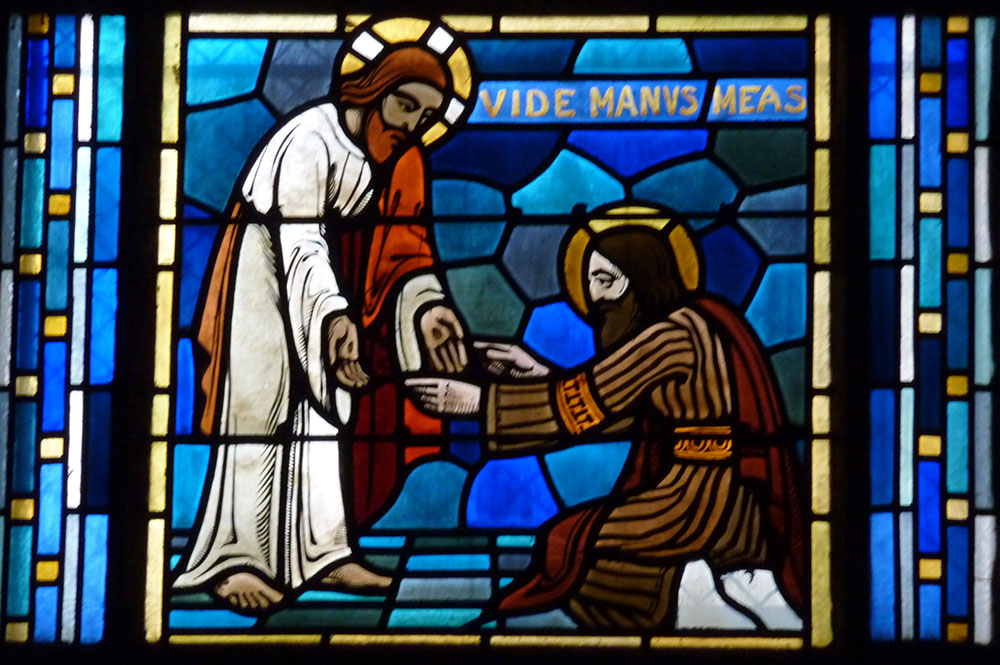
Jesus appears to Thomas with the Latin words, “See my hands,” in Notre-Dame-du-Rosaire Church, Saint-Ouen, France 

The Invitation

There’s no beating around the bush with Jesus. He immediately engaged Thomas and invited him to touch the wounds on his very real body. Christ knew Thomas’ hang-up, and went right to it. Thomas wanted evidence; Jesus offered it. If we get anything out of this encounter, it is that risen Christ honors honest doubt.

The evidence is here. Now believe it, and stop disbelieving. We have documentary evidence of the Old and New Testaments; the Church’s witness in Creeds, Confessions, and contemporary narratives of changed lives; and the internal testimony of the Holy Spirit. Therefore, look into them carefully and draw a sound conclusion.

The Confession

“My Lord and my God!” That’s the confession and the conclusion Thomas drew from the evidence – not only that Jesus is real, alive, existed, a good teacher; or other people’s Lord and God – but that he is my Lord and my God.

Jesus cared enough for Thomas to specifically meet him personally at his point of need. The grace of God keeps coming and never runs out. Jesus is filled up to the full in both grace and truth.

The Believer

Thomas had the physical evidence. But it doesn’t take that to truly believe. God blesses those who’ve never seen nor touched, but still believe. Jesus was thinking of you and me, and not only the people in front of him at the time. The Lord Jesus blesses us with the gift of peace, grace, and faith.

Though you have not seen him, you love him; and even though you do not see him now, you believe in him and are filled with an inexpressible and glorious joy, for you are receiving the end result of your faith, the salvation of your souls. (1 Peter 1:8-9, NIV)

The Conclusion

All this is for our benefit, so that we, too, may believe that Jesus is the Christ, the Son of the living God. Since Jesus is alive, he continues to bless us with his presence, power, and peace.

Jesus is with us:

  • through the Word of God, giving us his peace, showing up and meeting needs people.
  • at the Table in the sacrament of communion, bringing grace and forgiveness
  • in the person of the Holy Spirit, enabling and energizing us for mission and ministry to the world

It’s a life worth living, a Christ-centered life, full of God’s blessing.

O God and Father of our Lord Jesus Christ, in whom we receive the legacy of a living hope, born again not only from his death but also from his resurrection. May we who have received forgiveness of sins, set others free, until we enter the inheritance that is imperishable and unfading, where Christ lives and reigns with you and the Holy Spirit, one God, now and forever. Amen.

Together As One (Philippians 1:1-11)

From Paul and Timothy, servants of Christ Jesus—

To all God’s people in Philippi who are in union with Christ Jesus, including the church leaders and helpers:

May God our Father and the Lord Jesus Christ give you grace and peace.

I thank my God for you every time I think of you; and every time I pray for you all, I pray with joy because of the way in which you have helped me in the work of the gospel from the very first day until now. And so I am sure that God, who began this good work in you, will carry it on until it is finished on the Day of Christ Jesus. You are always in my heart! And so it is only right for me to feel as I do about you. For you have all shared with me in this privilege that God has given me, both now that I am in prison and also while I was free to defend the gospel and establish it firmly. God is my witness that I tell the truth when I say that my deep feeling for you all comes from the heart of Christ Jesus himself.

I pray that your love will keep on growing more and more, together with true knowledge and perfect judgment, so that you will be able to choose what is best. Then you will be free from all impurity and blame on the Day of Christ. Your lives will be filled with the truly good qualities which only Jesus Christ can produce, for the glory and praise of God. (Good News Translation)

One In Purpose

The Church is the community of the redeemed, the Body of Christ. In order to maintain health, the spiritual body needs unity, joy, and fellowship. This happens through a shared purpose of embracing the good news of Jesus Christ and proclaiming it to others.

Paul emphasizes throughout his letter that the church is to be a common community, sharing life together, working on supporting one another and reaching out to others.

Every pronoun, “you,” used in today’s text is plural, not singular. And that’s significant. We’re in the Christian life and the Christian Church together. Just as God is one, we too, in union with Christ, are one Body.

Wherever there is an absence of shared purpose, there you will find complaining, arguing, and a bunch of crotchety curmudgeons who nobody wants to be around. Without being one in purpose, we become divided and fight one another.

A Common Mission

Our common life together as believers, revolves around a shared mission of gospel proclamation, namely, that the kingdom of God is near. Through repentance and faith in the person and work of Jesus, there is forgiveness of sins, new life, and participation in the life of God.

Christian mission is not for larger church attendance, although that is nice and may happen; it isn’t to do more, or to get other people to stop swearing, avoid tattoos, or vote Republican.

The Apostle Paul knew without a focus on mission, on encouraging one another with the good news and sharing the gospel with others, the lack of purpose would create spiritual sickness. Apart from a deliberate focus on centering life and mission around the person and work of Christ, a group of people will nit-pick one another to death with their various opinions and wants.

Conversely, with a polestar on mission, the community of the redeemed work closely together and enjoy one another. Happy people are a breath of fresh air to be around. A good healthy spirit is a delight to others. Folks will inevitably find hope and healing through a common purpose of life together which imbibes liberally from the redemptive events of Jesus.

Good news is fun to share. It is joyful. The gospel of Jesus Christ is wonderful news, worthy of exuberant celebration. The Apostle Paul had fond memories of his partnership in the gospel with the Philippian believers. Although he had been jailed and beaten in the city of Philippi, Paul joyously sang in the prison – to the point where the jailer took notice and listened to the gospel of new life in Christ. The jailer and his entire family became followers of Jesus. (Acts 16:16-34)

Shared Experiences

The Philippians were Paul’s spiritual children. They had sacrificed with Paul toward the shared vision of proclaiming good news. So, Paul wanted them to remember their own significant events of coming to faith, enjoying fellowship together, and working toward common objectives.

In reminding the Philippian believers, Paul hoped to help get their heads screwed on straight again. He was confident this would happen, having an unshakable belief that God would continue the good work started within them.

This confidence was the basis of Paul’s prayers for the church. He beseeched God to unleash the Philippians’ collective love in a grand experiential knowledge of the divine so that they might discern well, making solid decisions which place the gospel as central to all of life.

There is an incredible depth to human need – a deep spiritual longing for what is good and beautiful. Relational unity brings out the beauty and majesty of humanity. Sometimes, when we are facing hard circumstances, we need to recall our collective shared experiences, to remember why we were joyful.

In difficult times of injustice, we need a vision of humanity which locks arms in unity without vilifying one another. When we place priority on the good news, I believe we will again discover the joy of life, of knowing Christ.

Perhaps, with a watching world observing basic human kindness and joyful relations, we will find ways of being better together and working toward the common good of all persons. And methinks, Jesus wants to help with this, if we will only let him.

God and Father of our Lord Jesus Christ: Give us grace to set aside our cranky unhappiness and divisive spirits. Take away all hatred and prejudice, and everything which hinders us from godly union and connection: that, as there is but one Body, and one Spirit, and one hope of our calling, one Lord, one faith, one baptism, one God and Father of us all; so we may be all of one heart, and of one soul, united in one holy bond of truth and peace, of faith and love, and with one mind and one mouth to glorify you, through Jesus Christ our Lord, and in the strength of the Holy Spirit. Amen.