Philippians 1:18-26 – Do What’s Most Important

A mosaic of the Apostle Paul, Ravenna, Italy, 5th century C.E.

But what does it matter? The important thing is that in every way, whether from false motives or true, Christ is preached. And because of this I rejoice.

Yes, and I will continue to rejoice, for I know that through your prayers and God’s provision of the Spirit of Jesus Christ what has happened to me will turn out for my deliverance. I eagerly expect and hope that I will in no way be ashamed but will have sufficient courage so that now as always Christ will be exalted in my body, whether by life or by death. For to me, to live is Christ and to die is gain. If I am to go on living in the body, this will mean fruitful labor for me. Yet what shall I choose? I do not know! I am torn between the two: I desire to depart and be with Christ, which is better by far; but it is more necessary for you that I remain in the body. Convinced of this, I know that I will remain, and I will continue with all of you for your progress and joy in the faith, so that through my being with you again your boasting in Christ Jesus will abound on account of me. (New International Version)

So, what do you think leads to disunity in any group, whether in a church or elsewhere?….

Yes, unfortunately, there are many things which can divide a group of people. Chances are that discord comes from a lack of listening and love. And behind that lack is a spirit that desires attention and accolades. In other words, there cannot be unity whenever everyone wants to take credit for what’s good and blame others for what’s bad.

The Apostle Paul, writer of the letter to the Philippian Church, had a humble self-effacing approach to ministry. Paul knew exactly what was important to him and the advancement of the Church, namely, that Jesus Christ is proclaimed, that the good news of grace and forgiveness in Christ is given to people.

“The two most important days in your life are the day you are born and the day you find out why.”

Mark Twain

And so, for Paul, his purpose was crystal clear. Although he really didn’t like bad attitudes and impure motives, if the message of Christ was preached, that was of upmost significance. It didn’t matter to him if people took credit for his work, or not. Not a lot of people can say that.

The Apostle focused on himself. Ultimately, we cannot control anyone; we can only practice self-control. And that is exactly what Paul did. Notice that in today’s New Testament lesson, Paul expressed his own desire to live a life of hope, courage, and selfless ministry. He understood that all the troubles he had experienced up to this point, would likely keep happening in this earthly life.

Paul could have started a new apostles’ retirement community, stepped out of the fray, and simply studied Torah all day. It’s probably what he really wanted to do. But Paul knew better. He knew it was better for all the churches he planted that he keep laboring on their behalf.

Even though Paul was ready to die and be with his Savior forever, he wasn’t going to grab control that wasn’t his. Someday he would die, or Christ will return before that time. Until then, he was going to do his darndest to ensure the gospel of Jesus is spread far and wide.

A spiritually healthy believer in Jesus both longs for heaven and Christ, and also puts their head down and faithfully plugs away with listening to others and loving them to Jesus with gracious words of forgiveness and merciful acts of kindness.

I imagine when Paul wrote this letter, he was downright tired. I can relate. Laboring day after day as a hospital chaplain and a church pastor often leaves me with little rest and carrying the emotional burdens of both places. There are so many people who need basic human kindness, common decency, and focused encouragement. And they don’t get it because there are far too many people far too absorbed in maintaining mastery of their very small worlds.

“The unexamined life is not worth living.”

Socrates

There are days I’d like nothing more than retreat to the Northwoods of Wisconsin, read and write in a small cabin, and catch fresh walleye for my supper. Maybe that will happen someday, but not today. Today is all we have. Today is the day of salvation. There will not always be Today. Christ is coming. Then it will be tomorrow. And tomorrow is too late for too many people.

So, I continue, working with all the energy (or lack thereof) which the good Lord gives me. After all, we are not God. Everyone on this planet has only a finite amount of energy and life. The question then becomes, How will you spend your energy and your finite resources?

I suggest we take our cues from good old Apostle Paul and not bad old Jacob Marley, who didn’t get the picture until it was too late. I’d rather live right, die well, and enjoy eternity – instead of living like a peacock, dying kicking and screaming, and having a miserable eternity.

In this Advent season, we have the opportunity to focus on what’s most important, then live with those priorities in the next year.

May it be so, to the glory of God.

Luke 4:16-30 – Good News for “Those” People

Jesus went back to Nazareth, where he had been brought up, and as usual he went to the meeting place on the Sabbath. When he stood up to read from the Scriptures, he was given the book of Isaiah the prophet. He opened it and read,

“The Lord’s Spirit
    has come to me,
because he has chosen me
to tell the good news
    to the poor.
The Lord has sent me
to announce freedom
    for prisoners,
to give sight to the blind,
to free everyone
    who suffers,
and to say, ‘This is the year
    the Lord has chosen.’”

Jesus closed the book, then handed it back to the man in charge and sat down. Everyone in the meeting place looked straight at Jesus.

Then Jesus said to them, “What you have just heard me read has come true today.”

All the people started talking about Jesus and were amazed at the wonderful things he said. They kept on asking, “Isn’t he Joseph’s son?”

Jesus answered:

You will certainly want to tell me this saying, “Doctor, first make yourself well.” You will tell me to do the same things here in my own hometown that you heard I did in Capernaum. But you can be sure that no prophets are liked by the people of their own hometown.

Once during the time of Elijah there was no rain for three and a half years, and people everywhere were starving. There were many widows in Israel, but Elijah was sent only to a widow in the town of Zarephath near the city of Sidon. During the time of the prophet Elisha, many men in Israel had leprosy. But no one was healed, except Naaman who lived in Syria.

When the people in the meeting place heard Jesus say this, they became so angry that they got up and threw him out of town. They dragged him to the edge of the cliff on which the town was built, because they wanted to throw him down from there. But Jesus slipped through the crowd and got away. (Contemporary English Version)

Jesus was the hometown boy of Nazareth, the rising star who was putting the small village on the map. He walked into the synagogue on the Sabbath with the people all watching with pride, their chests puffed with delight over one of their own making it to the big time. 

It just so happened that on that day the Old Testament reading was from the prophet Isaiah – a prophecy of grace and healing that fit the budding ministry of Jesus. Here was the hope of Israel. It was all bunnies and butterflies, until Jesus decided to say a few words to them all….

Jesus took the prophecy of Isaiah about proclaiming liberty to captives and the oppressed and then applied it, not to his fellow Jews who were present, but to, of all people, Gentiles! 

Jesus just had to open his mouth and point out that in the days of Elijah, the prophet was sent to a Gentile woman. In addition, Jesus let everyone know the prophet Elisha cleansed a Gentile. The gathered synagogue worshipers understood exactly what Jesus was doing – claiming to be the ultimate prophet, sent for “those” people. 

Are you ready to throw Jesus off a cliff?

It was too much for the people gathered for worship. All hell broke loose as the “worshipers” became so angry and insolent that they drove Jesus out of town and tried to kill him. Jesus had that kind of effect throughout his earthly ministry by saying and doing the unexpected. 

The people of Nazareth seemed to have always interpreted the message of Isaiah and the prophets as being for themselves, not others. This is a probing story for today’s Christian Church. Whenever we lose sight of a biblical message and re-interpret it as being for only us, then we end up like the Nazarenes of old who did not recognize Jesus for who he really is and what he really came to do. 

The burning question for individual Christians and all churches is this: Are you ready to throw Jesus off a cliff?

Take some time alone with God today and think about whether you have made Jesus into the image of what you want him to be, or whether you accept him as he is. 

One clue to this is if you believe some person or people group should not have Jesus – he belongs to people like us. Perhaps today some soul-searching repentance is in order so that Christians will be true worshipers of Jesus, and not just a fan of him.

O God, you made us in your own image and redeemed us through Jesus your Son: Look with compassion on the whole human family; take away the arrogance and hatred which infect our hearts; break down the walls that separate us; unite us in bonds of love; and work through our struggle and confusion to accomplish your purposes on earth; that, in your good time, all nations and races may serve you in harmony around your heavenly throne; through Jesus Christ our Lord. Amen.

1 Timothy 5:9-16 – A Ministry of Giving and Receiving

No widow may be put on the list of widows unless she is over sixty, has been faithful to her husband, and is well known for her good deeds, such as bringing up children, showing hospitality, washing the feet of the Lord’s people, helping those in trouble and devoting herself to all kinds of good deeds.

As for younger widows, do not put them on such a list. For when their sensual desires overcome their dedication to Christ, they want to marry. Thus, they bring judgment on themselves because they have broken their first pledge. Besides, they get into the habit of being idle and going about from house to house. And not only do they become idlers, but also busybodies who talk nonsense, saying things they ought not to. So, I counsel younger widows to marry, to have children, to manage their homes and to give the enemy no opportunity for slander. Some have in fact already turned away to follow Satan.

If any woman who is a believer has widows in her care, she should continue to help them and not let the church be burdened with them, so that the church can help those widows who are really in need. (New International Version)

The subject of widows is throughout all of Holy Scripture. Since well over half of all women in the ancient world above age 60 were widows, there were continual and ongoing needs to be addressed.

Women were mostly dependent upon men in the biblical world. So, whenever a husband died, this put the widow immediately at risk. The children and other extended family needed to step up and care for her. And, if this didn’t happen for whatever reasons, then the church would fill the void of caring for them.

Because of their vulnerable situation, God especially cares about widows. This is made evident by the many instructions and exhortations of the Lord to Israel:

The Lord your God is the God of all gods and Lord of all lords, the great, mighty, and awesome God who doesn’t play favorites and doesn’t take bribes. He enacts justice for orphans and widows, and he loves immigrants, giving them food and clothing. (Deuteronomy 10:17-18, CEB)

A father to the fatherless, a defender of widows,
    is God in his holy dwelling.
God sets the lonely in families. (Psalm 68:5-6b, NIV)

Jesus maintained the stance of care and concern for widows in the Gospels:

 Soon afterward, Jesus went to a city called Nain. His disciples and a large crowd went with him. As he came near the entrance to the city, he met a funeral procession. The dead man was a widow’s only child. A large crowd from the city was with her.

When the Lord saw her, he felt sorry for her. He said to her, “Don’t cry.”

 He went up to the open coffin, took hold of it, and the men who were carrying it stopped. He said, “Young man, I’m telling you to come back to life!” The dead man sat up and began to talk, and Jesus gave him back to his mother. (Luke 7:11-15, GW)

So, it is no wonder that the Apostle Paul gave his young protégé Timothy some detailed instructions on how to handle ministry to widows in his church at Ephesus. The gist of that instruction is to encourage younger widows to remarry so that they would be properly cared for and enrolling older widows on a church list for support.

These widows within the church were expected to have a ministry of prayer and good works. This is truly wise counsel from Paul. Good relations and lifestyles require a healthy rhythm of giving and receiving. Widows are honored by having their needs met, as well as providing opportunities for them to give in ways they are able.

Religion that God accepts as pure and without fault is this: caring for orphans or widows who need help, and keeping yourself free from the world’s evil influence.

James 1:27, NCV

Whenever widows are only on the receiving end, they tend to become busybodies and gossips. And whenever they only give, then widows can be overlooked, and their daily needs neglected. All this is to say that there really needs to be thoughtful and intentional ministry to the widows among us.

Although in today’s modern society the status and station of many widows is different from the ancient world, there are still widows who need a life-giving ministry of both giving and receiving.

For this important dynamic to be successful, it’s necessary that adult children care for their elderly parents. I can testify firsthand as a hospital chaplain that there are many sons and daughters who fall woefully short of providing basic help to their aging mothers through a failure of consistent relational interactions, following through on needed paperwork, and answering calls in a timely manner.

Also, far too many aging widows are lonely with little to no resources and support in the form of both relationships and basic necessities. A truly Christian community is aware of the widows in their parish and seeks to honor them through establishing a ministry of giving and receiving.

Learn to do good.
 Seek justice.
Help the oppressed.
    Defend the cause of orphans.
    Fight for the rights of widows.

Isaiah 1:17, NLT

Families and churches have a responsibility to the elderly in giving sufficient financial help, practical assistance with driving to appointments, and consistent companionship. They also have a responsibility to arrange opportunities for widows to give their time in prayer and helping out others through good works and good wisdom.

If we ourselves who are not widows have healthy rhythms of giving and receiving in our own lives, then we are in a position to help the elderly establish healthy rhythms, as well. Perhaps it is telling that any lack of attention to widows reflects our own personal neglect of spiritual and emotional health.

May God be in my head and in my understanding. May God be in my eyes and in my looking. May God be in my mouth and in my speaking. May God be in my heart and in my thinking. May God be at my end and at my departing. May God be with us, in all things and in every way. Amen.

John 13:31-35 – Love One Another

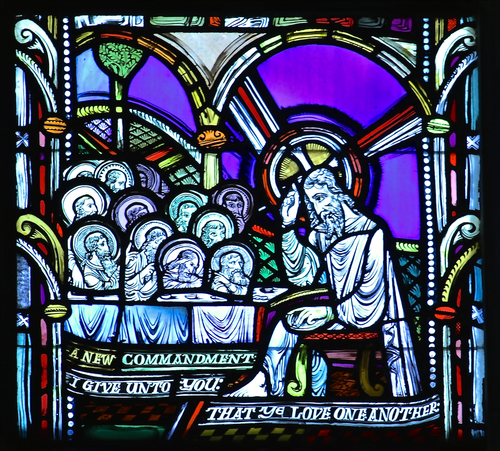
Stained glass by Edgar Miller (1899-1993)

When he was gone, Jesus said, “Now the Son of Man is glorified, and God is glorified in him. If God is glorified in him, God will glorify the Son in himself, and will glorify him at once.

“My children, I will be with you only a little longer. You will look for me, and just as I told the Jews, so I tell you now: Where I am going, you cannot come.

“A new command I give you: Love one another. As I have loved you, so you must love one another. By this everyone will know that you are my disciples if you love one another.” (New International Version)

The Church was formed to represent Christ on earth. The Church is a new community of believers in Jesus, called and empowered by the Holy Spirit for mission.

Christianity was never intended to be just a personal faith; it was designed by God to be the community of the redeemed. Christian community is vital to every individual’s faith.

“No one can have God for his Father who does not have the Church for his Mother.”

John Calvin (1509-1564)

Loyalty and commitment to God translates to having a dedicated and devoted spirit to one another in the church. 

One of the last commands Jesus gave to his disciples before he went to the cross was to “love one another.” The Old Testament instructed the Israelites to love each other (Leviticus 19:18). Yet, Jesus gives new meaning to the command through four distinctions of loving one another.

A New Model of Love: Jesus

Our Lord’s life and teaching gave new meaning to the command to love each other. Notice what Jesus did in the Upper Room just before giving the command to love one another:

It was almost time for the Jewish Passover festival. Jesus knew that the time had come for him to leave this world and go back to the Father. Jesus had always loved the people in the world who were his. Now was the time he showed them his love the most.

Jesus and his followers were at the evening meal. The devil had already persuaded Judas Iscariot to hand Jesus over to his enemies. (Judas was the son of Simon.) The Father had given Jesus power over everything. Jesus knew this. He also knew that he had come from God. And he knew that he was going back to God. So while they were eating, Jesus stood up and took off his robe. He got a towel and wrapped it around his waist. Then he poured water into a bowl and began to wash the followers’ feet. He dried their feet with the towel that was wrapped around his waist. (John 13:1-5, ERV)

Jesus modeled a service-oriented love of compassionately meeting the need of another, regardless of who that person is. It is instructive to us that Jesus washed the feet of Judas Iscariot, along with all the other disciples. 

Christ died for us while we were still sinners. This demonstrates God’s love for us.

Romans 5:8, GW

We are to love everyone in the community of saints, and not just our friends or the ones we like. Loving one another also means we will be realistic in understanding that community is messy and downright hard work.  

A New Motive: Christ First Loved Me

Jesus has loved us with a love that took care of our brokenness once for all. Because of that love, we are now motivated to love each other. John would later say in his first epistle: 

God showed his love for us by sending his only Son into the world, so that we might have life through him. This is what love is: it is not that we have loved God, but that he loved us and sent his Son to be the means by which our sins are forgiven. Dear friends, if this is how God loved us, then we should love one another. (1 John 4:9-11, GNT)

Love is an attitude and a frame of mind. The motivation for the Christian is different than anyone else’s motive:  We are so thankful for Christ’s love to us, that we cannot help but extend that same love to one another in the church. 

This kind of love transcends human willpower. This is love as a grateful response for the grace shown us in Christ.

A New Motivator: The Holy Spirit

The Spirit energizes and enables us to love each other. Jesus also said in the Upper Room: 

If you love me, you will do as I command. Then I will ask the Father to send you the Holy Spirit who will help you and always be with you. (John 14:15-16, CEV)

There are times when we may lack the ability or spiritual energy needed for the work of loving each other. It is in those times that we need to check our spiritual electrical box to make sure we haven’t tripped a breaker by trying to live the Christian life on our own strength. 

We need the Spirit. The Spirit gives us the zeal we need to love one another. 

We typically don’t do anything in life unless we have the motivation for it. The Spirit is like the Christian’s personal trainer – encouraging, exhorting, getting in our face, comforting, and spurring us – toward the new way of love. 

A New Mission: World Evangelization

All people will know we are Christ’s disciples if we love one another. The way we treat each other in the church is foundational and fundamental to the mission of loving our neighbors who don’t know Jesus.

“Mission is putting love where love is not.”

St. John of the Cross (1542-1591)

When the church has a healthy and even supernatural dynamic of loving one another, they joyfully proclaim the good news to every person that Jesus is the answer to the terrible brokenness of this world.

Community is necessary to mission. Lesslie Newbigin (1909-1998) was a British missionary to India for forty years. After retiring and returning to Britain, he found his homeland was very different than when he left. He was astounded to find Britain had become very less Christian and was now predominantly un-Christian. It was clearly a post-Christian society. What to do about it? Here is Newbigin’s response:

“I have come to feel that the primary reality of which we have to take account in seeking for a Christian impact on public life is the Christian congregation.  How is it possible that the gospel should be credible, that people should come to believe that the power which has the last word in human affairs is represented by a man hanging on a cross? 

I am suggesting that the only answer, the only hermeneutic of the gospel [the only way society can discern who Jesus is] is a congregation of men and women who believe it and live by it. I am, of course, not denying the importance of the many activities by which we seek to challenge public life with the gospel – evangelistic campaigns, distribution of Bibles and Christian literature, conferences, and even books such as this one. But I am saying that these are all secondary, and that they have power to accomplish their purpose only as they are rooted in and lead back to a believing community.”

Conclusion

The implications of community for our faith are significant. If we keep other Christians at a distance and give them the stiff arm, we are really giving God the stiff arm. Jesus identifies so closely in love to his people, that to love them is to love him.

The late African-American preacher E.V. Hill told the following story about an experience with a white Christian leader in the 1950s:

“As a freshman at Prairie View College (part of the Texas A&M system) I was actively involved and was one of two students selected to go to our denomination’s annual meeting in Memphis. The trip through the South was by car—three whites and two blacks traveling together. I had no idea how we’d eat or how we’d sleep. So great was my anxiety and hatred over how the trip might turn out that I almost backed out entirely …. In all my experience I had never seen a white man stand up for a black man and never felt I would. 

But then Dr. Howard, the director of our trip and a white man spoke up. ‘We’ll be traveling together,’ he said. ‘If there isn’t a place where all of us can eat—none of us will eat. If there’s not a place all of us can sleep—none of us will sleep.’ That was all he said, but it was enough! For the first time in my life, I had met a white man who was Christian enough to take a stand with a Christian black man.” 

May the Spirit give us the courage together to love one another.

Gracious Lord, I pray for those who will believe in you through the good news of forgiveness in Christ. I pray that all of them may be one just as you are one. May they be brought to complete unity to let the world know that you sent the Son, Jesus, and have loved them even as you have loved us. Righteous God, may you help us make you known in the world so that the love you have for us may be in them through the cross of Christ. Amen.