

Luke 9:28-43 – Transfiguration Sunday: Listen to Jesus

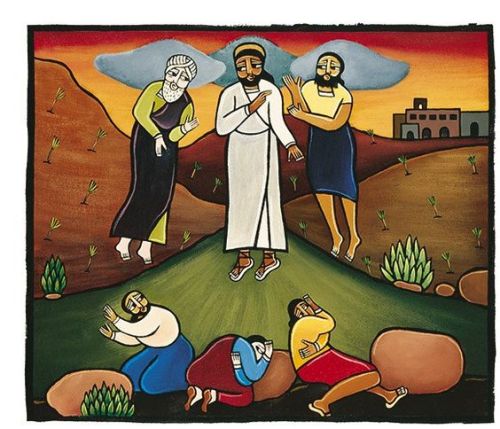
Transfiguration by Laura James

Jesus took Peter, John and James with him and went up onto a mountain to pray. As he was praying, the appearance of his face changed, and his clothes became as bright as a flash of lightning. Two men, Moses and Elijah, appeared in glorious splendor, talking with Jesus. They spoke about his departure, which he was about to bring to fulfillment at Jerusalem. Peter and his companions were very sleepy, but when they became fully awake, they saw his glory and the two men standing with him. As the men were leaving Jesus, Peter said to him, “Master, it is good for us to be here. Let us put up three shelters—one for you, one for Moses and one for Elijah.” (He did not know what he was saying.)

While he was speaking, a cloud appeared and covered them, and they were afraid as they entered the cloud. A voice came from the cloud, saying, “This is my Son, whom I have chosen; listen to him.” When the voice had spoken, they found that Jesus was alone. The disciples kept this to themselves and did not tell anyone at that time what they had seen.

The next day, when they came down from the mountain, a large crowd met him. A man in the crowd called out, “Teacher, I beg you to look at my son, for he is my only child. A spirit seizes him, and he suddenly screams; it throws him into convulsions so that he foams at the mouth. It scarcely ever leaves him and is destroying him. I begged your disciples to drive it out, but they could not.”

“You unbelieving and perverse generation,” Jesus replied, “how long shall I stay with you and put up with you? Bring your son here.”

Even while the boy was coming, the demon threw him to the ground in a convulsion. But Jesus rebuked the impure spirit, healed the boy and gave him back to his father. And they were all amazed at the greatness of God. (New International Version)

When Jesus is around, extraordinary things happen. And yet, sometimes we just don’t perceive it. The three disciples of Jesus – Peter, James, and John – experienced something incredible, yet they were not really aware of what it meant, at the time. The Transfiguration of Jesus on the mountain was unimaginable and awesome. The disciples, however, were confused, sleepy, and walked away silent about the whole affair. 
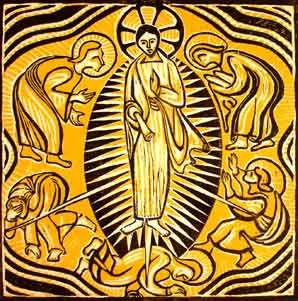
Woodcut of the Transfiguration by Sister Mary Grace Thul

Coming down from the mountain, the other disciples were found scratching their heads about a boy in need of healing. Jesus seemed rather perturbed about the all-around lack of faith. After curing the boy, everyone was amazed, as if they did not expect such a thing to occur.

We are not always told in the Gospels why Christ’s disciples often did not understand or perceive the significance of the miraculous, supernatural, or extraordinary events that took place right in front of them. Maybe their minds were somewhere else.

It could be that Peter had ADD (Attention Deficit Disorder) and was having trouble focusing.

Perhaps James trying to do some sort of ancient multi-tasking. 

Maybe John had some road rage on his way to the meeting on the mountain and was having a hard time thinking straight.

It could be that the three disciples were caught up in the anxiety of wondering where their next shekel was coming from.

Perhaps they were just up too late the night before binge watching the fishermen on the lake. But whatever was going on with the disciples, they were distracted.

So, we actually have God the Father step into the scene at the Transfiguration of Jesus on the mountain and speak. God isn’t typically in the business of exhorting people to listen unless they are not paying attention. The heavenly Father is clear, succinct, and to the point:

“This is my Son, whom I have chosen; listen to him.”

We are to listen to Jesus because he is God’s Son. Everything centers round him. 

Jesus is the full bodily and human representation of God on earth. Jesus is Savior, Lord and Master, Teacher and Healer.

Jesus is the complete fulfillment of all the Old Testament promises, and the one who will come again to judge the living and the dead.

Jesus is the mid-point of history, the hinge upon which all the universe swings. Jesus is the one whom we must listen to when he speaks and acts.

Therefore, our identity is to be fully bent, molded, and shaped in Jesus Christ. This spiritual formation of our lives happens as we intentionally seek to be with Jesus, listen to him, and do what he says. 
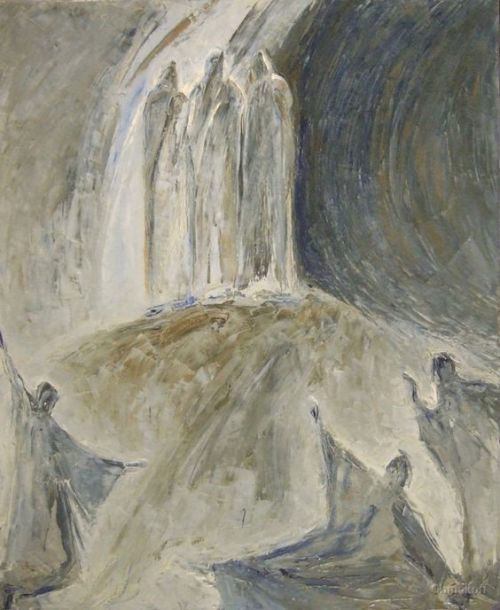
Transfiguration by Macha Chmakoff 

Jesus took Peter, James, and John up the mountain to experience his Transfiguration in a prayer meeting. Extraordinary things happen in prayer meetings. The early church gathered often in prayer meetings, following the example of their Lord Jesus. As the church listened to God and responded (in a rhythm of revelation and response) they saw Peter miraculously delivered from jail; ordinary people delivered from empty lives and demonic influence; and guidance in how to proceed as followers of Christ. 

Prayer is as much or more about listening to God as it is talking to him. It is in listening to God that we are filled with God’s Spirit and empowered to come down from the mountain and engage in God’s mission.

Jesus wanted the disciples to learn and discern something on the mountain. Jesus was changed in front of them. Moses and Elijah showed up and talked with him about his “departure,” that is, his “exodus.”

Moses was the one who listened to God and led the people in a mass exodus from slavery in Egypt to the freedom of the Promised Land.

Elijah was a prophet who listened to God and led the people out of centuries of idol worship and dead religion into the freedom of spiritual and national revival in Israel. 

And Jesus came to lead people in an exodus out of sin, death, and hell so that they can experience a new life of freedom, hope, peace, and joy.

Changed lives are God’s goal for us.  And a changed life will occur when we listen to God’s Son, Jesus, learn from him, and lean into faith in him – all of which takes humility.

Eventually, Jesus and his disciples came down from the mountain. Prayer meetings are great, but there is a time to descend the mountain and engage in God’s mission.

We are to participate with God in seeing changed lives through the work of Jesus.

We must bear witness to the redemptive saving events of Jesus to a world which desperately needs him – his healing work of both body and spirit.

The glory of God is presently here among us. We need to perceive it and be aware of it.  But to do so, we must listen well. 

Erik Weihenmayer is blind, yet on May 25, 2001, he reached the peak of Mount Everest. Suffering from a degenerative eye disease, he lost his sight when he was thirteen years old. But that did not stop him from mountain climbing. On a mountain where 90% of climbers never make it to the top—and 165 have died trying since 1953—Erik succeeded in large measure because he listened well. 

He listened to the little bell tied to the back of the climber in front of him, so he would know what direction to go. He listened to the voice of teammates who would shout back to him, “Death-fall two feet to your right!” so he would know what direction not to go. He listened to the sound of his pick jabbing the ice, so he would know whether the ice was safe to cross. 

When we journey through this life, listening well makes all the difference. So, how might we listen well to Jesus?  Here are some basic principles of active listening:

  1. Stop talking.  It was Mark Twain who said: “If we were supposed to talk more than we listen, we would have two tongues and one ear.” Proverbs 12:15 says, “The way of a fool seems right to him (therefore he has no need to listen) but a wise person listens to advice.”
  2. Prepare yourself to listen to God.  One of the ways I do this is by sitting in a quiet spot, free of distraction, and repeat several times to God, “Speak Lord, for your servant is listening” (1 Samuel 3:10). Then, I am quiet… and listen….  If this practice is way off your radar then I would recommend, at first, being quiet for only a few minutes. Then, after a few weeks, be quiet in longer stretches so that you can go 20-30 minutes or even an hour. We might even consider a silent retreat in which the sole purpose is to listen to what God is saying to us.
  3. Slowly and carefully read God’s Word. Scripture is meant to be digested in small bites and thoroughly savored. Slow down and be quiet enough to hear God speak through the Word. A contemplative and meditative readings of Holy Scripture will always yield spiritual health and vitality.
  4. Pray back to God what you hear him saying to you. This is active listening – a genuine dialogue between us and God. “Come, now, let us reason together,” the Lord has said (Isaiah 1:18). God wants a conversation with us.

God speaks, if we have ears to hear, through so much more than an audible voice.

The Lord’s Supper is a tangible proclamation of the person and work of Jesus Christ. It speaks to us, and, so, we must listen well. The Table proclaims Christ’s identity as God’s Son, the one who came to live a holy life, teaches us the way to live, and how Jesus died a cruel death so that we might be born again and experience new life. 

We Are All One in Jesus Christ by Soichi Watanabe, 2009

The Table proclaims our mission, that as often as we share in communion, we proclaim the Lord’s death until he comes again. That is, we witness to the reality of Christ’s redemption in our own lives. We share our own changed lives with others. We pray for them so that they will experience new life, as well. 

The Table proclaims our spiritual formation in Christ. At the Table, we are lifted and joined with Christ through the Holy Spirit. It is a mysterious joining that defies description, just as the disciples had a mysterious encounter that they could not fully explain. Yet they experienced it, nonetheless.

May we listen well, without distraction, to God’s Son. May we know God’s purpose for our life. And may we encounter Jesus at the Table, and in all of life, so that we experience new life. 

O God, teach us to listen to those nearest to us, our family, our friends, our co-workers. Caring God, teach us to listen to those far from us – the whisper of the hopeless, the plea of the forgotten, and the cry of the anguished. Holy Spirit of God, teach us to listen for your voice — in busyness and in boredom, in certainty and doubt, in noise and in silence. Gracious God, teach us to listen well to the message of your Table. May you change and transform us to be like Jesus. Teach us, Lord, to listen. Amen.

When Will We Engage Our Ministry?

Welcome, friends!

Acts 1:1-11 contains the final words of Christ on this earth. Jesus gave his followers a mandate, not to sit idly and wait for his return, but to embody their identity as witnesses to what they have seen and heard for a world in need of God’s deliverance and love. Click the videos below, and let us embrace our purpose and mission as the people of God….

Pastor Tim Ehrhardt, Acts 1:8

God of hope and courage, you call each of us to bear witness to your abundant love in a frightened world. All around us are signs the world is struggling and the future is unclear. Strengthen our confidence in your unfailing grace and grant us the courage to move onward even when we cannot see the way, knowing that you will guide our every step. Amen.

Acts 1:1-11 – When Will We Engage in Our Ministry?

In my former book, Theophilus, I wrote about all that Jesus began to do and to teach until the day he was taken up to heaven, after giving instructions through the Holy Spirit to the apostles he had chosen. After his suffering, he presented himself to them and gave many convincing proofs that he was alive. He appeared to them over a period of forty days and spoke about the kingdom of God. On one occasion, while he was eating with them, he gave them this command: “Do not leave Jerusalem, but wait for the gift my Father promised, which you have heard me speak about. For John baptized with water, but in a few days you will be baptized with the Holy Spirit.”

Then they gathered around him and asked him, “Lord, are you at this time going to restore the kingdom to Israel?”

He said to them: “It is not for you to know the times or dates the Father has set by his own authority. But you will receive power when the Holy Spirit comes on you; and you will be my witnesses in Jerusalem, and in all Judea and Samaria, and to the ends of the earth.”

After he said this, he was taken up before their very eyes, and a cloud hid him from their sight.

They were looking intently up into the sky as he was going, when suddenly two men dressed in white stood beside them. “Men of Galilee,” they said, “why do you stand here looking into the sky? This same Jesus, who has been taken from you into heaven, will come back in the same way you have seen him go into heaven.”

When will we engage in our ministry? The short answer: Now.

The angels in this story sound a lot like my mom when I was a kid: “Why are you just standing there looking into an empty sky?  You need to quit your gawking and get to work!”

But sometimes we can be confused about what it is we are supposed to be about or when we are supposed to do it. Jesus was quite clear about what the mission of his followers is to be: witnesses.  And the angels essentially tell the disciples to quite their gawking and get to work on being witnesses.

Being a Witness Now

The mission is not simply to do some sort of evangelical job of witnessing, but to be a witness. What we do flows from who we are and what we have seen. If we have seen and experienced the risen Lord, we are witnesses. We then tell of what we have seen and heard, not necessarily because it’s our job, but because we just cannot help it.

A mom nurtures her kids because she is a mom; it isn’t just a job – it’s who she is. To be a witness involves the kind of people we are. The word “witness” is literally the term “martyr.”  A martyr, as the term has been used throughout church history, is:

  • One who chooses to suffer death rather than deny the person and work of Jesus Christ.
  • One who bears testimony to the truth of what they have seen or have experienced with God.
  • One who sacrifices all things to further God’s kingdom.
  • One who is willing to endure anything from anyone to maintain their Christian witness. 

A martyr is someone we are, not a task that gets checked off a to do list.

There is a clear mandate and mission given by Jesus, the Head of the Church: We are witnesses. We are participants in service to Christ the King, and not fans of Jesus only cheering in the bleachers. It’s a very different experience being a fan in the stands than a player on the field.

In baseball, some fans think they know what all the right calls are, then graciously let the umpire know when he is wrong. Being a spectator is significant. Yet, for us here on this earth, it is not yet our time for that. Those who have gone before us, lived in faith, and were martyrs, are testifying to us….

Some faced jeers and flogging, and even chains and imprisonment. They were put to death by stoning; they were sawed in two; they were killed by the sword. They went about in sheepskins and goatskins, destitute, persecuted and mistreated—the world was not worthy of them. They wandered in deserts and mountains, living in caves and in holes in the ground. These were all commended for their faith, yet none of them received what had been promised, since God had planned something better for us so that only together with us would they be made perfect….

Therefore, since we are surrounded by such a great cloud of witnesses [martyrs], let us throw off everything that hinders and the sin that so easily entangles. And let us run with perseverance the race marked out for us, (Hebrews 11:36-40, 12:1, NIV)

The Christian fans in the heavenly stands are witnessing that they have participated in God’s mission. And they are not unruly – spilling their beer on people and getting kicked out of the stadium. Instead, they are encouraging us who are here, right now, on this earth, seeking to fulfill Christ’s mandate.

Those who have gone before us are passing the baton of leadership and the message of good news to us – and they expect us to run with it – not to try and sit in the stands as spectators because it is not yet our time.  They are cheering us on, letting us know it’s all worth it.

Now is the time to be witnesses of what God in Christ has done and is doing. God created a perfect world. Man and woman fell into disobedience and sin. Now, God is in the business of restoring and renewing all creation. So, we are to witness to what God has done, and is doing, because our identity is thoroughly in Jesus Christ. It is our heritage and our privilege.

“Let God be the Judge. Your job today is to be a witness.”

Warren Wiersbe

In the 1990s a Christian prisoner in Cuba was asked to sign a statement containing charges against fellow Christians that would lead to their arrest. He said, “The chain keeps me from signing this.” The communist officer protested, “But you are not in chains!” “I am,” said the Christian. “I am bound by the chain of witnesses who throughout the centuries gave their lives for Jesus Christ. I am a link in this chain. I will not break it.”

Christ’s words are directed to us: “You will be my witnesses,” you and me. If we look at this as merely a task, we will likely give up and whine, saying, “This is too hard. It takes too much time. There’s too much suffering. This isn’t for me!” 

If we understand our identity as being a witness, then we will love God with all our heart, soul, mind, and strength. We willingly abandon our own personal agendas and adopt the will of God for our lives. And the will of God is that we embrace our identity as witnesses to the redemptive events of Jesus – Christ’s incarnation, holy life, compassionate ministry, suffering and death, rising from the grave, and ascending to heaven.

What do you have to witness to? Here is a teenage girl’s witness when he stood glaring at her, his weapon before her face, asking, “Do you believe in God?” She paused because it was a life or death question. “Yes, I believe in God.” “Why?” asked her executioner. But he never gave her the chance to respond. The 17-year-old girl lay dead at his feet. 

This scene could have happened in the Roman coliseum, in the Middle Ages, or in any number of countries around the world today. People are still being imprisoned, tortured, and killed every day because they refuse to deny the name of Jesus. This particular story, though, did not happen in ancient times or in another country. It happened at Columbine High School in Littleton, Colorado on April 20, 1999.

Being a Witness Everywhere to Everyone Now

The original witnesses of Jesus Christ embraced the mandate of being witnesses. Not far into the New Testament book of Acts, 3,000 people in Jerusalem were converted to Christianity through one sermon from Peter’s witness. Philip broke all kinds of taboos by going to Samaria and being a witness to the half-breed Samaritans. Peter broke all convention by going into a Gentile’s house and seeing the Spirit come on them. Saul, who became Paul, was dramatically converted and went on three separate missionary journeys so that he could take the good news of Jesus Christ to the ends of the earth.

We are to be witnesses wherever we go with whomever we encounter. We will be witnesses in Jerusalem (our families); in Judea (our community); in Samaria (other races and people different from ourselves); and, to the ends of the earth (overseas).

Being a Witness Through the Spirit’s Empowerment Now

Only after giving the mission to his followers did Jesus ascend to heaven. The ascended Lord is to be our confidence and our hope. We are not alone. We possess Christ’s authority and the Spirit’s help. The power to be a witness is not generated from within us but comes from God’s Spirit.

Jesus will return. Until then, we are to be his witnesses. It’s not the time to sit in the bleachers. We have been given power to accomplish the mission before the end of this world comes, and before Jesus comes again to judge the living and the dead.

Being a witness is not a one-time, one-size-fits-all work. Our own witness is just that: ours. We all have our own stories of faith and experiences of the risen and ascended Christ. There’s really nothing flashy or sexy about being a witness. Rather, it mostly entails a consistent and patient witness of love. It’s a lifestyle and a way of life in which our love for God pours out of our heart and soul and is expressed with all our mind and strength.

Every Christian can witness to what God is doing in their life – to tell our story of what God has done and is doing with us.

Holy God, you are making all things new through your gracious reconciling and restorative work. Grant us, your people, the vision to see you at work in our world healing our brokenness and making us new. Grant us the wisdom to hear your voice through the noise that surrounds us. And grant us the courage to bring to fruition the world you are creating, through Jesus Christ our Lord, in the power of your Holy Spirit. Amen.

Luke 11:37-52 – Calling Them Out

Pharisees by German painter Karl Schmidt-Rottluff, 1912

When Jesus had finished speaking, a Pharisee invited him to eat with him; so, he went in and reclined at the table. But the Pharisee was surprised when he noticed that Jesus did not first wash before the meal.

Then the Lord said to him, “Now then, you Pharisees clean the outside of the cup and dish, but inside you are full of greed and wickedness. You foolish people! Did not the one who made the outside make the inside also? But now as for what is inside you—be generous to the poor, and everything will be clean for you.

“Woe to you Pharisees, because you give God a tenth of your mint, rue and all other kinds of garden herbs, but you neglect justice and the love of God. You should have practiced the latter without leaving the former undone.

“Woe to you Pharisees, because you love the most important seats in the synagogues and respectful greetings in the marketplaces.

“Woe to you, because you are like unmarked graves, which people walk over without knowing it.”

One of the experts in the law answered him, “Teacher, when you say these things, you insult us also.”

Jesus replied, “And you experts in the law, woe to you, because you load people down with burdens they can hardly carry, and you yourselves will not lift one finger to help them.

“Woe to you, because you build tombs for the prophets, and it was your ancestors who killed them. So, you testify that you approve of what your ancestors did; they killed the prophets, and you build their tombs. Because of this, God in his wisdom said, ‘I will send them prophets and apostles, some of whom they will kill and others they will persecute.’ Therefore, this generation will be held responsible for the blood of all the prophets that has been shed since the beginning of the world, from the blood of Abel to the blood of Zechariah, who was killed between the altar and the sanctuary. Yes, I tell you, this generation will be held responsible for it all.

“Woe to you experts in the law because you have taken away the key to knowledge. You yourselves have not entered, and you have hindered those who were entering.” (New International Version)

“The greatest way to live with honor in this world is to be what we pretend to be.”

Socrates

An outward showy spirituality means little to nothing – and it actually results in injustice and a lack of concern for others. Conversely, paying attention to the inner person has the effect of making our outer actions helpful and healing.

As you can tell from today’s Gospel lesson, Jesus had no use for the showy kind of spirituality. He was looking for a generous spirit of love and justice, willing to share with others from altruistic and benevolent motives. Instead, he got bupkis.

The woes Jesus pronounced on the showy spiritual charlatans were a kind of grieving and lamenting of how far astray the religious were from genuine heartfelt spirituality.

Unfortunately, there are pious people today who claim the name of Christ and slam the door of God’s kingdom in the faces of others by:

  • Saying God’s grace is for all, then turning around and avoiding certain people, calling them “sinners.”
  • Having explicit written statements or rules that exclude people from serving God.
  • Binding people to human traditions and practices instead of Holy Scripture. 
  • Declaring the seven deadly words of the Church: “We’ve never done it that way before.” 

Jesus called the religious leaders out. And rather than listening and changing, the leaders just felt insulted and offended. They refused to hear that their nit-picking religious obsessions and criticizing judgments of others kept people from accessing God’s love and justice.

The Lord’s words are pointed and hard. Jesus talked to them this way, it seems to me, because they probably wouldn’t have heard it any other way. In other words, Christ talked their language so they could hear him.

The Pharisees often get a bad rap. But they were faithful givers. They rightly and deservedly gave a tenth of everything they had. However, the problem was that they did it so they could feel really good about themselves, thereby feeling justified in neglecting the weightier matters of the law, the stuff they really didn’t want to do. 

This is the kind of mental gymnastics which is still done today, by saying, “Hey, man, I do my part. I give,” but all the while having no intention of focusing on weightier matters of justice, mercy, and faithfulness. It is essentially using money and stuff to buy off God. It is focusing on the minutia of pennies and dimes, instead of saving lives.

The weighty matters of the Law were there in the Old Testament. They just got ignored….

“This is what the Lord All-Powerful said:
‘You must do what is right and fair.
    You must be kind and
    show mercy to each other.
Don’t hurt widows and orphans,
    strangers, or poor people.
Don’t even think of doing bad things to each other!’”

But they refused to listen
    and refused to do what he wanted.
They closed their ears so that they
    could not hear what God said.
They were very stubborn
    and would not obey the law.
The Lord All-Powerful used his Spirit
    and sent messages to his people through the prophets.
But the people would not listen,
    so the Lord All-Powerful became very angry. (Zechariah 7:9-12, ERV)

Righteousness is profoundly social. It has to do with pursuing right relationships with people, not just people I like or who I feel deserve it. Jesus mentioned justice and love because these terms really have to do with our neighbors, not only our buddies and cronies. 

Any evil person can love those who love him; but the one who loves Jesus, loves the people for whom no one else cares or loves.

As God’s people, we are meant by the Lord to be forthright, frank, genuine, honest, humble, open, real, truthful, authentic, just, righteous, sincere, and upright in all our relations with others. To do otherwise is to be hypocritical.

Hypocrisy does not practice what it preaches, keeps people out of God’s kingdom, focuses on externals, and majors on the minors. Jesus loved the Pharisees enough to call them out and call them back to the true worship of God.

Because anything less than a deep concern for all humanity is not true religion.

Blessed God and Father of the universe, I am not above you and I am not the master of all things. Instead, I am your servant and your child. Help me be quick to look at myself when I am prone to look over to others. Thank you that you have wild and abundant grace for me that will never end nor let me go. Teach me your ways and help me be receptive to them, so I will not fall. I submit to your rule and reign over all things, including all my thoughts, opinions, perceptions, decisions, beliefs, and actions, through Jesus Christ my Lord. Amen.