Revelation 1:9-20 – I Am Fully Alive

Notre Dame Cathedral Basilica in Ottawa, Canada

I, John, your brother and companion in the suffering and kingdom and patient endurance that are ours in Jesus, was on the island of Patmos because of the word of God and the testimony of Jesus. On the Lord’s Day I was in the Spirit, and I heard behind me a loud voice like a trumpet, which said: “Write on a scroll what you see and send it to the seven churches: to Ephesus, Smyrna, Pergamum, Thyatira, Sardis, Philadelphia and Laodicea.”

I turned around to see the voice that was speaking to me. And when I turned I saw seven golden lampstands, and among the lampstands was someone like a son of man, dressed in a robe reaching down to his feet and with a golden sash around his chest. The hair on his head was white like wool, as white as snow, and his eyes were like blazing fire. His feet were like bronze glowing in a furnace, and his voice was like the sound of rushing waters. In his right hand he held seven stars, and coming out of his mouth was a sharp, double-edged sword. His face was like the sun shining in all its brilliance.

When I saw him, I fell at his feet as though dead. Then he placed his right hand on me and said: “Do not be afraid. I am the First and the Last. I am the Living One; I was dead, and now look, I am alive for ever and ever! And I hold the keys of death and Hades.

“Write, therefore, what you have seen, what is now and what will take place later. The mystery of the seven stars that you saw in my right hand and of the seven golden lampstands is this: The seven stars are the angels of the seven churches, and the seven lampstands are the seven churches. (New International Version)

“Let every man and woman count himself immortal. Let him catch the revelation of Jesus in his resurrection. Let him say not merely, ‘Christ is risen,’ but ‘I shall rise.’”

Phillips Brooks (1835-1893)

Easter Sunday may have come and gone, but the church remains in the season called “Eastertide,” which extends forty days until celebrating Christ’s ascension to heaven. This means that Easter is not just a one day affair; it is a joyous time of focusing on new life and exulting in the resurrected Lord. 

The Apostle John had a vision of the resurrected Jesus in his glory. Although John was quivering in his sandals, the Lord assured him that he need not be afraid. Christ is not dead but living.

Jesus is alive! Since Christ is risen, God’s people are united with him in his resurrection. That means the church is alive. Yes, the church is a-l-i-v-e, alive! 

The term “dead church” gets bantered around quite a bit these days. But that is really an oxymoron; a genuine Christ redeemed Body of believers cannot possibly be dead; they are alive! 

If a church is dead, it is not a church. It could be a country club, a benevolent organization, and even a moral institution, but a church is not a church if it is dead because Jesus is alive, and his Body is anything but dead.

Christians have life in Jesus Christ. We are alive forevermore because Jesus will never again die. So, then, we are to live as vigorous and vibrant believers. 

What things will you do differently since you know you cannot die? 

How will the knowledge of your eternal alive-ness impact you today and every day? 

The truth is: We have been raised with Christ to new life; we cannot die because death no longer has mastery over us. We can now live by faith in the Son of God who loved us and gave himself for us.

Just as Christ was raised from the dead through the glory of the Father, we too may live a new life.

For if we have been united with him in a death like his, we will certainly also be united with him in a resurrection like his. For we know that our old self was crucified with him so that the body ruled by sin might be done away with, that we should no longer be slaves to sin—because anyone who has died has been set free from sin.

Now if we died with Christ, we believe that we will also live with him. For we know that since Christ was raised from the dead, he cannot die again; death no longer has mastery over him. The death he died, he died to sin once for all; but the life he lives, he lives to God.

In the same way, count yourselves dead to sin but alive to God in Christ Jesus. (Romans 6:4-11, NIV)

“The glory of God is a person fully alive, and the life of a person is the vision of God.”

St. Irenaeus (130-202, C.E.)

Humanity’s alive-ness is what most fully displays the glory of God on this earth. Christ living within the believer is a powerful and potent manifestation of God’s goodness.

Whereas we may think that great miracles are the best sign of God’s presence and power in the world, the truth is that being full alive, and living into the new life we possess, is a bright light which shows the way of transformation to a fallen planet in the vice grip of sin, death, and hell.

God’s generosity, wisdom, and love are supremely viewed with the changed life of an individual. Living life to the full in this post-resurrection era, influences how we treat one another because we nobly honor our fellow humanity as people bearing the divine image of God.

We, therefore, in our alive-ness, seek to understand one another because we know that each person around us is worth understanding. Our being fully alive moves us to cultivate a virtuous life, knowing that a life well-lived is the best witness to God’s glory.

Believers raised with Christ are filled with joy, realizing that living is in itself a great good. We hope to carry this joy into the world and bear witness to the beauty of each human life.

O God, as people fully alive, make us bold in love, courageous in hope, and whole in faith. May the blessing of God almighty – Father, Son, and Spirit – be upon the Church everywhere, today and always, through Christ our risen Lord. Amen.

Revelation 1:4-8 – The One Who Is, Who Was, and Who Is To Come

John,

To the seven churches in the province of Asia:

Grace and peace to you from him who is, and who was, and who is to come, and from the seven spirits before his throne, and from Jesus Christ, who is the faithful witness, the firstborn from the dead, and the ruler of the kings of the earth.

To him who loves us and has freed us from our sins by his blood and has made us to be a kingdom and priests to serve his God and Father—to him be glory and power for ever and ever! Amen.

“Look, he is coming with the clouds,”
    and “every eye will see him,
even those who pierced him”;
    and all peoples on earth “will mourn because of him.”
So shall it be! Amen.

“I am the Alpha and the Omega,” says the Lord God, “who is, and who was, and who is to come, the Almighty.” (New International Version)

In my undergraduate college days, one of the required classes for my major was “Philosophy of History” taught by a crusty old professor who looked like he was one-hundred-and-ten-years-old. One day he came into the classroom and began his lecture by looking directly at me with those beady black eyes of his and said, as only he could say it, “Ehrhardt! Can God change history?”

The Apostle John was exiled to the island of Patmos. Late in the first century, all the other original disciples of Jesus were dead, having been martyred for their faith. Only John was left. The churches that the Apostle Paul established in Asia Minor were undergoing significant persecution. 

The trouble began with the church facing social ostracizing. Eventually, xenophobia took hold with many parts of the Roman Empire, and Christians began getting martyred. Misunderstandings of what the church is all about were rife.

If we were living during that time, we might seriously wonder if Christianity would survive, at all. Into this situation, the last Apostle, John, in exile, experienced a great vision (revelation) of Jesus concerning what is to come. While things looked awfully bleak, God graciously pulled back the veil between heaven and earth long enough for John to glimpse the great lordship of Jesus.

So, can God change history? You might be wondering about my response to the old professor. My answer was this: The question is only relevant if God were never in control and sovereign over history to begin with. There’s no need to change history if God is already actively working out divine purposes through history. Therefore, a more appropriate question is: Since God is Lord over all history, will we submit to the divine lordship? 

In difficult times, it’s only human to wonder if God is really sovereign over all the earth. With so much war, violence, and unrest in the world; with so many natural disasters and diseases all around; and whenever Christianity (and religion itself) is seen as a threat to many, we may sincerely ask ourselves, “Can God change history? Is God even in control of this present world?”

The revelation of Jesus to John, which he then shared with the struggling churches, was meant to encourage them – to give them hope that, even though Christ’s reign is invisible and seems limited and temporary, it will ultimately be visible, and is pervasive and permanent. 

Today’s New Testament lesson is meant to strengthen and bolster the believer’s faith with a vision of who Jesus is; what Jesus has done; and what Jesus will do.

Who Jesus Is

He is the faithful witness. The word “witness” is where we get our English word “martyr.” Faithful believers in the first centuries of the church witnessed to their faith and proclaimed the gospel of new life in Christ. They were effective enough to alter the social order, which brought persecution and, in some cases, death. 

These men and women died proclaiming their devotion to Jesus. They saw themselves as merely emulating and following the way of their sovereign Lord Jesus, who was himself a faithful martyr.

Jesus is the firstborn from the dead, that is, Christ has conquered death. Just as Christ rose from death, so also, we will be raised to life. Because Jesus is alive, Christians will live forever and experience bodily resurrection, as well.

Whatever happens to Jesus, happens to us. Jesus was persecuted, suffered, and died. We, too, shall suffer persecution and death. Jesus was raised from the dead and so shall we. The evil we experience in this life is very much known to God. Our solidarity with Jesus helps us to not grow weary and lose heart.

Jesus is the ruler, the king of kings and lord of lords. God reigns over the past, the present, and the future. Christ is in charge, presently now working out good plans and purposes. God bends events, situations, and hearts toward justice and righteousness. 

What Jesus Has Done

Jesus freed us from the power of sin by his blood. This is more than some nice information to know; it is truth designed for us to live a new life depending on King Jesus. Sometimes, we have horrible, no good, very bad days. We don’t respond to others well,  and then ask God’s forgiveness. Other days are wonderful, with bright sunshine and a spring in your step. We play well with others and express gratitude to God.

Jesus is Lord of both good days and bad days. Faith is not dependent upon our circumstances because it is the blood of Jesus which has freed us to live for God, no matter the situations we face. Christians overcome circumstances by the blood of Christ – and not because everything goes our way.  

We are never far from the cross of Christ. We overcome bad tempers, defeats, disordered love, fears, pettiness, and a host of other things by the blood of the Lamb. The daily goal is to not simply have a wonderful day without any adversity. Rather, the aim is to know Jesus Christ, and him crucified, dead, risen and ascended. 

Jesus has made us to be a kingdom of priests. Christians have continual access and unconditional acceptance of God through the blood of Jesus. We can intercede for others by going directly to God. Just as Jesus has unlimited access to the Father, so, the Christian has the privilege of coming to God at all times. 

Christians are a kingdom of priests where every believer intercedes for other believers, and even for the world which persecutes them. Jesus not only freed us from sin’s grip of evil for our own individual benefit, but also so that we can be agents of rescue for others. 

What Jesus Will Do

Jesus will come to judge the earth, the living and the dead. Moving deeper into Revelation, it truly becomes apocalyptic. It’s as if a group of trapped cave explorers choose one of the individuals to squeeze through a narrow flooded passage to get out to the surface and call for help. The point of the choice is more than personal salvation, it is the saving of the entire group. She is to bring help and equipment to ensure the rest get rescued.

Indeed, God elects, chooses, and calls us not only for our personal benefit but for the sake of many.

Conclusion

Jesus is worthy of our praise. He is the Alpha and Omega, the beginning and the end, the first and the last. His kingdom will never end. Since this is true, we are to faithfully serve God. In life and in death, we belong to God. We are not our own; we were bought at a price. 

“Can God change history?” is not the real question. Since God has changed history forever in the sending of the Son, the proper question is, “What will we do with the lordship of Christ over the world?”

Jesus is coming soon. When he returns, what will he find you doing?

Gracious God, we pray for Christ’s Church everywhere. Fill it with all truth and peace. Where it is corrupt, purify it; where it is in error, direct it; where anything it is amiss, reform it. Where it is right, strengthen it; where it is in want, provide for it; where it is divided, reunite it; for the sake of Jesus Christ, your Son, our Savior. Amen.

Luke 24:1-12 – The Wonder of Christ’s Resurrection

Women at the empty tomb of Jesus encountering an angel

On the first day of the week, very early in the morning, the women took the spices they had prepared and went to the tomb. They found the stone rolled away from the tomb, but when they entered, they did not find the body of the Lord Jesus. 

While they were wondering about this, suddenly two men in clothes that gleamed like lightning stood beside them. In their fright the women bowed down with their faces to the ground, but the men said to them, “Why do you look for the living among the dead? He is not here; he has risen! Remember how he told you, while he was still with you in Galilee: ‘The Son of Man must be delivered into the hands of sinners, be crucified and on the third day be raised again.’” Then they remembered his words.

When they came back from the tomb, they told all these things to the Eleven and to all the others. It was Mary Magdalene, Joanna, Mary the mother of James, and the others with them who told this to the apostles. But they did not believe the women, because their words seemed to them like nonsense. Peter, however, got up and ran to the tomb. Bending over, he saw the strips of linen lying by themselves, and he went away, wondering to himself what had happened. (New International Version)

“The message of Easter is that God’s new world has been unveiled in Jesus Christ and you’re now invited to belong to it.”

N.T. Wright

The disciples were stuck in the yesterday of Holy Saturday and the grief of Good Friday. Christ’s death was nothing but bad news, leaving them with an awful wondering about what could have been.

And now, an empty tomb. What does it mean? The disciples did not yet discern the reality and impact of what had happened. Their perplexity and curiosity eventually turned to a different kind of wondering: The amazement that Christ is alive! That Jesus has taken care of the sin issue once for all. That a new order is now in force that forever changes everything!

We, too, have the chance to be amazed and in wondrous awe over the resurrection of Jesus. Because the resurrection of Jesus is not just a doctrine to be believed; it is a powerful reality to be lived, and a source of eternal wonder and praise.

Women Arriving at the Tomb by He Qi

The Wonder of the Female Disciples

Do you wonder why women were the first disciples to encounter the empty tomb and the risen Lord?

Women are central to Luke’s resurrection account because women are central to the gospel. They play a significant role, along with men, in the ministry of the good news of Jesus. Within an ancient culture, and religious milieu, in which men were prominent and women were not regarded as reliable witnesses to anything, God used the female disciples as the very first witnesses of the empty tomb. 

Women now play an important part alongside men in ministry. 

This fact was not lost on the early church, who commissioned both men and women as apostles, serving in the highest ranks of the ministry. For example, Junia was a female apostle – an eyewitness of Christ’s life, ministry, and death, as well as a leader who helped build the Church. (Romans 16:7) 

If you ever “wonder” what role women ought to play in the church, the answer is: They ought to serve in the highest offices of leadership because the female disciples were prominent witnesses to the resurrection, on purpose.

The female disciples were curious about the empty tomb. While they were wondering about it, a couple of angels show up and ask them a question designed to lead them to a proper interpretation of Christ’s missing body:

“Why do look for the living among the dead?”

He Is Risen by He Qi

Many people today seek Jesus among the dead. They look for him in empty places.

Some look for Jesus in good ideas, as if knowledge or education save us. We may reason: If we have all the right information, express right belief, and sign-off on right doctrine, then we are okay. However, we are not saved by thoughts, even understanding, as if our brains are what deliver us from sin, death, and evil. We are saved by the person and work of Jesus Christ (Romans 6:1-23).

Many look for Jesus through their efforts, as if I can work my way into the good graces of God. We believe that action is the key. So, whenever we mess up, we seek penance by beating ourselves up, in some way, to somehow atone for the mistakes. However, Jesus finished the work! We participate with Christ in his death and resurrection through faith, not by works. We cannot do for ourselves what Christ has already done for us. Our “work” is to believe, and to be in wonder. (John 6:28-29)

Folks might search for Jesus in the heart – feeling that if our belief is sincere, if I’m basically a good person, if my heart is in the right place, that’s what matters. Yet, we are not saved through sincerity, or by warm-fuzzy feelings about God, as if our hearts save us.

Our hearts can be desperately wicked and are in need of redemption. Through repentance and faith, people find Jesus. Since Jesus is in the heart transplant business, you will find him wherever there are people with critically low heart function.

To find Jesus, in the ancient world, one needed to find the tax collectors, the lepers, the blind, the poor, or even a Roman Centurion. Today, if you want to find Jesus, he will still be found among the poor, the diseased, the refugee, the immigrant, the prisoner, and those who are despised by others.

The last place you would look, in Christ’s day, is with the religious leaders. And today, whenever we look for God to show up with all the answers and all the heart transformation in church, we then wonder why we cannot see Jesus. That’s because Jesus is not in the grave but, as the risen Christ, is out bestowing new life to the people with sick and hard hearts.

Why do you look for Jesus in church? Rather than asking Jesus to come to us, let’s go to where he is.

Since Christ is alive, we are alive.

We need not be perplexed about the empty tomb because Jesus is alive!  He is risen!  This reality is to impact our lives forever:

Since then, you have been raised with Christ, set your hearts on things above, where Christ is, seated at the right hand of God. Set your minds on things above, not on earthly things. For you died, and your life is now hidden with Christ in God. When Christ, who is your life, appears, then you also will appear with him in glory. (Colossians 3:1-4, NIV)

This is the gospel, the good news of Christ. It’s no secret. Jesus made this plainly known. The gospel is not insider news. It’s freely available to everyone. Early in his ministry Jesus said to his disciples:

“The Son of Man must suffer many things and be rejected by the elders, the chief priests and the teachers of the law, and he must be killed and on the third day be raised to life.” (Luke 9:22, NIV)

A few years later, before heading for Jerusalem, Jesus laid it out again for them:

“We are going up to Jerusalem, and everything that is written by the prophets about the Son of Man will be fulfilled. He will be delivered over to the Gentiles. They will mock him, insult him and spit on him; they will flog him and kill him. On the third day he will rise again.” (Luke 18:31-33, NIV)

The Wonder of Peter

The women hurried to tell the disciples. But the men were clueless; they didn’t believe the women. Peter, always the impetuous one, hurried to see the tomb for himself. He left wondering (thinking hard about) what all this empty tomb stuff means.

So, why (since the disciples were told what was going to happen) were they left wondering what in the world the empty tomb was all about? 

Its meaning was hidden from them. They did not know what Jesus was really talking about. But this would all change. After appearing to them…

Jesus opened their minds so they could understand the Scriptures. He told them, “This is what is written: The Messiah will suffer and rise from the dead on the third day, and repentance for the forgiveness of sins will be preached in his name to all nations, beginning at Jerusalem. You are witnesses of these things. I am going to send you what my Father has promised; but stay in the city until you have been clothed with power from on high.” (Luke 24:45-49, NIV)

Conclusion

Present-day Christians know of Christ’s redemptive events of cross, resurrection, ascension, and the giving of the Spirit at Pentecost. We do not need to wonder (be perplexed). We are clothed with power from on high to accomplish the mission of Christ on this earth.

We can now revel and rejoice in wonder and awe over the person and work of Jesus.  We possess forgiveness of sins, the Holy Spirit, and one another because of Christ’s mighty resurrection from death. 

Perhaps we need a newfound sense of wonder (awe) about Christ and his rising from death so that the resurrection of Jesus is not only a doctrine to believe, but a source of joy and wonder that impacts our daily lives.

Here are some ways we might cultivate a sense of wonder that will help us better connect with the risen Christ:

  • Watch kids play, learn, or do anything. Kids approach life with a sense of wonder. Everything is new, bright, and exciting – from being excited with a new toy to smiling at the simplest things – and even responding to Holy Scripture.
  • Read Scripture as if it were your first time. A great way to do this is to get together with someone or a group of people who aren’t familiar with the Bible. Spend some regular time reading through a book of God’s Word together, observing the wonder of the biblical characters.
  • Pay attention to God’s creation. All that we see is a window to the unseen. Whether taking a walk in nature, or traveling to other places, observe the changes of seasons and geography that elicits awe, reminding us of Christ’s resurrection.
  • Learn something new. Learn or rediscover a musical instrument. Research a topic you have always wanted to know something about. Take up a new hobby. Learn a new language. Doing anything new helps us to know new life in Christ better.

“Our Lord has written the promise of resurrection, not in books alone, but in every leaf in springtime.”

Martin Luther

All new life is wondrous and points to Easter, Resurrection Day. Whenever we lose our awe, we get stuck. Then, it’s hard to be excited about unseen spiritual realities. So, let us work at cultivating a sense of wonder so that the resurrection of Christ remains existentially fresh and alive.

Christ is risen!  Christ is risen, indeed!

John 13:1-17, 31b-35 – Maundy Thursday

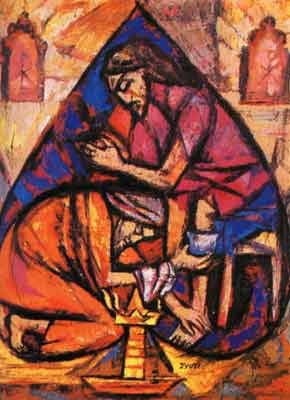
Jesus Washes Peter’s Feet

It was now the day before the Passover Festival. Jesus knew that the hour had come for him to leave this world and go to the Father. He had always loved those in the world who were his own, and he loved them to the very end.

Jesus and his disciples were at supper. The Devil had already put into the heart of Judas, the son of Simon Iscariot, the thought of betraying Jesus. Jesus knew that the Father had given him complete power; he knew that he had come from God and was going to God. 

So, he rose from the table, took off his outer garment, and tied a towel around his waist. Then he poured some water into a washbasin and began to wash the disciples’ feet and dry them with the towel around his waist. 

He came to Simon Peter, who said to him, “Are you going to wash my feet, Lord?”

Jesus answered him, “You do not understand now what I am doing, but you will understand later.”

Peter declared, “Never at any time will you wash my feet!”

“If I do not wash your feet,” Jesus answered, “you will no longer be my disciple.”

Simon Peter answered, “Lord, do not wash only my feet, then! Wash my hands and head, too!”

Jesus said, “Those who have taken a bath are completely clean and do not have to wash themselves, except for their feet. All of you are clean—all except one.” (Jesus already knew who was going to betray him; that is why he said, “All of you, except one, are clean.”)

After Jesus had washed their feet, he put his outer garment back on and returned to his place at the table.

“Do you understand what I have just done to you?” he asked. “You call me Teacher and Lord, and it is right that you do so, because that is what I am. I, your Lord and Teacher, have just washed your feet. You, then, should wash one another’s feet. I have set an example for you, so that you will do just what I have done for you. I am telling you the truth: no slaves are greater than their master, and no messengers are greater than the one who sent them. Now that you know this truth, how happy you will be if you put it into practice!…

Jesus said, “Now the Son of Man’s glory is revealed; now God’s glory is revealed through him. And if God’s glory is revealed through him, then God will reveal the glory of the Son of Man in himself, and he will do so at once. My children, I shall not be with you very much longer. You will look for me; but I tell you now, what I told the Jewish authorities, ‘You cannot go where I am going.’ 

“And now I give you a new commandment: Love one another. As I have loved you, so you must love one another. If you have love for one another, then everyone will know that you are my disciples.” (Good News Translation)

We all need love. 

Without love, relationships devolve into silent standoffs and destructive triangles. The world ceases to spin on its axis. 

But with love, all things are beautiful, personal relations have meaning and joy, and all seems right and just in the world.

This wonderful love, however, comes with a great cost. 

Because we live in a broken world filled with pride and arrogance, greed and avarice, hate and envy, we are victims of loveless, faceless, and unjust systems. 

We need Love to rescue and redeem us from the muck and crud of injustice. 

It’s as if we are constantly walking knee deep through icky sludge so thick that we can barely get anywhere. 

We need saving…. We need Jesus.

Christians everywhere around the world are journeying through Holy Week, the most sacred time of the year for followers of Christ. When we consider Holy Week, many are familiar with Good Friday and certainly Easter, but Maundy Thursday? 

On this day the church remembers the last evening Jesus shared with his disciples in the upper room before his arrest and crucifixion. 

The experiences in the upper room were highly significant because this was the last teaching and modeling that Jesus gave before facing the cross. Jesus was deliberate in communicating exactly what was important to him: Love one another.

Maundy Thursday marks three important events in Christ’s Last Supper with his disciples: 

  • The washing of the disciples’ feet (the action of loving service)
  • The instituting of the Lord’s Supper (the remembrance of loving sacrifice)
  • The giving of a “new” commandment to love one another (the mandate of a loving system). 

For Jesus, the last night with his disciples was all about love, God’s love. On that fateful night, having loved his disciples for the past three years, Jesus showed them the full extent of his love by taking the posture of a servant and washing each and every one of the disciples’ feet, including Judas. 

After demonstrating for them a totally humble service, Jesus said, “I have set you an example that you should do as I have done for you.”

Jesus Christ loves me just as I am, and not as I should be. 

Christ loves me even with my dirty stinky feet, my inconsistent half-hearted commitment to him, and my pre-meditated sin. 

Not only did Jesus wash the disciples’ feet; he also lifted the cup of wine and boldly asserted: 

“Take this and divide it among you.  For I tell you I will not drink again of the fruit of the vine until the kingdom of God comes.”  And he took the bread, gave thanks and broke it, and gave it to them, saying, “This is my body given for you, do this in remembrance of me.”  In the same way, after the supper he took the cup saying, “This cup is the new covenant in my blood, which is poured out for you.” (Luke 22:17-20, NIV)

Because of these words from Jesus, the church throughout the world, for the past two millennia, have practiced this communion so that we might have the redemptive events of Jesus pressed firmly into both our minds and our hearts by means of the visceral and common elements of bread and wine. 

We are to not just know about Jesus – we are to experience being united with him.

Having washed the disciples’ feet and proclaimed to them the meaning of his impending death, Jesus gave them a clear commandment: “A new command I give you: Love one another. As I have loved you, so you must love one another.  By this everyone will know that you are my disciples if you love one another.”

Love one another, insisted Jesus, through imitation of his humble service. We represent Christ on this earth when we carefully, diligently, and persistently practice love. 

Although love was by no means a new concept for the disciples, in the form and teaching of Jesus love was shown with four distinctions: 

  1. A new model of love: Jesus
  2. A new motive of love, that Christ first loved me
  3. A new motivator to help us love, the Holy Spirit
  4. A new mission, the evangelization of the world, utilizing the power of Christ’s love to accomplish it

Maundy Thursday is a highly significant day on the Church Calendar – one which deserves to be observed. It’s an opportunity to remember the important words and actions of Jesus on our behalf.

In Christ, we allow love to characterize our life together as we proclaim God’s love in both word and deed. A watching world will only take notice and desire to be a part of our fellowship if we are deeply and profoundly centered in the love of God in Christ. This is the reality that Maundy Thursday brings to us.

God of love, you have given us a new command to love each other. Help us to show that love in our care of creation, to all nations and ethnicities, in our communities and neighborhoods, through the Church everywhere, and with the persons closet to us and their needs. In all our thoughts, words, and actions may we be your servants and reflect your love, through our Savior, Jesus Christ, your Son, who lives and reigns with you and the Holy Spirit, one God, now and forever. Amen.