
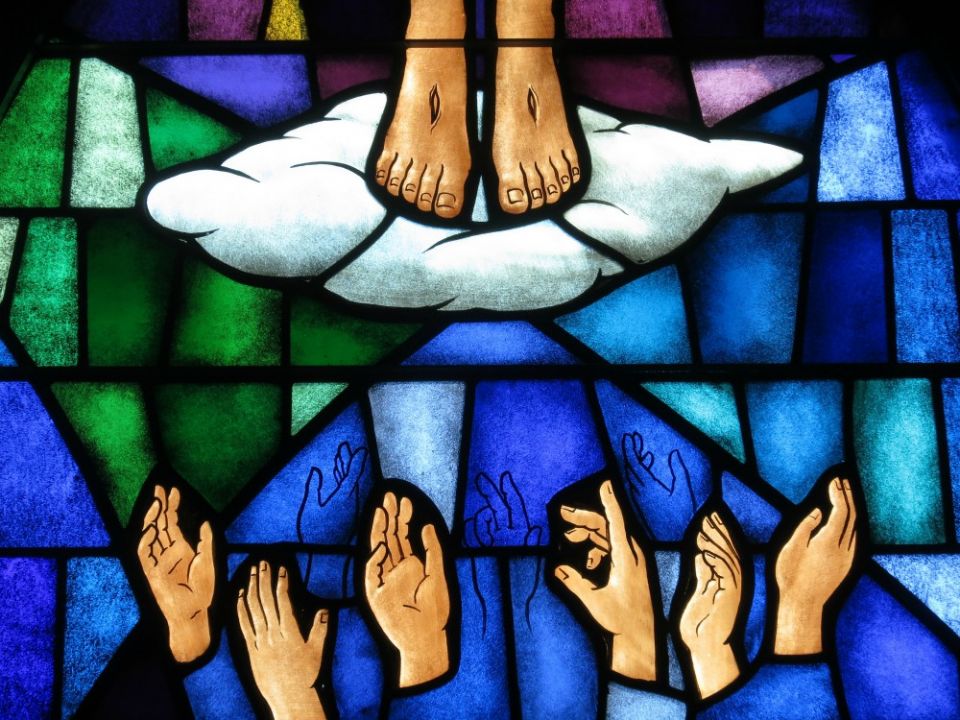
Acts 1:1-11 – Ascension of the Lord

In my first book I told you, Theophilus, about everything Jesus began to do and teach until the day he was taken up to heaven after giving his chosen apostles further instructions through the Holy Spirit. During the forty days after he suffered and died, he appeared to the apostles from time to time, and he proved to them in many ways that he was actually alive. And he talked to them about the Kingdom of God.

Once when he was eating with them, he commanded them, “Do not leave Jerusalem until the Father sends you the gift he promised, as I told you before. John baptized with water, but in just a few days you will be baptized with the Holy Spirit.”

So, when the apostles were with Jesus, they kept asking him, “Lord, has the time come for you to free Israel and restore our kingdom?”

He replied, “The Father alone has the authority to set those dates and times, and they are not for you to know. But you will receive power when the Holy Spirit comes upon you. And you will be my witnesses, telling people about me everywhere—in Jerusalem, throughout Judea, in Samaria, and to the ends of the earth.”

After saying this, he was taken up into a cloud while they were watching, and they could no longer see him. As they strained to see him rising into heaven, two white-robed men suddenly stood among them. “Men of Galilee,” they said, “why are you standing here staring into heaven? Jesus has been taken from you into heaven, but someday he will return from heaven in the same way you saw him go!” (New Living Translation)

“At his Ascension, our Lord entered Heaven, and he keeps the door open for humanity to enter.”

Oswald Chambers

Jesus was taken up to heaven in what Christians celebrate as the “Ascension of the Lord.” This is a hugely important event for followers of Jesus.

The Ascension means that Christ is now presently sitting at God’s right hand, offering continual prayers on our behalf to the Father. We have an advocate, a champion, who has gone before us and secured deliverance from sin, death, and hell.

On top of it all, Christ’s ascension means that Jesus is the universal ruler; he commands a kingdom that will never end. Yes, the Ascension of the Lord is a big deal.

So, why does a day set aside on the Christian Calendar celebrating the Lord’s mighty and redemptive ascension over all creation garner such scant attention from many churches?

Maybe the church has A.D.D. (Ascension Deficit Disorder).

Our clue to the inability to focus on such a grand redemptive event is the disciples’ response when Jesus ascended.

The picture St. Luke paints for us in the account of our Lord’s ascension, is a group of guys looking up into the sky slack-jawed and shoulders hunched.

It took a couple of angels to come along and ask them what in the world they were doing just standing there. Now is not the time to stand and gawk at the clouds, the angels insisted. Jesus will come back when he comes back. You aren’t going to know when. So, now is the time to get busy with what Jesus just told you to do two minutes ago: Tell everyone about me.

Christ’s ascension to heaven is a deeply theological event. It’s freighted with major implications for our prayer lives. And it means Christ is the King to whom we must obey.

Jesus is coming again. In the meantime, there’s to be no cloud-gawking. Instead, there is to be a well-developed and well-cultivated connection with Jesus which proclaims the good news that Christ died, rose from death, and ascended to heaven for mine and your forgiveness of sins and a new clean slate on life.

Trying to peer into the future about how the end of history will shake-out is, frankly, not the job we are called to do. Believers in Jesus aren’t supposed to stand and gawk at the clouds waiting for the Lord’s return, as if we are in some earthly holding tank until heaven. 

Rather, we are to bear witness about the person and work of Jesus. The Ascension of the Lord means we are God’s people blessed with deliverance from the realm of sin, and the hope of Christ’s coming again. The Church everywhere recognizes together the rule and reign of the Lord Jesus.

The world, as we know it, shall eventually come to an end. Until that time, Christians since the time of the ascension have been proclaiming Christ crucified, died, risen, ascended, and coming again.

This is a day of joy and celebration for us. Jesus is our ascended and glorified king! The fate of the earth is with the benevolent and mighty Ruler of all. Jesus is Lord, and no other human leader is. Thank you, Jesus.

The great Reformed Confession, the Heidelberg Catechism, question and answer 49, states:

Q: How does Christ’s ascension to heaven benefit us?

A: First, he is our advocate

            in heaven

            in the presence of his Father.

Second, we have our own flesh in heaven

            as a sure pledge that Christ our head

            will also take us, his members,

            up to himself.

Third, he sends his Spirit to us on earth

            as a corresponding pledge.

            By the Spirit’s power

                        we seek not earthly things

                        but the things above, where Christ is,

                                    sitting at God’s right hand.

Amen.

Luke 19:1-10 – I Want to See Jesus

Zacchaeus by Joel Whitehead

Jesus entered Jericho and was passing through. A man was there by the name of Zacchaeus; he was a chief tax collector and was wealthy. He wanted to see who Jesus was, but because he was short he could not see over the crowd. So, he ran ahead and climbed a sycamore-fig tree to see him, since Jesus was coming that way.

When Jesus reached the spot, he looked up and said to him, “Zacchaeus, come down immediately. I must stay at your house today.” So, he came down at once and welcomed him gladly.

All the people saw this and began to mutter, “He has gone to be the guest of a sinner.”

But Zacchaeus stood up and said to the Lord, “Look, Lord! Here and now, I give half of my possessions to the poor, and if I have cheated anybody out of anything, I will pay back four times the amount.”

Jesus said to him, “Today salvation has come to this house, because this man, too, is a son of Abraham. For the Son of Man came to seek and to save the lost.” (New International Version)

Every time I read this story about Zacchaeus climbing up the sycamore tree to see Jesus because he was a short man, I think of the old ‘70s song Short People by Randy Newman. The song was (and still is) criticized by some as being prejudiced against short people. 

Indeed, the criticism seems justified with lyrics such as “short people got no reason to live.” Yet, the song’s intended purpose was really the opposite – to be an attack on the pervasive prejudice of the day, and an attempt to heighten the awareness of the inability to recognize others different from ourselves. “Short people are the same as you and I. All men are brothers until the day they die” are the lyrics containing the real message within the song.

At first glance of the story of the short Zacchaeus, it seems to be about his inability to see. Yet the real heart of the story is that Zacchaeus is unable to see because the other people are obstacles to his sight. 

In turns out that Jesus is the only person who truly sees Zacchaeus. No one else sees him. No one else seems to care. While everyone else is busy with their own line of sight, Jesus is concerned to see the one person who is unseen – Zacchaeus. 

And here is the reason why Jesus had his radar attuned to picking up Zacchaeus: Because Jesus came to seek, see, and save those who are lost.

The most pertinent application of this story for us, it seems to me, is that we need to repent of being obstacles to others coming to Jesus – and turn to becoming the conduits to others meeting with Jesus. 

People who are short on faith, short on hope, and short on love desperately need the love of God in the gracious person of Jesus Christ. 

So, what will you and I do today to help another see Jesus?

You are the light of the world. A city on top of a hill can’t be hidden. Neither do people light a lamp and put it under a basket. Instead, they put it on top of a lampstand, and it shines on all who are in the house. In the same way, let your light shine before people, so they can see the good things you do and praise your Father who is in heaven. (Matthew 5:14-16, CEB)

Do we become discouraged when we cannot see what we expect to see?

When John was in prison, he heard about the things Christ had done. So, he sent his disciples to ask Jesus, “Are you the one who is coming, or should we look for someone else?”

Jesus answered John’s disciples, “Go back, and tell John what you hear and see: Blind people see again, lame people are walking, those with skin diseases are made clean, deaf people hear again, dead people are brought back to life, and poor people hear the Good News. (Matthew 11:2-5, GW)

Do we have eyes to see?

Jesus said, “I came into this world for judgment so that those who do not see may see, and those who do see may become blind.” (John 9:39, NRSV)

Anyone who has seen me has seen the Father! (John 14:9, NLT)

Will you and I humble ourselves, and stoop to see?

As they entered the tomb, they saw a young man dressed in a white robe sitting on the right side, and they were alarmed.

“Don’t be alarmed,” he said. “You are looking for Jesus the Nazarene, who was crucified. He has risen! He is not here. See the place where they laid him. But go, tell his disciples and Peter, ‘He is going ahead of you into Galilee. There you will see him, just as he told you.’” (Mark 16:5-7, NIV)

Can you see now?

God has put everything under our power and has not left anything out of our power. But we still don’t see it all under our control. What we do see is Jesus, who for a little while was made lower than the angels. Because of God’s gift of undeserved grace, Jesus died for everyone. And now that Jesus has suffered and died, he is crowned with glory and honor! (Hebrews 2:8-9, CEV)

Loving Lord Jesus, give me the grace to see you in all things throughout my days on this earth. Help me to see your benevolent kingdom come and see your ethical will be done, here on earth, as it is always done in heaven. Amen.

Acts 9:32-35 – Healed

St. Peter heals Aeneas, 12th century mosaic in Palermo, Italy

As Peter traveled about the country, he went to visit the Lord’s people who lived in Lydda. There he found a man named Aeneas, who was paralyzed and had been bedridden for eight years. “Aeneas,” Peter said to him, “Jesus Christ heals you. Get up and roll up your mat.” Immediately Aeneas got up. All those who lived in Lydda and Sharon, saw him and turned to the Lord. (New International Version)

The early church was growing. Both in numbers and in faith, the new believers following the words and ways of Jesus could be found everywhere in Judea. The Apostle Peter, therefore, decided to get out of Jerusalem and visit some of these folks in the town of Lydda, on the Mediterranean coast.

Back when Peter was following Jesus around in his earthly ministry, the Lord told the disciples that they will do the works he did, and, what’s more, they will do even greater things than Jesus himself. (John 14:12-14)

Peter emulated the example of his Lord. He simply stated that Christ is the one who heals you, Aeneas, so get up, take your mat, and go on home. (Mark 2:10-12; John 5:1-8)

The act of healing the paralyzed man, Aeneas, was a sign that the merciful saving ministry of Jesus was in effect, even when Jesus isn’t bodily present. Christ made it clear that the Holy Spirit would be the continuing presence of God on this earth. (John 16:1-15)

We, too, have this same Spirit.

The work of ministry is always done to the glory of God. People hear the good news, see the miracle, and believe in Jesus.

There are some who examine today’s New Testament lesson and expect that they (and all other believers) ought to be able to do exactly what Peter did: heal another miraculously.

Then, there are others who look at the same account and relegate it to some bygone era in which only the original apostles, like Peter, could do that sort of thing – if it even happened like that, at all.

To expect a dramatic physical healing, every time, all the time, is not consistent with healing narratives in Holy Scripture. And to never expect a miraculous healing is equally inconsistent with the biblical data.

It seems to me we need to reject both extremes. That’s because healing comes in all sorts of different forms.

An event which causes the need for healing and health, or a condition which prevents good health, isn’t limited to the body. A person’s mind, emotions, and spirit can also be damaged and need healing, as well. In fact, whenever there is trauma to the physical body, it profoundly effects the person’s thinking, feeling, and praying.

We need to beware of desiring the fast solution of dramatic and miraculous healing because of not wanting to deal with our emotions.

Perhaps you, like me, have had the experience of going to work or church when experiencing a difficult time in life. There is an emotional heaviness because of a strained, broken, or lost relationship. Or maybe there is emotional pain from an unexpected or unwanted situation.

Yet, when someone asks how you are doing, the response “Oh, fine!” tumbles automatically out of your mouth. But you are anything but fine. Inside, down in your heart, or painfully present in your head, the hurt dominates your thoughts and feelings.

Healing is for people. Fixing is for things and machines. It would be weird if I said I was going to heal a tractor. It is equally strange to try and fix people. To heal is to straighten what is broken. We cannot fix our emotions because, when hurt or damaged, they need healing – a process of restoration – and it usually doesn’t happen overnight.

Our emotional healing is like walking a slow journey. Along that path, our emotions are crying out for us to pay attention to three things:

  1. Grief. Grieving is the normal emotional reaction to any significant change or loss. To grieve our painful situations, whatever they may be, is necessary to healing our emotions. Putting a lid on our grief and sucking it up in a delusional show of strength at best prolongs our healing, and, at worst, brings further damage.
  2. Grace. Grace is an act of bestowing honor or forgiveness to a person. It is not dependent upon whether one deserves it, or not. Grace is the opposite of being judgmental. It chooses not to hold something over or against another, even oneself.
  3. Gratitude. Gratitude is a deliberate act of thankfulness for a specific act. It is both an attitude and an emotion. Gratitude comes from a heart of appreciation. Habits of gratitude creates new ways of being with others. And creating new experiences is one of the best ways of helping to heal the bad experience we just went through.

Embracing those three elements of grief, grace, and gratitude sets us on a healing path. Also, there are practices which we can utilize with each of those three which promote their healing work in our lives. For me, some of those practices include humor and laughter; meditation and other spiritual practices; walking the dog; watching cartoons; and journaling.

Healing is an art. It takes time, lots of practice, and plenty of love. Healing comes from God, which is a good thing, because the Lord knows exactly the kind of healing we need.

God of all comfort and healing, our help in time of need: We humbly ask you to relieve the suffering of your sick servants everywhere. Look upon them with the eyes of your mercy; comfort them with a sense of your goodness; preserve them from the temptations of the enemy; and give them patience in their afflictions. In your good time, restore them to health, and enable them to glorify your most holy name and dwell with you forever in the land of the living, through Jesus Christ our Lord. Amen.

Luke 14:12-14 – Abundance and Inclusion For All

The Great Banquet by Hyatt Moore

Then Jesus said to his host, “When you give a luncheon or dinner, do not invite your friends, your brothers or sisters, your relatives, or your rich neighbors; if you do, they may invite you back and so you will be repaid. But when you give a banquet, invite the poor, the crippled, the lame, the blind, and you will be blessed. Although they cannot repay you, you will be repaid at the resurrection of the righteous.” (New International Version)

A lot of people live by the old adage, “You scratch my back and I’ll scratch yours.” It’s a phrase referring to reciprocity. In other words, if you give me something I want, I will then respond by giving you something you want.

That old adage works fine, that is, unless you have no ability to give or give back to another. If we only operate by the principle of reciprocity, a large chunk of people automatically get left out. And this situation is untenable and unacceptable to Jesus.

Christ observed that the religious insiders of his day were keeping entire groups of people on the outside through their practice of scratching one another’s backs.

We need to get ahold of the reality that God loves us, as well as everyone else – even the people we may not give the time of day to. God so loved the world that he sent his Son. Jesus has come to feed us. 

The kingdom of God is about food. The food given by Jesus is to feed the hungry by staging a banquet. It is a feast of God’s abundance. Yet, many seem to hoard the resources they have, only thinking about their friends, family, and people just like them. They act as if there is no need to invite outsiders, consumed as they are with their own daily lives.

We have an incredible abundant feast contained in Scripture – in fact, Jesus said that his food and drink was to do the Father’s will, that Scripture was his bread. (Matthew 4:4; John 4:34) 

It’s much too easy to take our blessings of food for granted. After all, when we are well-fed, it’s easy to assume that everyone else is, too. Feeling healthy, it’s easy to forget that others are hurting. Making money, it’s easy to think there are not many poor people around. Living in a community with plenty of churches and more bibles than people, it’s natural to assume that everyone knows the gospel of Jesus – but they don’t!

Then, whenever we get around to acknowledging there are people who need Jesus, we keep devising ways to reach them without having to change or accommodate our own lives to do it.

Christ’s call to faithful discipleship requires people to change from having a narrow focus on our small circle of friends, to including those who have no means to pay us back.

The gospel of Jesus Christ is open to outcasts and failures, to problem people and to unimpressive persons. People with needs and flaws are especially dear to Jesus. It’s the people who outwardly have it all together who are being replaced wholesale with those who admit their need. 

We must not be picky about who we invite to participate in the largess of abundance we possess. We are to avoid the spiritual snobbery of looking down our noses at the needy and less fortunate, who have nothing to offer us in return.

St. John Chrysostom (348-407, C.E.) was a Bishop of Constantinople and arguably one of the greatest preachers in the history of Christianity. John always thought of both the recipient and the giver in his sermons, insisting that both need God’s mercy.

With a concern for the giver’s soul, John insisted that givers provide for all – even the lazy, the fool, and the sinner. By opening our hearts in almsgiving, we open ourselves to Christ, who is present in the least of those among us. Refusing mercy to people deemed as unworthy, givers then actually shut themselves off from the very mercy God desires for them.

There is no reward from God when there is only reward from others.

“If we are going to examine lives, we will never have mercy upon any human being; rather, hindered by this inopportune meddlesomeness, we will remain fruitless and destitute of all help ourselves.”

St. John Chrysostom, On Repentance and Almsgiving

It’s not only the poor who suffer when the rich fail to give. In judging whether or not a particular person is worthy of love and aid, the wealthy person rejects the spiritual fruit that he would have received by giving with humility.

Giving to the poor, simply to relieve our own conscience, is not real charity; it doesn’t consider the other. We attend fully to the other by observing their spiritual and holistic needs for community, purpose, respect, and dignity. Dispassionate giving from a distance, without relationship, refuses to acknowledge the whole person. It exploits the poor for the mental comfort of the rich.

We need to be involved in people’s lives, and that takes a lot of blood, sweat, and tears. There are too many lost people who need Jesus, and too many Christians who are the walking wounded and need the healing touch of Jesus, for us to pay scant attention to the call of Jesus to invite the needy into our lives. 

Seeing people come into God’s great banquet, and into a joyous and vital relationship with Christ, probably takes about ten times more work than what you are thinking it does right now. Yet, this is the pathway of true blessing – to having God’s stamp of approval on our lives.

Merciful God, thank you for the abundance of life, relationships, health, comfort, and wealth you have provided to so many. Thank you that, even in times of need, despair, and brokenness, you are there. Please, put your arms around children and families in  poverty and disability so that they feel your comfort and hope. Meet their needs both physically and spiritually. And guide me so I can be your hands and feet pursuing justice for the poor and upholding the cause of the needy, in the way of Jesus Christ our Lord. Amen.