Matthew 25:31-46 – Meeting Jesus

On a bright Sunday morning, Lefty and his wife Goatrude were sitting at home enjoying a leisurely cup of coffee together. Lefty was slowly going through some of his emails.

And then, it happened.

“Oh, my goodness, look at this!” said Lefty to Goatrude. “I got an e-mail from Jesus! It says he will be here at 10am on Sunday. Egad! That’s any minute now!”

“The house is a mess! Hurry! Let’s get this all picked up.” said Goatrude. “And, for God’s sake, where is that big Bible? It needs to be here on the coffee table when Jesus gets here!”

“I think I know where that Bible is….” said Lefty. After rummaging around a junk closet, Lefty found the Bible dusted it off, and placed it prominently on the coffee table as the centerpiece of the living room.

As Goatrude and Lefty were hurriedly trying to make everything just right for Jesus, there was a knock at the door.

“That must be Jesus!” said Goatrude. “Answer it, Lefty. And, for goodness sake, stand up straight and be polite. We want Jesus to see us at our best.”

Lefty answered the door, surprised to see a ragged looking young man on the step.

“I’m sorry to bother you on a Sunday morning, but I haven’t had anything to eat all weekend. Might you have some food to spare?”

Perturbed with this interruption, Lefty answered the young man harshly. “No, I don’t. You need to go, right away. I have an important guest coming, and he’ll be here anytime now.” And he slammed the door shut.

Lefty had barely began getting back to tidying the living room when another knock came at the door.

“He’s here!” said Goatrude, moving quickly toward the door. But when she opened it, there stood a harried looking woman.

“Hello. My car broke down and I can’t get it started. And my cell phone died. Might I come in for just a few minutes so that I can get a bit warmed up and make a phone call?” said the woman.

Goatrude rudely responded, “We all have problems lady. I’ve got my own right now. You try and get ready for a visit from Jesus at the last minute. Try someone else.” And with that, Goatrude shut the door.

Lefty and Goatrude continued their hasty preparations for a visit from Jesus, when yet a third knock came at their door. This time, they answered it together, believing this to be Jesus for sure.

But when they opened the door, a frantic husband immediately said, “My wife just fell on the sidewalk. Please help me!”

“For God’s sake, man, we’re about to have Jesus here! We can’t be seen with a woman lying in front of our house! Get her up and go next door. And make it quick!”

Together, Goatrude and Lefty shut the door. Then, they sat down and anticipated Jesus to show.

Minutes pass… It’s now 10:15 and no Jesus. So, Goatrude, looking at Lefty, says, “I never figured Jesus to be somebody who is late. Maybe he got held up.”

“Hey, how about if I open this Bible and read something. When Jesus gets here, we’ll impress him with some knowledge. We’ll be the talk of the town, hosting Jesus.”

So, Lefty opened the big book, randomly turned to a page, and began reading….

“When the Son of Man comes in his glory, and all the angels with him, he will sit on his glorious throne. All the nations will be gathered before him, and he will separate the people one from another as a shepherd separates the sheep from the goats. He will put the sheep on his right and the goats on his left.

“Then the King will say to those on his right, ‘Come, you who are blessed by my Father; take your inheritance, the kingdom prepared for you since the creation of the world. For I was hungry, and you gave me something to eat, I was thirsty, and you gave me something to drink, I was a stranger and you invited me in, I needed clothes and you clothed me, I was sick, and you looked after me, I was in prison, and you came to visit me.’

“Then the righteous will answer him, ‘Lord, when did we see you hungry and feed you, or thirsty and give you something to drink? When did we see you a stranger and invite you in, or needing clothes and clothe you? When did we see you sick or in prison and go to visit you?’

“The King will reply, ‘Truly I tell you, whatever you did for one of the least of these brothers and sisters of mine, you did for me.’

“Then he will say to those on his left, ‘Depart from me, you who are cursed, into the eternal fire prepared for the devil and his angels. For I was hungry, and you gave me nothing to eat, I was thirsty, and you gave me nothing to drink, I was a stranger, and you did not invite me in, I needed clothes and you did not clothe me, I was sick and in prison and you did not look after me.’

“They also will answer, ‘Lord, when did we see you hungry or thirsty or a stranger or needing clothes or sick or in prison, and did not help you?’

“He will reply, ‘Truly I tell you, whatever you did not do for one of the least of these, you did not do for me.’

“Then they will go away to eternal punishment, but the righteous to eternal life.” (New International Version)

1 John 3:11-17 – Love, Not Hate

Cain and Abel by Gunter Tanzerel, 2011

The message you heard from the very beginning is this: we must love one another. We must not be like Cain; he belonged to the Evil One and murdered his own brother Abel. Why did Cain murder him? Because the things he himself did were wrong, and the things his brother did were right.

So do not be surprised, my friends, if the people of the world hate you. We know that we have left death and come over into life; we know it because we love others. Those who do not love are still under the power of death. Those who hate others are murderers, and you know that murderers do not have eternal life in them. This is how we know what love is: Christ gave his life for us. We too, then, ought to give our lives for others! If we are rich and see others in need, yet close our hearts against them, how can we claim that we love God? (Good News Translation)

For the world to be a life-giving place of thriving people, it must spin on the axis of love, grace, and belonging – and not be a death-dealing haunt of murder, hate, and disconnection.

“Death” and “life” are full of meaning in Holy Scripture. Whereas we tend to use death and life as referring chiefly to the body, they are primarily relational terms in the Bible.

Death is a separation from God and others; and life is connection with God and others.

In addition, death and life are biblically understood as forces or realms of being within or without. Whenever someone moves from death to life, they leave the realm of separation with its loneliness, lostness, lethargy, and lack of meaningful and helpful interaction with God and others to a place of connection in which there is love.

There is no love in the realm of death. Death is awful in the sense that it places one outside of love.

Like death and life, love is also a relational term and a force or power which exists. Love, in fact, is such a huge realm of being and such a large domain that it almost defies definition. We are mostly left to describe love because all attempts to nail down love with a precise definition will never do it justice.

Therefore, the Apostle Paul, in his great ode to love, did not even try to define it, but merely attempted to characterize love:

Love is patient. Love is kind. Love isn’t jealous. It doesn’t sing its own praises. It isn’t arrogant. It isn’t rude. It doesn’t think about itself. It isn’t irritable. It doesn’t keep track of wrongs. It isn’t happy when injustice is done, but it is happy with the truth. Love never stops being patient, never stops believing, never stops hoping, never gives up. (1 Corinthians 13:4-7, GW)

Consistent with the force and relational nature of death, life, and love, hate is not primarily a feeling toward another but exists as a stance toward another within the domain of darkness and death. To hate is to deliberately and volitionally separate from another person and/or from God. It is to consider someone as the “other” who is not like me, and so, I will neither associate nor interact with “those” people.

Love, however, thrives in the vast multi-dimensional realm of life. Love seeks connection with another and desires to act mercifully and kindly through discovering needs and meeting them. Although emotions of love are very real, those feelings are the result of calculated actions and words which benefit humanity and the common good of all persons.

It is vital that we make clear decisions to pursue life and love others. And Jesus is our model for this. Christ is the ultimate Connector, bringing vibrant life, even eternal life, through loving actions. Jesus intentionally entered the dark realm of death and absorbed all the hate of the world for you and me. In a great and loving reversal, Jesus Christ’s death – his separation from God and others – brought connection with God and others.

Likewise, followers of Jesus will learn to take on the world’s hatred, not fearing death’s ability to disconnect, and love others as they themselves have been loved by Christ. Christians are known by the way they act toward those in the realm of death; believers love and do not hate; despite being hated by another.

The biblical character Cain is Exhibit A of modeling the way of hatred and death. He separated himself from his brother, Abel, in every way possible – relationally, emotionally, mentally, and finally, physically through outright killing of the body.

The message from the Apostle John is this: Do not be like Cain. Be like Jesus. Love others, and do not hate them. Live for others, die to self.

Murder is also a relational term in Scripture. It is, of course, a tool forged from the flames of hell to be used by the hand of hatred to bring death’s realm of separation. Jesus clearly understood murder in this manner:

You know that our ancestors were told, “Do not murder” and “A murderer must be brought to trial.” But I promise you that if you are angry with someone, you will have to stand trial. If you call someone a fool, you will be taken to court. And if you say that someone is worthless, you will be in danger of the fires of hell. (Matthew 5:21-22, CEB)

Christians are people who put love where love is not – which means they brave death’s door to pull others from the flames.

But you, dear friends, must build each other up in your most holy faith, pray in the power of the Holy Spirit, and await the mercy of our Lord Jesus Christ, who will bring you eternal life. In this way, you will keep yourselves safe in God’s love. And you must show mercy to those whose faith is wavering. Rescue others by snatching them from the flames of judgment. Show mercy to still others, but do so with great caution, hating the sins that contaminate their lives. (Jude 20-23, NLT)

May your soul be blessed with love’s kiss.

May the grace and kindness of love bring life and continue to be life-giving for you.

May the hardness of hatred be far from you.

May death’s destructive power dwindle to nothing in the face of Christ’s love working in and through you to the glory of God. Amen.

Luke 10:25-37 – The Parable of the Good Samaritan

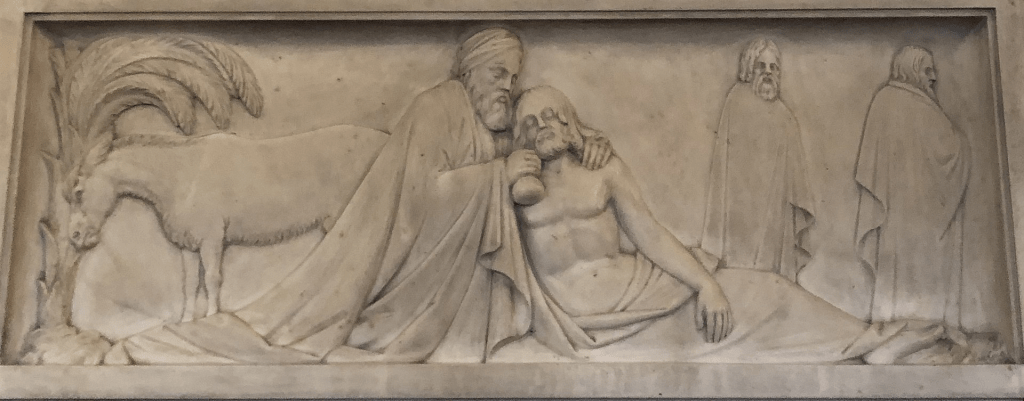
The Good Samaritan by Samuel Nixon. St. Paul’s Church, Halifax, Nova Scotia, Canada

 On one occasion an expert in the law stood up to test Jesus. “Teacher,” he asked, “what must I do to inherit eternal life?”

“What is written in the Law?” he replied. “How do you read it?”

He answered, “‘Love the Lord your God with all your heart and with all your soul and with all your strength and with all your mind’; and ‘Love your neighbor as yourself.”

“You have answered correctly,” Jesus replied. “Do this and you will live.”

But he wanted to justify himself, so he asked Jesus, “And who is my neighbor?”

In reply Jesus said: “A man was going down from Jerusalem to Jericho, when he was attacked by robbers. They stripped him of his clothes, beat him and went away, leaving him half dead. A priest happened to be going down the same road, and when he saw the man, he passed by on the other side. So too, a Levite, when he came to the place and saw him, passed by on the other side. 

But a Samaritan, as he traveled, came where the man was; and when he saw him, he took pity on him. He went to him and bandaged his wounds, pouring on oil and wine. Then he put the man on his own donkey, brought him to an inn and took care of him. The next day he took out two denarii and gave them to the innkeeper. ‘Look after him,’ he said, ‘and when I return, I will reimburse you for any extra expense you may have.’

“Which of these three do you think was a neighbor to the man who fell into the hands of robbers?”

The expert in the law replied, “The one who had mercy on him.”

Jesus told him, “Go and do likewise.” (New International Version)

Who do you relate to in the story? Which character most resonates with you in your life right now?

The Lawyer (an expert in the Old Testament Law)

The Gospel writer, Luke, gives us insight into the thought process of the person for whom Jesus told the parable to. That man sought to justify himself. In Christianity, no one justifies themselves. The kingdom of God turns on grace, and not with us working more or harder. 

Christ’s mercy is not dependent on what kind of people we are but is simply based on need. God graciously gives us the gift of faith and the mercy of deliverance. By Christ’s wounds we are healed. 

As Christians, we already possess justification by grace alone apart from human effort.

Each individual must realize they are in a theological ditch. We are all unable to get out of our predicament. Everyone needs the compassion of Christ.

But now God’s way of putting people right with himself has been revealed. It has nothing to do with law, even though the Law of Moses and the prophets gave their witness to it. God puts people right through their faith in Jesus Christ. God does this to all who believe in Christ, because there is no difference at all: everyone has sinned and is far away from God’s saving presence. But by the free gift of God’s grace all are put right with him through Christ Jesus, who sets them free. (Romans 3:21-24, GNT)

We do not need to justify ourselves.

The Priest and the Levite (experts in the Law)

The shock that hits closes to home, from Christ’s parable, is how frequently we are the ones who pass by and ignore the other. The command to “Go and do likewise,” extends about as far as the end of the story for modern hearers, landing us in the ditch between knowing the Samaritan and his compassionate generosity are set forth as an example and our tendency to ignore the cries of the downtrodden and disenfranchised.

Do not seek revenge or bear a grudge against anyone among your people but love your neighbor as yourself. I am the Lord…. When a foreigner resides among you in your land, do not mistreat them. The foreigner residing among you must be treated as your native-born. Love them as yourself, for you were foreigners in Egypt. I am the Lord your God. (Leviticus 19:18, 33-34, NIV)

The Lord defends the cause of the fatherless and the widow, and loves the foreigner residing among you, giving them food and clothing. And you are to love those who are foreigners, for you yourselves were foreigners in Egypt. (Deuteronomy 10:18-19, NIV)

We are to go and do likewise.

The Samaritan

The Samaritan, the Christ figure in the story, comes and shows the man mercy. This grace was free, lacked any sort of favoritism, and was full of sheer kindness. Without the Samaritan’s actions of binding up the man’s wounds and getting him to a safe place, the victim would have died.  

It is no coincidence that there are many hospitals throughout the country named “Good Samaritan.” Christians were at the forefront of establishing hospitals because of this very parable of Jesus. It was a significant way of living into the values of God’s kingdom.

Mercy is at the heart of all Christian ministry.

Jesus, responding to those who questioned his acts of mercy toward questionable people, said:

“Those who are well have no need of a physician, but those who are sick. Go and learn what this means, ‘I desire mercy, not sacrifice.’ For I have not come to call the righteous but sinners.” (Matthew 9:12-13, NRSV)

I appeal to you therefore, brothers and sisters, on the basis of God’s mercy, to present your bodies as a living sacrifice, holy and acceptable to God, which is your reasonable act of worship. (Romans 12:1, NRSV)

Do justice. Love mercy. Walk humbly. (Micah 6:8)

The Victim

The wounded hapless man was left for dead. In the story, we know he would die apart from help – the kind of help the man could not do for himself. He was completely dependent on someone to rescue him from his plight.

The victim in the ditch reminds us of what it feels like to be forgotten by others — and perhaps even by God. The feeling of loneliness and forsakenness invites compassion and empathy for all who experience it.

Victimization needs a voice and a champion. There are powerless people who either cannot speak or who are not heard by others. There are people, victims of abuse, who cannot get out of their traumatic ditch – overwhelmed by what another did to them.

God stands for the victim and against the robbers.

You will never again
    make victims of others
or send messengers to threaten
    everyone on this earth. (Nahum 2:13, CEV)

God will send help.

When the righteous cry out, the Lord listens;
    he delivers them from all their troubles.
The Lord is close to the brokenhearted;
    he saves those whose spirits are crushed.

The righteous have many problems,
    but the Lord delivers them from every one of them. (Psalm 34:17-19, CEB)

By his wounds we are healed.

Conclusion

The victim in the ditch is worthy of help because he carries the divine image of God.

The one who showed compassion and mercy, the Samaritan, reflected God’s likeness through his actions.

Those who passed by, the priest and the Levite, also bear the indelible mark of their Creator, yet chose to ignore their gut and got lost in their heads.

Maybe God — through Christ — comes to us as the one in the ditch or maybe as the one who shows compassion and mercy; perhaps God even comes to us as a reminder that the call to care for others frequently goes unheeded as we pass by the cries of those in need of help.

Lord God, heavenly Father, you did not spare your only Son, but gave him up for us all to be our Savior, and along with him you have graciously given us all things. We thank you for your precious, saving gospel, and we pray that you would help us to believe in the name of our Savior faithfully and steadfastly, for he alone is our righteousness and wisdom, our comfort and peace, so that we may stand on the day of his appearing, through Jesus Christ, your dear Son, our Lord. Amen.

Luke 10:13-16 – Confronting Hard Hearts

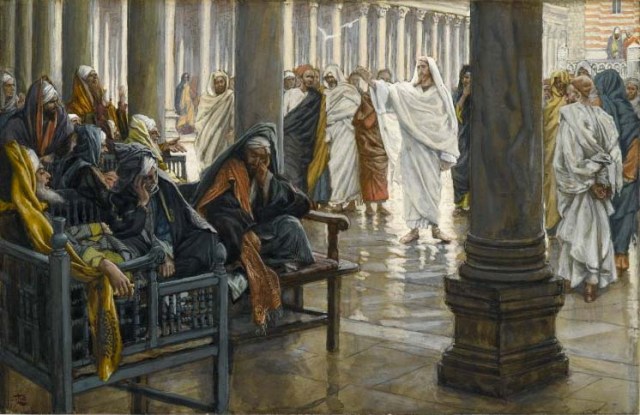
“Woe unto You” by French painter James Tissot (1836-1902)

“Woe to you, Chorazin! Woe to you, Bethsaida! For if the miracles that were performed in you had been performed in Tyre and Sidon, they would have repented long ago, sitting in sackcloth and ashes. But it will be more bearable for Tyre and Sidon at the judgment than for you. And you, Capernaum, will you be lifted to the heavens? No, you will go down to Hades.

“Whoever listens to you listens to me; whoever rejects you rejects me; but whoever rejects me rejects him who sent me.” (New International Version)

Hardness of heart is the greatest malady and the most serious condition which could ever afflict a spiritual person.

A soft heart needs only gentle words and humble responses in order to continue learning and growing in life. Not so with the hard heart. It needs a mighty chisel from God to scrape the encrusted barnacles off the heart so that it might receive goodness.

This is why today’s Gospel lesson recounts some rather harsh words from Jesus. Christ had some hard things to say in order to get at the hardness of heart he was experiencing from the people. His scathing words were specifically leveled at the towns in which he had performed miraculous healings. Their inability to accept what was happening in front of their very faces testified to how hard their hearts truly were.

The miracles of Jesus, in addition to being gracious restorations of individual lives, were also meant to demonstrate that the kingdom of God has broken into history in the person of Jesus Christ. The crowd refused to acknowledge this reality. So, Jesus began leveling a rebuke to the towns who observed his ministry firsthand, and yet did nothing in response to those good works.

A hard heart observing Christ’s ministry will likely be unresponsive to Jesus. A soft heart will likely reply with humility by forsaking everything to follow him. For Jesus, the height of hubris was to simply ignore his righteous works of merciful teaching and benevolent healing.

Christ’s denunciation of the particular towns came not because he was experiencing opposition or persecution; rather, he was denouncing them for their bonehead lack of response and refusal to change their lives to conform to what they were seeing and experiencing from God.

The crowd heard Christ’s teaching and saw his miracles, and it had no effect on them. So, Jesus gave them a big “C’mon, man!”

Judgment becomes the lot of someone who is unaffected and unresponsive to the vast sea of human need around them, viewing Jesus as just another voice, and living a life of mediocrity in the face of opportunity.

The Holy Spirit has been provided, who is the power source of the Christian life. We possess all the resources of grace necessary to step into this world and make a difference, yet so many do nothing but occupy a place in the pew [or couch] because they are too afraid to sacrifice their time in meaningful ministry.

There are neighbors, relatives, and co-workers who are lost and lonely, in need of the kind of grace Jesus gives, yet too many of us are oblivious to them and instead are constantly worried about things that, in the end, don’t really matter at all.

We have opportunities to grow in the grace and knowledge of Jesus Christ through a vast array of available ministries, yet many do not take the chance to change and be spiritually stretched. For these situations and more, the words of Jesus are there in front of our faces, and yet some, out of hardness of heart, will have the audacity to read them and remain unchanged, unchallenged, and unresponsive.

If our highest values in life are sameness, stability, and security, we may very well, at the least, miss Jesus altogether, and, at worst, find ourselves under his condemnation. These verses are for those whom Jesus has become all too familiar, as if he is just another piece of furniture in the living room – the coffee table with a dusty Bible resting on it.

There are times when nice gets us nowhere and we must have hard conversations because of hard hearts.

Yes, conversations, and not verbal rockets launched from one group to another. Jesus did not denounce from a distance; he did it up close and personal. Furthermore, he was specific and not generic about why he was speaking in the way he did.

So, may you be able to pray this prayer of repentance today with heartfelt conviction:

Almighty God, Father of our Lord Jesus Christ, Sovereign Lord of the universe, Creator of humanity, we, your unfaithful children, are sorry for our sins and the lives that we have lived apart from your grace. We sincerely believe and confess in our hearts that only through the precious blood of our Lord Jesus Christ on the cross, can we obtain your forgiveness.

We repent that: in thought, word, and deed, we have committed serious offences against you and our neighbors. Through spiritual laziness and prideful lust for power, we have provoked hatred, division, despair, and hurt within our communities.

Through our greed, deceit, and indifference, we have inflicted serious damage, unnecessary conflict, and aggravated destruction to those different than us.

Through our selfishness, insensitivity, and bias (both conscious and unconscious) we have encouraged and emboldened those who inflict hurt, pain, and sorrow on those who are already oppressed and poor.

In the name of religion, doctrine, and even of Christ himself, we have wounded fellow believers and those who genuinely pursue a faith different than ours.

In stubbornness, pride, and arrogance, we have caused division and strife within your church and among your people.

Mercifully send your Holy Spirit, the Spirit of order and comfort, to cleanse us from all unrighteousness; to restore in us true faith in Christ which brings truth, peace and harmony; and, to help us walk together
with our brothers and sisters in the peace of our Lord Jesus Christ, to the glory of your name. Amen.