The True Nature of Faith (Luke 7:1-10)

Jesus heals the servant of a Roman Centurion

After Jesus finished presenting all his words among the people, he entered Capernaum. A centurion had a servant who was very important to him, but the servant was ill and about to die. When the centurion heard about Jesus, he sent some Jewish elders to Jesus to ask him to come and heal his servant. When they came to Jesus, they earnestly pleaded with Jesus. “He deserves to have you do this for him,” they said. “He loves our people and he built our synagogue for us.”

Jesus went with them. He had almost reached the house when the centurion sent friends to say to Jesus, “Lord, don’t be bothered. I don’t deserve to have you come under my roof. In fact, I didn’t even consider myself worthy to come to you. Just say the word and my servant will be healed. I’m also a man appointed under authority, with soldiers under me. I say to one, ‘Go,’ and he goes, and to another, ‘Come,’ and he comes. I say to my servant, ‘Do this,’ and the servant does it.”

When Jesus heard these words, he was impressed with the centurion. He turned to the crowd following him and said, “I tell you, even in Israel I haven’t found faith like this.” When the centurion’s friends returned to his house, they found the servant restored to health. (Common English Bible)

Jesus the Jew used his authority to heal and transform a Gentile.

This particular Gentile, a Roman Centurion, clearly understood his place and who Jesus was. The Centurion felt unworthy to even have the Lord Jesus come into his house. And his profession of faith amazed even Jesus. “Just say the word,” he said in recognition of Christ’s authority.

The power and authority of Jesus is big enough to heal without even being present. In the ancient Roman Empire, Centurions were the backbone of the Roman military machine, and so, were hated by the Jews. Yet, Jesus the Jew not only responded to the Centurion’s request, but he also affirmed this Gentile’s faith as greater than any he had seen amongst his own people.

Grace answers to need, and not to smug self-confidence. The Roman Centurion asked for healing, not for himself, but for his servant. And Jesus graciously and mercifully listened and answered.

The Centurion neither demanded nor claimed healing; but instead, he came in a spirit of humility and asked with confidence that Jesus could heal his servant if he wanted to. The Centurion simply threw himself on God’s mercy. So, Jesus lifted him up as a model of faith for us all.

Real and genuine faith always serves as a solemn warning to the self-righteous – that their lack of humility and their pretentious faith will land them outside of God’s benevolent realm. In a great reversal, the insiders will become the outsiders, and the outsiders become the insiders.

Independently proud folk do not experience healing and transformation because they don’t even know they are sick with sin. They see no need for an intervention by Jesus because they already have their righteous deeds to boast about. Such persons are more concerned about looking good and saving face, and so, are unaware of their own unworthiness. 

The self-righteous approach to handling problems and difficult situations is to come up with good ideas and clever strategies. They rely on hard work, personal effort, and sheer willpower. Prayer may or may not happen after the plans are laid; there is no sense of addressing a problem or need with beseeching God. 

These are merely delusional thoughts of personal autonomy; they only serve to separate us from the grace of God that we so desperately need. 

There is a spiritual dimension to every situation and trouble we face – including sickness. If we only examine the medical end of physical problems, we may be dealing with symptoms instead of the root issue that plagues us.

Are you hurting? Pray. Do you feel great? Sing. Are you sick? Call the church leaders together to pray and anoint you with oil in the name of the Master. Believing-prayer will heal you, and Jesus will put you on your feet. And if you have sinned, you will be forgiven—healed inside and out. Make this your common practice: Confess your sins to each other and pray for each other so that you can live together whole and healed. (James 5:13-16, MSG)

Jesus healed and transformed outsiders. So, followers of Christ need to consistently ask:

  • Who are the outsiders among us?
  • Do we care about strangers? 
  • Are we willing to touch aliens and immigrants? 
  • Will we intercede in prayer for those who are foreign to us? 
  • Will we search for and pursue those on the periphery of society? 
  • Do we believe the risen and ascended Christ can and will heal, deliver, and transform people?

Jesus cannot be domesticated into some figurehead which suits our desires and conforms to our ideas about how things ought to be.

Instead, Christ is portrayed as eager to heal, wanting to show grace to the least and the lowly among society.

Our Father in heaven,
    may your name be kept holy.
May your Kingdom come soon.
May your will be done on earth,
    as it is in heaven.
Give us today the food we need,
and forgive us our sins,
    as we have forgiven those who sin against us.
And don’t let us yield to temptation,
    but rescue us from the evil one. Amen. (Matthew 6:9-13, NLT)

Encouragement to Be Faithful (2 Timothy 1:3-7)

Orthodox icon of St. Timothy
Orthodox icon of St. Paul the Apostle

Timothy, I thank God for you—the God I serve with a clear conscience, just as my ancestors did. Night and day I constantly remember you in my prayers. I long to see you again, for I remember your tears as we parted. And I will be filled with joy when we are together again.

I remember your genuine faith, for you share the faith that first filled your grandmother Lois and your mother, Eunice. And I know that same faith continues strong in you. This is why I remind you to fan into flames the spiritual gift God gave you when I laid my hands on you. For God has not given us a spirit of fear and timidity, but of power, love, and self-discipline. (New Living Translation)

Every individual person I meet is interesting. Everyone has a story. Each person has values which are important to them.  

The Apostle Paul had quite the story of conversion to Christianity. And so, he understandably had a high value of passing on the faith to reliable and competent persons who would then do the same. Timothy was one of those persons, a protégé of his mentor Paul.

Paul reminded Timothy of his identity, rooted in a faithful family, and encouraged him to tap into that robust spirit which resides within him. The Apostle encouraged him to fully express that spirit without fear or timidity.

For example, I care about kids. Children are a high value to both me and my wife. When meeting and engaging a family for the first time, we will inevitably talk to the child before addressing the parents. We care about any issue in the world which has to do with children – and we have a strong sense of morality concerning children because we love kids.

Be faithful to your calling, and to the values and ethics which undergird it. Whatever is important to us is where our sense of morality and ministry lie.

“Wherever your treasure is, there the desires of your heart will also be.”

Jesus (Matthew 6:21, NLT)

Everyone is moralistic because everyone cares about something. And we will live and die by our code of ethics, grounded in the values we most cherish.

In Holy Scripture, although there are hundreds of laws in the Bible, the highest standard of ethics and morality is contained in just a few chapters: The Ten Words (Commandments) found in the Old Testament chapter of Exodus 20; and Christ’s Sermon on the Mount found in the New Testament chapters of Matthew 5-7. 

These few chapters can be distilled into a few short ethical phrases:

“Love God with all your heart, soul, mind, and strength.” And “Love your neighbor as yourself.” (Matthew 22:37-39)

This means that every teaching found in the Bible comes down to love. (Mark 12:30-31)

Throughout the history of the church, the highest ethical values have always had to do with knowing and loving the Creator, Sovereign, and triune God – Father, Son, and Spirit – and the majesty of people who are created in the divine image and likeness.

The movement and trajectory of Holy Scripture is that a good and benevolent God makes and keeps promises to people. Even when they fall and try to create small petty worlds of their own, a gracious God is active, wooing lost people to return to the spirit which resides within them.

Therefore, the Bible is an unfolding drama of redemption in which a loving God goes out of the way to bring back straying, hurting, helpless people. (Luke 15)

Which is why, for me, attending to the inner soul, teaching people the words and ways of Jesus, and providing spiritual care to others is a very high value. I love God, and I love people. It’s easy to understand, then, why I treasure the following:

  1. Practicing solitude, silence, and other spiritual disciplines.
  2. Connecting with God daily in contemplative prayer and meditative Bible reading.
  3. Paying attention to hurting people and bringing them grace, mercy, faith, hope, love, and gentleness.
  4. Seeking to act with civility and respect toward others I disagree with, or just don’t like very well.
  5. Engaging others who don’t share my values of faith in God.
  6. Praying and hoping for people to be healed and whole.
  7. Pursuing the common good of all people, no matter who they are.

My deep conviction is that the care of the soul is just as important as the care of the body; that attention to exercising the mind with Holy Scripture is just as important to overall health and well-being as cardio workouts and sensible eating; and that the hope of the world resides with knowing Jesus Christ (and not with a lesser hope that wishes things will work out in the end if I’m sincere to my personal ethical beliefs).

Paul wanted Christians to engage in the care of souls, to fan into flame the spiritual gifts which already lie within us, even if they may seem dormant or non-existent.

So, be faithful to who you are, to what you have been called to, and especially to the good news:

For there is one God and one Mediator who can reconcile God and humanity—the man Christ Jesus. He gave his life to purchase freedom for everyone. This is the message God gave to the world at just the right time. (1 Timothy 2:5-6, NLT)

Great God and Father of all, remember the multitudes who have been created in your image but have not known the redeeming work of our Savior Jesus Christ; and grant that, by the prayers and labors of your Church, they may be brought to know and worship you as you have been revealed in your Son, who lives and reigns with you and the Holy Spirit, one God, now and forever. Amen.

Who’s the Greatest? (Matthew 18:1-7)

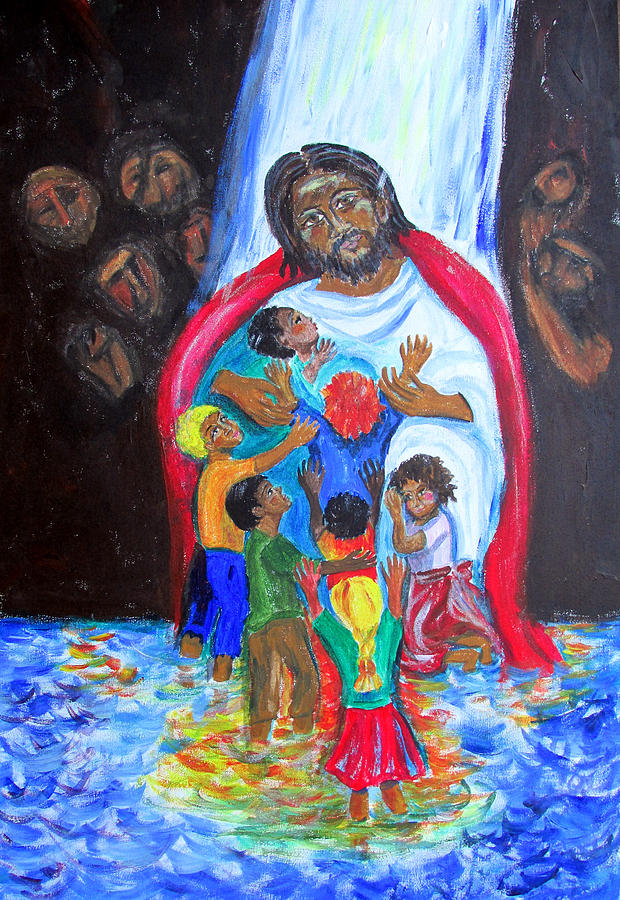
Jesus Loves the Children by Sarah Hornsby

At that time the disciples came to Jesus and asked, “Who is the greatest in the kingdom of heaven?”

Then he called a little child over to sit among the disciples, and said, “I assure you that if you don’t turn your lives around and become like this little child, you will definitely not enter the kingdom of heaven. Those who humble themselves like this little child will be the greatest in the kingdom of heaven. Whoever   one such child in my name welcomes me.

“As for whoever causes these little ones who believe in me to trip and fall into sin, it would be better for them to have a huge stone hung around their necks and be drowned in the bottom of the lake. How terrible it is for the world because of the things that cause people to trip and fall into sin! Such things have to happen, but how terrible it is for the person who causes those things to happen! (Common English Bible)

How would you answer the disciples’ question of who is the greatest in God’s kingdom?

Jesus answered the question by essentially stating that the least among us are the greatest. To be little is to be big. The kingdom hinges on being humble, gentle, meek, and lowly.

That definitely isn’t the way Western society looks at greatness – even the Western Church typically devalues the importance of such virtues and spiritual qualities.

In particular, many Americans takes pride in their can-do spirit. They seem always on the lookout for those who are assertive and can get things done efficiently and quickly. The tragedy of this is that, even though intentions may be noble, such a spirit often ends in causing others to stumble over their prideful beliefs of being hardworking and right.

Methinks Jesus and Horton the elephant would get along well together. In Dr. Seuss’s book, Horton Hears a Who, Horton exalted the littlest of persons whom others could neither see nor hear.

“A person’s a person no matter how small” said Horton to the people completely unconcerned for all the residents of Who Ville, living on a clover. They were unconcerned because the Who’s were invisible to them. 

Dr. Seuss chose to make Horton an elephant, a large creature able to hear with big ears and be attentive to the small. Largeness of heart comes from being attentive to the smallest ones among us – so small that the big people are unaware of them.

People who no one sees or notices, nonetheless matter to Jesus; and so, they should matter to us, too. 

Jesus often mingled with the little people of his time – children, women who had no rights, social misfits like lepers, the chronically ill, religious outsiders, tax collectors, and prostitutes. 

Our world is filled with similar people – angry adolescents, unwanted babies, forgotten old people, the mentally ill, moral failures, immigrants and refugees, and, if we have eyes to see and big ears to hear, lots of poor people who reside on the dark underbelly of society. They are around us, even if we fail to see or hear them.

The way to become great in the kingdom of God is to descend, not ascend, into greatness. The main enemy of any community is a desire to be prominent – it’s called “pride” and it will give us a terrible end if we hold onto it.

The disciples’ question is dripping with a desire for position and prestige. It’s a question meant to posture themselves into prominence and power. They want to know how to climb the ladder in God’s kingdom and be the important people.

I admire Christ’s grace for not throwing up his hands and going off on these guys: “What!? You’ve been with me how long and you ask me a stupid question like that?  Where have you been?  Have you learned nothing from me?” 

But instead, Jesus calmly called a child to him and used them as an example of his answer: Unless you become like this little child you will have no future at all with God. The way to have what you want is through humility.

In Jesus’ day children had no status or rights. Ancient culture was not kid oriented and there was no such thing as a youth culture. Children were, for the most part, viewed as potential adults – weak, small, and unable to contribute much of anything until they grew up. 

Christ’s disciples are to become like children, to become lowly; they are to give up their status and a desire to be important. They can only be big if they become small.

There’s another thing about the smallness of children that we ought to notice: Kids see what adults don’t. Whereas adults make distinctions between people on the basis of race, class, ethnicity, and gender, children see children and will play with just about anyone.

Only by getting on the same level as little people can we ever welcome Jesus; a person who is attentive to the lowly is attentive to Jesus. 

We are not to welcome people because they are great, wise, rich, powerful, good-looking, and just like you and me – but because they are noticed by Jesus. Christ stands for those we may tend to overlook.

The proud person who seeks prominence is forever looking for greener pastures, to do things that will impress others and help them advance up the ladder of success. In such a frame of mind, the proud person pays no attention to who they step on along the way. 

Christians, however, are to be different – giving socially insignificant people the time of day and treating them as important – because they are important to Jesus.

Here’s how Christ’s argument unfolds to the disciples:

  • Humility. Those who become like little children enter God’s kingdom, because it is only accessed through humility.
  • Attention. Those who pay attention and receive these little ones receive Jesus.
  • Rejection. Those who reject these little ones reject Jesus, and by their lack of loving them cause them to sin. 
  • Consequences. Leeching the poor and needy, ignoring the insignificant around us, and devaluing the littlest ones is damnable behavior, according to Jesus.

A person’s a person no matter how small. 

We need humility, to lower our sights in order to see and hear little people. No one is to be overlooked or to fall through the cracks under Christ’s rule and reign.

Loving Lord Jesus, you gave honor to the least, the forgotten, the overlooked, and the misunderstood and misjudged. You came to give first place to the last, those left behind and undervalued. You seek to provide a warm welcome to the lost, to the abandoned and the destitute.

Help us to be your ears to listen to their cries; your voice to speak love and acceptance; your feet to walk beside those in need; and your hands to clothe, feed and shelter them. Lord, in your mercy, hear our prayer. Amen.

I Am Sending You (Judges 6:11-24)

The Messenger of the Lord came and sat under the oak tree in Ophrah that belonged to Joash from Abiezer’s family. Joash’s son Gideon was beating out wheat in a winepress to hide it from the Midianites. The Messenger of the Lord appeared to Gideon and said, “The Lord is with you, brave man.”

Gideon responded, “Excuse me, sir! But if the Lord is with us, why has all this happened to us? Where are all the miracles our ancestors have told us about? Didn’t they say, ‘The Lord brought us out of Egypt?’ But now the Lord has abandoned us and has handed us over to Midian.”

The Lord turned to him and said, “You will rescue Israel from Midian with the strength you have. I am sending you.”

Gideon said to him, “Excuse me, sir! How can I rescue Israel? Look at my whole family. It’s the weakest one in Manasseh. And me? I’m the least important member of my family.”

The Lord replied, “I will be with you. You will defeat Midian as if it were only one man.”

Gideon said to him, “If you find me acceptable, give me a sign that it is really you speaking to me. Don’t leave until I come back. I want to bring my gift and set it in front of you.”

“I will stay until you come back,” he said.

Then Gideon went into his house and prepared a young goat and unleavened bread made with 18 quarts of flour. He put the meat in a basket and the broth in a pot. Then he went out and presented them to the Messenger of the Lord under the oak tree.

The Messenger of the Lord told him, “Take the meat and the unleavened bread, put them on this rock, and pour the broth over them.” Gideon did so. Then the Messenger of the Lord touched the meat and the bread with the tip of the staff that was in his hand. Fire flared up from the rock and burned the meat and the bread. Then the Messenger of the Lord disappeared. That’s when Gideon realized that this had been the Messenger of the Lord. So he said, “Lord God! I have seen the Messenger of the Lord face to face.”

The Lord said to him, “Calm down! Don’t be afraid. You will not die.” So Gideon built an altar there to the Lord. He called it The Lord Calms. To this day it is still in Ophrah, which belongs to Abiezer’s family. (God’s Word Translation)

Today’s story is familiar in more ways than one. It’s a typical interaction between the Lord and the individual. And it’s also the typical way people respond to God, even now in our contemporary world.

Notice how the interaction between the Lord and Gideon unfolds:

The message: The Lord is with you. You are brave.

The pushback: It doesn’t look like the Lord is with our people (and a purposeful ignoring of the bravery thing).

The message: The Lord is sending you (and a purposeful ignoring of the pushback).

The pushback: I’m too weak for that.

The message: The Lord is with you. You got this.

The pushback: It can’t be me. Give me sign.

The message: I will stay. I am with you.

The pushback: I am not acceptable. Here’s an offering.

The message: Chill, dude. You’re wound way too tight. I am with you. You got this.

The acceptance of the message: Here’s an altar to remind me that God is here, and God calms my fear.

Sound familiar? How many times have you had a similar sort of interaction with the Lord?

The message: “Don’t be afraid. The Lord is with you. You have everything you need.” (assurance and reassurance)

The pushback: “Huh!? If I had everything I need, why are my circumstances so hard? Every time I turn around, there’s another adversity staring me in the face!” (ignoring the presence of God)

The message: “Go and make disciples. Love God. Love your neighbor.” (ignoring the bunny trail)

The pushback: “I’m the least gifted person in the world to be doing that sort of ministry.” (goes off point)

The message: “I am with you always until the end of time.” (stays on point)

The pushback: “It can’t be me. Give me a sign.” (i.e. I can’t accept myself, so there’s no way that you do!)

The message: “You will receive power when the Holy Spirit comes upon you.” (a demonstration of the presence)

The pushback: “I’m not the acceptable person for this… Here, I’ll put something in the offering plate.” (having a hard time wrapping head and heart around God’s grace)

The message: “You are anxious and upset about a great many things. I am with you. You got this.” (still remains on point)

The acceptance of the message: “Here I am, Lord, a living sacrifice.” (now on the same page with the Lord)

Christian ministry is not the absence of doubt or fear; it is doing what the Lord calls us to do, despite the surrounding circumstances.

We are never promised anywhere in Holy Scripture that life will be a bowl of cherries, that somehow circumstances will always be smooth. Instead, we are continually reminded of the promise that God is with us.

It’s the presence of the Lord that makes all the difference. Our abilities, or lack thereof, have nothing to do with the equation. We are already in the image and likeness of God, created with the inner resources to do the will of God.

The Lord is my shepherd;
    I have everything I need. (Psalm 23:1, GNT)

We have everything we need to live a life that pleases God. It was all given to us by God’s own power. (2 Peter 1:3, CEV)

You already have God’s acceptance; you don’t need to earn it.

“I now realize that it is true that God treats everyone on the same basis. Those who fear him and do what is right are acceptable to him, no matter what race they belong to.” (Acts 10:34-35, GNT)

When God promised Abraham and his descendants that the world would belong to him, he did so, not because Abraham obeyed the Law, but because he believed and was accepted as righteous by God. (Romans 4:13, GNT)

Honor God by accepting each other, as Christ has accepted you. (Romans 15:7, CEV)

There’s a lot we don’t know. Yet, what we do know is that God is with us and God has accepted us. And that’s all we need to hang our hat on.