Hospitality Is a Matter of Life and Death (Jeremiah 49:7-11)

Concerning Edom, the Lord of heavenly forces proclaims:
Is wisdom no longer in Teman?
    Has good sense vanished from the perceptive?
        Are they no longer wise?
Turn, flee, and run for cover,
    you inhabitants of Dedan.
I’m bringing disaster on Esau:
    its day of reckoning.
If workers would come to you to pick grapes,
    they would at least leave a few on the vine.
If thieves would come in the night,
    they would take only what they needed.
But me? I will strip Esau bare.
    I will expose his hiding places,
        and he will find no place to take cover.
His offspring, family, and acquaintances will perish,
    and there will be no one left to say,
“Leave me your orphans,
    and I’ll look after them;
        trust your widows into my care.” (Common English Bible)

You might be saying to yourself, “What in tarnation is this crazy fool doing, having a Bible lesson on this here piece of Scripture that means nothing to you nor me?” Oh, really? To which I say, “What darned fool never gets into the backwoods of the prophets?”

Esau was the twin brother of Jacob, a real mountain man sort of guy. Being outdoors and hunting game was his thing. His descendants were the Edomites. They inhabited the southwest portion of what is now the country of Jordan, and the southeastern portion of Israel and Palestine in the middle east. It’s a territory made up of a network of clefts and caves in the rocks.

Edom tended to think of themselves as being invulnerable, the man’s man. They always had the high ground and knew how to handle themselves in the wilderness. For anyone interested in taking the Edomites down, it would be very difficult to dislodge them from their rocky fortress home. Yet, there is no place that is not vulnerable to the eye and purpose of Yahweh.

Site of an ancient Edomite stronghold in present day Jordan

Just as there was bad blood between Jacob and Esau, so also the Israelites and Edomites did not like each other throughout their history. Edom had no intention of helping their ancestral brother, and even participated with the Babylonians in the conquest of Jerusalem. What’s more, they rejoiced over the fall of the city – all of which raised the eyebrow of God.

Lord, remember what the Edomites did
        on Jerusalem’s dark day:
    “Rip it down, rip it down!
    All the way to its foundations!” they yelled. (Psalm 137:7, CEB)

Turns out that the Lord listened to the psalmist and remembered. The destruction of Edom came about because of two overlapping sins: the profound lack of hospitality; and the overt participation of doing harm. To refuse hospitality is to put someone or a group of people in harm’s way. It also betrays an attitude that works out in eventually becoming an agent of harm to those they could have helped.

In this vein, Edom is much more akin to Sodom and Gomorrah than to its brother Israel.

“Now this was the sin of your sister Sodom: She and her daughters were arrogant, overfed and unconcerned; they did not help the poor and needy.” (Ezekiel 16:49, NIV)

When the ancient Israelites, after having been delivered by God from Egyptian bondage, and traveling in the wilderness, came upon Edom, they made a request of their brother:

“Please let us cross through your land. We won’t pass through any field or vineyard, or drink water from any well. We will walk on the King’s Highway and not turn to the right or to the left until we have crossed your border.”

Edom said to him, “You won’t cross through, or I will come out against you with a sword.” (Numbers 20:17-18, CEB)

It does no one any good to refuse offering hospitality to others. Both the one in need, and the one being inhospitable, find themselves in dire straits. The reason the Lord cares so much about this is that God, at the core, is hospitable – loving the stranger and granting aid to the alien.

Jesus, upholding this long tradition of divine caring and prophetic utterance, had this to say to those who were indifferent:

“Depart from me, you who are cursed, into the eternal fire prepared for the devil and his angels. For I was hungry and you gave me nothing to eat, I was thirsty and you gave me nothing to drink, I was a stranger and you did not invite me in, I needed clothes and you did not clothe me, I was sick and in prison and you did not look after me.”

They also will answer, “Lord, when did we see you hungry or thirsty or a stranger or needing clothes or sick or in prison, and did not help you?”

He will reply, “Truly I tell you, whatever you did not do for one of the least of these, you did not do for me.”

Then they will go away to eternal punishment, but the righteous to eternal life. (Matthew 25:41-46, NIV)

It is high time that we, as a contemporary people, take the Old Testament prophets seriously, and adopt the divine heart for the alien, the stranger, the fatherless, the widow, and all who find themselves unable to meet their own basic needs.

And when a refusal of hospitality happens on a national scale, the people of that nation will discover themselves a bygone country – much like Edom and the Edomites of old.

Whenever the national zeitgeist translates into draconian tactics for keeping “those other people” at a distance and say to them, “get out of our country,” without any hospitality, that nation has come under the eye of a holy God who has a zero tolerance policy toward base unkindness and purposeful callousness.

So, we ought to have the fear of God when we believe we have a moral right to exclude immigrants because they may potentially harm citizens by taking away jobs, reducing wages, and draining social services. This line of reasoning is not consistent with the way of Christ.

I, for one, believe we have failed to live up to the moral universalism we pretend lies at the heart of the United States’ theories and political philosophies; and we have not been willing to accept the radical changes needed to accommodate even a modest notion of hospitality for those who have been the targets for hate crimes based upon their race, ethnicity, ancestry, religion, and gender.

The age old sin of this world is that the wealthy and the privileged, although giving out of their largess, have no intention of sharing power and would never think of following the example of the poor widow who gave everything she had.

So, God said of the Edomites, “I will ‘Edom’ up!” And like the wild game their ancestor Esau killed and ate, they were gone. Turns out that hospitality is really a matter of life and death.

Lord Jesus, you welcomed all who came into your presence. May we reflect that same spirit through the value of hospitality. May your light shine in our hearts this day and dispel the darkness of hate and bigotry. Remove from us anything that stands in the way of radiating your presence. Amen.

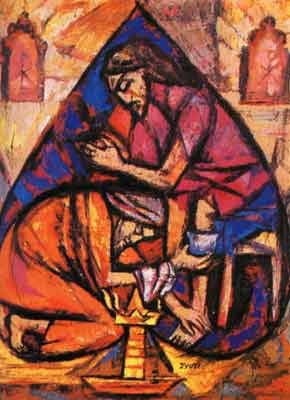
“I Have Set You an Example” (John 13:1-17)

Jesus Washes Peter’s Feet

Now before the festival of the Passover, Jesus knew that his hour had come to depart from this world and go to the Father. Having loved his own who were in the world, he loved them to the end. The devil had already decided that Judas son of Simon Iscariot would betray Jesus. And during supper Jesus, knowing that the Father had given all things into his hands and that he had come from God and was going to God, got up from supper, took off his outer robe, and tied a towel around himself. Then he poured water into a basin and began to wash the disciples’ feet and to wipe them with the towel that was tied around him. 

He came to Simon Peter, who said to him, “Lord, are you going to wash my feet?” Jesus answered, “You do not know now what I am doing, but later you will understand.” Peter said to him, “You will never wash my feet.” Jesus answered, “Unless I wash you, you have no share with me.” Simon Peter said to him, “Lord, not my feet only but also my hands and my head!” Jesus said to him, “One who has bathed does not need to wash, except for the feet, but is entirely clean. And you are clean, though not all of you.” For he knew who was to betray him; for this reason he said, “Not all of you are clean.”

After he had washed their feet, had put on his robe, and had reclined again, he said to them, “Do you know what I have done to you? You call me Teacher and Lord, and you are right, for that is what I am. So if I, your Lord and Teacher, have washed your feet, you also ought to wash one another’s feet. For I have set you an example, that you also should do as I have done to you. Very truly, I tell you, slaves are not greater than their master, nor are messengers greater than the one who sent them. If you know these things, you are blessed if you do them. (New Revised Standard Version)

One of the reasons I like Jesus so much is that he loves me as I am, and not merely as I should be. Jesus loves me even with my dirty stinky feet, my herky-jerky commitment to him, and my pre-meditated sin.

In fact, Jesus loved even Judas and washed his feet. Jesus serves people because they need his love, and not so that they will love him back.

I recently read about a man who lived in Paris. His wife had Alzheimer’s. He was an important businessman and his life was filled with busyness. Yet, he said when his wife fell sick:

“I just couldn’t put her into an institution, so I kept her. I fed her. I bathed her. Through the experience of serving my wife every day, I have changed. I have become more human. The other night, in the middle of the night, my wife woke me up. She came out of the fog for a moment, and she said, ‘Darling, I just want to say thank you for all you are doing for me.’ Then she fell back into the fog. I wept for hours to know this grace.” A Severe Mercy, by Sheldon Vanauken

Sometimes Christ calls me to love people who either cannot or will not love me in return. They live in the fog of some sort of disability, depression, poverty, or common spiritual blindness. As I serve them, I may only receive brief glimpses of gratitude. Just as Jesus loves me within my own spiritual confusion, so I desire to continue loving others as they walk through whatever fog they are in.

Lord willing, my life will be useful through my words and my witness. If God desires, my life will bear fruit through my prayers, my service, and my love. Yet, the usefulness of my life is God’s concern, not mine; it would be indecent of me to worry about that. I simply desire to follow my Lord’s example.

Ethiopian Orthodox Church icon of Jesus washing the disciples’ feet

Neither many Christians nor churches wash feet anymore. So, the following is today’s Gospel lesson put in a slightly different contemporary context:

It was just before the biggest and most important feast of the year. Jesus knew that it was finally the time for him to face the cross and die for the world’s sins. Having spent the past three years loving his followers, he now wanted to leave them with a clear demonstration of his love that they would never forget.

The evening meal was being served, and the devil had already gotten a hold of Judas Iscariot to betray Jesus to those who wanted him dead and gone. But it was all according to plan. Jesus knew that his heavenly Father had given him all authority because he was his Son, and he was ready to do what needed to be done to secure salvation and return to his rightful place at his Father’s right hand. 

So, Jesus got up from the meal, rolled up his sleeves, put an apron on, and ran a sink full of hot water. Jesus told the servants to take the night off, and he began taking the dishes from the dinner table and started washing them, taking care to do all that waiters and dishwashers would do.

When Jesus came to take care of Simon Peter’s dishes and serve him dessert and coffee, Peter said to him, “Lord, are you going to serve me?” Jesus replied, “I know you do not understand why I am doing this since it seems like something that is beneath me to do, but later you will look back on this night and understand completely what I am doing.”

“No,” said Peter, “this is not right – you are the Master, and this is not what a well-respected rabbi does – you are only disrespecting yourself and making us all look foolish. You are not going to take my dishes and wash them.”

Jesus answered, “Unless I wash these dishes and serve you, you are not going to be able to follow me anymore, and you will have no part of what I am doing in this world.”

“Well, then, Lord,” Simon Peter replied, “if that is the way it really is, then don’t just wash the dishes – come on over to my place and clean out the fridge and scrub the kitchen floor!”

Jesus answered, “A person who has had a decent meal needs only to wash the dishes so that he can enjoy the freedom of hospitable relationships with me and those around him. And all of you here have had a decent meal, though not every one of you.” For Jesus knew that Judas was only picking at his food in anticipation of betraying him.

When Jesus was all done washing the dishes and serving his disciples, he took his apron off, rolled his sleeves back down, and returned to the table. He looked them all squarely in the eye and said, “Do you understand what I just did for you? 

You call me ‘Teacher’ and ‘Master,’ and rightly so, for that is exactly what I am. So, now that I, your Master, and your Teacher have washed your dishes, you also should wash one another’s dishes. I have set you an example that you should do as I have done for you. I am telling you the plain truth that no follower is greater than the one he follows, nor is a preacher greater than the one he preaches about. 

Now that you know it is your task in this life to provide humble loving service, you will have God’s stamp of approval on your life if you quit thinking about how to possess and use power for your own purposes, and start thinking about how to use the authority I am giving you to love other people into the kingdom of God.

Loving Lord Jesus, how shocking it was for your disciples to be served by you in such a humble manner. But I cannot be spiritually cleansed unless I allow you to love me in an almost embarrassing fashion. Help me not to be so proud that I neither refuse your humble loving service toward me, nor neglect to offer that same kind of service to others. May love be the word, the idea, and the action that governs my every motivation and movement in your most gracious Name, I pray. Amen.

Both Body and Soul (1 John 4:1-6)

Dear friends, don’t believe everyone who claims to have the Spirit of God. Test them all to find out if they really do come from God. Many false prophets have already gone out into the world, and you can know which ones come from God. His Spirit says that Jesus Christ had a truly human body. But when someone doesn’t say this about Jesus, you know this person has a spirit that doesn’t come from God and is the enemy of Christ. You knew this enemy was coming into the world and now is already here.

Children, you belong to God, and you have defeated these enemies. God’s Spirit is in you and is more powerful than the one who is in the world. These enemies belong to this world, and the world listens to them, because they speak its language. We belong to God, and everyone who knows God will listen to us. But the people who don’t know God won’t listen to us. This is how we can tell the Spirit that speaks the truth from the one that tells lies. (Contemporary English Version)

Sometimes, it’s not what in someone says, but in what they don’t say.

The Apostle John gave some spiritually sage advice to a group of his disciples. They were being influenced by people who claimed Christian faith yet were not the real deal. Lots of people make claims, but the real muster of a Christian is in embracing an embodied spirituality that truly meets the holistic needs of others.

For John, affirming Christ’s deity, while denying Christ’s humanity, is unacceptable; he had no room for the Platonic Greek dualism of body and spirit. 

Jesus was a real man with a very real body. To deny this was to deny the faith. Ethereal musings about the insignificance of the body were flatly rejected by John. The apostle was concerned that the supreme Christian ethic of love be practiced through attention to both body and soul. 

Words are important; they’re also insufficient. Actual demonstrations of love are needed, as well. To downgrade or deny a bodily Jesus is to pay little attention to the real bodily needs of people. Christianity is a religion of both body and soul; it’s not a Greek philosophy of life.

I will be the first guy to insist on some deep theological reflection on the great spiritual, cultural, and social issues of our day. Yet, if our theology does not lead to tangible acts of love based on that reflection, then we have not yet been called God’s friend. 

Correct doctrine – embracing body and soul – leads to loving actions of faith. Ideally, we glorify God with both speech and service, physically and spiritually. Words and actions, heart and hands, must work together for an authentic Christian ministry.

The Word became a human being and lived here with us. (John 1:14)

The early church councils condemned the denigration of Christ’s full humanity for good reason. Not only did Jesus have a real flesh and body experience while on this earth, but Jesus also healed actual bodies and performed real physical miracles.

Jesus Christ met both the spiritual needs of forgiveness and reconciliation, and the needs of the body. What’s more, Jesus had no ranking system, as if the spiritual needs were the real commitments whereas tangible needs were just a means to the end of meeting intangible obligations.

The Gospel involves both body and soul; they are equally significant. To exalt one above the other is, frankly, heresy. So, let’s put this in more practical terms: Love is more than an expression of good feelings and goodwill toward others; love has skin on, using both physical actions and words formed from our vocal chords to bring goodness to others.

Jesus has always maintained the connection between spiritual and physical needs; it’s us who separate them. It’s the spiritual charlatan, and the huckster preacher, who speak out of one side of their mouth about spiritual salvation with no bodily human help or uplift.

Those who are against Jesus, the spirit of the antichrist, talk a good line but when push comes to shove, they have no intention of paying attention to both body and soul.

Our gut knows that feeling we cannot quite shake when we are around someone. It has real meaning. The spirit within us is greater than the spirit of the world. Just because we may not be able to respond very well to another, or give clear voice to what is inside us, does not necessarily mean that the other person is okay or right.

A proper Christian response to others incorporates head, heart, and gut. The interaction and alignment of all our faculties is needed. If we draw upon our entire selves, both body and soul, we will overcome the spirit of the antichrist through loving words and actions toward those who need it most.

The Antichrist wants us to get caught up in putting all our focus fighting theological battles and debating philosophical ideas – while our neighbor next door is dying of cancer; our co-worker is experiencing covert racism; and, our friend is stuck in poverty.

Since Jesus is fully human, that fact alone ought to impel us toward meeting the needs of the body – without wondering if it is the spiritual thing to do, or not. You already know this to be true. So, don’t let some esoteric preacher or teacher tell you otherwise.

Almighty God, Creator and Preserver of all humanity, I humbly ask: Make your ways known to everyone, and your saving health to all nations. May your church everywhere be guided and governed by your good spirit, so that all who profess and call themselves Christians may be led into the way of truth, and hold the faith in unity of spirit, in the bond of peace, and in righteousness of life.

Caring God, in your parental goodness, lift up those who are afflicted or distressed, in mind, body, or spirit. Comfort them and meet their every need, giving them patience under their sufferings, and a good outcome of all their afflictions. This we ask for the sake Jesus Christ your Son, our Lord, who with you and the Holy Spirit reign forever. Amen.

A Person’s a Person, No Matter How Small (Luke 17:1-4)

Jesus said to his disciples:

There will always be something that causes people to sin. But anyone who causes them to sin is in for trouble. A person who causes even one of my little followers to sin would be better off thrown into the ocean with a heavy stone tied around their neck. So be careful what you do.

Correct any followers of mine who sin, and forgive the ones who say they are sorry. Even if one of them mistreats you seven times in one day and says, “I am sorry,” you should still forgive that person. (Contemporary English Version)

In the children’s book by Dr. Seuss, Horton Hears a Who! Horton the elephant famously said, “A person’s a person no matter how small.” All the people around Horton were completely unconcerned for the residents of Who Ville living on a clover.

They were uninterested because the Who’s were invisible to them. Dr. Seuss chose to make Horton an elephant, a large creature able to hear with big ears and be attentive to the small.

Bigness and a large heart comes from becoming small and noticing little ones.

“Little ones” are people no one sees or notices. But Jesus sees them. They matter to him. And so they ought to matter to us, too. People need to be seen and heard by us – because they are visible to Jesus, and heard by him.

Christ often mingled with little people – children, women who had no rights, social misfits like lepers, the chronically ill, religious outsiders, tax collectors, and prostitutes. Our world is filled with similar people – angry adolescents, unwanted babies, forgotten old people, the mentally ill, moral failures, immigrants and refugees, and, if we have eyes to see and big ears to hear, lots of underprivileged people who reside on the dark underbelly of society.

They are around us, even if they are invisible to us.

Jesus envisioned a community that sees, honors, and protects little people. Truth be told, we are all little people before God, and the Lord notices us. So, we are to have enough humility to see the little people around us.

The way to become great in the kingdom of God is to descend, not ascend, into greatness. The chief enemy of any community is a desire to be prominent, to be the Big Cheese – it’s called “pride” and it will separate us from God if we hold onto it. Which is why we must do all we can to radically cut it out of our lives.

We are to welcome people – not because they are great, wise, rich, powerful, good-looking, and look like you and me. Rather, we are to welcome others because they are noticed by Jesus. Like Horton the elephant, Christ the Lord hears the cry from the place of smallness and is determined to do something about it.

The proud person who seeks prominence is always looking for greener pastures and impressing others. The proud connect with people who will help advance them up the ladder of success. Through that process of advancement, the proud do not care who they step on along the way.

Christians, however, are to give the small, insignificant people of society the time of day, treat them as important, and advocate for their needs. 

The Apostle Peter learned the hard way about paying attention to those different from himself. He experientially learned the saying, “love covers over a multitude of sins.” (1 Peter 4:9) This means that basic love for another prevents them from committing the sins they would have if they were unloved.

If we do not love, it would be better for us to be killed in a tragic millstone death. Jesus does not want people acting like leeches, just sucking the life out of others to get what they want.

So, what do we do about it? How shall we then live?

A person’s a person no matter how small. We need humility, to lower our sights and our bodies to see little people. We can truly see a two-year-old toddler whenever we lower ourselves to view them as equal and important. The way to see another requires slowing down, observing, and stooping or sitting to look them in the eye and give them the dignity of attention they deserve.

The danger of reading a post like this is the thought that all this stuff is really for someone else. After all, I don’t want to hurt anyone or see anybody deprived, right? Yet, the fact remains that we do no one any good when we neglect getting on the floor.

When we assume blessing for ourselves without the intent of giving it to others, we have come under the judgment of Christ. Perhaps we fear forgiveness – either accepting an apology from another or offering one to someone we have wronged. Out of sight, out of mind, is the approach of the one who causes others to stumble and make them fall.

Christ’s admonition is to watch ourselves, to be vigilant of both overt and covert sins against the unseen and forgotten amongst us. The pyramid below concerning racism is just one example of many other forms of causing others to stumble and fall:

Even though I write this warning, dear friends, I am confident of better things in your case—the things that have to do with salvation, deliverance, and liberation for all persons.God is not unjust; he will not forget your work and the love you have shown him as you have helped others and continue to help them.

Continue to show this same diligence so that what you hope for may be fully realized; and, imitate those who through faith and patience are doing good work. May the Lord be with you.

For those deprived of their human needs and their human rights: Just God, may they may be given the dignity by others which you confer on all his people.

For all who are forgotten and unseen, especially the poor, the sick, and the aged: All-seeing God, may you move us to love them as the image of Christ.

For all who are lonely or afraid, for teenagers on the street, the elderly in nursing homes, prisoners with no one to visit them, and all whom the world has forgotten: Lord Christ, may you lead us to them.

For those who suffer mental illness or disorder: Attentive God, may we cherish the gifts you have given them, and in their lives hear the voice of your love.

For each human life: Creator God, may we value every person as you do.
We pray in the name of Jesus Christ, our Savior. Amen.