A Life-Giving Message of Grace and Love (2 Thessalonians 2:13-3:5)

But we ought always to thank God for you, brothers and sisters loved by the Lord, because God chose you as first fruits to be saved through the sanctifying work of the Spirit and through belief in the truth. He called you to this through our gospel, that you might share in the glory of our Lord Jesus Christ.

So then, brothers and sisters, stand firm and hold fast to the teachings we passed on to you, whether by word of mouth or by letter.

May our Lord Jesus Christ himself and God our Father, who loved us and by his grace gave us eternal encouragement and good hope, encourage your hearts and strengthen you in every good deed and word.

As for other matters, brothers and sisters, pray for us that the message of the Lord may spread rapidly and be honored, just as it was with you. And pray that we may be delivered from wicked and evil people, for not everyone has faith. But the Lord is faithful, and he will strengthen you and protect you from the evil one. We have confidence in the Lord that you are doing and will continue to do the things we command. May the Lord direct your hearts into God’s love and Christ’s perseverance. (New International Version)

Turn to any page in Holy Scripture, focus on it’s contents, seek to live the message you find, and you will discover a rich and full spiritual life.

Standing firm in faith, holding to the apostolic teachings, and living into the good news of grace will translate into a daily life of loving others in both word and deed.

There are several elements contained in today’s New Testament lesson to spotlight in living a solid spiritual life: gratitude; salvation; sanctification; truth; spiritual calling; sharing in God’s glory; love; grace; hope; encouragement; prayer; faithfulness; perseverance; and, deliverance.

We could even highlight just one of these words and, if seeking to do a deep dive with it, could spend unending days learning and living into its multi-faceted dimensions.

I want to pause here and do a bit of a check-in with you. How we approach this passage of Scripture, as well as any other verses which encourage us to hold onto sound teaching and living, will likely determine our level of joy, satisfaction, confidence, and success in life.

It all begins with our view of self. If we come at the Christian life and Holy Scripture with a view of self as a mere tool or object for God’s use – then we are truly objectifying ourselves.

The key point of awareness to realizing whether we have such an objectifying view is if we continually “should” ourselves. The word “should,” brings self-hatred. We primarily see only shortcomings and original sin – and are blind to the majesty of being in God’s image.

In such a view there is typically boat loads of shame for not living up to the ideal form of a devoted Christian. Belittling ourselves inwardly only translates outwardly to looking down on others for their failures. Any exhortation from me or anybody else would be seen in this view as demanding a duty.

Instead, we can approach Scripture’s admonitions, encouragements, and exhortations with the glasses of grace. After all, our text for today says that God loved us and by grace gave us this teaching. The dense amount of Christian living in such a few verses, when viewed through the lenses of grace, are merciful words of support and encouragement.

God wants to strengthen us with grace just because of love. God does not objectify us by peering down on us as pawns in some twisted divine game of cosmic pleasure. Rather, God is looking to direct our hearts toward a delight in love. Because only love and grace is what endures throughout our Christian lives.

Not everyone has faith, and that saddens the heart of God. It also puts us, at times, in awkward situations. Again, the love of God does not leave us alone. Divine love will strengthen and protect us.

The Apostle Paul never wags his finger and levels the “should” on us like some uptight legalist. Paul expresses confidence, knowing that we most certainly have the capacity to live the will of God. The Scriptures are given to engender strengthening of faith and spiritual growth rather than self-hatred – which has a nasty tendency to come out sideways in a lack of compassion and grace toward others.

The second letter to the Thessalonian Christians was written because the believers were finding it difficult to endure their hard circumstances. They began longing for heaven to such a degree that they were losing their grip on living presently in the moment of now. This is one reason why Paul encouraged them to pray for him and his colleagues. The people needed to put some focus on the now of spreading the message of God’s grace and love.

The truth be told, the chief reason I write these daily reflections on Scripture is because I need God’s Word. Yes, I do, of course, write for the reader. I want to contribute to people’s growth in grace and I have a deep desire to make the message known.

Yet, honestly, I write more for myself. This is a way for me to remind myself of God’s love and grace and utilize it every day. When I hear Paul talking in biblical texts like these, I detect some of the same reason – Paul himself wants to continue growing in grace, and when writing to and for others he is very much writing to himself.

The reading of the Bible and the dedication to living its message is meant to be life-giving, or rather, eternally life-giving.

So, today, I offer you this blessing:

May you take refuge in the wondrous grace of God, and all the little miracles of mercy which he bestows each day.

May you always be inclined to rush into God’s Holy Word and discover it working within you.

May you imitate the flower as it opens to the day’s sunshine in receiving all that God has for you this day.

May you be in solidarity with brother stone, who sits in silence, calm and secure, and be excessively gentle with yourself.

May you wisely steer clear of those vexed in spirit with only God knows what; and, when in that space of others walking all over your boundaries, may your confidence surge and God’s protection deliver you.

May you return to the glory that is yourself, learning a new respect for your heart, and the joy that has always been there, given graciously to you by a God who has invited you to share in Jesus Christ.

Amen.

Jesus Shows Up (John 20:19-31)

Jesus shows himself to Thomas, by Rowan and Irene LeCompte

On the evening of that first day of the week, when the disciples were together, with the doors locked for fear of the Jewish leaders, Jesus came and stood among them and said, “Peace be with you!” After he said this, he showed them his hands and side. The disciples were overjoyed when they saw the Lord.

Again Jesus said, “Peace be with you! As the Father has sent me, I am sending you.” And with that he breathed on them and said, “Receive the Holy Spirit. If you forgive anyone’s sins, their sins are forgiven; if you do not forgive them, they are not forgiven.”

Now Thomas (also known as Didymus), one of the Twelve, was not with the disciples when Jesus came. So the other disciples told him, “We have seen the Lord!”

But he said to them, “Unless I see the nail marks in his hands and put my finger where the nails were, and put my hand into his side, I will not believe.”

A week later his disciples were in the house again, and Thomas was with them. Though the doors were locked, Jesus came and stood among them and said, “Peace be with you!” Then he said to Thomas, “Put your finger here; see my hands. Reach out your hand and put it into my side. Stop doubting and believe.”

Thomas said to him, “My Lord and my God!”

Then Jesus told him, “Because you have seen me, you have believed; blessed are those who have not seen and yet have believed.”

Jesus performed many other signs in the presence of his disciples, which are not recorded in this book. But these are written that you may believe that Jesus is the Messiah, the Son of God, and that by believing you may have life in his name. (New International Version)

When Jesus shows up, there is peace. Wherever Jesus goes, the Spirit of God is there. When Jesus appears, people believe.

The Meeting

After the crucifixion of Christ, the disciples were huddled together, mostly in fear of being found out and put out by the religious authorities. Out of nowhere, Jesus showed up, smack in the middle of the anxious group of men.

Christ in the center makes all the difference. From this central place, Jesus bestowed to the disciples his peace. The very first word the risen Christ spoke to his disciples was neither a command to stop being afraid, nor a rebuke for sitting around and doing nothing, or disappointment that they all ran away in the final hour of need at the crucifixion; instead, the first word of Christ was a gift of peace.

The presence and peace of Christ melted the disciples’ fear. Christ-centered peace is graciously given; so let us gratefully receive it.

The Reality

Jesus showed up, then showed off his hands and his side. He was not fabricated out of the disciples’ imagination; he was not some ghostly apparition. Rather, Christ was standing in the middle of them, very real, very physical, and very alive.

Christ gave his disciples real truth: actual wounded hands and side on a real body. Christ is risen and alive – not just spiritually, but physically. Since the resurrection of Jesus really happened, then nothing else matters; our joy is complete. We have what we need.

The Mission

As Jesus was sent by the Father, so Jesus sent his disciples; and is still sending us out into the world. And as Jesus came not to condemn the world but to save it, so we go out with words of grace and peace. The church exists for the life of the world – to bless it with the presence and peace of Christ.

“Whoever believes in me does not believe in me only, but in the one who sent me. The one who looks at me is seeing the one who sent me. I have come into the world as a light, so that no one who believes in me should stay in darkness.” (John 12:44-46, NIV)

Our spiritual DNA makes us little Christ’s walking around, doing the will of God, for the benefit of a world in darkness. We bear the name of Christ: Christians, proclaiming a message of life, delighting in God and creation; and not destroying the earth and its inhabitants.

The Gift

Right now, we are not alone. The Holy Spirit has been graciously given to us by Jesus. Although our mission is a big one, our resource for accomplishing it is even bigger. Jesus gives the Spirit in the same way he gives himself – as a sheer gift with no strings attached. Just as God breathed life into the very first people on earth, so Jesus breathes on the disciples and gives them new life and a new heart.

I will give you a new heart and put a new spirit in you; I will remove from you your heart of stone and give you a heart of flesh. And I will put my Spirit in you and move you to follow my decrees and be careful to keep my laws… and you will be my people, and I will be your God. (Ezekiel 36:26-28, NIV)

The Privilege

Christ has redeemed us, forgave us of our guilt and shame. Now, we have the privilege of passing the forgiveness to others. The special mission of the Church is giving Jesus to others with grace and peace, so that they may believe he is truly the risen Lord; and so, receive Jesus, the Spirit, forgiveness, and purpose in life, with Christ at the center of all things.

For the one whom God has sent speaks the words of God, for God gives the Spirit without limit. The Father loves the Son and has placed everything in his hands. Whoever believes in the Son has eternal life, but whoever rejects the Son will not see life, for God’s wrath remains on them.” (John 3:34-36, NIV)

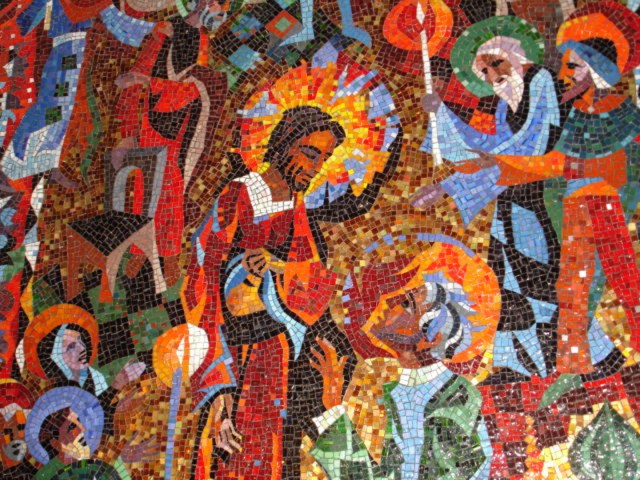
The Risen Lord, by He Qi

The Appearance

When Jesus appears, its good if we also show up to see him. It seems Thomas was late for church and missed the beginning of the service. He wasn’t with the other gathered disciples. Nobody knows where he was or what he was doing. But the important thing is that he did eventually show up, because showing up is the beginning of a changed life.

The Witness

After Jesus showed up, the disciples bore witness to what they saw and heard to Thomas. Yet Thomas, bless his doubting heart, wasn’t having it. He’s a realist. He wants proof, some actual physical evidence. Thomas was clearly a tactile learner because he needs some touch to believe any of this crazy talk of his disciple brothers.

Sometimes Thomas gets a bad rap, but he is really our Everyman. Doubt and skepticism are an important part of a full-orbed and honest faith. Jesus gave Thomas some space, time, and respect to begin wrapping his head and heart around this new reality of resurrection. I wonder if we all can do the same with others.

The Middle

A second time, Jesus shows up in the middle of the disciples. The Word became flesh and dwelt among us – and didn’t become a ghost and hang out in secret places. Once again, peace is given by Jesus to his followers.

Both appearances happen on a Sunday (which is why Christians have always worshiped on Sundays); and both meetings are literally Christ-centered (which every Christian meeting is supposed to be). Every Sunday. Christ always in the middle. Keep those two, and keep them together, and you can’t go wrong.

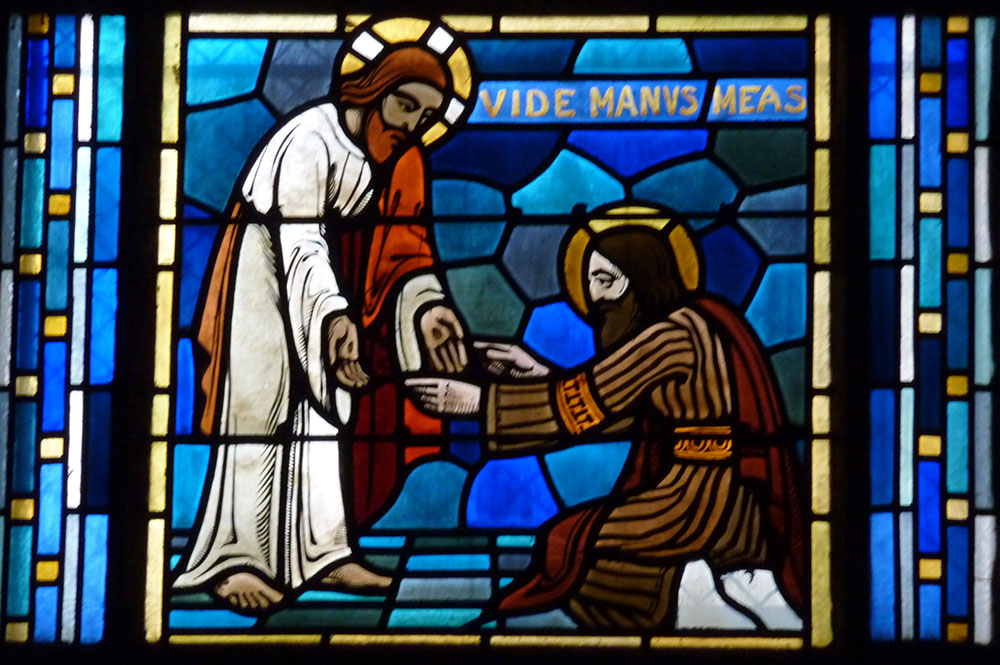
Jesus appears to Thomas with the Latin words, “See my hands,” in Notre-Dame-du-Rosaire Church, Saint-Ouen, France 

The Invitation

There’s no beating around the bush with Jesus. He immediately engaged Thomas and invited him to touch the wounds on his very real body. Christ knew Thomas’ hang-up, and went right to it. Thomas wanted evidence; Jesus offered it. If we get anything out of this encounter, it is that risen Christ honors honest doubt.

The evidence is here. Now believe it, and stop disbelieving. We have documentary evidence of the Old and New Testaments; the Church’s witness in Creeds, Confessions, and contemporary narratives of changed lives; and the internal testimony of the Holy Spirit. Therefore, look into them carefully and draw a sound conclusion.

The Confession

“My Lord and my God!” That’s the confession and the conclusion Thomas drew from the evidence – not only that Jesus is real, alive, existed, a good teacher; or other people’s Lord and God – but that he is my Lord and my God.

Jesus cared enough for Thomas to specifically meet him personally at his point of need. The grace of God keeps coming and never runs out. Jesus is filled up to the full in both grace and truth.

The Believer

Thomas had the physical evidence. But it doesn’t take that to truly believe. God blesses those who’ve never seen nor touched, but still believe. Jesus was thinking of you and me, and not only the people in front of him at the time. The Lord Jesus blesses us with the gift of peace, grace, and faith.

Though you have not seen him, you love him; and even though you do not see him now, you believe in him and are filled with an inexpressible and glorious joy, for you are receiving the end result of your faith, the salvation of your souls. (1 Peter 1:8-9, NIV)

The Conclusion

All this is for our benefit, so that we, too, may believe that Jesus is the Christ, the Son of the living God. Since Jesus is alive, he continues to bless us with his presence, power, and peace.

Jesus is with us:

  • through the Word of God, giving us his peace, showing up and meeting needs people.
  • at the Table in the sacrament of communion, bringing grace and forgiveness
  • in the person of the Holy Spirit, enabling and energizing us for mission and ministry to the world

It’s a life worth living, a Christ-centered life, full of God’s blessing.

O God and Father of our Lord Jesus Christ, in whom we receive the legacy of a living hope, born again not only from his death but also from his resurrection. May we who have received forgiveness of sins, set others free, until we enter the inheritance that is imperishable and unfading, where Christ lives and reigns with you and the Holy Spirit, one God, now and forever. Amen.

Keep the Main Thing the Main Thing (Galatians 2:1-10)

Fourteen years after that first visit, Barnabas and I went up to Jerusalem and took Titus with us. I went to clarify with them what had been revealed to me. At that time I placed before them exactly what I was preaching to the non-Jews. I did this in private with the leaders, those held in esteem by the church, so that our concern would not become a controversial public issue, marred by ethnic tensions, exposing my years of work to denigration and endangering my present ministry.

Significantly, Titus, non-Jewish though he was, was not required to be circumcised. While we were in conference we were infiltrated by spies pretending to be Christians, who slipped in to find out just how free true Christians are. Their ulterior motive was to reduce us to their brand of servitude. We didn’t give them the time of day. We were determined to preserve the truth of the Message for you.

As for those who were considered important in the church, their reputation doesn’t concern me. God isn’t impressed with mere appearances, and neither am I. And of course these leaders were able to add nothing to the message I had been preaching. It was soon evident that God had entrusted me with the same message to the non-Jews as Peter had been preaching to the Jews.

Recognizing that my calling had been given by God, James, Peter, and John—the pillars of the church—shook hands with me and Barnabas, assigning us to a ministry to the non-Jews, while they continued to be responsible for reaching out to the Jews. The only additional thing they asked was that we remember the poor, and I was already eager to do that. (The Message)

The former devout Jew, Saul, had become the Christian apostle and missionary, Paul. His ministry was as radical and dramatic as his conversion to Christianity was.

The Struggle

Keep in mind that the earliest church was predominantly made up of Jewish Christians. They had to struggle with the relationship between their historic Judaism and their newfound Christianity. For many of them, Paul was doing the unthinkable; he not only purposely sought to reach Gentiles (non-Jewish people) with the message of Jesus Christ, but he also did not require them to be circumcised. For Paul, one did not have to first become Jewish before becoming Christian.

Paul doggedly sought to preserve the core essence and spirit of Christ’s message, that is, to proclaim the good news of forgiveness and new life through the person and work of Jesus – and not by means of retaining Jewish customs or laws, including circumcision.

The Main Thing

Christianity is more than set of beliefs and practices; it’s a way of life which can be summed up in three important words: faith, hope, and love. 

Both new believers in Jesus and veterans in the faith know from experience how difficult it can be to live the Christian life. One reason for this difficulty, even when we want to please the Lord, is due to the confusion that occurs between our inner feelings and our outer actions.

The Confusion

The confusion starts with the creation and fall of humanity. In the beginning, God created humans as persons with a divine/human relationship as central to daily life. (Genesis 1:26; 2:16-25) 

What’s more, God created people with the capacity to receive divine revelation through our ability to think and reason. (Ephesians 4:24; Colossians 3:10) 

Before disobedience entered the world, in the original state before humanity’s fall, all human functions were under complete control with an inner experience of unity and harmony with one another and God. (Genesis 1:31; 2:7, 16-25) 

It is imperative for us to recognize the distinction between our personal being and our personal functions. (Romans 1:21-32; 6:16-22; 1 Corinthians 9:27; Ephesians 4:21-32)

If we don’t grasp how cataclysmic the fall of humanity was, we are going to have big struggles with living the Christian life – illustrated in the way that Paul needed to fend off a bunch of professing Christians who still seemed spiritually stuck. 

The Disobedience

In Adam and Eve’s original disobedience to God, the authority for life was transferred from God to us so that our sinful bent is to call our own shots without God. The source of authority also got whacky, transferred from a holistic and synergistic approach of body, mind, emotions, and spirit to a one-dimensional approach of simply how we feel at any given moment.

If we fail to understand this dynamic, we will be continually frustrated with people because they do irrational things. For example, many church pastors are flabbergasted that parishioners do not simply take what they teach them and go and do it. Yet, if it were that simple, there would be no place for the Holy Spirit!

Unfortunately, there’s more. In humanity’s fall, we lost control of our capacity to function well. We are all now vulnerable to manipulation, too easily swayed by the surrounding culture, and, of course, Satan. (Ephesians 2:2-3; Galatians 5:16-21) 

As a result, our inner conscience has become confused. We are not always certain of right and wrong. We misunderstand what life is really supposed to be all about. 

We lose sight of the main thing. And, in that state, there’s no way we can keep the main thing the main thing.

Instead, we become obsessed with feeling comfortable and secure; so, we pursue false gods – leaving usdisappointed and with a lack of fulfillment in life.

The Good News

However, the good news is that through the redeeming work of Jesus Christ, new life emerges; the bondage of sin is broken in our lives, and we are legally reinstated in a relationship with God in which the Lord is central in our daily life and the final authority. 

In this new relationship we can again receive truth through the Holy Spirit and the Holy Scriptures. We regain control of our functions. 

Yet, unless we learn the Scriptures and growin a daily walk with Jesus, the practical experience of this relationship with all its freedom, joy, assurance,  power, and fruitfulness may be greatly limited. (Romans 7:14-25; 1 Corinthians 3:1-4)

Even though we have redemption and faith, it is still possible to regress and give in to our old ways of functioning. This is a big reason why Christians can experience conflict, doubt, fear, anxiety, frustration, disappointment, and confusion.

To live keeping the main thing the main thing means to grow in the experience and application Christ’s centrality and authority in our lives. 

The Awareness

We must, therefore, make daily decisions of faith, hope, and love based in who we are in Christ and recognize his authority in our lives. The following seven recognitions and awareness may be helpful for you in experiencing Christian freedom and unity:

  1. You are a person with the ability to function in faith, hope, and love as God’s beloved child in Christ (2 Corinthians 7:1; Romans 8:14-17)
  2. There is a difference between who you are and what you do (or don’t do).  Evil thoughts and emotions do not make you evil, anymore than fantasizing about being a unicorn makes you a unicorn.
  3. You can take charge of your actions and your life (Galatians 5:22-23)
  4. The key is the use of your will through living in harmony with revealed biblical truth. In other words, you really can make choices of faith, hope, and love, no matter the situation. (Romans 4:17-21; Psalm 56:3; Psalm 43:5-11)  
  5. Reject whatever is contrary to Scripture, reason, and conscience. Listen to your whole self. Unhealthy patterns of acting and speaking must be broken in Jesus’ name. (Ephesians 4:22; Colossians 3:5-9; Titus 2:11-12)
  6. Choose to obey the Holy Spirit and the Holy Scriptures. Learn to think and act on the basis of truth. (Acts 27:25)
  7. Practicing the truth results in freedom, a re-patterning of thinking and functions, as well as the fruit of the Spirit. (John 8:32; Titus 2:11-14; Philippians 2:12-16)

The church is intended to be a supportive community of fellow redeemed people who worship and love Jesus together. 

Without sharing our collective learning of the Scriptures and daily struggles of faith, hope, and love, believers will inevitably be spiritually immature over the long haul. Instead, talk about your shared experiences of worship, Scripture reading, and Christian living. 

In doing so, God is glorified, the church is strengthened, and the cranky circumcisers are seen as the legalistic lunkheads they really are.

Good News for All (Acts 8:26-40)

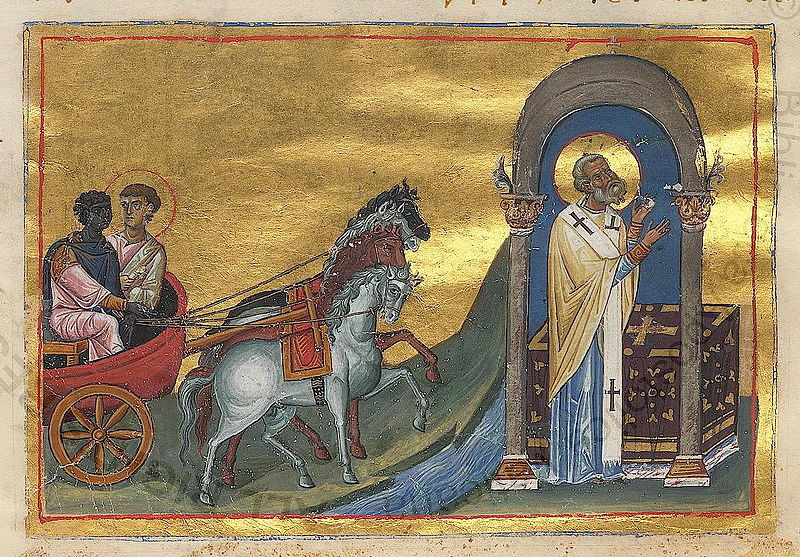
11th century Byzantine depiction of Philip and the Ethiopian eunuch

An angel from the Lord said to Philip, “Get up, and take the desert road that goes south from Jerusalem to Gaza.” So Philip went.

An Ethiopian man who had come to Jerusalem to worship was on his way home. The man was a eunuch, a high-ranking official in charge of all the treasures of Queen Candace of Ethiopia. As the official rode along in his carriage, he was reading the prophet Isaiah out loud.

The Spirit said to Philip, “Go to that carriage, and stay close to it.”

Philip ran to the carriage and could hear the official reading the prophet Isaiah out loud. Philip asked him, “Do you understand what you’re reading?”

The official answered, “How can I understand unless someone guides me?” So he invited Philip to sit with him in his carriage.

This was the part of the Scriptures that the official was reading:

“He was led like a lamb to the slaughter.
He was like a sheep that is silent
when its wool is cut off.
He didn’t open his mouth.
When he humbled himself,
he was not judged fairly.
Who from his generation
will talk about his life on earth being cut short?”

The official said to Philip, “I would like to know who the prophet is talking about. Is he talking about himself or someone else?” Then Philip spoke. Starting with that passage, Philip told the official the Good News about Jesus.

As they were going along the road, they came to some water. The official said to Philip, “Look, there’s some water. What can keep me from being baptized?”  The official ordered the carriage to stop. He and Philip stepped into the water, and Philip baptized him. When they had stepped out of the water, the Spirit of the Lord suddenly took Philip away. The official joyfully continued on his way and didn’t see Philip again.

Philip found himself in the city of Azotus. He traveled through all the cities and spread the Good News until he came to the city of Caesarea. (God’s Word Translation)

We are in the Christian season of Epiphany – a time of celebrating that the light of the Lord has been given not only to Jews but to Gentiles, as well. The good news of mercy, forgiveness, salvation, and peace in Jesus Christ is for everyone, and not just some.

So, we have a very appropriate story in today’s New Testament lesson illustrating God’s grace for those who have been typically the “outsiders” when it comes to the worship of God.

God’s grace is really a merciful divine intervention into another’s life, providing something a person or group needs, yet cannot obtain on their own.

Philip, one of the original twelve disciples of Jesus, received instructions from the angel of the Lord. Take a certain road. That’s it. No other explanation. The command is, however, full of grace. Most of us don’t do all that well with multiple instructions given at once. We do much better with a single imperative at a time.

And so, the next piece of guidance came as Philip was taking the road from Jerusalem south to Gaza. Go hang out around a certain carriage. Philip needed no more direction after that; he took to what was happening.

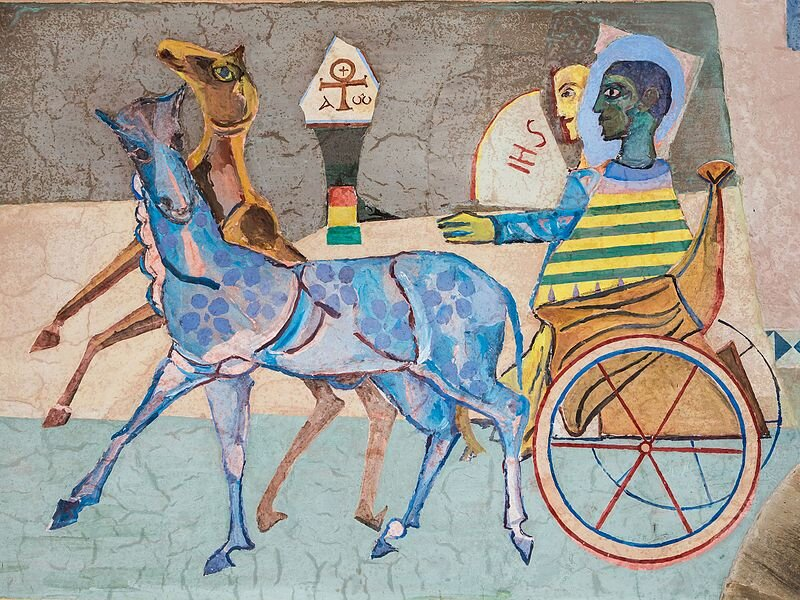
Philip and the Ethiopian Eunuch by Herbert Boeckl

Maybe reading the story from our contemporary perspective hinders us from seeing just how scandalous and unthinkable the story was for people in the first century. Jews and Gentiles didn’t hang out with each other; and, if they did, there were all sorts of rules regulating how the interaction would go.

We really don’t have any of this with Philip. He simply emulates his Lord and ignores societal and cultural mores to meet the need of someone very different than himself.

An Ethiopian man was in Jerusalem and heading back home. He was an official in the Queen of Ethiopia’s court, and a eunuch (a castrated official). He was a person of color with a mutilated body and could have very well been of a different gender than Philip was used to. In other words, he was about as foreign from Philip as one can get.

Yet, what better way to communicate that the gospel is for everyone? Philip had learned from Jesus not to adopt the divisions of race, religion, and gender that others did. See, instead, with spiritual eyes to the heart of a person.

And this Ethiopian eunuch had a heart curious about God, a mind trying to understand God’s words, and a gut that told him this guy approaching me for whom I don’t know and isn’t from my country is perhaps God’s messenger to me.

That’s what I call a divine appointment.

Those divine encounters always result in changed lives. I believe both the Ethiopian and Philip were changed that day. The only way that any of us truly changes is through the interaction with others different from ourselves.

The good news of Jesus is for all. If, however, we remain in a closed system which is not open to others of differing cultures and communities, then we harden into believing the gospel is for us, and not them.

Christianity is not, therefore, an exclusive club made up of insiders who demonize outsiders as not looking, acting, or thinking like we do. We already have plenty of that insidious junk in the world. At its inception, Christianity was different. And, I believe, it needs to keep that edge of reaching out to all persons with a life-giving message of salvation and peace – not a death-dealing sermon of Christian cultural hegemony.

Good news for all people everywhere means that proclamation of the gospel of Jesus Christ needs to occur for all nations and ethnic peoples. It’s a message of grace, not judgment; of mercy, not threats; of open love, not closed hate.

Philip and the Ethiopian show us the way through their sensitivity to the divine, their open dialogue with one another, and their shared commitment to doing what is right and serving the Lord. Philip was a guide, not a conqueror. And the Ethiopian became a follower of Jesus, not Philip.

Let’s make sure to keep it straight; and to keep reaching out.

Lord God, thank you that in love and mercy, you reached out to us – and that when we were dead in our sins, you sent Jesus to make us alive. Thank you that you have a heart that seeks the lost. Thank you for saving us.

Give us hearts that care for the people who are in darkness and need the light of Christ. Teach us to care for them as you do. Grow us to care for the common good of all humanity. 

Help your Church everywhere to know and love you; and to invite others into your divine dance. May our conversations with others be seasoned with salt and full of grace; may our relationships show people the love of Jesus. May our hearts reflect your own heart, through Jesus Christ our Lord, in the strength of the Holy Spirit. Amen.