Christ Is Effective (Hebrews 10:10-18)

Orthodox icon of Jesus Christ

Day after day every priest stands and performs his religious duties; again and again he offers the same sacrifices, which can never take away sins. But when this priest had offered for all time one sacrifice for sins, he sat down at the right hand of God, and since that time he waits for his enemies to be made his footstool. For by one sacrifice he has made perfect forever those who are being made holy.

The Holy Spirit also testifies to us about this. First he says:

“This is the covenant I will make with them
    after that time, says the Lord.
I will put my laws in their hearts,
    and I will write them on their minds.”

Then he adds:

“Their sins and lawless acts
    I will remember no more.”

And where these have been forgiven, sacrifice for sin is no longer necessary. (New International Version)

We are reminded in this Advent season of the Christian Year, that the coming of Christ had a purpose: Offering himself for all of the guilt and shame of the world.

Through the incarnation of Christ, God entered the world in order to deliver all creation from the power of evil, to give freedom from sin, death, and hell, so that people could come to God.

The old sacrificial system of Levitical priests offering sacrifices was good, but it was not effective. Jesus, as both priest and offering, is infinitely better. Christ’s offering was so superior that it was the sacrifice to end all sacrifices.

Jesus Christ was willing to do the work of offering himself, and was the perfect person to do it. No other could have done it.

In the Christian religious tradition, Jesus is the logical, reasonable, and promised way of reversing the curse upon humanity and doing away with sin forever.

The person and work of Christ is both a simple project to understand, as well as so complex that we will spend an eternity exploring Jesus and his ministry.

So, let’s make sure to maintain the tension of a message everyone can understand, as well as a message so deep and wide that we need to keep discovering how it continues to unfold, even up to this day and beyond.

The priest in the old covenant made daily offerings. The sacrifices were a reminder of guilt; none of them could take away sins. But Christ made one offering that potently took care of the sin issue once and for all.

The offerings of the Levitical priests in the old system were repeated because they were insufficient to take away human shame. But Jesus “endured the cross, scorning its shame, and sat down at the right hand of the throne of God.” (Hebrews 12:2)

The author of Hebrews tells us that the once-for-all offering of Jesus made the worshiper perfect. It makes sense that a perfect Savior offered a perfect sacrifice, with the effect of making perfect those who are coming to God.

“Perfect” does not mean that the worshiper is now completely without sin, as if an instant moral and ethical perfection occurred. The author was not communicating that Christians are completely unblemished, pure, and never error in their ways.

Rather, the Book of Hebrews has the message that we can come to God without any obstacles. Worshipers are now in a situation where they can engage in the project of Christian maturity without any hindrances to access with God.

Even death will not stop the believer from coming to God. Death, hell, and sin have been conquered by Christ’s offering of himself. We can now spiritually grow, instead of spiritually wither. The way is open to God.

For we do not have a high priest who is unable to empathize with our weaknesses, but we have one who has been tempted in every way, just as we are—yet he did not sin. Let us then approach God’s throne of grace with confidence, so that we may receive mercy and find grace to help us in our time of need. (Hebrews 4:15-16, NIV)

In Christ, we have shed our human weakness and have obtained an indestructible life. (Hebrews 7:16)

The “perfection” or maturity and full realization of God’s promises in Christ will culminate at the end of the age. So, it is theologically (doctrine of God) and anthropologically (doctrine of humanity) appropriate to say that we are perfect and not yet perfect.

Put a different way, in the context of soteriology (doctrine of salvation), we have been saved, are being saved, and will be saved. The Cross of Christ has secured perfect deliverance for us.

Yet, we must live into that deliverance, which is what we call “sanctification” or the process of being made holy, pure, and mature as Christians.

And we will not be completely free of the world’s evil machinations, our own sinful proclivities, and the devil’s stratagems against us until the second advent when Christ returns to judge the living and the dead.

For now, we are in the process of being made perfect. We struggle daily with the tension between good and bad, right and wrong, justice and injustice.

Its as if the offering of Jesus, the Cross of Christ, made the largest splash in history, with ripples still extending out in all directions into the past and the future that keep making significant waves.

Thank you, Jesus. Praise the Lord.

Heavenly Father, in you we live and move and have our being: We humbly pray you so to guide and govern us by your Holy Spirit, that in all the cares and occupations of our life we may not forget you, but may remember that we are ever walking in your sight; through Jesus Christ our Lord. Amen.

Korah’s Rebellion (Numbers 16:20-35)

Korah’s Rebellion, by John Bradford

The Lord said to Moses and Aaron, “Separate yourselves from this assembly so I can put an end to them at once.”

But Moses and Aaron fell face down and cried out, “O God, the God who gives breath to all living things, will you be angry with the entire assembly when only one man sins?”

Then the Lord said to Moses, “Say to the assembly, ‘Move away from the tents of Korah, Dathan and Abiram.’”

Moses got up and went to Dathan and Abiram, and the elders of Israel followed him. He warned the assembly, “Move back from the tents of these wicked men! Do not touch anything belonging to them, or you will be swept away because of all their sins.” So they moved away from the tents of Korah, Dathan and Abiram. Dathan and Abiram had come out and were standing with their wives, children and little ones at the entrances to their tents.

Then Moses said, “This is how you will know that the Lord has sent me to do all these things and that it was not my idea: If these men die a natural death and suffer the fate of all mankind, then the Lord has not sent me. But if the Lord brings about something totally new, and the earth opens its mouth and swallows them, with everything that belongs to them, and they go down alive into the realm of the dead, then you will know that these men have treated the Lord with contempt.”

As soon as he finished saying all this, the ground under them split apart and the earth opened its mouth and swallowed them and their households, and all those associated with Korah, together with their possessions. They went down alive into the realm of the dead, with everything they owned; the earth closed over them, and they perished and were gone from the community. At their cries, all the Israelites around them fled, shouting, “The earth is going to swallow us too!”

And fire came out from the Lord and consumed the 250 men who were offering the incense. (New International Version)

Rebellion in the community was afoot. There were certain Levite leaders who rejected the leadership of Moses, and especially Aaron. They failed to discern that these men were God’s appointed leaders.

On the surface of things, Korah the ringleader, put the matter in a pious sounding way by presenting Moses and Aaron as against democracy. He insisted that all the community is holy, so therefore, Moses and Aaron were exalting themselves over everyone else.

It becomes apparent, however, that Korah and the other Levites were with him to gain the priesthood. It was the age-old play for power and authority. At the least, the rebels were ungrateful for their own place in the religious system that God, not Moses, had set up.

Moses responded by having Korah and his followers act like priests. He had them come to the tent of meeting with censers to burn incense before the Lord. Then, they could clearly find out whether God would accept their priestly service, or not.

The entire camp, of course, showed up, looking like the townspeople in an old Western movie. The Sheriff and the gunslinging bandit, in the street, about to duel each other.

Since the Lord is a big God, the Lord showed up big.

Yahweh’s glory appeared, threatening to exterminate everyone, townspeople included. Clearly, God had had enough of the people’s continual grumbling and their incessant rebellious spirit.

To demonstrate, once and for all, which side of things God is on, the Lord caused a singular disaster to occur – which had never happened before or since. The ground opened up and the earth literally swallowed up the rebels’ households and all who were with them in the rebellion.

As for the 250 men who were challenging Moses and Aaron with their censers in hand, were seen for who they were: Rebels against God. The little fires in each of their censers erupted into great flames of fire which completely consumed them. They were dead on the spot.

That experience clarified forever who was supposed to be doing the priestly service in Israel.

Although today’s Old Testament lesson is one of the more famous (or infamous) stories of divine judgment in the Bible, it seems to me that perhaps we might focus a bit more on the grace which existed with Moses and Aaron.

After all, if we want to see humanity’s better angels, then let’s talk about them.

I’m not really sure if I would have the humility and wisdom of Moses and Aaron to be concerned for the entire community in such a suspenseful and vitriolic situation. And yet, the two of them appealed to God for mercy on the nation. As a result, it was only the 250 men and their households who experienced condemnation.

There will always be persons like Korah and his followers on this earth. No matter where we go, and no matter how much we may try to avoid them, they’ll show up. And we will have to deal with them.

At such a point, we certainly have a biblical warrant for praying great imprecatory (judgmental) prayers upon them, just as the psalmist did many times.

And there is nothing wrong with our feelings of anger, that is, unless we allow that anger to come out sideways and add to the problem.

Yet, we really do have other options, which is what I think Jesus was getting at with his followers when he said:

“You’re familiar with the old written law, ‘Love your friend,’ and its unwritten companion, ‘Hate your enemy.’ I’m challenging that. I’m telling you to love your enemies. Let them bring out the best in you, not the worst. When someone gives you a hard time, respond with the supple moves of prayer, for then you are working out of your true selves, your God-created selves. This is what God does. He gives his best—the sun to warm and the rain to nourish—to everyone, regardless: the good and bad, the nice and nasty. If all you do is love the lovable, do you expect a bonus? Anybody can do that. If you simply say hello to those who greet you, do you expect a medal? Any run-of-the-mill sinner does that.

“In a word, what I’m saying is, Grow up. You’re kingdom subjects. Now live like it. Live out your God-created identity. Live generously and graciously toward others, the way God lives toward you.” (Matthew 5:43-48, MSG)

We, of course, see the real stinker that Korah was, along with those who followed him. Yet, we also see the real deal with Moses the leader and Aaron the priest.

In the crucible of a very difficult situation, their true muster came out. They did not try to become judges themselves, nor did they encourage God to raze the entire place and start all over again. Instead, they prayed with humility and wisdom, demonstrating why God had them as leaders over the nation of Israel.

And we are left with the realization that people like you and me will always need to be cognizant and aware to keep developing those virtues of wisdom and humility in our lives.

For there is always a new situation which arises, needing our better angels to show up and handle things well.

O God, you guide the humble in all things, and cause light to bear upon the darkness. Help us, in all of our doubts, uncertainties, and insecurities, to depend upon your grace and ask what you would have us to do. May the Spirit of wisdom save us from foolish choices, so that in your light we can see light, and walking your straight path we may not stumble. Amen.

Third Sunday of Advent – The Ministry of John the Baptist (Luke 3:7-18)

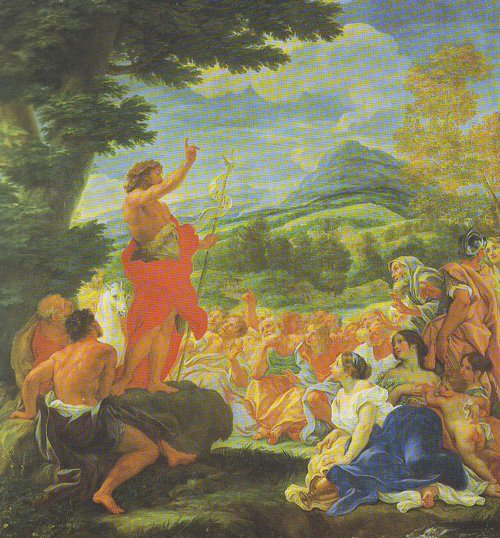
St. John the Baptist Preaching, by Giovanni Battista Gaulli (1639-1709)

John said to the crowds coming out to be baptized by him, “You brood of vipers! Who warned you to flee from the coming wrath? Therefore, bear fruits worthy of repentance, and do not begin to say to yourselves, ‘We have Abraham as our ancestor,’ for I tell you, God is able from these stones to raise up children to Abraham. Even now the ax is lying at the root of the trees; therefore every tree that does not bear good fruit will be cut down and thrown into the fire.”

And the crowds asked him, “What, then, should we do?” In reply he said to them, “Whoever has two coats must share with anyone who has none, and whoever has food must do likewise.” Even tax collectors came to be baptized, and they asked him, “Teacher, what should we do?” He said to them, “Collect no more than the amount prescribed for you.” Soldiers also asked him, “And we, what should we do?” He said to them, “Do not extort money from anyone by threats or false accusation, and be satisfied with your wages.”

As the people were filled with expectation and all were questioning in their hearts concerning John, whether he might be the Messiah, John answered all of them by saying, “I baptize you with water, but one who is more powerful than I is coming; I am not worthy to untie the strap of his sandals. He will baptize you with the Holy Spirit and fire. His winnowing fork is in his hand to clear his threshing floor and to gather the wheat into his granary, but the chaff he will burn with unquenchable fire.”

So with many other exhortations he proclaimed the good news to the people. (New Revised Standard Version)

John’s ministry was meant to be one of preparing people for the Lord’s coming. His understanding of that preparation may seem odd, even harsh, to us.

Yet, John believed that the coming of the Lord meant that Judgment Day was at hand. So, his words are consistent with that sort of theological understanding.

What John did not see at the time – nor anyone else, for that matter – was that the coming of the Lord was happening in two advents, and not just one.

The first advent, or coming, was the incarnation and earthly life of Jesus. This first coming is not yet the time for judgment. The second advent, however, will be all about judgment for both the living and the dead.

That reality, however, doesn’t mean John’s feisty words have no meaning for us. In fact, they have more meaning than ever, because the judgment he foresaw is still yet to come.

We need to hear John’s words, and have the ears to receive those words, because we are in a world that seems ripe for divine judgment.

Repentance – a change of mind and heart that leads to a new life of active justice (not judgment) – is the appropriate preparation for us in this current Advent season.

Amongst the crowds who gathered around John, some recognized how they had fallen short of loving God and neighbor. Some had a profound sense of failing to live faithfully. Others were overwhelmed and came to see and hear the Baptist preach.

Above all, however, John had a warning to the people about relying on their privilege as Jews. It isn’t pedigree that gets anyone anywhere in God’s kingdom.

Instead of putting faith in something like ethnicity or religious beliefs, people ought to be putting their efforts into living a good, right, and just life.

For us today, nobody can rely on special privileges either. It has always been humanity’s responsibility and obligation to love, not hate; serve, not always looking to be served; and showing mercy, not revenge.

The axe comes in many forms, yet it consistently exists to cut off something. Far too many persons, during this time of year, and especially in this season, feel cut off from family or friends. Many sense they are cut off from light, or sanity, as if the world is a surreal place filled with clowns and oligarchs who care nothing for others.

There’s a lot of suffering going on. And any threats of axes and separation are already a reality for too many persons. So, what are we to do with all these icky and unwanted thoughts, feelings, and situations?

John said to the crowd that they were to bear fruit that is worthy of repentance. That is a very biblically language-based way of saying that, for God’s sake, we had better start practicing forgiveness, and see one another from a different angle.

We need a changed viewpoint that leads to a changed heart and life.

There must be a new, or renewed, relationship with God.

If there is doubt about what to do, the answer lies within the problem:

  • For the money-hungry, don’t be greedy, but learn to give away resources
  • For those in authority, don’t abuse power through extortion, but learn to give it away, along with your wages
  • For those who talk a good line, don’t manipulate others, but learn to give your hands and feet to working for a better world, and for your neighbor next door

Learning how to change and be different in this season of Advent is the very best way of preparing to receive the Christ child at Christmas.

One greater than John is coming, with something better than anyone can imagine. It is the gift of a different baptism – fire and spirit – that breathes the power of God into everything it touches.

The axe may be at the root of the tree. There may already be plenty of separation and disconnection. But this year doesn’t have to end in disaster or destruction or disappointment.

You and I, along with everyone who calls on the name of the Lord, can experience deliverance from evil, and freedom to be the people we were always meant to be.

O God of the lost and the displaced, you promise restoration and wholeness through the power of Jesus Christ. Give us faith to live joyfully, sustained by your promises, as we eagerly await the day when they will be fulfilled for all the world to see; through the coming of your Son, Jesus Christ. Amen.

I Want To Know Christ (Philippians 3:7-11)

Jesus Christ and the Apostles, by Nikolas Martínez Ortiz de Zarate (1907-1990)

But whatever were gains to me I now consider loss for the sake of Christ. What is more, I consider everything a loss because of the surpassing worth of knowing Christ Jesus my Lord, for whose sake I have lost all things. I consider them garbage, that I may gain Christ and be found in him, not having a righteousness of my own that comes from the law, but that which is through faith in Christ—the righteousness that comes from God on the basis of faith. 

I want to know Christ—yes, to know the power of his resurrection and participation in his sufferings, becoming like him in his death, and so, somehow, attaining to the resurrection from the dead. (New International Version)

Whenever someone asks me what my favorite portion of Holy Scripture is, I reflexively turn to these verses in our New Testament lesson for today.

I resonate with these words from the Apostle Paul to the Church at Philippi, because they match what I truly believe, and how I really feel about Jesus.

We go through a lot of loss in this earthly life. We experience hardship and adversity. We grieve and lament.

Some of the losses in this life, we are okay with, or at least, we come around to being okay with them after a bit of time. Yet, there are other losses that are heartrending.

On the flipside, there are many gains we experience in this life. Some of them we worked very hard for, and others came to us as gifts.

Oftentimes, our gains and our losses are inextricably bound with each other. Something we consider precious is lost. We may even choose to set aside or give up something we have – we allow it become lost – so that we can gain something even better.

At other times, the process of gaining, losing, then gaining something good was not purposed by us, but by God.

And, to me, that’s probably the best sort of good there is.

Another way of putting the matter is: We must let go and accept how something or someone is, before we can experience what a truly good life really is.

Jesus, by Ghanshyam Gupta

Allow me, or please indulge me, as I frame the Apostle’s words in my own sort of language:

Anything in this life that I have achieved; anything I have come to possess; any sort of position or title I hold or have held; any kind of identification I have, or prestige  I have gained, is of no value. In reality, it’s all rather worthless.

If you will let me take it even further, compared to having an authentic, real, and experiential relationship with Jesus as my Savior, my Lord, and my Friend, everything else is like a bunch of garbage. That’s how much I value Jesus. There’s no other thing, no other relationship, that comes remotely close to knowing Christ.

It isn’t so much that I found Jesus, but that he found me. So, I have a faith that’s got nothing to do with keeping up appearances or rule-keeping, or keeping ahold of anything. I have the life that is truly life.

But, oh my, there is so much more to experience and to know with Jesus! I want to experientially know the power of Christ’s mighty resurrection. I  want to be like him, and participate with him, as if Jesus were living his life through me.

And, I must tell you, I know that this sort of life means suffering. But I also know that this suffering puts me in solidarity with my Lord – which is exactly where I want to be.

I only want to live up to who I’m supposed to be in Christ, to be my true self, and not some faux Christian living according to mere rules and regulations. The only thing that counts to me is faith expressing itself through love.

I understand that I took a lot of liberties with the text, and elaborated on it in order to make it my own. But, truth be told, we all need to find ways to make scripture as our own.

We all must let go of some old ways and unlearn a lot of things, in order to discover new life and be united with Christ. Everyone needs to learn from the past, so that we can live a new life here in the present.

If you don’t like my words, that’s fine. You aren’t under any obligation to read them. Yet, I do believe we have an obligation to Holy Scripture, and specifically, to ingest it as if it were the best meal you’ve ever eaten.

Indeed, we end up experiencing a lot of losses in this life. Yet, with Jesus, we will never lose him, because he will never forsake us. Christ is our eternal gain. He’s alive, always living, so that we need never be concerned about him not existing anymore.

That’s my faith. That’s what I trust in, or rather whom I put my faith in, and my trust upon. It’s all about Jesus. Anything less will not stand the test of time, nor of satisfaction in life.

What will you do with Jesus?

Christ isn’t going to strongarm you into the kingdom of God. But he will doggedly go after you, and be a pester pup in your ears and an ever-present sense in your heart.

You might as well go ahead and consider him, or perhaps reconsider him, like you’ve never done before.

After all, you’ve really got nothing to lose.

We believe in one Lord, Jesus Christ,

the only Son of God,
eternally begotten of the Father,
God from God, Light from Light,
true God from true God,
begotten, not made,
of one being with the Father;
through him all things were made.
For us and for our salvation
he came down from heaven:
was incarnate of the Holy Spirit and the Virgin Mary,
and became truly human.
For our sake he was crucified under Pontius Pilate;
he suffered death and was buried.
On the third day he rose again
in accordance with the Scriptures;
he ascended into heaven
and is seated at the right hand of the Father.
He will come again in glory to judge the living and the dead,
and his kingdom will have no end. – The Nicene Creed, on Jesus Christ