How Can the World Change? (Philippians 1:21-30)

For to me, living is Christ and dying is gain. If I am to live in the flesh, that means fruitful labor for me, yet I cannot say which I will choose. I am hard pressed between the two: my desire is to depart and be with Christ, for that is far better, but to remain in the flesh is more necessary for you. Since I am convinced of this, I know that I will remain and continue with all of you for your progress and joy in faith, so that, by my presence again with you, your boast might abound in Christ Jesus because of me.

Only, live your life in a manner worthy of the gospel of Christ, so that, whether I come and see you or am absent and hear about you, I will know that you are standing firm in one spirit, striving side by side with one mind for the faith of the gospel and in no way frightened by those opposing you. For them, this is evidence of their destruction but of your salvation. And this is God’s doing. For he has graciously granted you the privilege not only of believing in Christ but of suffering for him as well, since you are having the same struggle that you saw I had and now hear that I still have. (New Revised Standard Version)

I believe that one of the greatest tragedies of this contemporary age is that millions of people suffer in silence, alone, with nobody knowing what they’re going through. Countless others cry by themselves, even in public. It’s as if someone who is suffering or sad is a pariah whom we cannot get close to.

It is not supposed to be this way. Suffering by oneself is a tragedy. Suffering with others is a privilege. We are not only meant to be one in spirit when things are going well and it’s a joyous occasion; we’re also to maintain that close unity when the world seems to be falling apart and there are those who are profoundly hurting in either mind, spirit, or emotion.

A few years ago, I stood amongst a gathered group of people, most of whom I did not know.  I was there for a memorial service of a fellow colleague. She received the kind of news that no one wants to hear. In a matter of weeks, she was gone. Not every funeral I attend (or even officiate) is beautiful. This one was, and here’s why: It was a collective experience of both joy and sorrow.

I walked away from my friend’s remembrance with a clear conviction – one that had been percolating and forming within me for quite some time.

This conviction might seem exaggerated, yet it by no means is meant to be. It’s just what I have come to believe about the universal human experience.  It comes from the confidence and experience of a lifetime of observation and ministry.

It is neither merely a heartfelt sentiment nor a passing feeling. No, it really is a conviction, a firm principle or persuasion. It is this:

Crying with strangers in person has the power to change the world.

I think I’ve always known this. It just crystalized for me through that experience. After all, I have watched with awe the privilege of walking into a dying patient’s room, full of tearful family, and be with them in their pain.  The sharing of stories is powerful, eliciting both great joy, reminiscent laughter, and profound gratitude; as well as tremendous sorrow, grinding grief, and sad lament. 

Tears and celebration mix in a sacred alchemy producing a kind of care which transcends description.

It’s one thing to observe other’s joy and sorrow on the evening news, or even from afar. It is altogether a different reality to participate up close and personal. It’s something akin to watching a travel documentary on Yellowstone Park versus visiting the place in person; there’s just no comparison. 

Shared human experiences of suffering will nearly always translate into new and emerging capacities for empathy. And where empathy exists, there is hope for all humanity. 

Being with another person or group of people in their suffering creates a Grinch-like transformation in which our hearts suddenly enlarge. A single tear from a singular small little Who girl in Whoville had the power to penetrate years of hardness of heart and change what everyone thought was a shriveled soul full of garlic and gunk.

Said a different way: The spiritual and emotional heart of a human being is able to shrink or expand. It shrinks from spending far too much time alone and/or holding others at bay, at arms-length, while playing the armchair critic to those who are out rubbing shoulders with real flesh and blood people. 

The Grinch never went back to his isolation. Instead, he did what Whoville thought was the unbelievable: The Grinch fully participated in the joy of the community, up close and personal.  It was a full-bore holding of hands, singing, and eating – which illustrates a conviction I’ve held for a long time:

Hospitality, that is, showing love to outright strangers through celebrative participation with food and drink, has the power to change the world.

Hospitality cannot happen from afar. Sitting around the table with strangers and interacting with them is needed. It alters our perspectives so that we live our shared humanity. It is rather difficult to hate someone when you get to know them and discover their loves and joys, hurts and wounds.

This all leads toward asking one of the most fundamental and basic biblical questions that must be asked by every generation and considered by everyone who respects God and/or the Christian Scriptures:

Am I able to see the image of God in someone very different from myself?

The Christian doesn’t have to go very far to answer this one, at least from an objective cerebral perspective.  Jesus saw the humanity in everyone he encountered, from Jew to Gentile, from sinner to saint.  In fact, Jesus saw this image so deeply within another that he sat around the table and ate with people whom others saw as not worthy to eat with.  Jesus’ willingness to participate in the hospitality of strangers was downright scandalous.  It isn’t a stretch to say that it got him killed.

What’s more, Jesus wept. He cried in public with strangers. For followers of Christ who seek to emulate him in his practical ministry, that point ought to be noticed. After all, we choose to remember and participate in the life of Christ through the elements of bread and wine at the Table. God’s radical hospitality toward us is truly meant to translate to an open heart toward those who look and act differently than me.

The great fourteenth century mystic, Julian of Norwich, a female devotee of Christ and an influential theologian in her own right amongst a world of men who tended to see the image of God in women as flawed, understood what it would take to reawake image-bearing humanity. She stated:

“All that is contrary to peace and love — is in us and not in God. God’s saving work in Jesus of Nazareth and in the gift of God’s spirit, is to lessen our wrath in the power of his merciful and compassionate love.”

Julian of Norwich

Don’t think for a minute that suffering with and crying with strangers is an easy thing for me. Truth is, crying is not something I typically do, or even like to do. Yet, constrained by the love of God in Christ, and putting myself in a position to feel with the emotions of others in front of me, I allow those tears to come.

Yes, collective experiences of emotion have the power to change the world. Yet, this occurs only if we show up.  Perhaps that was the reason for the Christian doctrine of the incarnation: Jesus is our Immanuel, God with us, the One who is present.  He showed up, and salvation happened.

And that is what the Philippian Church needed to remember, tap into, and live as one Body of Christ for the life of the world.


Together As One (Philippians 1:1-11)

From Paul and Timothy, servants of Christ Jesus—

To all God’s people in Philippi who are in union with Christ Jesus, including the church leaders and helpers:

May God our Father and the Lord Jesus Christ give you grace and peace.

I thank my God for you every time I think of you; and every time I pray for you all, I pray with joy because of the way in which you have helped me in the work of the gospel from the very first day until now. And so I am sure that God, who began this good work in you, will carry it on until it is finished on the Day of Christ Jesus. You are always in my heart! And so it is only right for me to feel as I do about you. For you have all shared with me in this privilege that God has given me, both now that I am in prison and also while I was free to defend the gospel and establish it firmly. God is my witness that I tell the truth when I say that my deep feeling for you all comes from the heart of Christ Jesus himself.

I pray that your love will keep on growing more and more, together with true knowledge and perfect judgment, so that you will be able to choose what is best. Then you will be free from all impurity and blame on the Day of Christ. Your lives will be filled with the truly good qualities which only Jesus Christ can produce, for the glory and praise of God. (Good News Translation)

One In Purpose

The Church is the community of the redeemed, the Body of Christ. In order to maintain health, the spiritual body needs unity, joy, and fellowship. This happens through a shared purpose of embracing the good news of Jesus Christ and proclaiming it to others.

Paul emphasizes throughout his letter that the church is to be a common community, sharing life together, working on supporting one another and reaching out to others.

Every pronoun, “you,” used in today’s text is plural, not singular. And that’s significant. We’re in the Christian life and the Christian Church together. Just as God is one, we too, in union with Christ, are one Body.

Wherever there is an absence of shared purpose, there you will find complaining, arguing, and a bunch of crotchety curmudgeons who nobody wants to be around. Without being one in purpose, we become divided and fight one another.

A Common Mission

Our common life together as believers, revolves around a shared mission of gospel proclamation, namely, that the kingdom of God is near. Through repentance and faith in the person and work of Jesus, there is forgiveness of sins, new life, and participation in the life of God.

Christian mission is not for larger church attendance, although that is nice and may happen; it isn’t to do more, or to get other people to stop swearing, avoid tattoos, or vote Republican.

The Apostle Paul knew without a focus on mission, on encouraging one another with the good news and sharing the gospel with others, the lack of purpose would create spiritual sickness. Apart from a deliberate focus on centering life and mission around the person and work of Christ, a group of people will nit-pick one another to death with their various opinions and wants.

Conversely, with a polestar on mission, the community of the redeemed work closely together and enjoy one another. Happy people are a breath of fresh air to be around. A good healthy spirit is a delight to others. Folks will inevitably find hope and healing through a common purpose of life together which imbibes liberally from the redemptive events of Jesus.

Good news is fun to share. It is joyful. The gospel of Jesus Christ is wonderful news, worthy of exuberant celebration. The Apostle Paul had fond memories of his partnership in the gospel with the Philippian believers. Although he had been jailed and beaten in the city of Philippi, Paul joyously sang in the prison – to the point where the jailer took notice and listened to the gospel of new life in Christ. The jailer and his entire family became followers of Jesus. (Acts 16:16-34)

Shared Experiences

The Philippians were Paul’s spiritual children. They had sacrificed with Paul toward the shared vision of proclaiming good news. So, Paul wanted them to remember their own significant events of coming to faith, enjoying fellowship together, and working toward common objectives.

In reminding the Philippian believers, Paul hoped to help get their heads screwed on straight again. He was confident this would happen, having an unshakable belief that God would continue the good work started within them.

This confidence was the basis of Paul’s prayers for the church. He beseeched God to unleash the Philippians’ collective love in a grand experiential knowledge of the divine so that they might discern well, making solid decisions which place the gospel as central to all of life.

There is an incredible depth to human need – a deep spiritual longing for what is good and beautiful. Relational unity brings out the beauty and majesty of humanity. Sometimes, when we are facing hard circumstances, we need to recall our collective shared experiences, to remember why we were joyful.

In difficult times of injustice, we need a vision of humanity which locks arms in unity without vilifying one another. When we place priority on the good news, I believe we will again discover the joy of life, of knowing Christ.

Perhaps, with a watching world observing basic human kindness and joyful relations, we will find ways of being better together and working toward the common good of all persons. And methinks, Jesus wants to help with this, if we will only let him.

God and Father of our Lord Jesus Christ: Give us grace to set aside our cranky unhappiness and divisive spirits. Take away all hatred and prejudice, and everything which hinders us from godly union and connection: that, as there is but one Body, and one Spirit, and one hope of our calling, one Lord, one faith, one baptism, one God and Father of us all; so we may be all of one heart, and of one soul, united in one holy bond of truth and peace, of faith and love, and with one mind and one mouth to glorify you, through Jesus Christ our Lord, and in the strength of the Holy Spirit. Amen.

Bored To Death (Acts 20:7-12)

On Sunday we met to break bread. Paul was discussing Scripture with the people. Since he intended to leave the next day, he kept talking until midnight. (Many lamps were lit in the upstairs room where we were meeting.)

A young man named Eutychus was sitting in a window. As Paul was talking on and on, Eutychus was gradually falling asleep. Finally, overcome by sleep, he fell from the third story and was dead when they picked him up. Paul went to him, took him into his arms, and said, “Don’t worry! He’s alive!” Then Eutychus went upstairs again, broke the bread, and ate. Paul talked with the people for a long time, until sunrise, and then left.

The people took the boy home. They were greatly relieved that he was alive. (God’s Word Translation)

I’m bored

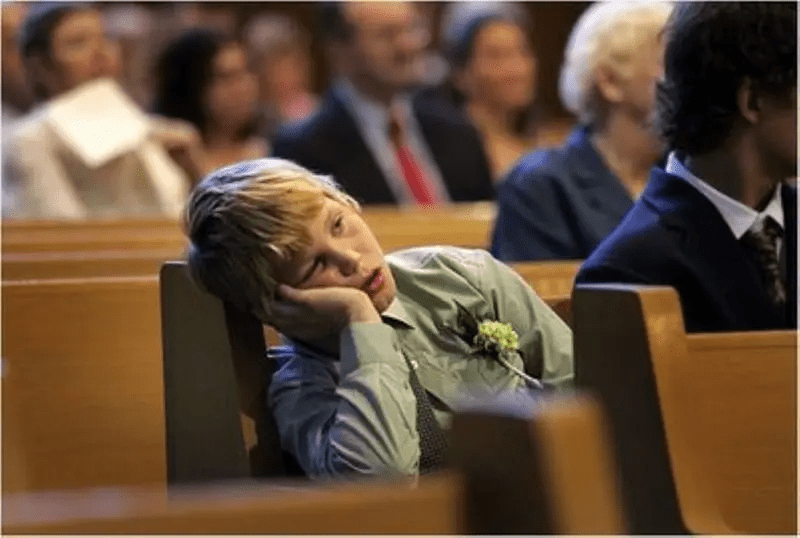
When I was a kid, the church worship service on Sunday was the longest hour of my week. I wanted to play in the pew, but my mom wouldn’t let me. I asked to go the bathroom, but my dad wasn’t having it. I tried to draw in the hymnal, but my sister always took everything around me ought of sight. My only relief was to sleep and drool on whatever I could lay my head on.

I’ve come a long way since then. But my experience taught me something. God isn’t boring, so I’m not going to be boring, either. Maybe I could have taught the Apostle Paul a thing or two.

In our New Testament lesson for today, the lateness of the hour (past midnight) and the ambiance of the room (all those burning oil lamps, presumably to keep people awake without any coffee) clues a church-going person immediately that something bad is about to go down. A long-winded preacher only serves to make for a combustible situation.

Uh-oh

In all fairness to Paul, if the congregants were bored out of their minds, the text doesn’t tell us. My guess is that the author, Luke, doesn’t want to go there. Yet, we have evidence of a bored person in the form of none other than a young person, a kid named Eutychus.  

He’s over by the open window, propped up on the ledge, and can’t keep his eyes open. Heck, for all we know, everyone was starting to doze off. And, as every preacher has experienced, as somebody slips into sleep, we just talk even longer.

The young man’s precipitous position leads to disaster: he falls out the third floor window. And, as one might expect, he fell to his death. Now, instead of some slap-stick comedic set up, we have a genuine tragedy: a young person literally bored to death by preaching.

The Apostle Paul raises Eutychus to life, by Gerard Hoet, 1728

All of a sudden, the story is no laughing matter. So, what might we learn from the preacher who bored Eutychus to death?

He finally stops preaching

The sermon is interrupted (as it turns out, of course, only momentarily) in order to attend to the tragedy. Sometimes, the sermon has to stop. Everything has to stop. We have to take a good, hard look at what’s going on. There are questions to ask, things to notice, conversations to begin. We have to get particular about where we are, and what we’re doing, before we can keep going with anything.

Maybe, just maybe, if Eutychus was part of the communion service, he wouldn’t have been on the margins and at risk of falling. As for many churches today, it could be there’s no young people around because they all fell out the window. Never underestimate the power of participation. Most youth just need to be asked to help out. But most adults don’t ask. And most kids aren’t going to volunteer.

He threw himself on him

Paul went down to Eutychus, and bending over him, took him in his arms in an emotional embrace – similar to what the father did when the prodigal son came home. (Luke 15:11-32)

In both cases – the prodigal son and Eutychus – they each needed a new life. The prodigal fell asleep to who he was, in a living death, and woke to his condition and went home. Eutychus literally fell asleep to an actual death and was woke to a resurrected life – returning back to the congregation (and even more preaching! *sheesh* leave it alone, Paul).

Each was found. Each had someone care about them by throwing their arms around them and giving them new life. That’s what grace is. Grace is giving the gift of seeing another person and embracing them – no matter whether they’re worthy of it, or not.

He’s alive

“He’s alive” is a statement of fact, of reality. It puts all the attention on what is true, right now, in this moment – and deflects attention away from who’s around the living person. In other words, Paul doesn’t take credit for Eutychus coming to life or restoring breath to him.

Implicitly, we know where the power comes from to raise Eutychus to life. It doesn’t come from the preacher. However, there is an important task that every preacher can do: witness a new life and bring the announcement of that life to the community. Preaching can (and ought to) bear witness to the activity of God in raising the dead and granting life.

The preacher can encourage the congregation to celebrate life around the Lord’s Table, notice the people on the margins of the community, and stay awake to the possibilities of what God can do amongst us.

Turns out, neither the length of a sermon nor the level of boredom is the issue. What’s most important is proclaming the gospel of grace in word and sacrament. And that’s something we all can participate in together and celebrate.

God of life, may we learn how to live from the mercy which was brought to us through the mission of your Son – whose saving love extends to every person, whose presence reaches into every place, Jesus Christ, who makes all things new, who lives and reigns with you and the Holy Spirit, one God, now and forever. Amen.

What Does God Want? (John 11:1-45)

The Raising of Lazarus, by Rembrandt, c.1632

Now a man named Lazarus was sick. He was from Bethany, the village of Mary and her sister Martha. (This Mary, whose brother Lazarus now lay sick, was the same one who poured perfume on the Lord and wiped his feet with her hair.) So the sisters sent word to Jesus, “Lord, the one you love is sick.”

When he heard this, Jesus said, “This sickness will not end in death. No, it is for God’s glory so that God’s Son may be glorified through it.” Now Jesus loved Martha and her sister and Lazarus. So when he heard that Lazarus was sick, he stayed where he was two more days, and then he said to his disciples, “Let us go back to Judea.”

“But Rabbi,” they said, “a short while ago the Jews there tried to stone you, and yet you are going back?”

Jesus answered, “Are there not twelve hours of daylight? Anyone who walks in the daytime will not stumble, for they see by this world’s light. It is when a person walks at night that they stumble, for they have no light.”

After he had said this, he went on to tell them, “Our friend Lazarus has fallen asleep; but I am going there to wake him up.”

His disciples replied, “Lord, if he sleeps, he will get better.” Jesus had been speaking of his death, but his disciples thought he meant natural sleep.

So then he told them plainly, “Lazarus is dead, and for your sake I am glad I was not there, so that you may believe. But let us go to him.”

Then Thomas (also known as Didymus) said to the rest of the disciples, “Let us also go, that we may die with him.”

On his arrival, Jesus found that Lazarus had already been in the tomb for four days. Now Bethany was less than two miles from Jerusalem, and many Jews had come to Martha and Mary to comfort them in the loss of their brother. When Martha heard that Jesus was coming, she went out to meet him, but Mary stayed at home.

“Lord,” Martha said to Jesus, “if you had been here, my brother would not have died. But I know that even now God will give you whatever you ask.”

Jesus said to her, “Your brother will rise again.”

Martha answered, “I know he will rise again in the resurrection at the last day.”

Jesus said to her, “I am the resurrection and the life. The one who believes in me will live, even though they die; and whoever lives by believing in me will never die. Do you believe this?”

“Yes, Lord,” she replied, “I believe that you are the Messiah, the Son of God, who is to come into the world.”

After she had said this, she went back and called her sister Mary aside. “The Teacher is here,” she said, “and is asking for you.” When Mary heard this, she got up quickly and went to him. Now Jesus had not yet entered the village, but was still at the place where Martha had met him. When the Jews who had been with Mary in the house, comforting her, noticed how quickly she got up and went out, they followed her, supposing she was going to the tomb to mourn there.

When Mary reached the place where Jesus was and saw him, she fell at his feet and said, “Lord, if you had been here, my brother would not have died.”

When Jesus saw her weeping, and the Jews who had come along with her also weeping, he was deeply moved in spirit and troubled. “Where have you laid him?” he asked.

“Come and see, Lord,” they replied.

Jesus wept.

Then the Jews said, “See how he loved him!”

But some of them said, “Could not he who opened the eyes of the blind man have kept this man from dying?”

Jesus, once more deeply moved, came to the tomb. It was a cave with a stone laid across the entrance. “Take away the stone,” he said.

“But, Lord,” said Martha, the sister of the dead man, “by this time there is a bad odor, for he has been there four days.”

Then Jesus said, “Did I not tell you that if you believe, you will see the glory of God?”

So they took away the stone. Then Jesus looked up and said, “Father, I thank you that you have heard me. I knew that you always hear me, but I said this for the benefit of the people standing here, that they may believe that you sent me.”

When he had said this, Jesus called in a loud voice, “Lazarus, come out!” The dead man came out, his hands and feet wrapped with strips of linen, and a cloth around his face.

Jesus said to them, “Take off the grave clothes and let him go.”

Therefore many of the Jews who had come to visit Mary, and had seen what Jesus did, believed in him. (New International Version)

The Raising of Lazarus, by Vincent Van Gogh, 1890

Here’s a Captain Obvious observation:

what God wants, and what we want, is not always the same thing. 

Today’s Gospel story centers around a man named Lazarus, the brother of Mary and Martha. The disciples were familiar with them since they were committed followers of Jesus. 

Their friend Lazarus became deathly ill. Christ and the disciples caught wind of it. Everyone believed Jesus could do something about this. But Jesus stayed put. He didn’t make a move to go to his sick friend. 

After a few days, Lazarus died. It was only then, that Jesus made his move.

The religious authorities in Jerusalem had it out for Jesus. But Jesus decided to go to Bethany and Jerusalem anyway. This made no sense to the disciples. Lazarus was lying dead in Bethany. Going there would put everyone at risk – which is why Thomas uttered the defeatist and dramatic statement, “Let us also go, that we may die with him.”

Yet, they all went. And once they arrived, Christ and his disciples found the grieving sisters. Mary and Martha believed that Jesus was the promised Messiah who would come and save the people. They didn’t understand why Jesus stayed away and didn’t come sooner. 

If Jesus had been there, he could have healed Lazarus. He healed other people, so why not a friend and a brother?

The death of Lazarus seemed to be the end. No one was happy with how things shook-out. Lazarus died. The disciples’ plans were dead. Mary and Martha’s expectations died…

but death is exactly what it takes in to have resurrection.

There’s no such thing as a painless miracle. Death isn’t a pleasant affair. I have been with countless people at the end of life, and I will tell you that, although it’s possible for a death to be peaceful, it’s still ugly business. 

It’s also painful to watch carefully laid and prayed over plans die. It hurts to see a long sought after dream just go up in smoke and die. To see anything or anyone we deeply care about die is gut-wrenching. Yet, in order for a resurrection to occur, there must first be a death.

There cannot be a new life unless there’s an old one. 

Jesus did the impossible by raising Lazarus from death and giving him new life. And the resurrection of Lazarus pointed to an even greater truth: Christ’s own death and resurrection was coming, and it will change everything.

Whenever what we want dies, then we are in a position to ask: So, what does God want? 

God wanted something better than what everybody else wanted. By allowing ourselves to be consumed with what God wants, it turns out to be the very best thing for us, even if it does not quite jive with what I want.

Everyone’s expectations needed to die, along with Lazarus, for the resurrection to become reality. Only then did Jesus act by rising Lazarus from death.

Jesus pointed to himself as the one able to bring life to all that is dead among us. Sometimes:

  • dreams must die so that Jesus can resurrect them to new life, with outcomes far more glorious than you and I could ever imagine
  • plans have to be dead and buried before Jesus will breathe new life into them, making those plans so much more than they could ever have been in our hands.
  • ministries, even churches, need to be dead as a doorknob so that Jesus can resurrect them and give them new life, invigorated with spiritual resurrection power.

If we desire to see the miracle of resurrection, we must die to ourselves – take up our crosses and follow Jesus into the grave so that he can transform our lowly expectations into a glorious new existence. Death does not have the last word because Christ’s resurrection makes it possible for us to have new life. Again, I ask:

What does God want? God wants to raise the dead to life.

Do you believe this? Yes, I believe. Help me in my unbelief.

Follow the path of what God wants and watch what the Lord will do for you.