Mercy Is Why Jesus Came (Matthew 9:9-13, 18-26)

The Hem of His Garment, by Crystal White, 2018

As Jesus went on from there, he saw a man named Matthew sitting at the tax collector’s booth. “Follow me,” he told him, and Matthew got up and followed him.

While Jesus was having dinner at Matthew’s house, many tax collectors and sinners came and ate with him and his disciples. When the Pharisees saw this, they asked his disciples, “Why does your teacher eat with tax collectors and sinners?”

On hearing this, Jesus said, “It is not the healthy who need a doctor, but the sick. But go and learn what this means: ‘I desire mercy, not sacrifice.’ For I have not come to call the righteous, but sinners….”

While he was saying this, a synagogue leader came and knelt before him and said, “My daughter has just died. But come and put your hand on her, and she will live.” Jesus got up and went with him, and so did his disciples.

Just then a woman who had been subject to bleeding for twelve years came up behind him and touched the edge of his cloak. She said to herself, “If I only touch his cloak, I will be healed.”

Jesus turned and saw her. “Take heart, daughter,” he said, “your faith has healed you.” And the woman was healed at that moment.

When Jesus entered the synagogue leader’s house and saw the noisy crowd and people playing pipes, he said, “Go away. The girl is not dead but asleep.” But they laughed at him. After the crowd had been put outside, he went in and took the girl by the hand, and she got up. News of this spread through all that region. (New International Version)

The late Abigail Van Buren, better known as the newspaper columnist, “Dear Abby,” was the person who made famous the phrase: “The church is a hospital for sinners, not a museum of saints.” That quote is an accurate reflection of what Jesus was doing and saying. We occasionally need words like Dear Abby’s to remind and reorient us toward why the church exists.  

The church of the Lord Jesus does not remain on this earth solely for our benefit, any more than a hospital exists for the benefit of the doctors or insurance companies! Rather, the church lives to extend the mission of Jesus through proclamation of good news with the restorative touch of grace. The church’s calling is not to find others who can help them with their giving and attendance. Instead, the church is the community of the redeemed, the temple of the Holy Spirit, gathered and sent to be the continuing presence of Jesus on this earth.

Some of us are not healthy. Some are sick – sick with guilt and shame, heart-sick, or just plain sick-and-tired of being sick-and-tired. Jesus came neither to condemn nor heap a pile of unrealistic expectations on us. Rather, Christ points us to the source of healing and restoration; and invites us to admit our need and come to him. 

The question I want us to grapple with is this: Why did Jesus come to this earth? The answer to that question is to also answer the question of our own purpose and existence as followers of Christ.

Jesus came to forgive sin and transform sinners.Forgiveness, healing, and restoration are the three activities which bring about true spiritual and physical healing. There are two healings In today’s Gospel lesson: one is a spiritual healing; and the other a physical healing.

The Calling and Healing of Matthew

At the heart of the human condition is spiritual brokenness. And Jesus is all about taking away guilt and shame, creating a new person and a new community. It’s a radical vision which seeks to encompass and embrace all persons – which means Jesus touched many people overlooked by others.

Jesus came to call the despised people of society, the “sinners.” He called Matthew, a tax collector. Tax collectors were hated. They were corrupt characters who extorted money from innocent people just trying to make ends meet. Jesus not only called the despised Matthew, but he also had dinner with him and all his unsavory buddies. This kind of behavior by Jesus was deeply offensive to the upstanding citizens and religious leaders of the time.

Yet, Jesus did not back down. He responded by saying that it is not the healthy who need a doctor, but those who are sick. And he backed up his social actions with Scripture by encouraging offended folks to meditate on what this biblical phrase means: “I desire mercy, not sacrifice.” (Hosea 6:6)

It is possible to engage in outward rituals of worship, do all the right things, fulfill our duties, yet still miss the heart of God wants for humanity. Mercy is what God wants. Jesus knew this. So, Christ entangled himself with sinners to bring spiritual healing and restoration.

When Corrie Ten Boom sought to bring deliverance of the Jews from the Nazis during World War II, she had to entangle herself with Jewish refugees. When Christian missionaries seek to be the light of Jesus to people, they must entangle themselves with the people’s culture. If we want to see God deliver people from their situations, we must entangle ourselves with them, into complicated lives that are not pretty, with persons who have been tainted by sin. 

Lots of people are in awful predicaments. Christians, like their Lord, will need to get their hands dirty and their feet wet to extend Christ’s ministry of mercy and forgiveness. The gospel was never intended to be proclaimed from afar, but up close and personal through entanglement in people’s lives. If the merciful mission of Jesus is to occur, it requires the following three levels of intimacy with others:

  1. Intimacy with Jesus. Engaging in the spiritual disciplines of prayer, giving, fasting, reading, and meditating on Scripture are the activities which help us to know Christ better and know and how to respond with mercy.
  2. Intimacy with fellow believers. We are hard-wired by God for community. Superficial relationships can only provide superficial community. Christians need to help one another with spiritual growth. They must hold one another accountable for the mission of Christ.
  3. Intimacy with “sinners.” This world is filled with sick, needy, hurt, and lonely, people who are locked in unhealthy patterns of living. They need a merciful change of life that comes from the merciful Jesus acting through merciful Christians.

Mercy, not judgment, is at the heart of all change. If we desire others to be different, we will need to be acquainted with the mercy of God.

The Approach of a Grieving Father and Bleeding Woman for Healing

The dead girl being raised to life and the bleeding woman experiencing healing are, perhaps at the surface, unrelated. Yet, Matthew’s Gospel presents them together in a sandwich story. The dead girl’s father approaches Jesus, and in the middle of the story, while Jesus and the father are on the way to the deceased girl, a woman who had been hemorrhaging for twelve years approaches Jesus without saying a word.

In both cases, the father and the woman exhibited confident faith that their heartfelt desires would be met with Jesus. And, in both situations, two people were restored, not only to health, but to fully functioning members of the community.

And this is where the two of them are related to Matthew. With all three persons, the healings involved a restoration to society. When Jesus heals a person, that person is completely healed – both body and soul – and healed not only of traumatic physical ailments (even death!) but also healed of disordered or demented minds, of deep emotional wounds, and of spiritual neglect and/or abuse.

In the woman’s case, she had to contend with being separated from the community because of her bleeding. She was ritually unclean and could not participate like the others in worship and communal life. And in the case of the father and synagogue ruler with a dead daughter, he would have to put up with not only the severe grief of a lost daughter, but also the misguided cultural beliefs of an untimely death being the result of either the girl’s personal sin, or the sin of the father. Oy.

So, when Jesus heals, Jesus heals completely! It always involves forgiveness (if needed) and a restoration of the individual (and sometimes whole families) back into arms of the society which everyone is dependent upon for each other’s welfare.

And, also like Matthew, Jesus was willing to cut through any cultural barriers and existing societal norms in order to accomplish God’s will and purpose of restoring lost people. I want us to observe that Jesus asks us to follow him because he himself is also willing to do so.

A woman with a bloody discharge and a dead girl’s body were touched by Jesus, who reached across Israel’s purity laws in doing so. Two people who were ritually unclean and not to be touched were given a new lease on life through Christ’s willingness to follow God’s will. Notice that Jesus did not initiate the contact, but followed them in their requests and desires.

Sometimes the church needs to learn the art of following by observing how Christ followed.

Many churches today, including yours and mine, wonder how to draw people in rather than how to engage human beings where they live. Instead of waiting for people to come in, or trying to attract through marketing efforts, perhaps the church should follow our neighbors out into the world, responding to their needs as they emerge.

Maybe, just maybe, we might explore how to participate in what is already going on in the community and follow the leading of the Spirit, who is the continuing presence of Jesus on this earth. Maybe we could put our focus on how to show mercy, not sacrifice.

Lord Jesus Christ, you stretched out your arms of love on the hard wood of the cross so that everyone might come within the reach of your saving embrace. Clothe us in your Spirit so that we, reaching forth our hands in love, may bring those who do not know you to the knowledge of your love, for the glory of your Name. Amen.

Never a Dull Moment (Acts 28:1-10)

Miracle of St. Paul on the Island of Malta, by David Teniers, c.1620

Once safely on shore, we found out that the island was called Malta. The islanders showed us unusual kindness. They built a fire and welcomed us all because it was raining and cold. Paul gathered a pile of brushwood and, as he put it on the fire, a viper, driven out by the heat, fastened itself on his hand. When the islanders saw the snake hanging from his hand, they said to each other, “This man must be a murderer; for though he escaped from the sea, the goddess Justice has not allowed him to live.” But Paul shook the snake off into the fire and suffered no ill effects. The people expected him to swell up or suddenly fall dead; but after waiting a long time and seeing nothing unusual happen to him, they changed their minds and said he was a god.

There was an estate nearby that belonged to Publius, the chief official of the island. He welcomed us to his home and showed us generous hospitality for three days. His father was sick in bed, suffering from fever and dysentery. Paul went in to see him and, after prayer, placed his hands on him and healed him. When this had happened, the rest of the sick on the island came and were cured. They honored us in many ways; and when we were ready to sail, they furnished us with the supplies we needed. (New International Version)

There never seemed to be a dull moment in the life of the Apostle Paul. Throughout his life, he experienced all sorts of extreme circumstances, having survived as if he had the nine lives of a cat.

Once, when in the town of Lystra, Paul had such an impact on the people through his gift of healing, that the crowd believed he must be one of the gods; and they tried to worship him. But when Paul resisted, and a rival group from another town came along and turned the crowd, Paul was stoned and left for dead by the very people who tried to venerate him. (Acts 14:8-20)

So, it’s almost as if today’s New Testament lesson was just another day at the office for the Apostle Paul. After a suspenseful sea voyage, and then the wreck of a Roman prison ship, the drama of Paul’s life just kept going.

One minute, the people on the island in which Paul was shipwrecked were convinced that he’s a murderer, and the next minute they’re ready to assign him as a god. Nobody I’ve ever known can elicit such opposite reactions in such a short period of time – more than once. But that’s our Apostle Paul for you.

Circumstances are circumstances. But the way in which we interpret them is another thing. Take, for instance, the word “change.” For some, change is a wonderful word which brings thoughts of healing and hope. For others, change is a dirty word to be resisted, conjuring up feelings of fear and anxiety.

For one group, never-a-dull-moment is exciting and adventurous. For another group, never-a-dull-moment is nerve wracking and to be avoided at all costs.

Opposite reactions of a group of people comes from the different perspectives of change they see. It isn’t helpful to talk about who is right and who is wrong; the real trick is in how we choose to look at a thing.

I had only one grandparent when I was growing up. My Grandma was seventy-nine years old when I was born, and she lived to be ninety-seven. Even though I always knew her as an old lady, she had a lot of spunk in all ninety-five pounds of her. 

She had an old wooden cutting board in her kitchen. I’m not sure how old it was, but it was likely purchased from Methuselah’s Kitchen Outlet. It was cracked and falling apart. The board had deep furrows in it from the thousands of cuts made on it. Grandma liked her cutting board.

For Mother’s Day one year, my Dad bought her a nice brand new cutting board. And what did my Grandma do?  She put the new board in the back of her cupboard and continued using her nasty old cutting board. 

Whenever my Mom or sisters were in her house and helped her in the kitchen, they were not about to touch that old board; the thing was a bacteria trap. But Grandma didn’t care about bacteria or that it was falling apart. 

My Dad asked her why she did not use her new cutting board. She simply answered, “Oh, it’s much too nice to use.” But we all knew that was Grandma’s way of saying that she liked her nasty old cutting board, didn’t think it was all that bad, and wasn’t getting rid of it.

It seems we all have a bit of Grandma in us, bless her stubborn old heart. We like the way they do things, and really don’t see what another person sees. We don’t see that no one else has an emotional attachment to our cutting board. Sometimes we don’t realize how overwhelming and even intimidating our ways can be for someone else. 

Just imagine being in a new place with people you don’t know. Are you nervous? Does it help to have someone you know bring you and introduce you to people? Is it beneficial to have someone let you know what is happening and what is going on? 

Many years ago, I remember walking into a beautiful new church building, sitting down, and seeing a huge old pulpit that was literally falling apart. Since I’ve been around a lot of churches, I quickly discerned it was likely the old pulpit from the old church building. And, I discovered, it was. But, honestly, I had zero emotional attachment to that pulpit, and it was a distraction because it just looked like a big old ratty collar on a new puppy.

The point is thisOur view of change – whether to do it, or not, to embrace or resist – must be motivated by a solid set of values and a worthy purpose.

Paul put up with a lot, experienced a lot, and never had a dull moment. And he did it without bellyaching. That’s because he was continually focused on his ultimate purpose and values.

Our purpose, like Paul’s, is the Great Commission, to make disciples. (Matthew 28:18-20)

Our values, likewise, are the Great Commandment, to love God and neighbor. (Matthew 22:36-40)

Since our purpose is disciple-making, then we are always to make decisions based upon that standard. Since our values are loving others, then we always know how to go about our purpose.

If any faith community is helping people grow spiritually, then there is no need to change. But if a Christian community has not seen a person come to faith in Christ in the last year, that’s a significant reason to change. If a church has not seen anyone come to Christ in the last five years, then that church is eating meat prepared on a cutting board full of bacteria, and it’s making everyone sick.

Have we taken the old cutting board for granted, and just expect other people to use it if they are in our kitchen? Or do we have a vision, a motivation, and a driving desire to see all sorts of people find new life in Jesus Christ? 

If you don’t like empty seats, or the way things are, then the biblical solution is to change – specifically to change practices, speech, and daily behavior to reach others with the good news of grace. Change, or the lack thereof, for any other reason, is a bad reason to change.

Just so you know, after about a year of sitting in my Grandma’s cupboard, my Dad took out the new cutting board, put it on the kitchen counter and threw away the old board. 

It was about time. Never a dull moment with Grandma around.

Gracious God, we thank you that in love and mercy, you reached out to us. When we were dead in our sins, you sent Jesus to die in our place. Thank you that he humbled himself, even to death on a cross. And thank you that you have a heart that seeks the lost. 

Merciful Lord, please give us hearts that care for people in darkness. Teach us to care for them as you do. Thank you for including us in the mission of reaching other people for your name. Grow us to care for humanity, for the people who haven’t yet come to know and trust in you. Amen.

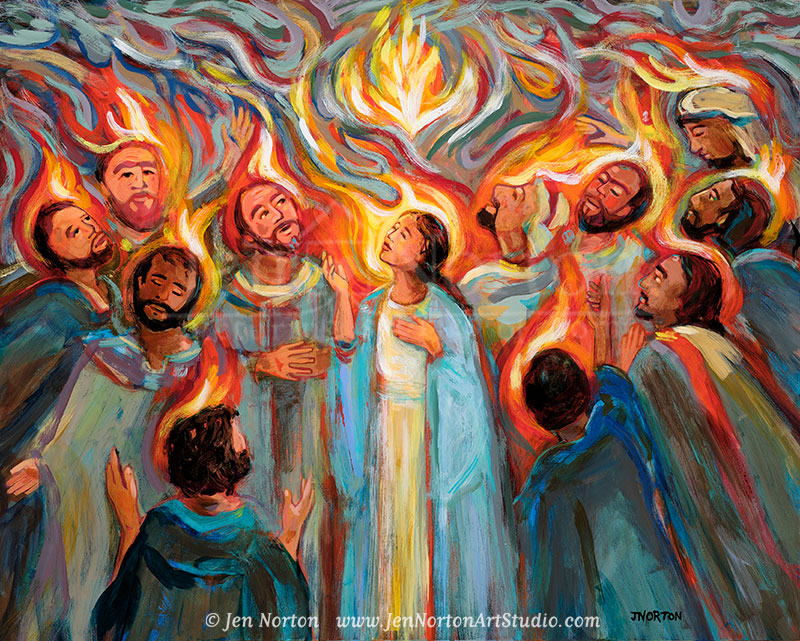
The Spirit’s Ministry (John 14:25-26)

Jesus said:

“I have spoken these things to you while I am with you. The Companion, the Holy Spirit, whom the Father will send in my name, will teach you everything and will remind you of everything I told you.” (Common English Bible)

“These things I have spoken to you while I am still with you. But the Helper, the Holy Spirit, whom the Father will send in my name, he will teach you all things and bring to your remembrance all that I have said to you.” (English Standard Version)

“I’m telling you these things while I’m still living with you. The Friend, the Holy Spirit whom the Father will send at my request, will make everything plain to you. He will remind you of all the things I have told you.” (The Message)

“All this I have spoken while still with you. But the Advocate, the Holy Spirit, whom the Father will send in my name, will teach you all things and will remind you of everything I have said to you.” (New International Version)

“These things have I spoken unto you, while yet abiding with you. But the Comforter, even the Holy Spirit, whom the Father will send in my name, he shall teach you all things, and bring to your remembrance all that I said unto you.” (American Standard Version)

“These things I have spoken to you, while I am still with you. But the Counselor, the Holy Spirit, whom the Father will send in my name, he will teach you all things, and bring to your remembrance all that I have said to you.” (Revised Standard Version)

“The Holy Spirit is the bond by which Christ unites us to himself.”

John Calvin

We are now in the season of “Ordinary Time” or “Proper Time” in the Church Year. It is “ordinary” in the sense that the Holy Spirit has been given to do the “proper” ongoing work of growing believers in Christ and helping them live into his directives.

The Spirit is our Teacher, cultivating and stirring-up within us all that we need for the Christian life.

As you can see from a few of the various English translations of today’s Gospel verses, there is no uniform rendering of the original Greek word, “Paraclete.” That’s because this word for the Spirit is so rich and full that it’s difficult to encompass what it means with a single English word.

A straightforward literal translation of “Paraclete” needs a phrase rather than a word: “Called alongside for encouragement,” fairly-well translates it. All the various words used in the different versions of the New Testament are accurate – yet they merely bring out one dimension to the understanding of the Holy Spirit’s ministry.

Our needs as followers of Jesus are many – thus requiring a multi-faceted mentoring ministry by the Spirit.

The Spirit was sent to be with Christians continually as their Teacher, reminding them of all Jesus has said and done as the ultimate witness to Christ’s life and ministry.

The role of the Holy Spirit is to provide comfort and aid for Christians, especially in difficult situations; the Spirit helps in a time of need.

The force of “Paraclete” is even more than this because there’s also the dimension of the Spirit being our close companion. Indeed, it is a special friend who stands up for us, advocates on our behalf, gives us remedial teaching, and brings comfort.

The Holy Spirit is motivated (just like the Father and the Son) with love for us, to give whatever we need to live a successful, abundant, and full Christian life.

In whatever situation we face, the Holy Spirit is something of a divine concierge in the middle of adversity who is attentive to every need.

The true difficulty in describing the Spirit’s ministry with us is that the Spirit is God – and no amount of description will adequately get our minds around the Spirit. God is much too big for that. All metaphors, images, and words fall short of genuinely expressing the Spirit’s immense work.

Perhaps a story will better illustrate the Spirit’s nature and work. When my girls were small and I was a financially struggling seminarian, we were one evening down to our last bit of food. Although they thought it was a privilege to eat Wheaties for supper, my wife and I knew the cupboard was now bare. So, we prayed.

As we got up from our knees and started off for bed, there was a knock at our patio back door. We looked at each other wondering who in the world it could be at such a late hour. When I drew the shades, one of our neighbors, a little Puerto Rican woman, was outside holding what appeared to be more than her own body weight in overflowing grocery bags.

I ushered her in and before I could say a word, she said, “I went to bed and had just fallen into a deep sleep. But the Holy Spirit woke me up and told me to take as many groceries as I could carry to you. So, here I am.” In that moment, I knew in my head and felt in my heart a ministry of the Spirit which transcends language.

The next morning our girls learned something about God that they would never get from listening to their Dad’s teaching and preaching. This is a story which gets retold often because it reminds us of how God meets us in our need and how much God cares.

Through such encounters with the Spirit (and I have mercifully been granted many of them!) I begin to understand and appreciate the wisdom of the saints throughout the ages:

“When the grace of the Holy Spirit enters a soul and is established there, it gushes forth more powerfully than any other spring; it neither ceases, dries up, nor is exhausted. And the Savior, to signify this inexhaustible gift of grace, calls it a spring and a torrent; He also calls it gushing water, to indicate its force and impetus.”

St. John Chrysostom

“Trying to do the Lord’s work in your own strength is the most confusing, exhausting, and tedious of all work. But when you are filled with the Holy Spirit, then the ministry of Jesus just flows out of you.”

Corrie Ten Boom

May you know the ministry of the Spirit, inside and out, in all ways and in all circumstances.

A Prayer of St. Augustine:

Breathe in me, O Holy Spirit,
That my thoughts may all be holy.
Act in me, O Holy Spirit,
That my work, too, may be holy.
Draw my heart, O Holy Spirit,
That I love only what is holy.
Strengthen me, O Holy Spirit,
To defend all that is holy.
Guard me, then, O Holy Spirit,
That I always may be holy. Amen.

For the Common Good of All (1 Corinthians 12:4-13)

There are different spiritual gifts, but the same Spirit gives them. There are different ways of serving, and yet the same Lord is served. There are different types of work to do, but the same God produces every gift in every person.

The evidence of the Spirit’s presence is given to each person for the common good of everyone. The Spirit gives one person the ability to speak with wisdom. The same Spirit gives another person the ability to speak with knowledge. To another person the same Spirit gives courageous faith. To another person the same Spirit gives the ability to heal. Another can work miracles. Another can speak what God has revealed. Another can tell the difference between spirits. Another can speak in different kinds of languages. Another can interpret languages. There is only one Spirit who does all these things by giving what God wants to give to each person.

For example, the body is one unit and yet has many parts. As all the parts form one body, so it is with Christ. By one Spirit we were all baptized into one body. Whether we are Jewish or Greek, slave or free, God gave all of us one Spirit to drink. (God’s Word Translation)

Being given a gift from someone is rightly associated with joy, celebration, goodness, and the possibility of what the gift is and how it might be used.

Unpacking Our Spiritual Gifts

And this is why we unpack gifts with curiosity and abandon. It would be weird if we were given a gift, then let it sit unopened. Instead, we typically receive the gift, rip it open, and express gratitude for the thoughtfulness. Then, we explore it, enjoy it, and use it.

The Spirit, likewise, has been marvelously given to God’s people. Each individual Christian is specially provided a gift to open, use, and enjoy. Spiritual gifts graciously given to us are meant for the common good of all. And this use for the common good is where the gift is different than Christmas presents or birthday gifts.

Spiritual gifts are designed by God to be acts and words of service, dispersed for the benefit of others. Yes, they are meant for us to enjoy them. Yet, they are not meant solely for personal satisfaction.

Using Our Spiritual Gifts

So, if a person’s spiritual gift is teaching, they do not stand in front of a mirror and talk at themselves. Rather, they jump into the fray of learning and explaining, and do it in such a gracious and loving way that the enablement of the Spirit is evident.

If a person’s gift is faith, they do not merely step out and act with unusual courage for the purpose of personal betterment in a holy belief from God. They also demonstrate faithfulness to God’s people and to God’s world. The gift is for the common good of all persons.

The accumulation of wisdom and knowledge is meant for the strengthening of faith in others. Spiritual gifts are intended by God to be shared freely for the common good of all people so that people are strengthened in faith and supported for the rigors of daily life in the world.

Therefore, we really need to take some initiative in identifying our gift(s), unpacking them, and indiscriminately using them. Spiritual health and wholeness can only truly be realized through everyone’s active participation in distributing their God-given abilities.

Stewarding Our Spiritual Gifts

Spiritual gifts are neither to be hoarded, nor miserly dealt to only people I like or my own little world of groupies and friends. Any and every ability comes from God, and is therefore, given for the benefit of all persons. Underprivileged groups need the giftedness of others, as well as discovering their own resources so that everyone is built up in a society of redeemed persons.

What’s more, spiritual mavericks are not so helpful here. The Lone Ranger is not a good model for us. Christians are the Body of Christ, meant to function as one. Just as the Holy Trinity of divine persons – Father, Son, and Spirit – work together in unity of purpose and harmony of being, so persons of the Church are to unify and act as one in the mission of God.

Diversity of gifts are to be expressed in unity of building up others and extending Christ’s love to the world. When we harmoniously coordinate our joint efforts in utilizing our collective spiritual gifts, the world is turned upside-down with kingdom grace and ethics.

Goodness, joy, and possibility become alive when people unpack their gifts and use them for the common good of everyone.

Spiritual Gift Envy

Sometimes, we might succumb to “gift envy.” We observe the talented gift of another and secretly wish it for ourselves. The proper remedy to such a malady is gratitude. When we give thanks to God for the gift(s) we truly possess, then envy has nowhere to reside and slithers away.

None of God’s gifts are “sexy” in the sense that they come easily without effort and always look appealing. On the contrary, our gifts are meant to be received and developed with lots of daily mundane work so that we live into the special endowment bestowed upon us.

In reality, this takes a lifetime of development. That’s because the Spirit’s gifts are so generously large – much bigger than we originally observe at first glance. Like an engagement ring in a tiny box, receiving the gift and putting it on will involve commitments and challenges we cannot at the time perceive.

Whatever it is you do well, do it to the glory of God. Allow God to activate it and energize it for the prevailing needs of a church and a world which is in want of seeing spiritual fruit manifested in kindness, goodness, and love.

O Lord, you have taught me that without love, whatever I do is worth nothing. Send your Holy Spirit and pour into my heart your greatest gift, which is love, the true bond of peace and of all virtue, without which whoever lives is accounted dead before you. Grant this for the sake of your only Son Jesus Christ, who lives and reigns with you and the Holy Spirit, one God, now and forever. Amen.