Justice for All (Matthew 12:15-21)

When Jesus became aware of this [a plot to kill him] he departed. Many followed him, and he cured all of them, and he ordered them not to make him known. This was to fulfill what had been spoken through the prophet Isaiah:

“Here is my servant, whom I have chosen,
    my beloved, with whom my soul is well pleased.
I will put my Spirit upon him,
    and he will proclaim justice to the gentiles.
He will not wrangle or cry aloud,
    nor will anyone hear his voice in the streets.
He will not break a bruised reed
    or quench a smoldering wick
until he brings justice to victory.
    And in his name the gentiles will hope.” (New Revised Standard Version)

Saying the words, “I love you” is important. And it’s also significant how we say it. If our tone of voice is monotone and our affect flat, then the incongruence between the words and the manner in which they are said will leave our love unrequited. If, however, our tone is soothing and excited and our face beaming as if starstruck, then the love expressed will likely be received, and stick.

Christians have a message of love to the world. It’s a message of Jesus Christ and his love for humanity. Both the content of our message and the way we communicate it are vitally significant.

For if the words we don’t match our tone of voice and affect, then love is not what we convey. Yet, if we have been profoundly and meaningfully touched by the love of God in Christ, then that love will not be constrained; it shall find a way to express itself with appropriate mannerisms.

The way in which Christ proclaimed his message, testified that he was, indeed, the promised Savior and the rightful Ruler for God’s world.

The message of Jesus was proclaiming justice to the nations. The disciple Matthew used a quote from the prophet Isaiah to explain the reason why Jesus withdrew, and told people not to make him known. This was a curious act for a Messiah, to say the least. 

After all, we might believe Jesus should loudly proclaim who he is and what he is doing. Human ingenuity might say he ought to be advancing, not retreating – getting his name out with some notoriety in a slick marketing message so that people will come running into the kingdom of God! 

But Jesus goes a different direction. Matthew (quoting the prophet Isaiah) made it clear who Jesus is and what he is all about. Jesus is God’s servant. Jesus is God’s beloved Son with whom he is well-pleased. The Holy Spirit came on him in his baptism. Jesus became a teacher of justice to the nations, that is, to gentiles, to all kinds of people – even the ones we do not like. 

I personally find it strange that some Christian folk think justice is something which is not part of the Gospel, as if it were nice, but optional. They might believe it’s important to engage in some sort of social justice toward the downtrodden, but want to put it on a secondary shelf. Speaking the message is primary to them, as if we could or should separate the message from the messenger.

Yet, we can no more divide the good news of forgiveness in Christ from social justice any more than we can neatly separate the cross and resurrection. All of it is redeeming work; it all goes together.

In the kingdom of God, all things and all people are to be redeemed and come under the Lordship of Christ. And the practice of justice is central to making redemption a reality for humanity.

He has told you, O mortal, what is good,
    and what does the Lord require of you
but to do justice and to love kindness
    and to walk humbly with your God? (Micah 6:8, NRSV)

Mercy and justice go together like corn on the cob and butter, and like pork ribs with barbeque sauce (I’m from Iowa, after all!). Kindness and mercy refers to God’s unconditional grace and compassion. Justice treats all people with equity, without any favoritism.

Biblical justice is not primarily punishment for wrongdoing; it gives people their rights – and this concept is overwhelmingly taught in Holy Scripture – over 200 times in the Old Testament alone. Jesus Christ’s back to the Bible movement rightly emphasized justice.

God loves and defends the weak, the poor, and the powerless:

He gives justice to the oppressed
    and food to the hungry.
The Lord frees the prisoners.
    The Lord opens the eyes of the blind.
The Lord lifts up those who are weighed down.
    The Lord loves the godly.
The Lord protects the foreigners among us.
    He cares for the orphans and widows,
    but he frustrates the plans of the wicked. (Psalm 146:7-9, NLT)

We, as God’s people, are to share the Lord’s passion for justice:

Speak out on behalf of the voiceless,
    and for the rights of all who are vulnerable. (Proverbs 31:8, CEB)

“Cursed is anyone who obstructs the legal rights of immigrants, orphans, or widows.” All the people will reply: “We agree!” (Deuteronomy 27:19, CEB)

Since believers are justified by faith in Christ, we bring justice to our communities, in both word and deed, by advocating for the least, the lost, the last, and anyone else without social or economic power in this world.

We are to use our voice for both us and for those who have no voice. The voice of justice is the voice of action.  To be concerned for the justice of God is to actively work for God’s rule and reign to enter every inch of this world, to penetrate every nook and cranny of our homes, neighborhoods, and schools. 

“If you are a Christian, and you refrain from committing adultery or using profanity or missing church, but you don’t do the hard work of thinking through how to do justice in every area of your life – you are failing to live justly and righteously” Tim Keller, Generous Justice

The Christian life is much more than avoiding sin; it’s about actively pursuing God’s will through words and acts of justice on behalf of the needy. Jesus came to this earth to proclaim justice, and, as his followers, he expects us to do it, too. For this to happen, we must overcome our prejudices toward anybody unlike us so that we will stand with the weak, the poor, the oppressed, the lowly, and the pained, all around us.

The probing question for all of us is: Am I able to see the image of God in someone different from me?

Jesus did. Christ will not quarrel or cry out; no one will hear his voice. That is, Jesus is gentle, humble, and meek. He did not look for dramatic confrontations with others, but instead went quietly about his Father’s business. 

Jesus was no bullhorn guy, loudly proclaiming his message on a street corner. Instead he interacted with and ministered to the lowliest people of society who had no power and nothing to give in return. Jesus did everything to connect with them, and not to avoid them.

Along the Jordan River in Israel, reeds grew by the millions, in Christ’s day. They had little value because there were so many of them. Reeds were used to make baskets, pens, flutes, and a variety of other things. A perfect reed is fragile, and a bruised one is useless. 

The reference that God’s servant will not break a bruised reed, means that Jesus will treat the weak with sensitivity. A smoldering wick is also not worth much; if it’s damaged, you just get another one. A contemporary example might be a paper clip; it’s not worth much to us, and a damaged one we simply discard and use another. 

The point is: Jesus handles hurting people with care. Society’s poor, disadvantaged, and struggling will not be callously overlooked and tossed aside by Jesus.

Jesus Christ discovered his own island of misfit toys. He then demonstrated to the world that are a needed part of society. Small wonder, then, that droves of the lowliest people throughout history have come to Jesus, placing their hope in him.

For we do not have a high priest who is unable to sympathize with our weaknesses, but we have one who has been tempted in every way, just as we are – yet was without sin.  Let us then approach the throne of grace with confidence, so that we may receive mercy and find grace to help us in our time of need. (Hebrews 4:15-16, NIV)

Our help is in the name of Lord who made heaven and earth. May you find Christ, God’s servant, as your anchor and hope in the world. Amen.

Endure Patiently to the End (Revelation 14:12-20)

God’s holy people must endure persecution patiently, obeying his commands and maintaining their faith in Jesus.

And I heard a voice from heaven saying, “Write this down: Blessed are those who die in the Lord from now on. Yes, says the Spirit, they are blessed indeed, for they will rest from their hard work; for their good deeds follow them!”

Then I saw a white cloud, and seated on the cloud was someone like the Son of Man. He had a gold crown on his head and a sharp sickle in his hand.

Then another angel came from the Temple and shouted to the one sitting on the cloud, “Swing the sickle, for the time of harvest has come; the crop on earth is ripe.” So the one sitting on the cloud swung his sickle over the earth, and the whole earth was harvested.

After that, another angel came from the Temple in heaven, and he also had a sharp sickle. Then another angel, who had power to destroy with fire, came from the altar. He shouted to the angel with the sharp sickle, “Swing your sickle now to gather the clusters of grapes from the vines of the earth, for they are ripe for judgment.” So the angel swung his sickle over the earth and loaded the grapes into the great winepress of God’s wrath. The grapes were trampled in the winepress outside the city, and blood flowed from the winepress in a stream about 180 miles long and as high as a horse’s bridle. (New Living Translation)

The Scripture meditations I offer each day are based in the daily readings of the Revised Common Lectionary. The readings are designed to move us through the whole of the Bible in a three year cycle. And they are arranged so that Thursday, Friday, and Saturday readings anticipate the Sunday scriptures, and the Monday, Tuesday, and Wednesday readings reflect on Sunday’s texts. Today’s New Testament lesson is such a reflection on Sunday’s Gospel reading of Christ’s Parable of the Weeds (Parable of the Wheat and Tares).

Jesus made it clear in the parable that it is not our job to weed out evil. This will be done by the angels at the end of the age. In Revelation, we look forward into the future as to what happens with the plants and the weeds. As you can readily see, it is a grim picture. Those who are visual learners, and picture the words in their minds, their stomachs might be turning after the reading of today’s text.

The entire book of Revelation was originally meant to encourage believers in Jesus to persevere, endure, and keep going in their commitment to Christ. As they were undergoing difficulty and even persecution for their faith, this apocalyptic vision of the Apostle John was to instill hope: It will not always be this way.

There is a time coming soon in which the problem of evil is taken care of, once and for all. Until that final day of judgment comes, we are to hold fast to our faith, and continue to keep the commandments of Christ.

The wrath of God has always been an issue with various people throughout history. In contemporary theology, it is common to have groups of folks polarized between either making God out to be constantly angry and looking to zap people; or dismissing God’s wrath altogether as some outdated and antiquated idea. Neither of these approaches will do.

God’s anger and wrath exist, yet is never divorced from God’s love. Rather than viewing wrath and love as two sides of the same coin, I believe a healthier and more biblical understanding is to discern God’s wrath as an expression of God’s love. I will explain….

When God bends to observe us in the world and sees injustice, war, poverty, oppression, trauma, and abuse from narcissistic people who exalt themselves above others and use them for selfish purposes, God is not okay with this!

Whenever God looks at the world and sees governments, institutions, corporations, and even churches which maintain structures that keep others from becoming all that God intends for them to become, divine compassion is stirred up, along with a determination to bring about justice and righteousness.

Only God has the combination of willingness, power, and ability to handle the evil of this world, in a way which is both just and loving.

I realize there are many times when we wonder if God is really watching, or not, and are curious if the Lord is aloof and uncaring to our plight. There is a day when the dramatic will happen, but that day is not today. For now, God is patiently and carefully working divine love into the fabric of this world, in such a way that it will not destroy the innocent and compromise the integrity of the righteous.

Until the time is ripe for God to act in a more decisive manner by equipping angels with scythes and bringing in the final harvest, we experience pain and hurt.

We sometimes are misjudged and misunderstood by others. We often get shafted by systems which are supposed to be helping us. We can, however, be assured that God is working behind the scenes, planting seeds of love and grace. The Lord is pastorally tending to our growth, till the time is right to gather the abundant crop.

Acting too soon, and going off half-cocked without enough information, is what we humans tend to do. Not so with God.

The fact of the matter is: Justice and injustice will co-exist side-by-side for a while. Righteousness and evil will be found together everywhere we go, including our own hearts – holding both our altruistic motives and our evil inclinations.

Sisters and brothers, let us endure, persevere, and be patient. God is good, and will not forget your deeds done in faith; your actions inspired by hope; and your work animated by love.

Lord Christ, you came into the world as one of us, and suffered as we do. As I go through the trials of life, help me to realize that you are with me at all times and in all things; that I have no secrets from you; and that your loving grace enfolds me for eternity. In the security of your embrace I pray. Amen.

The Parable of the Weeds (Matthew 13:24-30, 36-43)

Jesus told them another parable: “The kingdom of heaven is like a man who sowed good seed in his field. But while everyone was sleeping, his enemy came and sowed weeds among the wheat, and went away. When the wheat sprouted and formed heads, then the weeds also appeared.

“The owner’s servants came to him and said, ‘Sir, didn’t you sow good seed in your field? Where then did the weeds come from?’

“‘An enemy did this,’ he replied.

“The servants asked him, ‘Do you want us to go and pull them up?’

“‘No,’ he answered, ‘because while you are pulling the weeds, you may uproot the wheat with them. Let both grow together until the harvest. At that time I will tell the harvesters: First collect the weeds and tie them in bundles to be burned; then gather the wheat and bring it into my barn….’”

Then he left the crowd and went into the house. His disciples came to him and said, “Explain to us the parable of the weeds in the field.”

He answered, “The one who sowed the good seed is the Son of Man. The field is the world, and the good seed stands for the people of the kingdom. The weeds are the people of the evil one, and the enemy who sows them is the devil. The harvest is the end of the age, and the harvesters are angels.

“As the weeds are pulled up and burned in the fire, so it will be at the end of the age. The Son of Man will send out his angels, and they will weed out of his kingdom everything that causes sin and all who do evil. They will throw them into the blazing furnace, where there will be weeping and gnashing of teeth. Then the righteous will shine like the sun in the kingdom of their Father. Whoever has ears, let them hear. (New International Version)

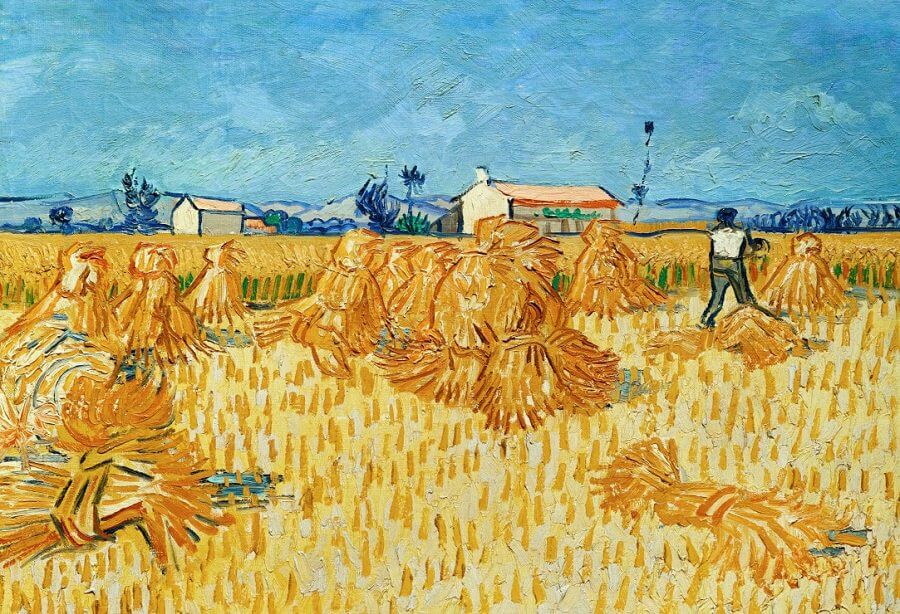
Harvest in Provence, by Vincent Van Gogh, 1888

People of every age struggle with the evil present in this world – and also within the church. For how do we make sense of those who profess Christ but have no fire and passion for their faith? How do we reconcile our own faith with folks in the church who seem to care more about getting their own way than about sacrificing themselves to reach people who do not know Christ. Jesus says, “He who has ears, let him hear.” In other words, listen!

Jesus has informed us that in this present evil age we live in, between his two advents of incarnation and Second Coming, not everything for Christians is going to be rainbows and unicorns.

There are competing pressures on the Church, and sometimes she will fail. The kingdom of God has broken into history and is present, but sin and evil is there, too. So, our focus must be on the hope we have when Christ comes again to judge the living and the dead.

In Christ’s parable of the weeds (or the parable of the wheat and the tares) the enemy of our souls seeks to distract the workers by overwhelming them with evil. If Satan cannot prevent God’s kingdom from being established in the human heart, the devil will try and corrupt the heart by throwing as much evil at it as he can. 

The devil has no problem with people saying they are Christians; the thing Satan has a problem with is people giving themselves unconditionally and unreservedly to God for kingdom business.

“Not everyone who says to me, ‘Lord, Lord,’ will enter the kingdom of heaven, but only the one who does the will of my Father who is in heaven.”

Jesus (Matthew 7:21, NIV)

Where did all these weeds come from?

I’ll frame this question in the modern form that many people have asked me over the years: “If God is a God of love, why is there so much evil in the world?” Or, “If this is Christ’s Church, why is it so messed up?”

Jesus is straightforward in his answer: An enemy did this. In other words, God didn’t plant evil – the source of evil comes from the devil, not God. God’s agenda is for the seed to take root in the human heart and grow into a full-fledged embodiment and commitment to the words and ways of Jesus.

When that growth doesn’t happen, the problem is not because God messed up; it’s because the devil has also done his own work of planting. And the devil wants the opposite of God: to have Christians nit-picking each other like a bunch of crazy chickens, and keeping a demonic pecking order; instead of being the continuing presence of Christ on this earth.

What do we do with all these weeds?

That is, how do we deal with wicked people?  The answer seems obvious: Pull the weeds up and get rid of them. Get rid of wicked people and their wicked behavior. Yet Jesus says in response to this line of reasoning in a clear and unequivocal answer of “No.” But why? Because doing violence to the weeds ends up doing violence to the wheat, as well.

Christ’s answer to the problem of evil is: Let God take care of it. Meanwhile, until that fully happens, we must co-exist with evil, rather than exterminate evil people.

There is always a temptation for believers to force people into the kingdom of God (e.g. the Spanish Inquisition). Yet, at the harvest (the final judgment at the end of the age) evil will be squarely dealt with. Judge Jesus will have the angels separate the wheat from the tares, and the weeds will be burned up.

This teaching from Jesus may open up a whole set of other questions, such as:

  • What am I supposed to do with evil? Just watch it happen? 
  • Am I to let that evil person just be evil? Shouldn’t I give them what they deserve?
  • Shouldn’t I at least tell evil people that they are no good rotten sinners? That they are going to hell because they are wicked?

This doesn’t mean we do nothing. Earlier in Matthew’s Gospel, Jesus has already said: Love your enemies and pray for those who persecute you. (Matthew 5:44)  We are to love and pray people into the kingdom, not force them in.

As for the evil, Jesus will decisively solve the problem of evil, not you, nor me! It isn’t our place to be judge, and if we make it our place, we’ll end up hurting and destroying our brothers and sisters.

Where is evil?

A sobering reality taught by Jesus in this parable is that it’s not a simple matter that we, the wheat are here, and they, the weeds, are over there. It is much more sinister than that; the enemy is within, not out there. 

We have no further to look than in our own hearts and within our own faith communities – which is why we need the lordship of Christ to completely overtake us. Evil is present in the Church, next to the good, seeking to:

  • discourage people in their commitment to Christ
  • offend and hurt others, particularly by overlooking and speaking ill of weaker people
  • step on others in order to get it’s way
  • be a stumbling block to those trying to do God’s will
  • promote ignorance of God’s Word, for no one can live by God’s will if they do not know what it is

The eventual end of sinister people is that, when Christ returns, they will be separated from the righteous and thrown into the fire, just like a harvester would do with a bunch of weeds. As the wicked went about their lives in anger, upsetting others in this life, so they will be tormented in the next.

Conclusion

We may expect God to handle evil in a hurry. But the kingdom of God doesn’t work that way; it’s intended to be planted in the ground, and takes time to grow. While it’s growing, evil is there, like a weed.

Whenever things go sideways because of wickedness, we might expect God to act quickly and drastically to uproot the evil. We may confuse God’s slowness as being uncaring, when in reality it means that God is patient, and desires people to change. And change always begins with you and me.

God Almighty, Creator of heaven and earth, we are a complacent people. While you desire us to be a beacon of light to a world in need, we are preoccupied with all the weeds in the field. We are sorry for the madness unleashed through our own selfish desires. May you plant the seed of love in our hearts for all people, not just our friends. And we shall commit to watering and nurturing that seed with your Word, through Jesus Christ our Lord. Amen.

Develop a Virtuous Ethic (Matthew 7:15-20)

“Beware of false prophets who come disguised as harmless sheep but are really vicious wolves. You can identify them by their fruit, that is, by the way they act. Can you pick grapes from thornbushes, or figs from thistles? A good tree produces good fruit, and a bad tree produces bad fruit. A good tree can’t produce bad fruit, and a bad tree can’t produce good fruit. So every tree that does not produce good fruit is chopped down and thrown into the fire. Yes, just as you can identify a tree by its fruit, so you can identify people by their actions.” (New Living Translation)

God has always been concerned for ethical virtue. And Jesus was always careful to take that ethic and help others identify it and apply it.

Virtuous ethics was well-known in the ancient world, especially thanks to the Greeks and Aristotle – who espoused that a person’s character is the determinative factor in discerning the extent to which that person is a good person.

For Aristotle, ethics includes moral virtues such as courage, temperance, compassion, generosity, honesty, and justice. The person in whom these moral virtues are to be found as steadfast dispositions can be relied on to exhibit a good character, and therefore, is able to make morally correct actions in moral decision-making situations.

For Jesus, religious legalism was a clear outward sign of the lack of inward moral virtue. Bad religion was a result of bad character. Therefore, everyone ought to beware of the religious leaders who exhibited stifling religious legalism.

Nothing can choke the heart and soul out of a person’s true spirituality, and hinder the development of virtue, like the legalist who teaches a precise extra-biblical list of do’s and don’ts.

For many folks, it seems easier to live by the list than to pursue the harder road of developing the character qualities needed for a solid and virtuous religious ethic. Christian discipleship involves growing into spiritual maturity and allowing a seasoned character to shape how we make decisions. 

To do so, we must patiently and consistently follow in the way of Jesus, which is the way of grace and of life.

Today’s Gospel lesson is Christ’s conclusion to his Sermon on the Mount. It is a sermon that sets forth the values of God’s kingdom and devalues the core of legalistic thought. 

I define legalism as a compulsion to spell out, in great detail, how everyone is to live a godly life; purposely going beyond the stated commands of Holy Scripture so that all persons can know exactly what they are supposed to do in any situation.

The problem with this approach to the Christian life is that godliness is merely an outward expression of our ability to hold to the list. It really has nothing to do with cultivating a virtuous ethic of life.

“Do not do what they do, for they do not practice what they preach. They tie up heavy, cumbersome loads and put them on other people’s shoulders, but they themselves are not willing to lift a finger to move them. Everything they do is done for people to see.”

Jesus on the legalist (Matthew 23:3-5, NIV)

The legalistic way of life and religion feeds human pride and boasting; it goes against the inner heart values of humility and meekness in Christ’s Beatitudes. The teaching of Jesus ends up getting lost in trying to do everything right or perfect.

Jesus, through the Sermon on the Mount, led the crowd to a point of decision, letting them know they are at a crossroads. There are two alternatives: Choose the way of life as expressed in Christ’s teaching, or else choose the way of destruction through the legalistic list. In order to press the crowd toward the necessity of choosing wisely, Jesus used metaphors to make his point.

False teaching in the form of legalism is like a wolf in sheep’s clothing. Be wary of people who seem pious and sincere, yet who do not quite pass the smell test. After all, Satan himself, the Apostle Paul once said, masquerades as an angel of light, appearing righteous, yet, is intent on deceiving many. (2 Corinthians 11:13-15)

So, how do we recognize a wolf who spiritually and emotionally devours people, and has no intention of helping but harming? Look at the fruit of the tree. 

Jesus is the good tree. Christ advocates for a searching of the heart. This leads to the result of righteous fruit. The bad tree is also seen by its fruit. Anyone who fails to live the Beatitudes of Jesus will be seen by the rotten fruit of boasting and pride.

False teachers tend to believe they are above others. After all, they are experts at keeping the list of do’s and don’ts! Yet, a false disciple will always be shown by their profound lack of grace, gentleness, and genuine humility. They inevitably advocate for holding to their brand of religion and keeping the unscriptural list. The absence of true righteousness and justice in their lives eventually results in their being cut down and thrown into the fire.

For Jesus, there is no riding the fence between the two alternatives presented – and it is a matter for him of life and death. The way of Jesus leads to life, good fruit, entrance into the kingdom of heaven, and stability. The other alternative ends in destruction, bad fruit and fire, exclusion from the kingdom, and being ruined.

The sobering reality of Christ’s teaching is that many people can be deceived with a devil’s bargain: “Take the nice handy legalistic list and you will become godly. Here are twelve principles to change your life. Follow these rules, pray this prayer, give your money to this, and all will be well.” It is, however, a highway to the grave.

The false teacher proclaims himself a “fruit inspector” and then goes on to judge everyone by his own contrived legalistic list. So then, there is a need to repent of religious lists, political agendas, and teachings which ignore and demean Christ’s Sermon on the Mount.

One of the telltale signs of holding to a conjured list is when we are not honest with one another about our struggles. The bald fact of list-living is that we cannot fulfill it. So, when we know we are not measuring up to the list, the temptation is to keep up appearances as if we are doing just fine. 

List-living eschews showing any weakness or imperfection:

  • I cannot admit my sin to anyone because the list pronounces me a failure if I do. 
  • I cannot enter a deep and prolonged grief over my loss because the list says I need to stay strong. 
  • I cannot profess my doubts about God because the list says if I doubt, I am not a real Christian.

My response and recommendation to legalistic list-living is this: To hell with the list! 

Instead, give praise to Jesus Christ who has given us the way of grace! For it is grace which transforms hearts, turns lives around, and provides genuine joy and satisfaction. If grace is not the answer, we are not asking the right question. The tree of life has an abundant supply of gracious fruit.

The greatest anti-legalistic prayer we can pray is the tried and true ancient prayer of the Church: “Lord Jesus Christ, Son of God, have mercy on me a sinner.”