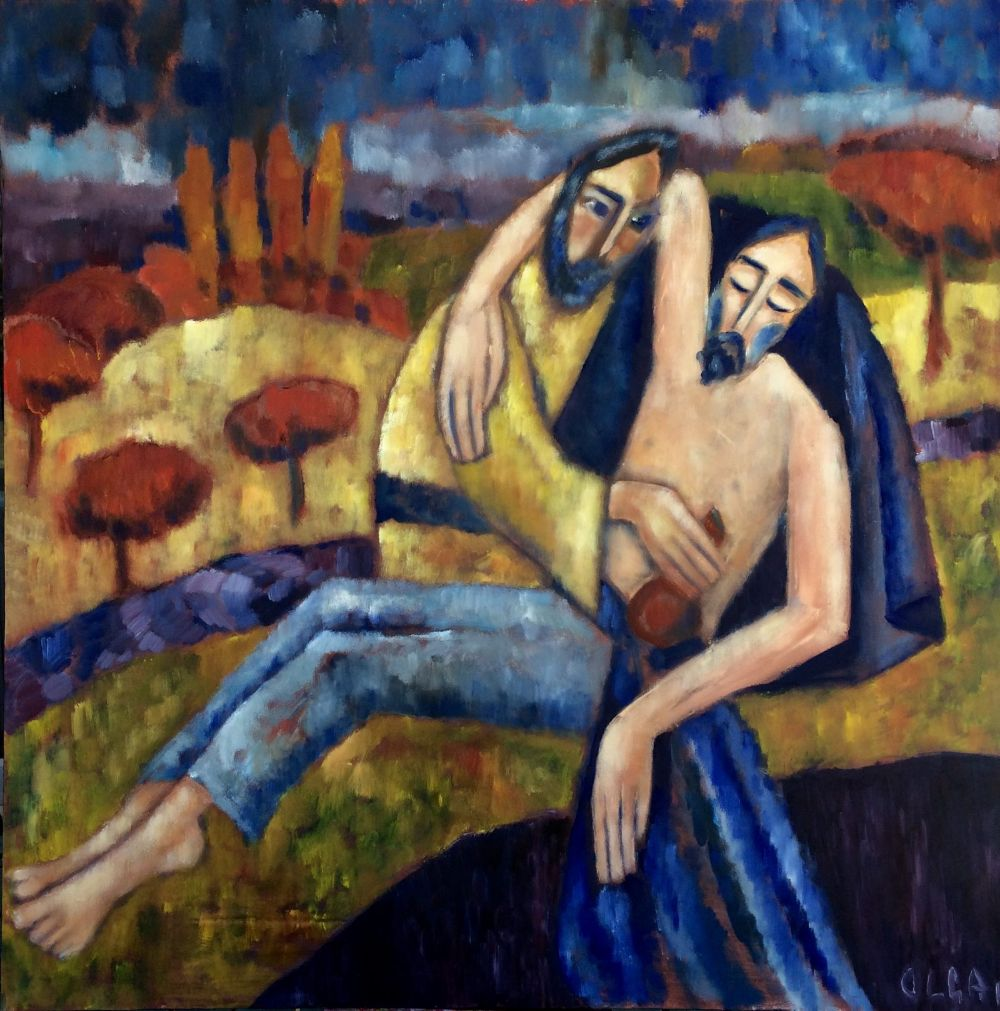
The Fruit of the Spirit

The fruit of the Spirit is love, joy, peace, patience, kindness, goodness, faithfulness, gentleness, and self-control. (Galatians 5:22-23, CEB)

It takes little effort to have a bad attitude; to slip a bit of gossip into the day; or to go along with the crowd in a divisive conversation. However, it takes a good deal of humility, energy, and commitment in order to live into the fruit of the Spirit.

On the one hand, the believer in Jesus Christ has been graciously given such fruit; we possess it by means of the Spirit. On the other hand, it feels as if we still need this fruit to be given to us, because our daily experience of it is such a struggle.

For me, experiencing the fruit of the Spirit is a bit like buying something from Ikea; I have it, but it needs to be put together. And I’m not so good at making sense of the directions and actually getting the thing in working condition.

Yes, there will be some frustration tapping into our spiritual reservoir and accessing the fruit provided for us. Yet, it’s totally worth it. In fact, the nine elements of spiritual fruit mentioned in the New Testament book of Galatians are experiences people really want to have – whether they are Christian, or not.

One of the reasons folks may become overwhelmed with the Spirit’s fruit is that they look at those nine words as nine different “fruits.” However, the grammar of the text is clearly not plural but singular. In other words, the “fruit” of the Spirit is one packaged piece.

It may be tempting to relieve ourselves of any responsibility or accountability with this fruit by saying, “I’m good at being kind and good, but I really have problems with patience and self-control.”

But the text doesn’t allow for such thinking. To not possess any one of the nine words is to not have the entire nine. The Holy Spirit of God is not divided; when the Spirit gives, it’s the whole kit-and-caboodle.

After all, the believer in Jesus seeks to be a person of integrity and wholeness, being aligned fully in all aspects of life around the person and work of Christ. Any fragmentation belies the reality that one, no matter how apparently peaceful or gentle, is attempting to manifest spiritual fruit on one’s own power.

There is a big difference  between trying to control the process of Christian sanctification (becoming holy) and exercising self-control. And there is an even wider chasm between accessing and using the accepted spiritual fruit, and trying to go on a self-improvement project that is disconnected from God’s given grace.

In truth, believers already have everything they need for life and godliness in this present evil age (2 Peter 1:3). The seed has been firmly planted within the soul. We possess the fruit. Yet, that fruit must grow and mature before it is ripe enough to eat. There is still the work of cultivating and nurturing to do, so that we might flower and flourish.

We only need the essential conditions to grow. Any seed – no matter what kind – will grow and produce a harvest if it has the proper amounts of sun, rain, and good soil. Then, we never need to wonder what will happen; the seed will grow.

As spiritual farmers, we need to be daily working in the field our soul, keeping the weeds and the critters out, so that there is no obstacle or impediment to the growth and maturity of our precious fruit.

If we need to build a fence, we build it. If we must buy or borrow a hoe, we do it. Whatever needs to happen to guard what we possess, we are committed to doing it.

None of us ever produces a seed. Not even in this modern age of genetically modified seeds can we do this. The scientist only manipulates what is already there; he cannot create a seed ex nihilo.

So, we have this tremendous spiritual fruit, graciously given to us by means of God’s Spirit. Perhaps the million dollar question is:

How do I access this grace? How can I realize the fruit of love, joy, peace, patience, kindness, goodness, faithfulness, gentleness, and self-control in my life?

We have no further to look than to the very words of the Lord Jesus himself:

Very truly I tell you, unless a kernel of wheat falls to the ground and dies, it remains only a single seed. But if it dies, it produces many seeds. Anyone who loves their life will lose it, while anyone who hates their life in this world will keep it for eternal life. Whoever serves me must follow me; and where I am, my servant also will be. (John 12:24-26, NIV)

We must die to ourselves. There is no other way. Christ demonstrated the way by dying and being placed in the earth. Only then could he rise from death. And only then could his disciples have their faith come to fruition, spreading gospel seed throughout the world.

For one cannot have a resurrection unless there is first a crucifixion. There must be suffering before glory.

That, my friend, is the cost of discipleship. It’s the cost of realizing the spiritual fruit that you and I long for in our lives. This is the struggle we must go through to experience the life that is truly life.

Heavenly Father, in you I live and move and have my being. I humbly pray You so to guide and govern me by your Holy Spirit, that in all cares and occupations of my life I may not forget You, but remember I am ever walking in Your sight, exhibiting Your fruit; through Jesus Christ my Lord. Amen.

The Healing of the Demoniac (Luke 8:26-39)

Mosaic of the exorcism of the Gerasene demoniac from the Basilica of Sant’Apollinare Nuovo, 6th century C.E.

Then they arrived at the region of the Gerasenes, which is opposite Galilee. As he stepped out on shore, a man from the city who had demons met him. For a long time he had not worn any clothes, and he did not live in a house but in the tombs. 

When he saw Jesus, he cried out and fell down before him, shouting, “What have you to do with me, Jesus, Son of the Most High God? I beg you, do not torment me,” for Jesus had commanded the unclean spirit to come out of the man. (For many times it had seized him; he was kept under guard and bound with chains and shackles, but he would break the bonds and be driven by the demon into the wilds.) 

Jesus then asked him, “What is your name?” He said, “Legion,” for many demons had entered him. They begged him not to order them to go back into the abyss.

Now there on the hillside a large herd of swine was feeding, and the demons begged Jesus to let them enter these. So he gave them permission. Then the demons came out of the man and entered the swine, and the herd stampeded down the steep bank into the lake and was drowned.

When the swineherds saw what had happened, they ran off and told it in the city and in the country. Then people came out to see what had happened, and when they came to Jesus, they found the man from whom the demons had gone sitting at the feet of Jesus, clothed and in his right mind. And they became frightened. Those who had seen it told them how the one who had been possessed by demons had been healed. Then the whole throng of people of the surrounding region of the Gerasenes asked Jesus to leave them, for they were seized with great fear. So he got into the boat and returned. 

The man from whom the demons had gone out begged that he might be with him, but Jesus sent him away, saying, “Return to your home, and declare how much God has done for you.” So he went away, proclaiming throughout the city how much Jesus had done for him. (New Revised Standard Version)

Jesus exorcising the Gerasene demoniac, from the Hitda Codex

Jesus came to this earth to deliver people from all obstacles that gets in the way between us and God, so that humanity may freely connect with the divine, each other, and creation.

Whether it was in the synagogue, in public, in private, in a Jewish community, or in Gentile territory, Christ’s ministry was marked by healing people. He did this so that people could (re)attach themselves to the neighborhood, to God, and even to themselves.

Today’s Gospel story has Jesus take an unexpected trip across the Sea of Galilee to a foreign place full of non-Jewish persons. It was a place marked by all sorts of ritual impurity, and sorts of Gentile practices which a good Jew would have nothing to do with.

So, it’s no surprise, in a heathen setting, that Christ encountered the demonic in the form of a man riddled with demons to the point of being named “Legion.” This confrontation became a type of wild west shootout between the superhuman tortured man and the divinely filled Son of God.

The confrontation was intense. The atmosphere was charged with anticipation that someone wasn’t going to walk away from this shootout. But Jesus knew what he was doing: Christ was about to breakout a man from a demonic prison; and it would not go well for the demons.

In this remote western town, Jesus ended up performing a most extraordinary miracle. It would take a miracle to free this demonized person from his satanic jailcell. The legion of demons, however, were no match for the singular Son of God. Christ had no problem using his authority to exorcise the demons from the victimized man.

The demons exited the man and entered an entire herd of pigs. The herd then proceeded to destroy themselves in a powerful scene of what the demonic is all about. Yet, rather than acknowledging a divine miracle, those who were tending the pigs went and told the people in the area of how this interloper came along and upset the status quo. Instead of seeing a delivered man, the pig herders could only see dead swine.

As a result of the pig herders report, the folks in nearby towns wanted nothing to do with Jesus. The people begged him to get out of town. Christ purged the region of a significant presence of bad guys, and all the townspeople could do was fear for what might happen.

But despite the townspeople’s and pig herders’ disturbing lack of faith, there was one man who became a committed disciple of Jesus on the spot. The demoniac, now turned new citizen of God’s kingdom, saw Christ for who he was, and immediately discerned to whom he belonged – not the demonic world but the kingdom of heaven.

Although the newly delivered man begged to remain with Jesus, the Lord had another plan for the new disciple. Christ sent him back to his home to proclaim what God had done for him. In doing so, the man would become a powerful witness to God’s power. And, important for the man, old broken familial and community relations could be renewed and restored. The healing would come full circle.

If we bear witness to the works of God, where we are, it will bear fruit – even if it is among folks who may be in opposition to it.

Not even a legion of demons could keep Christ from restoring a tortured person to himself, his family, and his community. And it all happened on the demons’ turf. Nothing can stop the kingdom of God from expanding it’s good reach over all that is evil.

The good news of Christianity is that Jesus has the power to bring life from death. Christ has the ability to put us in a position where we can reconnect with both the human community and the divine realm.

The satanic in this world is not nearly as powerful as God; and the demons are under Christ’s authority. In fact, there is no power on earth (or under the earth) that can overcome the strength of the almighty God. This can be a comforting thought for every Christian.

Anyone afraid of Jesus has not yet discerned that he is inherently good. Ultimate power needs to be seen in the light of ultimate good. Otherwise, a person will walk around much like the demoniac, oppressed in their soul.

Instead, deliverance from the evil which vexes us is possible. For nothing is impossible with God. Whenever and wherever the healed person becomes a healer to others, then we know that the kingdom of heaven is among us.

Hear our prayers, God of power and might. Through the ministry of your Son, free us from the grip of the tomb, so that we may desire you as the fullness of life, and proclaim your saving deeds to all the world in the strength of the Holy Spirit. Amen.

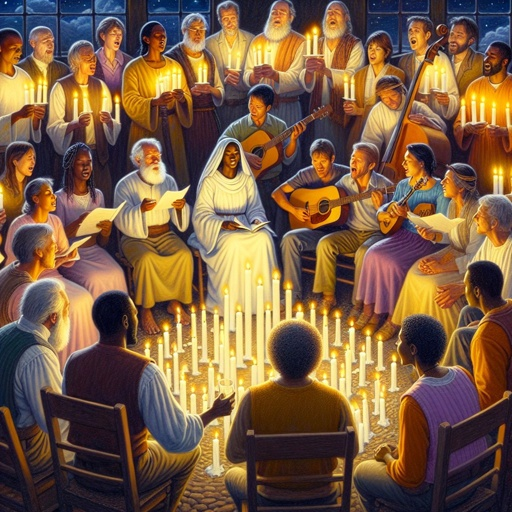
Sing Psalms and Hymns and Spiritual Songs to One Another (Ephesians 5:15-20)

By Bible Art

Be careful, then, how you live, not as unwise people but as wise, making the most of the time, because the days are evil. So do not be foolish, but understand what the will of the Lord is. Do not get drunk with wine, for that is debauchery, but be filled with the Spirit, as you sing psalms and hymns and spiritual songs to one another, singing and making melody to the Lord in your hearts, giving thanks to God the Father at all times and for everything in the name of our Lord Jesus Christ. (New Revised Standard Version)

It’s unlikely I need to tell anyone that the days are evil. The world is upside-down and topsy-turvy with injustice, waywardness, and narrow partisanship. In fact, there is a lot of similarity to the Apostle Paul’s time. Maybe that’s why Paul exhorted the church not to drown their sorrows in a bottle of spirits, but to be filled with the Spirit.

Perhaps, because of the times we live in, you don’t feel much like singing. You might not be finding much in your life right now to sing about. Yet, maybe singing is the very thing we need.

An inebriated person says and does things that they would not typically say or do when they’re sober. The Apostle’s point about being filled with the Spirit is that, instead of doing and saying foolishness, we are to be so filled with God that we do and say wisdom that we wouldn’t typically do and say, if not filled with God. 

Without the fullness of God’s Spirit, we end up mumbling, not singing; worrying, not making music in our hearts; complaining and arguing, not giving thanks. Half-filled Christians can only practice a half-hearted Christianity. And they’re only half-baked in their service and devotion to Christ.

Why sing? 

Because singing is part of being filled with the Spirit of God. Singing happens when we experience God’s overflowing grace in our lives through the blessings of being chosen, adopted, and redeemed into God’s new community. (Ephesians 1:3-11)

Music is powerful. It’s not only a means of expressing praise and commitment to Christ and each other, it is also a powerful means of remembering.

For example, when we first teach kids the alphabet, we teach it in a song. Trying to teach letters in a rote fashion doesn’t work well for pre-school kids. But words set to music is why we can still remember words from old TV shows, because those words were set to a catchy tune (alas, the lyrical theme from Gilligan’s Island will forever be in my head).  Music is why an Alzheimer’s patient doesn’t remember her daughter’s name, yet can flawlessly sing all four verses of Amazing Grace.

Singing is an offering and a sacrifice of praise to God (Hebrews 13:15). And singing is also a vehicle whereby we are taught, encouraged, and built up in the community of believers. We sing to God, one another, and even to ourselves.

Christian music, then, is to be both a means of praising God and a practice of encouraging each other. We accomplish this through singing psalms, hymns, and spiritual songs.

Sing Psalms

The word “psalm” helps us rightly think of the biblical book of Psalms. Singing the psalms is an ancient practice, going all the way back to the Israelites singing psalms in the temple and synagogue. The early church maintained this practice, especially as a means of being faithful to praying without ceasing. 

However, over time, medieval congregations began neglecting the practice. In fact, European congregations eventually gave up most singing altogether. Almost all the singing was done by church choirs and professional musicians employed by the king (there was no separation of church and state) to write, compose, and perform in worship services. 

Five-hundred years ago, during the Reformation, Martin Luther reinstituted congregational singing. He gave music back to the people. One of the results of this change was putting the book of psalms to song – the Psalter.  For many Protestant denominations, the Psalter became the primary means of singing. The Psalter chiefly set prayers to song. It was both a means of expressing prayer to God and learning Scripture.

Singing Hymns

There have always been hymns in the church. Yet, it was not until the Reformation that hymns began to be written and sung by congregations. For the Reformers, hymns were used to teach sound doctrine and theology, as well as a means of confessing the faith together

A mighty fortress is our God,
a bulwark never failing;
our helper he, amid the flood
of mortal ills prevailing.
For still our ancient foe
does seek to work us woe;
his craft and power are great,
and armed with cruel hate,
on earth is not his equal. (Martin Luther, 1529)

Singing Spiritual Songs

Spiritual songs are the present day equivalent of praise and worship choruses, or what some refer to as contemporary songs. These are songs purposefully designed to be emotional expressions of praise to God and to give powerful testimony for what God has done or is doing.

Remember When You Sing…

  • Psalms are used to pray and learn Scripture.
  • Hymns are used to teach us sound doctrine and confess the faith together.  
  • Spiritual songs are an important way of expressing praise to God and being encouraged in the faith. 

Therefore, church music is to serve as both a revelation from God, and as a response from God’s people.

There are two important deductions from the Apostle Paul’s exhortation:

  1. A variety of songs is inferred and expected
  2. Their use is commanded

The reason worship style seems always to be a controversial topic is because everyone has their personal preferences. And yet, if we are to be faithful to today’s New Testament lesson, we will do more than focus on what I want. 

Truth be told, we are selfish people when it comes to music. We want what we want, and we don’t care what somebody else wants. And we’ll persist in that self-absorbed spirit until somebody calls us on it… That somebody is the Apostle Paul. Scripture calls us to encompass psalms, hymns, and spiritual songs – all three of them – in our worship.

I have an old friend who is an accomplished church musician and worship pastor. I once asked him how I can lead a worship service among such a variety of preferences concerning music. He answered my question with a question:

“How highly do people, including and especially your musicians, value the unity of the church? Do they love each other so much that they can allow for a wider range of style, and do so without vocally complaining about it?”

My friend went on to say, “When I arrived at one church as their pastor, some people were in a rather bad habit of saying very openly, ‘Oh I hate that song,’ or, ‘If I hear this song one more time I’m walking out.’ What I tried to do was teach people that this is not the most loving or mature approach; and it does little to build up the rest of the Body of Christ.”

If a group of people are being faithful to Scripture, and doing their best musically, then – if the music seems lifeless, dull, or strange to us – the real issue isn’t style but our hearts.    

A heart filled with the Spirit of God will speak to others using the Psalter, time-honored hymns, and fresh new contemporary songs. The result is believers built up in the faith.

Gracious God, give us grace to take to heart the great dangers we are in by our unhappy divisions about all kinds of things, including music. Take away all hatred and prejudice, and whatever else may hinder us from godly union and harmony, so that as there is but one body and one Spirit, one hope of our calling, one Lord, one faith, one baptism, one God and Father of us all, we may from this time forward be all of one heart and of one soul, united in one holy bond of peace; and may with one mind and one mouth glorify you, through Jesus Christ our Lord. Amen.

Trinity Sunday (John 16:12-15)

Holy Trinity, by Andrei Rubley

“I still have many things to say to you, but you cannot bear them now. When the Spirit of truth comes, he will guide you into all the truth, for he will not speak on his own but will speak whatever he hears, and he will declare to you the things that are to come. He will glorify me because he will take what is mine and declare it to you. All that the Father has is mine. For this reason I said that he will take what is mine and declare it to you.” (New Revised Standard Version)

Trinity Sunday is an annual celebration on the Christian Calendar which focuses intentionally on the mystery, power, and beauty of the triune God – Father, Son, and Spirit. All three persons of the Holy Trinity exist together in eternal love, harmony, and unity with each other as one God.

This day is much more than a doctrinal and theological affirmation. It is a reminder that our theological impulses are to have movement toward union with this triune God, to participate in the Divine dance of the Trinity.

The Christian life is oriented toward the Trinity. Christianity is a path, a road, a journey with God. It is a pilgrimage of the soul that demands our time, effort, and courage.

In other words, we are meant to experience God as Father, Son, and Spirit, rather than merely acknowledging the Trinity. Not only are we to know God; we are designed to feel at the core of our being the existential presence of God. What’s more, the Holy Trinity participates within the Godhead to help make that happen within us.

The Trinity we see in the Gospel of John is a presentation of God’s love for us. A gracious window is opened to the mystery of the one God in three persons. This allows us to see and feel that this trinitarian love holds us in a Divine embrace.

In Christ’s Farewell Discourse (John chapters 13-17) love is the dominant theme. Love is what Jesus wanted to leave with his disciples, and to remind them that all things are to be said and done with love. Christ promised the giving of the Spirit as a gift of love, so that we will learn to love ourselves and others.

There is eternal love, unity, and harmony continually flowing from the Father who sent the Son for us and for our deliverance, and from the Spirit who dwells with us in an abiding presence of love. Together the Father, Son, and Spirit develops us as lovers, loving the world just as God does.

The heavenly Father holds us in love so that we will hold the world in love.

Jesus the Son comes among us and reassures us of Divine love so that we will bring love to the world.

The Spirit guides us into the truth of love so that we will display love for one another in front of the world.

As Christians bravely, patiently, and calmly walk the road of the Christian life, they grow more and more in love with God, and therefore, more in love with the world that God loves so much.

There is an interaction between the Father and the Son marked by truth and love. Jesus graciously invites the believer into this conversation. In addition, the Spirit instructs us so that our speech and behavior will emulate the love which always takes place within the Trinity.

The reality of the Holy Trinity helps us experience and feel that God is for us; God is with us; and God is in us.

Sometimes we get hung up on the timing of things. We want what we want now. We don’t understand why God isn’t coming to our rescue. We wonder if God is even around because of this crud-encrusted planet we live on with all of its natural disasters and human destruction.

Yet, let’s keep in mind that the triune God has forever existed. God is constant. Father, Son, and Spirit are continually working in the immediacy of the now. We have been offered Living Water, but the water pouring forth now is not the same as what came before and what is to come – just as the water in a river flows by us, having come from somewhere downstream, and going somewhere else.

Time is irrelevant. All we have is the now. When we hold on to the past and/or have anxiety about the future, we are failing to live in the present. And in this very moment, the triune God is present with you, is in you, and is for you. Live in the now, and not so much in the has been and the not yet.

God only becomes real to us when I am. Then, the great “I AM” is able to dwell with the little “I am” of me in the present tense of now.

Because God is God, there will always be a mystery, because trying to understand the Holy Trinity – the great Three in One – shall forever elude us. We have not been called to understand God; we are called right now to submit to the unfolding of what God wants to reveal to us.

The triune God has shown us that within the Trinity there exists perfect love, harmonious unity, infinite beauty, and great goodness. As people created in the image of this God, we have the capacity to pursue these very same qualities. With God’s enablement, we can be a source of light and hope to a world which needs an experience of Divine love and truth.

God of heaven and earth, before the foundation of the universe and the beginning of time you are the triune God: the Author of creation; the eternal Word of salvation; and the life-giving Spirit of wisdom.

Guide us, O God, to all truth by your Spirit, so that we may proclaim all that Christ revealed and rejoice in the glory he shared with us. Glory and praise to you – Father, Son, and Spirit – now and forever. Amen.