Are Your Ears Being Tickled? (2 Timothy 3:14-4:5)

But as for you, continue in what you have learned and firmly believed, knowing from whom you learned it and how from childhood you have known sacred writings that are able to instruct you for salvation through faith in Christ Jesus. All scripture is inspired by God and is useful for teaching, for reproof, for correction, and for training in righteousness, so that the person of God may be proficient, equipped for every good work.

In the presence of God and of Christ Jesus, who is to judge the living and the dead, and in view of his appearing and his kingdom, I solemnly urge you: proclaim the message; be persistent whether the time is favorable or unfavorable; convince, rebuke, and encourage with the utmost patience in teaching. For the time is coming when people will not put up with sound teaching, but, having their ears tickled, they will accumulate for themselves teachers to suit their own desires and will turn away from listening to the truth and wander away to myths. As for you, be sober in everything, endure suffering, do the work of an evangelist, carry out your ministry fully. (New Revised Standard Version)

It’s only human in wanting to hear only those things we like to hear. Rarely do any of us purposely seek to listen to another voice which is contrary to our likings. This may be why we exist in such a polarized world; we simply have no intention of listening to any sort of opposing view on anything.

We put our fingers in our ears to stop hearing things we don’t want to hear; and conversely, we surround ourselves only with people who tell us what we want to hear.

The Apostle Paul would say that we like our ears tickled.

One of the hardest things to hear is that sometimes we need to hear hard things.

There is no spiritual growth, and no Christian maturity, apart from the willingness to hear what we need to hear, rather than to always hear what we want to hear. All of us need to keep developing our listening skills.

I would argue that one of the reasons there are umpteen Protestant denominations in this world is that groups of people don’t really want to listen to one another. We’d much rather insulate ourselves; label ourselves as right; and declare that everyone else is worldly and wrong, or an antichrist and a terrorist.

But that sort of thinking will not do for the Apostle Paul. It’s one of the reasons he took the time to write to his young protégé Timothy.

Paul’s letter to Timothy is filled with exhortations and warnings about making sure the church is ethical with their words; avoids useless and profane speech; holds to sound biblical talk; and stays away from speaking erroneously about apostolic teaching.

In other words, church folk must keep their life, their doctrine, and their speech in line with the words and ways of Jesus – even when we encounter hard words from our Lord and his apostles.

Listening to what we need to hear, instead of always what we want to hear, is a significant way of maturing in the Christian life.

We choose to listen to hard things, and things we don’t necessarily want to hear in order to connect with God and others; and to compassionately understand what they’re saying to us.

We need not be at the mercy of our own reactivity. Knee jerk reactions only breed ignorance, not spiritual growth.

Since listening is a skill to develop, that means we need a lot of practice doing it. We can begin by listening to Scripture; embracing the sort of faith which it advocates; and following the examples of godly persons, like the Apostle Paul.

In Timothy’s case, faith was learned and nurtured through the examples of his mother Eunice and grandmother Lois (2 Timothy 1:5). Their compassionate and beloved way of life displayed an embodied source of sound teaching.

There was a whole lot more going on with the godly examples than catechism classes and Sunday School lessons. Their teaching effected a deep and enduring desire to follow the example of godly living.

Every believer needs helpful examples and models, whether they are family or not. The truly Christian person is one who allows the inspiration of Holy Scripture to manifest itself in their life in profoundly powerful ways which brings transformation, not just information.

And whenever these godly persons are together, making up a Christian community, then there is wise discernment in carefully listening to what is right, true, good, and just. Gossip is jettisoned. Lack of evidence is not ever entertained. Rather, encouragement and spiritual nurture take hold.

Christians with the inspired text in the very marrow of their souls faithfully call out deviations and departures from godly scriptural speech. They hold to righteousness and embrace the good. They love mercy and exhibit humility in all things.

Holy Scripture was not a collection of facts for Timothy, but was engrafted into his mind and heart so that what came out of him was faith, hope, and love. Christians like Paul and Timothy had a well-rounded spirituality which was attuned to following Jesus and nurturing the faith of others.

Paul lovingly and confidently exhorted Timothy (and his congregation) to go diligently after Scripture, so that it could do its work within them. They were to speak out the gospel of grace, no matter the situation.

Believers are to liberally use apostolic teaching to convince, rebuke, and encourage each other toward the righteousness of God.

Everyone is to work together in practicing holiness, proclaiming grace, and promoting a way of life rooted in the life of Christ.

Everyone is to avoid flocking to leaders who only tell them what they want to hear. They are to instead flock toward humble and wise leadership who possess time-tested teaching – not pithy slogans and promotions of hate.

Reliable true-blue teaching understands perseverance, long-suffering, honesty, and fidelity to Christ’s words. The truth is stated plainly, and thinks of others. There’s no get-down-and-dirty pride; no posturing nor slick salesmanship.

Timothy cared nothing about getting as many social media followers as he could. And he wasn’t so insecure as to want everyone in his congregation to like him. But neither was he calloused by forcing his way on everyone. Paul taught him better than that.

Paul’s instruction took hold with Timothy by cultivating a genuine spiritual growth that is organic and patient, rooted in love, that can always hearken back to the faithfulness of Christ and the apostles.

It is profoundly sad to me how many persons have left the church. And yet, I understand why. There are too many pastors and elders and deacons who are driven by their own selfish desires for power, control, money, and personal followers. That stuff is a sure prescription for people to get hurt and disillusioned with Christianity, let alone the church.

The Apostle Paul wanted to see leadership which reflects the grace by which he himself had been saved. Furthermore, Paul was devoted to being a mentor in helping others like Timothy and Titus to live in ways which exhibit the grace and mercy of Christ.

A hard teaching is really only hard wherever there exists a hard heart. We all need ever-expanding and softening hearts which are receptive to the voice of Holy Scripture.

What’s more, we need non-itchy ears which listen to the voice of God and the voice of hurting people who need the gospel of grace.

We need godly leadership who knows the difference between truth and being a jerk.

Where are you in your own faith walk?

O God, Spirit of righteousness, you temper judgment with mercy. Help us to live out the covenant which is written on our hearts so that when Christ returns we may be found worthy to receive your gracious presence. Amen.

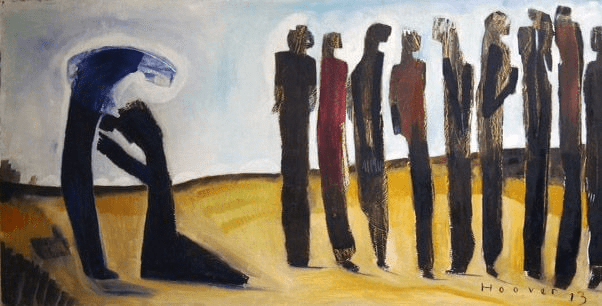
“Your Faith Has Made You Well” (Luke 17:11-19)

Jesus heals ten lepers, with one returning to give him thanks

On the way to Jerusalem Jesus was going through the region between Samaria and Galilee. As he entered a village, ten men with a skin disease approached him. Keeping their distance, they called out, saying, “Jesus, Master, have mercy on us!” When he saw them, he said to them, “Go and show yourselves to the priests.” And as they went, they were made clean. Then one of them, when he saw that he was healed, turned back, praising God with a loud voice. He prostrated himself at Jesus’s feet and thanked him. And he was a Samaritan. Then Jesus asked, “Were not ten made clean? So where are the other nine? Did none of them return to give glory to God except this foreigner?” Then he said to him, “Get up and go on your way; your faith has made you well.” (New Revised Standard Version)

Ten persons seeking healing called out to Jesus. And they got it. Yet, those persons were much more than passive receivers of healing. And Jesus was more than simply a giver.

Even though the lepers had heard about Jesus, they did not personally know him. It seems that – from their perspective – they had a chance encounter with Jesus. When they least expected a healing, a healing happened.

They called out to Christ, recognizing who it was that had entered their village. There was enough faith present for the diseased persons to make themselves known to Jesus – to expectantly put themselves out there and cry out for a healing to happen.

If you think about it, the power of any healing is really in the connection of being seen and heard in crying out to Jesus.

Although the healing of a person can come through a wondrous miracle, healing most often happens by the beautiful act of mutuality and participation. That is, the healer and the one in need of healing encounter each other with the willingness to both give and receive.

It’s in real human connection that healing happens. And it’s more than a physical cure; it’s also a healing reconnection of persons who were once isolated from the community. In other words, the healed person no longer needs to be on the outside of society, but can once again be a full participant in neighborhood and community.

Faith is central to what happens in the healing process. We all have some agency in realizing our own healing. We need not be passive spectators just wishing for things to be different.

Our anxiety and/or discouragement of present circumstances can move to a different place. We can discover relief through participating in social activities, taking walks in nature, and other modes requiring us to actively make a meaningful connection.

It requires faith.

Where faith is present, relational interaction and participation happens. In this context, a healing can occur. Rarely, if ever, does healing happen in complete isolation from others.

The fact that Jesus declared to the cleansed leper, “your faith has made you well,” indicates the mutuality of the healing encounter.

Let’s keep in mind that it takes at least two in order to have a healing: the healer and the healed one. Both participate together in the healing.

What’s more, when Christ heals, he heals without prejudice or favoritism.

In my front yard is a large ash tree with broad and expansive boughs. It is the ultimate shade tree. The tree’s name is Bob (I have a tendency to name trees, especially the ones I enjoy daily). Bob and I share the similarity of being created by the same Creator; and we both glorify God by simply being who we are created to be.

For Bob, he provides shade to people and animals without prejudice or favoritism. Anyone who comes under his great limbs can enjoy his shade. All that is needed for the protective and enjoyable experience of Bob’s boughs is a person under him.

Although it is appropriate to highlight the need for gratitude and praise in today’s story, the narrative itself builds to the climax of faith, of a participatory experience between Jesus and the leper(s).

And it did not matter if the persons healed were lepers, Samaritans, or even miscreants. What mattered was the faith-dialectic of the healer Jesus and the ones to be healed. All may enjoy the grace of divine shade if they move to becoming participants together with Christ by merely coming under his mercy.

I find that many people get hung-up about faith. We often make faith either too simple or too difficult. We create an overly simplistic faith when it becomes a completely passive affair of just waiting on God, or expecting someone else to heal me. We make faith a great difficulty whenever it becomes all about our level or amount of faith through the strenuous effort of intense prayer and contacting umpteen prayer chains.

But more or less prayer, more or less work, more or less of anything misses the point – because even a puny amount of faith will do, if it moves toward Jesus and seeks the participatory experience of a divine/human relation.

There is a cost to healing. It requires participation, relationship, and most of all, the humility to be seen and heard, instead of trying to control some sort of process to get the healing I want.

We call this genuine participation faith.

When the Son of Man comes, will he find faith on the earth? (Luke 18:8)

The only thing that counts is faith expressing itself through love. (Galatians 5:6)

Your faith has made you well. (Luke 17:19)

In your love, O God of all, your people find healing. Grant that the pains of our journey may not obscure the presence of Christ among us, but that we may always give thanks for your healing power as we travel on the way to your kingdom; through Jesus Christ, your Son, our Lord, who with you and the Holy Spirit are one God, now and forever. Amen.

Increase Our Faith? (Luke 17:5-10)

The apostles said to the Lord, “Increase our faith!” The Lord replied, “If you had faith the size of a mustard seed, you could say to this mulberry tree, ‘Be uprooted and planted in the sea,’ and it would obey you.

“Who among you would say to your slave who has just come in from plowing or tending sheep in the field, ‘Come here at once and take your place at the table’? Would you not rather say to him, ‘Prepare supper for me; put on your apron and serve me while I eat and drink; later you may eat and drink’? Do you thank the slave for doing what was commanded? So you also, when you have done all that you were ordered to do, say, ‘We are worthless slaves; we have done only what we ought to have done!’ ” (New Revised Standard Version)

Here’s a simple observation of today’s Gospel text: Because Christ’s apostles said to the Lord, “Increase our faith!” they were acknowledging that they did not have enough faith.

But is that really true? Did the apostles – or do any of us – lack the faith we need to live the sort of life Jesus wants us to live?

I know that I sometimes feel like I have such little faith that it prevents me from being the person I want to be, and to do the good things I want to do. Yet, if I’m honest with myself, I truly don’t lack for anything in living out my faith. For God has already given me what I need.

God is good, all the time. Divine resources are always present. The Spirit dwells within us.

I’m reminded of Peter’s encouragement:

His divine power has given us everything we need for a godly life through our knowledge of him who called us by his own glory and goodness. (2 Peter 1:3, NIV)

Jesus gave his disciples a hard answer to their request for faith. Perhaps hearing a bit of exasperation in the Lord’s voice, Christ communicated to them that they already have all the faith they need.

It’s never about the amount of faith. That’s because we already have enough faith. It doesn’t take much faith to radically change things. It’s much more an issue of accessing the faith which has already been provided for us.

Indeed, even if we have faith the size of a tiny little mustard seed, we could command a tree to be uprooted and throw itself into the sea. (Matthew 17:20; Mark 11:20-25)

Therefore, the apparently weakest of people in the world actually have the power to move mountains and uproot trees.

For example, when a sinful woman poured out expensive ointment on Jesus and applied it with her hair, Christ responded with a resounding “Your faith has saved you.” (Luke 7:50)

Furthermore, when a blind beggar longed to see again…

When a Samaritan leper looked for healing…

When a woman reached out and touched a tassel of the Lord’s garment…

When and a Gentile Roman Centurion came to Jesus on behalf of his ailing servant…

Christ affirmed the existing faith which was present with them – and each one of them therefore experienced the healing they so expected to realize. (Luke 3:48; 7:9; 18:42; 17:19)

In God’s economy, there is no distinction between basic trust in God and the faith that uproots trees. There is absolutely no need to try and manipulate spiritual forces in order to access a special kind of supernatural power. That’s what the pagans of old were always trying to do with their religion.

Getting a right or particular formula for a healing or a miracle is the stuff of other religions, not Christianity. For the Christian, something else is going on with faith.

What is impossible for us is possible with God. The issue with faith is where it is placed, and not with how much or how little you have. Any amount of faith that is directed to Jesus is more than enough. Even a mustard-seed-sized faith.

When participating in the sacrament of communion, you may wonder why a quarter-sized communion wafer is supposed to feed you anything. But this is communicating something important about our faith: Even a tiny portion of bread can fill and satiate the Christian’s need for spiritual sustenance.

A little bit of Jesus goes a very long way, no matter how many are gathered around the Table.

Having faith involves possessing thoughts, feelings, and actions which are thoroughly transformed by God. In other words, it involves being a “slave” of God, being a person who is devoted to engaging in God’s purposes for this world.

Whenever we engage in our work as servants of God, there’s no need for medals and accolades; we are simply doing what is expected of us. Our faith is quite enough to sustain us in doing our normal work in the world. Nothing added or unique is needed.

So, how do we access the faith needed to live the Christian life, in order to please God and bless the world? We do the work which is expected of us.

Then, we will find and see that the faith is there to do and to say what is needed. We need not wait for it; the faith is already there. But we will have to act if we want to see faith in action.

God of all ages, you have revealed your grace to us in the Savior, Jesus Christ our Lord. As we actively live into your mercy, strengthen us to do justice, to love mercy, and to walk humbly with You. May we accomplish Your divine will and live by the faith You have so graciously provided for us; through Christ, who lights the way to everlasting life. Amen.

Pray with Persistence (Luke 11:1-13)

He [Jesus] was praying in a certain place, and after he had finished, one of his disciples said to him, “Lord, teach us to pray, as John taught his disciples.” So he said to them, “When you pray, say:

Father, may your name be revered as holy.
    May your kingdom come.
    Give us each day our daily bread.
    And forgive us our sins,
        for we ourselves forgive everyone indebted to us.
    And do not bring us to the time of trial.”

And he said to them, “Suppose one of you has a friend, and you go to him at midnight and say to him, ‘Friend, lend me three loaves of bread, for a friend of mine has arrived, and I have nothing to set before him.’ And he answers from within, ‘Do not bother me; the door has already been locked, and my children are with me in bed; I cannot get up and give you anything.’ I tell you, even though he will not get up and give him anything out of friendship, at least because of his persistence he will get up and give him whatever he needs.

“So I say to you, Ask, and it will be given to you; search, and you will find; knock, and the door will be opened for you. For everyone who asks receives, and everyone who searches finds, and for everyone who knocks, the door will be opened. Is there anyone among you who, if your child asked for a fish, would give a snake instead of a fish? Or if the child asked for an egg, would give a scorpion? If you, then, who are evil, know how to give good gifts to your children, how much more will the heavenly Father give the Holy Spirit to those who ask him!” (New Revised Standard Version)

If we desire to see the power of prayer become a reality in our lives, we will have to avoid drive-by prayers in favor of sustained and focused prayers taught to us from the Lord Jesus.

Prayer empowered Jesus in his earthly ministry. His disciples saw this, and wanted it, too. So, Christ encouraged them in what to pray, and to keep persistently praying, despite the circumstances.

We are instructed by Jesus to approach the heavenly Father just as he himself did – in a straightforward and intimate manner. The content of our prayers ought to encompass the following five petitions:

  • Let God’s name be made holy. In other words, we are to let the Lord’s name be seen by others as holy within us in our daily lives. This is a petition for God to establish divine sovereignty and holiness in the heart of the believer. When this happens, the name of God is exalted and set apart as holy before a watching world.
  • Let God’s kingdom come. This is a prayer that asks for the reign of God to extend over the entire earth in a very practical way – to have God’s rule draw near to everyone and everything, including ourselves.
  • Let us have our daily bread. That is, pray that God will give us everything we need for life and godliness in this present evil age, including physical sustenance, mental acuity, emotional intelligence, and spiritual food. None of us lives by bread alone, but by every word that proceeds from the mouth of God.
  • Let forgiveness come. Sin is a reality. Therefore, every one of us needs forgiveness; and everyone needs to forgive others. Forgiveness is powerful; it releases us to freedom. And thus, we have the power to release others through the act of forgiving the egregious sins of others. The failure to do this is why the kingdom of God is so disestablished in this world.
  • Let us not become victims of the cosmic conflict. There is a continual struggle of unseen powers on this earth that no human is armed to deal with. Apart from God’s intervention, humanity gets caught in the crosshairs of the conflict. We are to pray that this trial does not overcome us.

These prayers are to be consistently and persistently prayed every day. Christ wants us to keep asking, seeking, and knocking.

Jesus, in his teaching ministry on earth, often used the lesser-to-greater argument in getting his point across. And that is precisely what he was doing with his disciples in today’s Gospel lesson by instructing them about the nature and motivation of prayer.

The lesser-to-greater argument implies a comparison of values. It’s grounded on a common sense and logical convention that if this lesser thing is true, then, of course, how much more is this greater thing!

If something less likely to happen is true, then something more likely to happen will probably be true as well. The technical phrase for this is an argument a fortiori – a Latin term meaning, “for a still stronger reason.”

Jesus wanted his followers to understand that prayer has value because God is a loving Father, not a begrudging friend. Whereas the friend in the story was badgered just so the person could get some real necessities, God needs no badgering to generously give good gifts that may or may not be considered as necessities by us.

Jesus desired to highlight that prayer has veracity because of whom those prayers are directed.

In the ancient world, it was common understanding you needed to get the local gods attention if you wanted something. Which is why, for example, in the prophet Elijah’s showdown with the prophets of Baal, that Baal’s worshipers were yelling, gesticulating, and even cutting themselves for hours. They fully expected to put a lot of work into getting Baal’s attention, maybe even needing to convince him of intervening in their ancient version of a wild West shootout.

In contrast to four-hundred prophets of Baal, a single prophet of the Lord utters one simple prayer, then fire comes rushing down from heaven. Much like the person who badgered the friend for bread, the prophets pestered Baal for hours. (1 Kings 18)

In Christ’s story, it all comes down to who really cares. The friend? Not enough to jump out of bed right away and meet a need. Baal? Not so much. God? Now we’re talking.

We typically don’t ask, seek, or knock, if we believe we will not get a response – or if it will take a lot of energy, time, and effort we don’t have. Yet, if we are confident of being heard and our requests taken seriously with care, then we are likely to have a habit of asking, seeking, and knocking.

If a friend begrudgingly gives to you because of persistent knocking, how much more will God graciously, generously, and with gaiety give you goodness when you ask?

Because God is good, God gives. The largess of the Lord is willing and ready to dispense grace from an infinite storehouse of mercy.

This is why Jesus encouraged people to not pray like those who don’t know God, babbling on because they think they’ll be heard because of the sheer volume of words. (Matthew 6:7-8)

Two misconceptions of prayer existed in Christ’s day (and today); they come from non-Christian sources:

  1. There must be a lot of prayer before prayer “works.” Although I believe repetition is important for forming good habits, praying the same prayers over and over again so as to be heard betrays an ignorance of God, not to mention an actual lack of faith. Many ancient religions were based in learning how to manipulate the spiritual forces out there to get what we need. It’s kind of like a divine version of hustling for love in all the wrong places. Christians need to know they don’t need to have thousands of people praying in order to get God’s attention to answer prayer.
  2. I must convince God of the need to answer my prayer. God is not a reluctant listener. The reason the Lord already knows what we need before we ask is because God has been paying close attention to us well before we got around to asking, seeking, and knocking on the divine door. God’s ear is already inclined to hear us – expectantly and anxiously awaiting our petitions. This is a tremendously freeing idea, that I can come to God openly and honestly, without drudgery, and without wondering if I am heard, or not.

May we be encouraged to pray, to truly connect with God, because the Lord is available without appointment, and is waiting for us to ask with bended ear.

Eternal God, by whose power we are created and by whose love we are redeemed: Guide and strengthen us by your Spirit so that we may give ourselves to your service and live today and every day in love to one another and to you, through Jesus Christ our Lord, in the strength of the Holy Spirit. Amen.