Everyone who has faith in me also has faith in the one who sent me. And everyone who has seen me has seen the one who sent me. I am the light that has come into the world. No one who has faith in me will stay in the dark.
I am not the one who will judge those who refuse to obey my teachings. I came to save the people of this world, not to be their judge. But everyone who rejects me, and my teachings will be judged on the last day by what I have said. I do not speak on my own. I say only what the Father who sent me has told me to say. I know that his commands will bring eternal life. That is why I tell you exactly what the Father has told me. (CEV)
Everybody has a philosophy of ministry of how to proceed with the actual doing of Christian works and service to others. We might think of philosophy as a theory about how to gain knowledge and what we are supposed to do with the knowledge we possess. We all have philosophies, even if they are not written down for others to see.
Ponder the thought that Jesus had a philosophy of ministry… which he did. If Christ’s words carry a lot of weight for us, then perhaps he articulated what he believes about the nature of knowledge; what to do with that knowledge; and, how to handle humanity. Contained within today’s Gospel lesson is the heart of Christ’s philosophical (and thus practical) approach.
Here are several observations about Christ’s philosophy of ministry:
True faith is Trinitarian faith.
Jesus came to dispel darkness by deposing its ruler.
Jesus did not come to nit-pick, harangue, or reject people.
Jesus came to save the world.
Jesus has the authority to save the world.
Belief in Jesus brings deliverance from sin, death, and hell.
Yes, there is a Day of Judgment coming – but that day is not today. Today is the day of salvation, of availing oneself of the opportunity to discover the life, teaching, claims, death, resurrection, and ascension of Christ. Jesus has declared (in a loud voice so we can hear him) that he is the light of the world, the path to God, the Savior of humanity. Those are some very audacious assertions! So, before tomorrow comes, we need to consider the claims of Christ today.
Those whose philosophies include generous portions of people-pleasing and posturing for people-praise will not be judged or rejected by Jesus today (and, so, ought not to be rejected by us, as well!) but will be judged by the words and message of Jesus on the Last Day. According to this philosophy of ministry, there is neither a precedent nor a need to step in and (attempt) to do the Spirit’s work. Rather, we place our faith in Jesus and allow that belief to shape our conversations and interactions with others. A Christian philosophy of ministry does not need to be complex; it just needs to be Christ-centered.
Great God of deliverance, thank you that you sent your Son, Jesus, to save people from their sins. I believe in you and what you did and what you stand for. Each time I open my mouth, may you form my words so that they are not judgmental, but helpful in bringing others to realize life-giving faith through the power of your Holy Spirit. Amen.
My brothers and sisters, I know without a doubt that you are full of goodness and have all the knowledge you need. So, you are certainly able to counsel each other. But I have written to you very openly about some things that I wanted you to remember. I did this because God gave me this special gift:to be a servant of Christ Jesus for those who are not Jews. I serve like a priest whose duty it is to tell God’s Good News. He gave me this work so that you non-Jewish people could be an offering that he will accept—an offering made holy by the Holy Spirit.
That is why I feel so good about what I have done for God in my service to Christ Jesus. I will not talk about anything I did myself. I will talk only about what Christ has done with me in leading the non-Jewish people to obey God. They have obeyed him because of what I have said and done. And they obeyed him because of the power of the miraculous signs and wonders that happened—all because of the power of God’s Spirit. I have told people the Good News about Christ in every place from Jerusalem to Illyricum. And so, I have finished that part of my work. I always want to tell the Good News in places where people have never heard of Christ. I do this because I don’t want to build on the work that someone else has already started. But as the Scriptures say,
“Those who were not told about him will see,
and those who have not heard about him will understand.” (ERV)
Paul was an Apostle – a person commissioned by God for a specific purpose. His task was to go to the Gentiles – non-Jewish people. Although a Jew himself, Paul was sent as the missionary to places where Gentiles were the dominate culture. Through the Apostle Peter, and then Paul, the good news of Jesus spread to persons that were beforehand considered unreachable. Paul viewed himself as having no limits as to who could hear and respond to the gospel of new life in Jesus Christ.
The Apostle Paul understood himself as standing between heaven and hell, interceding, and pleading on behalf of people in need.
It is quite likely there are persons in our sphere of influence for whom we think would never respond to the message of Christ’s redemption. In these dog days of summer’s ordinary time in which we may be just trying to beat the heat; and, we might see family that we typically don’t throughout the rest of the year; it could be easy to lose sight that attending a virtual meeting, family gathering, and/or interaction with a person outdoors, there are those who need the kind of life which Jesus invites us to – and we will never know if God is wooing them to himself unless we share life with them.
Perhaps we need to see ourselves as Paul did – standing in the gap and always trying to find ways to speak good news to people who need deliverance from empty ways of life. The cousin or uncle, co-worker or friend, neighbor, or new acquaintance, can be forgotten by us as to their very real need to discover faith and the spirituality which resides within. We, my friends, are the conduit that God has ordained to bring the life-giving message to people all around us – people for whom we might have already written off as unreachable.
Sometimes the Apostle Paul gets a bad rap as moving beyond the bounds of his apostolic authority in dedicating his life to reaching the non-Jewish person, as if Gentiles were not really on the radar of Jesus. Yet, Paul took pains to demonstrate biblically that his mission was really God’s mission. Indeed, Paul did not fabricate including Jew and Gentile together as one people of God. Romans 15 is filled with Old Testament quotes pertaining to God’s agenda that all peoples of the earth would come and worship together.
It has always been God’s vision to restore humanity, Jewish and Gentile alike, to a life-giving place of beauty and joy in the Garden.
So, Paul had a healthy pride in his work as an Apostle sent from God to the task of reaching the vast numbers of non-Jewish people. I sit here today, two millennia later, the spiritual progeny of the Apostle’s great effort. Because Paul kept pioneering new churches, pushing ever farther into places which knew little to none about Jesus, and being concerned for people very different from himself, Christians today enjoy a rich legacy of faith and works to draw upon in our own lives.
Yes, as an historian I am quite aware of the complicated history between the Jewish people and their Gentile neighbors. I perhaps know more than the average bear about how the Church has far too often brought harm and not help to the world. Yet, this in no way mitigates the incredible new life which has occurred for so many people and cultures throughout the past two-thousand years of Christian history. In fact, in the light of today’s New Testament lesson, it behooves us Christians to establish gracious and loving connections with our Jewish brothers and sisters, as well as all of humanity. Their pain of persecution and difficulty through the centuries is our pain, as well.
May the power of God’s Spirit come upon us all. May we all become a community of priests and prophets proclaiming peace, love, and joy – the life we are all meant to experience and share together.
We praise you, O God, for the ministry and success of your servant, the Apostle Paul, through whom we who are Gentiles owe our own faith and calling. Grant us a vision like his, the conviction and commitment to pursue it, and the grace which confirms and prospers it. Amen.
Then Jesus rejoiced in the Holy Spirit and said, “I praise you, Father, Lord of heaven and earth, because you have hidden these things from the people who are wise and smart. But you have shown them to those who are like little children. Yes, Father, this is what you really wanted.
“My Father has given me all things. No one knows who the Son is, except the Father. And no one knows who the Father is, except the Son and those whom the Son chooses to tell.”
Then Jesus turned to his followers and said privately, “You are blessed to see what you now see. I tell you, many prophets and kings wanted to see what you now see, but they did not, and they wanted to hear what you now hear, but they did not.” (NCV)
A healthy view of Holy Scripture is to look at it as an unfolding drama of redemption. Ever since the fall of humanity, God has been on a rescue mission to reclaim, redeem, and restore people. This human project has obviously taken several millennia; and, it still has not reached its fulfillment.
The Christian tradition understands that the climax of victory and final restoration to our true state as humans will occur when Christ returns. By warning us that divine mysteries are hidden to some and revealed to others is Jesus’ way of cautioning us toward triumphalism and self-congratulation. Yes, redemption is a reality; and, it is also not a reality. It is both here and is coming. We are delivered from sin, death, and hell – and, we still labor against the evil machinations of systemic world problems, our own sinful nature, and a demonic realm which is looking for every opportunity to exploit sin’s residue upon the earth.
What this all means on a practical basis is that the good old days for some were the bad old days for others. History is always written by the winners and those in power. The hidden voices are typically squelched. The vision of Jesus is that all kinds of people, not just a certain segment of winners, should enjoy God’s favor.
There were ancient people who longed for spiritual and physical freedom. They looked forward into history and had the hope of Messiah and God’s promises being fulfilled. History is still unfolding. People yet remain locked in personal bondage and large swaths of humanity still experience oppression and a longing to enjoy blessings which others possess and take for granted.
On this Independence Day in the United States it is important that we recognize and hold together both the blessings of realized freedom along with the limits of others’ freedom. And, with this realization, we continue to actively work for all people and keep praying that God’s kingdom come and God’s will be done, here on earth, as it is always done in heaven.
Frederick Douglass, circa 1852
So, today, I am lifting a voice from history which exemplifies the struggle of the black experience in America. The following is a small portion from a speech by the ex-slave Frederick Douglass orated on July 4, 1852, nine years before civil war, with President Millard Fillmore and many congressional politicians in attendance:
“The feeling of the nation must be quickened; the conscience of the nation must be roused; the propriety of the nation must be startled; the hypocrisy of the nation must be exposed; and its crimes against God and man must be proclaimed and denounced. What, to the American slave, is your 4th of July? I answer: a day that reveals to him, more than all other days in the year, the gross injustice and cruelty to which he is the constant victim. To him, your celebration is a sham; your boasted liberty, an unholy license; your national greatness, swelling vanity; your sounds of rejoicing are empty and heartless; your denunciations of tyrants, brass fronted impudence; your shouts of liberty and equality, hollow mockery; your prayers and hymns, your sermons and thanksgivings, with all your religious parade, and solemnity, are, to him, mere bombast, fraud, deception, impiety, and hypocrisy — a thin veil to cover up crimes which would disgrace a nation of savages. There is not a nation on the earth guilty of practices more shocking and bloodier than are the people of these United States, at this very hour.”
Because history is forever unfolding, freedom and blessing develop over time and come more powerfully to some than others. True spiritual discernment, with the awareness to labor on behalf of the common good, does not ultimately come through astute observation and superior intellect; it comes by divine revelation. God will both conceal and reveal according to divine purposes and not human agendas.
Christian spirituality cannot be reduced to praying a sinner’s prayer and then maintaining a holding pattern on earth until heaven. Rather, Jesus remains present in this world through the person of the Holy Spirit and is continually interceding on behalf of those who need freedom and blessing. As Christ’s Body, Christians are to be the hands and feet of Jesus, animated by the Spirit to bring God’s ethical and benevolent regime to those who need it most.
If we are blessed, we are to pass blessing on without prejudice. For the kingdom of God belongs to the poor in spirit.
Dear God, Creator of the universe and all that inhabit it, we come as your Church, and as individuals, in humble submission to your word and your way. God, you are the Alpha and Omega, The Almighty Judge and The Forgiver of All Sins, so we come with humility and contrition on behalf of generations past, present and those yet unborn. We ask that you forgive us and create in us a new spirit. Bind our hearts and send forth the healing power that you and you alone can give to us and this sin-sick world. Bring us into reconciliation with one another and restore us to your righteous and holy path. Amen.
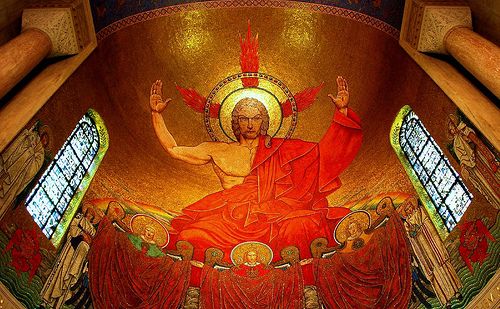
“Christ in Majesty” by Polish artist Jan Henryk de Rosen at the National Shrine of the Immaculate Conception
Then Jesus began to denounce the towns in which most of his miracles had been performed, because they did not repent. “Woe to you, Chorazin! Woe to you, Bethsaida! For if the miracles that were performed in you had been performed in Tyre and Sidon, they would have repented long ago in sackcloth and ashes. But I tell you, it will be more bearable for Tyre and Sidon on the day of judgment than for you. And you, Capernaum, will you be lifted to the heavens? No, you will go down to Hades. For if the miracles that were performed in you had been performed in Sodom, it would have remained to this day. But I tell you that it will be more bearable for Sodom on the day of judgment than for you.” (NIV)
Today’s New Testament lesson from the Gospel of Matthew, recounting the words of Jesus, are not filled with unicorns and butterflies, to say the least. We might be somewhat unfamiliar with these not so famous, maybe even infamous, words from our Lord. Before Jesus tells who is accepted in the kingdom of God (Matthew 11:28-30) he tells us who is not accepted. These scathing words are specifically leveled to the towns in which Christ had performed his ministry of healing and miracles.
We need to hear the hard words of Jesus. Up to this point in Matthew’s Gospel, he has laid out the birth narrative of incarnation in chapters 1-2; the preparation for Christ’s ministry in baptism and being sent to the desert in chapters 3-4; Christ’s teaching on what constitutes a genuine follower of God, the Sermon on the Mount, chapters 5-7; and, chapters 8-10, recording ten miracles which were meant to demonstrate that the kingdom of God has broken into history in the person of Jesus Christ. In chapter 11, Jesus begins leveling a rebuke to the crowd who had observed his ministry and did nothing in response to his works.
For Jesus, the height of hubris was to simply ignore his righteous works of gracious teaching and benevolent healing.
If you are not a fan of Monday Night Football, let me explain a pre-game segment each week during the season called, “C’mon, man!” Each commentator picks out a bonehead play from the previous week that would cause someone to shake their head in dismay and say “c’mon, man!” They are typically situations where the player’s head just was not in the game and they ended up, in some cases, costing their team points or even the game.
Reading Christ’s words sounds a lot like Jesus picking out the towns in which he performed his miracles, and saying to them: “C’mon, man!” “You saw me cleanse a man from leprosy, heal paralyzed people and a woman with a chronic disease, calm a great storm, exorcise demons from people, give sight to the blind and speech to the mute. You saw all of this, but it has not changed you one bit. You still live the same way you always have and have not come to me as the source of your deliverance… “C’mon, man!”
Notice that Jesus’ denunciation comes not because he was experiencing opposition or persecution; he was denouncing them for their bonehead lack of response and refusal to change their lives to conform to what they were seeing right in front of their faces. The crowd heard his teaching and saw his miracles, and it had no effect on them. So, Jesus gave them a great big “C’mon, man!” Judgment becomes the lot of someone who is unaffected and unresponsive to the vast sea of human need around them, viewing Jesus as just another voice, and living a life of mediocrity in the face of opportunity.
So, what would the segment “C’mon, man!” look like today? What would Jesus say to us? Keep in mind we are people with access to Christ’s teaching. We have the Sermon on the Mount to read, study, meditate upon, and live by – yet, too many [Christians] don’t take the time to examine it with the intent of seeing Jesus and allowing him to change their lives… “C’mon, man!”
The Holy Spirit has been provided, who is the power source of the Christian life. We possess all the resources of grace necessary to step into this world and make a difference, yet so many do nothing but occupy a place in the pew [or couch] because they are too afraid to sacrifice their time in meaningful ministry… “C’mon, man!”
There are neighbors, relatives, and co-workers who are lost and lonely, in need of the kind of grace Jesus gives, yet too many of us are oblivious to them and instead are constantly worried about things that, in the end, don’t really matter at all… “C’mon, man!”
We have opportunities to grow in the grace and knowledge of Jesus Christ through a vast array of available ministries, yet many do not take the chance to change and be spiritually stretched… “C’mon, man!”
Today the words of Jesus are right in front of our faces, and some of us will have the audacity to read them and remain unchanged, unchallenged, and unresponsive… “C’mon, man!”
If our highest values in life are sameness, stability, and security, we may very well, at the least, miss Jesus altogether, and, at worst, find ourselves under his condemnation. These verses are for those whom Jesus has become all too familiar, as if he is just another piece of furniture in the living room – the coffee table with a dusty Bible resting on it.
Perhaps this post may seem a bit out of place on a website which promotes itself as caring. I would like to think of it as obnoxiously caring. I trust you will accept today’s writing and the words of Jesus as caring enough to confront. There are times when Mid-West nice gets us nowhere and we must have hard conversations. Yes, conversations, and not verbal rockets launched from one group to another. Jesus did not denounce from a distance; he did it up close and personal. Furthermore, he was specific and not generic about why he was speaking in the way he did.
So, may you be able to pray this prayer of repentance today with heartfelt conviction:
Almighty God, Father of our Lord Jesus Christ, Sovereign Lord of the universe, Creator of humanity, we, your unfaithful children, are sorry for our sins and the lives that we have lived apart from your grace. We sincerely believe and confess in our hearts that only through the precious blood of our Lord Jesus Christ on the cross, can we obtain your forgiveness.
We repent that: in thought, word, and deed, we have committed serious offences against you and our neighbors. Through spiritual laziness and prideful lust for power, we have provoked hatred, division, despair, and hurt within our communities.
Through our greed, deceit, and indifference, we have inflicted serious damage, unnecessary conflict, and aggravated destruction to those different than us.
Through our selfishness, insensitivity, and bias (both conscious and unconscious) we have encouraged and emboldened those who inflict hurt, pain, and sorrow on those who are already oppressed and poor.
In the name of religion, doctrine, and even of Christ himself, we have wounded fellow believers and those who genuinely pursue a faith different than ours. In stubbornness, pride, and arrogance, we have caused division and strife within your church and among your people.
Mercifully send your Holy Spirit, the Spirit of order and comfort, to cleanse us from all unrighteousness; to restore in us true faith in Christ which brings truth, peace and harmony; and, to help us walk together with our brothers and sisters in the peace of our Lord Jesus Christ, to the glory of your name. Amen.