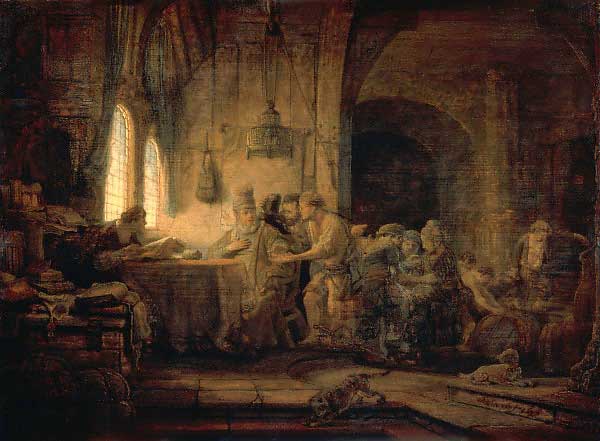
Guilt, Grace, and Debt-Collecting: The Parable of the Unmerciful Servant

Parable of the Unforgiving Servant by Nikola Saric
Parable of the Unforgiving Servant by Serbian German painter Nikola Saric

Then Peter came to Jesus and asked, “Lord, how many times shall I forgive my brother or sister who sins against me? Up to seven times?”

Jesus answered, “I tell you, not seven times, but seventy-seven times.

“Therefore, the kingdom of heaven is like a king who wanted to settle accounts with his servants. As he began the settlement, a man who owed him ten thousand bags of gold was brought to him. Since he was not able to pay, the master ordered that he and his wife and his children and all that he had be sold to repay the debt.

“At this the servant fell on his knees before him. ‘Be patient with me,’ he begged, ‘and I will pay back everything.’ The servant’s master took pity on him, canceled the debt, and let him go.

“But when that servant went out, he found one of his fellow servants who owed him a hundred silver coins. He grabbed him and began to choke him. ‘Pay back what you owe me!’ he demanded.

“His fellow servant fell to his knees and begged him, ‘Be patient with me, and I will pay it back.’

“But he refused. Instead, he went off and had the man thrown into prison until he could pay the debt. When the other servants saw what had happened, they were outraged and went and told their master everything that had happened.

“Then the master called the servant in. ‘You wicked servant,’ he said, ‘I canceled all that debt of yours because you begged me to. Shouldn’t you have had mercy on your fellow servant just as I had on you?’ In anger his master handed him over to the jailers to be tortured, until he should pay back all he owed.

“This is how my heavenly Father will treat each of you unless you forgive your brother or sister from your heart.” (Matthew 18:21-35, NIV)

It is unfortunate that one of the few guarantees in life is that someone will hurt you, and that hurt will tear a hole in your heart and last a long time.

When the hurt comes, we all must decide how to handle the issue of forgiveness. Oh, it’s easy to talk about forgiveness when you are doing fine – its another thing when you are hurt. One man, during a conversation with his Pastor, had this story:

“Nineteen years ago, this guy stole my wife away from me. They got married and moved to Florida while my life unraveled.  After I was arrested for assaulting a police officer, this guy smirked through the entire hearing.  When I was convicted, he flipped me the finger. I’ve hated him for nineteen years. He’s coming up here next week. I have a thirty-two-caliber pistol strapped around my ankle, and when I see him, I will kill him. I’ve thought about it. I’m sixty-three years old. I’ll get a life sentence, but I’ll also get free medical, a warm bed, and three meals a day.  I’m ready to end my life this way.”

We may wonder: “Why even bother to forgive?  Why even care about that person?” Emotional pain and angry hurt can be so deep that we see no need for forgiveness. “After all,” we might reason, “look at what that person has done to me!”

Jesus does not want bitterness to be the last word; he wants it to be forgiveness. The parable of the unmerciful servant is a piece of Christ’s teaching concerning “little people,” that is, people who are, by status, lowly and unimportant to others. The heavenly Father’s heart is one that cares deeply for them. They are lost, lonely, and languishing in pain. They need help. Jesus clearly explained what to do, giving a three-step process to privately go to others who have hurt us and win them back through reconciliation (Matthew 18:15).

The disciple Peter, ever the wondering, if not wandering disciple knows that if a person hurts someone, they might do it again. So, if a lost sheep is brought back to the fold, and then is offensive again-and-again, at what point do we say enough-is-enough and stop forgiving?

We as people can often feel a keen sense of “ought to.” We feel we ought to pay the debt we owe to others, and that others must pay us the debt they owe. This works on the emotional level just as much or more than any other arena of life. If we offend someone and they become angry, we believe we ought to make them feel better.  If someone angers us, we expect them to make it right and make us feel better.

The late Methodist scholar and author, Dr. David Seamands, said the two major causes of most emotional problems among Christians are: 1) The failure to understand, receive, and live out God’s unconditional grace and forgiveness; and, 2) The failure to give that grace and forgiveness to other people. I wholeheartedly agree with Dr. Seamands.

We have grace available to us in Jesus Christ through his death and resurrection. We cannot earn forgiveness.  Grace is free.  Equally true is the fact that no one owes us anything.  Grace is free for others, as well.

The Failure to Receive Forgiveness

In the end, was the unmerciful man in Christ’s parable forgiven?… No…. Why not?… Because he failed to understand forgiveness and receive it.  It was not the master’s fault; it was the man’s own fault. So, why did he react so mercilessly to a fellow person in debt? (The man’s debt was in the billions and could not be paid off, but the other man’s debt was just a few dollars). The unmerciful guy failed to grasp the master’s grace; he didn’t get it.  He thought he could work it off, and when the debt was canceled, he could not wrap his heart around such mercy. None of us can repay grace – it is free.

The inability to know and receive grace drives many Christians to the tragic treadmill of constant striving for perfection, achievement, and recognition from others. Many people refuse grace and instead try to get rid of their guilt through endless work – fueling the workaholic, motivating the addict, and animating much of the service done in the church and the world. The problem is not a lack of understanding sin or acknowledging personal sinful actions among Christians; the problem is what to do about it. Too many believers are trying to work-off their debt.

The Unforgiving Servant by American artist James B. Jangknegt

Here is a little test: Why do you do what you do? Why do you do good and right things?  Be honest.  Is it to truly worship and celebrate the Lord who has erased such a great debt of sin in our lives? Or, are we working to pay off a debt to God?  Am I striving to assuage my guilt? Are we searching to feel better through our service to others?

We can be so accustomed to operating according to guilt instead of grace that we don’t know what to with the absence of guilt – so we just go back to guilt as our default setting, like a dog returning to its vomit. Furthermore, the tragedy is compounded by insisting that others operate out of guilt, too.

Another little test: Are we content to simply ask people to help or to serve, or do we believe that there must be arm-twisting with some guilt to motivate them? Guilt and arm-twisting are inconsistent with the gospel of grace.  If we believe we must guilt our kids, family, co-workers, neighbors, or anyone else before they will do anything, then it is us who have a spiritual problem.

Ideally, we live and work out of a sense of gratitude toward God and not by guilt. Yet, there are always folks who continue to work out their unhappiness on other people by insisting they get on the guilt train along with them. We are unable to forgive ourselves, so we live with the guilt and try to pay off our debt, making ourselves and everyone else miserable in the process.

The Failure to Give Forgiveness

The unforgiven are the unforgiving. The reason the guy in the story responded so violently to a person who only owes him a few bucks is because he never really believed he was forgiven by the master in the first place. He could not envision a world in which his debt was paid. The unmerciful man was still operating as though life were a matter of collecting debts.

At the heart of many broken relationships and emotional conflicts is an insistence on debt-collecting. We want from others something they cannot give us. God in Christ erases the great debt we have, not some other person.  Yet, we go out and seek from others what only God provides. People are good at being people – but they make lousy gods. It is God who meets the deepest needs of our hearts – your spouse, children, friends, church, and community cannot do it. That is a job for Jesus. The watershed issue is grace – whether we can receive it, or not.  We cannot give something we have not first received.

It would be weird if a marriage vow went something like this: “I have a lot of terrific inner needs and inner emptiness and debts to pay, and I’m going to give you a marvelous opportunity to fill my Grand Canyon of insecurity and take care of me!”

Sometimes people have a nasty tendency to make idols of other people and look at them as though they owe us a debt of happiness, joy, and peace. For example, the weird marriage vow, if followed through with, inevitably will result in debt-collecting. A few years down the road the spouse says, “This is not what you were like when I married you… You owe me!” Our insecurity comes from the inability to receive grace. It is all about grace. Everything is about grace, not guilt and not debt-collecting because the debt has already been paid and the guilt has been erased.

Let us draw near to God with a sincere heart in full assurance of faith, having our hearts sprinkled (with the blood of Christ) to cleanse us from a guilty conscience. (Hebrews 10:22)

Conclusion

You and I are forgiven. There is no need to collect a debt which is already paid. The cross of Jesus Christ has taken care of the sin issue once for all, and not one person reading this is an exception to grace. Here is a final exam, to determine if there is someone we need to forgive:

  1. The Resentment Test: Is there someone you resent? Is there someone who has wronged you?  When you see them or think about them, do you have resentment in your heart?
  2. The Responsibility Test: You say to yourself, “I wouldn’t have this problem if it wasn’t for ________.”  This is passing the buck and believing that my happiness is dependent on another person. The truth is that no one is responsible for your emotional well-being and happiness except you.
  3. The Reminder and Reaction Test: Is there someone who “presses your buttons?” This is when we see or talk to a person who reminds us of someone else who hurt us, and we react to that person by transferring our anger and/or pain onto them.

The Pastor responded to the man mentioned earlier who had lost his wife to another man by saying, “Well, I guess it doesn’t matter if you go to jail because you’re already in jail.  The guy who stole your wife and smirked at your hearing isn’t in jail. You are. You are a prisoner of your own hate, and you are slowly killing yourself.”  A week after that conversation the man called the Pastor and said, “You know, I get your point.  I put the gun away.  I don’t want to spend the rest of my life in jail – and I want to get rid of this bitterness.”

The way to do deal with bitterness is through forgiveness. To forgive involves a long journey, just like every other aspect of following Jesus. Hopefully, by retelling the gospel of grace to one another week after week our hearts will be soft.  We will want to begin the journey to forgive others, stumbling forward with hearts torn by hurts, yet set free by grace.

May it be so to the glory of God.

How to Handle a Sinner, Part 1

Christ teaching the disciples
A medieval portrait of Christ teaching his disciples.

We live in a fundamentally broken world.  It is filled with broken people. And broken people tend to hurt each other. None of us are immune.  What do you do when you are hurt?

Jesus had something to say on the subject (Matthew 18:15-20). It would be good to hear him out on it because all of us get hurt at some time or another and we need to know how to handle the offending person. We need to get this right. If we do not, the cycle of pain, hurt, damage, and brokenness gets perpetuated.

Just before Jesus offered some teaching on how to handle a sinner, he a parable about a lost sheep – communicating that he is not willing that any sheep should be lost to the sheepfold (Matthew 18:10-14). The teaching on dealing with a person who wounds us is simply the logical extension of the parable. That is, Jesus told us in clear terms what must be done to bring the straying sheep back into the fold.

When attempting to retrieve a wandering person, the tools of guilt, gossip, nagging, and punishment are not consistent with the gospel of grace. Standing at a distance and lobbing verbal grenades toward an erring person is not mentioned by Jesus as an acceptable means of proceeding with those who have caused us suffering.

Jesus offered a three-step process of gracious intervention and a compassionate confrontation with the aim to rescue and restore. Radical independence has no place in the Church.  Strays must be lovingly pursued, carefully rescued, and gently restored.  Anytime someone wanders from the Lord, they hurt another or a group of people, and that wayfaring sheep’s life gets worse. We are not to add to their misery by going to the extremes of either being obnoxiously passive-aggressive to get them to change, or simply ignoring the person altogether, doing nothing, and just hanging back and licking our own wounds.

What others call an “intervention” Christians call “church discipline.”  It seems to be rarely practiced today, which is one reason why we have growing legions of de-churched people. In this post, I focus on step one of this process, because nine out of ten times this first step takes care of the situation. A subsequent post shall deal with the second and third steps.

Cartoon Matthew 18

The First Step – One on One (Matthew 18:15). 

Here are several observations about this step:

  • Approach the person privately. We are never to confront an individual in a group, having not first talked to the offending person one on one. We do not start with step two because these are progressive steps.  Furthermore, we are to avoid what I call the “Middle School adolescent way” of confrontation by having someone else do it for you and report back.
  • Focus on the sin event. We are to show the person their fault, and not make a list of all the things the person has done wrong in the last ten years; or, talk about how terrible they are. We must stick to the offense.  What is more, confrontation is not to be done simply with something we do not like. A person’s individual idiosyncrasies or personality is just that, and we need to have the maturity to allow people to be who they are.
  • Be vigilant to avoid overreactions. Steer clear of accusing others of wrongdoing based in some disputable matter. Let us be sure to face the person about a clear sin which has been committed. On the contrary, if we tend to dodge conflict at all costs, we must watch for our own denial and rationalization by saying “it wasn’t so bad.” The health of the church, not to mention our own personal well-being, may very well require that we do the risky thing and talk directly to the one who has affronted us.
  • Pay attention to the approach. The manner in which we oppose another person is critical. The bull-in-the-china-shop approach is nothing more than responding to a sin with another sin. For example, rather than saying, “You need to stop and get right with God or you’ll go to hell,” you could say instead, “When you did that I felt sad and upset because I need to be in a place that values love. Will you please stop this unloving action?” In other words, knee-jerk reactions rarely go over well. But well-placed words said in love and wisdom go a long way toward restoration.
  • Confront our brother or sister. No one is to be the self-appointed ethics Nazi for people outside the church.
  • Confrontation is commanded. If we are to take the words of Jesus seriously, this is not a matter which is open for debate on whether we do it or not. We are to take the attitude that I am my brother’s keeper.  I am not to let a person run rampant with their sin over myself or others. When we are abused and offended, we do not wait for the person to come to us. Even as the victim, we are to initiate the reconciliation and restoration. “Go” to the person, Jesus said. Face-to-face is the way, without reliance on email or voice mail.  It is to be a conversation, not a drive-by comment or accusation.
  • Confrontation is not negotiation. This is a matter of restoring a person who has sinned.  Having differing positions on certain issues in a church or Christian community is a matter for negotiating, not confronting.
  • Do it more than once. This first can (and should) be repeated many times over. The goal is restoration, not get-this-step-out-of-the-way-so-I-can-see-you-get-in-trouble attitude.

Jesus did not invent something new with his teaching but upheld and restated Old Testament ethics about our attitudes in reproving others:

Do not secretly hate your neighbor. If you have something against him, get it out into the open; otherwise you are an accomplice in his guilt. Do not seek revenge or carry a grudge against any of your people. Love your neighbor as yourself. I am God.” (Leviticus 19:17-18, MSG).

In most situations, this first step takes care of the issue and mends the problem with a genuinely restored relationship. If, however, this does not occur, yet other steps ought to be taken. These will be handled in the next post.

May the grace of the Lord Jesus, the love of God our heavenly Father, and the encouragement of the Holy Spirit be with you, today and always. Amen.

Revelation 3:7-13 – Love and Obedience

Chuck Colson quote

“To the angel of the church in Philadelphia write:

These are the words of him who is holy and true, who holds the key of David. What he opens no one can shut, and what he shuts no one can open. I know your deeds. See, I have placed before you an open door that no one can shut. I know that you have little strength, yet you have kept my word and have not denied my name. I will make those who are of the synagogue of Satan, who claim to be Jews though they are not, but are liars—I will make them come and fall down at your feet and acknowledge that I have loved you. Since you have kept my command to endure patiently, I will also keep you from the hour of trial that is going to come on the whole world to test the inhabitants of the earth.

I am coming soon. Hold on to what you have, so that no one will take your crown. The one who is victorious I will make a pillar in the temple of my God. Never again will they leave it. I will write on them the name of my God and the name of the city of my God, the new Jerusalem, which is coming down out of heaven from my God; and I will also write on them my new name. Whoever has ears, let them hear what the Spirit says to the churches. (NIV)

Over thirty-five years ago, the late Chuck Colson, a former White House Counsel and founder of Prison Fellowship, wrote a timely and influential book entitled Loving God.  In it, he presented a simple yet biblical premise concerning the life of every believer in Jesus: The way to love God is to obey God.  Everything turns on our listening to God and doing what he says to do.

Jesus himself communicated to the church at Philadelphia (not Pennsylvania, but ancient Asia Minor, now present-day Turkey) affirming their faithful obedience of the message.  Because of their steadfast observance of the gospel, the Philadelphian believers would be protected and loved by Jesus.

The church at Philadelphia did much more than offer a confession of loving God – they affirmed that confession through loving obedience to Jesus. In some Christian circles, we call this “living into our baptism.”  That is, it is one thing to experience the sign of baptism as being set apart by the Holy Spirit for a relationship with God through the person and finished work of Jesus.  It is quite another thing to “live into” this reality by knowing God’s Word and dutifully obeying it.

Human beings are complex creatures in their psychology, sociology, and history. However, there is at least one simple straightforward biblical truth we all can live into: To love God is to obey God. Therefore, it is quite necessary for us to spend extended times reading and knowing our Bibles well so that we can adhere to what it says.

“It is not what we do that matters, but what a sovereign God chooses to do through us. God doesn’t want our success; He wants us. He doesn’t demand our achievements; He demands our obedience. The Kingdom of God is a kingdom of paradox, where through the ugly defeat of a cross, a holy God is utterly glorified. Victory comes through defeat; healing through brokenness; finding self through losing self.” –Chuck Colson

Gracious God, thank you for the message of good news that in Jesus Christ I have forgiveness of sins.  Help to hold onto this gospel through all the vicissitudes of life so that obedience springs from my heart in all things by the power of the Holy Spirit.  Amen.

Revelation 3:1-6 – Remember

Sardis
Ruins from the ancient city of Sardis, the capital of the kingdom of Lydia, in present day western Turkey.

“To the angel of the church in Sardis write:

These are the words of him who holds the seven spirits of God and the seven stars. I know your deeds; you have a reputation of being alive, but you are dead. Wake up! Strengthen what remains and is about to die, for I have found your deeds unfinished in the sight of my God. Remember, therefore, what you have received and heard; hold it fast, and repent. But if you do not wake up, I will come like a thief, and you will not know at what time I will come to you.

Yet you have a few people in Sardis who have not soiled their clothes. They will walk with me, dressed in white, for they are worthy. The one who is victorious will, like them, be dressed in white. I will never blot out the name of that person from the book of life but will acknowledge that name before my Father and his angels. Whoever has ears, let them hear what the Spirit says to the churches. (NIV)

When Christians think of biblical epistles (letters) to churches, the Apostle Paul might immediately come to mind. Yet, contained within the first three chapters of Revelation are seven succinct letters to seven different churches.  What makes these short bursts of exhortation so powerful is that they come from Jesus himself.  Yes, that Jesus – the Lord Jesus Christ, the head of the church.  So, it seems to me that Christ’s observations about the church carry more weight than anybody else’s thoughts.

And the thoughts of Christ were about how far the church was from completing the work of God. So, Jesus gave a pointed admonition, almost like a parent trying to awaken a teenager in the morning. “Wake up!” said Jesus because he found the church’s obedience incomplete and lacking strength. If this were the Apostle Paul talking, he would likely have framed it this way: “You have sinned and fallen short of the glory of God.”

Our Lord went directly to the heart of the church’s life… that is, death.  The stark reality is that these statements from Jesus remain penetrating and relevant for today’s church. So, what is to be done about the situation of spiritual death and dryness in the church?  Jesus did not leave the church hanging but in a few compact words let them know exactly what they are to do to remedy their spiritual malady: Remember. Obey. Repent.

The Seven Churches of Asia - York Minster
The Seven Churches of Asia, stained glass window in York Minster, England.

Sometimes, if not many times, we may tend to forget the things we need to remember and remember the things we are to forget. We are to follow God in his pattern of remembering and forgetting. God has said:

I wipe away your sins because of who I am. And so, I will forget the wrongs you have done. (Isaiah 43:25, CEV)

I will forgive their wrongdoing and never again remember their sins. (Jeremiah 31:34, CEB)

I will forget their sins and never again remember the evil they have done. (Hebrews 10:17, ERV)

When it comes to those who have wronged us, we are to emulate God’s grace, mercy, and kindness through forgiveness. To “forget” does not mean performing a personal lobotomy but simply not to hold an offense against another by continually bringing it to mind. On the other hand, God remembers his promises to his people. Likewise, we are to constantly bear in mind what God has put before us to remember:

For I received from the Lord what I also handed on to you, that the Lord Jesus on the night when he was betrayed took a loaf of bread, and when he had given thanks, he broke it and said, “This is my body that is for you. Do this in remembrance of me.” In the same way he took the cup also, after supper, saying, “This cup is the new covenant in my blood. Do this, as often as you drink it, in remembrance of me.” For as often as you eat this bread and drink the cup, you proclaim the Lord’s death until he comes. (1 Corinthians 11:23-26, NRSV)

We are to have an abiding remembrance of the Lord Jesus, the very person who spoke to the church hundreds of years ago. It is in those times when we become distressed that we must center our memory on Christ:

We must focus on Jesus, the source and goal of our faith. He saw the joy ahead of him, so he endured death on the cross and ignored the disgrace it brought him. (Hebrews 12:2, GW)

Remembering Jesus Christ sets us on the path to fulfilling the work of God and completing that which has been given us to do. This is precisely why I choose to follow the Church Year and remember time by having it centered around the life and ministry of Jesus.

Always think about Jesus Christ. He was brought back to life and is a descendant of David. This is the Good News that I tell others. (2 Timothy 2:8, GW)

I have been a constant example of how you can help those in need by working hard. You should remember the words of the Lord Jesus: “It is more blessed to give than to receive.” (Acts 20:35, NLT)

Let us remember together in prayer:

Awesome Lord Jesus, your words penetrate to the core my being.  Strengthen me by the continuing presence of yourself through the Holy Spirit so that my every thought, word, and deed is done in your holy Name. Kindle in my heart a vision of your love and shine the light of your victory over sin, death, and hell over this dark world. Continually take me to yourself; keep me in your wounds and mindful of your presence so that I shall fulfill all the will of God for my life through your divine enabling. Amen.