James 1:1-8 – How to Face Painful Trials

James, a servant of God and of the Lord Jesus Christ,

To the twelve tribes scattered among the nations:

Greetings.

Consider it pure joy, my brothers and sisters, whenever you face trials of many kinds,because you know that the testing of your faith produces perseverance. Let perseverance finish its work so that you may be mature and complete, not lacking anything. If any of you lacks wisdom, you should ask God, who gives generously to all without finding fault, and it will be given to you. But when you ask, you must believe and not doubt, because the one who doubts is like a wave of the sea, blown and tossed by the wind. That person should not expect to receive anything from the Lord. Such a person is double-minded and unstable in all they do. (New International Version)

Where do you turn when unwanted circumstances leave you wondering how to cope?

The Apostle James, no stranger to adversity and stressful situations, likened our position in hard situations as faith being on the witness stand, put to the test. Faith is being examined and cross-examined. And it must stand the test. 

Our attitude toward such trials, in all their varied forms, determines whether we will become upset, hard-hearted, and calloused, or, come through having our faith confirmed with newfound peace and joy.

James wrote to Jewish Christians who felt like fish out of water. They were part of the dispersion of believers from Jerusalem in the persecution against Stephen and the church (Acts 7). The dispersed believers were refugees – poor, in a foreign country, just trying to carve out an existence and live for Jesus the best they could under a lot of adversity. 

James exhorted the Christians to view their situation as an opportunity for their faith in Christ to develop and grow.

Rejoice in the midst of trials.

“Consider the adverse circumstances as joy? Are you smoking something?” we might wonder. Telling someone to consider their tough situation as pure joy is a really hard pill to swallow. 

I’m not sure what the believers were thinking when they first heard this from James, but they might have thought the guy was crazy. These were people experiencing a lot of hard things. To tell hungry families with scant resources, wondering where their next meal is coming from, that they ought to consider their situation as pure joy may seem strange, even downright calloused. 

James, however, was looking to fortify the believers’ faith. Whenever we get a cut or a laceration, the first thing needed is to apply peroxide to the wound so there will be no infection from the injury. It might seem insensitive because peroxide applied to an open wound, frankly, hurts like hell. Yet it must happen. It’s a necessary part of healing. 

The Apostle cared enough about the people to tell them what they needed to hear, up front. Without a positive, godly, and wise perspective on their difficult situation, they would not make it. Infection would set in and destroy the fledgling church.

Suffering, in the form of spiritual peroxide, is necessary. To merely say what itching ears want to hear helps no one. Suffering is a significant part of the Christian life. God never promised that life would be or should be all cupcakes and unicorns. 

In fact, Christ promised just the opposite – that everyone who wants to live for Jesus in this present broken world will have a hard time of it. It’s not a matter if you will face the testing of your faith, but of whenever you face trials.

The good news is that adversity can become our teacher. We can learn patient endurance, which is necessary to the development of our faith. Spiritual growth only matures through the testing of faith through adversity.

Faith is not a neutral or static thing. Faith is active and dynamic. It’s always either developing or degenerating.  Without spiritual peroxide, faith degenerates and becomes rancid. Eventually, gangrene sets in, and an amputation will happen. To avoid this, we need to learn how to experience joy in the middle of hard things.

It seems to me a great tragedy, for many Christians and faith communities, is that we can live a trivial, blasé, and superficial existence as believers in Jesus, and get away with it. Because we have the ability to be independent, self-sufficient, and hold our own, we don’t really need anybody, including God. We say we need God, then turn around and live our lives as if no divine being existed, at all. 

Too many folks are doing everything but exercising spiritual disciplines that would put them in touch with Jesus. To try and keep from getting hurt, church becomes optional; reading and reflecting on Scripture becomes our daily crumb instead of our daily bread; prayer becomes a hail Mary, only for times of desperation, and not as a means of connecting with Jesus; giving and serving becomes ancillary, done only if there is any discretionary time and money left over. 

The Christian life was not meant to be easy! It requires blood, sweat, and tears. Faith is challenging, and often hard. Yet, even within the pain, faith is incredibly invigorating and joyful.

Do not avoid trials.

We need perseverance. If we always bail out when things get hard, we will be immature. Only through endurance does the maturation process occur. Let your hard situation do its necessary work. Immature people avoid hard things and instead put their energy into keeping up appearances.

Conversely, the mature person spends energy standing the test and trial of faith. They understand that there must be pressure for spiritual maturity to occur.

Oyster pearls are valuable and expensive. They result from years of irritation. Natural pearls form when an irritant – usually a parasite – works its way into an oyster. As a defense mechanism, a fluid is used to coat the irritant. Layer upon layer of this coating is deposited until a beautiful pearl is formed.

God is looking to do something beautiful in our lives. So, if we constantly run away and do not deal with our hard situations, there will never be a pearl. It takes about ten years for a pearl to form in an oyster in the ocean.  Observing an oyster every day, you never notice any movement is happening. You only see the irritation.

In the Christian life, the consistent daily choices over a long period of time (perseverance) form the eventual beauty.

No one needs to go looking for trials. And, I might add, you don’t need to take upon yourself being someone else’s trial. There’s no such thing in the New Testament of anyone having the spiritual gift of irritation. The trials come from God, not people. Therefore, we are to let our faith develop and grow through the testing.

Yet, what if I am in the middle of something so hard that I just cannot see God’s perspective on it? What if there is seemingly nothing redemptive from this adversity?

Pray for wisdom in the trials.

Ask God for wisdom to see the situation from a different angle – of its positive good, and for what God is accomplishing in and through it. The truth is, God is developing within people a strong vibrant faith, if we allow it.

Growing up on the farm, we had apple trees on the property. My Dad had a shop in the garage with a big vice on the workbench. Vices and little boys were made for each other. My brother and I used to find all kinds of things to put in that vice and squeeze them until they broke, split, or exploded. 

Putting fresh apples in the vice was one of our favorites. The best were the strong juicy ones because we could get them to splatter everywhere. We hated the wormy apples. They were rotten inside and collapsed with only a little pressure.

God will, at times, put us in the divine vice – not because the Lord is mean or delights in our pain. God places us in situations of extreme pressure for fresh prayers to explode out of us to heaven.

If we are walking with God, we will be strong and juicy. However, if we have neglected God, then just a smidge of pressure will create a collapsing wormy mess. With no meaningful prayers, there is no meaningful wisdom for our circumstances.

Believe God is good no matter the trial.

God is not mean, but generous. The Lord gives with no questions asked, and without giving us a hard time about our situation. Yet, there is a condition….

We must believe – that God is good, answers prayer, and gives wisdom. Doubting God’s generosity and benevolence is a demonstration of a weak wormy faith. We may doubt a lot of things. Yet we are always to be secure in the knowledge that God has our best interests at heart. This is why there can be joy and perseverance, even when everything around us is going to hell.

Grant, O God, that we may never lose our way through stubborn self-will, and never abandon the struggle but endure to the end. Help us never to choose the cheap way of avoiding or circumventing our trials but embrace the Via Dolorosa. May we never forget that sweat is the price of all things, and that without the cross, there cannot be the crown. Amen.


John 15:16-25 – On Facing Hatred

 The Face of the Savior by Noehani Harsono

You did not choose me, but I chose you and appointed you so that you might go and bear fruit—fruit that will last—and so that whatever you ask in my name the Father will give you. This is my command: Love each other.

“If the world hates you, keep in mind that it hated me first. If you belonged to the world, it would love you as its own. As it is, you do not belong to the world, but I have chosen you out of the world. That is why the world hates you. Remember what I told you: ‘A servant is not greater than his master.’ If they persecuted me, they will persecute you also. If they obeyed my teaching, they will obey yours also. They will treat you this way because of my name, for they do not know the one who sent me. If I had not come and spoken to them, they would not be guilty of sin; but now they have no excuse for their sin. Whoever hates me hates my Father as well. If I had not done among them the works no one else did, they would not be guilty of sin. As it is, they have seen, and yet they have hated both me and my Father. But this is to fulfill what is written in their Law: ‘They hated me without reason.’” (New International Version)

In his earthly ministry, Jesus suffered on this earth. He was hated, persecuted, and killed. Although Christians readily recognize this, somehow we still seem surprised when, following Jesus, there are people who downright dislike us. 

Yet, Jesus clearly and unequivocally stated that we ought to expect persecution. Emotional, psychological, verbal, and even physical abuse can and does occur against God’s people who seek to follow the words and ways of Jesus. 

There was a time in the first few centuries of the church that becoming a martyr for one’s faith was welcomed. It was considered a privilege to imitate Christ in his suffering and death.  Even many modern day Christian martyrs around the globe have estimated martyrdom as an opportunity to experience solidarity with their Savior.

God has generously granted you the privilege, not only of believing in Christ but also of suffering for Christ’s sake. (Philippians 1:29, CEB)

This kind of thinking may sound quite strange to Westerners who tend toward the notion that, if we do everything with excellence and effectiveness, then there will be no reason for persecution and suffering. 

However, the Christian reality is that Jesus promised his devout followers that there will indeed be those who seethe with hatred toward us. We are not above our Master. If he suffered, we will, as well.

So, the question is not whether we can or ought to avoid suffering. Rather, our consideration needs to be how we will respond to the inevitable persecution of verbal violence, physical violence, or both – not to mention the various forms of discrimination, abuse, and oppression we might face.

“They gave our Master a crown of thorns. Why do we hope for a crown of roses?”

Martin Luther

First off, there is no honor for any Christian suffering because of one’s own stupidity or obnoxiousness. If we face persecution because we have initially made others suffer through our bullhorn presentations of the gospel, or metaphorically clubbing groups of people with oversized King James Version Bibles, then whatever consequences come are of our own making and have nothing to do with being united with Christ.

And second, paying no attention to the real human needs of people locked in poverty or dismissing the body as secondary to the soul is a gross misrepresentation of Christ – not to mention the sheer ignoring of multiple books in Holy Scripture which point to caring about such things.

If, however, we endure abuse because of being humble, merciful, gentle, pure in heart, and an unflinching peacemaker amid conflict, then we can enjoy the smile of heaven. If we communicate good news with grace and compassion, seeking love-laced words of truth, along with genuine acts of mercy – and then are repaid with unmerciful oppression from prideful persons – then we understand the type of hate Jesus faced.

We gladly suffer, because we know that suffering helps us to endure. And endurance builds character, which gives us a hope. (Romans 5:3-4, CEV)

The genuine article withstands the test of adversity. It doesn’t fall apart in the vigorous agitation of the first washing. People who oppose Christians with persecuting words and actions need to discover an authentic believer who is ready and willing to absorb the hatred, repackage it as love, and along with the gospel of grace, gift it back to the persecutors as an offering to God.

Experiencing the hatred of others is not the worst thing which could ever happen. Knowing Jesus better is of utmost value – even if, at times, comes through the worst of circumstances.

God, who shows you his kindness and who has called you through Christ Jesus to his eternal glory, will restore you, strengthen you, make you strong, and support you as you suffer for a little while. (1 Peter 5:10, GW)

Almighty God, thank you for sending your Son, the Lord Jesus, on my behalf.  Just as he suffered for me, I willingly suffer for him, since his infinite grace has delivered me from sin, death, and hell.  I only ask to be found faithful at the end of the age when he returns to judge the living and the dead.  Amen.

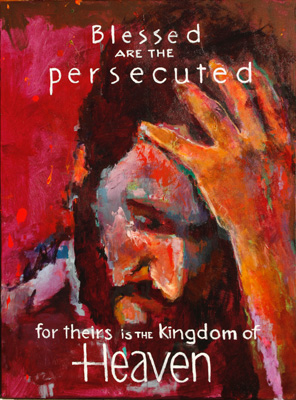
Matthew 5:10-12 – Blessed are Those Who are Persecuted Because of Righteousness

Painting by Hyatt Moore

“You’re blessed when your commitment to God provokes persecution. The persecution drives you even deeper into God’s kingdom.

“Not only that—count yourselves blessed every time people put you down or throw you out or speak lies about you to discredit me. What it means is that the truth is too close for comfort, and they are uncomfortable. You can be glad when that happens—give a cheer, even! —for though they don’t like it, I do! And all heaven applauds. And know that you are in good company. My prophets and witnesses have always gotten into this kind of trouble. (The Message)

No matter our vocation or avocation, what we do, or don’t do, what we say, or don’t say, we will not avoid insult and persecution. Just ask Jesus.

The issue is not if we will suffer but why we suffer. The Apostle Peter devoted his first epistle to helping Christians deal with their suffering. He made his point clear about suffering: 

If you suffer, it should not be as a murderer or thief or any other kind of criminal, or even as a meddler. However, if you suffer as a Christian, do not be ashamed, but praise God that you bear that name. (1 Peter 4:15-16, NIV)

That’s Peter’s way of saying, “Blessed are those who are persecuted because of righteousness.”  We will endure abuse, in some form, from others. So, let’s make sure it’s for being characterized by Christ’s Beatitudes, and not for being obnoxious.

Christ’s followers take up their cross and share with him in the world’s hatred directed toward us. This kind of living is blessed and receives the approval of God.

What is persecution?

Persecution is not only physical abuse. It is also verbal abuse, ridicule, slander, discrimination, and generally making one’s life harder just because of a commitment to Christ. Persecution is not necessarily a sign of doing something wrong. It could be that something right is being done. 

Thomas à Kempis (1380-1471) wrote what has become one of the best-selling Christian books of all-time, The Imitation of Christ. Thomas had the right perspective on the subject of persecution:

“Sometimes it is to our advantage to endure misfortunes and adversities, for they make us enter into our inner selves and acknowledge that we are in a place of exile and that we ought not to rely on anything in this world.  And sometimes it is good for us to suffer contradictions and know that there are those who think ill and badly of us, even though we do our best and act with every good intention.  Such occasions are aids in keeping us humble and shield us from pride. When men ridicule and belittle us, we should turn to God, who sees our innermost thoughts, and seek His judgment.

Therefore, we should so firmly establish ourselves in God that we have no need to seek much human encouragement. It is when a person of good will is distressed, or tempted, or afflicted with evil thoughts, that they best understand the overwhelming need for God, without whom we can do nothing. While enduring these afflictions they take themself to prayer with sighs and groans; they grow tired of this life and wish to be undone in order to live with Christ. It is in such times of trial they realize that perfect security and full peace are not to be found in this world.”

Insult, negativity, and verbal abuse can trip us up and discourage us. It doesn’t feel good to be disliked. Trouble and conflict is something most of us would like to avoid, as much as possible.

We might be able to steel ourselves for a large persecution against denying Christ and would be willing to die a martyr’s death to hold on to our faith. Yet, conversely, we may:

  • Crumble in a heap if we think someone is mad or displeased with us.
  • Worry that our lives will get complicated and difficult if we uphold the righteousness and justice of God.
  • Be afraid of others who might think bad of us if we showed mercy by standing with the unpopular person or if we actively and overtly engage in peacemaking.
George Reeves in The Adventures of Superman (1952-1958)

It is the “small” abuses which can cause us so much grief. We are determined to stand tall when the bullets of blatant, oppressive, and systemic persecution comes. Then, when the gun is thrown at us, we may flinch, duck, and fret over one person being upset.

Back when I was a kid, I watched old reruns of the original Superman television series. In more than one episode, Superman stood tall and faced the person peppering him with bullets. Then, when the bullets ran out, the villain threw his gun at Superman, who then promptly flinched and ducked the gun!

It is not our job to ensure that everyone is happy – it is our business to do God’s will and to embody Christ’s Beatitudes. Our calling as believers in Jesus is not to worry about what people (including family) are going to think if we live a humble, righteous life of mourning over the world’s sins, exhibiting a meek and gentle spirit, standing for grace when others want blood, refusing to defile our hearts with impure thoughts and actions, and standing up to do something about the injustice around us.

How and why do respond to persecution?

            The proper response to persecution is joy! There are two reasons why we can face persecution and come away glad instead cringing and discouraged:

  1. Because being characterized by the Beatitudes of Jesus brings heavenly reward. Show me a person who puts all their eggs in the earthly basket, and I’ll show you a person who is never satisfied and constantly unhappy. Show me a person who lives to please God and pursues the blessing of Christ, accepting any flak from others, and I’ll show you a person who is inwardly rejoicing that they are a Christian, loved by God, and counting it a privilege to suffer for the Name of Jesus. (Acts 5:27-29, 40-42)
  2. Because we are in good company. God’s people throughout history have endured the same kinds of sufferings and received a Christian purple heart award. We are not just to face persecution with a stoic, grind-it-out mentality, but with rejoicing! (Hebrews 11:36-40)

Who does the persecuting?

            The ones who persecuted the prophets were religious folks. I wish I could say the worst persecution I ever received was from evil people who live ungodly lives. However, the most insult, hardship, and slander I have ever endured has come from the lips and the efforts of people who claim the name of Christ. The reason abuse happens is because there are people not characterized by the Beatitudes of Jesus, so they become the persecutors, instead of the persecuted. 

            All the sufferings and hardships of Jesus, all the persecution he faced did not come from the world, but from his own people, including a person from his inner circle of disciples. Although the church, throughout its history, has done immense good, it also has had a chronic problem of shooting its wounded.

Far too many people have adopted a legalistic form of righteousness that focuses on outward conformity and myriad rules and regulations. Abundant grace is needed. Not judgment.

Conclusion

If we are persecuted, let’s make sure it is because we are advocating for others who need mercy and are facing injustice; addressing the brokenness of this world through specifically Christian lenses; and desiring the applause of heaven.

See if you can hear the Beatitudes in what the Apostle Peter, had to say about persecution:

For it is commendable if someone bears up under the pain of unjust suffering because they are conscious of God. But how is it to your credit if you receive a beating for doing wrong and endure it? But if you suffer for doing good and you endure it, this is commendable before God. To this you were called, because Christ suffered for you, leaving you an example, that you should follow in his steps. (1 Peter 2:19-21, NIV)

Be like-minded and sympathetic. Love one another. Be compassionate and humble. Do not repay evil with evil or insult with insult. On the contrary, repay evil with blessing, because to this you were called so that you may inherit a blessing. For,

“Whoever would love life
    and see good days
must keep their tongue from evil
    and their lips from deceitful speech.
They must turn from evil and do good;
    they must seek peace and pursue it.

 For the eyes of the Lord are on the righteous
    and his ears are attentive to their prayer,
but the face of the Lord is against those who do evil.” (1 Peter 3:8-12, NIV)

Dear friends, do not be surprised at the fiery ordeal that has come on you to test you, as though something strange were happening to you. But rejoice inasmuch as you participate in the sufferings of Christ, so that you may be overjoyed when his glory is revealed. If you are insulted because of the name of Christ, you are blessed, for the Spirit of glory and of God rests on you. (1 Peter 4:12-14, NIV)

May you know the blessing of solidarity with Christ through the afflictions of this present life.

Ephesians 6:10-20 – Spiritual Combat

A final word: Be strong in the Lord and in his mighty power. Put on all of God’s armor so that you will be able to stand firm against all strategies of the devil. For we are not fighting against flesh-and-blood enemies, but against evil rulers and authorities of the unseen world, against mighty powers in this dark world, and against evil spirits in the heavenly places.

Therefore, put on every piece of God’s armor so you will be able to resist the enemy in the time of evil. Then after the battle you will still be standing firm. Stand your ground, putting on the belt of truth and the body armor of God’s righteousness. For shoes, put on the peace that comes from the Good News so that you will be fully prepared. In addition to all of these, hold up the shield of faith to stop the fiery arrows of the devil. Put on salvation as your helmet, and take the sword of the Spirit, which is the word of God.

Pray in the Spirit at all times and on every occasion. Stay alert and be persistent in your prayers for all believers everywhere.

And pray for me, too. Ask God to give me the right words so I can boldly explain God’s mysterious plan that the Good News is for Jews and Gentiles alike. I am in chains now, still preaching this message as God’s ambassador. So, pray that I will keep on speaking boldly for him, as I should. (New Living Translation)

When I think of the Apostle Paul, I think of a guy who had a bucket load of boldness, who did not sidestep tough situations, but who fearlessly stepped into the world with the good news of God’s grace in Christ. 

Maybe Paul was that way because of prayer and the prayers of God’s people. Maybe what stands in the way of people knowing Jesus and believers maturing in faith is a profound lack of intense, consistent, and sustained prayer. Maybe too many of God’s people have been duped by the enemy of our souls to retreat in a bubble of fear, unable to effectively engage God’s big world with confidence.

Paul told the Ephesian Church what kind of practical and vital obligations were needed to put aside fear and flourish as Christians….

Be strong in the Lord because we are in an invisible war.

There is an unseen world all around us. We serve an invisible God, and we have an invisible enemy. Satan and all his wicked spirits exist. They are organized for war with methodical schemes and strategies designed to blunt our spiritual development and the expansion of God’s benevolent kingdom. The enemy seeks to render us ineffective in our walk with Christ, unproductive for God, and all knotted up inside in a broken mess so that we are weak, not strong.

The names of our invisible enemy in Scripture tells us the kind of diabolical and methodical work he is doing to snare us: 

  • Satan (the adversary who opposes us)
  • Lucifer (the shining one who comes looking like the light but only delivers darkness)
  • Beelzebub (lord of the flies, who is a false god promising protection and help apart from God)
  • Belial (the evil one, who seeks to have us engage in sin instead of righteousness)
  • Tempter (offering alternative plans to the will of God)
  • Accuser (the false judge, using criticism to bully people into shameful submission)
  • Prince of this world (the architect behind all systemic evil)
  • Devil (the diabolical one who engages in spiritual guerilla warfare against God’s people)

The unseen wicked spirits of this dark world pull out whatever technique they can to turn us from knowing who we are in Christ and how we are to really live. They seek to distract us from our mission, to keep us busy fighting among ourselves, so that we will put our ultimate confidence in anything or anyone but Christ.

Put on the armor of God and prepare for spiritual battle.

Satan is a defeated foe. The nails that crucified the Lord Jesus, and the power of God that raised him from the dead, ensured Satan’s doom.

Although we stand in the victory of the Lord Jesus, the world, the flesh, and the devil still dog us at every turn. So, we must discover and dislodge every threat to our spiritual growth and the mission of the church to step into the world with the gospel of grace. 

Jesus said he will build his church and the gates of hell will not prevail against us. The picture is not one of the church being defensive and only responding to threats, but of a church pushing forward and storming the gates. 

The promise we have is that we can engage the enemy to the point of hell itself – and will not be burned by demonic enemy fire. Therefore, we are not to hunker down in self-protective foxholes; we are to engage the enemy with our spiritual armor on.

  • Put on the belt of truth. We need to combat the demonic lies. The truth will set us free. Lies will place us in bondage. Shame will keep us in the dark shadows. We are to embrace Jesus who is the way, the truth, and the life. The truth is that we belong to God. We are not to fight demonic fire with fire. Instead, we fight Satan with the waters of baptism, remembering who we are in Christ. Just as the wicked witch of the west was killed with water, so we are to fling our baptismal water in the face of the enemy and watch him melt away.
  • Put on the breastplate of righteousness. It protects our heart as we push forward and engage the enemy. Satan is aiming for our hearts, so it is vital that they are well-guarded. Our hearts belong to God. Before we chose God, God chose us before the creation of the world to be holy and blameless (Ephesians 1:4).         
  • Put on the gospel shoes of peace. Satan and his minions are trying to cause chaos, unrest, and division.  We are to be ready for his methods through embracing God’s peace and harmony with others. We are to use our shoes, both for digging in and standing firm, and stepping forward into situations as peace-makers. Those who ready themselves with the gospel of peace live differently, openly, with grace and integrity.

Take up your spiritual weapons and do battle.

Whereas the spiritual armor is protective, giving us a solid defensive posture, our spiritual weapons help us to go on the offense and walk into the struggle.

  • Take up the shield of faith. Extinguish all the nasty flaming arrows of the evil one. The Roman phalanx was a rectangular military formation where the army took their shields and connected them together for protection and the ability to push forward, engaging the enemy. This tactic helped the Romans to conquer most of the known world of the time. It was based not on individual ability but on the strength of the entire army working together. The devil seeks to divide and conquer. Yet, there is strength in numbers, that is, as long as we work together!  Linking our shields together through unity, fellowship, and encouragement is absolutely necessary if we are going to win the battle.
  • Take up the helmet of salvation. Active transformation through the renewing of our minds enables us to avoid retreating and going back to old sinful patterns of thinking. We need mindfulness, not mindlessness, aware of who we are in Christ and actively occupying our thoughts with God’s Word.
  • Take up sword of the Spirit. This is the word of God. The written word is to be the spoken word. Our primary offensive weapon in the battle against the evil one is God’s Word. It needs to be read, memorized, meditated upon, learned, talked about, and, used by speaking it aloud.

Be alert and pray.

Prayer is to undergird everything we do. The early church was effective and successful through prayer. They all joined together constantly in prayer (Acts 1:14). They devoted themselves to the apostles’ teaching and to the fellowship, to the breaking of bread and to prayer (Acts 2:42). After they prayed, the place where they were meeting was shaken. And they were filled with the Holy Spirit and spoke the word of God boldly (Acts 4:31).  The early apostles re-arranged their busy schedules so that they could give their attention to prayer and the ministry of the word (Acts 6:4). Believers in Jesus pray.

Whenever prayer takes a back seat to everything else, believers end up fighting the wrong battles with the result of a lot of friendly fire where people get spiritually and emotionally hurt. Our battle is not with flesh and blood human beings; it is with Satan and his wicked spirits. Fight them, not each other!

Conclusion

The spiritual forces we are up against are wicked, evil, cunning and do not observe any kind of Geneva Convention rules when it comes to war. They are out for blood. Therefore, we must be ready and put on our spiritual armor, take up our spiritual weapons, and move forward with the word of God and prayer. This present darkness requires that we be at our best. Our very lives depend on it.