Revelation 2:8-11 – Spiritual Endurance

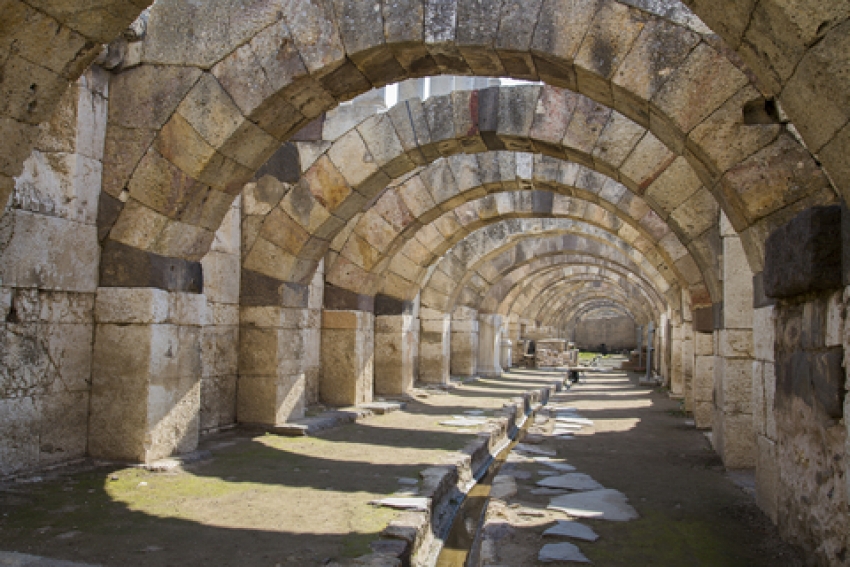
The remains of ancient Smyrna in Izmir, Turkey

This is what you must write to the angel of the church in Smyrna:

I am the first and the last. I died, but now I am alive! Listen to what I say.

I know how much you suffer and how poor you are, but you are rich. I also know the cruel things being said about you by people who claim to be Jews. But they are not really Jews. They are a group that belongs to Satan.

Don’t worry about what you will suffer. The devil will throw some of you into jail, and you will be tested and made to suffer for ten days. But if you are faithful until you die, I will reward you with a glorious life.

If you have ears, listen to what the Spirit says to the churches. Whoever wins the victory will not be hurt by the second death. (Contemporary English Version)

Jesus not only speaks in the four Gospels of the New Testament; Christ also speaks in the final biblical book of Revelation to seven different churches.

In today’s New Testament lesson, Jesus addresses the church at Smyrna – a large and beautiful port city in the ancient world, on the eastern coast of the Aegean Sea (present day Turkey). 

Jesus was letting the believers in Smyrna know they were about to experience severe persecution. However, they need not be fearful and can remain faithful because their Lord knows all about suffering. 

The church’s perseverance under such trouble would result in the crown of life, given to them by Jesus himself. Words coming directly from their Lord and Savior must surely have been an encouragement to the believers as they underwent extreme difficulty.

The congregation at Smyrna was facing imprisonment and, for some, even death for their faith. The heart of the message by Jesus is to remain faithful. 

The seven churches of Revelation which Jesus addressed

There will always be those who are faint of heart with weak faith, giving up when the going gets tough. Yet, persecution and hardship have a way of purging the soul, as well as the church, of its dross. Suffering is inevitable; how we handle adversity when it comes is completely under our own control.

Few of us will likely never face a hardship that could result in martyrdom. Knowing there are brothers and sisters in the faith throughout the world who do face daily hardship for devotion and beliefs puts our own troubles in a different light.

The daily irritations and trials that God puts in our way to refine us and shape our faith certainly seem small compared to imprisonment and martyrdom. Yet, no matter who we are and where we are located on this earth – whether facing uncommon hardship or banal difficulty – the afflictions of both body and soul come to us as opportunities to lean into faith and love Jesus to the end.

Jesus is not looking for perfect people – just faithful followers willing to endure suffering with the truth that our Lord stands with us. 

Whatever our current circumstances may be, Jesus offers us his perspective on it. He knows precisely what is going on and understands the spiritual resources you and I possess for each adverse situation we encounter.

In fact, few of us really discern the largess of internal resources within us because of Christ’s redemptive work and the Spirit’s abiding presence – not to mention the very personhood God graciously gave us in the womb before we were even born.

Even though it seems, at times, we lack the strength, wisdom, and courage for what is ahead – Jesus has supreme confidence in us to maintain faith and endure through our afflictions.

Life is not a sprint; life is a marathon. And to finish the race we need to be in good spiritual health. The perseverance of the saints will happen as we run – step by step, stride by stride – with boldness, despite fear of the unknown future around the bend.

Spiritual endurance requires becoming comfortable with risk, vulnerability, accountability, and the steadfast love which is both received and given.

Perhaps, most of all, it requires keeping our heads up and running toward the promise of reward at the finish. The crown of life is an image of both congratulation and celebration of a race well-run and the enjoyment of unending fellowship with our Lord for whom we have endured so much.

After all is said and done, and the end of the age has occurred, we will be able to look back in hindsight and see that it was really Jesus who all along was fortifying us to keep standing and keep going. Christ is so vested in us that he continually ensures our ultimate victory through a constant presence of help and encouragement. The heritage of both the Reformation and Holy Scripture testify to this truth:

“All our progress and perseverance are from God.”

John Calvin (1509-1564)

“I’m sure about this: the one who started a good work in you will stay with you to complete the job by the day of Christ Jesus.” (Philippians 1:6, CEB)

May the grace of Jesus sustain you; the love of God surround you; and the encouragement of the Spirit surprise you, today and every day. Amen.

Grant, O God, That we may never lose the way through our self-will, and so end up in the far countries of the soul; that we may never abandon the struggle, but that we may endure to the end, and so be saved; that we may never drop out of the race, but that we may ever press forward to the goal of our high calling; that we may never choose the cheap and passing things, and let go the precious things that last forever; that we may never take the easy way, and so leave the right way; that we may never forget that sweat is the price of all things, and that without the cross, there cannot be the crown.

So keep us and strengthen us by your grace that no disobedience and no weakness and no failure may stop us from entering into the blessedness which awaits those who are faithful in all the changes and chances of life down even to the gates of death; through Jesus Christ our Lord. Amen

William Barclay, Prayers for the Christian Year

Romans 4:1-12 – Saved by Grace Through Faith

“Abraham Journeying to the Land of Canaan” by Giovanni Benedetto Castiglione (1609-1664); The Fitzwilliam Museum; http://www.artuk.org/artworks/abraham-journeying-to-the-land-of-canaan-5550

So how do we fit what we know of Abraham, our first father in the faith, into this new way of looking at things? If Abraham, by what he did for God, got God to approve him, he could certainly have taken credit for it. But the story we’re given is a God-story, not an Abraham-story. What we read in Scripture is, “Abraham entered into what God was doing for him, and that was the turning point. He trusted God to set him right instead of trying to be right on his own.”

If you’re a hard worker and do a good job, you deserve your pay; we don’t call your wages a gift. But if you see that the job is too big for you, that it’s something only God can do, and you trust him to do it—you could never do it for yourself no matter how hard and long you worked—well, that trusting-him-to-do-it is what gets you set right with God, by God. Sheer gift.

David confirms this way of looking at it, saying that the one who trusts God to do the putting-everything-right without insisting on having a say in it is one fortunate man:

Fortunate those whose crimes are whisked away,
    whose sins are wiped clean from the slate.
Fortunate the person against
    whom the Lord does not keep score.

Do you think for a minute that this blessing is only pronounced over those of us who keep our religious ways and are circumcised? Or do you think it possible that the blessing could be given to those who never even heard of our ways, who were never brought up in the disciplines of God? We all agree, don’t we, that it was by embracing what God did for him that Abraham was declared fit before God?

Now think: Was that declaration made before or after he was marked by the covenant rite of circumcision? That’s right, before he was marked. That means that he underwent circumcision as evidence and confirmation of what God had done long before to bring him into this acceptable standing with himself, an act of God he had embraced with his whole life.

And it means further that Abraham is father of all people who embrace what God does for them while they are still on the “outs” with God, as yet unidentified as God’s, in an “uncircumcised” condition. It is precisely these people in this condition who are called “set right by God and with God”! Abraham is also, of course, father of those who have undergone the religious rite of circumcision not just because of the ritual but because they were willing to live in the risky faith-embrace of God’s action for them, the way Abraham lived long before he was marked by circumcision. (The Message)

“Abraham Journeys Forth into the Unknown” by Yoram Raanan

We all need help. Yes, we like our independence and would rather give help than receive it. Yet, there are some things which we can do nothing about without some divine intervention. This is where faith comes into the picture.

“Faith” is a big word in Holy Scripture and in the Christian life. Faith encompasses the totality of how we come to Jesus Christ, and then how we live for him. In talking about faith, it is important to distinguish between the faith which saves us from guilt, shame, sin, death, and hell, and the faith which sanctifies and makes us holy. 

“Salvation” and “sanctification” are also big words in Scripture and in life. If we are fuzzy on our understanding and application of these two spiritual realities of salvation and sanctification, we are going to end up sleepwalking through life as spiritual zombies.

Christianity’s answer to the vital help we need for deliverance is the death and resurrection of Jesus Christ. This deliverance, or salvation, only occurs by faith. A person is “saved” by knowing about Jesus and his finished work on the cross and trusting that this work has taken care of my need for salvation, once for all. 

Christ sacrificed himself for us. He took our place. The punishment that belonged to us, he bore. When we acknowledge our lost and wayward lives, and believe Jesus is the way, the truth, and the life, then we are delivered and experience salvation from the awful emptiness of life. 

A person cannot earn this deliverance; they cannot buy it or work for it. No, salvation is a gift that comes only by faith in the person and work of Jesus. That is the essence of saving faith in Christianity. It is a one-time event of trust.

“Sanctification,” on the other hand, is what begins when becoming a believer in Jesus. The word simply means “to become holy,” or, “to be set apart for God.” Sanctification is not a singular event, but a process Christians engage in for the rest of their earthly lives. 

Whereas saving faith is a gift given to us without effort, sanctification requires a great deal of effort. We work and struggle and expend lots of energy to live the Christian life. 

“Grace [God’s gift to us in granting forgiveness] is not opposed to effort, it is opposed to earning. Earning is an attitude. Effort is an action. Grace, you know, does not just have to do with forgiveness of sins alone.” 

Dallas Willard

When a student gets a college scholarship at a university, the giving of the scholarship is a one-time event. It is granted to the student. They now possesses it and are able to attend school without trying to earn the money to pay for it. 

But that scholarship has been given for a reason – so that the student can now focus entirely on their studies and/or sport. The work has just begun. More blood, sweat, and tears will take place living into that scholarship than the student could ever imagine. It won’t be easy, and it will consume the student’s waking hours for the next four years.

Our life is a matter of faith, not of sight.

2 Corinthians 5:7, GNT

The biblical character of Abraham is Exhibit A of faith. He was delivered from an empty way of life in a pagan country and given a gift of grace to move to the country God would show him. Abraham did nothing to earn this favor. Before Abraham chose God, God chose him. 

Abraham sojourned as a pilgrim throughout the land God gave him, which mirrored his spiritual sojourning and learning to be a follower of God. Abraham likely faced the greatest test of faith a person could ever experience; he was asked to sacrifice his son. He responded to God with complete obedience.

Abraham’s faith was made complete by what he did; and it occurred well before his circumcision of being physically marked as belonging to God. 

We are made right not on our own but through the sheer grace of God in Christ by faith. Then, we continue to exercise faith by living into the righteousness given to us by the mercy of God.

God’s mercy is so abundant, and his love for us is so great, that while we were spiritually dead in our disobedience he brought us to life with Christ. It is by God’s grace that you have been saved. In our union with Christ Jesus he raised us up with him to rule with him in the heavenly world. He did this to demonstrate for all time to come the extraordinary greatness of his grace in the love he showed us in Christ Jesus. For it is by God’s grace that you have been saved through faith. It is not the result of your own efforts, but God’s gift, so that no one can boast about it.

Ephesians 2:4-9, GNT

God grants his faith scholarships to whomever he wants: rich and poor, men and women, from every race, ethnicity, and background imaginable across the entire earth. 

From the standpoint of faith, Abraham did nothing to receive God’s gracious scholarship of faith. He did not work for it. It was granted to him solely because of God’s grace. Then, his faith was confirmed and proven as genuine by his life of faith and obedience.

Therefore, our own deliverance and ability to live rightly is firmly rooted in faith – and not by holding a prominent position, having a particular pedigree, or expending personal power. All of humanity needs the saving help of Jesus Christ. Salvation is in Christ alone, by grace alone, through faith alone.

Lord Jesus Christ, I am sorry for the things I have done wrong in my life. Please forgive me. I now turn from everything that I know is wrong. Thank you that you died on the cross for me, so that I could be forgiven and set free. Thank you that you offer me forgiveness and the gift of your Spirit. I receive that gift with a grateful heart. Amen.

Blessed Is He Who Comes In the Name of the Lord

Welcome, friends, on this second Sunday in Lent. During his earthly ministry, Jesus had no intention of halting his travels because of all the unrest in the world. Christ assured his listeners that the work he is doing will be done today, and the next, and the day after that—building ultimately to his greatest work of securing redemption through his crucifixion and resurrection. Click the videos below and let us say together, “Blessed is he who comes in the name of the Lord!”…

Pastor Tim Ehrhardt, Luke 13:31-35

Lord, grant us simplicity of faith
and a generosity of service
that gives without counting cost.
A life overflowing with Grace
poured out from the One
who gave everything,
that we might show
the power of love
to a broken world,
and share the truth
from a living Word.
Lord, grant us simplicity of faith,
and a yearning to share it. Amen.

Luke 13:31-35 – Blessed Is He Who Comes In the Name of the Lord

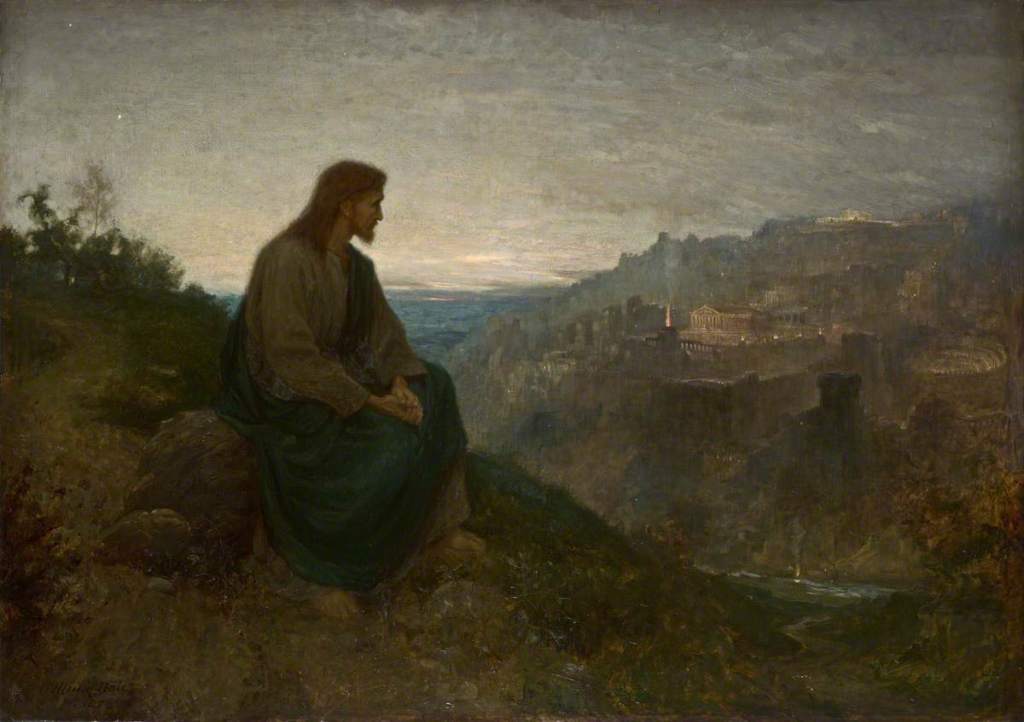
“If Thou Had’st Known” by William Brassey (1846-1917) Royal Scottish Academy of Art & Architecture; http://www.artuk.org/artworks/if-thou-hadst-known-186809

At that time some Pharisees came to Jesus and said to him, “Leave this place and go somewhere else. Herod wants to kill you.”

He replied, “Go tell that fox, ‘I will keep on driving out demons and healing people today and tomorrow, and on the third day I will reach my goal.’ In any case, I must press on today and tomorrow and the next day—for surely no prophet can die outside Jerusalem!

“Jerusalem, Jerusalem, you who kill the prophets and stone those sent to you, how often I have longed to gather your children together, as a hen gathers her chicks under her wings, and you were not willing. Look, your house is left to you desolate. I tell you – you will not see me again until you say, ‘Blessed is he who comes in the name of the Lord.’” (New International Version)

King Herod of Judea, who was in the pocket of the Roman Empire, was issuing threats against Jesus. And those threats had some teeth behind them. Herod had recently beheaded Christ’s friend and cousin, John the Baptist (Luke 9:7-9). Yet, Jesus seemed unconcerned by the warnings. He made it clear that he was going to keep doing what he was doing, unfazed by Herod’s bluster.

Jesus had no intention of halting his travels, even because of a credible threat by the governing powers. Christ emphasized his words by assuring his listeners that the work he is doing will be done today, and the next, and the day after that—building ultimately to his greatest work of securing redemption through his crucifixion and resurrection. 

I hope to be always journeying towards Jerusalem with a heart full of compassion that will not waver in the midst of violent killing and injustice. That isn’t easy, yet I know that my humble pilgrimage with Jesus will be worth it all, in the end.

A pilgrimage is an apt description for the Christian season of Lent. Believers journey with Jesus, making the slow trek with him through his earthly ministry and to Jerusalem, up the Mount of Olives. There Christ is crucified – and we with him:

I have been crucified with Christ and I no longer live, but Christ lives in me. The life I now live in the body, I live by faith in the Son of God, who loved me and gave himself for me. (Galatians 2:20, NIV)

So far, we have made a stop in Bethlehem, following the star to the place where the newborn king was laid in a simple stinky feeding trough. The juxtaposition of that reality could not be more pronounced. The rightful Lord of all, far more powerful than old King Herod or the Roman Emperor, comes to earth not to be served, but to serve, and give his life as a ransom for many. (Mark 10:42-45)

In our walk with Jesus, we observe him deliberately posturing himself as a lowly servant throughout his earthly ministry. Whereas Herod acted the predictable part of a power hungry worldly ruler, squelching all rivals to the throne, Jesus shared his authority with others, along with a promise of continual presence. (Matthew 2:16-18, 28:16-20)

There is nothing romantic about this journey, this walk with Christ. It is often a hard road, and many count the cost of discipleship and choose to walk away.

Yet, Jesus is down for the struggle. He knows that injustice and systemic evil must be carefully rooted out. He understands that hearts and minds aren’t changed overnight. It will take time. So, we walk slowly with our Lord because Christ is in it for the long haul. We see Jesus is patiently, and sometimes imperceptibly, using divine power and authority to preserve the good and weed out the bad.

Dealing with human sin and the awful fallenness of this world will take a while. It will be an extended process because there are so many hard hearts. Jesus was ready, willing, and able to gather people together, as a mother hen gathers her chicks – yet there was an unwillingness to it.

And Christ, the heavenly ruler, isn’t in the business of twisting arms and manipulating others, like Herod, the earthly ruler.

Instead, Jesus invites. He doesn’t squeeze people like an orange to get their juice. Christ carefully prepares a meal. He sets the table himself. He gives of himself. Like some wildly potent superfood, a bit of wine and morsel of bread is more than enough to fill the hungry soul and the thirsty spirit.

With Jesus, there is always room at the Table.

There is room for you and for me. There is room for every kind of person – from every nation, race, gender, ethnicity, class – no matter the distinctions and no matter the past. It is the love of God in Christ, not the judgment, which brings people peace and salvation. It comes through a baby who grew and learn and suffered, just like us, and not through some wily old fox of a ruler.

Eventually, the phrase will be uttered, “Blessed is he who comes in the name of the Lord.” Jesus pulled this phrase from the Old Testament psalms. He did this, knowing quite well the context surrounding the verse:

The stone the builders rejected
    has become the cornerstone;
the Lord has done this,
    and it is marvelous in our eyes.
The Lord has done it this very day;
    let us rejoice today and be glad.

Lord, save us!
    Lord, grant us success!

Blessed is he who comes in the name of the Lord. (Psalm 118:22-26, NIV)

The chicks may scatter and refuse to be gathered. The builders might reject the crucial cornerstone and still try to build. Yet, it will not always be this way. As we journey with Jesus, eventually along the Via Dolorosa, the way of suffering, the road to Calvary, with an eye to where this will all culminate at an empty tomb and a great celebration of new life.

We will not be looking down at our feet forever in sorrow but will lift our faces toward the clouds. Just as we see Jesus ascending, we shall see Christ coming again. The time is near….

Look! He comes with the clouds of heaven.
    And everyone will see him—
    even those who pierced him.
And all the nations of the world
    will mourn for him.
Yes! Amen! (Revelation 1:7, NLT)

The triumphal entry of Jesus on Palm Sunday is followed by a triumphal entry into my heart, and the hearts of many. And there is coming yet another triumphal entry, back to this earth. All things will made new….

“There will be no more death, no more grief or crying or pain. The old things have disappeared.” Then the one who sits on the throne said, “And now I make all things new!” (Revelation 21:4-5, GNT)

May it be so, to the glory of God.

Almighty God, you know that we have no power in ourselves to help ourselves: Keep us both outwardly in our bodies and inwardly in our souls so that we may be defended from all adversities that may happen to the body, and from all evil thoughts that may assault and hurt the soul, through Jesus Christ our Lord, who lives and reigns with you and the Holy Spirit, one God, for ever and ever. Amen.