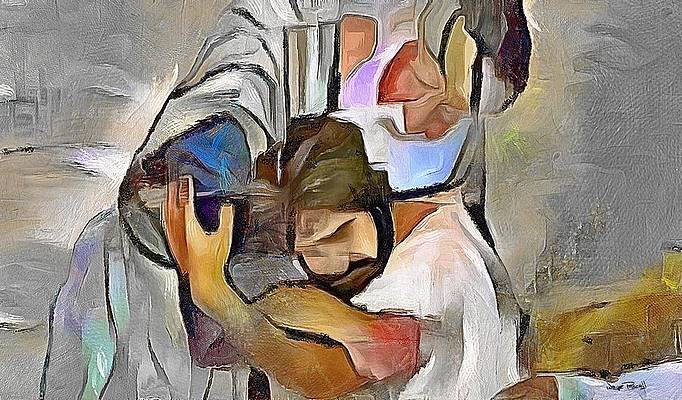
Luke 15:1-3, 11b-32 – Parable of the Lost Son

Prodigal Son by Wayne Pascall

Now all the tax collectors and sinners were coming to hear him. But the Pharisees and the experts in the law were complaining, “This man welcomes sinners and eats with them.”

So, Jesustold them this parable….

“A man had two sons. The younger of them said to his father, ‘Father, give me the share of the estate that will belong to me.’ So, he divided his assets between them. After a few days, the younger son gathered together all he had and left on a journey to a distant country, and there he squandered his wealth with a wild lifestyle. Then after he had spent everything, a severe famine took place in that country, and he began to be in need. So, he went and worked for one of the citizens of that country, who sent him to his fields to feed pigs. He was longing to eat the carob pods the pigs were eating, but no one gave him anything. But when he came to his senses he said, ‘How many of my father’s hired workers have food enough to spare, but here I am dying from hunger! I will get up and go to my father and say to him, “Father, I have sinned against heaven and against you.I am no longer worthy to be called your son; treat me like one of your hired workers.”’ So, he got up and went to his father. But while he was still a long way from home his father saw him, and his heart went out to him; he ran and hugged his son and kissed him. Then his son said to him, ‘Father, I have sinned against heaven and against you; I am no longer worthy to be called your son. ’But the father said to his slaves, ‘Hurry! Bring the best robe and put it on him! Put a ring on his finger and sandals on his feet! Bring the fattened calf and kill it! Let us eat and celebrate,because this son of mine was dead, and is alive again—he was lost and is found!’ So, they began to celebrate.

“Now his older son was in the field. As he came and approached the house, he heard music and dancing. So, he called one of the slaves and asked what was happening. The slave replied, ‘Your brother has returned, and your father has killed the fattened calf because he got his son back safe and sound.’ But the older son became angry and refused to go in. His father came out and appealed to him, but he answered his father, ‘Look! These many years I have worked like a slave for you, and I never disobeyed your commands. Yet you never gave me even a goat so that I could celebrate with my friends! But when this son of yours came back, who has devoured your assets with prostitutes, you killed the fattened calf for him!’ Then the father said to him, ‘Son, you are always with me, and everything that belongs to me is yours. It was appropriate to celebrate and be glad, for your brother was dead, and is alive; he was lost and is found.’” (New English Translation)

Lost people matter to God.

In the story of the lost prodigal son, that son hit rock bottom and rehearsed a speech he would give to his father when he came back. He never got to finish it, because the father interrupted his confession of sin and got the celebration going! 

We celebrate the things that are important to us. Lost people matter to God so much that it is a cause for a great celebration. God’s grace steps in and takes over, erasing past guilt and bringing radical forgiveness and reconciliation.

The Prodigal Son by Kaye Redman

Today there are literally tens of thousands of children who have walked away from their upbringing in faith, and even many times, literally walked away from their family of origin. Their parents know the feeling of standing at the window, wondering how their prodigal daughter really is, and longing for their prodigal son to come home. 

So, what do you do when you are the parent of a prodigal? How do you deal with the pain and the estrangement of a wayward son or daughter? 

  • Don’t expect a prodigal to be Christ-like. If the son or daughter is not a Christian, they aren’t going to act like one. Exhortations to stop drinking cheap wine, cease partying, not get a tattoo, or even go to church is not only useless, but it can also be harmful. Behind all the speech or behavior of a prodigal that might make a parent cringe, there is a world of hurt. The heart is sick or broken. Prodigals need to be treated as fellow humans and equals.

He was pierced because of our rebellions
    and crushed because of our crimes.
    He bore the punishment that made us whole;
    by his wounds we are healed.
Like sheep we had all wandered away,
    each going its own way,
    but the Lord let fall on him all our crimes. (Isaiah 53:5-6, CEB)

  • Welcome a prodigal home. It is possible (and necessary!) to remain connected in relationship, even if there are differing values or practices between parents and prodigals. In other words, don’t make it hard for a son or daughter to come home. Yes, there are instances when parents need to clarify and maintain boundaries, but those instances are actually rare.

In most cases, if a daughter smells like weed or an ashtray, just spray her jacket with Febreze and change the sheets when she leaves – but let her come home. If you find out she’s pregnant, then be with her and take her to her twenty-week ultrasound.

If a son is broke because he spent all the money you lent him on women and liquor, then forgive his debt as you’ve been forgiven; don’t give him any more money—and let him come home. If in doubt, always go with grace.

For God has revealed his grace for the salvation of all people. That grace instructs us to give up ungodly living and worldly passions, and to live self-controlled, upright, and godly lives in this world. (Titus 2:11-12, GNT)

  • Point a prodigal to Christ. A prodigal’s real problem is not sex or addiction, laziness or crime, cussing or ill manners. It is very possible that they simply don’t see Jesus for who he really is. So much Christian dogma or traditional practice might be encrusted on them that they simply cannot experience Jesus Christ’s love. God’s grace is what draws us all to faith – not hellfire preaching or parental badgering.

At one time you were separated from God. You were his enemies in your minds, and the evil things you did were against God. But now God has made you his friends again. He did this through Christ’s death in the body so that he might bring you into God’s presence as people who are holy, with no wrong, and with nothing of which God can judge you guilty. (Colossians 1:21-22, NCV)

We are to all share the same heart of the father in the parable of the lost son – a heart of hospitable love, abundant grace, and open celebration.

Loving heavenly Father, thank you that Jesus showed us your heart of love for the children of this world. Help us to do everything we can so that they will know how much you love them and want them to know your blessing. Thank you for your compassion for those who have strayed from you. Thank you that you are always ready to welcome us back with mercy and acceptance. Amen.

Luke 15:1-10 – The Parable of the Lost Sheep and the Lost Coin

Parable of the Lost Sheep by Sieger Köder (1925-2015)

Now all the tax collectors and sinners were coming to hear him. But the Pharisees and the experts in the law were complaining, “This man welcomes sinners and eats with them.”

So, Jesus told them this parable: “Which one of you, if he has a hundred sheep and loses one of them, would not leave the ninety-nine in the open pasture and go look for the one that is lost until he finds it? Then when he has found it, he places it on his shoulders, rejoicing. Returning home, he calls together his friends and neighbors, telling them, ‘Rejoice with me, because I have found my sheep that was lost.’ I tell you, in the same way there will be more joy in heaven over one sinner who repents than over ninety-nine righteous people who have no need to repent.

“Or what woman, if she has ten silver coins and loses one of them, does not light a lamp, sweep the house, and search thoroughly until she finds it? Then when she has found it, she calls together her friends and neighbors, saying, ‘Rejoice with me, for I have found the coin that I had lost.’ In the same way, I tell you, there is joy in the presence of God’s angels over one sinner who repents.” (New English Translation)

Lost people matter to God… a lot. They matter so much to the Lord that one lost soul who is found is the grounds for a big celestial party. 

Please note this simple observation of today’s Gospel lesson: If there is rejoicing in the presence of angels over one sinner who repents, then it is God who is doing the rejoicing. The Lord is absolutely giddy with joy over a lost person being found.

Jesus told two short stories, each teaching the same thing, so that we will be absolutely sure to get it: A loving God has unbounded joy over lost people being found. These parables of Jesus give us a glimpse of God’s own heart. The Lord would do anything to find a lost person, to restore and reconcile that person to right relationships. 

God would go dumpster diving and wade through stinky nasty garbage to find just one lost valuable person.

Restoring lost people is such a high priority to God that the Father sent the Son to this earth. Jesus paid the ultimate price of a cruel death on a cross to reconcile a broken lost relationship between people and God.

I have not always been a devoted follower of Christ. I still remember what it felt like to be separated from God and estranged from the church – it was lonely and awful, like being in a deep black hole with no way of getting out and no one around to help. 

But God mercifully sent people into my life to share good news with me and help me out of my prodigal way of life. I once was lost. But now I am found. When I turned from my path of destruction and embraced Jesus Christ, there was a big party in heaven.

Lost Sheep Parable by Thomas Bertram Poole

God gathering wayward and lost persons is a gracious activity, seemingly free from criticism. But there was. And because there were complaints leveled at Jesus for purposely going after the lost, it therefore needs to be asked: 

Where do we locate ourselves in these parables? 

The two stories were downright offensive to many of Christ’s original hearers. Those upset with Jesus were so inwardly focused that they believed ministry ought to revolve around them and their needs.

And, what’s more, the religious leaders were offended because they thought all the fuss about sinners would only highlight their sin. In other words, there ought to be no party and no rejoicing for people who have lived an ethically and morally dubious life.

Preaching grace is always offensive to people who work for their salvation. It is scandalous to such persons to hear that Jesus did not come to call the righteous, but sinners to repentance. 

If we hear Christ’s parables and the concern for lost sinners who don’t know Jesus and say, “Well, all this talk about outreach is well and good, but what about us?  What about me? After all, I never went down a path of immorality or hurt anyone. I’m a good person. Where’s my party?” Then, we must locate ourselves as the lost persons in need of being found by God’s grace.

Consider for a moment the worst sinner you can think of – a person for whom you would label as being akin to the devil…. Now picture that person being found by God and becoming a follower of Christ….

Would you attend the party to celebrate that person’s repentance, reconciliation, and recovery? 

If any of us feels justified in our hate, then we are the lost one in need of turning from our sin.

In leaving the ninety-nine sheep in the flock and going after the one sheep, God gave preferential attention to the lost…. Can you live with that? 

These parables of Jesus have significant meaning for church programs, budgets, and committees. By most estimations, only one-in-five lost people in America even knows one Christian. Statistics like that are what keep me up at night; it deeply saddens me. It drives me to prayer.

God’s unconditional mercy and amazing grace is what makes all the difference. 

If we lose the sense of awe and appreciation for what God has done for us in Christ, then there will be no outreach. Finding lost people is not dependent on completing a class on evangelism or getting training in how to answer every question.

Outreach is fueled by passion and desire. Healthy Christians reproduce themselves. I assume you didn’t take a class on how to procreate – you just had the desire and the willingness; and then, you celebrated nine-months later, the birth of new life.

New life always needs to be celebrated because that’s what God does. Yet, the party cannot commence until the lost are found….

O God – blessed Father, Son, and Spirit – sanctify all believers everywhere with your abiding presence. Enlighten the minds of your people more and more with the light of the Gospel. Bring lost people to the knowledge of our Savior Jesus Christ; and those who are walking in the way of life, keep steadfast to the end. Guard those who are strong and prosperous from forgetting you and straying from the flock. Increase in us your grace and love so that we may participate with you in finding the lost. Amen.

Luke 13:18-21 – What is the Kingdom of God Like?

A mustard seed

Jesus asked, “What is God’s kingdom like? What can I compare it to? It’s like a mustard seed that someone planted in a garden. It grew and became a tree, and the birds nested in its branches.”

He asked again, “What can I compare God’s kingdom to? It’s like yeast that a woman mixed into a large amount of flour until the yeast worked its way through all the dough.” (God’s Word Translation)

I grew up on a rural Mid-West America farm. Working with seeds was our livelihood. And making bread was second nature to us. Even though my parents worried incessantly about the weather and the price of groceries, there were two things they were never anxious about: seeds and yeast.

My dad knew that when we planted seeds in the Spring, there would be a harvest in the Fall. That’s because he knew the seed already has within itself everything it needs to germinate, take root, grow, and produce a harvest. His role was simply to tend to it all by keeping the fields free of weeds, worms, and critters.

My mom knew that when she put the bread in the oven, it would bake and rise into a glorious loaf. That’s because she had full confidence that the little bit of yeast she worked into the dough would do it’s job. Her role was simply to ensure the proper amount of ingredients and oversee the time and temperature of baking.

Since I was the youngest, I typically got the grunt work of our massive garden. I was always excited when we planted things because I knew what was coming in a few months: some delicious veggies on my dinner plate which were fresh from the garden I tended. I never wondered whether there would be food on the table, or not.

Seeds are, of course, small. If you think about it, they appear quite unimpressive. Yet, we know better. We understand that when planted, watered, and cultivated, those seeds turn into amazing plants. 

But it takes time. Even as dumb little kid, I clearly knew that my planting seeds would not result in seeing anything above ground the next day. I understood it would take a few weeks before new growth would break the ground.

The kingdom of God, Jesus told us, is like a mustard seed – a very small seed which can grow into a tree big enough for birds to nest. Unlike the mighty Roman Empire, or contemporary powerful national governments, the kingdom of God had humble beginnings. It grows, over a long period of time, to become a force greater than anything the world can produce.

While our world races forcefully on with the speed of the hare, Jesus is carefully and patiently building his church at the pace of a tortoise. In the end, the kingdom of God will rule over all creation, while the kingdoms of this world shall no longer exist. 

Even though many of us now live in a society where the quick, the fast, and the strong dominate everything, still the best things in life come as a result of tedious perseverance over an extended period of time. 

We are in such a hurry to accomplish our goals, make as much money as we can, and keep constant vigilance over our work. And for what purpose?

“What an unspeakable comfort it is to know that in the midst of humanity’s mischief, in the midst of their scheming and bad speculations, their shaping and misshaping, their activism and their failures, there is still another stream of events flowing silently on, that God is letting divine seeds grow and achieving divine ends.” 

Helmut Theilicke

Quiet, humble submission to King Jesus is at the heart of the kingdom. God is working-out good purposes in and through us with all the care of the farmer expecting to eventually reap a harvest. To get ourselves into the groove of God’s unforced rhythms of grace, we must learn to slow down, so as to not miss Christ’s benevolent kingdom. So, how do we do that?

  • Listen to yourself. Our bodies send us signals all the time, telling us what we need. There is a time for work and a time for rest, a time to hurry and a time to slow down. If we continually stressed, it could be that we are trying to force God’s kingdom into our lives or the lives of others.

But if you listen to me,
you will be safe and secure
    without fear of disaster. (Proverbs 1:33, CEV)

  • Practice gratitude. Count your blessings. Keep things in proper perspective. Sit with joy and happiness. Whenever something really good happens, slow down and savor the moment – don’t just quickly move on to the next thing. The kingdom of heaven revolves on thankfulness, not criticism.

O give thanks to the Lord, for he is good,
    for his steadfast love endures forever.
O give thanks to the God of gods,
    for his steadfast love endures forever.
O give thanks to the Lord of lords,
    for his steadfast love endures forever. (Psalm 136:1-3, NRSV)

  • Use breath prayers. Take some deep breaths. While inhaling, pray, “More of you, Lord.” And exhale saying, “Less of me.” Or inhale, praying, “Fill me with your Spirit,” then exhaling, “So that I may be a blessing.” Go ahead and develop your own prayers, as well.

“Speak, Lord, for your servant is listening.” (1 Samuel 3:10, NRSV)

  • Say, “no.” If we are in the habit of helping others, it can be hard to say “no.” But if we are working to understand how to slow down, learning to say “no” is a skill we need to develop. We must set boundaries and manage our time responsibility. That means leaving plenty of time to slow down, rest, observe, and relax.

Just say ‘yes’ and ‘no.’ When you manipulate words to get your own way, you go wrong. (Matthew 5:37, MSG)

  • Walk outdoors. Nature walks are an opportunity to stroll through God’s creation and notice the wonder that is all around us.

The heavens proclaim the glory of God.
    The skies display his craftsmanship.
Day after day they continue to speak;
    night after night they make him known.
They speak without a sound or word;
    their voice is never heard.
Yet their message has gone throughout the earth,
    and their words to all the world. (Psalm 19:1-4, NLT)

  • Ask for help. To ask for what we need and want is neither selfish nor a sign of weakness. Rather, piling on responsibilities only causes us to run ragged and never get around to slowing down. Asking for help requires humility, which is the very thing needed to enter the kingdom of heaven.

Jesus said, “Ask and it will be given to you; seek and you will find; knock and the door will be opened to you. For everyone who asks receives; the one who seeks finds; and to the one who knocks, the door will be opened.” (Matthew 7:7-8, NIV)

Spiritual formation and development are dependent upon slow growth over a long period of time. Don’t short circuit the process through accumulating more and more responsibility and constant busyness. Let God’s grace do its work and sense the kingdom of God near you.

Lord God, everlasting Father, you have brought me to this point in time.  Preserve me according to your unassuming power so that I might not be seduced by worldly might, nor be overcome by the rantings of politicians, but in all things daily direct me to the fulfilling of your purpose, through Jesus Christ, my Lord.  Amen.

Romans 2:12-16 – Doing, Not Just Hearing, Makes the Difference

If you sin without knowing what you’re doing, God takes that into account. But if you sin knowing full well what you’re doing, that’s a different story entirely. Merely hearing God’s law is a waste of your time if you don’t do what he commands. Doing, not hearing, is what makes the difference with God.

When outsiders who have never heard of God’s law follow it more or less by instinct, they confirm its truth by their obedience. They show that God’s law is not something alien, imposed on us from without, but woven into the very fabric of our creation. There is something deep within them that echoes God’s yes and no, right and wrong. Their response to God’s yes and no will become public knowledge on the day God makes his final decision about every man and woman. The Message from God that I proclaim through Jesus Christ considers all these differences. (The Message)

Every single person on planet earth has been created by a good Creator in the image and likeness of God, without exception.

Because we are all stamped with the Lord’s divine image deep within us, there is a universally inherent sense of justice, rightness, fairness, integrity, morality, and love. Particulars of ethics may differ from culture to culture, yet all persons and societies have a broadly similar innate understanding of right and wrong.

Within the ancient Roman Church were a mix of Jews (the historical people of God who were given the law and the covenant through Moses) and Gentiles (non-Jewish persons). The Apostle Paul wrote his lengthy and probing letter to them because the two groups of Jew and Gentile were at odds with one another.

The Gentile Christians could not understand the Jewish Christian fondness and insistence on ancient rules and particular commands, and so, they looked down on their brothers and sisters in the faith as being hopelessly locked into outdated traditions and practices.

Conversely, the Jewish Christians could not understand the Gentile Christian affinity for a freedom that seemed to not care about the religious importance of food and eating, seasons and holy days, and outward signs of Christianity, and so, they tended to look down on their brothers and sisters in the faith as ignorant, immature, and in need of ritual practices.

We are made right with God by placing our faith in Jesus Christ. And this is true for everyone who believes, no matter who we are.

Romans 3:22, NLT

The Church back then was almost like putting a group of people with O.C.D. (Obsessive-Compulsive Disorder) with a group of people with A.D.D. (Attention-Deficit Disorder). At the least, it’s going to very interesting to watch them try to live and worship together; at the worst, it’s going to spark an all-out battle for supremacy.

Paul was intervening somewhere in the middle between the interesting situation and the pitched battles so that the Church would not turn into total war. The last thing he wanted was two churches: one Jewish and one Gentile. No, there is one church, just as there is one God. Paul was determined that these knuckleheads are going to have to learn to get along.

Since Paul himself was a Jewish Christian, he tended to get pretty testy with his fellow Jews. Although Paul often went back-and-forth throughout his letter to the Romans, addressing Jews, then Gentiles, he most often had more to say to the Jewish brothers and sisters.

And that is what’s happening in today’s New Testament lesson. The Apostle Paul is directing his words chiefly toward the Jewish believers. He is lifting the Gentile believers and placing them on the same level as the Jews. Although the Gentiles weren’t the ones who received the law, they’ve always had that law deep inside them.

God is not only the God of the Jews. He is also the God of those who are not Jews. There is only one God. He will make Jews right with him by their faith, and he will also make non-Jews right with him through their faith.

Romans 3:29-30, ERV

Not only ought the Gentile Christians to be respected because of their inherent sense of God’s law, but this also makes them accountable for their own words and actions. In other words, there’s no excuse for any sinful talk or behavior.

What’s more, the real issue isn’t whether one group has the law, or not. The rub is whether one actually obeys and does the will of God. It doesn’t matter whether one hears the law read aloud in a Jewish synagogue or whether one hears the law spoken in the individual conscience. All are responsible for acting on that voice and engaging in deeds of justice, peace, and love. All must connect with the stamped image of God within us.

I’m not sure what is worse: committing overt sins or observing the sin and doing nothing about it. Indifference is at the core of most sin – both for the perpetrator and the passive spectator seeing it. Each one is living against both their conscience and by what they’ve heard and been taught.

The Word of God has not been truly received until it is put into practice. This is a consistent theme in the New Testament: 

Jesus said, “The people who are really blessed are the ones who hear and obey God’s message!”

Luke 11:28, CEV

Obey God’s message! Don’t fool yourselves by just listening to it. If you hear the message and don’t obey it, you are like people who stare at themselves in a mirrorand forget what they look like as soon as they leave. But you must never stop looking at the perfect law that sets you free. God will bless you in everything you do, if you listen and obey, and don’t just hear and forget. (James 1:22-25, CEV)

Listening to the Word without obedience is just that – it is mere hearing.

Profession of faith in Jesus means nothing without a practice of that faith.

Learning the Bible is useless without living it.

Acceptance of the Word is nothing more than a mental exercise without action to back it up.

Profession, knowledge, and acceptance alone does not satisfy God’s plan for our lives. 

The danger is that we have the potential to deceive ourselves into thinking we are okay just because we know the right things and believe the right things. Christianity is a vital love relationship with Jesus, and, so, is not merely a matter of hearing and affirming orthodox truth; it also involves orthopraxy, that is, having right practice, the doing of truth.

Whenever the Gentile Christians in Rome refused to love the Jewish Christians, they were not hearing God and doing his will.

Whenever the Jewish Christians listened to law and gospel, but then had no intention of changing to accommodate the Gentile Christians, they were being disobedient.

And whenever we hear about how God forgives us in Jesus’ name, but then we insist on not forgiving another person, we are not being doers of the Word.

So, let’s take a lesson from the ancient Roman Church: Live by faith. Be attentive to all persons in the Body of Christ. Include them and care for them. Pay attention to God’s Word. Include it and engraft into your life. Because care of the Body and care of the Word go hand-in-hand together.

May the God who created a world of diversity and vibrancy,
Go with us as we embrace life in all its fullness.

May the Son who teaches us to care for stranger and foreigners,
Go with us as we try to be good neighbors in our communities.

May the Spirit who breaks down our barriers and celebrates community,
Go with us as we find the courage to create a place of welcome for all. Amen.