Acts 2:1-21 – The Day of Pentecost

When Pentecost Day arrived, they were all together in one place. Suddenly a sound from heaven like the howling of a fierce wind filled the entire house where they were sitting. They saw what seemed to be individual flames of fire alighting on each one of them. They were all filled with the Holy Spirit and began to speak in other languages as the Spirit enabled them to speak.

There were pious Jews from every nation under heaven living in Jerusalem. When they heard this sound, a crowd gathered. They were mystified because everyone heard them speaking in their native languages. They were surprised and amazed, saying, “Look, aren’t all the people who are speaking Galileans, every one of them? How then can each of us hear them speaking in our native language? Parthians, Medes, and Elamites; as well as residents of Mesopotamia, Judea, and Cappadocia, Pontus and Asia, Phrygia and Pamphylia, Egypt and the regions of Libya bordering Cyrene; and visitors from Rome (both Jews and converts to Judaism), Cretans and Arabs—we hear them declaring the mighty works of God in our own languages!” They were all surprised and bewildered. Some asked each other, “What does this mean?” Others jeered at them, saying, “They’re full of new wine!”

Peter stood with the other eleven apostles. He raised his voice and declared, “Judeans and everyone living in Jerusalem! Know this! Listen carefully to my words! These people aren’t drunk, as you suspect; after all, it’s only nine o’clock in the morning! Rather, this is what was spoken through the prophet Joel:

In the last days, God says,
I will pour out my Spirit on all people.
    Your sons and daughters will prophesy.
    Your young will see visions.
    Your elders will dream dreams.
    Even upon my servants, men and women,
        I will pour out my Spirit in those days,
        and they will prophesy.
I will cause wonders to occur in the heavens above
    and signs on the earth below,
        blood and fire and a cloud of smoke.
The sun will be changed into darkness,
    and the moon will be changed into blood,
        before the great and spectacular day of the Lord comes.
And everyone who calls on the name of the Lord will be saved. (Common English Bible)
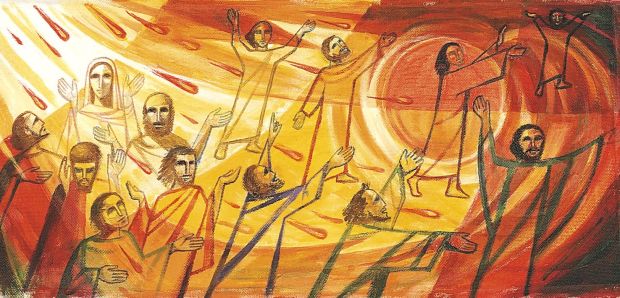
The Holy Spirit is the distinguishing mark of the believer in Jesus Christ.

Therefore, since the Spirit is given, the main responsibility of Christians is to receive. 

Christianity is distinctive in this sense – it is primarily a religion of receiving. The Christian life is lived by the power of the Holy Spirit, and not in our own strength. The function of faith is to receive what grace offers. 

We are saved and sanctified by grace alone through faith. God lives in and through us by means of the Spirit. The miraculous and the supernatural cannot, obviously, be done by any human person.  It can, however, be accomplished through the power of the Holy Spirit.

People tend to put a lot of pressure on themselves to be a certain way and to do certain things. The result? Tiredness. Discouragement. Imbalance. Lots of giving. Little receiving.

Christianity is not chiefly about giving but receiving. The Christian life is about putting oneself in a position to receive through prayer and humility. In Christianity, the opposite of receiving is not giving – it’s pride. 

Maybe this kind of talk makes you uncomfortable. I’m not talking about being passive or lazy. I’m highlighting the need of receiving grace from God by means of the Holy Spirit. Then, the Spirit to work in and through us. 

Jesus said we would do greater works than even he himself with the advent of the Spirit! (John 14:12-14)

The question then becomes: Will we let God be God? Will we allow the Spirit to do work in us?
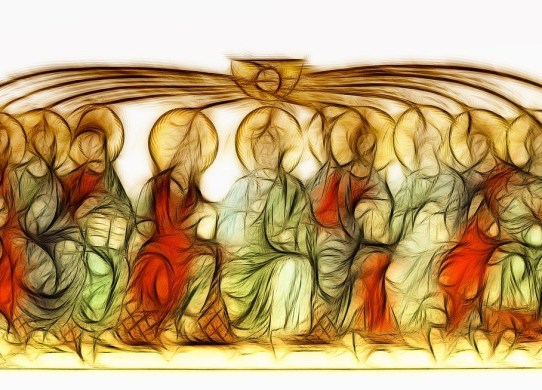
The Spirit is elsewhere described in Holy Scripture as a gentle presence, an encourager, counselor, and comforter. Yet, not here at Pentecost – the Spirit is portrayed like a violent wind and an unusual fire.

The Holy Spirit on the Day of Pentecost was not some gentleman caller entering politely when invited. Instead, the Spirit appears more like a drunken sailor who bursts into the room and causes a big ruckus. There’s nothing subtle about the Spirit at Pentecost. The Spirit is electric, bombastic, and volcanic, causing a huge scene and upheaving the status quo.

Because of Pentecost, Christians are marked and defined by God’s Spirit living within them and being full of the Spirit. God wants to pour out the Spirit on all kinds of people to overflowing so that what comes out of them is “prophecy.” 

The prophet Joel and the Apostle Peter do not intend the word “prophecy” to mean predicting the future. Rather, they are referring to inspired speech coming from a heart overflowing with the Spirit. 

Just as an inebriated person says and does things they would not typically say or do because they are filled with alcohol, so the person filled with God’s Spirit says things and does things they would not typically say or do because their inspiration and courage come as a result of God within them.

Thus, we must cast off the unholy spirits of inebriation and receive the Holy Spirit of God.

Descent of the Holy Spirit at Pentecost mosaic by Anna Wyner

God sobered-up the little band of Christ followers from learners to practitioners, sending them into the world with a mission.

Being on a mission from God is not really about ability; it’s about being filled and sent. 

First time parents may read and learn all they can about parenting before their child is born. Yet, when that little bundle comes into the world, and the hospital puts this kid in your arms and sends you out, you feel inadequate for the task. Parenting becomes a kind of supernatural affair where you pray and learn on the fly, finding out that you need something beyond yourself to get anywhere in raising this screaming, pooping, sleeping person who depends completely on you for everything. 

God sends us into the world to make disciples. And we may feel very inadequate for the task. However, this has more to do with receiving the Spirit. The Spirit comes looking to turn our lives upside-down with new life in Jesus Christ. 

Pentecost means that the Spirit came to shake things up and accomplish among God’s people what they could never do on their own.

Everyone who calls on the name of the Lord will be saved. 

The Church in the New Testament was not a country club for people to simply enjoy the perks of membership.  The community of the redeemed, the Church, is actually more like a place where the people seem drunk because they are all talking with inspired speech from the Holy Spirit. 

Maybe we don’t need to be saved in the sense that we have already called on the name of the Lord concerning forgiveness in Christ. Yet, maybe we need to call on the name of the Lord to be delivered from our misguided attempts to see the Christian life as a pleasant affair.

Perhaps we need deliverance from disordered priorities and misguided loves. We may need to be saved from ourselves so that we are open to the Holy Spirit with palms up receiving from God whatever it is the Spirit wants to do in and through us, rather than telling God how we think things ought to go. 

Prayer, then, is more about receiving the Spirit and God’s purposes for us rather than giving God an earful and expecting the Lord to bless our plans.

Pentecost is the launching pad of the church’s mission – it was explosive because the Spirit is a kind of wild man who fills people up to overflowing so that what comes out of them is inspired speech and missional actions.

If a language barrier cannot stop the Spirit from operating, then how much more can God transform us and use us in the lives of those around us?

Joel’s prophecy, quoted by Peter, is only partially fulfilled. Events have been set in motion by Pentecost for the complete fulfillment of God’s justice. So, there’s some urgency for people to fill their vacuous souls with the grace freely offered to them in Christ.

The outpouring of the Spirit is a sign: The end is near. And the generous giving of the Spirit is inclusive – there is room for all kinds of people. Through the Spirit, God saves all who call on the name of the Lord.

Today is not just another day on the calendar. It is the Day of Pentecost! 

Just as marriages occasionally need a spark and a fire and a fresh wind, so we need the Holy Spirit to breathe on us, comfort us, and inspire us.

May we be filled with the Spirit as we anticipate what our God will do now, and in the years to come.

Spirit of the living God, through the reading and proclamation of the Word, may you refresh our spirits, reshape our desires, recreate our hearts, and reform our ways so that we will shine with your enduring glory, through Jesus Christ, our risen and ascended Lord. Amen. 

Galatians 6:7-10 – You Harvest What You Plant

Photo by Johann Piber on Pexels.com

Do not be deceived; God is not mocked, for you reap whatever you sow. If you sow to your own flesh, you will reap corruption from the flesh; but if you sow to the Spirit, you will reap eternal life from the Spirit. So let us not grow weary in doing what is right, for we will reap at harvest time if we do not give up. So then, whenever we have an opportunity, let us work for the good of all, and especially for those of the family of faith. (New Revised Standard Version)

“You reap what you sow” is one of those famous (or infamous) phrases of the Bible. Some people have a visceral reaction to the statement because it was used in the negative sense to keep kids obedient. 

However. the actual context for the statement, while not excluding the need to avoid disobedience, is aimed much more toward the necessity of doing good works for others. 

In the Church’s and the Christian’s work of burden-bearing on behalf of those with crushing loads to carry, we are not to become weary as the walk goes on and on. Persevering in good works will eventually lead to a bumper crop of righteousness.

We don’t typically use the words “sow” and “reap” much anymore. We really don’t use very many agrarian metaphors anymore since most folks are no longer living on farms and working the soil. We’re likely more familiar with the words “plant” and “harvest.”

We understand that if we plant seeds in our garden, it will take some time for them to germinate, take root, break the ground, grow, and produce what we want from them. The same is true in life. To expect instantaneous results for the spiritual life is unrealistic; it just doesn’t work that way.

The main orientation of today’s New Testament lesson is patience and perseverance in the doing of good works. Although it might not seem, at the moment, that our labors are really making a dent at all, God is taking notice. The Lord sees each act of service.  Eventually, if we will keep up the slow, tedious, and often dull work of persisting in doing what is right, it will all pay-off in a harvest of righteousness.

Perhaps you have been struggling lately – wanting to see something happen that you’ve been working on or praying for. And it hasn’t happened yet. You’re ready for the harvest and are tired of waiting. 

There are times when I grow weary of having the same conversations with people over and over again. I sometimes grow impatient with impenitent people who only seem to think of themselves. Alas, welcome to the human race! 

God cares just as much, or more, about the process of planting and tending as the actual end of the harvest. In other words, the means of how we go about things are as important as the end result. To help us be accountable, we very much need the encouragement of others in our Christian pilgrimage through this life. 

Accountability is a humble willingness to accept the consequences of our choices, our words, and our behaviors. That is, we need to own our part in situations we’ve been in. It’s about taking responsibility (not for others and their behavior) for one’s self and making things right.

Now all discipline seems painful at the time, not joyful. But later it produces the fruit of peace and righteousness for those trained by it. (Hebrews 12:11, NET)

Honesty, integrity, wisdom, courage, forgiveness, and humility don’t simply fall out of the sky for us. A good and abundant harvest which can be shared with many requires patient and tedious work. These virtues, along with the fruit of the Spirit – love, joy, peace, patience, kindness, goodness, gentleness, and self-control – need careful attention. Like a faithful and patient gardener, we must tend to them, keeping ourselves free of weeds, bugs, and critters.

As we daily tend to our personal garden, we pay attention to how we use our time; know and honor our limits; and remain open to change. We cannot control outside forces, such as the weather, but we can take responsibility for our own choices and the consequences which result from them.

We cannot care for others and do good works unless we have done the work of self-care. Doing good flows from being good, first to ourselves, then to others. We can only give what we have. If we have tended to our garden with care, then the bounteous harvest can be shared with many. But if we neglect our own garden, there will be nothing to give when the season of harvest comes around.

“Which of the commands is most important?” Jesus answered, “The most important command is this: ‘Listen, people of Israel! The Lord our God is the only Lord. Love the Lord your God with all your heart, all your soul, all your mind, and all your strength.’The second command is this: ‘Love your neighbor as you love yourself.’ There are no commands more important than these.” (Mark 12:28-31, NCV)

Caring for ourselves isn’t a luxury. We must give ourselves permission to do it. The way in which we talk to ourselves will eventually become the manner in which we talk to others. The care we learn to extend to ourselves will be the care we give to others.

If we sow and plant good things in our own lives, then we will reap a harvest of good works for others. So, let us do good, especially to our sisters and brothers in the faith.

Patient God, you have been waiting for several millennia to complete your work in this world. It is a small thing for me to keep doing your will with perseverance over the span of my own lifetime. I look to my model, Jesus Christ, who for the joy set before him endured the cross and reaped eternal life for all who would believe. Amen.

Galatians 5:16-25 – Let the Spirit Guide You

So, I say, let the Holy Spirit guide your lives. Then you won’t be doing what your sinful nature craves. The sinful nature wants to do evil, which is just the opposite of what the Spirit wants. And the Spirit gives us desires that are the opposite of what the sinful nature desires. These two forces are constantly fighting each other, so you are not free to carry out your good intentions. But when you are directed by the Spirit, you are not under obligation to the law of Moses.

When you follow the desires of your sinful nature, the results are very clear: sexual immorality, impurity, lustful pleasures, idolatry, sorcery, hostility, quarreling, jealousy, outbursts of anger, selfish ambition, dissension, division, envy, drunkenness, wild parties, and other sins like these. Let me tell you again, as I have before, that anyone living that sort of life will not inherit the Kingdom of God.

But the Holy Spirit produces this kind of fruit in our lives: love, joy, peace, patience, kindness, goodness, faithfulness, gentleness, and self-control. There is no law against these things!

Those who belong to Christ Jesus have nailed the passions and desires of their sinful nature to his cross and crucified them there. Since we are living by the Spirit, let us follow the Spirit’s leading in every part of our lives. (New Living Translation)

It seems that sometimes the Holy Spirit gets treated as a third wheel.

For example, there are some Christians who rigidly rank the Holy Trinity as Father, Son, and Spirit – in that order – as if the Spirit were nothing more than some ethereal “it.” In fact, I’ve been in some churches where it seems their understanding of the Trinity is Father, Son, and Holy Bible – with the Spirit nowhere to be found.

Even among those who respect and acknowledge the Holy Spirit, the Spirit still gets the short end of the stick. We pray to the almighty heavenly Father. We pray in the blessed name of Jesus. And what of the Holy Spirit? Seems the Spirit gets treated like a younger sibling in the Trinity family.

Truth is, we never quite know what the Spirit might do. Heck, we aren’t even sure what pronoun to use for the Holy Spirit. It? He? She? They?  Because the Spirit seems so mysterious, otherworldly, and unpredictable, we send he/she/it off to some metaphorical bedtime so that we can watch TV and do whatever we want. 

Perhaps we strive, work, and wrestle to live a good life. Yet, somehow, we too often fall short and feel like a failure. Why is that?

Could be that we’ve looked at the Holy Spirit as some weird stepchild and largely ignore the Spirit’s presence. We believe in the Spirit. We have faith the Spirit is there. Yet, we don’t have any idea how to relate.

God is big and sovereign. Jesus has a real body and blood. The Spirit? Well, the Spirit’s out there, man, like some old hippie past his prime.

“What we need is not more learning, not more eloquence, not more persuasion, not more organization, but more power from the Holy Spirit.”

John R.W. Stott

How do you have a relationship with such an incorporeal Being who seems so different? Well, it’s time we got to know the Spirit….

The Holy Spirit is the power source of the Christian life. Without the Spirit, we can easily degenerate into all kinds of illicit thinking and behavior – including immorality, moral corruption, doing whatever feels good, idolatry, substance abuse, casting evil spells, hate, fighting, obsessive behaviors, violent anger, competitive opposition, conflict, selfishness, group rivalry,jealousy, drunkenness, or living for the party.

It is the Spirit who helps, comforts, provides strength, and enables us to replace old habits with new ones, and dead practices with solid spiritual action. The Christian virtues which flower and produce the fruit of love, joy, peace, patience, kindness, goodness, faithfulness, gentleness, and self-control occur through a close intimate relationship with the Holy Spirit. 

The Spirit helps us in our weakness when we pray, speak, and act. The Christian actually has such a close association with the Holy Spirit that it is as if we are a like a sacred temple in which the Spirit takes up residence. 

By means of the Holy Spirit, God is always with us and continually, at this moment, working within us to make our redemption in Christ an actual real-live encounter. The Spirit helps us walk the path of Christianity with God’s love inside us and overflowing out of us.

Here’s a simple observation: All the spiritual virtues mentioned in today’s New Testament lesson are the “fruit” of the Spirit, not “fruits.” The nine ethics are a package deal. To have the Spirit and spiritual fruit, you have all nine Christian values. 

If we look at the list and say, “Well, I’m pretty good at kindness and goodness, but I don’t have much peace or patience,” this means we are probably doing kindness and goodness from a different place than by means of the Holy Spirit. Because when the Spirit is manifested in us, we exhibit spiritual fruit. We cannot separate the nine spiritual virtues any more than we can separate the Trinity. They’re all one spiritual fruit, cultivated and produced within the inner person by the agency of God’s Spirit.

Maybe we need to consider the shadow side of our lives. It could be that, for example, we are far more driven by our anxiety about most things than about genuine altruism and love. The results of our actions and words might look the same, but the motivation might be far from truly altruistic. It simply will not last if our actions are generated from a place of worry – because it is not of the Spirit.

So, what to do about it?  We must mortify (put to death) the deeds of the sinful nature.

My old self has been crucified with Christ. It is no longer I who live, but Christ lives in me. So, I live in this earthly body by trusting in the Son of God, who loved me and gave himself for me. (Galatians 2:20, NLT)

If we have C-clamped our hearts so tight that the Spirit cannot get in, then it’s high time to loosen the grip and enable God to do some gracious and merciful work within us.  It’s the only way to experience genuine transformation of life.

The spiritual life can be scary. Letting go of control is hard for many people, including me. But the results are worth it. The Spirit is competent and cannot be controlled by us.

The Holy Spirit often works in wild and crazy ways and might show up on “Saturday Night Live” where you least expect to discover her.

Jesus said that the work of God is to believe in the one he sent (John 6:29). The Spirit always points us to Christ, the one who has delivered us from the realm of sin and brought us forgiveness. This work of Christ enables the work of the Spirit, who now makes our deliverance a practical reality in daily life.

The Holy Spirit is not a third wheel, but the real deal. Whenever we open our hearts to the Spirit, we experience the wideness of God’s mercy.

Pentecost is nearly here. Get ready to receive the Spirit.

Luke 9:18-27 – Jesus Makes All the Difference

Christ the Redeemer, Rio De Janeiro, Brazil

Once when Jesus was praying in private and his disciples were with him, he asked them, “Who do the crowds say I am?”

They replied, “Some say John the Baptist; others say Elijah; and still others, that one of the prophets of long ago has come back to life.”

“But what about you?” he asked. “Who do you say I am?”

Peter answered, “God’s Messiah.”

Jesus strictly warned them not to tell this to anyone. And he said, “The Son of Man must suffer many things and be rejected by the elders, the chief priests and the teachers of the law, and he must be killed and on the third day be raised to life.”

Then he said to them all: “Whoever wants to be my disciple must deny themselves and take up their cross daily and follow me. For whoever wants to save their life will lose it, but whoever loses their life for me will save it. What good is it for someone to gain the whole world, and yet lose or forfeit their very self? Whoever is ashamed of me and my words, the Son of Man will be ashamed of them when he comes in his glory and in the glory of the Father and of the holy angels.

“Truly I tell you, some who are standing here will not taste death before they see the kingdom of God.” (New International Version)

In my work as both a church pastor and hospital chaplain, not to mention just being a regular guy, I rarely encounter people who characterize Christians as setting self-interest aside to follow Jesus completely with humble ministry which is willing to suffer on behalf of others.

Instead, I daily interact with folks who have long left the Church with stories of Christians squelching genuine questions about God and faith; being judgmental toward others who are not like them; having a hypocritical double-standard approach to most issues; and verbally abusing individuals who don’t conform to their cultural ideas and biblical interpretations.

We need Christians who make a difference in this world. We need Jesus.   

A right and real confession of Jesus by his Church speaks a relevant word into the culture; proclaims the gospel of grace (not judgment); and consistently and lives what it believes.

Confessing Jesus as Lord makes all the difference.

After interacting with a lot of people on their ministry journeys, Jesus asked two questions of his disciples: “Who do people say I am?” and “Who do you say I am?” Out of all the questions we can ask people, these are two good ones: “Who do others say Jesus is?” and “Who do you say Jesus is?”  

The disciples gave a variety of answers, which is to be expected. Today, you will also get variegated answers, such as, Jesus is a good teacher, a model humanitarian, a myth or a legend. A few times I’ve been told that Jesus was an alien from another planet. My all-time personal favorite response is that Jesus was a nudist and that if we all just took off our clothes, there would be peace in the world.

Although the disciples are sometimes clueless, Peter as the spokesperson, gave an insightful answer: “You are God’s Messiah.” 

Messiah or Christ literally means, “The Answer.”  Peter confessed Jesus as being The Answer, the person for whom it all comes down to. Peter may not have fully understood what he was saying, but he said it, nevertheless.

Being called by God makes all the difference.

“The Answer” was revealed to Peter by the heavenly Father. Faith in Jesus Christ is a gift given to us by God.

“My Father has entrusted everything to me. No one truly knows the Son except the Father, and no one truly knows the Father except the Son and those to whom the Son chooses to reveal him.” (Matthew 11:27, NLT)

Peter was blessed – not because he did anything to deserve it – but because of sheer grace. It was revealed to Peter who Jesus really is, The Answer. We know who God is and who Jesus is by revelation, by God’s gracious self-revealing to people. Scripture is God’s revelation, a self-disclosure. It is through Scripture that we know. 

Revelation isn’t just a matter of waiting for some spiritual zap to occur, in which God bonks me in the brain and deposits the knowledge and understanding of who Jesus is. 

Peter put himself in a position to know by obeying the voice of Jesus to follow him. Then, Peter got to know Jesus over time.

Since it took years of being with Jesus for Peter and the other disciples to make a right confession of faith, then we need to have a great deal of patience for others, as well as ourselves. Others need time to get to know us, they need some time in the Scriptures, and they need some time with Jesus, too.

People do not typically come to a right confession of Jesus without having spent a good deal of time around us and within Holy Scripture.

Denying self, taking up our cross, and following Jesus makes all the difference.

God chooses to use you and me. The Lord only knows why. We are most certainly an imperfect people. Yet, it seems that our imperfections are the very thing God keeps using to reveal Jesus to others. Another way to put the matter is this: Genuine openness and vulnerability is needed, and not perfection or keeping up a tidy appearance.

Most people aren’t crazy about the word “vulnerable.”  We might expect openness in others yet have no intention of being vulnerable ourselves. If you have ever poured out your heart to someone or a group of people and only got blank stares in return; sincerely loved someone and they did not love you back; shared your genuine thoughts on something important to you and received only criticism; well then, we may believe vulnerability is a bad thing and not worth the emotional effort.

However, Jesus became vulnerable – descending from heaven, submitting to the machinations of evil persons, and exposed on a cruel cross. (Philippians 2:5-11)

In the Gospel of John, Mary displayed vulnerability in pouring expensive perfume on Jesus’ feet and wiping them with her hair, all the while exposing her true feelings for her Lord. In return, Mary got pushback and criticism from Judas. But Jesus upheld Mary’s actions and told Judas to leave her alone. (John 12:1-8).

In the Psalms, even a cursory reading reveals a boatload of vulnerability on the part of the psalmists. They were unafraid to explore the depth of human emotion, misery, joy, and praise of God.

Maybe we need the person who will stand up and say they are finally learning patience by being among a group of really annoying co-workers. Perhaps instead of laboring so hard to keep our thoughts and emotions in check, we need a church environment that lends itself to a person bawling their eyes out, while others just sit and cry with them.

That kind of vulnerability won’t happen unless we ourselves are real with God, who is never fooled by our deceitful hearts. Our evil-radar might be carefully attuned to others’ sin, but we are woefully inept at identifying the blackness within ourselves.

Jesus became completely exposed, naked, abandoned, alone and vulnerable on a cruel cross. Yet, instead of being shamed by the whole thing, Jesus scorned the shaming power of his crucifixion and embraced the suffering as the means of victory for our salvation. 

Vulnerability might seem ugly, but it turns whatever it touches into beauty. God can change our weakest, worst, and most shameful places into incredible strength and newfound love.

The broken and despised, the struggling and the lost, are the ones worthy of God’s kingdom. 

Whenever we are too afraid to walk into the mud of people’s lives, including our own, and are enamored instead with every spiritual shiny thing that comes along, we may have lost sight of our Lord, whom we are to imitate in his vulnerability. 

Christians don’t  have all the answers. But we do know the One who knows all things.

Methinks people will be drawn to Jesus when they observe Christians forsaking the path of the self-righteous prick, in favor of the humble servant who loses their life, only to find it.